


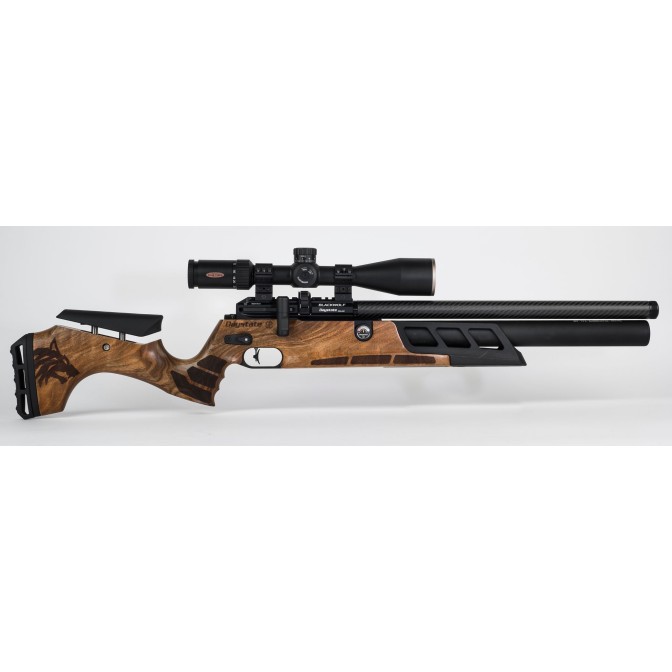


Daystate Blackwolf

€1,789.00
The Daystate Blackwolf is a next-generation modular PCP air rifle that showcases five decades of Daystate innovation and engineering excellence. Designed as a fully adaptable shooting platform, the Blackwolf combines advanced technology, exceptional shot consistency and modular versatility in a lightweight, compact package ideal for hunting, precision shooting and long-range work.
Available in Carbon Grey, Walnut, and Laminate stock options, the Blackwolf blends premium aesthetics with practical ergonomics. Measuring just 980 mm and weighing as little as 2.9 kg, the rifle offers superb balance and natural pointability, making it comfortable and responsive in the field.
At the heart of the Blackwolf is Daystate’s largest-ever regulator chamber, paired with a revolutionary titanium firing valve system for smoother cycling, greater efficiency and exceptional shot-to-shot consistency. The rifle’s 20-stage power adjuster allows rapid on-the-fly tuning to suit different shooting conditions, pellets or slugs, while the tensioned ART barrel system improves rigidity and long-range accuracy.
The modular platform allows shooters to quickly change barrel lengths and calibres, transforming the rifle to suit different disciplines and power requirements. Compatible with Daystate’s dedicated 711 mm slug barrel, the Blackwolf is equally capable with pellets or slugs. Adjustable hammer spring tension, regulator pressure and interchangeable components further enhance its adaptability.
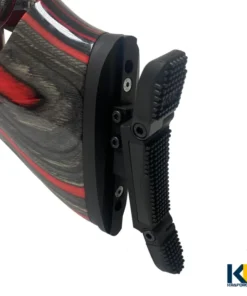
Additional premium features include an eight-point adjustable trigger, ambidextrous sidelever system, AR-style reversible safety, 20 MOA Picatinny rail, adjustable cheekpiece and buttpad, plus interchangeable air bottle and cylinder options.
Built around Daystate’s future-proof modular philosophy, the Blackwolf is more than just a rifle—it’s a highly configurable shooting platform designed to evolve with the shooter. Combining lightweight handling, advanced PCP technology and exceptional precision, it stands as one of the most versatile and capable Daystate rifles ever produced.
The Specs:
| Calibre | .177 & .22 |
| Power | <16 Joules |
| Fill Pressure | 250 Bars |
| Shots per fill | (Cylinder) 230 in .177/ 250 in .22 (Bottle) 400 in .177/ 430 in .22 |
| Magazine Capacity | 13 shot in .177/ 10 shot in .22 |
| Trigger | Eight-point adjustable trigger |
| Safety | Side Safety |
| Barrel Length | 430mm |
| Overall Length | 980mm |
| Weight | 2.9kg |
Daystate Blackwolf – Modular Mechanical PCP Air Rifle Platform
The Daystate Blackwolf is a modular pre-charged pneumatic platform that combines mechanical firing controls with Daystate’s modern regulated-air architecture. Rather than depending on electronic firing management, Blackwolf uses a mechanical trigger, mechanically adjustable power system, reversible sidelever, titanium firing valve, large regulator chamber, and interchangeable barrel and stock configurations.
Daystate offers three principal barrel lengths: 430 mm, 600 mm, and 711 mm. The compact 430 mm version supports .177 and .22, while longer versions extend the available configurations to .25 and .30. Current specifications list reservoir capacities of 300 cc, 480 cc, and 580 cc, depending on cylinder or HiLite bottle configuration, with a maximum fill pressure of 250 bar / 3,625 psi.
The platform incorporates an eight-point adjustable mechanical trigger, with Daystate publishing a pull range of approximately 8 oz to 3.5 lb. A 20-stage mechanical power wheel alters hammer-spring tension, while a large regulated chamber is designed to promote repeatable pressure delivery. The reversible sidelever and reversible/removable AR-style safety also contribute to ambidextrous operation.
Daystate Delta Wolf Performance
Daystate Delta Wolf Performance represents Daystate’s electronically managed approach. Blackwolf takes a different route by combining mechanical firing controls with extensive modularity.
Daystate Blackwolf
The daystate blackwolf is designed as a complete platform rather than a single fixed specification. Stocks, barrels, reservoir types, calibers, and compatible accessories can vary across the family.
Delta Wolf
The delta wolf introduced several modular principles that influenced later development, including rapid barrel and caliber changes.
Huntsman Daystate
huntsman daystate rifles follow a more traditional sporting layout. Blackwolf places greater emphasis on modular hardware and interchangeable configurations.
Day State
The day state Blackwolf platform represents a newer mechanically operated design within the manufacturer’s premium PCP range.
Daystate Delta Wolf
The daystate delta wolf remains electronically controlled, which separates it technically from the mechanical firing architecture used here.
Daystate Alpha Wolf
The daystate alpha wolf is another electronically managed platform. Consequently, its electronics and programming architecture should not be confused with Blackwolf controls.
Puddy Bottle Cover
A puddy bottle cover or protective reservoir sleeve is an accessory rather than part of the operating action. Compatibility depends on the specific cylinder or bottle fitted.
Daystate
daystate states that Blackwolf combines 16 major features that had not previously appeared together on one of its models, including modular componentry, fast caliber changes, adjustable controls, interchangeable stocks, and large regulated-air capacity.
Alpha Red Wolf
The phrase alpha red wolf combines searches associated with two different electronic product families. Neither designation identifies the Blackwolf mechanical system.
Air Gun PC
An air gun pc search commonly refers to PCP technology. Compressed air is stored inside a reservoir and metered through the regulated firing system.
Air Gun Suppressor
An air gun suppressor or sound-moderating accessory may be legally restricted depending on jurisdiction. Muzzle compatibility and local law should always be checked.
What Is a Delta Wolf
For anyone asking what is a delta wolf, it is an electronically controlled modular Daystate PCP that preceded Blackwolf and helped establish the company’s quick-change philosophy.
Airgun Moderator
An airgun moderator is designed to reduce muzzle report where permitted. Threading, caliber suitability, alignment, and applicable regulations all matter.
Black Snood
A black snood is not a functional component of the action, regulator, barrel, trigger, or reservoir and should be treated as a separate accessory term.
Daystate Wolverine Sapphire
The daystate wolverine sapphire belongs to another premium family with a different stock and action format.
Day Wolf M-LOK to Picatinny Rail Adapter
A day wolf m-lok to picatinny rail adapter may provide an accessory interface where compatible mounting surfaces exist. Exact fit should be verified rather than assumed.
How to Put a Gun Sling on a Rifle
For searches such as how to put a gun sling on a rifle, sling attachment should use purpose-designed mounting points without obstructing the safety, trigger, loading mechanism, filling system, or pressure gauge.
177 Magazine
The standard Blackwolf 177 magazine is listed at 13 shots. Standard magazine capacity is 11 in .22, 10 in .25, and 8 in .30 for applicable configurations.
Magpul MOE SI
magpul moe si accessories should not automatically be considered compatible simply because some Blackwolf stocks use tactical-style furniture.
Enhanced Rubber Butt Pad
An enhanced rubber butt pad can influence shoulder comfort and repeatable positioning. Blackwolf configurations provide adjustable rear-stock ergonomics depending on stock type.
Can Wolverine Go on Planes
For anyone asking can wolverine go on planes, airline transport of compressed-air equipment depends on carrier policy, reservoir requirements, and destination law.
Wolf Battery
A wolf battery is primarily relevant to electronically fired models. Blackwolf’s firing release itself is mechanical.
Daystate Redwolf
The daystate redwolf belongs to Daystate’s electronic PCP family rather than the mechanically fired Blackwolf platform.
Cocking Ball
A cocking ball or replacement lever component should only be fitted when designed for the relevant sidelever assembly.
Air Rifle Moderator
An air rifle moderator should match the barrel, caliber, muzzle interface, and applicable legal requirements.
Alpha Wolf Barrel
An alpha wolf barrel should not automatically be assumed interchangeable. Blackwolf has its own quick-change barrel architecture.
FX Airgun Dealer Near Me
The phrase fx airgun dealer near me concerns another manufacturer. Blackwolf technical support should instead follow Daystate documentation or qualified Daystate service channels.
How to Attach Sling to Rifle
For how to attach sling to rifle, the attachment should remain secure without interfering with operating controls or placing unintended pressure on the barrel or reservoir.
Daystate Redwolf Price
daystate redwolf price relates to another product family and does not determine Blackwolf specification, configuration, or mechanical design.
Daystare
daystare is a common spelling variation encountered in searches relating to Daystate equipment.
Delta Wolf Meaning
The delta wolf meaning in this context is the product designation for Daystate’s electronically managed modular PCP platform.
Weatherby Vanguard Trigger Adjustment
weatherby vanguard trigger adjustment concerns an unrelated firearm platform. Those procedures should not be applied to Blackwolf. Blackwolf uses its own eight-point mechanical trigger architecture.
Daystate Delta Wolf PCP Air Rifle
The Daystate Delta Wolf PCP Air Rifle helped introduce quick-change caliber concepts later incorporated into Blackwolf’s modular philosophy.
Daystate Electronic PCP Rifle
The phrase Daystate Electronic PCP Rifle correctly describes several earlier premium models. Blackwolf is mechanically fired, so describing it as electronically triggered would be inaccurate.
Daystate PCP Rifle
As a Daystate PCP Rifle, Blackwolf uses stored compressed air, regulated pressure, a mechanical valve system, and interchangeable components.
Buy Daystate Delta Wolf Performance
Buy Daystate Delta Wolf Performance is a transactional phrase relating to another model. Anyone comparing the platforms should first distinguish Delta Wolf’s electronic controls from Blackwolf’s mechanical architecture and follow applicable ownership laws.
Best Electronic PCP Air Rifle
The phrase Best electronic PCP air rifle does not technically classify Blackwolf because its firing controls are mechanical.
Smart PCP Air Rifle
A Smart PCP air rifle commonly implies digital or programmable electronic management. Blackwolf instead achieves adaptability through mechanical adjustment, regulation, and modular components.
Daystate Delta Wolf Performance Review
A Daystate Delta Wolf Performance review can provide useful comparison context for understanding Daystate’s electronic architecture versus the mechanical Blackwolf concept.
Daystate Delta Wolf Performance Air Rifle
The Daystate Delta Wolf Performance Air Rifle remains part of the Delta family and should not be confused with Blackwolf specifications.
Daystate Delta Wolf for Sale
Daystate Delta Wolf for sale is another model-specific search phrase. Technical specifications should remain separated between the two families.
Modular Platform Engineering
One of Blackwolf’s defining characteristics is modularity. Daystate offers interchangeable barrels, stocks, cylinder or HiLite bottle configurations, and multiple caliber options. This allows the basic platform to be adapted without treating every configuration as a completely different action.
Barrel Length Options
Current factory specifications list 430 mm, 600 mm, and 711 mm barrels. The shortest configuration measures approximately 980 mm overall and weighs from around 2.9 kg unscoped, while longer-barrel configurations increase overall length and weight.
Fast-Change Caliber Architecture
Blackwolf uses removable barrel assemblies that support caliber and length changes with appropriate matched components. Daystate supplies dedicated barrel-change kits containing a barrel, shroud, magazine, and matching pellet probe.
Eight-Point Mechanical Trigger
The trigger provides adjustment for pull characteristics and blade position. Daystate states that the blade can be positioned through multiple axes, while published pull weight spans approximately 225 g to 1.6 kg.
20-Stage Power Control
A numbered 20-stage mechanical wheel alters hammer-spring tension. This gives the platform broad factory-designed adjustability without requiring an electronic firing board.
Any setting must remain within local energy restrictions and the manufacturer’s approved configuration.
Large Regulator Chamber
Daystate describes Blackwolf as having the largest regulator chamber fitted to one of its PCP models. The purpose is to promote stable regulated pressure across different approved configurations and ambient conditions.
Titanium Firing Valve
A lightweight titanium firing valve is used to reduce moving mass. Daystate states that lower valve inertia supports faster valve closure and contributes to the efficiency of the pneumatic cycle.
Reversible Sidelever
The sidelever can be moved from one side of the action to the other, supporting both right- and left-handed configurations.
AR-Style Safety
The safety lever is reversible or removable according to configuration. It is positioned close to the firing hand for accessible operation.
Inclined Picatinny Optics Rail
Blackwolf uses a 21 mm Picatinny rail with approximately 20 MOA of inclination. The standardized interface supports compatible optics while the built-in angle provides additional optical adjustment range compared with a flat rail.
Adjustable Ergonomics
Depending on stock configuration, Blackwolf provides adjustable cheek support and rear-stock positioning. Correct adjustment helps establish repeatable head placement, eye alignment, shoulder contact, and trigger reach.
Cylinder and HiLite Bottle Options
Blackwolf is available with either alloy-cylinder or HiLite carbon-bottle air storage. Daystate lists 300 cc, 480 cc, and 580 cc capacities across the platform.
Maximum Fill Pressure
The published maximum fill pressure is 250 bar / 3,625 psi. High-pressure filling requires appropriately rated equipment and clean, dry compressed air.
Why Mechanical Control Matters
Mechanical firing controls eliminate dependence on a battery or electronic trigger board for the firing release itself.
That creates a different ownership and operating character from Daystate’s electronically managed models while retaining extensive adjustment capability.
Why Barrel Stability Matters
Barrel condition, mounting integrity, crown condition, projectile quality, pressure stability, and optic security all contribute to repeatability.
No single feature should be treated as solely responsible for precision.
Why Ammunition Quality Matters
Consistent projectiles help reduce one source of variation. Damaged skirts, malformed heads, contamination, inconsistent weights, or unsuitable projectile designs can affect results.
Ammunition should always match the exact factory caliber and barrel configuration.
Why Proper Gun Fit Matters
Cheek position, shoulder contact, grip angle, trigger reach, and optic height influence how consistently the shooter can reproduce the same position.
Proper ergonomic setup can therefore contribute significantly to practical precision.
Where the Platform Fits
Blackwolf is suitable for lawful target and other permitted airgun sporting disciplines when configured within local rules.
Exact caliber, muzzle energy, transport, storage, and accessory requirements differ between jurisdictions.
When Professional Maintenance Matters
Internal regulator servicing, valve work, persistent air leaks, pressure-vessel concerns, and significant trigger problems should be handled by suitably qualified technicians.
Daystate specifically warns that compressed-air servicing can be dangerous and should only be attempted by people competent to work with high-pressure PCP systems.
Overall Technical Character
The Daystate Blackwolf combines a modular action, mechanical eight-point trigger, reversible sidelever, 20-stage power control, titanium firing valve, large regulated chamber, interchangeable barrel system, multiple air-storage options, standardized optics mounting, and configurable stocks within one PCP architecture.
Its principal technical identity is therefore not simply power or appearance. Instead, Blackwolf is built around mechanical modularity, pressure consistency, adaptable ergonomics, and interchangeable factory components.
For responsible long-term use, the exact caliber, barrel, reservoir, energy setting, ammunition, accessories, servicing, storage, and transportation should remain within Daystate guidance and the laws applicable where the rifle is operated.
Mechanical Operation, Pressure Stability, Ergonomics, Precision Factors, and Long-Term Reliability
Understanding the Mechanical System
This platform uses a mechanically controlled pre-charged pneumatic action rather than an electronically fired system. Its operation depends on regulated compressed air, a mechanical trigger, valve timing, spring tension, and carefully matched internal components.
Because the system is mechanical, consistent performance depends heavily on stable pressure delivery, correct adjustment, clean compressed air, and proper maintenance.
High-Pressure Air Management
Compressed air is stored inside the reservoir and released through a regulated pneumatic system.
The reservoir, filling port, pressure gauge, regulator, valve, and seals should remain free from leaks, damage, contamination, or unauthorized alteration.
Internal high-pressure servicing should be left to suitably qualified technicians.
Reservoir Condition
The air reservoir should be inspected regularly for scratches, dents, corrosion, damaged threads, valve problems, or suspected leaks.
Any unusual surface damage should be evaluated before further filling.
A pressure reservoir contains significant stored energy, so physical damage should never be dismissed as merely cosmetic.
Filling Equipment
Only suitable high-pressure filling equipment should be used.
Hoses, connectors, pumps, compressors, filters, and charging adapters should be rated for the required pressure.
Damaged fittings or improvised connections should never be pressurized.
Clean and dry compressed air helps protect internal pneumatic components.
Controlled Filling
Charging should take place gradually while the pressure gauge is monitored.
Rapid filling can produce unnecessary heat and make pressure control less predictable.
The manufacturer’s maximum filling pressure should never be exceeded.
If the gauge behaves unexpectedly, filling should stop until the problem is identified.
Regulator Stability
The regulator controls the pressure supplied during each firing cycle.
Stable regulation supports repeatable performance by reducing unnecessary pressure variation between shots.
Unexpected changes in sound, efficiency, or consistency may indicate a developing regulator or seal problem.
Persistent irregularity should be professionally assessed.
Mechanical Power Adjustment
The platform provides a broad mechanical adjustment range.
These settings should remain within factory guidance and applicable local energy limits.
Frequent unnecessary changes can complicate troubleshooting because several mechanical variables may begin influencing performance at the same time.
Trigger Characteristics
The adjustable trigger allows the user to tailor pull characteristics and blade position.
A predictable trigger can support consistent technique during controlled target use.
However, adjustment should remain conservative.
An excessively light or incorrectly configured trigger can reduce safe handling margins.
Trigger Blade Position
The trigger blade should sit naturally beneath the finger.
The shooter should not need to twist the wrist, stretch the finger, or change grip pressure simply to reach it.
Comfortable alignment supports repeatable hand positioning.
Sidelever Operation
The loading lever should move smoothly and positively through its normal cycle.
Grinding, looseness, incomplete closure, or unusual resistance may indicate dirt, wear, or an adjustment issue.
Forcing the mechanism should be avoided.
Magazine Condition
The magazine should remain clean and index correctly.
Debris, damaged ammunition, or worn internal components can interfere with feeding.
Projectiles should not be forced into the magazine.
If feeding becomes inconsistent, the cause should be identified before continued use.
Single-Loading Option
Where a compatible single-loading accessory is available, it can be useful during careful target sessions.
Loading one projectile at a time allows each item to be inspected immediately before insertion.
This can help separate ammunition-related variation from mechanical variation.
Barrel Stability
The barrel assembly should remain securely mounted and free from impact damage.
Any visible movement, unusual alignment, or looseness deserves attention.
A stable barrel contributes to repeatable alignment between the action, optic, and projectile path.
Barrel Harmonics
Every barrel experiences vibration during the firing cycle.
The way those vibrations behave can influence consistency.
However, repeatability depends on the complete setup rather than barrel behavior alone.
Pressure stability, ammunition quality, optic security, mounting integrity, and shooter technique all contribute.
Projectile Quality
High-quality ammunition of the correct caliber should be used.
Bent skirts, damaged heads, contamination, or inconsistent manufacturing can influence repeatability.
Projectiles should be stored carefully and inspected before loading.
Optic Mounting
The optics rail provides a standardized mounting surface.
Rings should match both the optic and the rail.
Mounting hardware should be tightened according to the optic and mount manufacturer’s recommendations rather than simply being overtightened.
Eye Alignment
The cheek support should place the eye naturally behind the optic.
The shooter should not need to stretch upward, lean excessively forward, or force the head downward to obtain a complete sight picture.
A repeatable head position supports consistent visual alignment.
Rear Support Adjustment
The rear section should rest comfortably against the shoulder.
Length, height, and pad position influence eye relief, balance, and overall handling.
Adjustment should focus on natural support rather than excessive pressure.
Grip Position
The grip should allow the wrist to remain relaxed.
Excessive muscular tension can make a stable position harder to reproduce.
A controlled and comfortable grip generally supports more consistent handling.
Rifle Balance
Reservoir size, barrel length, optic weight, mounts, and accessories all affect balance.
Some configurations may feel forward-heavy, while others may concentrate mass closer to the shooter.
Balance preference is individual and should be evaluated during safe handling.
Accessory Mounting
Accessories should use compatible interfaces.
Bipods, sling attachments, and other lawful sporting equipment should not obstruct the trigger, safety, pressure gauge, filling port, loading mechanism, or muzzle.
Unnecessary accessories can also increase weight and alter balance.
Bipod Use
A compatible bipod can provide stable support during controlled target sessions.
It should attach securely to the intended mounting surface.
The support should not place unintended pressure on the air reservoir or barrel assembly.
Sling Use
A sling can assist with transport and carrying.
It should attach only to suitable mounting points and should not interfere with operating controls.
Attachment hardware should be checked periodically for looseness.
Muzzle Components
Any muzzle attachment should match the specific barrel and caliber.
Where sound-reducing equipment is regulated, local law should be checked before installation or use.
Poor alignment can affect consistency and may create projectile contact.
Exterior Cleaning
Routine cleaning should focus on removing dust, fingerprints, moisture, and surface contamination.
A soft cloth is generally suitable.
Strong solvents should not be used around seals, finishes, composite materials, polymers, or adhesives unless specifically approved.
Seal Condition
Seals are essential for maintaining pressure.
Unexpected pressure loss, unusual filling sounds, or visible damage may indicate that servicing is required.
Internal seal replacement should follow approved procedures.
Gauge Inspection
The pressure gauge should remain clear, secure, and reliable.
Fogging, looseness, damage, or unrealistic readings should be investigated.
Pressure should never be estimated during filling.
Moisture Protection
After use in damp conditions, the rifle should be dried before storage.
Water should not remain around screws, rails, controls, or metal interfaces.
Long-term moisture exposure can contribute to corrosion and material deterioration.
Storage Conditions
The rifle should be stored unloaded and secured against unauthorized access.
The environment should remain dry and reasonably temperature-stable.
Direct sunlight, excessive heat, chemical vapors, and high humidity should be avoided.
Local storage requirements should always be followed.
Transport Protection
A padded case can protect the barrel, optic, reservoir, action, and external controls.
The rifle should remain unloaded and secured during transport.
Regional transport requirements may differ, particularly when travelling with a pressurized reservoir.
Fastener Inspection
External screws and mounting points can loosen gradually through normal handling.
Stock hardware, optic mounts, accessory mounts, and visible components should therefore be checked periodically.
Fasteners should only be tightened to suitable specifications.
Monitoring Performance Changes
Sudden changes in consistency may have several causes.
Loose mounts, damaged ammunition, pressure irregularities, seal wear, barrel contamination, or loose hardware may all contribute.
A systematic inspection is usually more effective than changing several adjustments at once.
Avoiding Unnecessary Modification
The platform offers substantial modularity, but not every component needs to be altered.
Frequent internal modification can affect reliability, legality, and serviceability.
Factory-approved parts and procedures should remain the preferred approach.
Professional Servicing
Regulator work, valve servicing, persistent leaks, reservoir damage, and significant mechanical faults should be handled by qualified technicians.
High-pressure internal servicing requires appropriate tools, procedures, and technical knowledge.
Long-Term Reliability
Reliable long-term use depends on careful filling, clean compressed air, suitable ammunition, secure optics, stable adjustments, proper storage, and periodic professional inspection.
The rifle should be treated as one integrated mechanical and pneumatic system.
When pressure stability, ergonomics, maintenance, mounting integrity, and ammunition quality remain consistent, the platform becomes easier to handle, diagnose, and maintain throughout lawful sporting use.
Real-World Handling, Setup Consistency, Comfort, Inspection, and Continued Reliability
Real-World Handling
A precision pre-charged pneumatic platform should feel stable, predictable, and comfortable during lawful sporting use. Practical performance depends on the relationship between stock fit, optic position, grip angle, balance, pressure condition, and accessory weight.
A well-fitted setup helps reduce unnecessary movement and makes repeatable technique easier to maintain over longer sessions.
Establishing a Stable Position
Consistency begins with body position.
The shooter should be able to support the rifle without excessive muscular tension. Whether used from a bench, rest, or another lawful sporting position, the body should remain comfortable and repeatable.
Changing shoulder pressure, cheek placement, or hand tension from shot to shot can alter sight alignment.
Cheek Support Adjustment
The cheek support should place the eye naturally behind the optic.
The shooter should not need to stretch upward, lean excessively forward, or force the head downward to obtain a clear sight picture.
A repeatable cheek position helps maintain consistent alignment.
Rear Support Position
The rear section should sit naturally against the shoulder.
Its position influences eye relief, balance, and how the rifle settles between shots.
Adjustment should focus on comfort and repeatability rather than excessive pressure.
Grip Comfort
The grip should allow the wrist to remain in a relaxed position.
The trigger finger should reach the blade without forcing the hand to twist or stretch.
A controlled grip is generally more useful than excessive hand tension.
Trigger Familiarity
An adjustable trigger should be approached carefully.
The user should become familiar with the factory setting before making changes.
Any adjustment should remain within approved limits.
An excessively light or poorly configured trigger can reduce safe handling margins.
Loading Routine
A consistent loading routine helps reduce mistakes.
The magazine should be inserted correctly, while the loading lever should move smoothly through its normal cycle.
Projectiles should be checked for obvious damage before loading.
Damaged ammunition can affect feeding and repeatability.
Magazine Inspection
The magazine should remain clean and free from grit, damaged ammunition, or deformation.
It should index without hesitation.
If feeding becomes unreliable, forcing the mechanism is not recommended.
The cause should be identified before continued use.
Monitoring Air Pressure
Pressure should be checked routinely.
Unexpectedly rapid pressure loss can indicate a leaking seal, valve issue, or loose fitting.
Repeatedly topping up the system without identifying the cause can hide a developing fault.
Persistent pressure loss should be professionally investigated.
Filling Procedure
High-pressure filling should remain controlled and gradual.
Hoses, connectors, adapters, filters, and charging equipment should be rated for the required operating pressure.
Damaged fittings should never be pressurized.
Clean, dry compressed air helps protect internal pneumatic components.
Recognizing Seal Problems
Slow pressure loss during storage may indicate seal deterioration.
Other warning signs can include unusual sounds during filling or irregular pressure behavior.
Because the system stores significant compressed energy, internal investigation should not be attempted casually.
Qualified servicing is the safer approach.
Gauge Condition
The pressure gauge should remain clear, secure, and believable.
Fogging, damage, looseness, or inconsistent readings deserve attention.
Pressure should never be estimated during filling.
If the gauge cannot be trusted, the system should be inspected.
Optic Positioning
The optic should be positioned so the shooter obtains a full sight picture naturally.
Eye relief, cheek height, and mount location should work together.
Once a comfortable position is established, the mounting setup should remain consistent.
Checking Mount Security
Loose mounts can create apparent accuracy problems that may incorrectly be blamed on the barrel or regulator.
Mounting screws should be checked periodically.
Correct tightening is important because overtightening can damage the rail, rings, or optic tube.
Accessory Weight Management
Additional equipment can change balance substantially.
A large optic, bipod, sling hardware, or other accessories can shift the center of gravity.
Only equipment that serves a clear lawful sporting purpose should be installed.
Unnecessary weight can make handling less comfortable.
Bipod Condition
If a bipod is used, it should attach securely to the intended mounting point.
The attachment should be checked periodically for movement.
The bipod should not interfere with the air reservoir, filling system, or operating controls.
Sling Condition
A sling can assist with carrying and transport.
It should attach only to compatible points and should not obstruct the trigger, safety, pressure gauge, or loading controls.
Mounting hardware should remain secure.
Barrel Exterior Inspection
The barrel assembly should be checked for visible movement, impact damage, looseness, or changes in alignment.
Any significant impact to the barrel area should be investigated before further use.
External mounting components should remain secure.
Protecting the Muzzle
The muzzle should be protected from knocks, dirt, and careless handling.
Damage around the crown can influence consistency even when the rest of the barrel appears undamaged.
The rifle should never be rested directly on the muzzle.
Muzzle Accessory Alignment
Any compatible muzzle attachment should remain properly aligned.
If unusual sound, unexplained performance changes, or contact marks appear after installation, use should stop until alignment is checked.
Applicable local restrictions should always be respected.
Projectile Storage
Ammunition should remain clean and dry.
Loose projectiles can become damaged through repeated movement, dirt, or impact.
Careful storage helps reduce one preventable source of inconsistency.
Exterior Cleaning
Routine exterior cleaning should focus on removing dust, fingerprints, moisture, and surface debris.
A soft cloth is generally sufficient.
Strong solvents should not be used around seals, finishes, composite materials, or adhesives unless specifically approved.
Moisture Protection
After use in damp conditions, the rifle should be dried before storage.
Water should not remain around screws, rails, controls, or metal interfaces.
Prolonged moisture exposure can contribute to corrosion and deterioration.
Reservoir Protection
The pressure reservoir deserves careful physical protection.
Impacts, deep scratches, valve damage, unusual surface marks, or suspected structural damage should not be ignored.
Any concern should be professionally assessed before additional filling.
Safe Storage
The rifle should be stored unloaded and secured against unauthorized access.
The environment should remain dry and reasonably temperature-stable.
Excessive heat, direct sunlight, chemical vapors, and high humidity should be avoided.
Applicable storage laws should always be followed.
Transport Protection
A padded case can protect the optic, barrel, reservoir, action, and external controls.
The rifle should remain unloaded and secured during transport.
Regional transport requirements may differ, especially when travelling with a pressurized reservoir.
Fastener Inspection
External screws and mounting points can loosen gradually through normal handling.
Stock hardware, optic mounts, accessory mounts, and visible components should therefore be checked periodically.
Fasteners should only be tightened to appropriate specifications.
Monitoring Performance Changes
Sudden changes in consistency may come from several sources.
Loose mounts, damaged ammunition, pressure irregularities, seal wear, barrel contamination, or loose hardware may all contribute.
A systematic inspection is usually more effective than changing several adjustments at once.
Avoiding Unnecessary Modification
The platform offers substantial modularity, but not every component needs to be altered.
Frequent internal modification can affect reliability, legality, and serviceability.
Factory-approved parts and procedures should remain the preferred approach.
Professional Servicing
Regulator work, valve servicing, damaged pressure vessels, persistent leaks, and significant mechanical faults should be handled by qualified technicians.
High-pressure internal servicing requires the correct tools, procedures, and technical knowledge.
Long-Term Ownership
Reliable long-term use depends on careful filling, clean compressed air, suitable ammunition, secure optics, stable adjustment, proper storage, and periodic professional inspection.
Overall Practical Character
The rifle performs best when treated as one integrated mechanical and pneumatic system.
Comfortable ergonomics, stable pressure management, secure mounting, appropriate ammunition, careful storage, and responsible maintenance all influence consistency.
When these factors are monitored carefully, the system remains easier to handle, easier to diagnose, and more dependable throughout lawful sporting use.
Be the first to review “Daystate Blackwolf”
Related products

Daystate Air Rifle


Daystate Air Rifle

Daystate Air Rifle
AIR GUN RIFLES


Daystate Air Rifle
Daystate Air Rifle

Daystate Air Rifle

Daystate Air Rifle
Reviews
There are no reviews yet.