


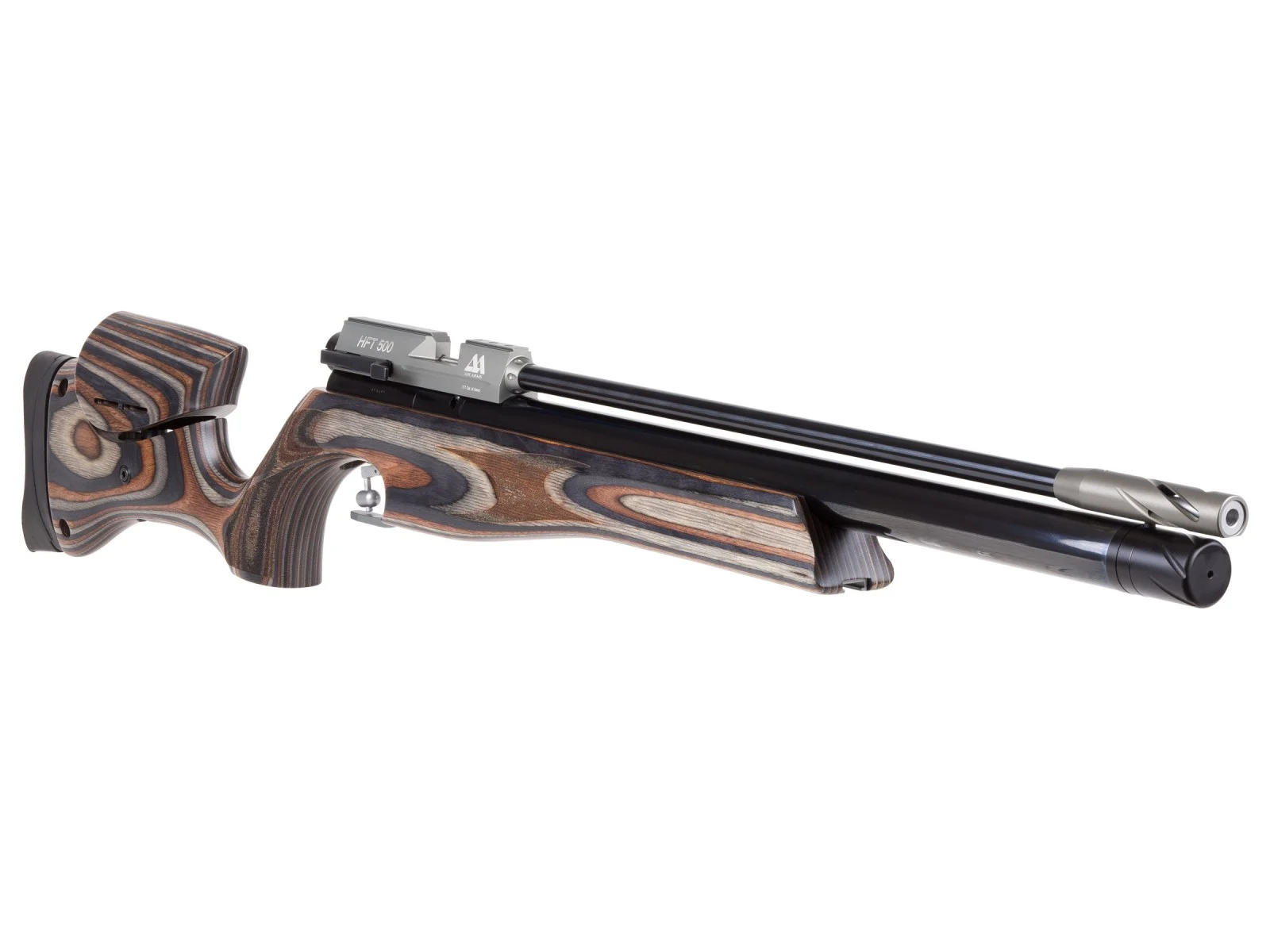

Air Arms HFT 500 Air Rifle


€1,350.00
Description
While all the nice features in this air gun will make your mouth water, there’s really only one thing that matters: Precision. And that’s where all Air Arms guns excel!
If you can aim and hold the gun steady, you’ll get small groups. The HFT 500 does the rest.
Sometimes, you really do get what you pay for, and the Air Arms HFT 500 air rifle is a prime example. It delivers the goods…and then some. Never wonder, again, if you’ll hit your target or quarry. You do your part and the gun does its part. Yes, it’s just that simple!
Guns made by Air Arms have earned an international reputation as being among some of the finest in the world. They’re unmatched when it comes to metal finishing and superb stocks. Because the HFT 500 PCP air rifle is so adjustable, it’ll fit you like a custom rifle. Once you buy an Air Arms airgun, you’ll be spoiled and never again be satisfied with the run-of-the-mill airguns you used to buy.
- Shop related categories: pellet guns, pellet rifles
- Air Arms HFT 500 air rifle
- Precharged pneumatic
- Single-shot
- Sidelever
- Lothar Walther match barrel (fully floated)
- Multi-ported air stripper reduces muzzle flip
- Highly adjustable match trigger (both stages and more)
- Fixed cylinder
- Max fill pressure of 190 bar (2756 psi) delivers ~90 full-power shots
- Integral manometer (air pressure gauge)
- 20-micron inline filter
- 11mm scope dovetails
- Spring-loaded bolt probe
- Laminated ambidextrous stock
- Highly adjustable cheekpiece (up, down, back, forth and sideways) twists laterally and articulates on a ball joint
- Vertically adjustable rubber buttpad
- Accessory rail for optional weights, bipod or sling (accessories not included)
- Includes fill adapter
Specifications
BrandAir Arms
Caliber.177 (4.5mm)Max Velocity800 fpsMuzzle Energy12 ft/lbsSuggested forCompetitionPowerplantPre-charged pneumaticLoudness3-MediumWeight8.2 lbsFunctionSingle-shotMax Shots per Fill90Cylinder Size263 ccActionBolt-actionFixed/adj. powerFixedScopeable11mm dovetailFront SightsnoneRear SightsnoneSafetynoneTriggerTwo-stage adjustableBarrelRifledBarrel Length19.25″Overall Length40.1″Capacity1 round(s)Body TypeRifleStockLaminatedButtplateAdjustableOperating Pressure2755 PSI / 190 BARGrip OrientationAmbidextrousRegulatedNoIs Safe To Dry FireYes
Air Arms HFT 500 Air Rifle – Precision Hunter Field Target Competition Platform
The Air Arms HFT 500 Air Rifle is a purpose-built Hunter Field Target competition rifle developed around consistency, repeatable handling and precise positional shooting.
Rather than adapting a general-purpose sporting rifle for competition, Air Arms engineered the HFT 500 specifically around the requirements encountered on an HFT course.
The rifle uses a single-shot, pre-charged pneumatic action and is currently offered in .177 calibre. Air Arms specifies the standard UK version at sub-12 ft/lb, while the rifle’s fixed air cylinder has a maximum fill pressure of 190 bar and provides approximately 90 shots per fill under normal operating conditions.
Its free-floating Lothar Walther match-grade barrel is intended to reduce external influence on barrel harmonics and support consistent pellet placement. Meanwhile, the smooth side-lever action allows the shooter to reload with relatively little disturbance to their established position.
A finely adjustable two-stage match trigger, adjustable cheekpiece, adjustable butt pad and competition-oriented stock further allow the rifle to be configured for standing, kneeling and prone shooting positions.
Purpose-Built for Hunter Field Target
The HFT 500 is primarily designed for Hunter Field Target competition.
HFT places unusual demands on both the shooter and rifle because competitors must engage targets from multiple positions while maintaining consistent sight alignment and trigger control.
Therefore, repeatability matters as much as raw mechanical accuracy.
.177 Calibre
The HFT 500 is currently offered exclusively in .177 calibre.
This calibre is commonly used in target disciplines because its relatively flat trajectory simplifies range-related holdover calculations compared with heavier, slower pellets.
Single-Shot PCP Operation
The rifle uses a single-shot PCP configuration rather than a magazine-fed system.
This arrangement reflects its competition role.
Each pellet is individually loaded before the side lever is closed.
Unregulated Air System
The HFT 500 is currently specified as an unregulated PCP.
Instead of relying on a secondary regulator, its air system is tuned to provide a useful consistency window through the working portion of the cylinder pressure range.
Air Arms states that typical velocity variation can remain approximately 13–15 fps across roughly 80–95 shots when correctly set up.
190-Bar Maximum Fill Pressure
The fixed cylinder has a stated maximum fill pressure of 190 bar, approximately 2756 psi.
An integrated manometer allows cylinder pressure to be monitored.
Only suitable filling equipment and manufacturer-approved procedures should be used.
Approximately 90 Shots Per Fill
Air Arms lists approximately 90 full-power shots per fill for the HFT 500.
Actual useful shot count may vary with setup, temperature, pellet choice and operating pressure.
Free-Floating Lothar Walther Barrel
The HFT 500 uses a free-floating Lothar Walther match-grade barrel.
The free-floating arrangement minimizes external stock pressure acting directly on the barrel.
Consequently, the barrel can behave more consistently from shot to shot.
Side-Lever Action
A side lever operates the firing mechanism.
Its smooth movement allows the shooter to load the rifle while minimizing unnecessary movement between shots.
This is particularly valuable during competition because maintaining body position can contribute to repeatability.
Two-Stage Match Trigger
The HFT 500 incorporates a position-variable, adjustable two-stage match trigger.
A predictable trigger break helps reduce unwanted rifle movement during shot release.
Adjustment should remain within manufacturer guidance rather than being altered beyond safe operating limits.
Adjustable Cheekpiece
The stock includes an adjustable cheekpiece.
Correct cheekpiece height helps the shooter’s eye align naturally with the scope.
This is particularly important when moving between prone, kneeling and standing positions.
Adjustable Butt Pad
An adjustable butt pad allows the rear of the stock to be positioned more appropriately against the shoulder.
Good fit can reduce unnecessary muscular strain and improve positional consistency.
Adjustable Forend Support
Air Arms also specifies an adjustable forend arrangement for competition setup.
This can assist when establishing consistent support in the different legal HFT positions.
Ambidextrous Stock
The stock design accommodates both left- and right-handed shooters.
That broadens its practical usability without requiring fundamentally different action geometry.
Air Stripper
A multi-ported air stripper is fitted at the muzzle.
Its purpose is to manage escaping compressed air as the pellet leaves the barrel.
This can help reduce turbulent gas interaction immediately after pellet exit.
Accessory Rail
A recessed accessory rail is incorporated beneath the forend.
It can support competition accessories where permitted by the relevant rules.
Any accessory should be installed securely and should not interfere with safe handling.
air rifle
An air rifle uses compressed gas or mechanical spring energy rather than firearm propellant to launch a projectile.
The HFT 500 uses pre-compressed air stored in its cylinder.
air gun
An air gun is a broad category that includes pneumatic, spring-powered and CO₂-powered systems.
The HFT 500 belongs specifically to the PCP category.
air arms
Air Arms is the British manufacturer responsible for the HFT 500 and several other sporting and competition air-rifle platforms.
air rifles
Air rifles vary widely in intended use, power system, calibre and configuration.
The HFT 500 is specialized around competitive target shooting.
pellet guns
The term pellet guns describes air-powered guns designed to fire shaped pellets rather than conventional firearm cartridges.
cal .177 pellets
cal .177 pellets are the ammunition format used by the HFT 500.
Pellet consistency, weight and barrel compatibility can influence grouping.
break barrel pellet gun
A break barrel pellet gun uses a hinged barrel to cock its powerplant.
The HFT 500 does not use this mechanism; it is a PCP design.
airguns
Airguns include PCP, spring-piston, gas-ram and CO₂ platforms.
The HFT 500 uses stored compressed air.
air pisto
The search phrase air pisto generally refers to air pistols, which are distinct from the rifle-format HFT 500.
177 caliber
177 caliber is the standard chambering currently specified for this competition model.
177 pellet vs.22 pellet
When comparing 177 pellet vs.22 pellet, .177 generally offers a flatter trajectory for target competition, while .22 uses a larger and typically heavier projectile.
The HFT 500 is currently offered in .177 only.
what is an air rifle
For what is an air rifle, it is a shoulder-fired air-powered gun that launches a pellet using compressed gas or another non-powder powerplant.
.22 air rifle
A .22 air rifle uses a larger pellet than .177.
The HFT 500 should not be described as a .22 model because Air Arms currently lists it exclusively in .177.
target air rifle shooting
Target air rifle shooting emphasizes repeatability, sight alignment, trigger control and safe range procedures.
The HFT 500 is particularly suited to organized target disciplines.
Air rifle cleaning kit
An Air rifle cleaning kit suitable for precision PCP rifles should be used conservatively and according to manufacturer guidance.
Air Arms recommends keeping the rifle clean and dry and periodically cleaning the barrel with a suitable pull-through system.
pcp hand pump
A pcp hand pump is one method of filling compatible PCP cylinders, provided the equipment is rated for the required pressure and used according to proper procedures.
air rifle calibers
Common air rifle calibers include .177, .22 and larger options.
For this model, Air Arms specifies .177.
Important Safety and Maintenance Information
The rifle should always be treated as loaded until personally verified otherwise.
Keep the muzzle pointed in a safe direction.
Use an appropriate backstop.
Wear suitable eye protection where required.
Store the rifle securely and comply with all applicable local laws.
Only use correctly specified pellets and approved filling equipment.
Air Arms recommends keeping the exterior clean and dry, periodically maintaining the bore appropriately, and obtaining professional servicing at suitable intervals.
Final Section 1 Assessment
The Air Arms HFT 500 is a highly specialized .177-calibre Hunter Field Target competition rifle rather than a general-purpose airgun.
Its technical strengths come from the combination of a free-floating Lothar Walther barrel, single-shot PCP action, smooth side lever, adjustable two-stage trigger, competition-oriented stock, 190-bar cylinder and extensive ergonomic adjustability.
For organized target shooting, those characteristics allow the rifle to be configured around repeatable standing, kneeling and prone positions.
Its unregulated pneumatic system is deliberately tuned for consistency rather than relying on a separate regulator, while the approximate 90-shot operating capacity is intended to cover demanding competition sessions.
The HFT 500 should be operated, filled, maintained, transported and stored according to Air Arms instructions and all applicable laws. Its intended context is controlled sporting and target use on suitable ranges or authorized competition grounds.
Handling, Competition Setup, Ergonomics, Accuracy, Filling, Maintenance and Long-Term Ownership
Overall Handling Character
The Air Arms HFT 500 is designed around controlled, deliberate shooting rather than rapid fire or general-purpose handling.
Its single-shot format, adjustable stock, side-lever action and match-oriented trigger all encourage a measured shooting rhythm.
That makes the rifle especially well suited to structured target disciplines where repeatability matters from shot to shot.
Rather than depending on one feature alone, the rifle combines several systems that work together.
The stock establishes body position.
The cheekpiece supports head alignment.
The butt pad helps shoulder placement.
The trigger controls shot release.
The barrel and action support consistency.
The air system provides the operating energy.
When all of these elements are adjusted correctly, the rifle can feel very settled and predictable.
Why Fit Matters
Rifle fit influences how naturally the shooter can hold position.
A rifle that feels too long, too short, too low at the cheek or badly positioned at the shoulder can force the shooter to compensate with muscle tension.
That usually makes consistency harder.
The HFT 500 includes several ergonomic adjustments that allow the shooter to refine the relationship between body and rifle.
Cheekpiece Position
The cheekpiece should support the head without forcing the neck into an uncomfortable position.
The goal is to establish a natural eye line behind the scope.
Why This Matters
If the shooter must lift or twist the head to see through the optic, the same head position may be difficult to repeat.
Small changes in eye position can also affect perceived sight picture.
Butt-Pad Position
The adjustable butt pad helps the rear of the rifle sit consistently against the shoulder.
Why This Matters
Shoulder placement affects:
Head position
Trigger reach
Rifle angle
Overall stability
Why Repeatability Is More Important Than Maximum Comfort
A comfortable setup is useful, but a repeatable setup is even more important.
The rifle should settle into the same position each time.
Length and Reach
Trigger reach should allow the shooter to place the finger naturally on the trigger blade.
Why
An awkward reach can cause the hand to twist or the wrist to tense.
Why Tension Matters
Excessive muscular tension can disturb the rifle during shot release.
Two-Stage Trigger Use
The two-stage trigger allows the shooter to separate preparation from final shot release.
The first stage takes up initial movement.
The second stage provides the final release point.
Why This Can Improve Control
A predictable second stage lets the shooter increase pressure smoothly without disturbing the rifle.
Why Trigger Technique Matters
A good trigger cannot compensate for poor technique.
The finger should move independently rather than pulling the entire hand.
Why Trigger Adjustment Should Remain Conservative
Trigger systems are safety-critical.
Any adjustment should remain within manufacturer instructions.
A trigger should never be modified in a way that compromises reliable engagement.
Side-Lever Operation
The side lever allows the shooter to cock and prepare the action with relatively little disturbance.
Why This Is Useful
Competition shooters often want to maintain as much of their position as possible between shots.
A smooth lever operation can reduce unnecessary movement.
Single-Shot Loading
Each pellet is loaded individually.
Why This Suits Competition
Single-shot loading encourages attention to pellet condition and orientation.
It also removes magazine indexing from the firing sequence.
Pellet Handling
Pellets should be handled carefully.
Damaged skirts or deformed heads can produce inconsistent results.
Why Visual Inspection Helps
A quick check can identify obvious defects before loading.
Why Consistency Matters
Target shooting depends heavily on minimizing variables.
Pellet quality is one of those variables.
Barrel Characteristics
The rifle uses a free-floating match barrel.
Why Free-Floating Matters
The barrel is not intended to rest heavily against surrounding stock material.
That reduces unwanted external pressure.
Why Barrel Consistency Matters
The pellet’s final guidance occurs inside the barrel.
Any change in barrel condition can therefore affect grouping.
Cleaning Philosophy
Precision air-rifle barrels do not necessarily require aggressive cleaning after every session.
Over-cleaning can be just as unhelpful as neglect.
When Cleaning May Be Appropriate
Cleaning may be useful when:
Accuracy changes unexpectedly
The barrel has been exposed to contamination
A new pellet type behaves inconsistently
The manufacturer recommends scheduled maintenance
Why Gentle Cleaning Matters
The bore and crown should not be damaged by hard tools.
Use suitable airgun cleaning equipment and follow manufacturer guidance.
Barrel Crown
The muzzle crown should remain protected.
Why
Damage at the crown can disturb pellet exit.
Air Stripper
The muzzle assembly helps manage air around the pellet as it exits.
Why This Matters
Compressed air leaves the barrel immediately behind the pellet.
Controlling that gas can help maintain consistent pellet departure.
Scope Setup
A target-oriented rifle is normally used with a suitable optic.
The scope should be mounted securely and aligned correctly.
Why Mount Security Matters
Loose mounts can create apparent accuracy problems.
Why Position Matters
Eye relief should be comfortable in the positions most commonly used.
Why Excessive Scope Height Can Be a Tradeoff
A higher scope can change trajectory compensation requirements.
However, comfort and head position also matter.
Why Setup Should Be Tested Across Positions
A scope position that works perfectly from prone may feel different from standing or kneeling.
Prone Position
Prone shooting can provide a stable base.
Why
More of the body is supported by the ground.
Why Rifle Fit Still Matters
The shooter still needs consistent shoulder, cheek and trigger contact.
Kneeling Position
Kneeling introduces more balance demand.
Why
Less of the body is supported.
Why Stock Adjustment Helps
A well-fitted rifle can reduce unnecessary strain.
Standing Position
Standing is typically the least mechanically stable of the common positions.
Why
The shooter relies more heavily on body balance and skeletal support.
Why Excess Tension Is Harmful
Muscular effort can create movement.
Why Natural Point of Aim Matters
The body should be aligned so the rifle naturally points near the target.
Why This Helps
Less muscular correction is required.
Breathing Control
Breathing changes upper-body position.
Why
The chest and shoulders move during respiration.
Why Shooters Use a Natural Pause
A brief natural respiratory pause can reduce movement during shot release.
Trigger Follow-Through
The shooting process does not end the instant the trigger breaks.
Why Follow-Through Matters
The shooter should maintain position and sight picture immediately after the shot.
Why
Premature movement can disturb consistency.
Recoil Characteristics
As a pre-charged pneumatic rifle, the HFT 500 produces very little recoil compared with spring-powered systems.
Why This Helps
The shooter can maintain a more stable sight picture.
Why Technique Still Matters
Even low-recoil systems respond to poor hold and trigger control.
Air Pressure Management
The rifle operates from compressed air stored in its cylinder.
Why Pressure Monitoring Matters
The shooter should remain within the intended operating range.
Why Overfilling Is Not Appropriate
The cylinder should never be filled beyond the manufacturer’s stated maximum pressure.
Why Underfilling Can Reduce Usable Shot Count
Lower starting pressure may shorten the useful operating window.
Filling Equipment
Only properly rated filling equipment should be used.
Common Options
High-pressure hand pumps
Diving cylinders
Suitable compressors
Why Equipment Rating Matters
PCP systems operate at very high pressure.
Improvised filling equipment should never be used.
Why Clean Air Matters
Moisture and contamination are undesirable inside high-pressure systems.
Why Dry Air Is Preferred
Moisture can contribute to corrosion over time.
Filling Procedure
The rifle should be filled slowly and according to the manufacturer’s instructions.
Why Slow Filling Helps
Rapid compression can generate heat.
Why Temperature Matters
Pressure readings can change as the system cools.
Pressure Gauge
The built-in gauge allows the user to monitor cylinder pressure.
Why the Gauge Is Useful
It provides a quick indication of remaining pressure.
Why It Should Not Replace Safe Filling Practice
The filling source and hose should also be monitored.
Shot Count
The useful number of shots from a fill depends on several factors.
These Include
Starting pressure
Ambient temperature
Pellet choice
Rifle setup
Why Shooters Track Shot Count
Recording shot count can help identify the most consistent part of the pressure curve.
Chronograph Use
A chronograph can be useful for routine performance checks where legally permitted.
Why
It can help confirm that velocity remains consistent.
Why Legal Compliance Matters
Air-rifle energy limits vary by jurisdiction.
The rifle should remain within all applicable legal limits.
Why Power Modification Is Not Appropriate Without Proper Authority
Changes to output can affect safety, legality and reliability.
The rifle should remain within manufacturer and legal specifications.
Consistency
Consistency is one of the most important characteristics in target shooting.
Why
Predictable velocity supports predictable trajectory.
Why This Matters at Different Distances
Small velocity changes can alter pellet drop.
Pellet Selection
Different barrels may show preferences for different pellet weights or designs.
Why Testing Helps
Two pellet types with similar specifications may still group differently.
Why Controlled Testing Is Better
Change one variable at a time.
Useful Test Factors
Pellet type
Pellet weight
Scope setup
Fill pressure
Wind conditions
Why Wind Matters
Light pellets can be affected significantly by crosswind.
Why Reading Wind Is Important
Even a mechanically accurate rifle cannot remove environmental effects.
Why HFT Rewards Observation
The shooter must account for:
Distance
Wind
Position
Target size
Why Range Estimation Matters
Correct range estimation is important when aiming at small targets.
Why Trajectory Knowledge Matters
The pellet does not travel in a perfectly flat line.
Why Shooters Build Drop Data
Knowing expected trajectory helps with consistent hold points.
Why Actual Rifle Data Is Better Than Generic Charts
Every setup differs slightly.
Factors That Affect Trajectory
Scope height
Pellet velocity
Pellet ballistic characteristics
Zero distance
Why Recording Results Helps
A notebook or digital record can make setup changes easier to evaluate.
Useful Information to Record
Pellet type
Fill pressure
Zero distance
Weather conditions
Group size
Zeroing
The scope should be zeroed in a controlled environment.
Why
A stable zero provides the reference point for all other distances.
Why Rechecking Zero Is Important
Transport, mount movement or environmental changes can alter impact point.
Why a Stable Rest Helps During Setup
A secure support reduces shooter error.
Why the Rifle Should Still Be Verified From Normal Positions
Bench accuracy does not fully represent field performance.
Balance
Rifle balance influences how easily it can be held.
Why
A rifle that feels excessively front-heavy or rear-heavy may require more muscular effort.
Why Adjustability Helps
Stock configuration can influence perceived balance.
Why Accessories Change Balance
Scopes, mounts and other permitted accessories add mass.
Why Weight Placement Matters
Mass farther from the body has greater leverage.
Long Sessions
Comfort becomes increasingly important during long competitions.
Why
Small fit problems can become tiring over time.
Why Fatigue Affects Accuracy
Tired muscles are less stable.
Why Good Setup Reduces Fatigue
A natural position requires less effort.
Pre-Session Inspection
Before use, check the rifle carefully.
Inspect
Air pressure
Scope mounts
Stock screws
Trigger operation
Barrel condition
Why
Small problems are easier to correct before shooting begins.
Why Loose Hardware Should Be Addressed Early
Movement can affect both accuracy and safety.
Post-Session Care
After shooting, wipe the rifle down.
Why
Fingerprints and moisture can remain on metal surfaces.
Why Exterior Care Matters
Surface protection helps prevent corrosion.
Stock Care
The stock should be kept clean and dry.
Why
Wood and finishes can be affected by prolonged moisture.
Why Harsh Chemicals Should Be Avoided
Aggressive cleaners can damage stock finishes.
Metalwork Care
A lightly protected metal surface resists corrosion better than a neglected one.
Why Excess Oil Is Not Helpful
Too much oil can attract dust and debris.
Storage
The rifle should be stored securely, unloaded and in accordance with local law.
Why Secure Storage Matters
Unauthorized access should be prevented.
Why Dry Storage Matters
Moisture can damage both metal and stock components.
Why Long-Term Compressed-Air Storage Should Follow Manufacturer Guidance
High-pressure systems should be stored according to the maker’s instructions.
Transport
During transport, the rifle should be protected from impact.
Why
Scopes and stock adjustments can be disturbed by rough handling.
Why a Proper Case Helps
A fitted case protects the rifle and optic.
Why Zero Should Be Checked After Travel
Even secure equipment can shift slightly.
Temperature
Temperature can influence compressed-air behavior.
Why
Gas pressure changes with temperature.
Why Large Temperature Changes Matter
A rifle filled in a warm environment may show different pressure when taken into cold conditions.
Why Consistent Preparation Helps
Allowing equipment to stabilize before competition can reduce surprises.
Rain and Damp Conditions
Target events can occur in poor weather.
Why Immediate Drying Matters
Water should not remain on the rifle after the session.
Why Optics Also Need Attention
Lens surfaces and mounts should be dried carefully.
Long-Term Reliability
The HFT 500 is mechanically sophisticated but still relies on routine care.
Main Areas to Monitor
Seals
Air system
Trigger
Action
Barrel
Stock fittings
Seals
PCP rifles depend on seals to retain compressed air.
Signs of a Possible Leak
Unexpected pressure loss
Audible air escape
Reduced shot count
Why Leak Diagnosis Should Be Professional
High-pressure systems should not be disassembled casually.
Servicing
Professional service can help maintain long-term reliability.
Why
Technicians can inspect seals, internal components and pressure systems safely.
Why Service Intervals Depend on Use
A heavily used competition rifle may need attention sooner than one used occasionally.
Side-Lever Maintenance
The action should remain smooth and consistent.
Why
Changes in feel can indicate contamination or wear.
Why Forcing the Lever Is Wrong
Resistance should be investigated rather than overcome with excessive force.
Trigger Maintenance
The trigger should remain clean and reliable.
Why
A predictable trigger is central to both safety and precision.
Why Unauthorized Internal Alteration Is Poor Practice
Improper adjustment can create unsafe behavior.
Stock Adjustment Hardware
Adjustable components should remain tight.
Why
Movement can alter shooting position.
Why Position Marks Can Help
Marking preferred settings makes them easier to restore after transport.
Scope Mount Maintenance
Mount screws should remain secure.
Why
Even small movement can shift point of impact.
Why Excessive Tightening Is Not Better
Over-tightening can damage screws, rails or optics.
Long-Term Accuracy
Mechanical accuracy depends on multiple parts remaining consistent.
Why
Barrel condition, scope mounting, air system performance and trigger operation all contribute.
Diagnosing Accuracy Changes
If groups suddenly worsen, avoid changing everything at once.
Check First
Scope mounts
Pellets
Air pressure
Barrel condition
Wind
Why This Approach Helps
It isolates the cause.
Why Pellet Quality Should Be Rechecked
A damaged or inconsistent batch can mimic a rifle problem.
Why Scope Problems Are Common
Optic movement can create unpredictable impact shifts.
Why Air-System Changes Matter
Pressure inconsistency can alter pellet velocity.
Competition Preparation
Preparation should begin before arriving at the range.
Useful Checks
Fill pressure
Pellet supply
Scope condition
Tools
Weather protection
Why Preparation Reduces Stress
Fewer equipment problems allow the shooter to focus on performance.
Why Familiarity Matters
Competition is not the best time to introduce major setup changes.
Why New Settings Should Be Tested Beforehand
The shooter needs time to adapt.
Why Consistency Beats Constant Tuning
Repeated changes can make results difficult to interpret.
Building a Baseline
Choose a reliable setup and record it.
Include
Cheekpiece height
Butt-pad position
Scope position
Zero distance
Pellet choice
Why This Helps
The rifle can be returned to a known configuration.
Training Value
The rifle can support detailed technique work.
Useful Areas of Practice
Position building
Trigger control
Breathing
Follow-through
Wind reading
Why Mechanical Consistency Helps Training
The shooter can focus more clearly on technique.
Why Accurate Equipment Still Requires Skill
A precise rifle does not automatically create precise shooting.
Human Factors
The shooter still controls:
Aim
Hold
Trigger release
Environmental judgment
Why This Is Important
Equipment should reduce variables, not replace fundamentals.
Suitability for New Competition Shooters
A newer target shooter may benefit from the rifle’s adjustability and low-recoil behavior.
Why
It can provide clear feedback without the movement associated with spring-powered systems.
Why Coaching Is Still Valuable
Correct habits are easier to learn early.
Suitability for Experienced Competitors
Experienced shooters may appreciate the fine ergonomic adjustment and repeatable action.
Why
Small improvements in fit and consistency become increasingly valuable at higher levels.
Why the Rifle Is Specialized
The HFT 500 is not primarily designed as a casual all-purpose rifle.
Its Strengths Are Focused On
Target precision
Ergonomic setup
Shot-to-shot consistency
Competition handling
Why Specialization Can Be an Advantage
Purpose-built equipment can perform its intended role exceptionally well.
Long-Term Ownership Costs
Ongoing ownership typically involves:
Pellets
Filling equipment
Routine servicing
Cleaning supplies
Scope maintenance
Why Air Supply Should Be Planned
PCP rifles depend on high-pressure air.
Why This Matters
The rifle cannot be used effectively without a suitable filling method.
Hand Pump Considerations
A manual pump can provide independence from external air sources.
Why
It does not require a dive shop or cylinder refill.
Why It Requires Physical Effort
Compressing air to high pressure is demanding.
Cylinder Filling Considerations
A larger external cylinder can make filling quicker.
Why
It stores a larger quantity of compressed air.
Why Cylinder Testing Matters
Pressure vessels must remain within legal inspection requirements.
Compressor Considerations
A suitable high-pressure compressor can provide another filling option.
Why Equipment Quality Matters
Only compressors designed for breathable-quality or suitable dry high-pressure air should be considered for PCP use.
Why Moisture Management Matters
Water contamination inside high-pressure equipment is undesirable.
Safety During Filling
Always keep the system stable and follow the correct connection procedure how do air guns work.
Why
High-pressure air contains substantial stored energy.
Why Damaged Hoses Should Never Be Used
A compromised hose can fail under pressure Air Arms S510 XS Ultimate Sporter FAC Walnut Stock.
Why Proper Fittings Matter
Connections must match the system and pressure rating Air Arms S510 FAC.
Final Section 2 Assessment
The Air Arms HFT 500 is designed around precise, repeatable target shooting, and its greatest strength comes from the way its components work together rather than from one isolated specification.
The adjustable cheekpiece and butt pad allow the shooter to establish a repeatable position.
The single-shot side-lever action supports a controlled competition rhythm.
The two-stage trigger allows a deliberate release what is break barrel air rifle.
The free-floating barrel supports mechanical consistency.
The PCP system provides low-recoil operation and a substantial useful shot count.
Those characteristics make the rifle especially suitable for structured target disciplines where shot placement depends on both equipment consistency and shooter technique.
Proper setup is important.
The stock should fit naturally.
The scope should provide comfortable eye relief.
The trigger should remain safe and predictable 177 air rifle.
The rifle should be zeroed carefully with a pellet that performs consistently in the individual barrel.
Air pressure should remain within the manufacturer’s specified limits jts airguns.
Maintenance should also be conservative and methodical air riflery air arms tx200.
Keep the exterior clean and dry air arms s510 ultimate sporter .177 sub 12.
Protect the barrel crown.
Use suitable cleaning equipment only when needed airgins air compressor rifle.
Inspect scope mounts and stock hardware Air Arms S510 XS Ultimate Sporter FAC.
Monitor the air system for unusual pressure loss airgun shooting range near me 177 caliber vs 22.
Arrange professional servicing if the rifle develops a leak air guns for home defense, trigger issue or internal fault.
Long-term reliability depends more on correct care than frequent adjustment.
A stable setup that is recorded and repeated usually provides better results than constant tuning.
For competition use, the rifle should be treated as a precision sporting instrument.
Its purpose is to reduce mechanical variables so that the shooter can concentrate on position, range estimation, wind, trigger control and follow-through prosport air arms.
When maintained correctly and operated within legal and manufacturer limits, the HFT 500 provides a highly refined platform for disciplined, accurate and repeatable target shooting air arms s410.
Be the first to review “Air Arms HFT 500 Air Rifle”
Related products



Air Arms


Air Arms
Air Arms
Reviews
There are no reviews yet.