
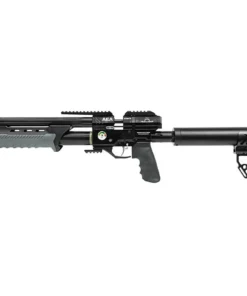
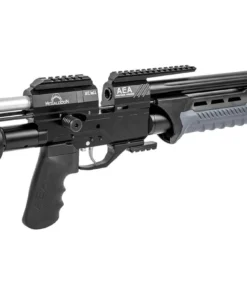
Megalodon 15″ Pump-action
€1,200.00
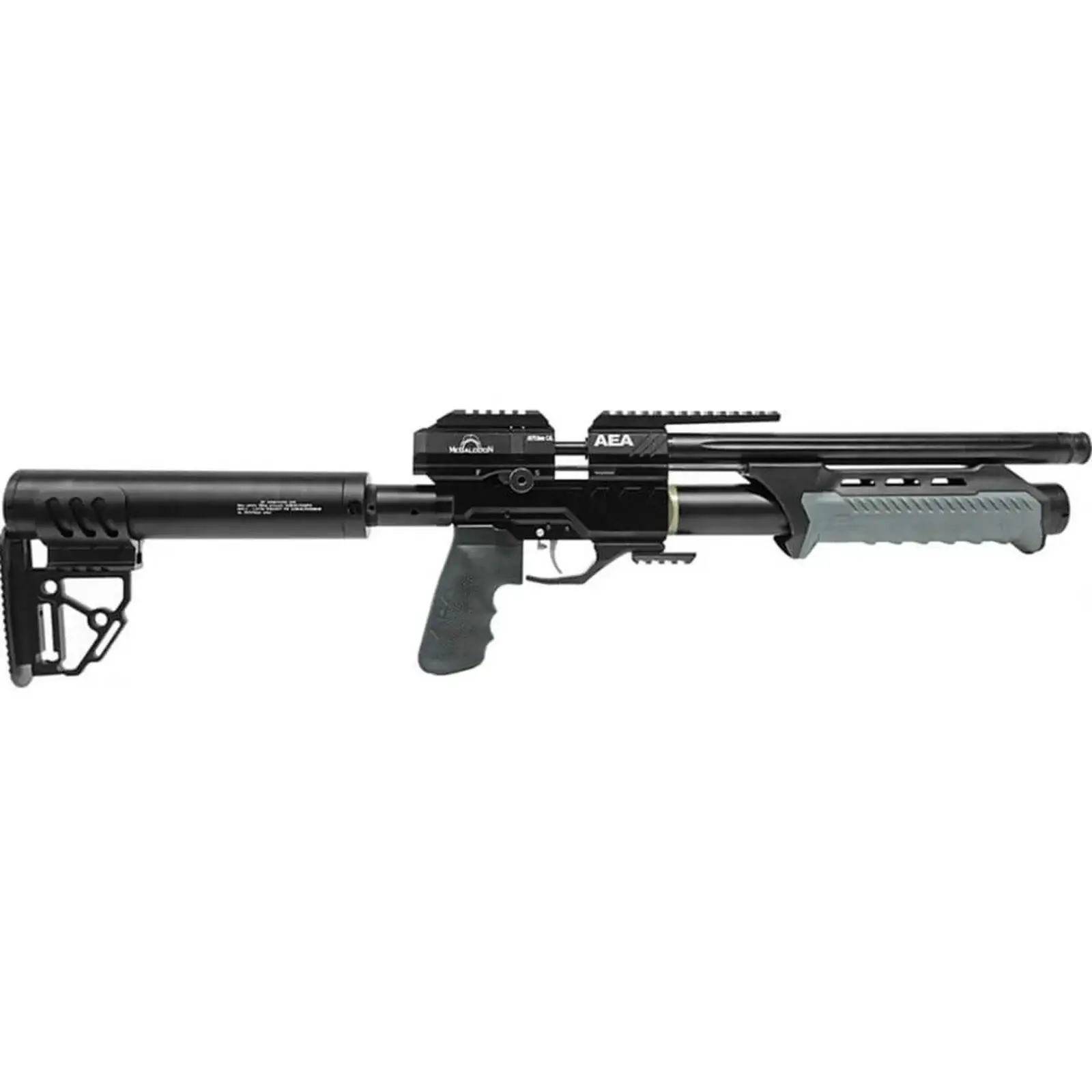
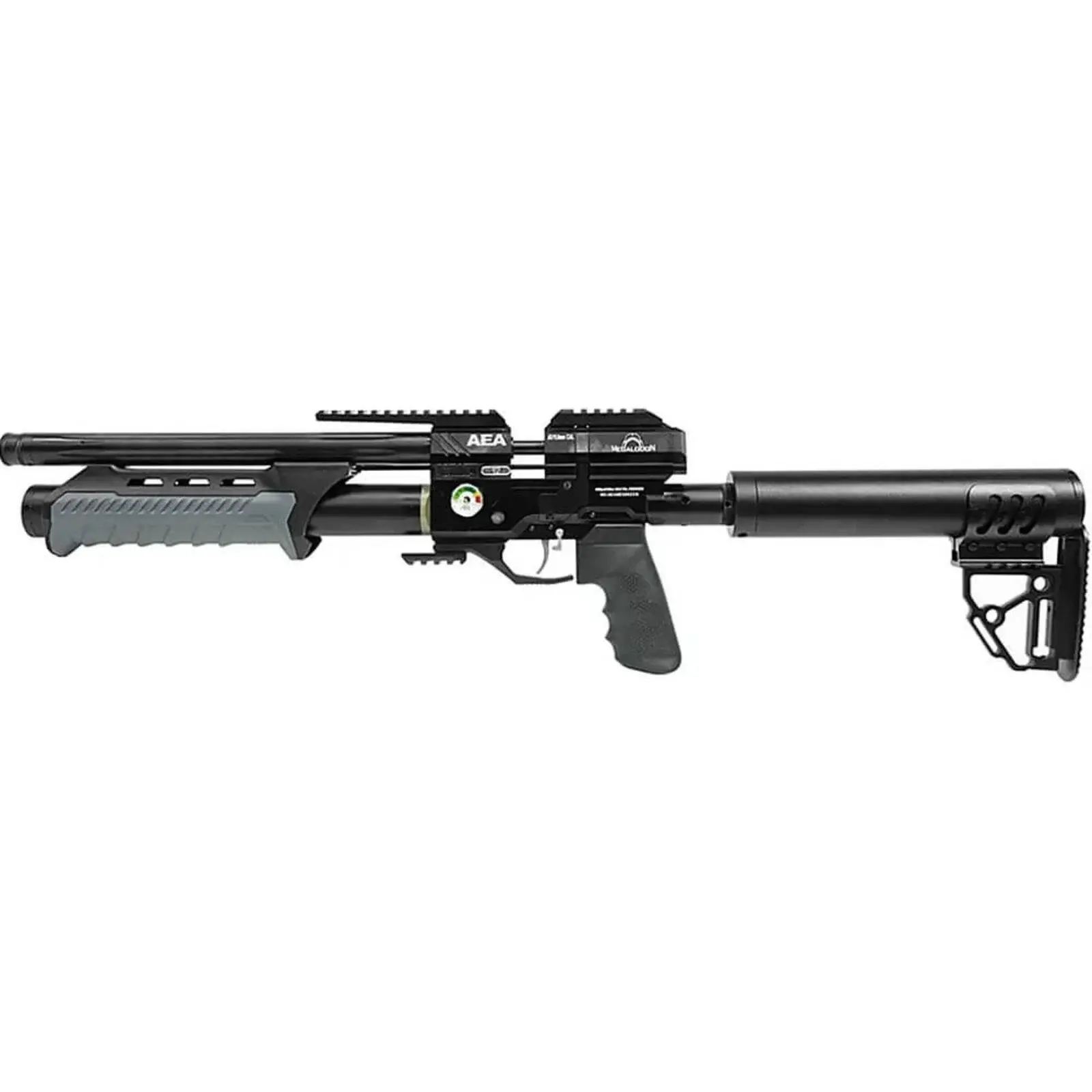
The AEA Megalodon PCP rifle combines power with speed thanks to its user-friendly pump-action loading system.
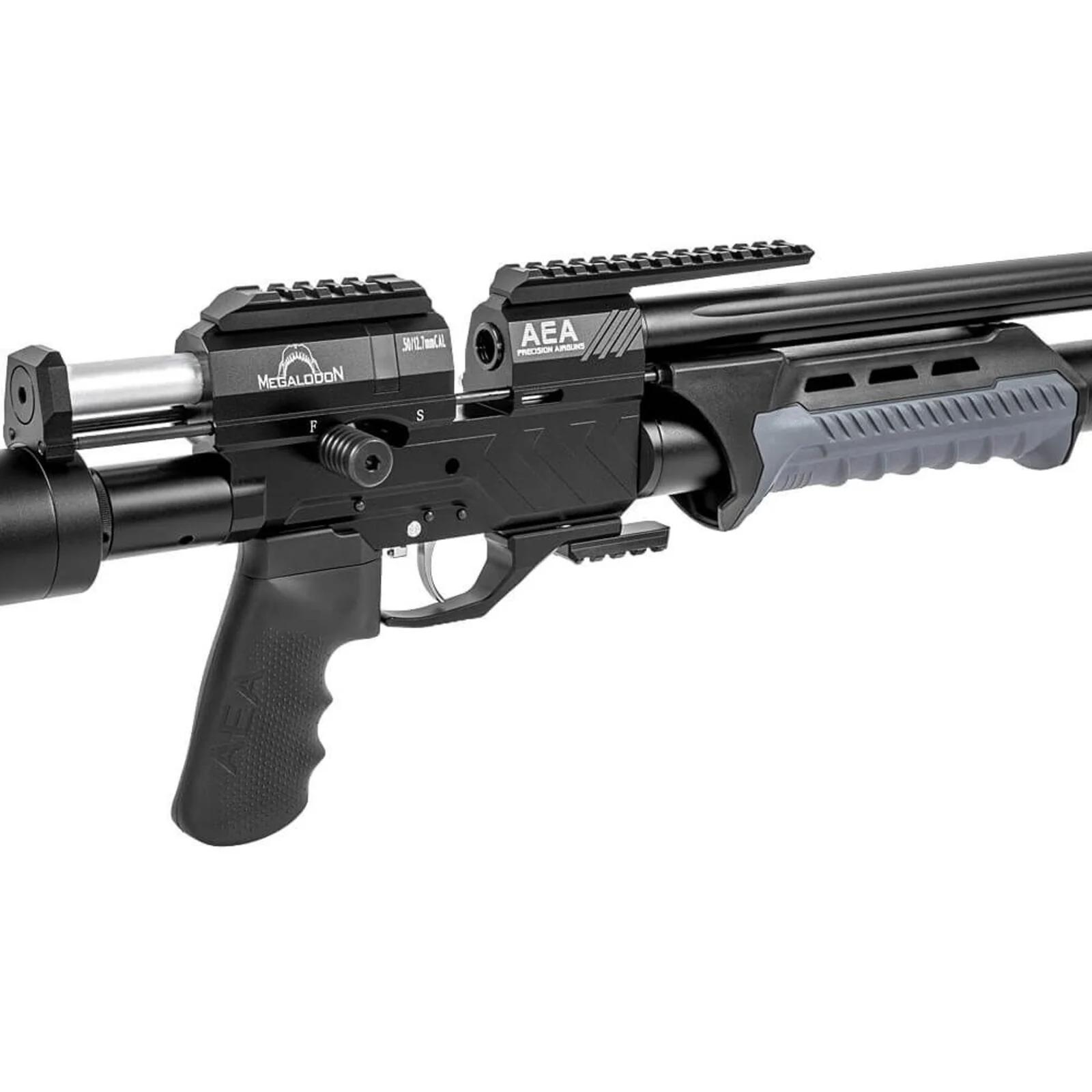
The rifle is equipped with an ergonomic pistol grip with pre-shaped finger grooves, ensuring a firm and natural hold.
At the rear, a second air tank is integrated into the frame, bringing the total air volume to 500cc with a maximum fill pressure of 310 bar.
Optionally, the rear reservoir can be expanded using the 7000 PSI Kit from BinTac.
Power and Speed
The notorious AEA Megalodon should definitely not be underestimated!
This powerhouse is available with a 15-inch barrel length in large calibers .35, .45, and .50.
With this setup, the Megalodon achieves a muzzle energy between 214 and 472 joules (depending on caliber and ammunition).
Thanks to the pump-action loading system, the Megalodon is ready for the next shot in no time.
The pump slide is positioned around the front air tank and ensures a smooth and reliable reloading motion without having to shift your grip.
Slide it back, slide it forward and you’re ready for a follow-up shot!
Optics & Accessories
For accessories, the Megalodon features a split Picatinny/Weaver rail for optics.
This allows almost any type of sighting system, such as a red dot/reflex sight for fast and dynamic shooting, or a riflescope for precision at longer distances.
Or perhaps you prefer the golden middle ground with an LPVO like the 1-8×24 Forester?
At the bottom front of the Megalodon, there is an accessory rail for mounting, for example, a bipod or attaching it to a tripod.
Suppressor options
On the 9mm (.35 version) there are M14x1 threads at the end of the barrel.
This is not a common thread for suppressors.
For the 9mm version, the most affordable option is the AE Megalodon 9mm suppressor.
Alternatively, we recommend a DonnYFL Ronin or Emperor with the DonnyFL M14x1 end cap.
For all the larger calibers, you can use the Ronin, emperor or Kami with M18x1 threads without the need of an adapter.
| Power source: | Pre compressed pneumatic (PCP) |
| Caliber: | 9mm | 11.4mm | 12.7mm |
| Muzzle energy: | 214 | 421 | 472 joule |
| Fill pressure: | 310 Bar |
| Air capacity: | 600cc |
| Regulator: | No |
| Operating system: | |
| Magazine: | – | 11 | 8 |
| Max. projectile length: | 18mm |
| Optic mounting: | 22mm picatinny/weaver |
| Weight: | 4.04kg |
| Length: | 800mm |
| Barrel length: | 381mm |
| Muzzle: | 9mm: M14x1 | .45/.50: M18x1 |
| Accessories: | 2x Magazines, Fill probe (requires foster) |
AEA Megalodon 15″ Pump-Action PCP Air Rifle – Big Bore Engineering, Dual Air Reservoir, Precision Construction and Technical Overview
AEA Megalodon 15″ Pump-Action – Product Description, Mechanical Engineering, Technical Specifications and Manufacturing Quality
1.1 Introduction: Understanding the AEA Megalodon 15″ Pump-Action
The Megalodon 15″ Pump-action represents a distinctive example of large-calibre pneumatic engineering, combining a manually operated repeating mechanism with a compact structural design.
Developed within the aea airguns product family, this model incorporates a 15-inch barrel, detachable magazine, dual compressed-air reservoirs and an industrial-style chassis.
Furthermore, the shorter configuration distinguishes it from the manufacturer’s longer 22-inch version.
The aea megalodon belongs to a specialized category of pressure-powered sporting equipment whose mechanical complexity requires careful maintenance and professional servicing.
However, its compact dimensions do not eliminate regulatory requirements or pressure-system safety responsibilities.
Consequently, understanding the exact factory configuration remains essential.
1.2 AEA Airguns and the Megalodon Product Family
The manufacturer offers several specialized pneumatic designs under the broader aea guns catalogue.
Common searches include megalodon air rifle, aea megalodon air rifle, and aea megalodon 50 caliber.
Additional variations appear under aea megalodon 58 cal and aea megalodon 50 cal price.
These terms identify related products but do not necessarily describe the same factory configuration.
Furthermore, aea megalodon 58 cal bintac m50 is a comparative search involving separate product families.
Accurate identification prevents confusion between different mechanical systems, calibres and production revisions.
1.3 Technical Specifications and Factory Construction
Published specifications for the standard 15-inch configuration include:
- Operating system: Pre-charged pneumatic
- Action: Manually operated pump-action mechanism
- Barrel length: 15 inches (381mm)
- Overall length: Approximately 31–31.5 inches
- Weight: Approximately 7.9lb (3.58kg)
- Air reservoir arrangement: Dual reservoirs
- Combined reservoir capacity: Approximately 500cc
- Published maximum fill pressure: 4,500 PSI (approximately 310 bar)
- Optics interface: Picatinny-style rail
- Available calibres: Multiple large-calibre configurations
Magazine capacities vary by calibre. Published listings commonly identify 11 rounds for .357 and eight rounds for .457 and .50. Figures for .58 differ between distributors and require version-specific confirmation.
Additionally, some packages feature different reservoir or regulator arrangements.
Therefore, the exact manufacturer’s documentation should govern technical identification.
1.4 Pump-Action Engineering and Precision Manufacturing
The manually operated mechanism represents a defining element of the equipment’s mechanical architecture.
Its construction incorporates specialized moving assemblies manufactured to defined dimensional requirements.
Furthermore, the dual-reservoir arrangement introduces additional pressure-containing components within the overall structure.
However, sophisticated construction does not independently guarantee particular accuracy measurements.
Mechanical consistency depends on verified factory specifications, manufacturing quality and component condition.
Consequently, owners should avoid unauthorized modifications and rely on qualified servicing.
1.5 BinTac Product Comparisons: T9, M50, T50 and MCAR
Related catalogue searches include bintac, bin tac, bintaclic, bintac lIc, bintac t9, and bintac t9 price.
Other names include bintac m50, bintac t50, bintac t 50, bintac t50 extreme, and aea bintac t50 extreme.
Furthermore, bintac mcar, bintac mcar air rifle, and bintac mcar 457 identify another mechanical platform.
Commercial searches include bintac m50 for sale, bintac t50 for sale, and bintac s45 for sale.
Meanwhile, bintac s45 aea, b&w m50, and bintac m50 pump action concern separate products or naming conventions.
Searches for bintac t9 full auto and bintac t9 amazon should not be interpreted as characteristics of the featured model.
1.6 AEA Harpoon and Defender Product Comparisons
Other industry searches include aea harpoon, bintac aea harpoon, aea harpoon price, and harpoon for sale.
Related expressions include aea harpoon magnum, aea .50 harpoon, aea harpoon gun, aea harpoon cartridge, harpoon air gun, and aea harpoon air gun.
The wider catalogue also includes aea defender, aea defender 2, and aea defender 3.
However, these products differ in mechanical architecture, dimensions and technical specifications.
Consequently, their components and published characteristics should not be treated as interchangeable.
1.7 Zeus, Terminator and Other Large-Calibre Equipment
Additional models include aea terminator, aea terminator gen 3, and AEA Zeus MKII (Bullpup) Standard 18 Big Bore.
The expression zeus 72 cal air rifle price refers to another calibre category.
Likewise, pistol, bee bee gun rifle, and airgun shotgun describe broader or different sporting-equipment classifications.
The search phrase air tank for pep airguns appears to concern pneumatic reservoirs, whereas anti air tanks relates to an entirely different subject.
These distinctions help keep product information technically accurate.
1.8 Why Engineering Quality, Authenticity and Responsible Ownership Matter
The principal design characteristics of this platform include its compact barrel configuration, manually operated repeating mechanism and dual-reservoir pneumatic architecture.
Furthermore, the manufacturer offers several factory configurations with different technical characteristics.
However, prospective owners should not assume that specifications from one version apply to another.
Authentic documentation, legal eligibility, professional maintenance and secure storage remain essential.
Ultimately, the AEA Megalodon 15″ Pump-Action PCP Air Rifle represents a specialized example of contemporary pneumatic engineering whose technical identity depends on verified specifications, manufacturing consistency and responsible ownership.
Advanced Pneumatic Engineering, Mechanical Construction, Precision Manufacturing, Structural Durability, Safety, and Long-Term Ownership
2.1 Understanding the Engineering Philosophy Behind Modern Pneumatic Equipment
Modern pneumatic sporting equipment combines precision manufacturing, mechanical engineering, carefully selected materials, and contemporary industrial design. Each component contributes to the completed assembly, while the relationship between individual systems influences mechanical integrity, structural durability, and long-term serviceability.
This specialized platform reflects an engineering philosophy centered on coordinated construction, material compatibility, and the integration of several mechanical assemblies within a compact structural framework.
Furthermore, the manufacturer must consider dimensional accuracy, component durability, manufacturing consistency, and professional maintenance requirements.
However, sophisticated construction does not automatically establish exceptional precision, superior reliability, or universal suitability.
Actual equipment quality depends on production standards, material properties, environmental exposure, and maintenance history.
Consequently, prospective owners should evaluate authentic technical documentation rather than relying exclusively on promotional descriptions.
Ultimately, dependable engineering combines appropriate materials, accurate manufacturing, professional inspection, and responsible ownership throughout the equipment’s intended service life.
2.2 Advanced Compressed-Air Technology and Mechanical Innovation
Compressed-air technology represents an established field of mechanical engineering involving pressure-containing components and specialized pneumatic assemblies.
Modern systems incorporate metallic reservoirs, sealing materials, mechanical interfaces, and structural supports manufactured according to defined technical requirements.
Furthermore, these components must remain compatible with the manufacturer’s original engineering specifications.
Unlike simpler mechanical products, pressure-powered equipment requires careful consideration of stored energy and pressure-containment integrity.
However, advanced construction does not eliminate the possibility of component deterioration.
Environmental conditions, ordinary material aging, accidental damage, and maintenance history can influence the condition of individual assemblies.
Consequently, pressure-containing components require appropriate inspection and professional servicing.
Unauthorized disassembly or improvised repairs may create serious hazards.
Therefore, owners should preserve the original factory configuration and consult qualified technicians whenever specialized maintenance becomes necessary.
Ultimately, modern pneumatic engineering provides technical sophistication while introducing important responsibilities concerning maintenance, storage, and product safety.
2.3 Understanding the Importance of Precision Manufacturing
Precision manufacturing involves producing mechanical components within carefully defined dimensional tolerances.
These tolerances establish acceptable differences between intended measurements and completed production dimensions.
Sophisticated mechanical equipment depends on accurate manufacturing because several components must remain compatible within a coordinated structural arrangement.
Furthermore, modern production facilities may incorporate computer-controlled machinery, specialized measuring instruments, and documented inspection procedures.
However, advanced manufacturing technology alone does not guarantee exceptional quality.
Material verification, professional assembly, component inspection, and consistent production standards remain equally important.
Different components may undergo several manufacturing stages before final assembly.
Consequently, effective quality-control procedures help identify dimensional inconsistencies and manufacturing irregularities.
Buyers should nevertheless avoid assuming that specific inspection standards apply unless supporting documentation exists.
Ultimately, manufacturing precision contributes to structural integrity, component compatibility, and dependable long-term serviceability.
2.4 Premium Metallic Construction and Material Durability
Metallic components play an important role in the structural development of sophisticated mechanical equipment.
Carefully selected alloys can provide useful strength, dimensional stability, and resistance to deformation under intended conditions.
Furthermore, modern machining methods allow manufacturers to produce detailed structural surfaces and accurately defined mechanical interfaces.
However, premium materials do not automatically guarantee exceptional durability.
Material composition, protective finishing, manufacturing tolerances, and assembly quality all influence structural integrity.
Environmental exposure can also affect metallic components.
Moisture, abrasive contamination, harsh chemicals, and accidental impact may contribute to corrosion or surface damage.
Consequently, appropriate storage and preservation remain important.
Owners should follow manufacturer-approved maintenance recommendations and seek professional assistance when structural damage becomes apparent.
Ultimately, metallic construction provides meaningful long-term value when appropriate materials are combined with accurate manufacturing and responsible care.
2.5 Compact Structural Engineering and Industrial Design
Compact mechanical engineering requires careful organization of multiple assemblies within a relatively limited physical framework.
The manufacturer must consider structural strength, component placement, material compatibility, and professional servicing requirements.
Furthermore, compact construction can introduce sophisticated manufacturing challenges because adjoining components occupy closely coordinated positions.
However, smaller dimensions do not necessarily indicate simpler mechanical engineering.
A compact product may contain specialized internal assemblies requiring qualified inspection and maintenance.
Additionally, structural organization influences overall dimensions, storage requirements, and transportation considerations.
Prospective owners should consult verified manufacturer measurements rather than judge physical characteristics exclusively from photographs.
Protective cases should accommodate the complete equipment without placing unnecessary pressure on exposed components.
Nevertheless, compact dimensions do not change legal classification or remove secure-storage responsibilities.
Ultimately, coordinated structural engineering demonstrates how contemporary manufacturing can integrate complex mechanical systems within a distinctive industrial design.
2.6 Understanding the Manually Operated Mechanical Architecture
The manually operated mechanism represents a distinctive aspect of the equipment’s mechanical construction.
Its design incorporates specialized moving components that interact within a carefully manufactured structural arrangement.
From an engineering perspective, these assemblies require accurate dimensions, suitable materials, and appropriate mechanical support.
Furthermore, component compatibility must remain consistent with the manufacturer’s original specifications.
However, mechanical movement can produce ordinary wear throughout the equipment’s service life.
Environmental contamination, accidental damage, and unsuitable maintenance may also affect component condition.
Consequently, unusual resistance, visible deterioration, or suspected mechanical malfunction should prompt professional assessment.
Unauthorized alterations can compromise the original factory arrangement and introduce safety concerns.
Additionally, replacement components should correspond with manufacturer-approved specifications.
Ultimately, responsible ownership involves preserving mechanical integrity through genuine components, appropriate inspection, and dependable technical support.
2.7 Pressure Reservoir Construction and Structural Integrity
Pressure reservoirs represent critical components within sophisticated pneumatic equipment.
Their construction must satisfy defined pressure-containment requirements established by the manufacturer.
Furthermore, pressure-containing assemblies must integrate correctly with adjoining mechanical components.
Material selection, manufacturing quality, structural condition, and professional inspection contribute to safe ownership.
However, exterior appearance alone cannot establish the integrity of a pressure vessel.
Damage may occur through accidental impact, unsuitable environmental exposure, or material deterioration.
Consequently, visible damage, suspected leakage, unusual deformation, or corrosion should prompt qualified evaluation.
Damaged pressure-containing components should never receive improvised repairs.
Manufacturers may also establish inspection schedules, replacement requirements, or service-life limitations.
Owners should consult official documentation for the exact production version.
Ultimately, responsible reservoir ownership depends on verified specifications, appropriate preservation, and qualified professional servicing.
2.8 Understanding Multiple Pressure-Containing Assemblies
Some sophisticated pneumatic platforms incorporate more than one pressure-containing component within the complete structural arrangement.
This type of construction introduces additional engineering considerations involving material compatibility, component identification, and structural integrity.
Furthermore, individual assemblies may have distinct inspection or replacement requirements.
However, the presence of multiple components does not automatically establish superior performance or greater reliability.
Technical characteristics must be evaluated through documented manufacturer specifications.
Environmental exposure, component aging, and accidental damage may influence individual pressure-containing assemblies differently.
Consequently, comprehensive professional inspection remains important.
Owners should never assume that visually similar pressure vessels share identical technical ratings.
Likewise, replacement components require verified manufacturer compatibility.
Unauthorized modifications may compromise the original design and introduce substantial hazards.
Ultimately, sophisticated pressure-system construction requires responsible ownership, accurate documentation, and dependable professional maintenance.
2.9 Precision Barrel Manufacturing and Material Quality
The barrel represents an important example of specialized metallic manufacturing.
Its construction requires careful consideration of material properties, dimensional accuracy, internal geometry, and compatibility with adjoining components.
Modern production methods allow manufacturers to create precisely defined surfaces and consistent component dimensions.
Furthermore, appropriate quality-control procedures contribute to manufacturing consistency.
However, advanced barrel construction does not independently establish guaranteed accuracy.
Verified performance claims require documented testing conditions and clear identification of the relevant factory configuration.
Environmental exposure and maintenance history may also affect component condition.
Consequently, improper cleaning materials and unauthorized mechanical intervention should be avoided.
Where specialized inspection or replacement becomes necessary, qualified professionals should undertake the work.
Ultimately, the technical significance of precision manufacturing lies in material consistency, structural quality, and integration within the complete mechanical system.
2.10 Magazine Construction and Mechanical Compatibility
The detachable magazine represents another specialized mechanical assembly.
Its construction requires appropriate material selection, dimensional accuracy, and compatibility with the original factory configuration.
Furthermore, production revisions may introduce differences between components that appear similar.
Consequently, owners should not assume that visually identical replacement parts are interchangeable.
Official technical documentation provides the appropriate reference for component identification.
However, unauthorized modifications may compromise the original mechanical arrangement.
Visible deformation, unusual wear, or suspected damage should prompt professional evaluation.
Appropriate storage can also contribute to preserving component condition.
Dust, moisture, accidental impact, and unsuitable chemicals may affect exposed surfaces.
Additionally, genuine replacement components help maintain compatibility with the manufacturer’s original design.
Ultimately, reliable component identification and responsible preservation contribute significantly to long-term serviceability.
2.11 Structural Weight Distribution and Physical Characteristics
Weight distribution represents an important consideration in mechanical design.
Although total mass provides a useful numerical measurement, it does not completely describe the physical characteristics of a finished product.
Metallic components, pressure-containing assemblies, structural supports, and exterior materials all contribute to overall weight.
Furthermore, their relative positions influence the balance of the complete assembly.
Two products with similar total mass may have different physical characteristics because their components occupy different locations.
Consequently, prospective owners should evaluate verified manufacturer specifications rather than rely exclusively on promotional photographs.
Production variations may also introduce differences in dimensions or materials.
Physical measurements are particularly important when selecting suitable protective storage equipment.
Ultimately, thoughtful weight distribution reflects coordinated industrial engineering and careful consideration of structural organization.
2.12 Ergonomic Design and Individual Physical Suitability
Ergonomic engineering examines the relationship between equipment dimensions and individual physical characteristics.
People differ in height, body proportions, mobility, strength, and personal comfort preferences.
Consequently, no single sporting-equipment configuration can guarantee universal suitability.
The external structure contributes to the completed product’s distinctive physical appearance and overall dimensions.
Furthermore, material selection and surface finishing influence the perceived quality of exterior components.
However, individual suitability should not be determined exclusively through photographs.
Prospective owners may benefit from examining an example through an authorized retailer or appropriately supervised sporting facility.
The quality of connecting interfaces and structural components also deserves attention.
Moving or adjustable assemblies may experience ordinary wear.
Ultimately, thoughtful ergonomic design combines accurate manufacturing, individual requirements, and appropriate professional guidance.
2.13 Protective Surface Finishing and Industrial Appearance
Exterior finishing contributes significantly to the visual identity of specialized mechanical equipment.
Metallic surfaces, synthetic components, and carefully defined structural shapes create a distinctive industrial appearance.
Furthermore, protective finishes may help preserve selected materials against ordinary environmental exposure.
However, visual sophistication does not automatically establish superior mechanical quality.
An attractive exterior cannot independently confirm manufacturing tolerances, internal component condition, or long-term reliability.
Consequently, buyers should examine authentic documentation alongside visible product condition.
Retail photographs may represent different production versions or contain optional accessories.
Transparent product descriptions should therefore distinguish factory components from additional equipment.
Protective finishes also require suitable maintenance.
Moisture, abrasion, harsh chemicals, and accidental impact can affect exterior surfaces.
Ultimately, professional finishing contributes to product identity while genuine quality depends on verified manufacturing standards.
2.14 Understanding Quality-Control Procedures
Quality control plays an important role in the manufacture of complex mechanical products.
Manufacturers must consider material consistency, dimensional accuracy, structural alignment, and assembly procedures.
Furthermore, systematic inspection can help identify irregularities before the completed product reaches the customer.
However, quality control involves more than specialized measuring instruments.
Qualified personnel, reliable documentation, and consistent manufacturing procedures remain essential.
Individual components may require different manufacturing and inspection methods.
Consequently, coordination between production stages contributes to finished-product consistency.
Manufacturers may also introduce technical revisions throughout a product’s commercial life.
These changes can influence component compatibility and professional servicing requirements.
Therefore, owners should identify the exact production version before requesting replacement components.
Ultimately, effective quality control supports product integrity and dependable long-term technical assistance.
2.15 Mechanical Consistency and Realistic Precision Expectations
Mechanical consistency describes the extent to which equipment maintains its intended characteristics under comparable conditions.
However, consistency must be established through appropriate measurements rather than assumed from technical descriptions.
Sophisticated pneumatic systems contain multiple interacting components whose condition influences overall mechanical behavior.
Manufacturing tolerances, material properties, environmental conditions, and maintenance history contribute to the completed system.
Furthermore, ordinary wear may influence individual assemblies over time.
Consequently, claims promising exceptional accuracy or guaranteed consistency require verifiable supporting evidence.
Independent technical evaluations may provide useful context, although their findings do not necessarily apply to every production version.
Buyers should distinguish controlled testing results from generalized promotional statements.
Ultimately, realistic expectations depend on authentic manufacturer specifications, documented evaluation methods, and responsible interpretation of technical information.
2.16 Practical Ownership in Authorized Sporting Environments
Specialized pneumatic equipment may form part of organized recreational activities when possession and use comply with applicable legislation.
Authorized sporting facilities provide structured environments with established safety procedures and professional supervision.
However, equipment eligibility varies between organizations and jurisdictions.
Some facilities restrict particular categories, while others require additional documentation.
Consequently, prospective participants should confirm relevant requirements before attending.
Furthermore, organized sporting disciplines may follow rules established by recognized governing bodies.
Equipment permitted in one activity may not qualify for another.
Therefore, owners should review the regulations governing their intended participation.
Qualified instructors can explain facility procedures, lawful handling requirements, and general safety obligations.
Importantly, sophisticated equipment does not eliminate the need for appropriate training.
Ultimately, responsible sporting participation depends on legal eligibility, authorized facilities, qualified supervision, and compliance with established procedures.
2.17 Environmental Conditions and Equipment Preservation
Environmental exposure can influence both the appearance and mechanical condition of sophisticated equipment.
Humidity, airborne dust, temperature fluctuations, and prolonged sunlight introduce different preservation challenges.
For example, excessive moisture may encourage corrosion on susceptible metallic surfaces.
Similarly, abrasive particles can damage protective finishes and exposed mechanical interfaces.
Although modern materials resist certain environmental influences, they cannot prevent every form of deterioration.
Consequently, suitable storage remains important.
Temperature management deserves particular attention because the equipment incorporates pressure-containing assemblies.
Owners should follow manufacturer-approved environmental limits.
Furthermore, sudden temperature changes may encourage condensation when equipment moves between different surroundings.
This moisture can introduce additional preservation concerns.
Protective cases may reduce ordinary contact damage during lawful transportation.
However, enclosed cases are not automatically appropriate for prolonged storage in humid environments.
Ultimately, responsible preservation helps maintain product condition and reduce avoidable maintenance requirements.
2.18 Routine Maintenance and Professional Servicing
Long-term ownership requires maintaining equipment according to official manufacturer guidance.
Even carefully manufactured mechanical products contain components that may experience ordinary wear.
Sealing elements, protective finishes, moving interfaces, and pressure-containing assemblies deserve attention throughout the service life.
However, maintenance requirements vary according to factory configuration and production generation.
Generic recommendations cannot account for every technical difference.
Consequently, owners should consult the documentation associated with their exact equipment.
Visible damage, suspected leakage, unusual mechanical behavior, or accidental impact should prompt professional evaluation.
Internal pneumatic assemblies require particular caution.
Unauthorized disassembly may create serious pressure-related hazards.
Furthermore, incompatible replacement parts can compromise the original engineering design.
Qualified technicians should therefore perform specialized inspections and repairs.
Ultimately, responsible maintenance combines environmental preservation, genuine components, and dependable professional assistance.
2.19 Long-Term Reliability and Mechanical Durability
Durability describes the ability of equipment to withstand intended conditions throughout its service life.
However, long-term durability depends on several interacting factors.
Material quality, manufacturing standards, environmental exposure, assembly procedures, and maintenance history contribute to product condition.
Different components may experience different forms of deterioration.
Metallic surfaces can develop corrosion or cosmetic wear, while sealing materials may deteriorate with age.
Furthermore, moving mechanical interfaces can experience gradual wear.
Such changes do not automatically indicate manufacturing defects.
Nevertheless, unexpected damage or irregular mechanical behavior should receive professional attention.
Manufacturers may also establish inspection schedules or recommend replacement of particular components.
Owners should follow those instructions rather than assume that premium equipment requires no maintenance.
Ultimately, dependable ownership combines appropriate engineering, suitable preservation, and qualified technical support.
2.20 Genuine Replacement Components and Compatibility
Replacement-part availability represents an important consideration for long-term ownership.
Sophisticated mechanical equipment may incorporate proprietary assemblies requiring exact dimensional compatibility.
Consequently, replacement components should correspond with manufacturer-approved specifications.
Visually similar parts may differ in materials, dimensions, or production generation.
Therefore, compatibility should never be assumed solely from appearance.
Authorized technicians can consult official technical documentation to identify suitable components.
Furthermore, accurate product identification helps simplify professional maintenance inquiries.
Owners should retain purchase records, identification information, and relevant service documentation.
These records can help establish the original factory configuration.
Unauthorized replacement components may introduce mechanical problems and affect warranty eligibility.
Ultimately, genuine parts and dependable manufacturer support contribute significantly to structural preservation and long-term serviceability.
2.21 Product Authenticity and Manufacturer Documentation
Authenticity represents an essential consideration when purchasing specialized sporting equipment.
Genuine products should correspond with manufacturer identification details and official technical documentation.
However, professional-looking packaging alone does not establish authenticity.
Buyers should verify seller credibility and product provenance through reliable channels.
Authorized distributors may provide confirmation of factory specifications and warranty arrangements.
Furthermore, production revisions can create differences between visually similar examples.
Accurate identification helps prevent misunderstandings concerning included components.
Customers should retain purchase receipts, warranty information, and professional service documentation.
Such records support legitimate ownership inquiries.
Transparent retailers should provide accurate photographs and clearly identify the configuration being supplied.
Any differences between promotional images and the actual product should be explained.
Ultimately, genuine manufacture and reliable documentation contribute substantially to purchasing confidence.
2.22 Warranty Protection and After-Sales Support
Warranty coverage represents an important part of the ownership experience.
A manufacturer’s warranty may provide defined protection against eligible defects under specified conditions.
However, coverage varies according to equipment, distributor, jurisdiction, and purchase arrangement.
Consequently, buyers should examine warranty documentation before completing a transaction.
Important considerations include coverage duration, exclusions, authorized servicing requirements, and procedures for requesting assistance.
Furthermore, unauthorized modifications may affect warranty eligibility.
Accidental damage and improper maintenance may also fall outside standard coverage.
Customers should retain original purchase receipts and identification information.
These records can simplify legitimate service inquiries.
Authorized retailers may help coordinate manufacturer support.
However, buyers should distinguish retailer promises from official warranty obligations.
Ultimately, clear warranty terms and accessible technical assistance provide greater reassurance than unsupported guarantees of lifetime reliability.
2.23 Legal Classification and Responsible Ownership
Legal classification represents an essential consideration when purchasing regulated sporting equipment.
Requirements differ significantly between countries and sometimes within national jurisdictions.
A particular factory configuration may be legally available under one classification while requiring additional authorization elsewhere.
Consequently, buyers should verify applicable regulations before purchasing, importing, transporting, or possessing the equipment.
Manufacturer specifications do not replace local legislation.
Furthermore, international transportation may involve customs procedures, licensing obligations, and carrier restrictions.
Customers should confirm these requirements with relevant authorities.
Responsible storage remains equally important.
Appropriate security helps prevent unauthorized access and may be required by law.
Importantly, compact dimensions and contemporary engineering do not reduce these obligations.
Ultimately, lawful ownership depends on accurate information, appropriate authorization, secure storage, and continued compliance with applicable regulations.
2.24 Total Ownership Costs and Financial Considerations
The initial purchase price represents only one part of the financial commitment associated with specialized sporting equipment.
Additional expenses may include secure storage, professional servicing, authorized inspections, replacement components, and applicable licensing requirements.
Furthermore, regional technical support availability can influence maintenance costs.
Specialized assemblies may require professional assessment or replacement through approved distribution channels.
Consequently, prospective owners should investigate servicing arrangements before purchasing.
Warranty coverage also deserves consideration.
Terms may vary according to distributor, jurisdiction, and purchasing circumstances.
Customers should examine exclusions involving unauthorized modifications, accidental damage, and improper maintenance.
Long-term value depends partly on equipment condition and continued manufacturer support.
However, resale prices cannot be guaranteed.
Ultimately, realistic financial planning supports informed ownership decisions and reduces unexpected responsibilities.
2.25 Final Assessment: Engineering Innovation, Structural Quality, and Long-Term Ownership
This sophisticated mechanical platform demonstrates how contemporary manufacturing techniques, specialized materials, and compressed-air engineering can be integrated into a distinctive sporting product.
Its technical identity extends beyond exterior appearance.
The combination of compact structural construction, specialized pressure-containing assemblies, manually operated mechanical components, and accurately manufactured interfaces reflects a coordinated engineering philosophy.
Furthermore, the integration of these systems illustrates the importance of dimensional accuracy, material compatibility, and professional technical support.
Nevertheless, long-term satisfaction depends on more than the manufacturer’s original construction.
Appropriate storage, authentic product identification, professional maintenance, and compliance with applicable legislation remain essential.
Prospective owners should maintain realistic expectations regarding mechanical performance and recognize that factory specifications may differ between production configurations.
Ultimately, the equipment’s long-term value depends on verified technical information, manufacturing quality, responsible maintenance, legal compliance, and dependable professional support.
Be the first to review “Megalodon 15″ Pump-action”
Related products



AEA Air Gun



AEA Air Gun



AEA Air Gun
Reviews
There are no reviews yet.