
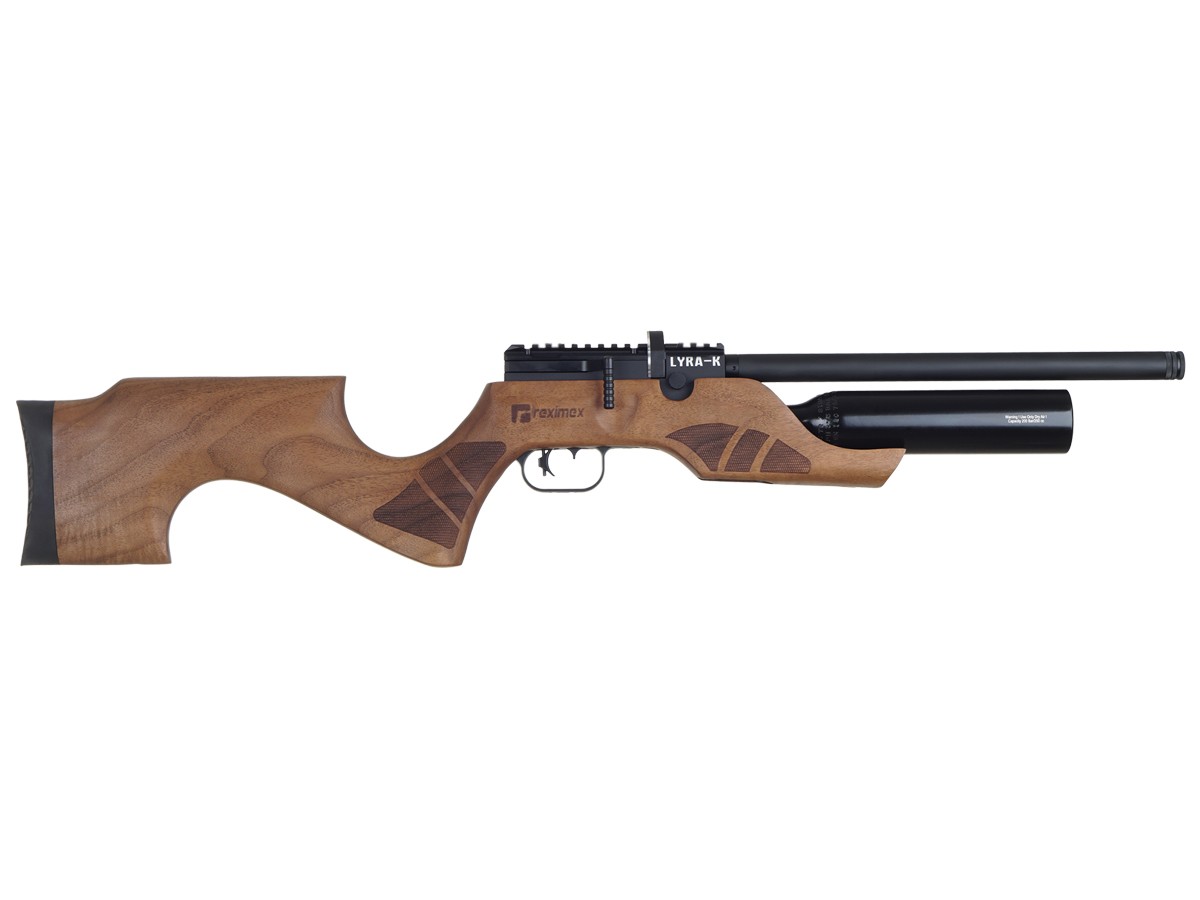

Reximex Lyra-K PCP Air Rifle

Price range: €230.00 through €250.00
The Reximex Lyra-K is a carbine-format PCP available in .177, .22, and .25, with a synthetic stock built for field use. Velocities were tested with quality JSB pellets — 1,000 fps in .177, 900 fps in .22, and 800 fps in .25 — so you know you’re getting real-world numbers, not marketing fluff. It’s a capable multi-caliber hunter and target gun in a handy carbine package.
- Calibers available: .177 Cal (1,000 fps), .22 Cal (900 fps), .25 Cal (800 fps)
- Carbine format: shorter, lighter, and easier to carry in the field
- Synthetic stock: weather-resistant and durable for hunting conditions
- Pre-charged pneumatic: consistent, recoil-free performance across all three calibers
- Velocities verified with JSB pellets — honest, real-world performance specs
Caliber Reximex Lyra-K Carbine PCP Air Rifle, .177 cal, Wood Stock, Reximex Lyra-K Carbine PCP Air Rifle .177 cal, Synthetic Stock, Reximex Lyra-K Carbine PCP Air Rifle, .22 cal, Wood Stock, Reximex Lyra-K Carbine PCP Air Rifle, .22 cal,Synthetic Stock, Reximex Lyra-K Carbine PCP Air Rifle, .25 cal, Wood Stock, Reximex Lyra-K Carbine PCP Air Rifle, .25 cal, Synthetic Stock Brand Reximex
Reximex Lyra-K PCP Air Rifle – Compact Walnut-Stock PCP with Side-Lever Action, Adjustable Power and Multi-Caliber Performance
The Reximex Lyra-K PCP Air Rifle is a compact pre-charged pneumatic rifle designed for shooters who want traditional walnut-stock ergonomics in a shorter, lighter platform. It combines a side-lever action, multi-shot magazine system, adjustable trigger, integrated sound moderation, power adjustment, and a 250cc air reservoir in a rifle measuring approximately 880mm overall.
Reximex currently offers the Lyra-K in .177, .22, and .25 calibers. Manufacturer specifications list maximum velocities of approximately 1000 fps in .177, 900 fps in .22, and 800 fps in .25. Magazine capacity is 14, 12, and 10 shots respectively. The rifle weighs about 2.8kg and uses a 380mm barrel.
Why Choose the Reximex Lyra K?
The Reximex Lyra K stands out because it offers compact dimensions without abandoning the feel of a conventional rifle.
At approximately 34.6 inches overall, it is noticeably shorter than the full-length Lyra while still retaining a Turkish walnut stock and shoulder-supported configuration. This makes it easier to maneuver on a range bench, transport in an appropriate case, and handle in confined shooting positions.
The 250cc reservoir also gives the rifle useful shot capacity without adding the bulk of a larger bottle system.
How Good Is the Side-Lever Action?
The side-lever arrangement provides a short and practical operating stroke.
A smooth lever can help the shooter maintain shoulder and cheek position between shots, which is useful when shooting groups from a supported position.
The action should always be cycled fully and deliberately.
Rushed or incomplete movement can create feeding problems, particularly when using a multi-shot magazine.
Caliber Options and Published Performance
The Lyra-K is available in three calibers.
- .177 / 4.5mm: approximately 1000 fps
- .22 / 5.5mm: approximately 900 fps
- .25 / 6.35mm: approximately 800 fps
Current factory figures place muzzle energy at roughly 25.4–31.6 joules in .177 depending on catalogue revision, around 44.3–50.8 joules in .22, and approximately 49.1–55.4 joules in .25. Reximex notes that results vary with pellet weight, temperature, elevation, and other conditions.
Searches for tps to joules calculator, Tps joule calculator, fps to ft Ibs, and airgun joules calculator can assist with unit conversion, but actual performance should be confirmed with suitable chronograph equipment where necessary.
250cc Reservoir and 250 BAR Fill Pressure
The rifle uses a 250cc air tube with a maximum fill pressure of 250 BAR.
Published shot counts are approximately 100 shots in .177, 70 in .22, and 60 in .25 through the manufacturer’s stated optimal pressure range.
This capacity makes the rifle practical for extended target sessions without requiring an oversized reservoir.
Filling should always be completed with compatible high-pressure equipment, and the stated maximum should never be exceeded.
Turkish Walnut Stock
The stock is manufactured from Turkish walnut, giving the rifle a traditional appearance while maintaining relatively low overall weight.
The shorter carbine-style geometry helps keep the rifle manageable.
A rubber butt pad provides shoulder contact, while the stock shape supports a conventional shooting position.
Natural wood grain varies between individual rifles, so exact appearance may differ slightly from catalogue photographs.
Adjustable Trigger and Manual Safety
The rifle incorporates a four-way adjustable trigger and manual safety.
Trigger adjustability allows the shooter to refine feel and finger position within safe manufacturer limits.
A predictable release can support better consistency during deliberate target shooting.
However, an excessively light trigger is not automatically an advantage.
Secure engagement and predictable operation remain more important.
Integrated Sound Moderator
The Lyra-K includes an integrated sound moderator and a 1/2 UNF threaded arrangement according to Reximex specifications.
This can help reduce muzzle report where legal.
Regulations concerning airguns and moderation devices vary by jurisdiction, so local laws should always be confirmed before purchase or use.
Power Adjustment
A manufacturer-provided power adjustment knob is included.
This allows the rifle to be configured within its intended operating range for different lawful sporting environments and ammunition preferences.
Any adjustment should remain within factory limits and applicable local energy restrictions.
Magazine Capacity
Magazine capacity depends on caliber:
- 14 shots in .177
- 12 shots in .22
- 10 shots in .25
The magazine should rotate smoothly and pellets should be loaded without damaging their skirts.
Clean, undamaged magazines generally provide more reliable indexing.
Reximex Airguns Range
The wider reximex and reximex airguns catalogue includes many different platforms.
Searches for reximex throne gen2, reximex throne gen 2, reximex mito, reximex mitos, reximex гр, reximex rра, reximex lieva, and reximex accura pcp air rifle refer to separate products or model families.
Reximex also maintains individual manuals for Lyra-K, Accura, Throne, and other platforms, which helps prevent specifications from being mixed between models.
Reximex Lyra-K PCP Air Rifle Search Intent
The phrase Reximex Lyra-K PCP air rifle accurately describes this compact pneumatic platform.
Similarly, Reximex Lyra-K airgun, Reximex Lyra-K PCP rifle, and Reximex Lyra-K compact PCP rifle reflect genuine product-search intent.
The rifle’s compact dimensions, walnut stock, side-lever action, and multi-caliber availability make these descriptions appropriate.
Reximex Lyra-K Regulated PCP Search
The phrase Reximex Lyra-K regulated PCP appears frequently in search behavior, but current official Lyra-K specifications emphasize its reservoir, adjustable power, trigger, and side-lever action rather than listing a regulator as a standard specification on the current product page.
For that reason, buyers should verify the exact configuration of the rifle being sold rather than assuming regulation from third-party listings.
Reximex Lyra-K Tactical Air Rifle Search
The phrase Reximex Lyra-K tactical air rifle reflects buyer interest, but the Lyra-K is visually closer to a compact traditional sporting rifle because of its Turkish walnut stock.
Shooters specifically seeking aluminum chassis systems or full tactical furniture may prefer another platform.
Reximex Lyra-K Review and Accuracy Test
Searches for Reximex Lyra-K review and Reximex Lyra-K accuracy test usually focus on practical grouping, trigger feel, air efficiency, magazine reliability, and handling.
Actual accuracy depends on pellet choice, pressure, optic setup, environmental conditions, and shooter technique.
For meaningful testing, several pellet types should be compared under similar conditions rather than judging the rifle from one group.
Reximex Lyra-K Scope Package
The phrase Reximex Lyra-K scope package describes bundled retail offerings rather than the standard factory specification.
The manufacturer’s broader documentation notes that optics may not be included depending on the listing. Buyers should therefore confirm whether a scope, mounts, case, magazines, filling probe, or other accessories are actually part of the package.
Reximex Lyra-K Pellet Gun
The phrase Reximex Lyra-K pellet gun is commonly used by consumers searching for a magazine-fed pneumatic rifle.
However, technical buyers will generally find “PCP air rifle” more precise because it identifies the high-pressure pneumatic operating system.
Buy Reximex Lyra-K Online
Searches for buy Reximex Lyra-K online, best price Reximex Lyra-K, and gunseek reflect strong buyer intent.
Before purchase, shoppers should verify caliber, legal requirements, warranty coverage, included accessories, filling equipment compatibility, and retailer credibility.
Terms such as roxy max and mx rex may also appear in broad search data but do not represent official features of this rifle.
Reximex Lyra-K Hunting Rifle
The phrase Reximex Lyra-K hunting rifle reflects one potential lawful sporting application.
Likewise, Reximex Lyra-K for pest control and Reximex Lyra-K small game hunting describe use cases that depend heavily on local law, appropriate energy, suitable ammunition, landowner permission, and humane practice.
The rifle can equally be used for lawful recreational target shooting without assuming live-quarry use.
Important Specifications
- Side-lever cocking system
- .177, .22, and .25 caliber availability
- 250cc air reservoir
- 250 BAR fill pressure
- Turkish walnut stock
- 880mm overall length
- 380mm barrel
- Approximately 2.8kg weight
- 14/12/10-shot magazine capacity
- Four-way adjustable trigger
- Manual safety
- Integrated sound moderator
- 1/2 UNF muzzle thread
- Power adjustment knob
- Rubber butt pad
Why the Lyra-K Offers Strong Practical Value
The Lyra-K combines compact dimensions, traditional walnut ergonomics, generous pressure capacity, multi-shot convenience, multi-caliber choice, and useful adjustment features in one relatively lightweight package.
For buyers wanting something shorter than a conventional full-length rifle but more traditional than a bullpup, the design occupies a useful middle ground.
When paired with suitable ammunition, maintained correctly, filled safely, and used within applicable regulations, the Reximex Lyra-K PCP Air Rifle offers a practical balance of portability, repeatability, attractive wood construction, and precision-focused pneumatic performance.
Accuracy, Handling, Air Management, Trigger Control, and Practical Shooting Performance
Developing Consistent Accuracy
Consistent accuracy depends on stable technique, suitable ammunition, correct sight setup, and controlled pressure management.
A compact pneumatic rifle can perform very well when the shooter keeps the main variables consistent from one shot to the next.
Grip pressure, shoulder contact, cheek position, trigger movement, and follow-through should all remain repeatable.
Ammunition selection also matters because different pellet weights, head sizes, and profiles may produce noticeably different groups.
For that reason, practical testing should be systematic rather than based only on published velocity figures.
Building a Stable Shooting Position
A stable shooting position helps reduce unnecessary movement.
Whether shooting from a bench, rest, supported kneeling position, or standing, the rifle should sit naturally rather than being forced into alignment.
Shoulder contact should remain consistent.
The supporting hand should steady the rifle without squeezing excessively.
The trigger hand should remain relaxed enough to allow the finger to move independently.
A natural position is usually easier to repeat over a long session.
Cheek Placement and Sight Alignment
Cheek placement should remain consistent so the eye returns to the same sighting position.
If an optic is fitted, the eye should naturally align with the center of the sight picture without requiring excessive head movement.
If open sights are used, front and rear alignment should remain identical for every shot.
Small differences in head position can change the apparent point of aim.
For this reason, sight alignment should be treated as part of the shooting position rather than a separate step.
Trigger Control
Trigger technique has a major influence on precision.
The trigger should be pressed smoothly instead of pulled abruptly.
The shooter should become familiar with the first stage and the final release point.
Once the trigger feel becomes predictable, the shooter can focus more attention on sight alignment.
A sudden or rushed release can disturb the rifle at the moment of firing.
Smooth movement supports more consistent groups.
Follow-Through
Follow-through should continue briefly after the shot is released.
The shooter should maintain shoulder contact, cheek position, and sight alignment rather than moving immediately.
This helps preserve consistency through the complete firing cycle.
It also makes it easier to evaluate technique.
If the shooter lifts the head too early, poor habits can become difficult to recognize.
Side-Lever Operation
The side-lever mechanism can help maintain shooting position between shots.
A short and deliberate movement allows the action to be cycled without completely rebuilding the shooting position.
The lever should be operated fully.
Rushing the movement or failing to complete the cycle can create feeding problems.
A consistent operating rhythm also helps the shooter maintain concentration during magazine-fed strings.
Magazine Feeding
The magazine should rotate smoothly and load pellets without damaging them.
Pellet skirts should remain round and clean.
If a pellet is visibly damaged, it should not be used for accuracy testing.
The magazine itself should be kept free from dust and debris.
If resistance develops, the cause should be checked rather than forcing the mechanism.
Reliable feeding supports consistent results.
Single-Shot Testing
Single-shot loading can be useful when evaluating ammunition.
Removing magazine indexing from the test can make it easier to determine whether accuracy differences come from the barrel, pellet, or feeding system.
The shooter should keep pressure, support method, distance, and sight settings unchanged during the comparison.
Changing several variables at once makes the results less useful.
Managing Reservoir Pressure
Pressure should be monitored during longer sessions.
Performance may remain most consistent within a particular portion of the usable fill range.
Groups fired at very different pressures should not always be compared directly.
Recording starting and ending pressure can help identify the most stable operating window.
This also makes refill timing more predictable.
Filling Technique
Filling should be carried out slowly with compatible high-pressure equipment.
The connection should remain clean.
Dust or moisture entering through the filling system can affect seals and internal components.
The gauge should be watched throughout the process.
The stated maximum pressure should never be exceeded.
Slow charging also reduces unnecessary heat buildup.
Pressure Consistency and Point of Impact
Pressure variation can influence velocity and therefore point of impact.
If groups begin to shift vertically, the pressure level should be checked before making major sight adjustments.
Temperature can also affect stored pressure.
For this reason, testing should be performed under reasonably consistent conditions whenever possible.
Ammunition Selection
Different barrels may prefer different pellets.
The best way to identify a suitable option is to test several appropriate weights and designs.
Each type should be fired in separate groups.
The same support position and distance should be used.
A pellet that produces the highest speed is not always the one that groups best.
Accuracy should remain the primary comparison.
Pellet Condition
Pellet quality influences repeatability.
Bent skirts, damaged heads, or inconsistent dimensions can create poor groups.
A quick visual inspection before loading is useful.
Obvious defects should be removed from the test.
This reduces the chance of judging the rifle based on damaged ammunition.
Group Testing
Group size provides more useful information than a single shot.
Several carefully fired shots show whether the combination of rifle, ammunition, and technique is consistent.
Multiple groups should be compared.
One unusually small group may happen by chance.
Repeatability across several groups provides a more reliable result.
Chronograph Testing
A chronograph can provide useful information about shot-to-shot velocity.
Stable velocity can help support a consistent vertical point of impact.
However, chronograph numbers should not replace target testing.
A slightly slower pellet may still produce better groups.
The best setup usually combines stable output with reliable accuracy.
Optic Mounting
A securely mounted optic is essential for consistent results.
Mounting hardware should remain tight but should not be over-tightened.
The optic should be positioned so the shooter obtains a full sight picture without stretching or twisting the neck.
If the point of impact changes unexpectedly, the mounts should be checked before assuming a mechanical problem.
Zero Confirmation
Zero should be confirmed after changing ammunition or moving the optic.
A stable bench or rest can help establish the initial setup.
Once the zero is confirmed, it should also be checked from practical shooting positions.
Different support methods can slightly change how the rifle is held.
A useful zero should remain practical outside the bench.
Supported Shooting
A front rest or similar support can reduce movement during testing.
The rifle should rest naturally rather than being clamped too tightly.
The same contact point should be used for every shot.
Consistent support pressure helps make group comparisons more meaningful.
Standing Practice
Standing shooting requires more body control.
The shooter should avoid unnecessary muscular tension.
The supporting arm should help create a balanced position.
Short practice strings are often more useful than long sessions because fatigue can reduce control.
Accuracy should be built gradually.
Kneeling and Sitting Positions
Kneeling and sitting positions can provide more stability than standing.
The shooter should still maintain the same cheek position, trigger technique, and follow-through.
Using repeatable body support helps reduce movement.
These positions can be useful for practical practice after the rifle has been zeroed from a bench.
Environmental Conditions
Wind can affect lightweight projectiles significantly at longer distance.
A crosswind may move the point of impact even when the rifle and optic remain unchanged.
Temperature and air density can also influence performance.
For this reason, weather conditions should be considered when comparing results from different sessions.
Managing Fatigue
Fatigue affects grip, trigger control, sight alignment, and concentration.
The shooter may begin changing technique without noticing.
Short breaks can restore consistency.
A poor group fired late in a session should not automatically be treated as evidence of a rifle problem.
Barrel Care and Accuracy
The barrel should not be cleaned aggressively without reason.
If groups remain stable, frequent deep cleaning may not be necessary.
When cleaning is required, suitable materials should be used to avoid damaging the bore or muzzle crown.
The crown should be protected because pellet exit consistency can influence accuracy.
Recording Shooting Data
A simple shooting log can be very useful.
The shooter can record pellet type, pressure range, distance, group size, weather, and sight settings.
Over time, patterns become easier to identify.
This helps reduce unnecessary adjustment and makes future testing more efficient.
Long-Term Practical Performance
A compact pneumatic rifle can provide highly repeatable performance when pressure, ammunition, sight setup, and shooting technique are managed consistently.
The strongest results come from methodical testing rather than constant adjustment.
When the shooter maintains a stable position, uses smooth trigger control, monitors pressure, tests ammunition carefully, and records useful range data, the platform becomes easier to understand and more predictable over time.
Shooting Technique, Stability, Accuracy Development, Setup Refinement, and Consistent Results
Developing a Repeatable Shooting Position
A repeatable shooting position is one of the strongest foundations for consistent performance.
The relationship between the shoulder, cheek, supporting hand, trigger hand, and sighting system should remain as similar as possible from one shot to the next.
Small changes in head position or shoulder pressure can shift alignment and reduce consistency.
The aim is to create a natural position that can be reproduced without unnecessary muscular tension.
When the setup feels comfortable, the shooter can focus more effectively on sight picture, breathing, and trigger control.
Shoulder Contact
The rear of the rifle should sit securely against the shoulder without being forced into position.
Excessive pressure can create tension through the upper body.
Too little contact can make the rifle feel unstable.
A consistent amount of pressure is generally more useful than trying to hold the rifle as tightly as possible.
This becomes especially important during supported shooting because repeatable contact helps reduce variation between shots.
Cheek Placement
Cheek placement should remain light and consistent.
If the cheek is positioned differently each time, the eye may not align with the sighting system in exactly the same way.
The shooter should allow the head to settle naturally.
Excessive pressure against the stock can also introduce unnecessary tension.
A comfortable and repeatable cheek position improves sight alignment and helps reduce fatigue during longer sessions.
Supporting Hand Position
The supporting hand should stabilize the front of the rifle without squeezing it excessively.
Grip pressure should remain similar throughout the session.
Changing the supporting hand position can affect balance and may alter the point of aim.
The hand should therefore be placed where the rifle feels naturally balanced.
This helps the shooter hold the rifle with less effort.
Trigger-Hand Control
The trigger hand should maintain a relaxed but secure grip.
The shooter should avoid squeezing the grip harder as the trigger is pressed.
This can cause the rifle to move sideways during release.
The trigger finger should move independently from the rest of the hand.
A smooth movement allows the shooter to maintain better control over the sight picture.
Trigger Release
The trigger should be pressed gradually.
The shooter should become familiar with the point where the first stage ends and where the final release occurs.
Once this becomes predictable, the shooter can concentrate more effectively on maintaining alignment.
A sudden trigger movement can disturb the rifle just before the shot.
A smooth release usually produces more consistent results.
Breathing Control
Breathing affects movement.
The shooter should avoid holding the breath for an unnecessarily long period.
A natural pause after exhalation often provides a stable moment for the shot.
If the shooter begins to strain, the position should be reset.
A comfortable breathing rhythm helps maintain concentration and reduces unnecessary body movement.
Follow-Through
Follow-through should continue briefly after the shot is released.
The shooter should maintain the same cheek position, shoulder contact, and sight alignment rather than moving immediately.
This helps preserve consistency through the complete firing cycle.
It also makes it easier to identify whether poor results are caused by technique.
Establishing a Shooting Rhythm
A consistent shooting rhythm can improve repeatability.
The sequence may include building the position, confirming alignment, controlling breathing, pressing the trigger, maintaining follow-through, cycling the action, and resetting.
Rushing this sequence can introduce errors.
A deliberate rhythm allows the shooter to recognize when one step feels different from normal.
Ammunition Testing
Ammunition should be tested systematically.
Different pellet weights and shapes can produce different groups.
Each type should be tested under similar conditions.
Pressure, distance, support method, and sight settings should remain unchanged where possible.
Changing only one variable at a time provides clearer information.
Pellet Inspection
Pellets should be checked before loading.
Bent skirts, damaged heads, or visible defects can affect both feeding and precision.
A quick inspection is usually sufficient.
Damaged ammunition should be removed from the test.
This helps ensure that the final results reflect the performance of the rifle rather than defective pellets.
Group Testing
A single shot provides limited information.
Several carefully fired shots reveal much more about consistency.
Multiple groups should be compared rather than relying on one unusually small group.
Repeatability matters more than one impressive result.
The shooter should also note whether shots tend to move in a particular direction.
A repeated pattern can indicate technique, sight, or pressure issues.
Managing Pressure During Testing
Pressure should be monitored throughout the session.
The rifle may perform most consistently within a particular portion of the fill cycle.
Groups fired at very different pressures should therefore be compared cautiously.
Recording the starting and ending pressure can help reveal where the rifle feels most stable.
This also makes refill timing easier to manage.
Chronograph Use
A chronograph can provide useful information about shot-to-shot velocity.
Stable velocity may support a consistent vertical point of impact.
However, numerical speed should not be considered the only measure of performance.
A slightly slower pellet may still group better.
The most useful setup combines stable output with consistent target results.
Optic Alignment
If an optic is fitted, it should be positioned so the shooter obtains a full sight picture without stretching the neck.
The optic should remain level and secure.
Loose mounting hardware can cause unexpected changes in point of impact.
Mounts should be checked periodically.
However, over-tightening should be avoided because it can damage threads or mounting surfaces.
Zero Refinement
Zero should be adjusted gradually.
The shooter should fire a complete group before making corrections.
Changing the sight after every individual shot can make the process confusing.
Small adjustments followed by another group provide more useful information.
Once the desired zero is established, unnecessary changes should be avoided.
Bench Testing
A bench or stable rest can help reveal the rifle’s mechanical consistency.
The rifle should rest naturally rather than being forced into the support.
The same support point should be used for each shot.
This reduces variation and allows the shooter to compare ammunition more accurately.
Standing Position
Standing shooting requires balance and body control.
The shooter should avoid excessive muscular tension.
The supporting arm and body should work together to create a stable position.
Short practice strings are generally more productive because fatigue can develop quickly.
The objective is repeatability rather than holding the rifle perfectly motionless.
Kneeling and Sitting Positions
Kneeling and sitting positions can provide additional stability.
The shooter should use body support naturally.
Elbows and knees can help reduce movement.
The same trigger control, cheek placement, and follow-through should still be maintained.
These positions are useful for practical training after the basic setup has been confirmed.
Environmental Awareness
Wind can shift lightweight projectiles significantly at longer distances.
A crosswind may change the point of impact even when the rifle remains perfectly consistent.
Temperature can also influence stored pressure and velocity.
Lighting conditions may affect sight perception.
These factors should be considered before making unnecessary mechanical adjustments.
Managing Fatigue
Fatigue can affect grip, breathing, sight alignment, and trigger control.
The shooter may begin making small errors without noticing.
Regular breaks can help maintain concentration.
If groups begin opening up late in the session, fatigue should be considered before assuming there is a mechanical problem.
Recognizing Changes in Performance
A shooter who knows the rifle well can detect unusual changes more easily.
A different cocking feel, altered trigger response, shifting zero, or unexpected pressure loss can indicate that inspection is needed.
Repeated changes should be taken seriously.
Technique should not be used indefinitely to compensate for mechanical issues.
Keeping Useful Shooting Records
A simple log can improve long-term consistency.
Useful details include pellet type, pressure, distance, group size, weather, sight settings, and shooting position.
Over time, patterns become easier to identify.
This makes future adjustments more informed and reduces unnecessary experimentation.
Developing Long-Term Familiarity
Consistent performance develops gradually.
The shooter learns how the rifle balances, how the trigger feels, which ammunition performs best, and how pressure changes through the fill cycle.
This familiarity improves confidence and makes unusual behavior easier to detect.
When shooting technique, ammunition selection, pressure management, sight setup, and maintenance are handled consistently, the platform becomes increasingly predictable and effective for lawful recreational and precision-focused target shooting.
Reliability, Maintenance, Storage, Safety, and Long-Term Ownership
Long-Term Reliability
A compact pre-charged pneumatic rifle can remain dependable for many years when it is maintained correctly, stored in suitable conditions, and operated within the manufacturer’s intended limits.
Long-term reliability depends on the condition of seals, pressure-bearing components, the barrel, magazine system, trigger assembly, stock hardware, filling connection, gauge, moderator components, and visible fasteners.
The most effective maintenance strategy is regular observation rather than unnecessary internal adjustment.
If the rifle begins to feel different while loading, firing, or filling, the change should be noted.
Unexpected pressure loss, unusual cocking resistance, inconsistent groups, or a noticeably different trigger feel can indicate that inspection is required.
Preventive Maintenance
Preventive maintenance helps preserve consistency and reduces the chance of small issues developing into larger problems.
Dust, moisture, loose hardware, worn seals, and contaminated filling equipment can gradually affect performance.
External surfaces should therefore be checked after use.
Visible dirt or moisture should be removed before storage.
Moving components should remain clean, while mounting hardware and adjustment points should be checked periodically.
Routine maintenance should focus on cleaning and observation rather than frequent disassembly.
Reservoir Care
The air reservoir should always be treated as a high-pressure component.
It should never be filled beyond the stated maximum working pressure.
Overfilling can place unnecessary stress on seals, valves, gauges, and other pressure-bearing components.
The reservoir should also be inspected periodically for visible damage.
Deep scratches, dents, corrosion, or unusual marks should not be ignored.
If the condition of the cylinder becomes uncertain, use should stop until it has been assessed professionally.
Pressure Monitoring
The pressure gauge provides useful information about system condition.
A healthy rifle should normally hold pressure predictably while stored under suitable conditions.
Small changes may occur due to temperature.
However, rapid or continuous pressure loss may indicate a leak.
The owner should become familiar with normal pressure behavior so unusual changes are easier to identify.
Internal pressure components should not be dismantled casually.
Professional servicing is preferable when the cause of pressure loss cannot be identified externally.
Filling Connection Maintenance
The filling connection should remain clean and protected from contamination.
Dust, moisture, or debris entering the system can eventually affect seals and valves.
Before charging, both the fill connection and the charging equipment should be checked.
The connection should be attached carefully.
Filling should be carried out gradually while pressure is monitored.
Slow filling reduces unnecessary heat buildup and makes it easier to stop at the correct pressure.
Seal Condition
Seals are essential for maintaining pressure.
Over time, they can harden, flatten, or become damaged.
A slow leak may be one of the first signs that a seal requires attention.
Random lubricants should not be applied to pressure components.
Only products suitable for the system should be used.
Incorrect lubrication can damage seals or contaminate internal surfaces.
Barrel Care
The barrel should be treated as a precision component.
Frequent aggressive cleaning is normally unnecessary if accuracy remains stable.
When cleaning is required, suitable non-abrasive materials should be used.
Hard tools can damage the bore or muzzle crown.
The crown is especially important because it influences how consistently the projectile exits the barrel.
Cleaning should therefore remove contamination without damaging precision surfaces.
Magazine Maintenance
The magazine should rotate smoothly and feed consistently.
Dust, pellet fragments, or damaged components can interfere with indexing.
If the magazine becomes unusually stiff, it should be inspected rather than forced.
Pellets should be loaded carefully to avoid damaging their skirts.
Spare magazines should be stored in a clean and protected location.
Side-Lever Inspection
The cocking mechanism should move smoothly and predictably.
Unexpected resistance can indicate magazine misalignment, contamination, or another mechanical issue.
The lever should never be forced through resistance.
If the operating feel changes noticeably, the magazine and loading path should be checked first.
Persistent unusual behavior should be professionally evaluated before continued use.
Trigger Maintenance
The trigger should remain predictable from one session to the next.
If the release point changes noticeably or the mechanism begins to feel irregular, the rifle should be inspected.
The trigger area should remain clean and protected from contamination.
Adjustments should remain within safe manufacturer limits.
A predictable release is more important than an excessively light setting.
Stock Care
The stock should be protected from prolonged moisture, impact, and harsh chemicals.
Natural wood can respond to temperature and humidity changes.
For that reason, the rifle should not be stored in excessively damp or extremely hot environments.
The butt pad and visible mounting hardware should also be checked periodically.
Loose hardware can affect comfort and shooting consistency.
Moderator and Muzzle Care
The muzzle and moderation components should remain clean and correctly aligned.
Any visible damage, looseness, or unusual sound should be investigated.
External threaded components should not be forced.
If a removable component is fitted, thread condition should be checked periodically.
Alignment is important because any obstruction near the projectile path can affect both safety and accuracy.
Optic and Mount Inspection
A secure optic is essential for maintaining a stable point of impact.
Mounting hardware should be checked periodically.
Even a small amount of movement can alter zero.
However, screws should not be over-tightened.
Excessive force can damage threads, mounts, or the optic itself.
If accuracy changes unexpectedly, mount security should be one of the first areas inspected.
Fastener Checks
Visible fasteners can loosen gradually through repeated use and transport.
Periodic inspection helps identify these changes early.
The goal is not to tighten every screw aggressively.
Fasteners should remain secure within their intended tension.
Incorrect over-tightening can damage threads or surrounding material.
Storage Conditions
Storage has a major influence on long-term condition.
The rifle should be kept in a dry location away from excessive humidity, direct heat, and areas where it may be knocked or dropped.
If it has been exposed to moisture, visible dampness should be removed before storage.
A padded case can protect against impact and dust.
However, damp equipment should not be sealed inside a closed case for extended periods.
Environmental Exposure
Temperature, humidity, dust, and moisture can all influence equipment condition.
High temperatures can affect stored pressure.
Cold conditions may alter seal behavior.
Dust can collect around moving components, magazines, filling connections, and adjustment points.
After outdoor use, a brief inspection before storage can prevent gradual deterioration.
Safe Transport
The rifle should be unloaded and secured during transport.
A padded case can protect the barrel, stock, optic, reservoir, and external hardware.
Local laws may specify how air-powered sporting equipment must be transported.
Because requirements vary between jurisdictions, applicable rules should be checked before travel.
Safe Handling
Safe handling should remain consistent at all times.
The muzzle should always point in a safe direction.
The trigger should remain untouched until the shooter is ready to fire.
Before cleaning, transport, storage, or handing the rifle to another person, its condition should be checked.
Mechanical safety systems provide additional protection but should never replace disciplined handling.
Suitable Shooting Areas
A suitable shooting location requires a reliable backstop and a clear understanding of what lies beyond the target.
Open space alone does not make an area safe.
Projectiles can travel farther than expected.
Approved ranges provide controlled firing directions and established procedures.
Private property may also be suitable where local law permits it and appropriate permission has been obtained.
Building a Strong Ownership Routine
A good ownership routine is simple and repeatable.
Before use, pressure, optic security, magazine condition, stock hardware, and overall condition should be checked.
During the session, unusual sounds, feeding problems, pressure changes, or shifts in accuracy should be noted.
Afterward, visible dirt or moisture should be removed before storage.
Long-term reliability comes from careful pressure management, regular inspection, proper storage, safe handling, and professional servicing when necessary.
When these habits are maintained, the rifle is more likely to remain consistent, predictable, and dependable across many years of responsible use.
Be the first to review “Reximex Lyra-K PCP Air Rifle”
Related products

Reximex

Reximex

Reximex

Reximex

Reviews
There are no reviews yet.