
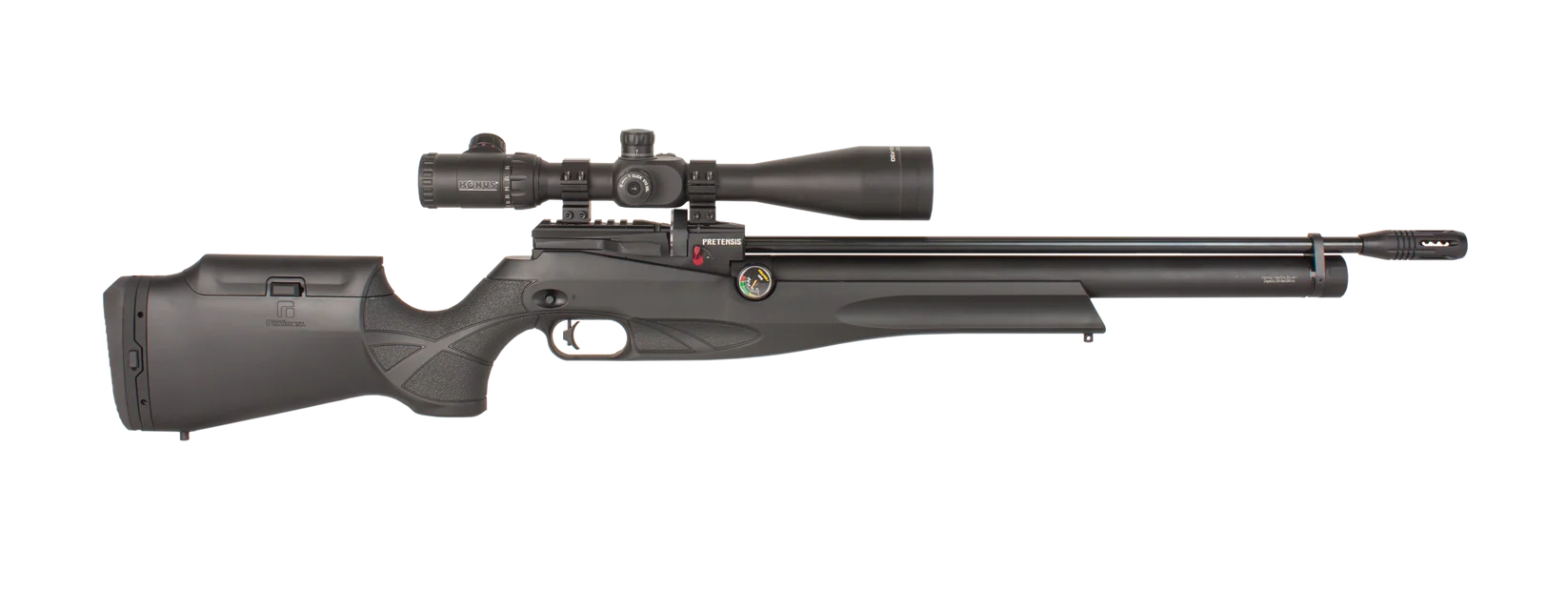
REXIMEX PRETENSIS SYNTHETIC REGULATED

€500.00
The Reximex Pretensis is a full length sporter rifle with a 260cc air cylinder. Due to the 260cc air cylinder the rifle is capable of 180 shots at 200bar. The Pretensis features a Synthetic Black stock with adjustable cheek piece, butt pad & pre-fitted swivel screws. The Pretensis has a cocking lever which is located on the right side of the action. You will find the manual safety to the rear of the stock which can be easily switched between on and off. The rifle also has a fully adjustable 2 stage trigger.
NB. Scope and Mounts not included.
- Calibre: .177/.22
- Capacity: 14/12
- Length: 109cm
- Power: 11.5
- Stock: Synthetic Black
- Thread: 1/2″ UNF
- Tube Size: 260cc
Reximex Pretensis Synthetic Regulated – Full-Length Regulated PCP Air Rifle with Adjustable Synthetic Stock
The Reximex Pretensis Synthetic Regulated is a full-length PCP air rifle designed for shooters who want consistent regulated performance, practical synthetic construction, comfortable adjustability and multi-shot convenience.
Rather than using a compact bullpup layout, the Pretensis follows a more conventional sporter configuration. That gives it a familiar shoulder position, long sighting platform and comfortable balance for extended target sessions.
At the heart of the rifle is a 260cc compressed-air cylinder combined with a regulated action. The regulator helps control the pressure supplied to the firing system as the main reservoir pressure falls, improving shot-to-shot consistency across the useful portion of the fill.
Current UK-market versions are commonly offered in .177 and .22, with magazine capacities of approximately 14 shots in .177 and 12 shots in .22. Some international sellers also list .25-calibre variants.
The synthetic stock is especially practical for owners who want a durable rifle that is easier to maintain than a traditional wood-stocked model. It features an adjustable cheekpiece, adjustable butt pad and pre-fitted sling swivel points, helping the shooter establish a repeatable shoulder position.
The rifle also uses a right-side cocking lever, manual safety and fully adjustable two-stage trigger.
Why Choose the Pretensis Synthetic Regulated
The main reason to choose this rifle is balance.
It combines:
Regulated PCP consistency
A relatively large 260cc air reservoir
Multi-shot magazines
A conventional full-length sporter layout
Adjustable synthetic furniture
Two-stage trigger control
Straightforward sidelever operation
1/2″ UNF muzzle threading
For shooters who prefer a traditional rifle layout rather than a bullpup, that combination can be especially attractive.
Why the Regulator Matters
A PCP rifle stores air at substantially higher pressure than the amount actually required for each shot.
The regulator reduces that pressure to a more controlled operating level before the air reaches the firing valve.
This helps reduce large velocity variations as the reservoir pressure falls.
More consistent velocity can support more repeatable point of impact.
Precision and Practical Accuracy
Practical accuracy depends on the complete system.
Important factors include:
Pellet consistency
Barrel condition
Regulator behaviour
Trigger technique
Scope mounting
Cylinder pressure
Stock fit
Shooter position
Environmental conditions
The rifle’s regulated action removes one important variable, but pellet testing and consistent technique remain essential.
260cc Air Reservoir
The 260cc cylinder provides considerably more capacity than many compact PCP platforms.
That makes the rifle better suited to longer target sessions.
Published shot counts vary between dealers because calibre, regulated pressure, local power limits and test methodology differ.
Therefore, actual shot count should be evaluated on the individual rifle rather than treated as a fixed universal figure.
Synthetic Stock
The black synthetic stock provides a practical alternative to walnut.
It is resistant to ordinary moisture and handling marks while requiring relatively little exterior care.
The stock also includes useful adjustment points.
Adjustable Cheekpiece
The cheekpiece can help the shooter establish a repeatable head position behind the optic.
Consistent head position can improve sight alignment and reduce variation between shots.
Adjustable Butt Pad
The butt pad allows the rear contact point to be better matched to the shooter.
This can improve shoulder comfort and overall rifle stability.
Two-Stage Trigger
A two-stage trigger allows the shooter to distinguish the initial take-up from the final break.
When properly adjusted within manufacturer guidance, this can make deliberate target shooting more predictable.
Sidelever Action
The right-side lever cycles the action manually.
A smooth sidelever allows the shooter to reload without significantly disturbing the rifle’s position.
Manual Safety
The rifle includes a manual safety.
It should never replace correct muzzle control or trigger discipline.
1/2″ UNF Muzzle Thread
The muzzle uses a common 1/2″ UNF threaded interface on UK-market examples.
Any accessory fitted to this thread must be legal in the user’s jurisdiction and mechanically compatible with the rifle.
Reximex Lyra K
Reximex Lyra K refers to a different compact rifle platform within the manufacturer’s range.
It should not be confused with the full-length Pretensis.
reximex
reximex manufactures a broad range of PCP rifles and pistols.
The Pretensis represents a conventional full-length sporter configuration within that broader range.
reximex airguns
reximex airguns include compact rifles, bullpups, pistols and full-length sporters.
This model is aimed at shooters who prefer conventional rifle ergonomics.
reximex throne gen2
The reximex throne gen2 uses a substantially different bullpup layout with a larger air system and greater configurability.
reximex гр
The phrase reximex гр may appear in regional-language searches for Reximex products.
Specifications should always be matched to the exact model and market.
reximex throne gen 2
The reximex throne gen 2 belongs to the company’s bullpup family rather than the Pretensis sporter family.
reximex mito
The reximex mito is a compact PCP pistol-oriented platform.
It is significantly shorter and lighter than the Pretensis.
reximex rра
The reximex rра search term relates to another compact PCP platform and should not be confused with the Pretensis.
reximex mitos
reximex mitos searches usually refer to the Mito family rather than this full-length rifle.
reximex lieva
The reximex lieva is another PCP rifle with a different design philosophy and configuration.
tps to joules calculator
A tps to joules calculator search usually refers to calculating projectile energy.
Accurate energy calculation requires both measured velocity and projectile mass.
reximex accura pcp air rifle
The reximex accura pcp air rifle is another full-size model within the same manufacturer’s range.
It should still be compared independently because air capacity, stock and configuration differ.
Tps joule calculator
A Tps joule calculator should use verified pellet weight and chronograph data rather than estimating energy from velocity alone.
roxy max
roxy max is not the correct model designation for this rifle.
The product described here is the Pretensis Synthetic Regulated.
mx rex
mx rex should not be confused with the Pretensis model name.
Correct product identification matters when ordering magazines, seals or accessories.
fps to ft Ibs
An fps to ft lbs calculation requires both muzzle velocity and pellet weight.
Velocity alone cannot determine muzzle energy.
airgun joules calculator
An airgun joules calculator can be useful for checking legal compliance when accurate velocity and projectile mass are known.
gunseek
gunseek and similar product-search terms may be used by buyers comparing availability and pricing.
Local airgun purchase laws should always be followed.
Reximex Lyra-K PCP air rifle
The Reximex Lyra-K PCP air rifle is a separate product.
The Pretensis uses a more traditional full-length configuration.
Reximex Lyra-K airgun
A Reximex Lyra-K airgun search may attract buyers looking for compact Reximex rifles.
The Pretensis is more conventional in overall layout.
Reximex Lyra-K review
A Reximex Lyra-K review does not directly describe the Pretensis because the two rifles use different dimensions and handling characteristics.
Reximex Lyra-K PCP rifle
The Reximex Lyra-K PCP rifle should be considered independently when comparing balance, length and reservoir capacity.
Reximex Lyra-K regulated PCP
A Reximex Lyra-K regulated PCP shares the general advantage of controlled air delivery, although the overall platform differs.
Reximex Lyra-K compact PCP rifle
The Reximex Lyra-K compact PCP rifle emphasizes reduced length.
The Pretensis instead favors a full sporter format.
Reximex Lyra-K tactical air rifle
The phrase Reximex Lyra-K tactical air rifle relates to another model and should not be used as a specification reference for the Pretensis.
Reximex Lyra-K hunting rifle
A Reximex Lyra-K hunting rifle search reflects a different platform and should not be treated as interchangeable with this model.
buy Reximex Lyra-K online
Anyone searching buy Reximex Lyra-K online should comply with local rules governing airgun purchase and transfer.
The same applies to the Pretensis.
best price Reximex Lyra-K
A best price Reximex Lyra-K comparison should take accessories, warranty and retailer support into account.
Price alone does not determine value.
Reximex Lyra-K accuracy test
A Reximex Lyra-K accuracy test concerns a different rifle.
For the Pretensis, controlled testing with several quality pellets gives a more meaningful indication of practical accuracy.
Reximex Lyra-K scope package
A Reximex Lyra-K scope package may include optics depending on the retailer.
Pretensis listings frequently exclude the scope, so package contents should be checked carefully.
Reximex Lyra-K pellet gun
The Reximex Lyra-K pellet gun belongs to the same broad PCP category while remaining a separate model.
Reximex Lyra-K for pest control
A Reximex Lyra-K for pest control search relates to applications that may be legal only in certain jurisdictions.
Any pest control should be lawful, humane and appropriate for the equipment used.
Reximex Lyra-K small game hunting
A Reximex Lyra-K small game hunting search concerns another platform.
Local hunting and airgun laws must always be followed.
AirForce
AirForce is a separate airgun manufacturer.
Its products are not part of the Reximex range.
Tex-Rex AirForce brush gun
The phrase Tex-Rex AirForce brush gun relates to other PCP platforms and does not describe the Pretensis.
Brush Gun
A Brush Gun is not the product category being described here.
The Pretensis is a regulated PCP sporter air rifle.
airforce airguns
airforce airguns use their own actions, reservoirs and design architecture.
They should be compared separately.
airforce airguns
The repeated airforce airguns phrase refers to a different brand and product family.
airforce texan
The airforce texan is a large-format PCP platform built around very different performance goals.
pellet gun
The Pretensis is a pellet gun using conventional airgun pellets in supported calibres.
Pellet quality has a major influence on precision.
air force guns
air force guns are produced by a different manufacturer and should not be confused with Reximex products.
tex-rex
The term tex-rex does not identify this rifle.
Correct model identification helps prevent compatibility problems.
air rifle and air pistol
The difference between an air rifle and air pistol includes overall size, stock design, shooting position and handling.
The Pretensis is firmly a full-length rifle platform.
airforce texan air rifle
The airforce texan air rifle belongs to a different class and manufacturer.
It is not directly comparable to the Pretensis sporter format.
texas air force rifle
A texas air force rifle search commonly refers to AirForce products rather than Reximex.
air force texan lss
The air force texan lss is a separate large-bore-style PCP platform and should not be used as a direct specification comparison.
airforce talon p
The airforce talon p is another compact PCP from a separate manufacturer.
Its format differs substantially from this conventional rifle.
airforce texan ss
The airforce texan ss is another specialist PCP rifle and not part of the Pretensis family.
air gun pump
A properly rated air gun pump may be used to fill compatible PCP rifles where the pressure rating and fittings are suitable.
The fill process should be controlled, and the rifle’s specified maximum pressure must not be exceeded.
Why the Pretensis Works Well for Longer Target Sessions
A 260cc reservoir provides considerably more stored air than a small PCP pistol cylinder.
Combined with a regulator, this supports longer strings of reasonably consistent shots.
Actual shot count depends on calibre, power level and individual configuration.
UK retailer claims range significantly—from roughly 150 to over 200 shots per fill—so owners should treat those figures as indicative rather than absolute.
How to Get the Best Accuracy
The most useful approach is systematic.
Use a stable backstop.
Choose several quality pellet types.
Shoot multiple groups with each.
Keep the same pressure range.
Maintain the same shooting position.
Keep scope settings unchanged while comparing ammunition.
A pellet that consistently groups well is generally more useful than one that simply produces the highest chronograph velocity.
Why the Synthetic Stock Is Practical
Synthetic furniture requires less concern about moisture and minor surface marks than traditional wood.
That makes the rifle well suited to shooters who prioritize practicality.
The adjustable cheekpiece and butt pad also help tailor the rifle to individual body dimensions.
Where the Pretensis Is Best Used
The rifle is well suited to lawful:
Range shooting
Paper-target practice
Bench shooting
Recreational plinking
Precision pellet testing
Other lawful sporting uses appropriate to its calibre and local power level
When the Pretensis Makes Sense
This rifle makes sense when a buyer wants:
A regulated PCP
A conventional sporter layout
A larger air reservoir
Multi-shot convenience
A synthetic stock
Adjustable ergonomics
A two-stage trigger
Straightforward sidelever operation
High-Pressure Air Safety
Only high-pressure equipment rated for the rifle should be used.
Hoses, pumps, bottles and connectors should all be appropriate for PCP filling.
The reservoir should never be overfilled.
Any cylinder showing major impact damage, corrosion or deep scratches should be professionally assessed before filling.
Maintenance
Routine maintenance should focus on:
Keeping the rifle dry
Keeping the fill connection clean
Monitoring seals
Protecting the muzzle
Maintaining magazines
Checking scope mounts
Monitoring air retention
Avoiding unnecessary internal disassembly
High-pressure internal servicing should be carried out by appropriately qualified technicians.
Legal Considerations
Airgun laws differ by country and region.
Rules may govern:
Ownership
Calibre
Muzzle energy
Age
Licensing
Transportation
Storage
Where the rifle may be discharged
The owner should confirm all applicable requirements before purchasing or using the rifle.
Final Section 1 Assessment
The Reximex Pretensis Synthetic Regulated is a conventional full-length PCP sporter designed around dependable regulated performance, practical synthetic furniture and comfortable adjustability.
Its 260cc cylinder provides useful capacity for extended sessions.
The regulator helps stabilize air delivery.
The multi-shot magazine improves convenience.
The adjustable cheekpiece and butt pad help establish repeatable fit.
The fully adjustable two-stage trigger supports deliberate target shooting.
The right-side lever provides straightforward manual cycling.
Meanwhile, the synthetic stock offers durability and easier maintenance than traditional wood furniture.
Current UK-market examples are most commonly found in .177 and .22, with approximately 14- and 12-shot magazine capacities respectively. Some retailers also list .25 options.
The rifle is particularly appealing to shooters who prefer a traditional sporter profile over a compact bullpup.
Its overall value comes from consistency, ergonomics, air capacity and practical construction rather than simply maximum velocity.
For lawful target and recreational use, the best performance comes from quality pellets, secure optics, careful trigger technique, correct pressure management and regular maintenance.
Used with a proper backstop, correctly rated filling equipment and full compliance with local law, the Pretensis Synthetic Regulated provides a capable and practical regulated PCP platform for shooters who value traditional rifle handling combined with modern pneumatic engineering.
Real-World Accuracy, Air Efficiency, Handling, Optics, Maintenance and Ownership
Understanding the Rifle in Real-World Use
The Pretensis Synthetic Regulated is best understood as a practical full-length PCP platform designed around consistency, comfortable handling and long-session usability.
Its conventional sporter layout gives the shooter a familiar shoulder position.
The synthetic stock keeps maintenance straightforward.
The regulator supports more stable pressure delivery.
The larger reservoir allows the shooter to spend more time shooting before stopping to refill.
Together, these characteristics make the rifle especially suitable for deliberate target work, recreational shooting and structured pellet testing.
Why the Full-Length Layout Matters
A conventional rifle layout provides a different feel from a bullpup.
The action sits farther forward.
The stock extends naturally into the shoulder.
The trigger position feels more familiar to shooters who are used to traditional rifles.
This can make the platform easier to settle into during long sessions.
Balance
Balance affects comfort more than many buyers expect.
A rifle that feels neutral is easier to hold.
It also reduces the amount of effort needed to maintain sight alignment.
The larger air cylinder contributes some forward mass, while the stock helps distribute weight toward the rear.
Why Balance Matters for Accuracy
If the rifle feels excessively front-heavy, the shooter may begin to fight the weight.
That can increase muscle tension.
Once tension increases, consistency often decreases.
A balanced hold allows the shooter to focus more on trigger control and sight picture.
Synthetic Stock Advantages
The synthetic stock is one of the most practical parts of the design.
It is less sensitive to ordinary moisture than traditional wood.
It also resists minor handling marks well.
For shooters who care more about function than luxury appearance, this can be a major advantage.
Adjustable Cheekpiece
The cheekpiece allows the shooter to better align the eye with the optic.
That matters because inconsistent head position can create inconsistent sight alignment.
A properly adjusted cheekpiece helps the eye return to the same position shot after shot.
Why Cheek Weld Matters
A consistent cheek weld supports repeatability.
If the head moves higher or lower between shots, the sight picture can also change.
That effect becomes more noticeable when using magnified optics.
Adjustable Butt Pad
The butt pad allows some control over how the stock sits in the shoulder.
A comfortable shoulder position can reduce fatigue.
It can also help keep the rifle stable during supported and unsupported shooting.
Length of Pull
Although the stock geometry may not offer the same range of adjustment as a fully modular chassis, the butt pad and cheekpiece still give the shooter useful ergonomic control.
Correct trigger reach matters.
The trigger finger should sit naturally on the blade.
Trigger Control
The two-stage trigger is one of the areas where good technique can make a significant difference.
The first stage allows the shooter to take up initial travel.
The second stage provides the final break.
Why a Predictable Break Matters
A predictable trigger gives the shooter a clear idea of when the shot will release.
That reduces the temptation to snatch the trigger.
A smooth press is usually more accurate than a sudden pull.
Trigger Finger Placement
The finger should contact the blade naturally.
If too much finger is placed through the trigger, sideways pressure can be introduced.
If too little is used, control may feel weak.
The goal is a straight rearward press.
Follow-Through
After the shot, remain in position briefly.
Keep the eye on the target.
Maintain shoulder contact.
Keep the trigger finger controlled.
This helps reinforce consistent technique.
Regulated Air Delivery
The regulator is central to the rifle’s performance character.
It controls the pressure delivered from the main reservoir to the firing system.
That helps create more consistent conditions across the useful portion of the fill.
Why Consistency Matters
If velocity varies significantly, point of impact can also vary.
A regulator helps reduce that problem.
The result can be more predictable vertical placement at target distances.
Regulator Behavior
A regulator should operate smoothly across the intended pressure range.
If performance changes abruptly, there may be an issue with:
Regulator seals
Pressure settings
Valve behavior
Reservoir pressure
Internal contamination
Any internal diagnosis should be left to qualified service personnel.
Reservoir Capacity
The larger cylinder supports longer sessions.
This can be especially useful during bench shooting and pellet testing.
Instead of stopping frequently to refill, the shooter can maintain concentration.
Why Longer Shot Strings Matter
A long shot string makes comparison easier.
The shooter can test multiple pellets or group sizes under similar conditions.
Frequent interruptions can make data less consistent.
Shot Count Variation
Actual shot count depends on several factors.
These include:
Calibre
Power level
Pellet weight
Regulator pressure
Temperature
Seal condition
Shooting pace
Individual rifle variation
Published figures should therefore be treated as general guidance.
Learning the Useful Pressure Window
The best approach is to record how the individual rifle behaves.
A simple shooting log can include:
Starting pressure
Ending pressure
Number of shots
Pellet type
Group size
Chronograph data if available
Over time, the useful pressure window becomes easier to identify.
High-Pressure Filling
Only properly rated filling equipment should be used.
Suitable options may include:
A hand pump
A charging bottle
A purpose-built compressor
The exact fitting should match the rifle.
Why Slow Filling Is Better
Compressed air heats as it is added.
A slower fill is easier to monitor.
It also reduces rapid temperature changes.
Clean Air
Clean, dry air helps protect the internal system.
Moisture can affect seals and metal components.
Fill Port Care
The fill connection should remain clean.
Dust, grit and moisture should be kept away from the port.
Pressure Gauge
The gauge provides useful information about remaining air.
It should be read regularly.
Why the Gauge Is More Useful Than Guessing
Shot count varies.
Pressure gives a more direct indication of reservoir status.
Sidelever Operation
The sidelever should cycle smoothly.
A smooth movement helps preserve the shooter’s position.
Why Smooth Cycling Matters
Aggressive cycling can disturb:
Shoulder position
Cheek weld
Support-hand placement
Optic alignment
A controlled action keeps the shooting rhythm more consistent.
If the Lever Becomes Stiff
Stop.
Possible causes can include:
Magazine misalignment
Pellet deformation
Debris
Mechanical wear
Feeding issues
The lever should not be forced.
Magazine Function
The magazine should rotate correctly and feed pellets cleanly.
Magazine Inspection
Check for:
Cracks
Debris
Worn indexing parts
Uneven rotation
Damaged internal components
Pellet Loading
Pellets should be loaded carefully.
Damaged skirts can affect accuracy.
Spare Magazines
Spare magazines can make longer sessions more convenient.
They can also help identify whether a feeding issue is magazine-specific.
Pellet Selection
Pellet testing is one of the most important steps in getting the best from a regulated PCP.
Not every barrel prefers the same ammunition.
What to Look For
Useful pellet qualities include:
Consistent weight
Clean skirts
Uniform heads
Good surface finish
Reliable manufacturing
Why Pellet Weight Matters
A heavier pellet may retain momentum differently.
A lighter pellet may produce more velocity.
Neither automatically means better accuracy.
Controlled Testing
Keep the following consistent:
Distance
Pressure range
Rest
Scope setting
Target type
Shooting position
Then compare multiple groups.
Why Multiple Groups Matter
One excellent group can be chance.
Several similar groups are more meaningful.
Barrel Condition
The barrel should remain protected from impact.
The crown area deserves particular attention.
Why the Crown Matters
The pellet leaves the barrel at the crown.
Damage there can disturb release symmetry.
That can affect grouping.
Barrel Cleaning
Aggressive cleaning should not be performed routinely.
Cleaning should be based on actual need.
When Cleaning May Help
Consider cleaning if:
Accuracy changes unexpectedly
Contamination is suspected
A new pellet behaves unusually
The rifle has been stored for a long period
A technician recommends it
Optic Selection
The rifle’s conventional layout makes it suitable for a broad range of scopes.
A practical optic should match the intended shooting distance.
Useful Optic Characteristics
Clear glass
Reliable adjustment
Comfortable eye relief
Appropriate magnification
Secure mounts
A practical reticle
Why Oversized Optics Can Be Counterproductive
A very large scope adds weight.
It can make the rifle top-heavy.
That may reduce comfort during unsupported shooting.
Scope Height
The scope should sit at a height that allows a natural cheek position.
If the shooter has to lift the head excessively, consistency may suffer.
Mount Security
Loose mounts can create zero shift.
They should be checked periodically.
Zeroing
Zero should be established at a safe, known distance.
Use:
A stable rest
Consistent pellets
A secure backstop
Small scope adjustments
Rechecking Zero
Zero should be checked after:
Transport
Impact
Scope removal
Mount changes
Pellet changes
Maintenance
Why Zero Can Shift
Possible causes include:
Loose mounts
Different pellets
Temperature
Transport
Shooter inconsistency
Mechanical movement
Benchrest Shooting
A bench is useful for evaluating the rifle’s mechanical potential.
It reduces some shooter movement.
Why Bench Testing Helps
It makes it easier to evaluate:
Pellets
Scope stability
Regulator behavior
Magazine consistency
Seated Shooting
Seated shooting provides useful stability without a full bench.
Kneeling
Kneeling can provide better support than standing.
Standing
Standing is more demanding.
The rifle’s weight becomes more noticeable.
Why Fatigue Matters
Fatigue can cause:
Tighter grip
Poor trigger control
Changing cheek weld
Shoulder tension
Wider groups
Taking breaks can help.
Support-Hand Position
The support hand should remain in a consistent position.
A relaxed support is usually better than excessive pressure.
Grip Pressure
The firing hand should remain secure but relaxed.
Too much tension can disturb the shot.
Chronograph Use
A chronograph can help monitor performance.
Useful information includes:
Velocity consistency
Pressure-related changes
Pellet variation
Possible seal issues
Why Chronograph Data Is Useful
It can show whether accuracy changes are related to inconsistent velocity.
It should be used as a diagnostic tool rather than for unsafe power modification.
Energy Monitoring
Muzzle energy depends on pellet mass and velocity.
Both are required for an accurate calculation.
Legal Compliance
Airgun power limits vary by jurisdiction.
The owner should ensure the rifle remains within local law.
Target Backstop
A proper backstop is essential.
It should stop pellets safely.
Why Paper Alone Is Not Enough
Paper records the shot.
It does not stop the projectile.
A suitable trap or backstop is still required.
Eye Protection
Eye protection is recommended.
Ricochets and fragments can occur.
Safe Muzzle Direction
The muzzle should remain pointed in a safe direction.
Trigger Discipline
The finger should stay away from the trigger until firing is intended.
Exterior Cleaning
The exterior should be wiped after use.
Remove:
Dust
Moisture
Fingerprints
Debris
Synthetic Stock Care
The stock is easy to maintain.
A damp cloth is often enough for ordinary cleaning.
Harsh solvents should be avoided.
Metal Surface Care
Exposed metal parts should remain dry.
Reservoir Inspection
The air cylinder should be inspected regularly.
Look for:
Dents
Deep scratches
Corrosion
Impact damage
Damaged fittings
Why Cylinder Inspection Matters
The cylinder stores high-pressure air.
Any questionable damage should be evaluated before refilling.
Seal Monitoring
Possible signs of seal problems include:
Pressure loss
Audible leakage
Reduced shot count
Inconsistent performance
Difficulty holding air
Pressure Loss During Storage
A small change can result from temperature.
Continuous loss may indicate a leak.
Avoiding Unnecessary Disassembly
High-pressure components should not be opened casually.
Professional servicing is preferable when the problem is unclear.
Why Professional Service Matters
A trained technician can diagnose:
Regulator issues
Valve problems
Seal failure
Trigger faults
Air leaks
Long-Term Storage
The rifle should be stored:
Dry
Secure
Away from heat
Away from unauthorized users
In accordance with local law
Magazine Storage
Magazines should remain clean and dry.
Damaged pellets should not be left inside.
Transport
The rifle should be transported unloaded and secured.
A padded case helps protect:
Barrel
Stock
Scope
Cylinder
Action
Why a Case Matters
Transport damage can affect both function and zero.
Documentation
Keep:
Owner manual
Serial number
Purchase records
Service history
Warranty information
Pellet notes
Chronograph data
Why Documentation Helps
Good records make future service easier.
They can also improve resale confidence.
Buying Used
A used example should be checked carefully.
Important Areas to Inspect
Reservoir condition
Pressure retention
Lever operation
Magazine function
Trigger feel
Stock adjustment
Scope rail
Fill connection
Overall condition
Pressure Retention Test
A PCP should hold pressure.
A steadily falling gauge may indicate a leak.
Checking the Lever
The sidelever should cycle smoothly.
Checking the Trigger
The trigger should feel predictable.
Checking Stock Adjustments
The cheekpiece and butt pad should lock securely.
Checking the Magazine
The magazine should feed correctly.
Service History
Useful questions include:
Has the rifle leaked?
Has the regulator been serviced?
Have seals been replaced?
Has the cylinder been damaged?
Has the trigger been altered?
Has the rifle been modified?
Why Unknown Modifications Matter
Unknown changes can affect:
Reliability
Safety
Legal status
Resale value
A factory-standard example is easier to evaluate.
Ownership Costs
The rifle is only part of the total cost.
Additional expenses may include:
Pellets
Filling equipment
Scope
Mounts
Spare magazines
Seals
Professional servicing
Storage case
Hand Pump Ownership
Manual filling may be possible.
However, a larger reservoir requires more effort than a compact pistol cylinder.
Charging Bottle
A high-pressure bottle can make filling faster.
Compressor
A suitable compressor can provide greater independence.
Why Air Quality Matters
Poor-quality air can introduce moisture.
Clean air helps protect internal parts.
Who May Appreciate This Rifle
The rifle may suit shooters who value:
Traditional sporter ergonomics
Regulated consistency
A larger air reservoir
Synthetic durability
Adjustable cheekpiece
Adjustable butt pad
Multi-shot convenience
Sidelever operation
Who May Prefer a Bullpup
A shooter who prioritizes very short overall length may prefer a bullpup.
Who May Prefer Wood
A buyer who values traditional appearance may prefer a walnut-stocked rifle.
Who May Prefer a Simpler Powerplant
A shooter who does not want external charging equipment may prefer a spring-powered air rifle.
Why the Pretensis Remains Practical
The rifle offers a useful middle ground.
It is more traditional in handling than a bullpup.
It provides more air capacity than a compact pistol.
It offers adjustable ergonomics without becoming excessively complex.
Session Preparation
Before shooting, check:
Pressure
Magazine
Pellets
Scope
Backstop
Safety area
Filling equipment
Why Preparation Helps
A prepared session reduces interruptions.
Troubleshooting Large Groups
If groups suddenly become wider, check:
Pellet condition
Pressure
Scope mounts
Shooter fatigue
Magazine condition
Wind
Barrel condition
Change One Variable at a Time
This makes troubleshooting easier.
Feeding Problems
If feeding becomes difficult:
Stop safely
Remove the magazine
Inspect the pellet
Check for debris
Do not force the lever
Air Loss
If pressure falls unexpectedly:
Check the gauge
Listen for leaks
Inspect the fill area
Check accessible seals
Seek qualified service if needed
Routine Inspection
Regularly inspect:
Cylinder
Gauge
Fill connection
Magazine
Sidelever
Trigger
Safety
Stock
Scope mounts
Visible seals
Preventive Maintenance
Routine care is more useful than frequent disassembly.
Keep the rifle clean.
Use quality pellets.
Protect the reservoir.
Monitor pressure.
Maintain magazines.
Address leaks early.
Long-Term Ownership Value
The Pretensis can provide strong long-term value for shooters who prefer traditional rifle handling combined with regulated PCP performance.
Resale Value
Resale confidence is helped by keeping:
Original magazines
Fill probe
Stock components
Manuals
Packaging
Service records
Why Completeness Matters
A complete package is easier for the next buyer to evaluate.
Final Section 2 Assessment
The Reximex Pretensis Synthetic Regulated is a practical full-length PCP designed around consistency, comfort and straightforward ownership.
Its conventional sporter layout makes it familiar.
The synthetic stock is durable.
The adjustable cheekpiece helps establish repeatable sight alignment.
The adjustable butt pad improves shoulder fit.
The two-stage trigger supports controlled shooting.
The regulator helps stabilize air delivery.
The larger reservoir supports longer sessions.
The sidelever provides convenient manual cycling.
The multi-shot magazine reduces loading interruptions.
The strongest results come from consistency.
Use quality pellets.
Maintain the correct pressure range.
Keep the scope secure.
Use a repeatable shooting position.
Operate the sidelever smoothly.
Keep the fill system clean.
Monitor air retention.
Store the rifle securely.
Follow local law.
For lawful target shooting, recreational practice and structured pellet testing, the Pretensis Synthetic Regulated can provide a stable, practical and accurate PCP platform when it is maintained properly and matched with suitable ammunition.
Section 3 – Long-Term Ownership, Accuracy Potential, Reliability, Fit, Service and Practical Buyer Guidance
Real-World Ownership Character
The Reximex Pretensis Synthetic Regulated is designed to deliver a traditional rifle feel with the consistency advantages of a regulated PCP system.
Its full-length layout gives the shooter a familiar balance.
The synthetic stock keeps day-to-day maintenance simple.
The larger air reservoir supports longer shooting sessions.
The regulator helps maintain more stable pressure delivery.
The multi-shot magazine and sidelever reduce interruptions between shots.
Together, these features create a rifle that is easy to understand and practical to own.
Why Traditional Rifle Geometry Still Matters
A conventional sporter layout remains popular because it places the trigger, action, stock and shoulder contact in familiar positions.
Many shooters find this easier to settle into than a compact bullpup.
The extra overall length also gives the rifle a calmer handling character.
Balance and Stability
The rifle’s balance affects how easy it is to hold consistently.
A stable platform should not force the shooter to fight the front end.
The support hand should be able to carry the rifle naturally.
Why Balance Affects Accuracy
Muscle tension increases when a rifle feels awkward.
As tension rises, trigger control and sight alignment can become less consistent.
A balanced hold reduces unnecessary movement.
Synthetic Stock Durability
The synthetic stock is especially practical for owners who want a rifle that can handle ordinary moisture, dust and regular use without the same cosmetic concerns associated with traditional wood.
This does not mean it is indestructible.
It should still be protected from impact and excessive heat.
Cheekpiece Adjustment
A properly adjusted cheekpiece helps the shooter return to the same head position every time.
This is especially useful with magnified optics.
Why Head Position Matters
The eye should align naturally with the scope.
If the shooter has to lift or twist the head, consistency may suffer.
Butt Pad Adjustment
The butt pad can help the rifle sit more naturally against the shoulder.
A comfortable shoulder position can improve:
Trigger reach
Head alignment
Control
Fatigue resistance
Trigger Familiarity
The two-stage trigger becomes easier to use once the shooter learns its feel.
The first stage allows initial movement.
The second stage provides the final break.
Why Trigger Predictability Matters
A predictable break helps the shooter avoid sudden movement.
This can improve practical group consistency.
Trigger Finger Placement
The finger should rest naturally on the blade.
Too much finger can create sideways pressure.
Too little can reduce control.
The goal is a smooth rearward movement.
Follow-Through
After the shot, remain in position briefly.
Maintain:
Cheek contact
Shoulder contact
Sight picture
Grip pressure
This helps reinforce consistent technique.
Regulated Performance
The regulator is one of the rifle’s defining features.
It controls the working pressure supplied to the firing system.
This can improve shot-to-shot consistency compared with a completely unregulated system.
Why Consistency Matters More Than Maximum Velocity
A rifle that produces the same result repeatedly is more useful for target shooting than one that produces occasional higher numbers.
Stable output supports predictable point of impact.
Learning the Rifle’s Pressure Window
The shooter should learn how the rifle behaves across its useful fill range.
A simple log can help.
Useful Information to Record
Record:
Starting pressure
Ending pressure
Number of shots
Pellet type
Group size
Chronograph data if available
Environmental conditions
This creates a more reliable picture of performance.
Reservoir Capacity and Session Length
The larger reservoir means the shooter can spend more time shooting and less time refilling.
That is useful during:
Bench testing
Pellet comparison
Long recreational sessions
Zero confirmation
Practice drills
Why Fewer Refills Can Improve Testing
Every refill interrupts the shooting process.
Reducing interruptions can help maintain the same rest position, scope setting and shooting rhythm.
High-Pressure Filling
Only equipment designed for PCP pressures should be used.
Suitable options may include:
A hand pump
A compatible fill bottle
A PCP compressor
Why Fill Equipment Quality Matters
Poor-quality equipment can introduce:
Moisture
Contamination
Leaking connections
Pressure inaccuracies
Good equipment supports long-term reliability.
Filling Slowly
A controlled fill is preferable.
Compressed air can heat quickly.
A slower process makes the gauge easier to monitor.
Why Overfilling Is a Bad Idea
The rifle should never be filled above its specified maximum pressure.
More pressure does not automatically mean more usable shots.
Overfilling can place unnecessary stress on the system.
Clean and Dry Air
Dry compressed air helps protect seals and internal metal surfaces.
Moisture should be minimized.
Fill Connection Care
The fill point should remain clean.
Dust and grit should be kept away from the fitting.
Pressure Gauge Use
The gauge helps the shooter understand reservoir status.
It should be checked before and during long sessions.
Why Shot Count Should Not Be Guessed
Published shot figures can vary.
Actual results depend on:
Calibre
Power level
Pellet weight
Temperature
Regulator behavior
Seal condition
Individual rifle variation
Sidelever Operation
The sidelever should cycle smoothly.
A controlled motion helps preserve the shooter’s position.
Why Smooth Cycling Matters
Aggressive cycling can disturb:
Shoulder contact
Cheek weld
Scope alignment
Support-hand position
A smooth lever stroke keeps the rhythm more consistent.
If the Lever Feels Abnormal
Stop using excessive force.
Possible causes can include:
Magazine misalignment
A damaged pellet
Debris
Mechanical wear
A feeding issue
Magazine Reliability
The magazine should rotate and index correctly.
Why Magazine Condition Matters
A damaged magazine can cause feeding problems even when the rifle itself is functioning correctly.
Magazine Inspection
Check for:
Cracks
Debris
Poor rotation
Damaged internal parts
Loose components
Pellet Condition
A pellet with a bent skirt or damaged head can feed poorly.
It can also reduce accuracy.
Spare Magazines
Spare magazines can reduce interruptions during long sessions.
They can also help diagnose magazine-specific problems.
Pellet Selection
A regulated PCP still depends heavily on suitable ammunition.
Different pellet types can behave very differently in the same barrel.
What Makes a Good Pellet Match
Useful characteristics include:
Consistent weight
Uniform head dimensions
Clean skirts
Good surface finish
Repeatable manufacturing
Why the Fastest Pellet Is Not Always Best
Higher velocity does not automatically produce tighter groups.
A slower pellet may be more stable and more accurate.
Controlled Pellet Testing
Use the same:
Distance
Pressure range
Rest
Optic setting
Target type
Shooting position
Then compare several groups.
Why Several Groups Are Needed
One excellent group can be accidental.
Repeated results are more meaningful.
Barrel Care
The barrel should remain protected from impact.
The muzzle area deserves particular care.
Why the Muzzle Matters
The pellet exits the barrel at the crown.
Damage here can influence accuracy.
Cleaning the Barrel
Cleaning should be done only when there is a reason.
Frequent aggressive cleaning can be unnecessary.
When Cleaning May Be Appropriate
Consider cleaning if:
Accuracy changes unexpectedly
Contamination is suspected
A different pellet behaves unusually
The rifle has been stored for a long time
A qualified technician recommends it
Optic Setup
The full-length rifle layout can accept a wide range of scopes.
However, the optic should still be matched to intended use.
Why Moderate Optic Weight Helps
A very heavy scope can alter rifle balance.
A moderate optic can preserve handling.
Eye Relief
The scope should be positioned so the shooter gets a full sight picture without stretching the neck.
Scope Height
The optic should work naturally with the cheekpiece.
Mount Security
Mounts should remain secure.
Loose mounts can cause point-of-impact shifts.
Zeroing
Zero should be established at a known, safe distance.
Use:
A stable rest
Consistent pellets
Small adjustments
A proper backstop
Why Zero Should Be Rechecked
Zero may shift after:
Transport
Impact
Scope removal
Mount changes
Pellet changes
Maintenance
Benchrest Use
A bench can help show the rifle’s mechanical potential.
Why Bench Testing Is Useful
It reduces shooter movement and makes it easier to evaluate:
Pellet performance
Regulator consistency
Scope stability
Magazine function
Seated Shooting
Seated shooting can provide good stability without requiring a full bench.
Kneeling
Kneeling offers more support than standing.
Standing
Standing is the most physically demanding common position.
Why Fatigue Matters
Fatigue can lead to:
Tighter grip
Poorer trigger control
Changing head position
Less stable aim
Short breaks can improve consistency.
Support-Hand Position
The support hand should contact the rifle in a consistent place.
Why a Relaxed Support Is Better
Excessive tension can introduce movement.
Grip Pressure
The firing hand should be secure but relaxed.
Chronograph Monitoring
A chronograph can help identify performance trends.
Useful Chronograph Information
It can reveal:
Velocity spread
Pressure-related changes
Pellet variation
Possible seal problems
Why Chronograph Data Should Be Used Carefully
The main value is diagnosis and legal monitoring.
It should not be used as a reason to chase unsafe power increases.
Energy Calculations
Projectile energy depends on both velocity and pellet mass.
Both are needed for accurate calculation.
Legal Limits
Airgun laws can regulate:
Power
Calibre
Ownership
Transport
Storage
Use location
The owner should understand the rules that apply locally.
Safe Backstop
A reliable pellet trap or other suitable backstop is essential.
Why Paper Targets Are Not Enough
Paper records impact.
It does not safely stop the projectile.
Eye Protection
Eye protection is recommended.
Ricochets and fragments can occur.
Muzzle Discipline
The muzzle should always point in a safe direction.
Trigger Discipline
The finger should remain away from the trigger until firing is intended.
Exterior Maintenance
The exterior should be wiped down after use.
Remove:
Dust
Moisture
Fingerprints
Debris
Synthetic Stock Care
The stock requires little maintenance.
A mild cleaning method is usually enough.
Metal Component Care
Metal surfaces should remain dry and free from corrosion.
Reservoir Inspection
Inspect the cylinder regularly for:
Dents
Deep scratches
Corrosion
Impact marks
Damaged fittings
Why Reservoir Condition Matters
The cylinder contains high-pressure air.
Any questionable damage should be assessed before filling.
Seal Monitoring
Signs of seal problems may include:
Pressure loss
Audible leaks
Reduced shot count
Inconsistent performance
Difficulty holding air
Pressure Loss During Storage
A small change may be caused by temperature.
Continuous loss may indicate a leak.
Why Internal Work Should Be Limited
PCP systems contain high-pressure components.
Internal servicing should follow manufacturer procedures.
Professional Service
Qualified servicing is preferable for:
Regulator issues
Valve problems
Internal leaks
Trigger faults
Cylinder concerns
Storage
The rifle should be stored:
Unloaded
Dry
Secure
Away from unauthorized users
Away from excessive heat
In accordance with local law
Long-Term Air Storage
Manufacturer guidance should be followed regarding reservoir pressure during extended storage.
Magazine Storage
Magazines should be kept clean and dry.
Transport
The rifle should be transported unloaded and protected.
A padded case can help protect:
Barrel
Stock
Scope
Cylinder
Action
Why a Proper Case Matters
Impact during transport can affect both function and zero.
Documentation
Keep:
Owner manual
Serial number
Purchase receipt
Service history
Warranty information
Pellet-testing notes
Chronograph records
Why Documentation Adds Value
Good records help with maintenance.
They can also increase buyer confidence at resale.
Buying Used
A used example should be inspected carefully.
Important Areas to Check
Reservoir condition
Pressure retention
Sidelever operation
Magazine function
Trigger feel
Stock adjustments
Scope rail
Fill connection
Overall finish
Pressure Retention Test
A healthy PCP should hold pressure.
A steadily falling gauge may indicate a leak.
Sidelever Check
The lever should operate smoothly.
Trigger Check
The trigger should feel predictable and safe.
Cheekpiece and Butt Pad
Adjustable parts should lock securely.
Magazine Check
The magazine should feed reliably.
Service History Questions
Ask:
Has the rifle leaked?
Has the regulator been serviced?
Have seals been replaced?
Has the cylinder been damaged?
Has the trigger been modified?
Has any internal work been performed?
Why Unknown Modifications Matter
Unknown modifications can affect:
Reliability
Safety
Legal status
Resale value
Ownership Costs
The rifle purchase is only part of the overall cost.
Other expenses may include:
Pellets
Scope
Mounts
Filling equipment
Spare magazines
Seals
Professional servicing
Storage case
Hand Pump Ownership
Manual filling is possible with suitable equipment.
However, a larger reservoir requires more effort than a compact pistol cylinder.
Fill Bottle Ownership
A charging bottle can make refilling quicker.
Compressor Ownership
A suitable compressor provides more independence.
Why Air Quality Matters Over Time
Clean, dry air supports seal and metal longevity.
Who May Appreciate This Rifle Most
The rifle may suit shooters who value:
Traditional sporter ergonomics
Regulated performance
Longer shot strings
Synthetic durability
Adjustable cheekpiece
Adjustable butt pad
Multi-shot convenience
Sidelever cycling
Who May Prefer a More Compact Platform
A shooter who prioritizes short overall length may prefer a bullpup.
Who May Prefer Wood Furniture
A buyer who values traditional aesthetics may prefer a walnut-stocked model.
Who May Prefer a Spring Rifle
A shooter who wants to avoid external charging equipment may prefer a self-contained spring-powered platform.
Why the Pretensis Offers a Useful Middle Ground
The rifle combines modern PCP technology with traditional rifle handling.
It offers more air capacity than compact platforms.
It is less mechanically unusual than many bullpups.
It provides adjustable ergonomics without becoming excessively complicated.
Range Session Preparation
Before shooting, check:
Reservoir pressure
Magazine
Pellet supply
Scope zero
Backstop
Safety area
Filling equipment
Why Preparation Matters
A prepared setup makes the session smoother and more consistent.
Troubleshooting Large Groups
If groups suddenly become larger, check:
Pellet condition
Pressure
Scope mounts
Shooter fatigue
Magazine condition
Wind
Barrel condition
Change One Variable at a Time
This makes diagnosis more reliable.
Troubleshooting Feeding Problems
If feeding becomes difficult:
Stop safely
Remove the magazine
Inspect the pellet
Check the magazine
Look for debris
Do not force the lever
Troubleshooting Pressure Loss
If pressure drops unexpectedly:
Check the gauge
Listen for leaks
Inspect the fill connection
Check accessible seals
Seek qualified service if the cause is unclear
Routine Inspection
Regularly inspect:
Cylinder
Gauge
Fill connection
Magazine
Sidelever
Trigger
Safety
Stock
Scope mounts
Visible seals
Preventive Maintenance
Routine care is more useful than frequent disassembly.
Keep the rifle clean.
Use quality pellets.
Protect the reservoir.
Monitor pressure.
Maintain magazines.
Address leaks promptly.
Long-Term Ownership Value
The Pretensis can provide strong long-term value for shooters who genuinely prefer conventional sporter handling.
Its strengths are practical rather than flashy.
It offers a stable platform, good air capacity, adjustable ergonomics and regulated consistency.
Resale Considerations
Keep:
Original magazines
Fill probe
Stock hardware
Manual
Packaging
Service records
Why Original Equipment Helps
A complete package is easier for future buyers to evaluate.
Final Section 3 Assessment
The Reximex Pretensis Synthetic Regulated is a practical full-length PCP rifle that combines traditional sporter ergonomics with modern regulated pneumatic performance.
Its greatest strengths are consistency, comfort, adjustability and straightforward ownership.
The larger air reservoir supports longer shooting sessions.
The regulator helps stabilize air delivery.
The synthetic stock is durable and easy to maintain.
The adjustable cheekpiece helps the shooter establish repeatable eye alignment.
The adjustable butt pad improves shoulder fit.
The two-stage trigger supports deliberate shooting.
The sidelever makes cycling straightforward.
The multi-shot magazine reduces loading interruptions.
For the best results, the owner should focus on repeatability rather than maximum velocity.
Use quality pellets.
Keep the air system within the proper pressure range.
Maintain secure optics.
Use a consistent shooting position.
Operate the sidelever smoothly.
Inspect the reservoir regularly.
Monitor air retention.
Store the rifle safely.
Follow local law.
When properly maintained and matched with suitable ammunition, the Pretensis Synthetic Regulated can provide a reliable, comfortable and accurate platform for lawful target shooting, recreational practice and structured PCP ownership over the long term.
Be the first to review “REXIMEX PRETENSIS SYNTHETIC REGULATED”
Related products

Reximex


Reximex

Reximex
Reximex
Reximex

Reximex

Reviews
There are no reviews yet.