
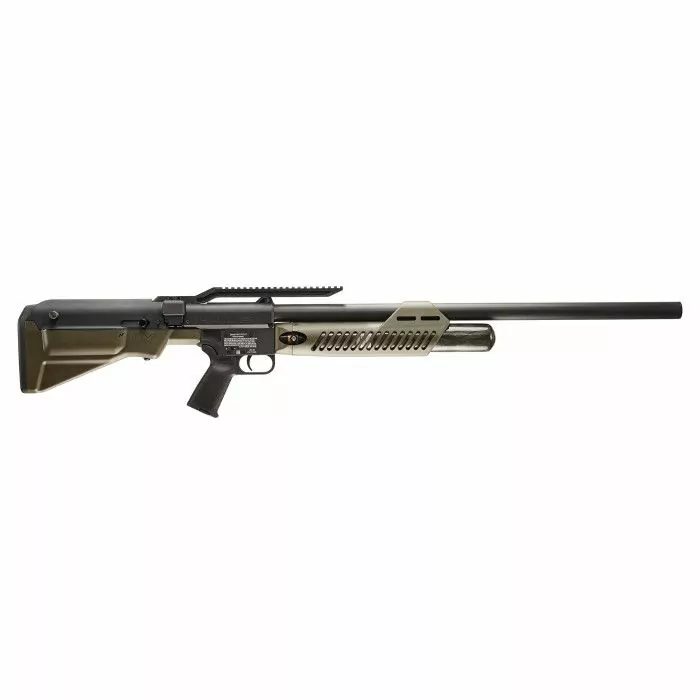
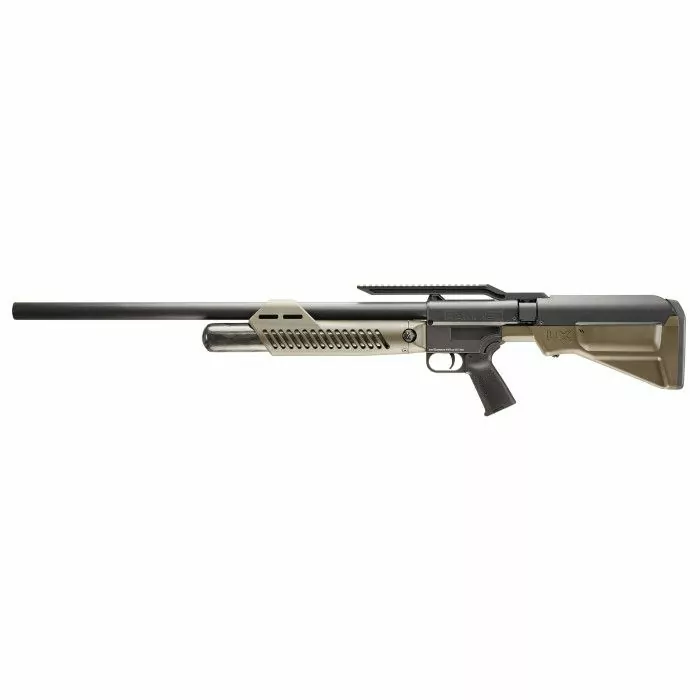
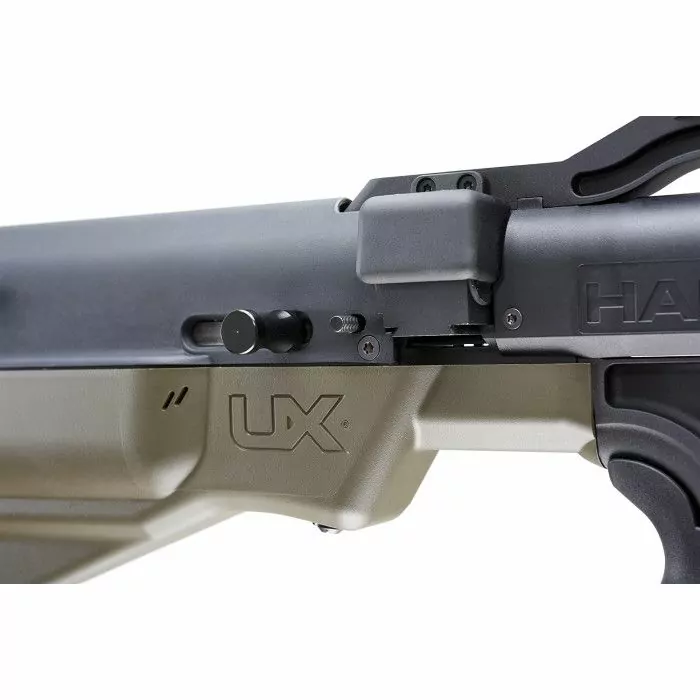
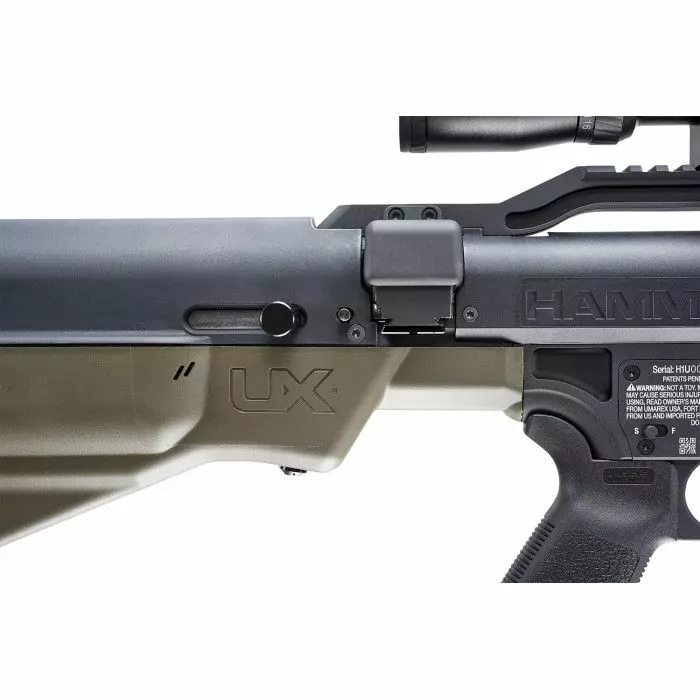
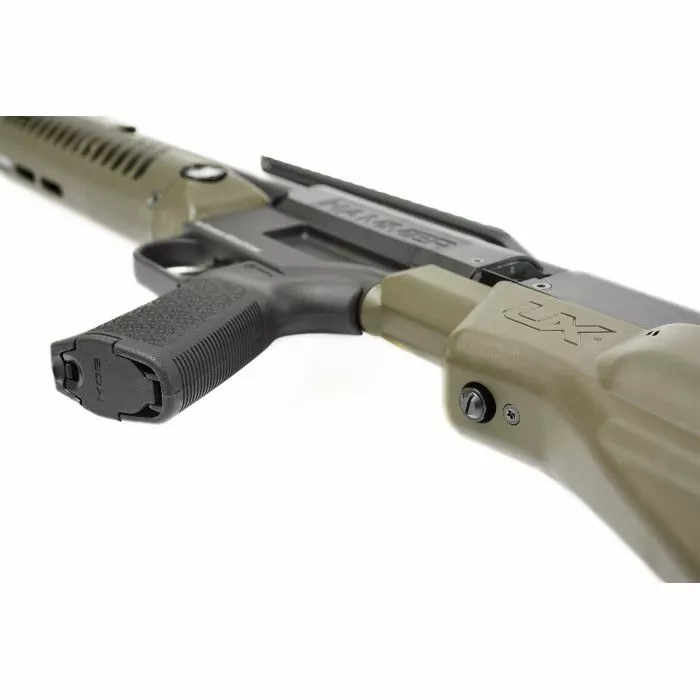
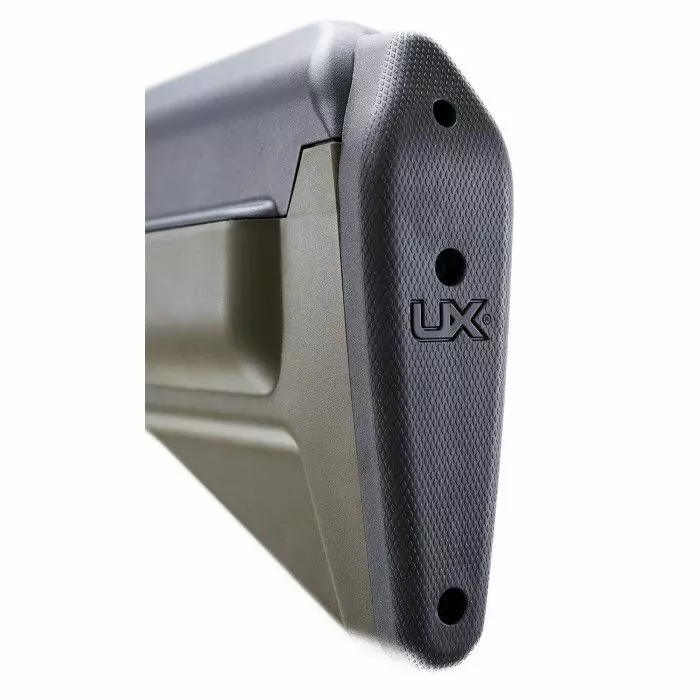
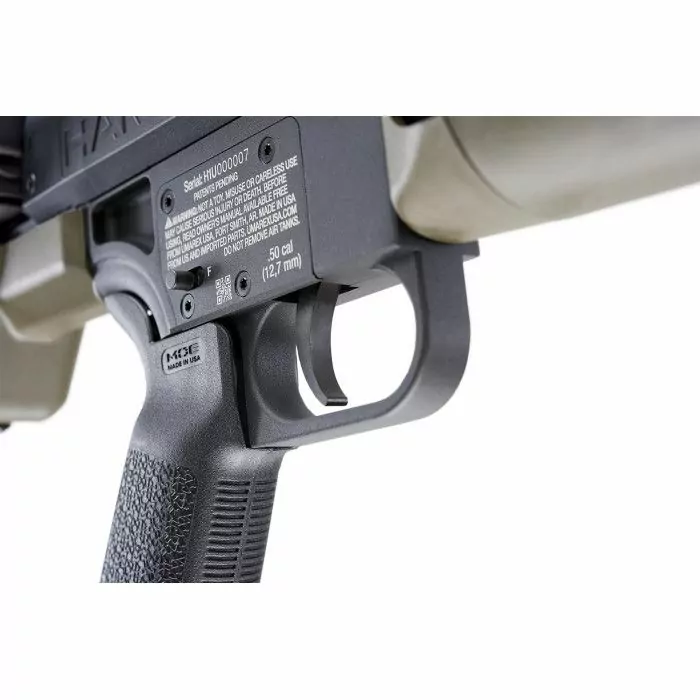

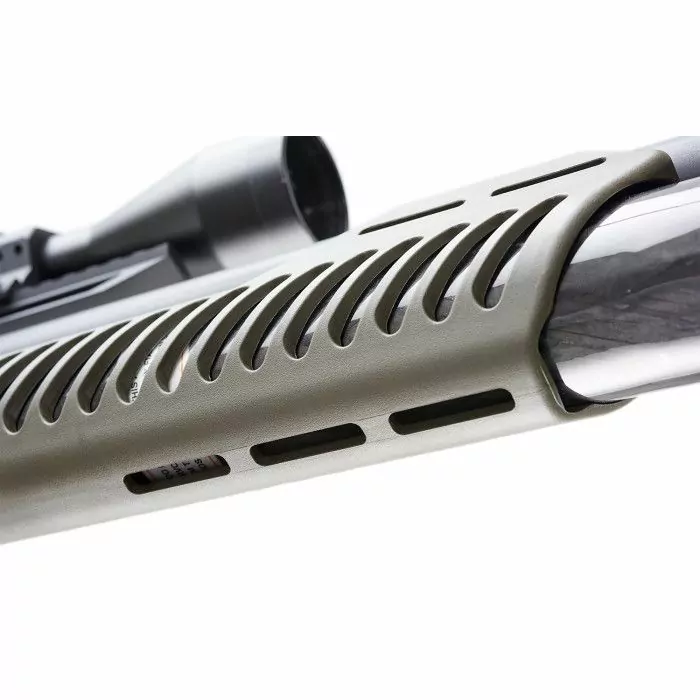

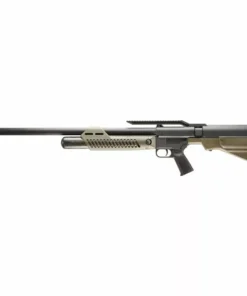
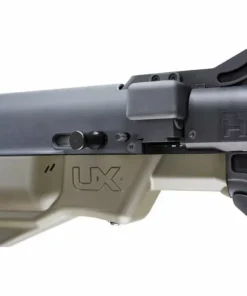

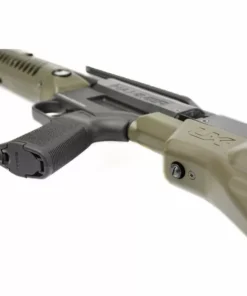



Umarex Hammer Big Bore .50 PCP Air Rifle

€1,000.00
Umarex Hammer Big Bore .50 PCP Air Rifle
The .50 caliber Umarex Hammer Airgun Hunting Rifle redefines airgun performance by leveraging the principles of physics. Engineered with cutting-edge technology and innovation, this exceptional rifle features a robust .510 caliber barrel that propels a 550-grain slug at an impressive 760 FPS, generating 705 ft-lbs of muzzle energy.
This rifle is designed for big game hunting, delivering big game power without the need for powder. As a Precharged Pneumatic (PCP) air rifle, it operates with high-pressure air, with an optimal operating fill pressure of 4,500 psi. Each shot is regulated to 3,000 psi, providing 2 full power shots plus a third shot at nearly 90% power from one fill of the 24 cubic inch non-removable carbon fiber tank.
The Hammer comes equipped with a 2-round chamber magazine, and each rifle includes two magazines. The removable magazine allows for easy unloading, while the dual-chamber precision magazine ensures quick follow-up shots. Safety is paramount with three mechanical safety devices, a straight pull speed-bolt with a 2 lbs cocking effort, and a 4-lb trigger weight.
Featuring a built-in manometer (pressure gauge), Picatinny riflescope rail, and a PolyOne designed and U.S. manufactured stock with an AR Magpul style grip, the Hammer is as functional as it is powerful. The integrated rear sling stud and three slots in the forearm grip to accept M-LOK attachments add to its versatility. The Quick Disconnect Foster fitting allows for easy air-fill connection.
With a 43.75-inch overall length and an 8.5-pound weight unloaded without a scope, the Hammer is both robust and manageable. Its 29.5-inch barrel length, full-length composite shroud, and 1:24 twist rifled German-made barrel by Walther ensure accuracy and durability. The ability to easily degas (remove all air) adds to the convenience of maintenance.
Unlike traditional firearms, the Umarex Hammer produces minimal noise and recoil, eliminating the need for hearing protection. The recoil feels like a firm push rather than a sharp kick, providing a more comfortable shooting experience.
Designed, engineered, assembled, and tested in the USA, the Umarex Hammer stands in a class of its own, offering unmatched power and precision for serious hunters and shooting enthusiasts. Experience the superior engineering and performance of the Umarex Hammer Airgun Hunting Rifle today.
This item can only be sold to persons 18 years and older.
For this item we have to carry out an age check.
You can upload a copy/scan/photo of a legal identification document such as a passport, European ID or driver’s license in the order. Parts of the document may be made illegible or designated as a copy. However, your name, document number and place of issue must be legible. Your copy ID will only be used for verification purposes and will not be retained. If you are not able to upload it right now, we will contact you per email before shipping
We can ship these items only to the countries listed below:
Belgium Bulgaria Cyprus Czechia Denmark Estonia Finland France Germany Greece Hungary Ireland Italy Kroatia Latvia Lithuania Luxembourg Monaco Netherlands Poland Portugal Romania Slovakia Slovenia Spain Austria Sweden United States
Specifications
| Model | .50 / 12,7 |
|---|---|
| Brand | Umarex |
| Energy (Joule / ft.lbs) | 950 / 700 |
| Cocking system | Side lever |
| Magazine capacity | 2 (.50) |
| Weight (gram) | 3855 |
| Barrel length (mm) | 750 |
| Length (mm) | 1111 |
| Mounting base | Weaver / Picatinny |
| Rifle Stock Type | Ambidextrous |
| Stock material | Synthetic |
| Extra accessories included |
Fill probe |
Umarex Hammer Big Bore .50 PCP Air Rifle – High-Pressure Large-Bore Pneumatic Platform
Umarex Hammer Big Bore .50 PCP Air Rifle
The Umarex Hammer Big Bore .50 PCP Air Rifle is an American-built, large-bore pre-charged pneumatic platform built around a .510-inch rifled barrel, a 24-cubic-inch non-removable carbon-fiber reservoir, and a maximum fill pressure of 4,500 PSI. A precision regulator supplies approximately 3,000 PSI to the firing system, while a straight-pull bolt operates the removable two-shot magazine. The original full-length model measures approximately 43.75 inches overall, weighs around 8.5 lb without an optic, and uses a 29.5-inch barrel with a full-length composite shroud.
The platform also incorporates a Picatinny optics rail, three M-LOK-compatible forearm slots, a Magpul-style grip, rear sling stud, built-in pressure gauge, quick-disconnect Foster filling connection, and three mechanical safety systems. Umarex identifies a magazine lock-out, trigger block, and field safety as part of the safety architecture.
Legends M3 Grease Gun S
Legends M3 Grease Gun S belongs to a replica-style product family and uses completely different operating principles from this large-bore PCP platform.
Umarex
umarex produces numerous air-powered platforms, ranging from replica pistols and sporting rifles to regulated PCP designs.
Umarex USA
umarex usa manufactures and supports this American-built large-bore platform and publishes its official operating specifications.
Umarex Notos
The umarex notos is a compact small-bore PCP carbine and occupies a very different category.
Umarex T4E
umarex t4e refers primarily to training and marking platforms rather than large-bore precision PCP rifles.
Glock BB Gun
A glock bb gun is a replica air pistol and should not be confused with this shoulder-fired pneumatic platform.
Umarex Airguns
Within umarex airguns, this model sits at the large-bore end of the manufacturer’s pneumatic range.
Umarex Air Rifles
Among umarex air rifles, the large reservoir, carbon-fiber tank, regulator, heavy-duty action, and .510-inch bore make this configuration distinctive.
Umarex Hammer
The umarex hammer uses a straight-pull bolt, two-shot removable magazine, regulated pneumatic action, and high-pressure carbon-fiber air tank.
Umerex
umerex is a common spelling variation used in searches for the manufacturer.
Airsoft Glock
An airsoft glock uses plastic airsoft ammunition and belongs to a completely different recreational category.
Umarex Gauntlet
The umarex gauntlet is another regulated PCP family but uses different calibers, reservoir architecture, dimensions, and handling characteristics.
Umarex TR50
The umarex tr50 is a CO₂-powered training platform rather than a high-pressure PCP rifle.
Umarex Smith
umarex smith searches generally concern licensed replica pistols rather than large-bore pneumatic rifles.
Glock 19 BB Gun
A glock 19 bb gun is a compact replica handgun and differs fundamentally from this full-size pneumatic platform.
Umarex Glock 19
The umarex glock 19 belongs to the licensed replica-pistol category.
Umarex Zelos
The umarex zelos is a smaller regulated bullpup PCP with different caliber, tank, magazine, and barrel architecture.
Umarexusa
umarexusa is another commonly used search variation for the manufacturer’s American website.
Umarex HDR 50
The umarex hdr 50 belongs to the training-marker category rather than this regulated large-bore PCP class.
Metal BB Gun
A metal bb gun generally refers to a steel-BB replica platform rather than a high-pressure slug-firing PCP rifle.
Air Guns
Within the broader air guns category, pre-charged pneumatic systems store compressed air before use instead of generating pressure through a spring or gas piston.
Umarex Glock 17 Gen 5
The umarex glock 17 gen 5 is a replica pistol and uses a completely different action.
Umarex T4E Smith
umarex t4e smith searches normally relate to training platforms rather than sporting PCP rifles.
Umarex HK Heckler
umarex hk heckler generally refers to licensed replica products based on Heckler & Koch designs.
Umarex Fusion 2
The umarex fusion 2 belongs to another conventional air-rifle category with different pressure and barrel architecture.
Umarex Gauntlet 2
The umarex gauntlet 2 provides regulated PCP operation in smaller calibers with a different stock and reservoir system.
Umarex H
umarex h is a broad search phrase that may refer to several different product families.
Umarex Komplete
The umarex komplete uses a disposable nitrogen-cartridge approach rather than this model’s refillable carbon-fiber reservoir.
Umarex Glock 17
The umarex glock 17 belongs to a licensed replica handgun family.
Umarex Airsoft
umarex airsoft products fire plastic airsoft ammunition and should not be compared directly with a large-bore PCP system.
Umarex P2P DR50 How Many Joules
The phrase umarex p2p dr50 how many joules concerns a separate training platform and is unrelated to this rifle’s regulated pneumatic architecture.
Umarex Glock
umarex glock generally refers to the licensed Glock replica range.
Glock 19 Airsoft
A glock 19 airsoft replica operates in a completely different category from a large-bore PCP rifle.
BB Gun Glock
A bb gun glock is generally a CO₂-powered replica handgun.
Umarex Primal 20
The umarex primal 20 is another large-bore pneumatic product with different bore size, ammunition, and operating geometry.
Pellet Pistol
A pellet pistol uses compact handgun ergonomics rather than the shoulder-fired architecture used here.
Umarex Trevox
The umarex trevox is a break-barrel air pistol and does not use a pre-charged reservoir.
Umarex Origin
The umarex origin belongs to the PCP category but uses conventional small-bore rifle architecture.
Umarex BB Gun
An umarex bb gun typically uses steel BB ammunition rather than large-diameter lead slugs.
Umarex MP40
The umarex mp40 belongs to a historical replica product line.
Umarex Legends
umarex legends covers replica-style airguns inspired by historical designs.
Loading Umarex Trevox Break Barrel .177
The phrase loading umarex trevox break barrel .177 concerns a completely different break-barrel pistol system.
Umarex Gauntlet 30
The umarex gauntlet 30 is a regulated .30-caliber PCP and uses smaller-bore architecture than the platform described here.
Umarex Notos Carbine
The umarex notos carbine is significantly smaller, lighter, and lower-capacity.
Umarex Pistol Break Barrel
An umarex pistol break barrel uses manual barrel cocking rather than stored high-pressure air.
Umarex Air Rifle
As an umarex air rifle, this platform sits within the manufacturer’s high-pressure large-bore PCP category.
Umarex Shotgun
An umarex shotgun search relates to another configuration rather than this single rifled barrel design.
Umarex Glock 19 Gen3 .177 Caliber
The umarex glock 19 gen3 .177 caliber is a compact replica pistol rather than a large-bore rifle.
BB Gun Air Pistol
A bb gun air pistol generally prioritizes replica handling and recreational use rather than regulated high-pressure rifle architecture.
Umarex DX17
The umarex dx17 belongs to an entry-level pistol category.
Umarex MP5
The umarex mp5 name commonly identifies replica designs based on the well-known submachine-gun profile.
Umarex Synergis Elite
The umarex synergis elite uses a different powerplant and conventional rifle architecture.
Umarex Glock 19X
The umarex glock 19x belongs to the licensed replica handgun range.
Umarex Hammer .50 Caliber
The umarex hammer .50 caliber uses a true .510-inch bore, high-pressure carbon-fiber tank, regulated valve system, and two-shot magazine.
Umarex Hammer Carbine
The umarex hammer carbine is a newer shorter configuration with a 23.25-inch barrel, larger 35-cubic-inch carbon-fiber tank, four full-pressure shots per fill, and approximately 34.13-inch overall length. It should not be confused with the original full-length version described here.
Umarex Komplete NCR .22
The umarex komplete ncr .22 uses a nitrogen cartridge rather than a conventional refillable PCP tank.
Umarex Air Saber
The umarex air saber launches arrows and belongs to a separate pneumatic sporting category.
50 Cal Air Rifle
A 50 cal air rifle uses a significantly larger bore than conventional pellet platforms. This model specifically uses a .510-inch bore and dedicated lead slug ammunition.
Umarex Air Javelin
The umarex air javelin launches arrows rather than conventional projectiles and uses a different pneumatic system.
.510-Inch Rifled Barrel
The original full-length platform uses a 29.5-inch barrel with a full-length composite shroud. Official Umarex information identifies a 1:24 twist Walther-made German barrel, giving the rifle a purpose-built large-bore barrel system.
24-Cubic-Inch Carbon-Fiber Tank
The rifle stores compressed air inside a 24-cubic-inch non-removable carbon-fiber reservoir rated to a maximum fill pressure of 4,500 PSI.
3,000 PSI Regulated Firing System
The internal regulator supplies approximately 3,000 PSI to the firing system from the higher-pressure main reservoir. This regulated architecture is intended to provide predictable pressure delivery across the primary usable shots.
Straight-Pull Bolt
A short straight-pull bolt operates the action and advances the removable two-shot magazine.
The simple linear movement reduces unnecessary control complexity while maintaining a mechanically robust loading system.
Two-Shot Magazine
The rifle uses a removable two-round magazine, and factory product information states that two magazines are included with the full-length model.
Multiple Mechanical Safeties
Three separate mechanical safety systems are incorporated: a magazine lock-out, trigger block, and field safety. These independent systems add redundancy to the handling architecture.
Picatinny Optics Rail
The receiver incorporates a substantial Picatinny rail for compatible optics.
Factory information describes approximately 8.5 inches of rail with 20 slots, providing considerable mounting flexibility.
M-LOK Forearm
Three M-LOK-compatible forearm slots support compatible sporting accessories without requiring a permanently bulky accessory system.
Why the High-Pressure Design Matters
A large projectile requires substantial controlled airflow, so the combination of a 4,500 PSI reservoir and 3,000 PSI regulated firing pressure gives the pneumatic system enough stored-air capacity for its intended factory operating envelope.
Because of these pressures, proper charging equipment and reservoir inspection are particularly important.
How Precision Is Supported
Practical precision depends on barrel condition, regulator consistency, secure optic mounting, appropriate factory-compatible ammunition, a stable shooting position, predictable trigger behavior, and correct pressure management.
Therefore, no single component should be treated as solely responsible for repeatability.
Where This Platform Fits Best
Its large dimensions, high-pressure system, substantial recoil impulse relative to smaller PCP rifles, and two-shot magazine make it most appropriate for lawful controlled sporting environments where users can manage the equipment safely and follow applicable local regulations.
When Maintenance Matters
Reservoir condition, pressure retention, regulator behavior, bolt movement, magazine function, safety operation, barrel security, optic mounting, and filling equipment should all be inspected regularly.
Umarex specifically instructs users to fill only with oil- and water-free compressed air or nitrogen, not to exceed 4,500 PSI, and not to refill a reservoir that leaks or appears unsafe.
Important Specification Information
Official factory specifications identify the original version with a .510-inch bore, 43.75-inch overall length, 8.5 lb unloaded weight, 29.5-inch barrel, 24-cubic-inch carbon-fiber reservoir, 4,500 PSI maximum fill pressure, 3,000 PSI regulated operation, straight-pull bolt action, two-round magazine, Picatinny optics rail, M-LOK forearm, pressure gauge, and multiple mechanical safeties.
Overall Engineering Character
The Umarex Hammer Big Bore .50 PCP Air Rifle is defined by its high-pressure carbon-fiber reservoir, regulated pneumatic action, large .510-inch barrel, short straight-pull bolt, removable two-shot magazine, substantial optics rail, M-LOK accessory interface, and multiple mechanical safety systems.
Its engineering emphasis is very different from smaller recreational PCP rifles. Instead, it is a specialized large-bore pneumatic platform that requires appropriate filling equipment, careful reservoir management, secure storage, and strict adherence to manufacturer guidance and applicable law.
Pressure Management, Mechanical Operation, Handling, Safety, Precision Support, and Reliability
High-Pressure Operating System
This large-bore pneumatic platform relies on stored compressed air, a regulated firing system, a mechanical bolt action, and a dedicated magazine arrangement. Because the system operates at substantial pressure, reservoir condition, regulator stability, sealing surfaces, filling equipment, and mechanical controls all require careful attention.
Reliable operation depends on the complete system working together rather than on any single component.
Reservoir Condition
The carbon-fiber air reservoir should be inspected regularly.
Deep scratches, impact marks, exposed fibers, damaged valve areas, deformation, or unusual surface changes should never be ignored.
Because the tank stores considerable energy, any suspected structural damage should be professionally evaluated before the reservoir is filled again.
Controlled Filling
Charging should always be gradual and carefully monitored.
Rapid filling can generate unnecessary heat and may temporarily affect pressure readings.
Only correctly rated filling equipment should be used, and the manufacturer’s stated maximum fill pressure should never be exceeded.
If the pressure gauge behaves abnormally, charging should stop until the cause has been identified.
Clean and Dry Compressed Air
Clean, dry compressed air is especially important in high-pressure pneumatic systems.
Moisture, oil, dirt, or other contamination can affect valves, seals, regulator components, and internal surfaces.
Therefore, compressors, hoses, filters, adapters, and connectors should remain clean and properly maintained.
Pressure Retention
Unexpected pressure loss during storage can indicate seal deterioration, valve leakage, or another pneumatic problem.
Repeatedly adding air without identifying the source can hide a developing fault.
Persistent or unusually rapid pressure loss should therefore be investigated professionally.
Regulator Stability
The regulator manages pressure delivered from the main reservoir to the firing system.
Stable regulation supports predictable operation.
If pressure behavior changes noticeably, possible causes can include seal wear, contamination, internal leakage, or another pneumatic issue.
Persistent irregularities should not be corrected through repeated unauthorized adjustment.
Straight-Pull Bolt Operation
The bolt should move smoothly through its complete operating cycle.
Grinding, stiffness, excessive looseness, or incomplete closure can indicate contamination, wear, damaged components, or alignment problems.
The action should never be forced when unusual resistance is present.
Magazine Condition
The removable magazine should remain clean and free from debris.
Damaged projectiles, dirt, or foreign material can interfere with correct seating and feeding.
If the magazine does not insert or cycle normally, the cause should be identified before continued use.
Safety System Inspection
The mechanical safety systems should operate clearly and predictably.
Controls should not feel vague, excessively loose, sticky, or unusually stiff.
If a safety mechanism behaves differently from normal, the rifle should be unloaded and professionally inspected before further use.
Trigger Characteristics
The trigger should provide predictable mechanical feedback.
Unnecessary adjustment should be avoided, particularly on a large-bore platform where safe handling margins are important.
Any adjustment should remain within manufacturer-approved specifications.
Trigger Reach
The trigger blade should sit naturally beneath the finger.
The wrist should not need to twist or stretch excessively to reach it.
Correct reach improves comfort and helps the user maintain a stable, repeatable position during controlled sporting use.
Shoulder Contact
The rear section should contact the shoulder comfortably and consistently.
Its position influences optic alignment, trigger reach, balance, and overall control.
A stable position should be achieved without excessive tension.
Grip Comfort
The grip should allow the hand and wrist to remain relaxed.
Excessive grip pressure can increase fatigue and make repeatable positioning more difficult.
A controlled but comfortable hold generally supports more consistent handling.
Supporting Hand Position
The supporting hand should rest naturally beneath the forward section.
It should not interfere with the pressure reservoir, filling connection, or other controls.
A repeatable support position helps maintain balance during longer sessions.
Weight Distribution
Large-bore pneumatic systems tend to feel different from smaller sporting rifles because of their reservoir, barrel, receiver, and action dimensions.
Optic weight and additional accessories can further alter balance.
Therefore, unnecessary accessories should be avoided when they do not serve a clear sporting purpose.
Barrel Stability
The barrel and shroud assembly should remain secure and protected from impact.
Visible movement, looseness, or alignment changes should be investigated.
A significant knock to the barrel area should be professionally assessed before the rifle is used again.
Muzzle Protection
The muzzle should remain clean and protected from knocks.
Damage around the crown can influence consistency even if the rest of the barrel appears normal.
The rifle should never be rested or stored directly on the muzzle.
Optic Mounting
The optics rail should remain clean and undamaged.
Rings and mounts should fit correctly, while fasteners should be tightened according to suitable specifications.
Excessive tightening can damage threads, mounting surfaces, rings, or optic tubes.
Optic Security
Loose optic hardware can create apparent consistency problems even when the pneumatic system is functioning normally.
Therefore, mounts should be inspected periodically.
Before assuming an internal fault exists, simple external causes such as loose mounting hardware should be considered.
Accessory Mounting
Accessory interfaces should remain clean, secure, and unobstructed.
Added equipment should not interfere with the trigger, safety, filling connection, reservoir, or normal handling.
Accessories should also remain appropriate for lawful sporting use.
Exterior Cleaning
Routine exterior cleaning should remove dust, fingerprints, moisture, and light surface contamination.
A soft cloth is normally sufficient.
Aggressive chemicals and abrasive materials should be avoided around seals, finishes, adhesives, polymer components, and pressure-related areas.
Moisture Protection
After use in damp conditions, the rifle should be dried before storage.
Moisture should not remain around screws, mounting rails, filling connections, safety components, or exposed metal interfaces.
Extended moisture exposure can reduce mechanical reliability.
Fastener Inspection
Normal handling and transport can gradually loosen external hardware.
Mounts, stock hardware, rail fasteners, and visible screws should therefore be inspected periodically.
Fasteners should only be tightened to appropriate specifications.
Transport Protection
A padded case helps protect the barrel, reservoir, optic, stock, and external controls.
The rifle should remain unloaded and secured during transport.
Applicable laws and carrier rules concerning pressurized sporting equipment should always be followed.
Safe Storage
Storage should remain secure, dry, and reasonably temperature stable.
Excessive heat, direct sunlight, high humidity, and chemical vapors should be avoided.
The rifle should remain unloaded and protected from unauthorized access.
Monitoring Changes in Operation
A sudden change in behavior can result from loose optics, pressure irregularities, seal deterioration, magazine problems, barrel contamination, or mechanical wear.
A structured inspection is usually more effective than making several adjustments at once.
Professional Servicing
Persistent leaks, regulator faults, reservoir concerns, safety problems, valve issues, trigger faults, or significant mechanical changes should be handled by qualified technicians.
High-pressure large-bore pneumatic systems require appropriate tools, correct procedures, and technical experience.
Overall Long-Term Reliability
Long-term reliability depends on a healthy reservoir, stable pressure management, clean compressed air, sound seals, smooth bolt operation, secure optics, careful charging, correct storage, and timely professional servicing.
When the pneumatic, mechanical, and ergonomic systems are maintained consistently, the rifle remains easier to inspect, more predictable to operate, and more dependable throughout responsible and lawful sporting use.
Practical Handling, Setup Consistency, Comfort, Inspection, and Everyday Ownership
Real-World Handling
A large-bore pneumatic rifle requires a more deliberate handling approach than a lightweight recreational airgun. Overall weight, reservoir size, barrel length, optic position, shoulder contact, grip angle, and supporting-hand placement all influence how stable the rifle feels during lawful sporting use.
Because the platform carries substantial mass and stored air pressure, a comfortable and repeatable setup is especially important.
Establishing a Repeatable Position
Consistency begins with body position.
The shoulder, cheek, supporting hand, and trigger hand should return naturally to approximately the same place each time.
Excessive muscular tension makes stable positioning harder to reproduce. Therefore, the setup should support the body rather than force the user into an awkward position.
Shoulder Contact
The rear section should contact the shoulder comfortably and securely.
Its position influences trigger reach, eye relief, balance, and overall control.
The objective should be consistent contact without unnecessary pressure or strain.
Grip Comfort
The grip should allow the wrist to remain as relaxed as possible.
The trigger finger should reach the blade naturally without stretching or twisting the hand.
A comfortable grip can reduce fatigue and make repeated positioning easier.
Supporting Hand Position
The forward hand should rest in a stable position without interfering with the reservoir, filling system, or other controls.
Excessive gripping pressure can introduce unwanted movement.
A consistent support position can improve balance during extended sessions.
Trigger Familiarity
The trigger should feel predictable before any adjustment is considered.
Users should become familiar with its normal travel and release characteristics.
Unnecessary adjustment should be avoided, and any changes should remain within approved manufacturer limits.
Bolt Familiarity
The straight-pull bolt should move through its complete cycle smoothly.
Partial movement can interfere with loading and magazine function.
If the action suddenly becomes rough, unusually stiff, or loose, it should be inspected rather than forced.
Magazine Handling
The magazine should seat correctly without excessive pressure.
It should remain clean and free from damaged projectiles, dirt, or other debris.
If insertion or feeding becomes irregular, the cause should be identified before continued use.
Safety Routine
The safety systems should be checked as part of normal handling.
Their operation should remain positive, predictable, and easy to understand.
If any safety control begins behaving differently from normal, the rifle should be unloaded and inspected before further use.
Pressure Planning
Reservoir pressure should be checked before longer sessions.
Because the platform uses a high-pressure air system, users should never assume adequate pressure without checking the gauge.
Unexpected pressure loss during storage can indicate seal or valve problems.
Controlled Filling Routine
Charging should remain gradual and carefully monitored.
Hoses, adapters, connectors, filters, and compressors should be correctly rated for the required pressure.
Damaged filling equipment should never be used under pressure.
Clean Air Management
Clean and dry compressed air helps protect seals, valves, regulator components, and internal pneumatic surfaces.
Moisture or contamination introduced during filling can reduce long-term reliability.
Therefore, filtration equipment should remain properly maintained.
Recognizing Pneumatic Problems
Abnormal pressure loss, unusual filling behavior, or unexpected changes in operation can indicate developing pneumatic faults.
Because the reservoir stores substantial energy, internal pressure-system repairs should not be approached casually.
Persistent problems should be assessed by qualified technicians.
Reservoir Inspection
The carbon-fiber reservoir should be inspected under good lighting.
Deep scratches, impact marks, exposed fibers, damaged valve areas, or unusual surface changes should never be ignored.
Any suspected structural concern should be professionally evaluated before further pressurization.
Barrel Stability
The barrel and shroud assembly should remain secure and protected from impact.
Visible movement, looseness, or alignment changes should be investigated.
A significant knock to the barrel area should be assessed before the rifle is used again.
Muzzle Protection
The muzzle should remain protected from dirt, knocks, and careless handling.
Damage around the crown can influence consistency even if the rest of the barrel appears normal.
It should never be used as a resting point.
Optic Positioning
The optic should provide a complete sight picture without forcing the head or neck into an uncomfortable position.
Eye relief and mount placement should work together.
Once a comfortable setup has been established, unnecessary changes should be avoided.
Mount Security
Loose mounting hardware can create apparent performance problems even when the pneumatic system is operating correctly.
Therefore, rings and mounting screws should be checked periodically.
However, excessive tightening can damage threads, rails, rings, or optic tubes.
Weight Management
Large-bore equipment naturally carries more mass than many smaller pneumatic platforms.
Heavy optics and unnecessary accessories can increase fatigue further.
Accessory selection should therefore consider both practical usefulness and added weight.
Accessory Placement
Accessories should serve a clear lawful sporting purpose.
Poor placement can interfere with the trigger, safety, filling connection, reservoir, or normal handling.
Every added component should remain secure and compatible with the mounting interface.
Rail Inspection
Mounting rails should remain clean and free from damage.
Dirt or debris beneath mounts can prevent proper seating.
Rail fasteners should be checked periodically without being overtightened.
Exterior Cleaning
Routine cleaning should remove fingerprints, dust, moisture, and light surface contamination.
A soft cloth is usually sufficient.
Strong solvents should be avoided around seals, polymer components, finishes, adhesives, and pressure-related areas unless specifically approved.
Moisture Protection
After use in damp conditions, the rifle should be dried before storage.
Moisture should not remain around screws, rails, filling fittings, safety components, or exposed metal interfaces.
Extended moisture exposure can affect mechanical reliability.
Fastener Inspection
Transport and repeated handling can gradually loosen external hardware.
Visible screws, rail fasteners, optic mounts, and stock hardware should therefore be inspected periodically.
Correct tightening specifications should be followed.
Case Selection
A padded case should support the rifle without placing unnecessary pressure on the optic, barrel, or reservoir.
Internal movement should be minimized.
A well-fitted case can help protect the platform from knocks during lawful transport and storage.
Transport Preparation
Before transport, the rifle should be unloaded and secured.
Loose accessories should be removed or firmly attached.
Carrier requirements and local rules concerning high-pressure sporting equipment should always be checked.
Safe Storage
Storage should remain secure, dry, and reasonably temperature stable.
Excessive heat, direct sunlight, high humidity, and chemical vapors should be avoided.
Access should be restricted appropriately.
Avoiding Excessive Heat
Long periods inside hot vehicles should be avoided.
High temperatures can influence seals, adhesives, optics, pressure behavior, and exterior finishes.
Vehicle storage can also create additional security concerns.
Monitoring Changes in Operation
A sudden change in behavior can result from loose optics, pressure irregularities, seal deterioration, magazine problems, barrel contamination, or mechanical wear.
A systematic inspection is usually more effective than immediately making several adjustments.
Maintaining Service Records
A simple maintenance record can be useful over long-term ownership.
Reservoir inspections, seal replacement, valve servicing, optic changes, and professional repairs can all be documented.
This makes future troubleshooting easier.
Professional Servicing
Persistent leaks, regulator problems, reservoir concerns, safety faults, valve issues, or significant mechanical changes should be handled by qualified technicians.
High-pressure large-bore pneumatic systems require appropriate tools, experience, and correct servicing procedures.
Overall Practical Reliability
Reliable everyday ownership depends on careful pressure management, clean compressed air, healthy seals, smooth bolt operation, secure optics, proper storage, and timely professional servicing.
When these mechanical, pneumatic, and ergonomic areas are maintained methodically, the rifle remains easier to inspect, more predictable to operate, and dependable throughout responsible and lawful sporting use.
Preventive Maintenance, High-Pressure System Care, Storage, Inspection, and Long-Term Reliability
Preventive Maintenance Routine
Long-term reliability depends on consistent inspection rather than waiting for a major fault to appear. A practical maintenance routine should include the air reservoir, regulator, seals, bolt mechanism, magazine, trigger assembly, safety systems, barrel, shroud, optic mounts, external fasteners, stock components, and filling equipment.
Regular checks make gradual wear easier to identify before it begins affecting normal operation.
Carbon-Fiber Reservoir Inspection
The high-pressure reservoir should be examined carefully and regularly.
Deep scratches, impact marks, exposed fibers, damaged valve areas, deformation, or unusual surface changes should never be ignored.
Because the reservoir stores considerable energy, any suspected structural damage should be professionally assessed before the system is pressurized again.
Pressure Retention Monitoring
Unexpected pressure loss during storage can indicate worn seals, valve leakage, regulator problems, or another pneumatic fault.
Repeatedly adding compressed air without identifying the cause can hide a developing issue.
Persistent or unusually rapid pressure loss should therefore be investigated rather than accepted as normal.
Filling Equipment Condition
Hoses, connectors, adapters, filters, compressors, pumps, and charging fittings should remain clean and undamaged.
Cracked hoses, worn seals, loose connectors, or improvised fittings should never be pressurized.
Every component should be correctly rated for the required operating pressure.
Controlled Charging
Filling should take place gradually while pressure is monitored carefully.
Rapid charging can generate unnecessary heat and may temporarily influence pressure readings.
The specified maximum working pressure should never be exceeded.
If the pressure gauge behaves abnormally, charging should stop until the cause has been identified.
Clean and Dry Air Supply
Clean, dry compressed air helps protect regulator components, valves, seals, and internal pneumatic surfaces.
Moisture, oil, or contamination introduced during charging can reduce long-term reliability.
Therefore, filtration systems should remain properly maintained.
Pressure Gauge Inspection
The pressure indicator should remain clear, secure, and believable.
Fogging, impact damage, looseness, or unrealistic readings should be investigated.
The reservoir should not be filled when pressure cannot be monitored accurately.
Seal Condition
Seals are essential for maintaining stable pneumatic operation.
Age, contamination, unsuitable lubrication, and unnecessary disassembly can contribute to deterioration.
Visible sealing surfaces should be checked where appropriate, while internal replacement should follow approved servicing procedures.
Correct Lubrication
Only lubricants suitable for high-pressure pneumatic systems should be used where lubrication is required.
Random workshop oils or unsuitable petroleum-based products should not be introduced into pressure-related areas.
Incorrect lubrication can damage seals and create additional safety concerns.
Regulator Care
The regulator should provide stable and predictable pressure behavior.
Unexpected changes in consistency can indicate contamination, pressure imbalance, seal wear, or another internal issue.
Persistent faults should be professionally diagnosed rather than repeatedly adjusted without understanding the cause.
Bolt Mechanism Maintenance
The straight-pull action should move smoothly through its complete cycle.
Grinding, stiffness, excessive looseness, or incomplete closure should be investigated rather than overcome with additional force.
Persistent resistance can indicate contamination, wear, or alignment problems.
Magazine Maintenance
The removable magazine should remain clean and free from dirt, debris, or damaged projectiles.
Feeding should remain smooth and predictable.
If insertion, indexing, or loading becomes unreliable, the magazine and action should be inspected before continued use.
Trigger Area Care
The trigger area should remain clean and free from contamination.
Unnecessary adjustment should be avoided.
If trigger behavior changes noticeably, the rifle should be unloaded and inspected before further use.
Any adjustment should remain within approved manufacturer limits.
Safety System Inspection
The mechanical safety controls should continue to operate clearly and consistently.
They should not feel unusually loose, vague, sticky, or excessively stiff.
Any unexpected change in behavior should be investigated before the rifle is returned to service.
Barrel Exterior Care
The barrel and shroud assembly should remain protected from impact, bending forces, and careless handling.
Visible movement, looseness, or alignment changes should be investigated.
External support points should remain secure.
Muzzle Protection
The muzzle should remain protected from knocks, contamination, and poor cleaning practices.
Damage around the crown can influence consistency even when the rest of the barrel appears normal.
The rifle should never be rested directly on the muzzle.
Barrel Cleaning
Barrel cleaning should only be performed when necessary and with equipment suitable for precision pneumatic barrels.
Aggressive rods, abrasive compounds, and unsuitable solvents can damage the bore or crown.
Manufacturer-approved cleaning procedures should take priority.
Optic Mount Inspection
The optics rail should remain clean and undamaged.
Rings, bases, and mounting screws should be checked periodically.
Loose mounting hardware can create apparent consistency problems even when the pneumatic system is functioning normally.
Avoiding Overtightening
Mounting hardware should only be tightened to appropriate specifications.
Excessive force can damage threads, rails, rings, or optic tubes.
More tightening force does not automatically create greater security.
Forearm and Accessory Care
Accessory interfaces should remain clean and free from damaged slots or loose hardware.
Mounted equipment should not interfere with filling connections, safety controls, the trigger area, or normal handling.
Unnecessary weight should also be avoided.
Grip and Stock Care
Grip and stock surfaces can collect dust, sweat, and general contamination through normal use.
These areas should be cleaned gently.
Strong solvents and aggressive scrubbing should be avoided because they can damage finishes, polymer surfaces, or textured areas.
Fastener Inspection
External screws and mounting points can gradually loosen through regular handling and transport.
Visible hardware should therefore be checked periodically.
Fasteners should only be tightened to appropriate specifications.
Moisture Protection
After use in damp conditions, the rifle should be dried before storage.
Water should not remain around rails, screws, filling fittings, safety components, or exposed metal interfaces.
Extended moisture exposure can reduce mechanical reliability and damage surface finishes.
Avoiding Excessive Heat
Long periods inside hot vehicles should be avoided.
High temperatures can affect seals, adhesives, optics, finishes, and pressure behavior.
Vehicle storage can also create additional security concerns.
Transport Protection
A padded case helps protect the reservoir, barrel, optic, stock, and external controls.
The rifle should remain unloaded and securely positioned during transport.
Applicable laws and carrier rules concerning pressurized sporting equipment should always be followed.
Long-Term Storage
For extended storage, the rifle should remain clean, dry, unloaded, and secured against unauthorized access.
Manufacturer guidance should be followed regarding stored reservoir pressure.
Direct sunlight, excessive heat, high humidity, and chemical vapors should be avoided.
Periodic Storage Inspection
Equipment that is not used regularly should still be inspected occasionally.
Pressure loss, corrosion, seal deterioration, loose hardware, reservoir damage, or mounting movement may otherwise remain unnoticed.
Keeping Service Records
Simple service records can be useful over extended ownership.
Reservoir inspections, seal replacement, regulator servicing, valve work, trigger maintenance, optic changes, and professional repairs can all be documented.
This makes future troubleshooting easier.
Professional Servicing
Persistent leaks, regulator problems, reservoir concerns, valve issues, trigger faults, safety problems, or significant mechanical changes should be handled by qualified technicians.
High-pressure large-bore pneumatic systems require appropriate tools, experience, and correct servicing procedures.
Long-Term Reliability
Long-term reliability depends on healthy pressure components, stable air management, clean compressed air, sound seals, smooth bolt operation, secure optics, careful charging, correct storage, and timely professional servicing.
When preventive maintenance remains consistent, developing problems become easier to identify, helping the rifle remain predictable, serviceable, and dependable throughout responsible and lawful sporting use.
Be the first to review “Umarex Hammer Big Bore .50 PCP Air Rifle”
Related products


umarex AirRifle
umarex AirRifle
Reviews
There are no reviews yet.