
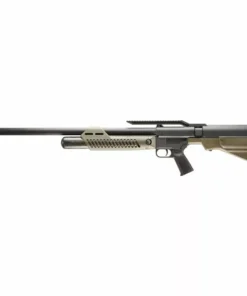
Umarex TUSK PCP Air Rifle
€700.00
Description
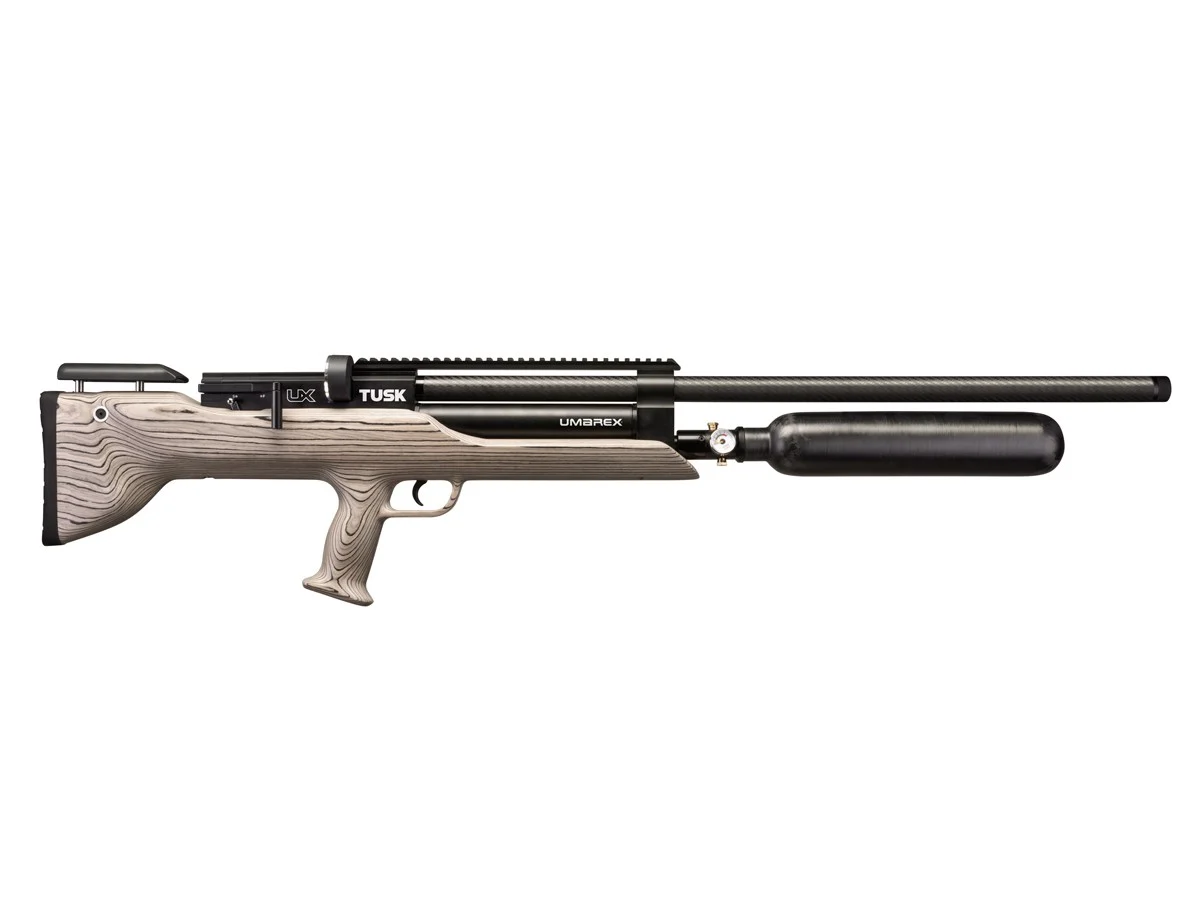
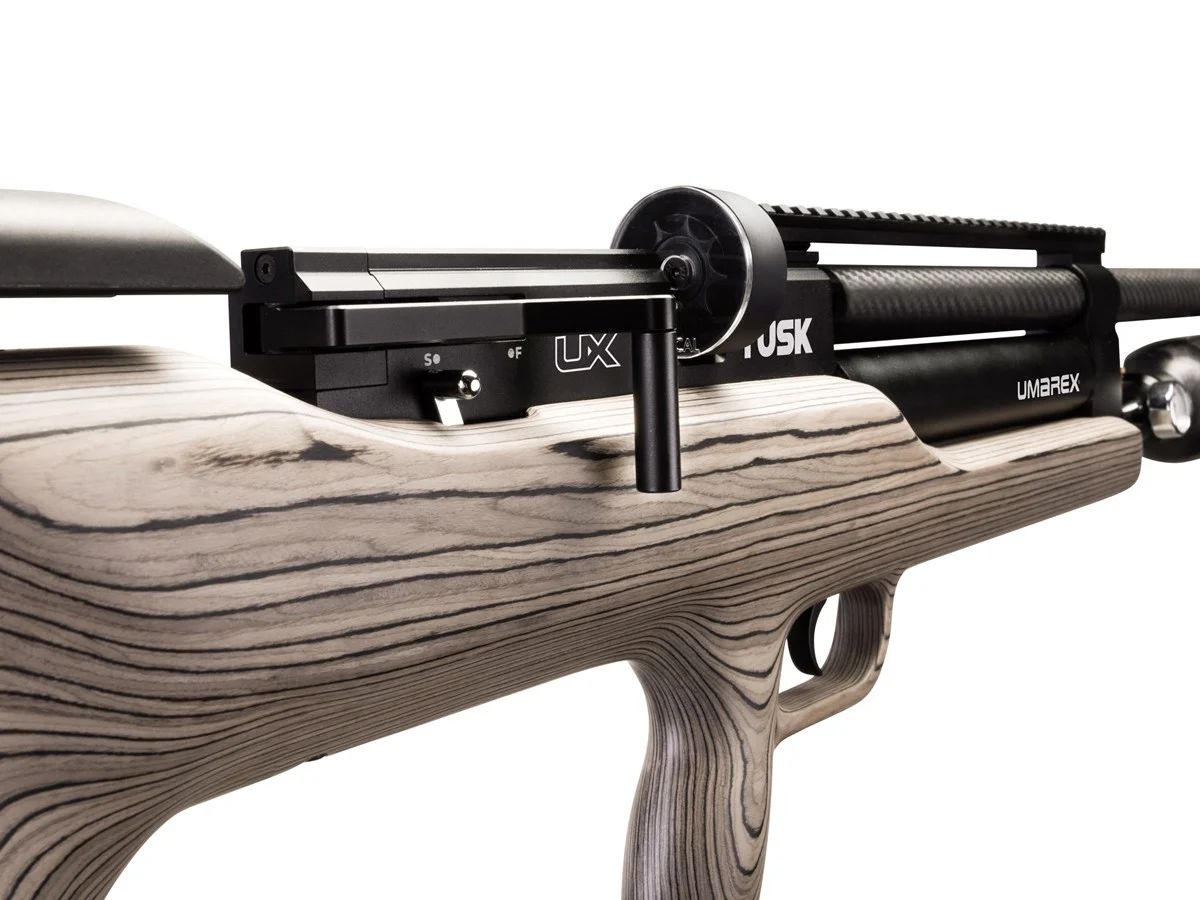
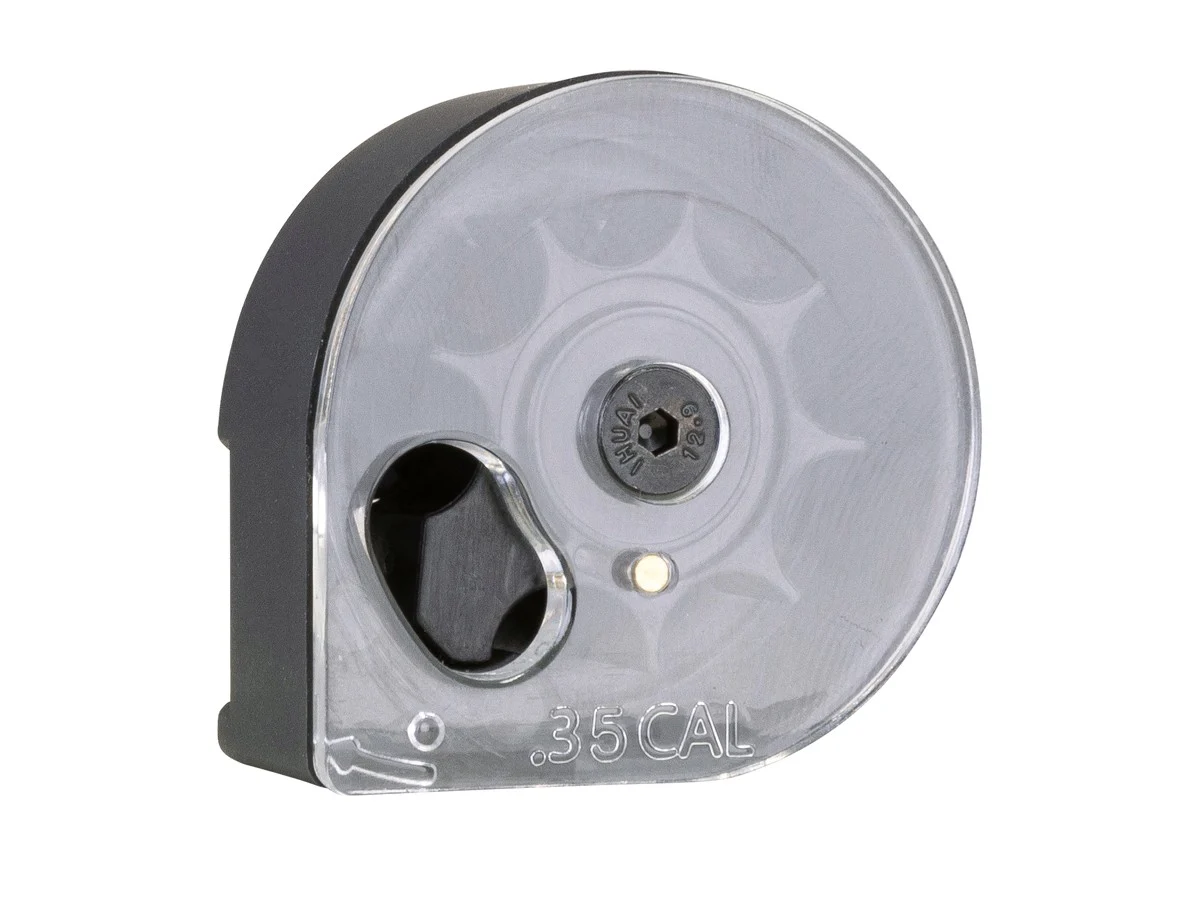
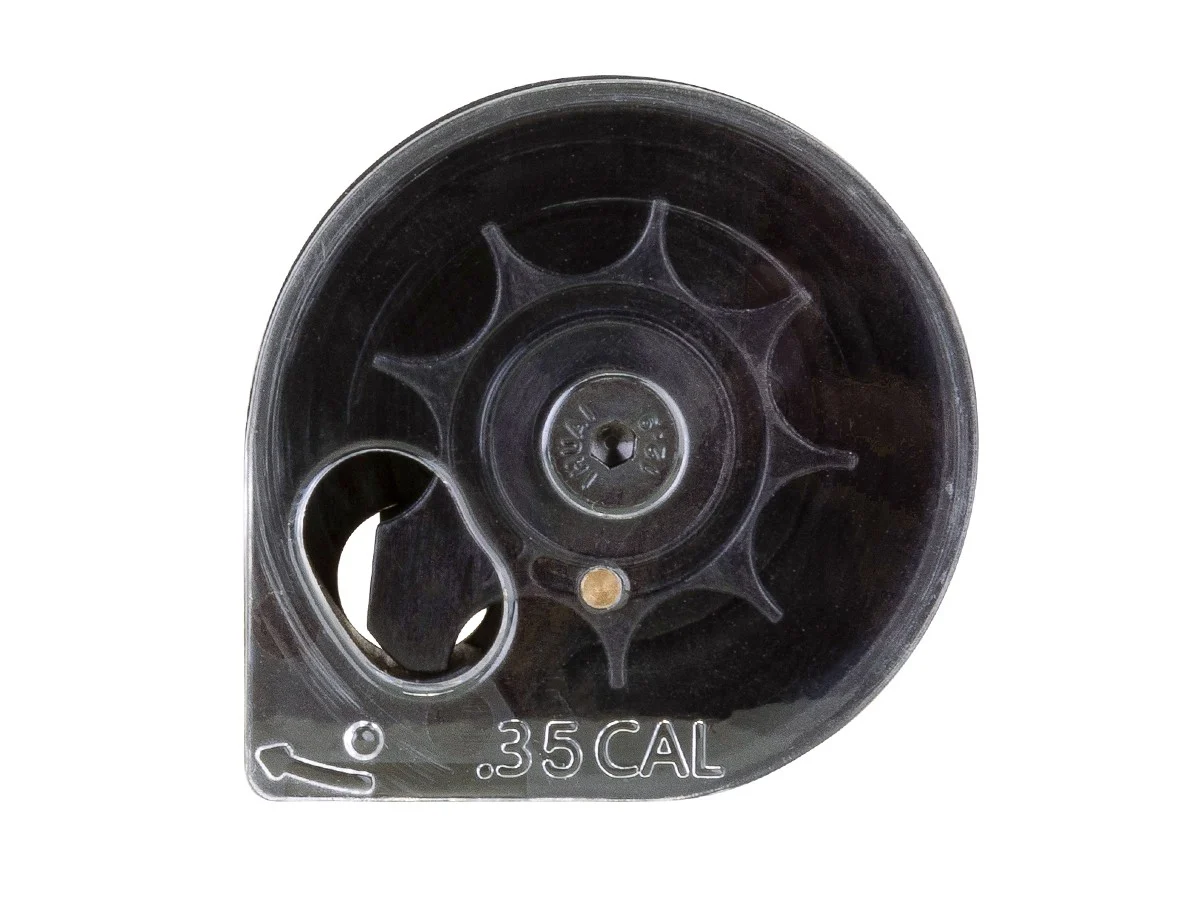
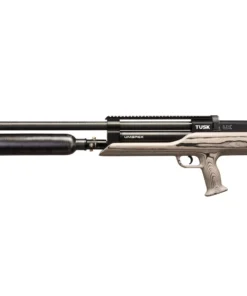
The Umarex Tusk combines affordability and power into a precharged pneumatic air rifle. It shoots slugs or pellets and can launch .357 (9mm) caliber pellets up to 1,085 FPS and deliver up to 228 ft/lbs of energy with 100-grain slugs. With that much power, the Umarex Tusk is a good option for hunting hogs or testing the limits of your target shooting. The side lever action provides quick, smooth operation with an 8-round rotary magazine to keep you in the hunt for longer.
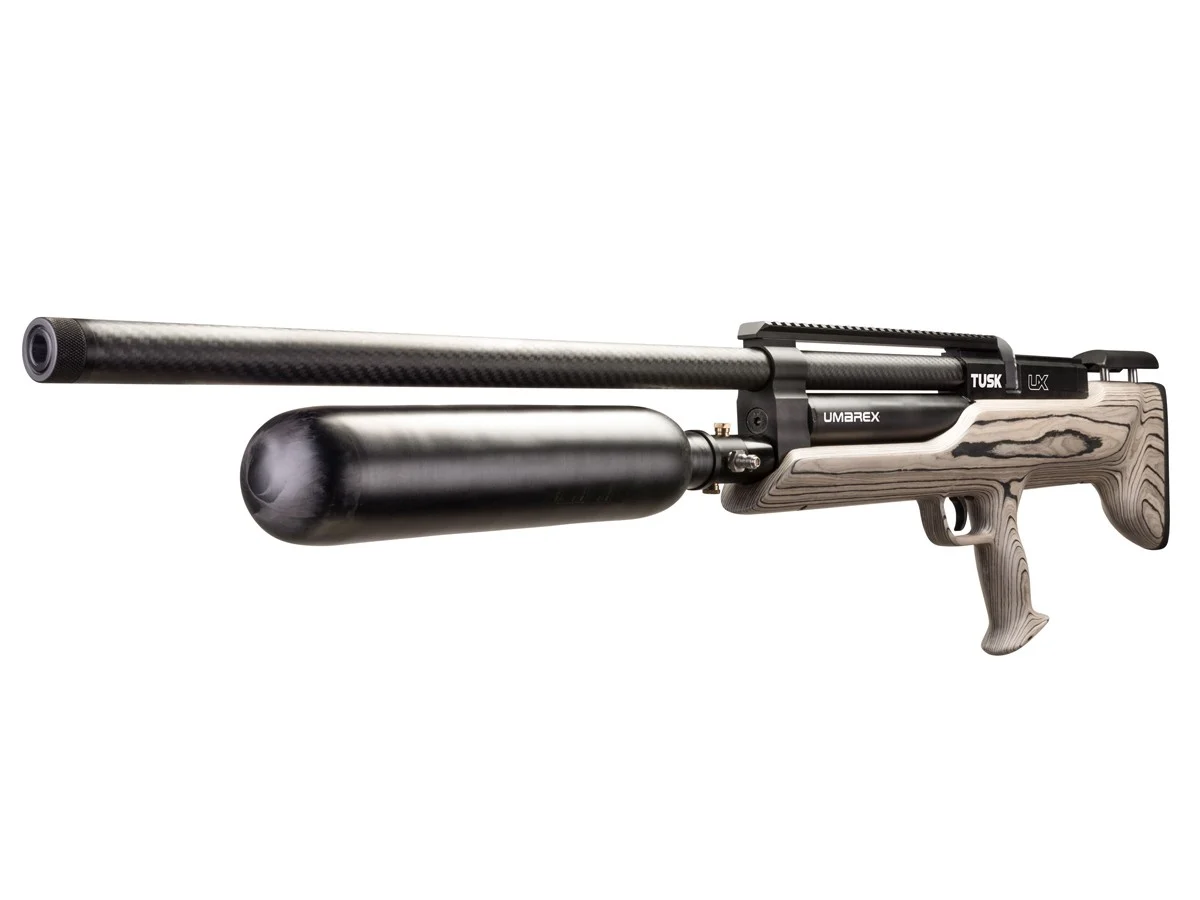
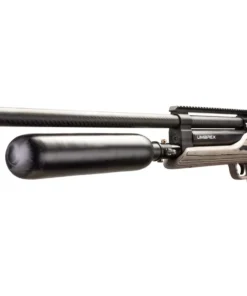
The 500cc carbon fiber tank provides enough air for prolonged shooting, and the regulated fill pressure of 3,250 PSI helps you land consistently powerful shots. Enhancing accuracy is a 28” rifled barrel with a 1:43 twist rate to help stabilize projectiles preflight. Mounting your choice of optic is easy thanks to its Picatinny rail.
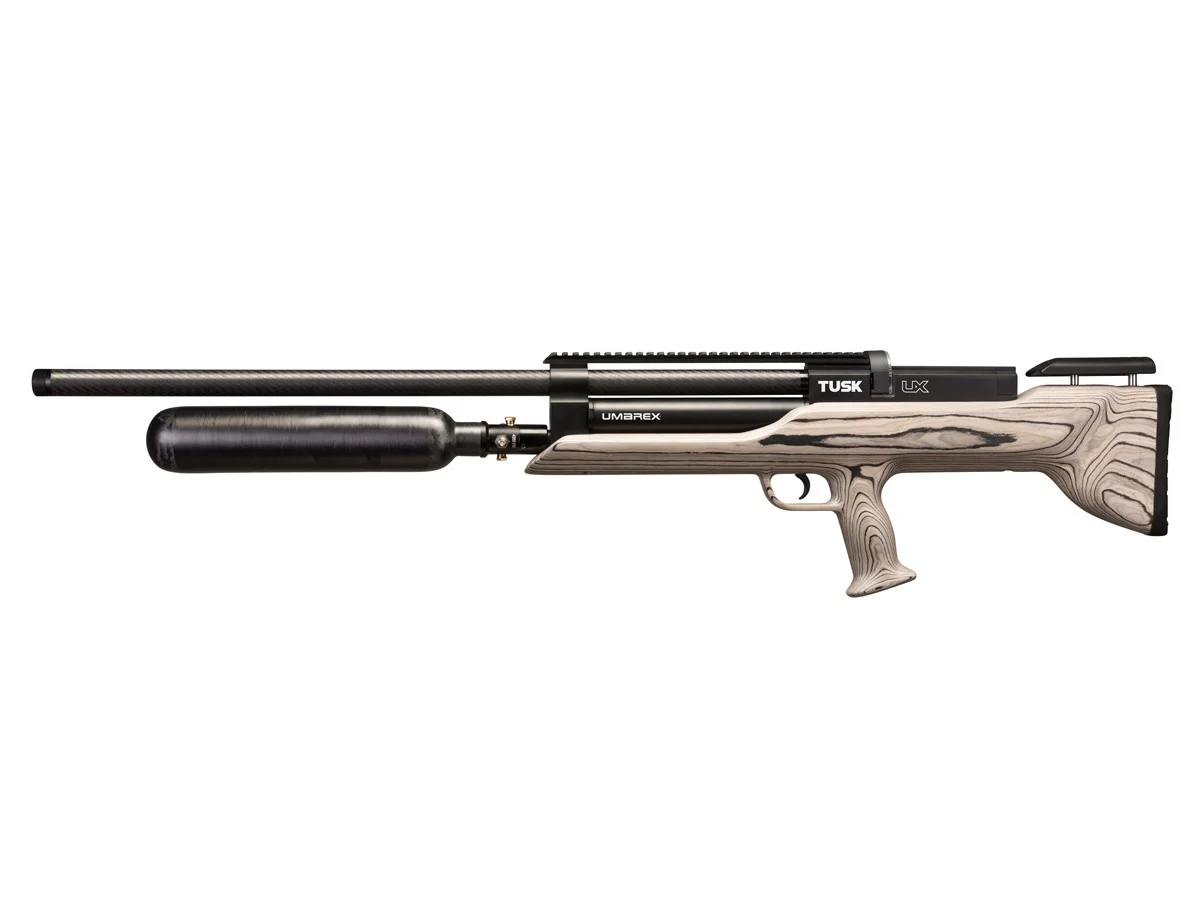
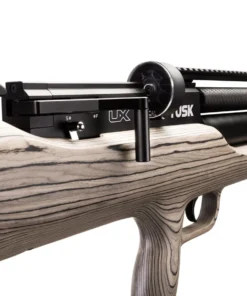
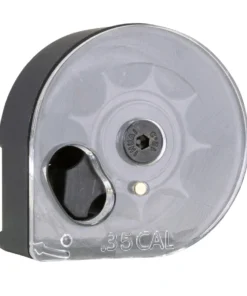
It has a carbon fiber shroud, a laminate stock with an adjustable length of pull and cheek piece height, and comes with two 8-round mags for faster reloading. This air rifle has a Foster quick-connect fitting and a degas screw for easy maintenance and transport. It is 41.75” overall and weighs 10.11 lbs.
Umarex TUSK PCP Air Rifle
- .357 caliber
- Precharged pneumatic
- 500cc, 4,350 PSI bottle
- Regulator: 3,250 PSI
- Bullpup design
- 28″ Rifled barrel with 1:43″ twist
- Max. velocity; 1,085 FPS w/ 82gr pellets
- Max. energy: 228 PFE w/ 100gr slugs
- Two stage trigger
- Picatinny rail
- Carbon fiber shroud
- QD Foster fill port
- Degas screw
- Weight: 10.11 lbs
- Length: 41.75″
- M18x1 muzzle thread
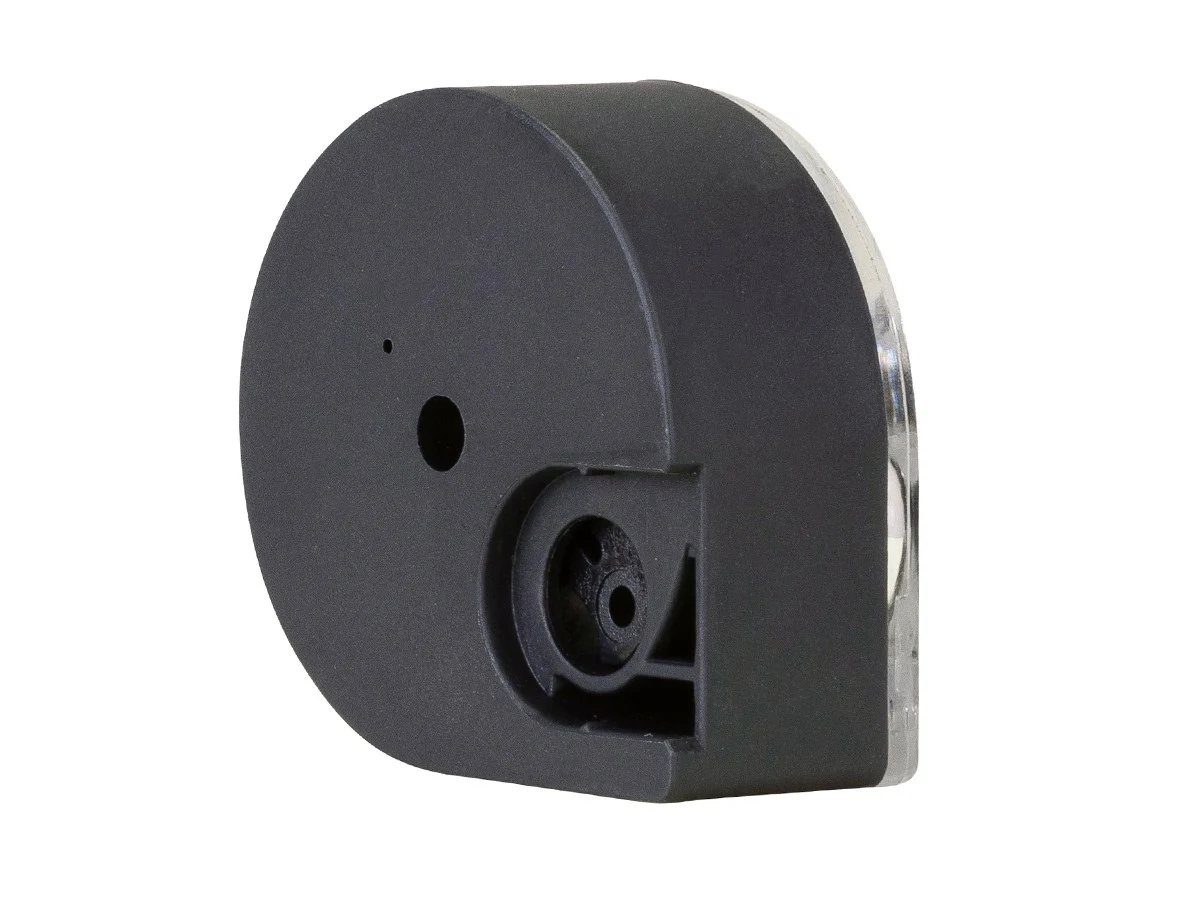
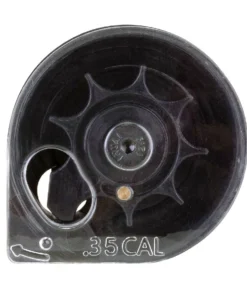
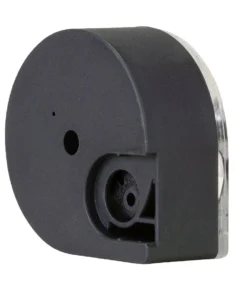
- Comes with two 8-round magazines
Specifications
BrandUmarex
Caliber.357 (9mm)Max Velocity1085 fps Muzzle Energy228 ft/lbsSuggested forHuntingPowerplantPre-charged pneumaticLoudness4-Medium-HighWeight10.11 lbsFunctionRepeaterCylinder Size500 ccActionSideleverShroudedYesScopeableWeaver/PicatinnyFront SightsnoneRear SightsnoneSafetyManualTriggerTwo-stage adjustableBarrelRifledCapacity8 round(s)Body TypeBullpupStockLaminatedButtplateRubberOperating Pressure4351 PSI / 300 BARBarrel Length28 inGrip OrientationAmbidextrousOverall Length41.75 inRegulatedYesBarrel Twist Rate1:43 TwistIs Safe To Dry FireYesMagazine Included1
Umarex TUSK PCP Air Rifle – .357 Caliber Big Bore Precision, Power, Features, Performance & Complete Product Guide
Comprehensive Product Description, Technical Specifications, Engineering, Performance, and Related Airgun Keywords
Umarex TUSK PCP Air Rifle – Advanced .357 Caliber Big Bore Engineering
The Umarex TUSK PCP Air Rifle represents a powerful addition to the modern big-bore pneumatic shooting category. Designed around a regulated pre-charged pneumatic system, this precision-oriented platform combines substantial muzzle energy, a sophisticated air delivery system, and a distinctive bullpup configuration. Consequently, shooters seeking a serious .357-caliber pneumatic rifle can examine a design that emphasizes mechanical consistency, high-pressure engineering, and practical handling.
Unlike conventional spring-powered alternatives, the Umarex TUSK PCP Air Rifle operates using compressed air stored within a dedicated cylinder. This arrangement eliminates the spring-piston recoil cycle and allows the rifle to deliver controlled pneumatic power through its regulated firing mechanism. Furthermore, its combination of a rifled barrel, side-lever action, and rotary magazine creates an operating experience suited to experienced enthusiasts who appreciate advanced mechanical design.
A major attraction of the Umarex TUSK PCP Air Rifle is its stated maximum muzzle energy of approximately 228 foot-pounds when tested with the appropriate 100-grain projectile. Manufacturer and retailer specifications also describe a maximum velocity of approximately 1,075–1,085 feet per second with lighter ammunition, depending on the published source. Importantly, these figures represent different test conditions rather than performance that should be expected simultaneously.
Beyond power, the rifle incorporates a 500cc high-pressure air cylinder, a 3,250 PSI regulator, and an eight-round rotary magazine. Together, these components distinguish it from entry-level recreational air-powered products. An adjustable cheek rest, laminated stock, and Picatinny optics rail further contribute to a configuration developed around practical shooting requirements.
The Umarex TUSK PCP Air Rifle is therefore best understood as an advanced pneumatic system rather than an introductory recreational BB platform. Its design encourages careful consideration of air supply equipment, shooting conditions, appropriate ammunition, safety procedures, and local regulations.
Umarex TUSK PCP Air Rifle Key Features and Technical Specifications
The following specifications summarize the principal characteristics published for this model.
| Specification | Details |
|---|---|
| Manufacturer | Umarex |
| Model | TUSK |
| Product category | Big-bore PCP rifle |
| Caliber | .357 / 9mm |
| Power source | Pre-charged pneumatic |
| Maximum advertised velocity | Up to approximately 1,085 FPS |
| Maximum advertised muzzle energy | Approximately 228 FPE |
| Air cylinder capacity | 500cc |
| Maximum fill pressure | 4,350 PSI / 300 BAR |
| Regulator pressure | 3,250 PSI |
| Magazine capacity | 8 rounds |
| Included magazines | 2, according to retailer specifications |
| Barrel | 28-inch rifled barrel |
| Barrel twist | 1:43 |
| Action | Side-lever |
| Trigger | Two-stage |
| Optics mounting | Picatinny-compatible rail |
| Stock | Laminated wood |
| Cheek rest | Adjustable |
| Muzzle thread | M18×1 |
| Fill connection | Quick-disconnect Foster fitting |
| Overall length | Approximately 41.75 inches |
| Weight | Approximately 10.11 lb |
| Safety | Manual |
These specifications are supported by the manufacturer’s 2026 catalog and published retailer listings. Actual performance depends on the supplied configuration, projectile, environmental conditions, and testing procedure.
umarexusa.com+2
Why the Umarex TUSK PCP Air Rifle Stands Out Among Modern Umarex Airguns
The Umarex TUSK PCP Air Rifle introduces several meaningful distinctions within the broader umarex product ecosystem.
First, the large-caliber configuration separates the rifle from many recreational models. Whereas smaller pneumatic systems frequently emphasize economical practice and lightweight handling, this particular design prioritizes substantial energy and specialized shooting requirements.
Second, the regulated air system supports a more controlled relationship between stored reservoir pressure and the pressure supplied to the firing mechanism. Consequently, its architecture offers an important foundation for repeatability when compared with simpler, unregulated arrangements.
Third, the bullpup layout places important operating components farther toward the rear of the assembly. As a result, the design can accommodate a relatively long barrel without requiring the overall proportions of a traditional long-stocked rifle.
Finally, the laminated stock and adjustable cheek rest provide a combination of distinctive appearance and practical ergonomics. The visual presentation is noticeably different from that of polymer-dominated recreational models.
Buyers researching umarex usa, umarexusa, umerex, and umarex airguns may encounter numerous product families marketed under similar names. However, the Umarex TUSK PCP Air Rifle belongs to a specific big-bore category and should not be confused with smaller CO₂-powered or spring-piston offerings.
How the Pre-Charged Pneumatic Operating System Works
The pneumatic mechanism forms the foundation of the Umarex TUSK PCP Air Rifle.
Instead of relying on a conventional spring to compress air during firing, the system stores pressurized air inside a dedicated reservoir. A valve-based mechanism then controls the release of a measured quantity of compressed air.
This approach offers several engineering advantages.
For example, the absence of a conventional spring-piston firing cycle removes the pronounced mechanical movement associated with many break-barrel models. Moreover, the reservoir allows multiple discharges without rebuilding the air supply after each shot.
The regulator is especially significant because the pressure inside the reservoir decreases as compressed air is consumed. By managing downstream pressure, the system helps reduce certain pressure-related variations that might otherwise influence performance.
Nevertheless, regulation does not guarantee identical velocity on every discharge. Projectile characteristics, temperature, mechanical tolerances, and the rifle’s operating condition remain important.
Understanding this distinction helps prospective owners develop realistic expectations about precision, consistency, and pneumatic efficiency.
Understanding the 500cc High-Pressure Reservoir and Regulator
The Umarex TUSK PCP Air Rifle uses a 500cc cylinder with a published maximum fill pressure of 4,350 PSI.
This specification places the equipment within a high-pressure pneumatic category that requires suitable filling hardware and disciplined safety procedures.
The cylinder’s volume determines how much internal space is available for compressed air, while its maximum rated pressure establishes the upper operating limit. These are different engineering measurements and should never be treated as interchangeable.
Additionally, the 3,250 PSI regulator operates as part of the pressure-management system. Its role is to provide a controlled pressure supply to the firing mechanism under appropriate operating conditions.
Owners should understand that a reservoir with a substantial pressure rating must be treated as a pressure vessel rather than an ordinary removable accessory.
Only manufacturer-approved, compatible filling equipment should be considered. Pressure ratings, cylinder inspections, connector compatibility, and maintenance intervals deserve particular attention.
The Umarex TUSK PCP Air Rifle also incorporates a Foster-style quick-disconnect filling connection. However, buyers should verify exactly which connectors, charging equipment, and accessories are included with their chosen package.
Umarex TUSK PCP Air Rifle Velocity, Energy, and Real-World Performance
Velocity and muzzle energy are two of the most important published performance measurements.
Velocity describes how quickly a projectile travels as it leaves the barrel. By comparison, muzzle energy represents kinetic energy and depends on both projectile mass and velocity.
The relationship explains why two different projectiles can produce substantially different performance figures even when fired from the same pneumatic system.
For the Umarex TUSK PCP Air Rifle, published figures include approximately 1,085 FPS with an 82-grain pellet and 228 FPE with a 100-grain slug.
These figures should not be combined as though they came from one identical test.
Furthermore, maximum advertised numbers do not establish guaranteed performance with every compatible projectile.
Variations in ammunition dimensions, projectile design, reservoir conditions, and the surrounding environment can influence actual measurements.
For this reason, serious buyers should distinguish between:
-
Manufacturer-advertised maximum velocity.
-
Manufacturer-advertised maximum muzzle energy.
-
Independently measured results.
-
Average velocity across a complete test sequence.
-
Repeatability and consistency under controlled conditions.
The last two measurements are particularly important when evaluating practical precision.
Although the Umarex TUSK PCP Air Rifle offers substantial advertised energy, no responsible assessment should substitute maximum specifications for documented accuracy testing.
Precision Engineering and the 28-Inch Rifled Barrel
The 28-inch rifled barrel is one of the defining components of the Umarex TUSK PCP Air Rifle.
Rifling consists of helical grooves within the barrel that impart rotational motion to a suitable projectile. This rotation contributes to aerodynamic stability when the projectile and barrel characteristics are compatible.
The listed twist rate of 1:43 describes one complete turn of the rifling over 43 inches of barrel length.
However, rifling alone does not establish a universal accuracy standard.
Projectile geometry, manufacturing consistency, environmental conditions, and the condition of the bore remain influential factors. Consequently, precise group-size claims should only be made when supported by actual testing.
The barrel is accompanied by a carbon-fiber shroud, which contributes to the rifle’s overall construction and distinctive exterior appearance.
Some retail descriptions associate the shroud with sound management, although it should not be represented as proof of a particular decibel reduction.
Likewise, the published M18×1 muzzle threading does not mean every aftermarket muzzle attachment is automatically compatible or legal.
The combination of rifling, barrel length, and a regulated pneumatic operating system creates a technically interesting platform, but practical precision must ultimately be assessed through reliable evidence.
Bullpup Design, Laminated Stock, and Ergonomic Handling
One of the most recognizable characteristics of the Umarex TUSK PCP Air Rifle is its bullpup configuration.
In a bullpup, major parts of the firing mechanism sit farther toward the rear compared with a conventional rifle layout. This design allows a relatively long barrel to fit within a different overall arrangement.
For the TUSK, the published overall length is approximately 41.75 inches.
Although that dimension is not exceptionally short compared with every other rifle, it should be considered alongside the 28-inch barrel.
The laminated stock adds both visual character and structural interest. Laminated wood is produced by bonding multiple layers together, resulting in a material with different characteristics from conventional solid wood.
Meanwhile, the adjustable cheek rest gives users a means of adapting the stock’s contact geometry to their physical proportions.
The approximately 13.75-inch length of pull provides another useful reference when assessing fit.
At roughly 10.11 pounds before adding certain accessories, the rifle is not an ultralight platform. Buyers should therefore consider the total carried weight when evaluating practical suitability.
An appropriate fit can support comfort and consistent positioning, although individual preferences vary.
Side-Lever Action and Eight-Round Rotary Magazine
The Umarex TUSK PCP Air Rifle combines a mechanical side-lever action with an eight-round rotary magazine.
This arrangement distinguishes it from single-shot designs and certain conventional break-barrel systems.
The rotary magazine provides a defined ammunition capacity, while the side-lever mechanism forms part of the rifle’s operating architecture.
According to published retailer specifications, two eight-round magazines are supplied with the standard package.
Nevertheless, package contents can vary by distributor, region, and product listing. Verification before purchase is therefore important.
Magazine compatibility must also be checked carefully. Similar-looking magazines from another product family should never be assumed interchangeable.
Additionally, owners should familiarize themselves with the manufacturer’s safety instructions, including correct ammunition identification, loading precautions, and storage procedures.
Mechanical condition, magazine integrity, and correct dimensional compatibility all contribute to reliable ownership.
Two-Stage Trigger, Safety, and Optics Compatibility
The Umarex TUSK PCP Air Rifle incorporates a two-stage trigger system.
A two-stage trigger provides a distinct initial movement followed by a second stage associated with the firing mechanism.
The configuration may appeal to experienced precision-shooting enthusiasts who value a clearly defined trigger feel.
However, trigger quality cannot be reduced to the number of stages alone. Mechanical consistency, adjustment range, manufacturing tolerances, and user preference all influence the evaluation.
Additionally, the rifle features a manual safety.
Every owner should regard the safety as one protective feature rather than a substitute for safe handling. The muzzle should always remain pointed in a safe direction, and the rifle should be treated as loaded until its status has been properly verified.
For optics, a Picatinny-compatible mounting rail is included in the published specifications.
This offers a standard mounting interface for suitable optical equipment, although sight height, mount compatibility, eye relief, and the specific optic must be considered separately.
A scope is not necessarily included in the standard product package.
When and Where the Umarex TUSK PCP Air Rifle May Be Appropriate
The Umarex TUSK PCP Air Rifle is best evaluated within controlled, lawful environments that accommodate high-energy pneumatic equipment.
Its substantial muzzle-energy rating places it beyond the requirements of many introductory recreational shooting activities.
Consequently, suitable use depends on the availability of an appropriately designed shooting facility, the relevant local rules, and the operator’s experience.
Some markets classify powerful pneumatic rifles differently from low-energy recreational airguns. In other jurisdictions, their possession or use may involve specific licensing, age, storage, or transport requirements.
The rifle is marketed in part for hunting applications, but that does not establish that every hunting use is permitted or appropriate in every location.
Legal authorization, humane standards, environmental responsibilities, and the specific limitations of the equipment must all be considered.
For a buyer mainly interested in inexpensive casual practice, a lower-powered model may be more practical.
By contrast, an experienced enthusiast who already understands high-pressure pneumatic equipment may find the engineering and performance category more relevant.
How the Umarex TUSK PCP Air Rifle Compares With Other Umarex Air Rifles
The Umarex product range contains several families designed around very different purposes.
The umarex notos and umarex notos carbine, for instance, occupy a smaller-caliber recreational and sporting category.
Meanwhile, the umarex gauntlet, umarex gauntlet 2, and umarex gauntlet 30 represent alternative PCP designs with their own technical specifications.
Other notable search comparisons include umarex zelos, umarex origin, umarex komplete, umarex komplete ncr .22, and umarex synergis elite.
These models should be evaluated individually rather than treated as interchangeable versions of the TUSK.
The umarex fusion 2 occupies another product category, while the umarex hammer, umarex hammer .50 caliber, and umarex hammer carbine are more directly relevant to discussions of large-caliber pneumatic performance.
Nevertheless, a 50 cal air rifle differs significantly from a .357-caliber system in ammunition dimensions and other design considerations.
The umarex primal 20 and umarex shotgun search terms may lead buyers toward larger-projectile pneumatic products, while umarex air saber and umarex air javelin refer to specialized air-powered arrow-launching equipment.
Understanding these distinctions prevents incorrect product substitutions.
For buyers comparing umarex air rifles, the most relevant considerations include intended use, caliber, pneumatic system, reservoir capacity, total weight, regulatory classification, and manufacturer documentation.
The Umarex TUSK PCP Air Rifle should therefore be evaluated on its own engineering merits instead of assuming that features from another Umarex air rifle carry over.
Umarex Glock Pistols, BB Guns, and Airsoft Product Comparisons
Although the Umarex TUSK PCP Air Rifle belongs to the big-bore pneumatic category, many customers discover the manufacturer through its replica pistol and recreational shooting products.
For example, searches involving umarex glock, umarex glock 17, umarex glock 19, and umarex glock 19x generally concern officially licensed replica-style products rather than the TUSK platform.
Similarly, umarex glock 17 gen 5, umarex glock 19 gen3.177 caliber, glock 19 bb gun, and bb gun glock relate to specific model generations, configurations, or product searches.
Customers investigating a glock bb gun, metal bb gun, bb gun air pistol, or pellet pistol should remember that projectiles, operating mechanisms, energy levels, and safety requirements differ considerably across products.
Furthermore, umarex airsoft, airsoft glock, and glock 19 airsoft refer to recreational airsoft categories that typically use different projectiles and operating pressures.
The umarex t4e series introduces another specialized product category. Related searches include umarex tr50, umarex hdr 50, umarex t4e smith, and umarex p2p dr50 how many joules.
These products cannot be evaluated using the TUSK’s specifications, because their projectiles, purposes, and power systems differ.
Other frequently researched models and terms include umarex smith, umarex hk heckler, umarex h, umarex mp40, umarex mp5, and umarex legends.
Additionally, entry-level products such as the umarex dx17, umarex bb gun, and umarex trevox may attract customers looking for accessible recreational equipment.
Searches for loading umarex trevox break barrel .177 and umarex pistol break barrel concern different mechanical systems and should be answered using their respective official manuals.
Therefore, the Umarex TUSK PCP Air Rifle should be presented as a separate high-pressure model rather than grouped indiscriminately with replica pistols, airsoft equipment, or low-energy recreational products.
Stoeger Airguns and Alternative PCP Rifle Comparisons
The Umarex TUSK PCP Air Rifle may also attract buyers researching competing manufacturers and alternative pneumatic systems.
One frequently encountered brand is stoeger, which supplies products across multiple shooting-related categories.
Popular searches include stoeger xm1, stoeger xm1 air rifle, stoeger xm1 suppressed, stoeger airguns, and stoeger guns.
The xm1 designation is especially relevant when comparing alternative pneumatic rifle platforms, although the actual specifications depend on the individual model and regional configuration.
Similarly, rx20 is associated with another product family, while stoeger xrd50 and xrd50 stoeger identify a separate specialized product.
Search spelling variations such as stoger, stoeg, stroeger, and stoiger commonly appear in online research. Nevertheless, the correct manufacturer name should be used in product specifications and purchasing documentation.
Buyers comparing brands should consider:
-
The actual caliber and permissible ammunition.
-
The type of pneumatic operating mechanism.
-
Maximum rated pressure and filling requirements.
-
Availability of genuine replacement components.
-
Published manufacturer warranties.
-
Product weight and ergonomics.
-
Regulatory classifications.
-
Verified technical specifications.
-
Appropriate maintenance procedures.
-
Local service and technical support.
The Umarex TUSK PCP Air Rifle distinguishes itself through its specific combination of .357-caliber capability, regulated compressed-air operation, laminated bullpup construction, and relatively large air reservoir.
However, suitability should be determined by the buyer’s intended application rather than by assuming that one manufacturer is categorically superior.
Beretta Company History, Stoeger Ownership, and Manufacturing Background
The history of competing brands provides useful context for customers interested in manufacturing heritage.
Questions involving beretta company history, history of beretta, and beretta founded generally refer to the Italian manufacturer whose documented origins date to 1526.
For buyers asking how long has beretta been in business or when did beretta start making guns, the company’s recognized foundation in 1526 provides the historical reference point.
Searches for who owns beretta lead to the corporate structure of Beretta Holding, which includes numerous international brands.
Meanwhile, who owns stoeger industries can be answered through its relationship with the Beretta corporate group and its associated operations.
Questions about where is beretta made require distinction between the historic Italian manufacturer and the group’s international production facilities.
Likewise, where is stoeger made cannot always be answered with one country for every product. Manufacturing locations depend on the specific product family and corporate operation. Beretta Holding identifies a major Stoeger manufacturing operation in Istanbul, Türkiye.
beretta.com+2
Additional searches for beretta gun, baretta gun, and baretta reflect both correct and alternative spellings used by shoppers.
Although these brands form part of the wider shooting-products industry, their corporate history should not be mistaken for the manufacturing history or ownership of the Umarex TUSK PCP Air Rifle.
Air Rifle Compressor Requirements and High-Pressure Accessories
A suitable air rifle compressor is an important purchasing consideration for owners of high-pressure pneumatic equipment.
The Umarex TUSK PCP Air Rifle operates with a reservoir rated to approximately 4,350 PSI, so filling equipment must be compatible with the manufacturer’s specified pressure limits and connection requirements.
Not every compressor advertised for recreational pneumatic equipment can safely supply the required pressure.
Therefore, equipment specifications should be reviewed before purchase.
A suitable filling system should have documented pressure capability, approved connections, appropriate pressure monitoring, and manufacturer-supported operating instructions.
Buyers should also understand the difference between compressed-air equipment and low-pressure inflation devices.
Another commonly researched accessory is an air gun suppressor. However, the presence of muzzle threading does not establish universal accessory compatibility.
Legal restrictions, appropriate engineering specifications, and manufacturer guidance must be checked before any muzzle accessory is considered.
Recommended ownership-related equipment categories include:
-
Manufacturer-approved compressed-air charging equipment.
-
Pressure-rated filling connections.
-
Compatible protective transport cases.
-
Suitable optical mounting hardware.
-
Approved cleaning and maintenance supplies.
-
Protective eyewear.
-
Secure storage equipment.
-
Genuine replacement magazines.
-
Manufacturer-authorized spare components.
Because the system uses high internal pressure, unauthorized modifications and incompatible equipment can introduce significant hazards.
Why Precision, Engineering Quality, and Maintenance Matter
The Umarex TUSK PCP Air Rifle should be evaluated as a complete mechanical assembly.
Its performance depends on more than one highly advertised specification.
For example, a rifled barrel contributes to projectile stabilization, but repeatability also depends on appropriate ammunition and consistent mechanical operation.
Similarly, a regulated pressure system supports controlled air delivery without eliminating every source of variation.
The trigger, stock, optics interface, and overall weight also affect how comfortably and consistently the rifle can be used.
Maintenance is equally important.
Clean external components, properly maintained seals, inspected filling hardware, and adherence to the manufacturer’s servicing schedule can help preserve reliable operation.
However, pressure-bearing components require special care. Internal disassembly should not be attempted without appropriate manufacturer authorization and technical expertise.
In addition, the equipment should be inspected for visible damage, corrosion, unusual leaks, and other concerns before use.
The importance of maintenance becomes especially clear when equipment is stored for extended periods or transported regularly.
For buyers who value durability, responsible maintenance is part of long-term ownership rather than an optional afterthought.
Is the Umarex TUSK PCP Air Rifle Worth Considering?
The Umarex TUSK PCP Air Rifle offers a distinctive combination of high-pressure pneumatic engineering, substantial advertised muzzle energy, and advanced exterior design.
Its principal strengths include the regulated reservoir, eight-round magazine, laminated stock, side-lever action, rifled barrel, and compatibility with the manufacturer’s designated .357-caliber ammunition types.
However, the rifle also demands appropriate supporting equipment, serious attention to safety, and an understanding of applicable regulations.
The relatively substantial weight may not suit every prospective owner. Likewise, the costs associated with high-pressure filling equipment, approved accessories, maintenance, and storage should be considered alongside the rifle’s purchase price.
For someone researching sophisticated pneumatic equipment, the TUSK offers a technically distinctive package.
Ultimately, its value depends on whether the engineering features, performance category, handling characteristics, and ongoing ownership requirements align with the intended lawful application.
Detailed Performance Analysis, Practical Ownership, Precision Evaluation, Safety, Maintenance, and Frequently Asked Questions
Understanding the Engineering Philosophy Behind the Design
A sophisticated pneumatic shooting platform should be evaluated as an integrated mechanical system rather than a collection of impressive specifications. Every major component contributes to the complete operating experience, from the pressure reservoir to the trigger mechanism and stock geometry.
The purpose of advanced engineering is not simply to produce a high advertised velocity. Instead, a successful design must balance power, repeatability, structural reliability, handling, and maintenance requirements.
Consequently, buyers should consider how individual design decisions interact. A powerful operating mechanism may offer substantial performance, but its advantages can be limited if supporting equipment is unsuitable or operating conditions are inconsistent.
Similarly, premium exterior materials may improve appearance and perceived quality without automatically guaranteeing superior mechanical performance.
A useful evaluation therefore begins with the intended purpose. Recreational target shooting, technical experimentation, and organized sporting activities create different demands.
Understanding those demands helps buyers distinguish meaningful engineering advantages from features that are simply attractive in product photographs.
Why Consistent Air Delivery Is Important
Consistency is fundamental to the evaluation of high-pressure pneumatic technology.
During operation, compressed air supplies the energy required by the mechanical system. As the reservoir’s stored pressure changes, the pressure-management assembly plays an important role in controlling the supply available to the firing mechanism.
However, controlled pressure is not the same as guaranteed identical results.
Mechanical tolerances, temperature, component condition, projectile variation, and other factors still contribute to measurable differences.
For that reason, high-quality performance assessments examine repeatability rather than relying exclusively on maximum advertised values.
The relationship between reservoir pressure and downstream pressure also deserves attention. These measurements describe different parts of the system, and misunderstanding them can lead to incorrect assumptions about operation.
Owners should always consult official documentation to understand pressure limitations and approved servicing requirements.
Furthermore, pressure-related components should never be modified simply to pursue a different performance figure. Changes outside manufacturer specifications can compromise safety, reliability, and legal compliance.
Ultimately, a well-engineered pressure-management system provides a foundation for consistent operation, but responsible ownership remains essential.
How Barrel Construction Contributes to Precision
The barrel forms one of the most mechanically significant parts of a precision-oriented shooting system.
Its internal geometry interacts directly with the projectile during the firing process. Accordingly, the quality and consistency of the bore can influence the projectile’s behavior.
Rifled barrels introduce rotational movement that helps stabilize compatible projectiles. Nevertheless, the effectiveness of this interaction depends on multiple variables, including projectile construction and dimensional compatibility.
A longer barrel also changes the physical proportions of the platform. Depending on the overall design, barrel length can influence weight distribution and the relationship between the main operating components.
It would be misleading, however, to suggest that a longer barrel automatically produces better accuracy in every circumstance.
Real precision must be demonstrated through repeatable testing performed under documented conditions.
For buyers, the most useful information includes the manufacturer’s stated barrel specifications, verified material quality, suitable ammunition requirements, and independent evidence of consistency.
The barrel should also receive appropriate maintenance in accordance with official instructions. Unnecessary abrasive cleaning, inappropriate tools, and careless handling can damage precision surfaces.
Therefore, long-term accuracy depends on both the original engineering and responsible care.
The Importance of Stock Design and Physical Comfort
Stock construction affects more than the external appearance of a shooting platform.
It helps determine how the equipment is supported, how its weight is distributed, and how comfortably different users can interact with it.
Physical fit is especially important because body proportions vary considerably.
A stock that feels appropriate to one person may feel less comfortable to another. Differences in arm length, facial structure, shoulder proportions, and personal preferences all influence the experience.
Adjustable contact surfaces can provide flexibility, although they do not guarantee a perfect fit for every user.
Material selection also affects the overall character of the product.
Laminated wood offers a distinctive layered appearance and can provide useful dimensional characteristics when properly manufactured. Nevertheless, the final performance depends on material quality, bonding processes, finishing, and design.
External surfaces should be inspected periodically for visible damage, loose fittings, and moisture-related deterioration.
Proper storage also helps maintain the condition of wooden and metallic components.
For buyers comparing premium sporting equipment, ergonomics should be regarded as a functional consideration rather than merely an aesthetic preference.
Evaluating the Trigger Mechanism
The trigger is an important interface between the user and the mechanical firing system.
Its design influences the tactile experience and contributes to the overall impression of engineering quality.
A sophisticated mechanism may provide a more clearly defined movement than a basic arrangement. However, the quality of that experience depends on manufacturing consistency, mechanical condition, and individual expectations.
Trigger characteristics should always be assessed within the manufacturer’s approved specifications.
Unauthorized adjustment or internal modification can create serious safety problems.
Additionally, the trigger should never be regarded as a substitute for disciplined handling practices.
A properly functioning safety mechanism, appropriate storage, and consistent attention to muzzle direction remain essential regardless of the trigger configuration.
When evaluating equipment, buyers should seek reliable information about factory settings, approved maintenance, warranty coverage, and available professional servicing.
These considerations offer a more meaningful understanding of mechanical quality than promotional claims alone.
Why Overall Weight Matters
Weight influences portability, comfort, storage requirements, and the physical experience of handling sporting equipment.
A heavier platform may feel substantial and stable in certain controlled settings. However, that same weight can become inconvenient during extended carrying or frequent transportation.
The significance of weight also depends on its distribution.
Two products with similar total masses can feel noticeably different because their components are positioned differently.
Furthermore, accessories add to the complete assembled weight. Optical equipment, mounting hardware, carrying attachments, and other compatible components can change the handling characteristics.
Therefore, advertised weight should not be interpreted as the final weight of every possible configuration.
Buyers should consider their physical capabilities, intended activities, and available storage arrangements.
Comfort is not determined by weight alone, but it remains a major factor in long-term satisfaction.
A suitable product should accommodate the user’s needs without creating unnecessary handling difficulties.
Understanding Advertised Velocity and Measured Results
Velocity is one of the most recognizable measurements in pneumatic product advertising.
Nevertheless, it is frequently misunderstood.
An advertised maximum usually represents a result achieved under particular testing conditions. The figure may depend on the characteristics of the projectile and the specific test configuration.
Consequently, maximum velocity should not be confused with the average result across every operating condition.
Independent testing can provide valuable additional context when its methodology is clearly documented.
Useful information includes the test environment, number of measurements, equipment condition, and whether the results were reproduced.
The absence of such information makes direct comparisons less reliable.
Additionally, higher velocity does not automatically establish greater precision.
Accuracy involves the interaction of several factors, including projectile stability, mechanical consistency, and external conditions.
A comprehensive performance assessment therefore examines multiple measurements instead of selecting the single largest published number.
Why Muzzle Energy Requires Separate Consideration
Muzzle energy describes the kinetic energy carried by a projectile as it leaves the barrel.
Unlike velocity, kinetic energy incorporates projectile mass.
This distinction is essential because two projectiles traveling at different velocities can produce different energy measurements.
Accordingly, a product’s advertised maximum energy and maximum velocity may come from separate tests.
Combining those figures without reviewing the test conditions can create a misleading description of performance.
Energy also has important safety implications.
High-energy projectiles can remain dangerous at considerable distances, and appropriate backstops are essential in any authorized shooting environment.
For that reason, a powerful pneumatic product should never be treated as harmless simply because it does not use conventional firearm ammunition.
Responsible users must account for the relevant legal classification, safe facility requirements, and potential consequences of improper handling.
Clear explanations of energy help buyers make informed decisions while avoiding exaggerated performance claims.
Why Precision Cannot Be Judged by Advertised Power Alone
Power and precision describe different characteristics.
A product may generate substantial kinetic energy without necessarily producing exceptional repeatability.
Likewise, a lower-powered system may demonstrate impressive consistency under suitable controlled conditions.
Precision depends on the complete relationship between the mechanical assembly, compatible projectile, environmental conditions, and evaluation method.
Manufacturing tolerances also matter.
Even small variations between components can influence the consistency of complex mechanical systems.
However, meaningful conclusions require evidence rather than assumptions.
Photographs of targets, isolated testimonials, and manufacturer claims can be useful starting points, but they do not replace structured performance testing.
Buyers should distinguish verified group measurements from unsupported descriptions such as exceptional, unmatched, or perfect accuracy.
A credible product description communicates the available specifications while acknowledging their limitations.
That approach provides greater long-term value than exaggerated claims that may not reflect actual ownership experiences.
Long-Term Reliability and Mechanical Durability
Reliability becomes particularly important when equipment contains pressurized components, moving mechanical assemblies, and precision surfaces.
A durable product should maintain its intended functions when used and maintained according to manufacturer instructions.
However, durability cannot be determined from appearance alone.
A substantial stock, attractive finish, or reinforced-looking exterior does not prove that every internal component will have an unusually long service life.
Long-term reliability depends on material selection, quality control, mechanical design, environmental exposure, and maintenance history.
Seals and other consumable components may require periodic professional attention.
Similarly, moving assemblies can experience wear over time.
Owners should follow the official service schedule and respond promptly to unusual noises, damaged parts, unexpected pressure changes, or other mechanical irregularities.
Unauthorized repairs can create additional hazards, particularly when pressure-bearing components are involved.
Responsible maintenance is therefore an essential element of reliable ownership.
The Importance of Proper Pressure-Vessel Care
A compressed-air reservoir is a specialized pressure vessel that requires careful handling.
Its structural integrity is fundamental to safe operation.
Consequently, the reservoir should be protected against significant impacts, excessive heat, corrosion, unauthorized modifications, and other damaging conditions.
Owners should verify the manufacturer’s inspection guidance and any applicable legal requirements for periodic testing.
A visible pressure rating does not mean the reservoir can be filled without regard to the equipment’s condition.
Likewise, the presence of a compatible-looking connector does not establish that a filling system meets the necessary technical standards.
Only approved filling equipment and procedures should be used.
If visible damage, leakage, or another suspected defect is discovered, operation should stop until the equipment has been assessed by an appropriately qualified professional.
Pressure-vessel maintenance should never be improvised.
These precautions protect both the equipment and the people who may be nearby.
Why Quality Control Matters Before Purchase
Product quality begins long before equipment reaches its eventual owner.
Manufacturing processes, inspection procedures, materials, and assembly controls all contribute to the final result.
However, individual products can still vary.
For this reason, buyers should examine the condition and documentation of the specific item they intend to purchase.
A trustworthy product listing should identify the exact model, configuration, manufacturer part number, warranty terms, and included components.
Photographs should represent the actual product or be clearly labeled as manufacturer illustrations.
Additionally, retailers should distinguish between factory-new, refurbished, previously owned, and display-condition equipment.
Condition descriptions are especially important for products containing seals or pressurized components.
Buyers should also confirm whether the manufacturer provides local warranty support and whether approved service facilities are reasonably accessible.
Clear purchasing information reduces uncertainty and supports a better ownership experience.
Practical Considerations for Controlled Sporting Environments
An appropriate shooting environment must accommodate the equipment’s energy level and the risks associated with its projectiles.
Not every recreational facility is designed for powerful pneumatic platforms.
Consequently, facility approval should be obtained before use.
Operators should also confirm that suitable backstops, protective arrangements, and supervision requirements are in place.
Public areas, residential surroundings, and improvised locations may create unacceptable hazards or violate applicable laws.
Furthermore, organized facilities may have their own rules concerning permitted equipment, operating procedures, and required protective gear.
Those rules should be followed even when local legislation imposes fewer restrictions.
For newcomers to advanced pneumatic technology, professional instruction can provide a valuable introduction to safe handling and ownership responsibilities.
Responsible recreational participation involves planning, respect for others, and compliance with established procedures.
Storage and Transportation Considerations
Secure storage is a central responsibility of ownership.
Equipment should be kept inaccessible to unauthorized individuals, including children and visitors who are unfamiliar with its hazards.
A locked storage system can provide an important layer of protection.
Ammunition and related equipment should also be secured appropriately.
Before transportation, owners should review the laws governing the journey, including any restrictions imposed by carriers or facilities.
Requirements may differ between private vehicles, commercial transport, and international shipping.
Furthermore, compressed-gas containers can be subject to additional transport restrictions.
Original packaging may provide some protection, but it is not necessarily a substitute for a suitable protective case.
Documentation can also be important when transporting regulated equipment.
Owners should retain purchase information, identifying details, and any required permits or certificates.
Secure transportation protects the equipment while helping prevent unauthorized access and accidental damage.
Environmental Conditions and Material Preservation
Environmental exposure can affect both exterior materials and internal mechanical components.
Moisture is a particular concern because it can contribute to corrosion and deterioration of certain finishes.
Excessive heat may also create problems for seals and pressure-bearing assemblies.
Therefore, equipment should be stored in a suitable location that meets the manufacturer’s environmental recommendations.
Wooden components deserve appropriate care because changes in humidity can influence their condition.
Metallic surfaces may require approved protective maintenance, while optical equipment should be cleaned using methods recommended by its manufacturer.
Direct exposure to rain, dust, and harsh environmental conditions should be minimized whenever practical.
After use in challenging weather, the exterior should be inspected and maintained according to official instructions.
Careful storage and cleaning help preserve appearance, functionality, and long-term value.
Choosing Suitable Supporting Equipment
The main product is only one component of a complete ownership arrangement.
Depending on the manufacturer’s package, additional equipment may be necessary.
Buyers should establish which components are included before ordering separately.
Suitable supporting products may include protective storage, eye protection, approved filling equipment, and compatible optics.
However, accessory selection should never rely exclusively on visual similarity.
Mechanical interfaces, pressure ratings, dimensions, legal requirements, and manufacturer recommendations must be considered.
A part designed for a different product may not be interchangeable, even when the two products belong to the same broad category.
Similarly, an accessory advertised as universal may still have important restrictions.
A reliable retailer should provide accurate compatibility information and identify the intended application.
This approach helps avoid unnecessary purchases while supporting safe, dependable ownership.
Evaluating the Total Cost of Ownership
Purchase price provides only an initial indication of long-term expense.
Advanced pneumatic equipment can involve additional costs for filling equipment, protective storage, maintenance, accessories, and transportation.
These expenses should be considered before the purchase is completed.
For instance, a buyer who does not already own approved high-pressure charging equipment may need to account for a separate investment.
Ongoing servicing can create further costs.
Likewise, replacement components may be subject to availability limitations or regional shipping charges.
A comprehensive budget should therefore include the initial product, essential accessories, and reasonable maintenance expectations.
Warranty support may also influence the total cost.
An inexpensive purchase from an unsupported seller can become less attractive if replacement parts or professional service prove difficult to obtain.
Transparent budgeting helps buyers choose equipment that remains practical beyond the initial purchase.
The Importance of Genuine Replacement Components
Mechanical compatibility is essential when replacing worn or damaged components.
Genuine manufacturer-supported parts offer an identifiable reference for compatibility and servicing.
By comparison, unverified aftermarket components may differ in dimensions, materials, or mechanical characteristics.
Those differences can become especially significant within pressure-bearing assemblies and critical safety mechanisms.
Therefore, replacement parts should be selected using the manufacturer’s documentation.
Where specialized service is required, a qualified technician should perform the work.
Owners should also avoid assuming that components from visually similar products are interchangeable.
Product revisions can introduce mechanical differences that are not obvious from exterior photographs.
Maintaining clear records of the exact model and its identifying information can simplify future service requests.
Why Manufacturer Documentation Is Essential
Official product documentation provides information that promotional descriptions cannot fully replace.
It identifies the manufacturer’s intended operating conditions, safety requirements, maintenance guidance, and service limitations.
Consequently, every owner should read the documentation before first use.
The manual should also remain accessible throughout the ownership period.
When uncertainty arises, its instructions should take priority over informal advice from unverified sources.
Online discussions can provide useful experiences, but individual recommendations may concern different configurations or operating conditions.
A manual also helps clarify which tasks fall within routine owner maintenance and which require professional service.
In the event of a suspected mechanical defect, direct manufacturer support is generally more appropriate than experimental troubleshooting.
Reliable documentation is therefore part of the product’s practical value.
Evaluating Warranty Coverage and Customer Support
Warranty terms can vary by manufacturer, seller, location, and product condition.
Buyers should not assume that all purchases receive identical coverage.
For example, international purchases may involve different servicing arrangements from products sold through an authorized domestic distributor.
Proof of purchase is often important when requesting warranty assistance.
Furthermore, unauthorized modifications may affect eligibility for certain types of support.
Before purchasing, customers should review the applicable warranty documentation and confirm available service channels.
A reputable seller should explain how warranty requests are handled and what documentation is required.
After-sales support deserves particular consideration for technically complex equipment because specialized maintenance may be necessary during ownership.
Accessible service can make a meaningful difference to long-term satisfaction.
Frequently Asked Questions About Performance, Ownership, and Practical Suitability
What makes this platform different from an ordinary recreational pneumatic product?
The most important distinction lies in its engineering category.
It incorporates a high-pressure reservoir, regulated air delivery, a relatively large projectile diameter, and mechanical components intended for a more demanding performance class.
Consequently, it requires greater attention to filling equipment, safety, maintenance, and legal compliance.
Entry-level recreational products often involve simpler ownership arrangements.
A technically advanced system should therefore be selected only after considering its complete requirements.
Is this equipment suitable for someone with no previous experience?
A first-time owner may find the technical requirements demanding.
High-pressure equipment introduces responsibilities that are not necessarily present with basic recreational products.
For that reason, appropriate training and familiarity with official safety instructions are strongly recommended.
A qualified instructor can help explain the responsibilities associated with powerful pneumatic equipment.
The buyer’s experience should form part of the purchasing decision.
Does a high advertised velocity guarantee excellent accuracy?
No.
Velocity measures projectile speed, whereas accuracy describes how closely repeated results correspond to the intended point of impact.
A high maximum velocity does not automatically produce small groups or consistent results.
Accurate assessment requires repeatable evidence under controlled conditions.
Why does the manufacturer provide both velocity and energy measurements?
Each measurement describes a different aspect of performance.
Velocity indicates speed, while energy accounts for the relationship between projectile mass and speed.
As a result, maximum values may come from tests using different projectile weights.
Both figures should be interpreted alongside the manufacturer’s test information.
What is the advantage of regulated pressure?
A regulator manages the pressure supplied to the operating mechanism.
This arrangement can help reduce certain variations associated with declining reservoir pressure.
However, it cannot eliminate every source of performance variation.
Overall consistency still depends on mechanical condition, ammunition characteristics, and environmental factors.
How important is ammunition compatibility?
Compatibility is critical.
Projectiles must meet the manufacturer’s specified requirements.
Different dimensions, materials, or shapes may not be suitable even when their nominal caliber appears similar.
Owners should rely on official compatibility guidance rather than assumptions based on packaging alone.
Can any high-pressure compressor be used?
No.
The charging equipment must meet the manufacturer’s pressure, connection, and safety requirements.
A compressor’s advertised maximum pressure is only one consideration.
Its approved application, condition, fittings, and operating documentation must also be checked.
Using unsuitable equipment can create serious hazards.
Is a manual pump always a practical alternative?
Not necessarily.
Practical suitability depends on the manufacturer’s guidance and the capabilities of the particular filling equipment.
High-pressure systems can require specialized charging arrangements.
Owners should verify approved options before purchasing accessories.
Why is a pressure gauge important?
Pressure monitoring helps users identify the state of a compressed-air system.
However, gauge readings must be interpreted correctly, and the equipment must remain within its rated limits.
A pressure gauge does not replace the need for an approved filling procedure or regular inspection.
How often should the pressure reservoir be inspected?
Inspection requirements depend on the manufacturer’s instructions, reservoir construction, age, condition, and applicable regulations.
There is no single universal schedule that applies to every pressure vessel.
Owners should follow the specific documented requirements and arrange qualified assessment whenever damage is suspected.
What should happen if a leak is detected?
Operation should stop.
The equipment should be handled according to the manufacturer’s safety instructions and examined by qualified service personnel.
Attempting an improvised repair on a pressurized assembly can be dangerous.
Does the exterior stock material affect durability?
Material selection influences appearance, environmental behavior, and structural characteristics.
However, durability also depends on manufacturing quality and maintenance.
No material should be assumed completely immune to moisture, impact, or wear.
Proper care remains important.
Is a laminated stock considered premium?
Laminated construction is frequently associated with distinctive appearance and engineered material properties.
Nevertheless, quality depends on the actual manufacturing process.
Buyers should assess construction, finishing, fit, and documented specifications rather than assuming that every laminated product is identical.
How important is the cheek-rest adjustment?
An adjustable contact surface can help accommodate differences in user proportions.
It may improve the comfort of the equipment when properly used within the manufacturer’s instructions.
However, individual fit remains subjective.
The presence of adjustment should not be interpreted as a guarantee of universal comfort.
Does a two-stage trigger automatically improve precision?
Not automatically.
A two-stage arrangement provides a particular mechanical feel, but accuracy depends on multiple factors.
Manufacturing consistency and the operator’s experience also influence results.
Unauthorized trigger modifications should be avoided.
Are rotary magazines always more reliable than single-shot systems?
Reliability depends on the specific design, manufacturing quality, mechanical condition, and correct ammunition.
A magazine increases convenience by accommodating multiple projectiles.
However, additional moving components can also require inspection and maintenance.
Neither arrangement should be described as universally superior.
Why are manufacturer-approved magazines important?
Correct magazines help maintain the intended mechanical compatibility of the system.
Visually similar magazines may have different dimensions or operating characteristics.
Accordingly, replacement purchases should be checked against official part numbers and documentation.
Is a long barrel automatically better?
No.
Barrel length influences the physical design and may affect certain performance characteristics.
Nevertheless, precision depends on more than length.
Bore quality, projectile compatibility, operating consistency, and testing conditions also matter.
Can the equipment be used without an optical sight?
That depends on the supplied configuration and the manufacturer’s intended sighting arrangements.
A mounting rail does not necessarily indicate the presence of factory-installed sights.
Buyers should check the package contents and approved equipment specifications.
Are all optical mounts interchangeable?
No.
Even when products use a common rail standard, differences in dimensions, construction, and mechanical suitability remain important.
The chosen equipment should be compatible with the manufacturer’s documented mounting interface.
Can an aftermarket muzzle accessory be fitted?
Compatibility cannot be established by thread dimensions alone.
The accessory must be mechanically suitable, manufacturer-approved where required, and lawful in the relevant jurisdiction.
Local restrictions may apply.
Buyers should verify these conditions before purchasing.
Is the equipment quiet enough for residential use?
No assumption of residential suitability should be made.
Powerful pneumatic equipment can generate considerable sound, and noise is only one aspect of safe operation.
Projectile hazards, property boundaries, local regulations, and the availability of appropriate backstops are equally important.
An approved shooting facility is the more appropriate environment.
Can this product be used at any shooting range?
No.
Facilities establish their own equipment restrictions and safety standards.
Some ranges may prohibit high-energy pneumatic equipment or require special arrangements.
Permission should always be obtained before use.
What type of protective equipment is important?
Appropriate protective eyewear is essential in authorized shooting environments.
Other safety equipment may be required by the facility or recommended by qualified instructors.
The exact requirements should reflect the activity, equipment, and local regulations.
Can the product be stored in a normal household cupboard?
Unsecured household storage may be inadequate.
A lockable storage arrangement that prevents unauthorized access is preferable.
The storage environment should also satisfy the manufacturer’s requirements for temperature, humidity, and general equipment protection.
Should ammunition be stored separately?
Separate secure storage can help reduce unauthorized access and accidental misuse.
Owners should follow the applicable laws and manufacturer’s safety guidance.
The storage system should reflect the hazards associated with the equipment.
Is international transportation straightforward?
Not always.
Transport requirements can vary significantly between countries.
Airlines, shipping companies, and customs authorities may impose additional restrictions.
Pressure vessels and regulated sporting equipment can require specific documentation.
Legal requirements should be verified before arranging transport.
Is it possible to maintain the equipment without professional assistance?
Routine exterior care may be suitable for owners when expressly covered by official instructions.
However, internal pressure components and critical mechanical assemblies may require specialized professional service.
The distinction between ordinary maintenance and technical repair is important.
What causes variation between advertised and measured performance?
Several factors can contribute.
Projectile differences, environmental conditions, measuring equipment, and the condition of the mechanical system may all influence results.
Consequently, independent measurements should be interpreted alongside their testing methodology.
Should buyers trust performance reviews?
Reviews can provide valuable information, especially when their methods are transparent.
However, isolated opinions should not be treated as definitive proof.
Independent testing, clear documentation, and consistent reporting are more useful than unsupported promotional claims.
What makes a product description trustworthy?
A reliable description distinguishes verified specifications from general explanations.
It avoids invented performance results and clearly identifies limitations.
Furthermore, it presents ownership requirements alongside benefits.
This balanced approach allows buyers to make more informed decisions.
What should be checked when receiving a new unit?
The package should be inspected for visible shipping damage, incorrect items, and missing documentation.
The purchaser should also verify that the supplied configuration matches the order.
Any suspected damage to pressure-bearing components should be reported before use.
Manufacturer instructions should be reviewed before operation.
Are replacement parts easy to obtain?
Availability varies by component, distributor, and region.
Common accessories may be easier to source than specialized internal components.
Buyers should confirm support availability before purchasing, particularly when ordering internationally.
Is the purchase price the only important financial consideration?
No.
The total cost may include compatible charging equipment, protective storage, routine servicing, and other essential ownership expenses.
Long-term budgeting provides a more accurate picture of value.
How important is an authorized dealer?
An authorized dealer can provide a clearer purchasing channel for product identification, documentation, warranty eligibility, and after-sales assistance.
Nevertheless, buyers should still verify the seller’s actual authorization and applicable policies.
What should buyers prioritize when comparing premium pneumatic systems?
The most meaningful priorities include intended application, legal suitability, documented specifications, safety, service availability, and total ownership cost.
Appearance and maximum performance figures can contribute to the decision, but they should not dominate it.
A well-informed purchase considers the product as a complete technical system.
Final Assessment: Engineering Quality, Precision, and Responsible Ownership
This high-pressure pneumatic platform combines distinctive design, substantial energy capability, and sophisticated mechanical construction.
Its most significant characteristics arise from the relationship between the regulated pressure system, rifled barrel, magazine assembly, trigger, and ergonomic stock.
Nevertheless, no individual specification guarantees exceptional performance in every application.
Practical suitability depends on the user’s experience, intended lawful activity, available facilities, supporting equipment, and willingness to maintain the product correctly.
Prospective owners should prioritize verified technical information, genuine manufacturer documentation, and appropriate safety procedures.
Furthermore, complete ownership costs and after-sales support should be evaluated before a purchasing decision is made.
For experienced enthusiasts interested in advanced pneumatic engineering, the design presents a technically interesting combination of features.
Ultimately, the strongest reasons to consider it are its documented mechanical characteristics and intended performance category—not unsupported claims of universal superiority.
A responsible purchase should be based on product suitability, reliable information, and a clear understanding of the obligations associated with powerful compressed-air equipment.
Be the first to review “Umarex TUSK PCP Air Rifle”
Related products
umarex AirRifle
umarex AirRifle
umarex AirRifle
umarex AirRifle
umarex AirRifle
umarex AirRifle
umarex AirRifle

umarex AirRifle
Reviews
There are no reviews yet.