




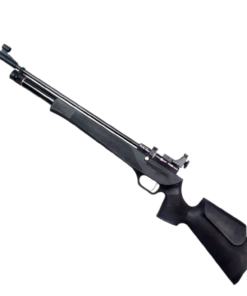
Airgun Technology Manul – Air Pistol


€900.00
The AGT URAGAN 3 Compact takes the advanced engineering of the URAGAN 3 and condenses it into a lighter, shorter, and more manoeuvrable package. Designed for shooters who demand the same cutting-edge performance in a portable format, the URAGAN 3 Compact is perfect for tight spaces, dynamic shooting scenarios, and those who value mobility without sacrificing precision.
Revolutionary Internal Upgrades
- Enhanced Block and Receiver: The compact version retains the redesigned receiver and trigger mechanism for unmatched precision and reliability.
- Improved Firing Valve Assembly: Built for durability, the updated valve system simplifies maintenance, ensuring effortless upkeep.
- Simplified Power Plenum: Optimized for efficient airflow and consistent shot performance.
- New Air Pressure Regulator: Ensures steady performance even under the stress of high-pressure conditions.
- Upgraded Hammer System: Features a stronger hammer spring and precise spring tension adjustments.
- Depinger: The added depinger reduces noise, making this compact model quieter than ever.
Compact Ergonomics and Versatility
- Shortened Top Picatinny Rail: Still long enough for advanced optics, including night vision add-ons, while maintaining a more streamlined profile.
- Colder Weather Adaptation: The updated trigger guard offers superior usability with gloves, ideal for cold-weather conditions.
- Swappable Side Lever: Fully ambidextrous for left or right-handed operation.
Optimized Specifications for Compact Performance
- Barrel: A 400mm shrouded barrel system with an integral silencer and M14CW threading for additional moderators.
- Stock: Adjustable butt pad for customized ergonomics.
- Trigger: Two-stage adjustable trigger for a personalized shooting experience.
- Rails: Built-in 20MOA top Picatinny rail and a lower Picatinny rail with a bottle guard attachment, including a forward Keymod mount.
Technical Data
- Length: 700mm
- Weight: ~3.2Kg
- Max Fill Pressure: 300BAR
- Operational Pressure Range: ~200-100BAR (varies by calibre)
- Shot Count: Approximately 120 shots per fill (calibre-dependent)
- Safety: Ambidextrous slide safety
The AGT URAGAN 3 Compact is the ultimate balance of portability and power. With its shortened profile and lightweight design, it’s perfect for shooters who need a rifle that performs flawlessly in tight spaces or during mobile scenarios. Whether you’re hunting, target shooting, or just enjoying some plinking, the URAGAN 3 Compact delivers top-tier performance and ease of use in a compact, efficient design.

Airgun Technology Manul Air Pistol – Compact PCP Precision and Refined Target Performance
Airgun Technology Manul Air Pistol Overview
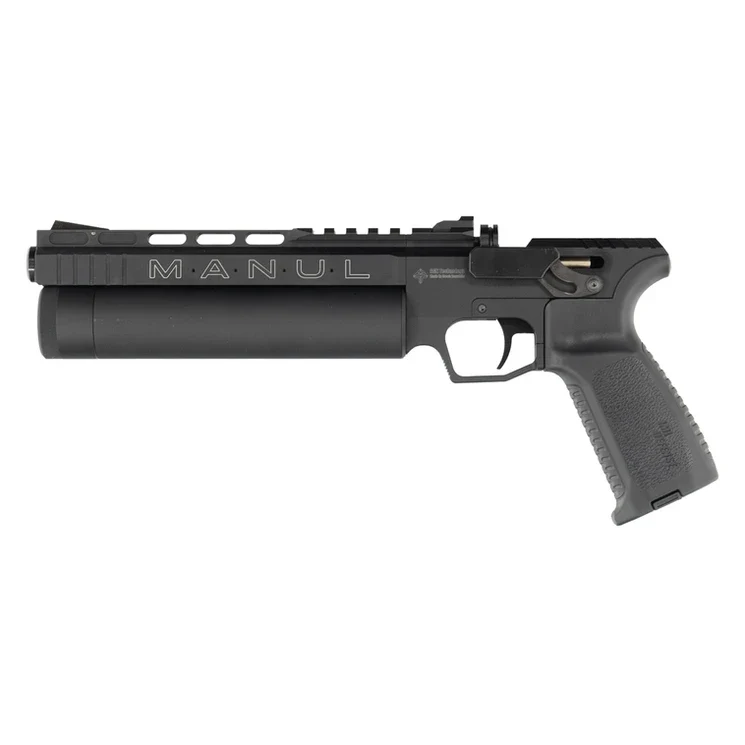
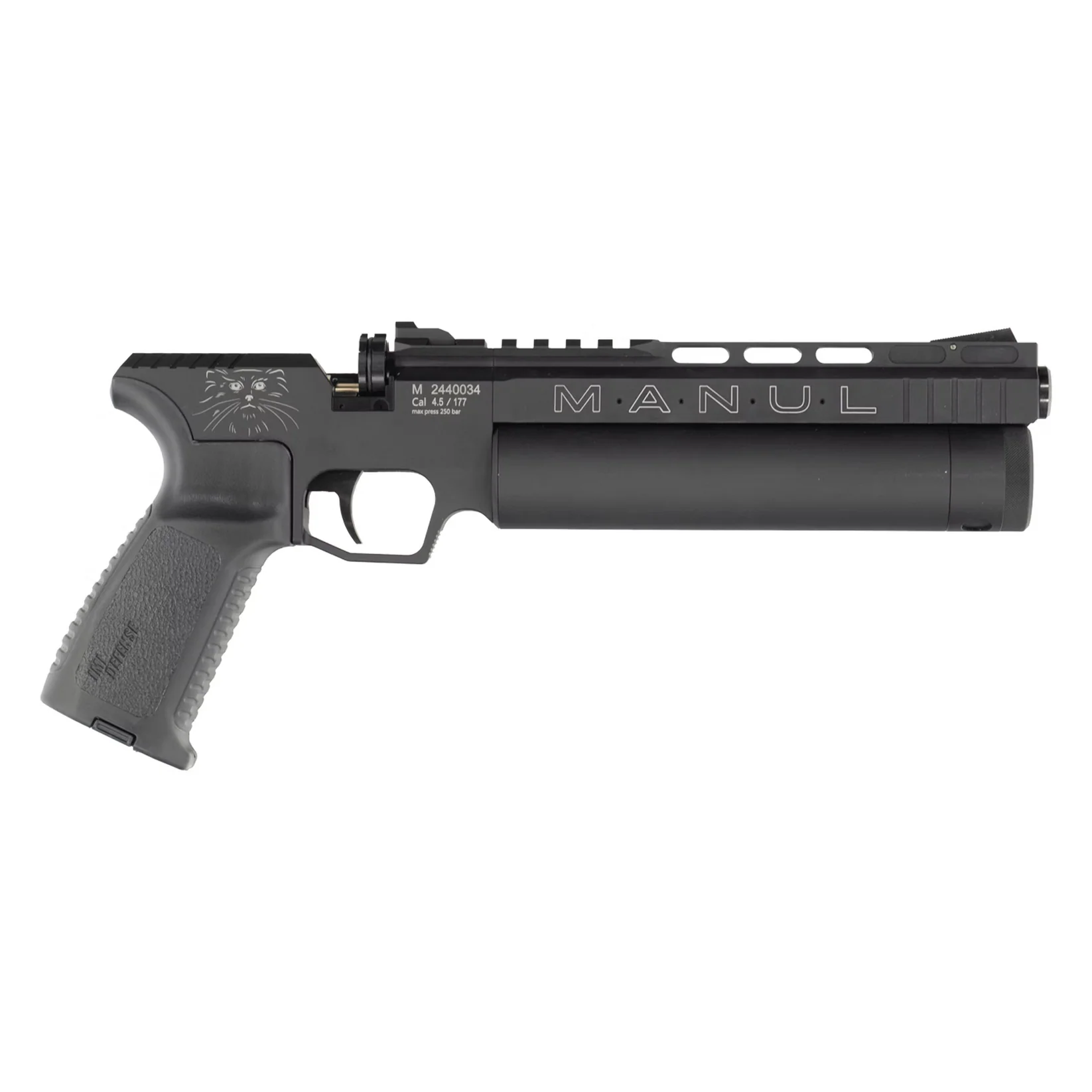
The Airgun Technology Manul Air Pistol is a compact PCP platform developed for shooters who want precision, controllability, and premium engineering in a highly portable format. Built in the Czech Republic, the Manul uses a 190 mm barrel, a compact 50 cc air cylinder, and a maximum fill pressure of 250 bar. Depending on the market configuration, it is available in .177 and .22 calibers, with a rotary multi-shot system and an included single-shot tray for more deliberate target work.
Its compact dimensions make the pistol particularly easy to handle, while the adjustable two-stage trigger and regulated action help support consistent shot placement. Several current dealers list a total length around 317–320 mm and weight around 750–810 g, reflecting minor specification differences between versions and listings.
Why Choose the Airgun Technology Manul Air Pistol?
The strongest reason to choose the Manul is its ability to combine a genuine PCP operating system with pistol-sized handling. Instead of using CO2 cartridges or a spring mechanism, compressed air supplies the firing energy. Therefore, the firing cycle remains relatively smooth and predictable.
Shooters who already follow premium AGT platforms may also recognize names such as AGT Uragan air rifle, AGT Uragan, Uragan air rifle, AGT Uragan 3, and AGT Uragan Compact. Although those rifles occupy a different category, they reflect the same broader interest in precision PCP engineering.
Likewise, shoppers searching for an AGT Uragan air rifle for sale, Best AGT Uragan review, AGT Uragan price, or Buy AGT Uragan air rifle may discover the Manul when comparing different AGT formats.
How Good Is the Manul for Precision Shooting?
The Manul is especially well suited to controlled target shooting. Its 190 mm barrel, compact weight, adjustable sights, optic rail, and adjustable trigger give the shooter several ways to refine the setup. Dealer information also describes a regulated action on many current versions, although specification listings vary between markets, so the exact configuration should always be confirmed before purchase.
The pistol’s multi-shot system allows faster follow-up shots, while the supplied single-shot tray supports more deliberate loading. Depending on caliber and version, current listings describe approximately five to seven shots in the rotary system.
Buyers researching AGT Uragan hunting, AGT Uragan .22, AGT Uragan .25, AGT Uragan high power, AGT Uragan PCP air rifle, and AGT Uragan accuracy are usually comparing performance characteristics such as power, shot consistency, barrel quality, regulator behavior, and ergonomics.
How Does the Manul Achieve Precision?
Precision depends on repeatability. The pistol’s barrel, trigger, air system, ammunition, and sights must work together consistently.
The adjustable two-stage trigger allows the shooter to tailor the firing interface more closely to personal preference. Meanwhile, the rigid barrel arrangement provides a stable path for the pellet. The pressure system also contributes because consistent air delivery helps reduce unnecessary variation between shots.
Searches such as AGT Uragan vs FX Impact, AGT Uragan review 2026, AGT Uragan PCP, AGT Uragan vs FX Impact, Uragan air rifle, and AGT Uragan accuracy show how modern PCP buyers increasingly compare complete shooting systems rather than raw velocity alone.
Where Should the Manul Be Used?
The Manul is primarily suited to recreational and precision target shooting where air pistols are legally permitted. Its compact size makes it convenient for approved ranges and controlled private shooting environments with an appropriate backstop.
The pistol should always be used according to local regulations. Airgun power restrictions, transport requirements, age limits, and licensing rules vary between jurisdictions.
Shooters comparing broader product families such as the Air Venturi Alpha, Air Venturi Alpha PCP Rifle, Air Venturi Alpha Air Rifle, Air Venturi Alpha Hunting Rifle, Air Venturi Alpha Tactical PCP, Air Venturi Alpha Regulated PCP, Air Venturi Alpha Multi Shot Rifle, and Air Venturi Alpha Precision Air Rifle should remember that rifles and pistols serve different handling and shooting purposes.
When Is the Manul the Right Choice?
The Manul makes the most sense when compact dimensions and precision are more important than rifle-sized power or long-range capability.
It is particularly appealing to shooters who want a premium PCP pistol for target practice, controlled recreational shooting, or development of trigger and sighting skills.
Users researching air venturi, air venturi avenger, airventuri, air venturi avenger, air venturi avenge, and air ventur avenge may be comparing different PCP price categories and formats.
Why Charging Equipment Matters
Like other PCP systems, the Manul requires a suitable high-pressure air source. Its maximum listed fill pressure is 250 bar, so compatible filling equipment is essential.
That is why buyers frequently research an air venturi compressor, venturi air, air venturi air compressor, air venturi rovair 4500 portable compressor, air venturi rovair, air venturi tank, air venturi air tank, air venturi pcp compressor, ventur air compressor, and air rifle compressor.
Correctly rated equipment should always be used, and the stated maximum pressure should never be exceeded.
Important Information About the Manul
The Manul occupies a very different role from full-size pcp airguns and pcp air rifles. Its small reservoir and pistol format prioritize compactness and handling rather than extended rifle-style shot strings.
Shoppers exploring air rifle and air pistol equipment may also encounter products such as air venturi microstrike, air venturi omnistorm, air venturi avenger 25, and searches for avenger price.
Meanwhile, terms such as dragon claw, seneca dragon claw, seneca air rifles, air bolt gun, 50 caliber dragon, and claw air gun describe substantially different airgun categories and should not be treated as direct alternatives to the Manul.
Overall, the Airgun Technology Manul Air Pistol stands out through its compact construction, PCP operation, precision-focused trigger system, practical sighting options, and multi-shot capability. For shooters seeking a refined target-oriented PCP pistol, it offers a distinctive balance of portability, control, and mechanical sophistication.
Engineering Quality, Shooting Performance, Handling, and Practical Use
The Airgun Technology Manul Air Pistol is designed around a simple but important idea: combine compact handling with the consistency and refinement normally associated with a quality pre-charged pneumatic platform. Rather than relying on excessive size or unnecessary complexity, the pistol focuses on balance, predictable operation, and a controlled shooting experience. This makes it suitable for shooters who appreciate a compact setup but still expect careful engineering and dependable performance.
Compact Engineering and Functional Design
One of the most noticeable characteristics of the pistol is its compact construction. A smaller platform is easier to carry, store, position, and control, especially when shooting from a bench or other supported position.
However, compact dimensions are only useful when the controls remain comfortable and accessible. The layout is designed so the shooter can operate the action, trigger, and sighting system without unnecessary movement.
This practical arrangement helps reduce fatigue during longer sessions. Instead of fighting against excess weight or awkward dimensions, the shooter can concentrate more fully on sight alignment and trigger control.
Regulated Air Delivery and Shot Consistency
Consistency is one of the most important qualities in any pneumatic shooting system. When the pressure supplied to each shot remains stable, velocity variation can be reduced, which supports a more predictable point of impact.
A regulated air system helps manage this process. Instead of allowing every discharge to depend directly on the changing pressure inside the main cylinder, the regulator controls the amount of pressure delivered to the firing mechanism.
This is especially valuable during precision-oriented shooting because vertical movement on the target can sometimes be caused by inconsistent velocity.
Nevertheless, air pressure is only one factor. Ammunition quality, environmental conditions, shooter technique, and sight setup also affect the final result.
Barrel Quality and Accuracy Potential
The barrel forms the foundation of practical accuracy. A quality barrel guides the projectile consistently and supports repeatable performance when matched with suitable ammunition.
Different projectile designs can behave differently in the same barrel. Therefore, testing several appropriate weights and shapes can help identify which option performs most consistently.
Shooters should evaluate group size rather than judging performance from one or two individual shots.
A stable test position is useful because it allows the shooter to separate ammunition performance from movement caused by poor support.
Once a preferred option is found, maintaining the same ammunition type can simplify future zeroing and accuracy testing.
Trigger Control and Precision
The trigger is one of the most important contact points between the shooter and the pistol.
A predictable trigger makes it easier to fire without disturbing the sight picture. Therefore, the shooter should become familiar with the first stage, the release point, and the amount of pressure required to complete the shot.
Good trigger technique involves smooth pressure rather than a sudden pull.
When the shooter presses the trigger gradually while maintaining proper sight alignment, unnecessary movement can be reduced.
Over time, familiarity with the trigger can make the entire firing process feel more natural and controlled.
Multi-Shot Convenience
A multi-shot system adds practical convenience by reducing the need to load each projectile individually between shots.
This can be useful during recreational target sessions where several shots are fired in sequence. It also allows the shooter to maintain a more consistent position because less movement is required between shots.
However, careful loading remains important.
Projectiles should be inspected before being placed into the magazine. Damaged skirts or poorly formed ammunition may affect feeding and accuracy.
The magazine itself should also be kept clean and protected from dirt or debris.
Single-Shot Shooting
A single-shot loading option can be valuable for shooters who prefer a slower and more deliberate style of shooting.
Loading one projectile at a time encourages the shooter to concentrate on each stage of the process.
This can be especially useful when testing ammunition because every shot can be observed individually.
It also simplifies certain forms of target practice where speed is less important than consistency.
For many shooters, having both multi-shot and single-shot capability makes the platform more versatile.
Sight Setup and Aiming
Correct sight setup is essential for consistent results.
Whether open sights or an optic is used, the shooter should establish a natural and repeatable aiming position.
The eye should return to the same relationship with the sights for every shot.
If an optic is mounted, it should be positioned so that the image appears clearly without forcing the head into an uncomfortable angle.
Once sight alignment is comfortable, the pistol should be zeroed from a stable position.
After zeroing, the shooter can confirm point of impact at several practical distances to understand trajectory changes.
Managing the Filling Process
High-pressure air systems require careful handling.
The filling connection should be clean before use, and compatible equipment should be attached securely.
Air should be introduced in a controlled manner while the pressure gauge is monitored.
Exceeding the approved pressure limit should always be avoided.
After charging, the filling line should be depressurized according to the equipment instructions before it is disconnected.
Good filling habits protect seals, fittings, and other internal components while also supporting safer operation.
Comfort During Extended Sessions
Comfort can influence accuracy more than many shooters expect.
An uncomfortable grip or awkward wrist position may introduce unnecessary movement.
Therefore, the pistol should be held with consistent pressure rather than excessive tension.
The shooter should also take regular breaks during longer sessions.
Fatigue can cause trigger control and sight alignment to deteriorate gradually.
By maintaining a relaxed grip and stable posture, the shooter can preserve consistency for longer periods.
Practical Shooting Experience
The strongest quality of the platform is the way its individual features work together.
Compact dimensions support maneuverability. Controlled air delivery helps maintain consistency. The barrel provides a stable foundation for accuracy, while the trigger gives the shooter a predictable firing interface.
Together, these characteristics create a shooting experience that feels deliberate and refined.
For shooters who value compact handling, smooth operation, careful engineering, and precision-focused performance, the pistol offers a well-balanced approach that can remain enjoyable through repeated use and long-term ownership.
Accuracy Development, Ergonomics, Reliability, Maintenance, and Long-Term Use
The Airgun Technology Manul Air Pistol becomes more rewarding as the shooter learns how its compact design, pneumatic system, trigger, sights, and ammunition interact. Initial impressions may focus on size and handling, but long-term performance depends on consistency. A well-set-up pistol can provide excellent precision, yet the best results come when the shooter develops repeatable habits and maintains the equipment carefully.
Building Better Accuracy Through Consistency
Accuracy improves when the shooter repeats the same process for every shot. Grip pressure, sight alignment, trigger control, breathing, and follow-through should remain as consistent as possible.
Even small variations can move the point of impact. Therefore, the shooter should avoid changing hand position unnecessarily between shots.
A stable bench or supported shooting position is useful when evaluating mechanical accuracy. Once the pistol is performing consistently from a rest, the shooter can begin practicing unsupported positions with a better understanding of the platform’s true potential.
This approach makes it easier to separate shooter error from equipment performance.
Understanding Grip and Hand Position
Grip quality has a major effect on pistol accuracy.
The shooter should hold the pistol firmly enough to maintain control but not so tightly that unnecessary muscle tension is introduced. Excessive grip pressure can cause the sights to move during the firing process.
The hand should return to the same position each time.
A repeatable grip helps keep the trigger finger aligned correctly and supports consistent recoil behavior, even though the firing movement of a pneumatic pistol is relatively mild.
Comfort is equally important because discomfort often leads to subtle changes in technique.
Trigger Technique and Shot Release
A smooth trigger press is one of the most important elements of precision pistol shooting.
The shooter should apply pressure gradually while keeping the sights aligned. Jerking or snatching the trigger can pull the muzzle away from the intended point of impact.
The exact moment of release should feel predictable.
Once the shooter becomes familiar with the trigger, less attention is required to operate it. This allows greater concentration on sight picture and breathing.
The trigger should always be adjusted conservatively and used within safe operating parameters.
Sight Alignment and Visual Focus
Correct sight alignment should become automatic through repetition.
With open sights, the front sight should remain the primary visual reference while the target appears slightly less sharp.
If an optic is used, the shooter should maintain consistent eye position behind it.
A good aiming setup reduces unnecessary head movement and makes the pistol easier to use during longer sessions.
The sighting system should also be checked periodically to ensure that screws and mounts remain secure.
A loose mount can create sudden changes in point of impact that may be mistaken for an accuracy problem.
Ammunition Testing
Ammunition selection should be treated as a controlled experiment.
Several suitable types can be tested from the same shooting position and distance.
Group size, feeding quality, point of impact, and consistency should be recorded.
The best option is usually the one that produces repeatable results rather than an occasional exceptional group.
Once suitable ammunition has been identified, using the same type consistently can simplify zeroing and trajectory understanding.
Damaged or deformed projectiles should be avoided because they may affect both accuracy and magazine operation.
Pressure Monitoring and Performance
Pressure should be monitored throughout the shooting session.
The pistol will perform most predictably within its useful pressure range.
As pressure changes, the shooter should pay attention to any noticeable difference in sound, velocity, or point of impact.
Learning how the pistol behaves through a normal fill cycle makes it easier to determine when a refill is appropriate.
A pressure gauge is therefore not simply a filling reference; it is also part of understanding the overall performance cycle.
Reliability During Repeated Use
Mechanical reliability is supported by careful handling.
The action should be operated smoothly rather than aggressively.
If unexpected resistance develops, the shooter should stop and inspect the magazine, loading system, or visible components.
Forcing the mechanism can turn a minor issue into a larger problem.
Likewise, unusual sounds, rapid pressure loss, or changes in firing behavior should be investigated before continued use.
Recognizing changes early helps protect the equipment.
Routine Cleaning and Exterior Care
Routine care does not need to be complicated.
Exterior surfaces should be wiped clean after handling, especially when the pistol has been used outdoors or in humid conditions.
Dust and moisture should be removed before storage.
The barrel should be cleaned only when necessary and with suitable equipment.
Excessive cleaning can be as unhelpful as neglect.
If accuracy changes suddenly, the shooter should first check sights, mounts, ammunition, and pressure before assuming the barrel needs intensive cleaning.
Protecting the Air System
The air system requires particular care because it operates under high pressure.
The filling connection should remain clean, dry, and protected from debris.
Only suitable high-pressure filling equipment should be used.
The pressure limit should always be respected.
If the pistol begins losing pressure unusually quickly, professional inspection may be appropriate.
Internal pneumatic components should not be dismantled casually.
Correct servicing protects both reliability and safety.
Storage and Transportation
The pistol should be stored in a dry, secure environment.
A protective case can help prevent scratches and damage during transport.
Extreme temperatures should be avoided because pressure can change as temperature changes.
The pistol should also be kept away from unauthorized users.
Safe storage protects the equipment and supports responsible ownership.
Transport rules may vary by location, so local requirements should always be followed.
Long-Term Ownership Experience
The greatest benefit of continued use is familiarity.
Over time, the shooter learns how the trigger feels, how pressure changes affect performance, which ammunition works best, and how the sights respond at different distances.
This familiarity creates confidence.
The pistol becomes easier to operate because its normal behavior is well understood.
That knowledge also makes it easier to detect problems early.
With careful handling, sensible maintenance, proper storage, and disciplined shooting technique, the platform can provide consistent and enjoyable performance over the long term.
Practical Shooting Setup, Performance Control, Safety, Storage, and Ownership Confidence
The Airgun Technology Manul Air Pistol is designed to deliver a controlled and enjoyable shooting experience when it is configured correctly and used with consistent technique. While the mechanical platform provides the foundation, practical performance depends heavily on how the shooter prepares the pistol, manages air pressure, selects ammunition, positions the sights, and maintains the equipment over time. A thoughtful setup can improve both accuracy and comfort while also helping to protect the pistol from unnecessary wear.
Setting Up the Pistol for Consistent Shooting
A reliable setup begins with understanding how the pistol fits the shooter’s hand and shooting position. Grip pressure should remain consistent from one shot to another, while the wrist should stay in a comfortable and natural position.
The shooter should avoid gripping the pistol too tightly. Excessive tension can cause unnecessary movement and may make the sight picture less stable.
Instead, the goal should be controlled support with enough firmness to maintain alignment without introducing strain.
Once a comfortable grip has been established, the shooter can begin refining the sights and trigger technique.
Establishing an Accurate Zero
A proper zero is essential if consistent results are expected.
The pistol should first be fired from a stable supported position. This reduces movement and allows the shooter to evaluate the relationship between the sights and the actual point of impact.
Adjustments should be made gradually.
Changing too much at once can make it difficult to understand how each adjustment affects the result.
After the primary zero is established, the shooter should confirm performance at several realistic distances.
This provides a better understanding of the projectile’s trajectory and helps prepare for different target positions.
Managing Air Pressure During a Session
The pressure inside the reservoir influences how the pistol performs.
A regulated system can help maintain consistency, but pressure should still be monitored throughout the session.
The shooter should become familiar with how many dependable shots can normally be obtained before a refill becomes necessary.
Recording this information during early shooting sessions can be useful.
Over time, the owner develops a better understanding of the pistol’s normal behavior.
If performance begins to change noticeably before the expected pressure level is reached, this may indicate that the system should be inspected.
Choosing Suitable Ammunition
Ammunition quality has a direct impact on precision.
Projectiles should be clean, correctly sized, and free from obvious deformation.
Bent skirts or damaged surfaces can influence how the projectile enters the barrel and how it travels through the air.
Testing should be performed carefully.
Several suitable options can be compared from the same position, under similar conditions, and at the same distance.
The shooter should pay attention to group size and consistency rather than focusing only on one unusually accurate shot.
Once a reliable choice has been identified, staying with the same ammunition can improve repeatability.
Understanding Environmental Conditions
Temperature, wind, and lighting can all influence shooting performance.
Wind is especially important because lightweight projectiles can be moved sideways even at relatively short distances.
The shooter should observe environmental conditions before firing.
Indoor ranges can provide more stable conditions for evaluating mechanical accuracy, while outdoor shooting offers a better understanding of how the pistol performs in real-world conditions.
Temperature can also influence air pressure.
For this reason, the pistol should not be exposed unnecessarily to extreme heat or cold.
Developing Better Follow-Through
Follow-through is an important part of accurate pistol shooting.
The shooter should maintain sight alignment briefly after the trigger releases rather than immediately lowering the pistol or changing grip pressure.
This helps reduce movement during the final part of the firing cycle.
It also makes it easier to identify mistakes.
If the sight picture moves sharply during the shot, the shooter can recognize that trigger technique or grip pressure may need improvement.
Over time, good follow-through becomes automatic.
Safe Handling Between Shots
Safe handling should remain consistent even during casual target practice.
The muzzle should always remain pointed in a safe direction.
The trigger finger should stay outside the trigger area until the shooter is ready to fire.
When loading or inspecting the pistol, the shooter should remain aware of where the muzzle is directed.
The target and the area behind it should also be clearly understood.
A proper backstop is essential because projectiles can travel beyond light or unsuitable target materials.
Protecting the Filling Equipment
The filling system deserves the same level of care as the pistol.
Hoses, connectors, probes, and gauges should be inspected regularly for visible damage.
The filling connection should remain clean and free from dust.
Air should be introduced gradually during charging.
Rapid filling can generate unnecessary heat and place additional stress on components.
The pressure gauge should be monitored throughout the process.
Once filling is complete, the line should be depressurized according to the instructions for the charging equipment before disconnection.
Proper Storage After Use
After shooting, the pistol should be inspected and cleaned lightly before storage.
Moisture and fingerprints can be removed from exterior surfaces with a suitable cloth.
The magazine should be removed and stored safely where appropriate.
The pistol should then be placed in a dry and secure location.
A protective case can help prevent accidental scratches or impacts, but the storage environment should not trap excessive moisture.
Long-term storage in damp conditions can damage metal components.
Transporting the Pistol Responsibly
Transport should always follow local legal requirements.
A secure case protects both the pistol and any mounted sighting equipment.
The pistol should be prevented from moving freely inside the case.
Accessories, magazines, and filling equipment can also be organized separately to reduce the risk of damage.
Before traveling, the owner should understand any applicable rules concerning transport, storage, or use.
Building Confidence Through Familiarity
Confidence develops through repeated and disciplined use.
As the shooter becomes familiar with the grip, trigger, sights, pressure behavior, and preferred ammunition, the pistol becomes easier to operate consistently.
This familiarity also helps identify abnormal behavior.
A different sound, unusual pressure loss, or unexpected resistance can be recognized more quickly when the shooter understands how the pistol normally performs.
Long-Term Practical Value
The strongest ownership experience comes from combining proper setup with responsible maintenance.
A well-maintained pistol that is used with suitable ammunition and consistent technique can provide reliable performance over many shooting sessions.
The compact design makes it easy to handle and transport, while the controlled pneumatic system supports repeatable operation.
Ultimately, careful ownership allows the pistol’s engineering to perform as intended.
When attention is given to pressure management, ammunition selection, sight alignment, safe handling, and regular inspection, the shooter can enjoy a precise, manageable, and dependable platform for long-term recreational and target use.
Precision Development, Comfort, Air Efficiency, Practical Handling, and Long-Term Performance
The Airgun Technology Manul Air Pistol is designed to reward consistency. Its compact format makes it easy to handle, but the best performance comes when the shooter develops a repeatable routine for grip, breathing, sight alignment, trigger control, and pressure management. Over time, familiarity with these details can improve confidence and help the pistol deliver the level of precision its engineering is intended to support.
Developing Better Precision Through Repetition
Precision improves when the same shooting process is repeated correctly. The shooter should aim to place the hand in the same position every time, maintain similar grip pressure, align the sights consistently, and press the trigger smoothly.
Even small changes can influence point of impact. For that reason, deliberate practice is more valuable than simply firing a high number of shots.
A stable shooting position can be used during early practice sessions to understand the pistol’s mechanical potential. Once consistent groups are established from support, unsupported shooting can be introduced gradually.
This method makes it easier to identify whether a poor shot was caused by technique, ammunition, environmental conditions, or equipment setup.
Grip Comfort and Control
Comfort has a direct influence on accuracy.
If the shooter holds the pistol too tightly, tension can spread through the hand, wrist, and forearm. This can make the sights move more than necessary.
A controlled but relaxed grip is generally more effective.
The wrist should remain stable, and the trigger finger should move independently without pulling the pistol sideways.
A consistent grip also helps the shooter develop a predictable relationship with the sights.
Over time, the correct hand position becomes natural and easier to repeat.
Managing the Trigger More Effectively
Trigger technique is one of the most important areas of precision pistol shooting.
The trigger should be pressed gradually rather than pulled suddenly.
A smooth press allows the sights to remain aligned as the shot is released.
The shooter should become familiar with the first stage and the point at which the trigger is close to releasing.
However, the shot should never be forced.
If the sight picture becomes unstable, it is better to reset and begin again.
This discipline can improve group consistency and reduce unnecessary errors.
Understanding Air Efficiency
The compact air reservoir is designed to support the pistol’s lightweight format.
Because the available air supply is smaller than that of a full-size rifle, efficient pressure management becomes particularly important.
The shooter should learn how many useful shots are normally produced from a fill.
This number can vary according to configuration, pressure, temperature, and individual setup.
Keeping simple records can help identify the normal operating range.
If the number of consistent shots changes suddenly, the owner may need to inspect filling equipment, seals, or pressure behavior.
Monitoring Pressure Carefully
Pressure should be checked before and during shooting sessions.
The pistol should always be filled within the manufacturer’s recommended limits.
Exceeding the approved pressure does not improve performance and may place unnecessary stress on seals and components.
Filling should be performed slowly and carefully.
Gradual charging allows pressure to stabilize more smoothly and reduces unnecessary heating.
Once the correct pressure is reached, the filling line should be depressurized properly before disconnection.
Consistent filling habits support both reliability and safety.
Maintaining Accuracy Across a Shooting Session
Accuracy can change if the shooter becomes tired or if equipment conditions change.
During longer sessions, grip pressure may gradually increase, breathing may become less controlled, or concentration may decline.
Taking short breaks can help maintain consistency.
The shooter should also monitor the target for unusual changes in group location.
If shots begin moving unexpectedly, simple checks should be made before adjusting the sights.
Pressure, ammunition condition, mounting screws, hand position, and environmental conditions should all be reviewed.
Making unnecessary sight adjustments can sometimes hide the real cause of the problem.
Practical Use of the Multi-Shot System
The multi-shot system provides convenience during repeated target shooting.
However, speed should not replace careful technique.
Each projectile should be loaded correctly, and the magazine should be handled gently.
The shooter should avoid cycling the action aggressively.
Smooth operation helps maintain mechanical condition and reduces the chance of feeding problems.
If resistance is felt, the shooter should stop and inspect the magazine rather than applying more force.
Good loading habits support both reliability and accuracy.
Importance of a Stable Shooting Position
Body position affects pistol movement.
From a standing position, the shooter should establish a stable stance that does not require excessive muscular effort.
From a bench, the arms or support equipment should stabilize the pistol without forcing it into an unnatural angle.
A consistent position helps make group comparisons more meaningful.
If the shooting position changes between groups, it becomes more difficult to determine whether changes in accuracy were caused by ammunition or technique.
Consistency therefore remains the foundation of useful testing.
Maintaining Mechanical Condition
Routine inspection can prevent minor issues from becoming larger problems.
The shooter should check that visible fasteners remain secure and that the sights or optic have not shifted.
The action should operate smoothly, and the magazine should rotate correctly.
Air pressure should remain stable during storage within normal expectations.
Any unusual sound, resistance, leakage, or change in performance should be investigated before regular use continues.
Early attention is usually easier than dealing with a more serious problem later.
Storage and Environmental Protection
The pistol should be stored in a clean, dry, and secure location.
Humidity can affect metal surfaces, while extreme heat can change pressure inside the reservoir.
Direct sunlight and hot vehicles should therefore be avoided.
A protective case can be useful during transportation, but the pistol should not be stored for long periods in a damp case.
Exterior surfaces should be wiped clean before storage.
This simple habit can help preserve both appearance and mechanical condition.
Building Long-Term Confidence
The greatest advantage of continued ownership is familiarity.
As the shooter learns the normal feel of the trigger, action, magazine, pressure system, and sights, the pistol becomes easier to use consistently.
This familiarity also makes troubleshooting easier.
Changes in sound, pressure behavior, or mechanical feel can be noticed quickly because the owner understands what normal operation feels like.
Over time, the pistol becomes more than a compact shooting platform.
It becomes a predictable and familiar piece of equipment.
With disciplined practice, correct pressure management, suitable ammunition, careful maintenance, and safe handling, the Manul can provide a refined and dependable shooting experience over the long term.
Be the first to review “Airgun Technology Manul – Air Pistol”
Related products


Uncategorized


Uncategorized

Snowpeak Airguns
Daystate Air Rifle

Uncategorized


FX Air Gun

Uncategorized
AIR GUN RIFLES
Reviews
There are no reviews yet.