


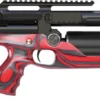
AirMaks Arms KRAiT Lite Long High Power
€1,700.00
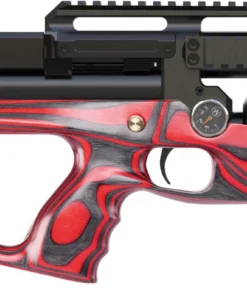
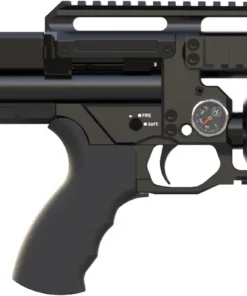
A lightweight and comfortable air rifle, the KRAIT Lite has an ambidextrous walnut stock, with height adjustable butt-pad and cheek-piece. The KRAIT Lite has 60 cc plenum size bottle. The Picatinny rail has 20 MOA. Easy-cocking side lever comfortably situated near the trigger with a possibility to change right-left side. The trigger has a 2-stage adjustment.
- Height adjustable cheek piece
- Length and height adjustable butt pad
- Picatinny rail for accessories
- AR15 right-hand Grip
- Side lever action, right-left changeable
- AR15 style safety, right-left changeable
- Two-stage trigger with external adjustment
- Supplied with Negrini case
- HUMA-AIR Regulator
- Anti-double feed system
- External velocity regulation screw
- 20MOA Picatinny rail
- 1/2” UNF thread for moderator
- CZ Barrel with 1:17.7 twist
- Magazine – 18 shot (.177), 16 shot (.22), 14 shot (.25)
- Shot Count:
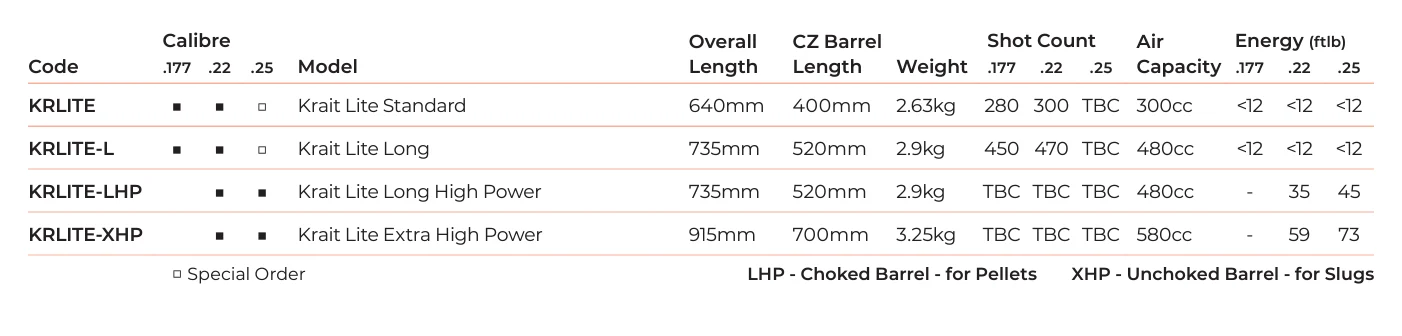
KRLITE .177 280
KRLITE .22 300
KRLITE-L .177 450
KRLITE-L .22 470
AirMaks Arms KRAiT Lite Long High Power PCP Air Rifle – Advanced Czech Engineering, Precision Design and Premium Sporting Performance
AirMaks Arms KRAiT Lite Long High Power – Exceptional Engineering, Precision Manufacturing and Advanced Pneumatic Technology
The AirMaks Arms KRAiT Lite Long High Power, officially designated KRAiT Lite L HP, combines Czech engineering with modern compressed-air technology and traditional wooden-stock craftsmanship. This specialized sporting rifle features a 520mm non-choked barrel, a 580cc high-pressure reservoir, and a compact bullpup design.
Furthermore, its internally regulated pneumatic mechanism, adjustable two-stage trigger, and reversible side lever demonstrate the manufacturer’s emphasis on mechanical sophistication.
The rifle measures approximately 735mm overall and weighs 2.9kg without additional accessories. Consequently, its architecture accommodates substantial internal components while maintaining relatively compact exterior dimensions.
Additionally, the ambidextrous beech stock incorporates an adjustable cheekpiece and buttpad, combining natural materials with contemporary ergonomic design.
airmaksarms.com
AirMaks Katran, AirMaks KRAiT and Czech Manufacturing Excellence
The airmaks katran and airmaks krait families represent different product lines from the Czech manufacturer.
Customers researching airmaks products may encounter alternative search expressions such as airmarks, katran airmaks, air marks, katran, air max krait, ar max, arm max, and max arms.
However, these variations should not be confused with official model designations.
Similarly, uramax is not the manufacturer of this rifle.
The Lite Long High Power configuration distinguishes itself through traditional wooden furniture, a substantial reservoir, and a non-choked barrel.
AirMaks Arms PCP Air Rifles – Understanding Compressed-Air Technology
For customers asking what does pcp air rifle mean, PCP stands for pre-charged pneumatic, describing equipment that operates using compressed air stored inside a dedicated reservoir.
The expression komprimiran zrak similarly means compressed air.
Within the wider range of AirMaks Arms air rifles, AirMaks Arms PCP air rifles, and AirMaks Arms PCP rifles, regulated pneumatic systems represent an important engineering characteristic.
The model incorporates an internal pressure regulator and specialized pneumatic components.
Furthermore, its reservoir has a manufacturer-stated maximum working pressure of 300 bar.
High-pressure systems require careful maintenance, professional servicing, and compliance with published operating limits.
Precision Barrel Construction, Wooden Stock and Accessory Compatibility
The 520mm non-choked barrel distinguishes this version from the standard configuration, which incorporates a choked barrel.
Furthermore, the ambidextrous beech stock combines traditional appearance with adjustable ergonomic components.
The rifle features a 20 MOA Picatinny optics rail and a lower accessory mounting interface.
Customers researching the javelin pro hunt tac bipod should verify hardware compatibility before purchasing additional equipment.
Precision depends on manufacturing consistency, approved ammunition, mechanical condition, and environmental factors. Therefore, exact accuracy guarantees should not be assumed without controlled testing.
Best Pellet Gun for Pest Control – Responsible Applications and Legal Awareness
Customers researching the best pellet gun for pest control, pellet gun for pest control, or air rifle for pest control should consider relevant legislation, wildlife protection, and humane animal-management requirements.
The High Power classification may require additional authorization depending on the jurisdiction.
Meanwhile, novelty searches such as hamster with gun, hamster with a gun, and hamster holding gun generally refer to fictional imagery rather than genuine product characteristics.
Responsible ownership requires lawful use, secure storage, and appropriate supervision.
AirMaks Arms for Sale – Product Availability and Authorized Distribution
Customers searching for AirMaks Arms for sale, AirMaks Arms shop, AirMaks Arms USA, or AirMaks Katran should confirm the exact manufacturer designation before purchasing.
This configuration is listed in .22, .25, and .30 calibers.
Furthermore, regional availability may vary according to legal requirements and distributor inventory.
Buyers should distinguish it from the standard Lite Long and the Long Tube High Power models, which have different specifications.
Benjamin Air Rifle – Comparing Alternative Pneumatic Platforms
The wider benjamin air rifle market includes several separate sporting configurations.
Common searches include benjamin air rifles, benjamin marauder pcp, benjamin marauder, benjamin armada, benjamin prowler, and benjamin bulldog.
Additionally, the Benjamin Bulldog Magnum Series Bullpup, benjamin marauder air rifle bulldog 357, and benjamin bulldog 457 20 joules refer to different models or specification-related searches.
Expressions such as benjamin break, benjamin airbow airgun, and air bows pellet rifle describe other product categories.
Meanwhile, the broader air rifle and air pistol market includes co2 pellet guns, which use a different propulsion system.
The term cal .177 pellets describes an ammunition diameter unavailable in the manufacturer’s listed High Power caliber range.
Western Airguns – Specialist Sporting Equipment Comparisons
The western airguns family represents another category within contemporary pneumatic equipment.
Customers may research western rattler, western airguns rattler, western rattler 357, and western rattler bullpup.
Likewise, mordax, western airguns mordax, mordax air gun, mordax airgun, western mordax venom, and western sidewinder relate to other models or associated product searches.
The variations western air guns and western air gun also appear in broader comparisons.
However, these alternatives differ in dimensions, construction, operating characteristics, and legal classifications.
AirMaks Arms KRAiT Lite Long High Power – Important Technical Specifications
-
Manufacturer: AirMaks Arms, Czech Republic
-
Official designation: KRAiT Lite L HP
-
Operating system: Regulated pre-charged pneumatic
-
Calibers: .22 (5.5mm), .25 (6.35mm), .30 (7.62mm)
-
Barrel: 520mm, non-choked
-
Overall length: 735mm
-
Weight: Approximately 2.9kg
-
Reservoir capacity: 580cc
-
Maximum working pressure: 300 bar
-
Magazine capacity: 16 (.22), 14 (.25), 12 (.30)
-
Stock: Ambidextrous beech wood
-
Cheekpiece: Height-adjustable
-
Buttpad: Height- and length-adjustable
-
Trigger: Adjustable two-stage
-
Action: Reversible side lever
-
Safety: Brass cross-bolt
-
Regulation: Internal pressure regulator
-
Optics mounting: 20 MOA Picatinny rail
-
Accessory mounting: Bottom Picatinny rail
-
Muzzle threading: 1/2-inch UNF
Why Choose the AirMaks Arms KRAiT Lite Long High Power?
The KRAiT Lite Long High Power brings together modern Czech manufacturing, traditional beech-wood craftsmanship, and advanced pneumatic engineering.
Its extended non-choked barrel, substantial reservoir, regulated operation, and adjustable ergonomic components demonstrate the manufacturer’s emphasis on technical refinement.
Furthermore, the compact bullpup architecture creates a distinctive alternative to traditional full-length sporting designs.
For enthusiasts who value precision manufacturing, natural materials, and contemporary mechanical technology, this model offers a notable combination of engineering features and practical ownership considerations.
The official manufacturer specifications distinguish this model from the standard Lite Long and Long Tube High Power configurations.
Advanced Czech Engineering, Premium Wooden Construction, Mechanical Innovation, Ergonomic Comfort and Long-Term Reliability
2.1 Exceptional Czech Engineering and Modern Manufacturing Excellence
The AirMaks Arms KRAiT Lite Long High Power represents a sophisticated combination of traditional craftsmanship and contemporary mechanical engineering. Developed in the Czech Republic, this model brings together natural wooden furniture, precision-manufactured components, and advanced compressed-air technology within a distinctive sporting platform.
Its construction reflects an emphasis on structural integrity, manufacturing consistency, and practical design. Rather than relying exclusively on exterior appearance, the manufacturer integrates specialized mechanical assemblies into a carefully organized configuration.
Furthermore, the combination of a substantial compressed-air reservoir and compact bullpup architecture demonstrates how modern engineering can accommodate complex components within relatively manageable dimensions.
Precision manufacturing plays an important role in the production of the internal mechanisms. Accurate machining, appropriate material selection, and reliable assembly procedures help maintain the intended relationships between connected parts.
However, manufacturing quality cannot be determined from exterior photographs alone. Internal alignment, component integrity, appropriate tolerances, and serviceability are equally significant.
The wooden stock introduces another dimension to the overall design. Its natural texture and traditional appearance create an interesting contrast with the contemporary mechanical assemblies.
Consequently, the equipment appeals to enthusiasts who appreciate both modern industrial engineering and established craftsmanship.
The combination of these characteristics reflects a deliberate attempt to balance advanced manufacturing technology with the distinctive appearance of natural materials.
2.2 Premium Beech Wood Stock and Traditional Craftsmanship
The ambidextrous beech stock represents one of the most recognizable elements of this configuration. Beech is a hardwood frequently used in furniture manufacturing and sporting equipment because of its relatively uniform grain, suitable machinability, and attractive appearance.
Furthermore, its fine texture allows manufacturers to produce carefully shaped surfaces while preserving the natural character of the material.
Unlike standardized synthetic furniture, genuine wood can display subtle differences in grain direction, tone, and visible pattern. These variations contribute to the individuality of the finished product.
However, natural materials require appropriate maintenance. Wood responds to humidity and temperature changes, making suitable storage conditions important.
Protective finishing helps reduce ordinary environmental exposure, although no coating offers unlimited resistance to moisture, scratching, or accidental impact.
The manufacturer’s choice of beech also contributes to the distinctive visual identity of the equipment.
Its warm appearance contrasts with darker metallic components, creating a combination of traditional craftsmanship and contemporary industrial styling.
For customers who appreciate genuine wooden products, this construction offers an alternative to conventional polymer furniture.
2.3 Innovative Bullpup Architecture and Compact Structural Design
The bullpup arrangement allows substantial mechanical components to occupy a relatively concentrated exterior configuration.
Unlike conventional layouts that position major operating elements farther forward, this design concentrates several assemblies toward the rear of the supporting structure.
Consequently, the manufacturer accommodates an extended barrel without requiring the overall dimensions associated with traditional full-length designs.
This approach illustrates the importance of spatial efficiency in modern industrial engineering.
Furthermore, the wooden stock surrounds selected components, creating a coherent exterior that combines natural materials with specialized mechanical technology.
However, compact construction introduces specific engineering considerations. Closely arranged assemblies must maintain appropriate alignment, structural support, and access for authorized maintenance.
The manufacturer must also account for the different physical properties of wood and metal.
Temperature changes, humidity, and mechanical loading may influence these materials differently.
Accordingly, accurate manufacturing and suitable component integration remain essential.
The resulting design demonstrates how sophisticated mechanical systems can coexist with traditional sporting furniture.
2.4 Precision Barrel Construction and Manufacturing Quality
The 520mm non-choked barrel forms an important component of the equipment’s mechanical architecture.
Manufacturing this element requires careful dimensional control, suitable materials, and consistent internal finishing.
Precision barrel production involves specialized machining procedures intended to preserve appropriate internal geometry throughout the finished component.
Furthermore, correct integration with the surrounding mechanical assembly contributes to the manufacturer’s intended operating characteristics.
However, barrel length alone cannot establish a guaranteed accuracy level.
Actual results depend on several interacting factors, including factory specifications, approved ammunition, equipment condition, and environmental influences.
Consequently, precise numerical performance claims should be supported by controlled testing rather than assumptions based exclusively on manufacturing origin or barrel dimensions.
The non-choked construction also distinguishes this configuration from certain standard alternatives.
Its integration into the compact structural arrangement illustrates how component dimensions can influence broader industrial design decisions.
For technically minded enthusiasts, this feature provides an interesting example of specialized precision manufacturing.
2.5 High-Capacity Compressed-Air Reservoir and Pressure Vessel Engineering
The substantial compressed-air reservoir forms one of the most technically significant elements of the operating system.
Its construction must withstand the considerable forces generated by pressurized gas.
Consequently, appropriate materials, structural integrity, and manufacturing standards are essential.
The manufacturer specifies a 580cc reservoir with a maximum working pressure of 300 bar.
These figures describe the intended pressure-containing system rather than a recommendation to exceed established limits.
Furthermore, reservoir capacity alone cannot determine the exact number of usable discharges.
Operating characteristics depend on factory configuration, environmental conditions, and the state of internal components.
The pressure vessel also requires appropriate maintenance throughout ownership.
Unauthorized modification, excessive heat exposure, or unsuitable repair techniques can create serious hazards.
Any indication of leakage, physical damage, or compromised integrity requires qualified professional assessment.
This component illustrates the sophisticated pressure engineering involved in contemporary pneumatic equipment while emphasizing responsible ownership.
2.6 Internal Pressure Regulation and Mechanical Consistency
The pneumatic assembly incorporates an internal regulator intended to manage the relationship between reservoir pressure and the operating conditions established by the manufacturer.
This introduces additional mechanical sophistication compared with simpler compressed-air arrangements.
Furthermore, the regulating mechanism operates alongside specialized valves, seals, and other carefully manufactured components.
These elements must function together within their intended engineering tolerances.
However, a regulated system should not be described as guaranteeing identical performance under every circumstance.
Temperature changes, normal component wear, and manufacturing variation may influence mechanical behavior.
Similarly, adjustable components should not receive unauthorized modifications.
High-pressure assemblies require specialized knowledge and suitable servicing facilities.
Consequently, inspection and repairs should follow manufacturer-approved procedures.
The integration of these systems demonstrates the importance of fluid mechanics, component manufacturing, and responsible engineering within modern sporting equipment.
2.7 Adjustable Two-Stage Trigger and Mechanical Refinement
The adjustable two-stage trigger represents another important element of the manufacturer’s technical design.
Its internal arrangement incorporates distinct phases of movement, differentiating it from simpler single-stage mechanisms.
Furthermore, the assembly contains interacting components that require appropriate alignment and consistent manufacturing quality.
Material selection, surface finishing, and correct assembly contribute to intended mechanical operation.
However, the trigger remains a safety-critical component.
Unauthorized modification may compromise the manufacturer’s intended safety characteristics.
Individual preferences concerning mechanical feel also vary considerably.
Consequently, features that one person considers comfortable may not appeal equally to another.
The most important considerations remain safe function, appropriate maintenance, and reliable component condition.
Any unusual behavior should receive qualified professional attention rather than improvised repair.
The mechanism contributes to the equipment’s sophistication while reinforcing the importance of responsible ownership.
2.8 Reversible Side-Lever Construction and Accessible Controls
The reversible side-lever mechanism reflects the manufacturer’s emphasis on adaptable mechanical design.
Its construction accommodates different user preferences while preserving the equipment’s distinctive exterior appearance.
Furthermore, the surrounding components require accurate machining and appropriate alignment.
Consistent surface finishing can contribute to the intended mechanical feel during ordinary operation.
However, no moving assembly remains completely unaffected by wear or environmental contamination.
Dust, moisture, accidental damage, and unsuitable maintenance products may influence exposed components.
Consequently, periodic inspection remains important.
A mechanism displaying abnormal resistance should never be forced.
Qualified servicing provides the appropriate response to suspected damage or malfunction.
The integration of this feature demonstrates how contemporary controls can complement traditional wooden furniture.
2.9 Adjustable Cheekpiece and Individual Ergonomic Comfort
The adjustable cheekpiece provides flexibility for individuals with different facial structures and physical proportions.
Its construction reflects an understanding that ergonomic comfort varies between users.
Furthermore, the wooden contact surface contributes to the distinctive appearance of the surrounding furniture.
Natural materials provide a different tactile experience from conventional synthetic components.
However, comfort remains subjective.
No single configuration can guarantee identical suitability for every individual.
The adjustment mechanism must also maintain appropriate structural integrity.
Loose fasteners, damaged surfaces, or abnormal movement may affect its intended condition.
Consequently, routine visual inspection remains important.
The cheekpiece demonstrates how traditional craftsmanship can complement modern ergonomic design principles.
2.10 Adjustable Buttpad and Rear Support Construction
The rear assembly incorporates an adjustable buttpad intended to accommodate different physical requirements.
This component complements the wooden stock while providing additional ergonomic flexibility.
Furthermore, its supporting structure must maintain appropriate rigidity and mechanical integrity.
The adjustment mechanism includes interconnected parts whose condition influences overall reliability.
However, unauthorized structural modifications should be avoided.
Changes outside the manufacturer’s approved configuration may damage components or compromise safety.
Individual preferences also differ, making personal comfort an important consideration.
The inclusion of this feature contributes to the equipment’s combination of traditional appearance and contemporary mechanical adaptability.
2.11 Ambidextrous Furniture and Inclusive Design
The ambidextrous stock demonstrates the manufacturer’s intention to accommodate a broader range of sporting enthusiasts.
Its external geometry avoids relying exclusively on a design intended for one dominant hand.
Furthermore, the wooden construction provides a consistent visual appearance across the supporting structure.
However, ambidextrous styling does not eliminate differences in individual comfort.
Hand dimensions, physical characteristics, and personal preferences influence the ownership experience.
Consequently, prospective buyers should evaluate ergonomic suitability rather than assuming identical results.
The manufacturer’s approach illustrates how inclusive industrial design can be incorporated into traditional sporting furniture.
Its combination of natural materials and adaptable exterior features contributes to a distinctive product identity.
2.12 Natural Wood Grain and Individual Character
Natural beech possesses grain patterns and coloration that vary between individual pieces.
These differences contribute to the appearance of each finished stock.
Furthermore, natural variations distinguish wooden furniture from standardized synthetic alternatives.
However, the appearance of wood may change gradually because of environmental exposure and ordinary handling.
Sunlight, moisture, and unsuitable cleaning products can affect protective finishes.
Consequently, appropriate storage remains important.
Owners should follow manufacturer recommendations for preserving natural surfaces.
A consistent maintenance routine helps reduce preventable deterioration.
The individual character of the wood represents an aesthetic feature rather than a measurable indication of mechanical performance.
2.13 Structural Integration of Wood and Metal Components
Combining natural wood with metallic components introduces specific engineering considerations.
The materials respond differently to temperature changes, moisture exposure, and mechanical loading.
Consequently, suitable connection points and accurate manufacturing are essential.
Furthermore, the supporting structure must maintain appropriate relationships between exterior furniture and internal assemblies.
Material compatibility contributes to long-term reliability.
However, wooden construction should not automatically be considered less durable than synthetic alternatives.
Actual service life depends on material quality, design geometry, environmental conditions, and maintenance.
The manufacturer’s integration of these materials reflects a deliberate balance between traditional craftsmanship and contemporary engineering.
2.14 Contemporary Industrial Styling and Traditional Appearance
The exterior combines warm wooden surfaces with darker mechanical components.
This creates a distinctive appearance that differs from conventional all-synthetic sporting configurations.
Furthermore, the compact architecture introduces modern geometric lines while retaining the visual character of natural furniture.
The result combines traditional craftsmanship with contemporary mechanical design.
However, appearance alone cannot establish engineering superiority.
Manufacturing quality, component integrity, and appropriate operating standards remain essential.
Nevertheless, aesthetics contribute to customer satisfaction.
For enthusiasts who appreciate traditional materials alongside modern technology, the overall presentation forms an important part of the product’s identity.
2.15 Protective Wooden Finish and Long-Term Preservation
Protective finishing helps maintain the appearance of natural wooden furniture.
It may reduce ordinary moisture absorption and surface contamination, depending on the treatment applied.
Furthermore, routine cleaning can remove fingerprints and dust.
However, excessive moisture, abrasive materials, and aggressive solvents may damage the protective surface.
Consequently, owners should use suitable maintenance products.
The stock should remain in a clean, dry environment whenever possible.
Periodic inspection can also help identify cracks, damaged finishing, or unusual movement.
Any significant structural concern warrants qualified assessment.
Responsible care supports long-term preservation while maintaining the distinctive appearance of the natural material.
2.16 Weight Distribution and Physical Dimensions
The equipment’s approximately 2.9kg unscoped weight reflects the combined mass of its wooden furniture, metal components, barrel, and pneumatic reservoir.
However, total weight does not fully describe the physical experience of handling equipment.
The distribution of mass also influences perceived balance.
Furthermore, the compact architecture concentrates several major components within a relatively short structural arrangement.
This creates proportions different from those of traditional full-length designs.
Individual preferences vary considerably.
Some customers appreciate substantial construction, while others prioritize minimal weight.
Consequently, physical suitability should be evaluated according to individual requirements rather than weight alone.
2.17 Environmental Conditions and Temperature Sensitivity
Environmental conditions can influence both natural materials and mechanical components.
Wood responds to humidity, while compressed gas reacts to temperature changes.
Furthermore, condensation may form on exposed metal surfaces when equipment moves between environments with different temperatures.
Appropriate storage therefore becomes important.
Excessive heat exposure should be avoided, particularly inside enclosed vehicles under direct sunlight.
Similarly, prolonged contact with moisture may affect protective finishes and vulnerable components.
However, specific weather-resistance ratings should not be assumed without manufacturer documentation.
Responsible environmental care contributes to preserving the equipment’s condition throughout ownership.
2.18 Manufacturing Tolerances and Component Alignment
Precision manufacturing depends on maintaining dimensional consistency across numerous interconnected components.
Every manufactured part contains some degree of allowable variation.
The engineering challenge involves ensuring that these variations remain compatible within the completed assembly.
Furthermore, material properties influence how components respond to mechanical loading and environmental changes.
Appropriate manufacturing controls help preserve intended relationships.
However, precise internal quality cannot be established solely through exterior photographs.
Technical documentation, independent inspection, and long-term service experience provide more meaningful evidence.
Credible product descriptions should therefore emphasize verifiable construction characteristics without inventing numerical tolerance measurements.
2.19 Mechanical Reliability and Preventive Component Care
Long-term reliability depends on the condition of multiple mechanical assemblies.
Seals, valves, springs, structural components, and pressure-containing elements must remain within their intended operating conditions.
Furthermore, manufacturing quality provides only part of the foundation for dependable ownership.
Normal wear, environmental exposure, and inappropriate maintenance can influence component condition.
Consequently, periodic visual inspection remains valuable.
Owners should remain attentive to visible damage, unusual resistance, or unexpected mechanical behavior.
However, internal inspection should never involve unauthorized disassembly of pressurized assemblies.
Qualified assistance is appropriate whenever a potential malfunction becomes apparent.
The manufacturer’s sophisticated construction requires equally responsible maintenance practices.
2.20 Routine Cleaning and Equipment Maintenance
Routine maintenance helps preserve the appearance and condition of precision sporting equipment.
Wooden surfaces should remain free from excessive moisture and unsuitable cleaning chemicals.
Meanwhile, exposed metallic components benefit from appropriate protection against environmental contamination.
Furthermore, visible moving parts should receive periodic inspection.
However, aggressive solvents may damage seals, coatings, or natural finishes.
Cleaning should therefore follow official recommendations.
Internal pneumatic components require additional caution because they operate under substantial pressure.
Unauthorized dismantling can create serious hazards.
Consequently, specialized servicing should remain with qualified personnel.
2.21 High-Pressure Safety and Professional Servicing
The compressed-air system operates under demanding pressure conditions.
Its reservoir and associated components require appropriate materials, manufacturing quality, and maintenance.
Furthermore, the manufacturer’s published operating limits must always be respected.
Pressure-containing assemblies should never be drilled, heated, structurally modified, or repaired using improvised techniques.
Replacement components must meet applicable compatibility and safety requirements.
A fitting that appears physically similar may not possess the necessary pressure rating.
Consequently, genuine components and professional servicing remain essential.
Any suspected damage or abnormal leakage requires qualified assessment.
Responsible ownership must always accompany sophisticated pressure-system engineering.
2.22 Secure Storage and Lawful Transportation
Secure storage is essential for responsible ownership.
The equipment should remain inaccessible to unauthorized individuals when not in use.
A suitable locked cabinet or legally compliant storage arrangement helps address this requirement.
Furthermore, protective cases can reduce ordinary transportation damage.
However, compact dimensions do not automatically make transportation legally unrestricted.
Local regulations may establish specific requirements concerning possession, licensing, and movement between locations.
These rules vary between jurisdictions.
Consequently, customers should verify applicable legislation before acquiring or transporting the equipment.
Responsible ownership combines physical security with appropriate legal awareness.
2.23 Regional Specifications and Legal Classification
Manufacturers may supply different configurations according to regional legal requirements.
Consequently, products sharing a similar commercial name may possess different approved specifications.
The High Power classification deserves particular attention because energy restrictions and licensing requirements vary internationally.
Furthermore, customers should distinguish the intended model from shorter or differently equipped alternatives.
Retailer descriptions may use abbreviated names or incomplete technical information.
Therefore, official manufacturer documentation provides a more reliable basis for identification.
Buyers should verify the exact configuration, legal classification, and applicable purchasing requirements.
This approach supports accurate information and responsible decision-making.
2.24 Manufacturer Support and Long-Term Ownership Value
After-sales support contributes significantly to the value of specialized mechanical equipment.
Official documentation provides essential information concerning maintenance responsibilities, safety requirements, and authorized operating procedures.
Furthermore, access to qualified technical assistance may become important when specialized components require inspection.
The availability of genuine replacement parts should therefore receive consideration.
Warranty coverage also deserves careful review.
Terms may vary according to region, distributor, and the nature of any reported defect.
Unauthorized modifications and unsuitable handling may fall outside applicable protection.
Consequently, customers should retain purchasing documentation and consult official support channels when necessary.
Long-term value depends on the relationship between manufacturing quality, maintenance requirements, service availability, and individual expectations.
2.25 Final Assessment of Engineering Quality, Durability and Ownership Experience
The AirMaks Arms KRAiT Lite Long High Power combines contemporary Czech engineering with traditional beech-wood craftsmanship within a distinctive sporting platform.
Its extended barrel, substantial air reservoir, internally regulated operating system, and adjustable furniture demonstrate the manufacturer’s emphasis on mechanical sophistication.
Furthermore, the compact bullpup architecture accommodates complex internal components while maintaining a recognizable exterior appearance.
The natural wooden stock introduces traditional character, creating a contrast with modern metallic assemblies.
However, responsible maintenance remains essential.
High-pressure components require qualified servicing, natural materials benefit from appropriate environmental care, and secure storage must always receive priority.
For enthusiasts who appreciate sophisticated manufacturing, traditional sporting aesthetics, and contemporary mechanical technology, this configuration presents an interesting combination of design characteristics.
Be the first to review “AirMaks Arms KRAiT Lite Long High Power”
Related products


AirMaks Arms


AirMaks Arms

AirMaks Arms


AirMaks Arms

AirMaks Arms

AirMaks Arms
AirMaks Arms
AirMaks Arms
Reviews
There are no reviews yet.