
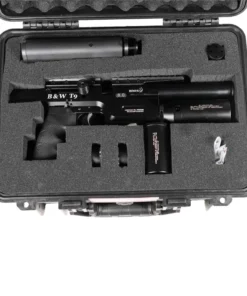

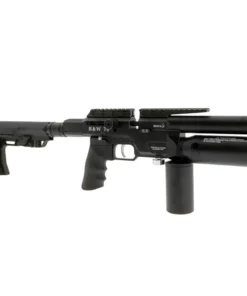
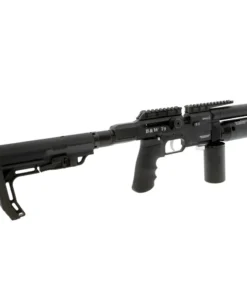
BinTac T9 Folding Stock PCP Air Rifle Cal.35 16 Joule

€800.00
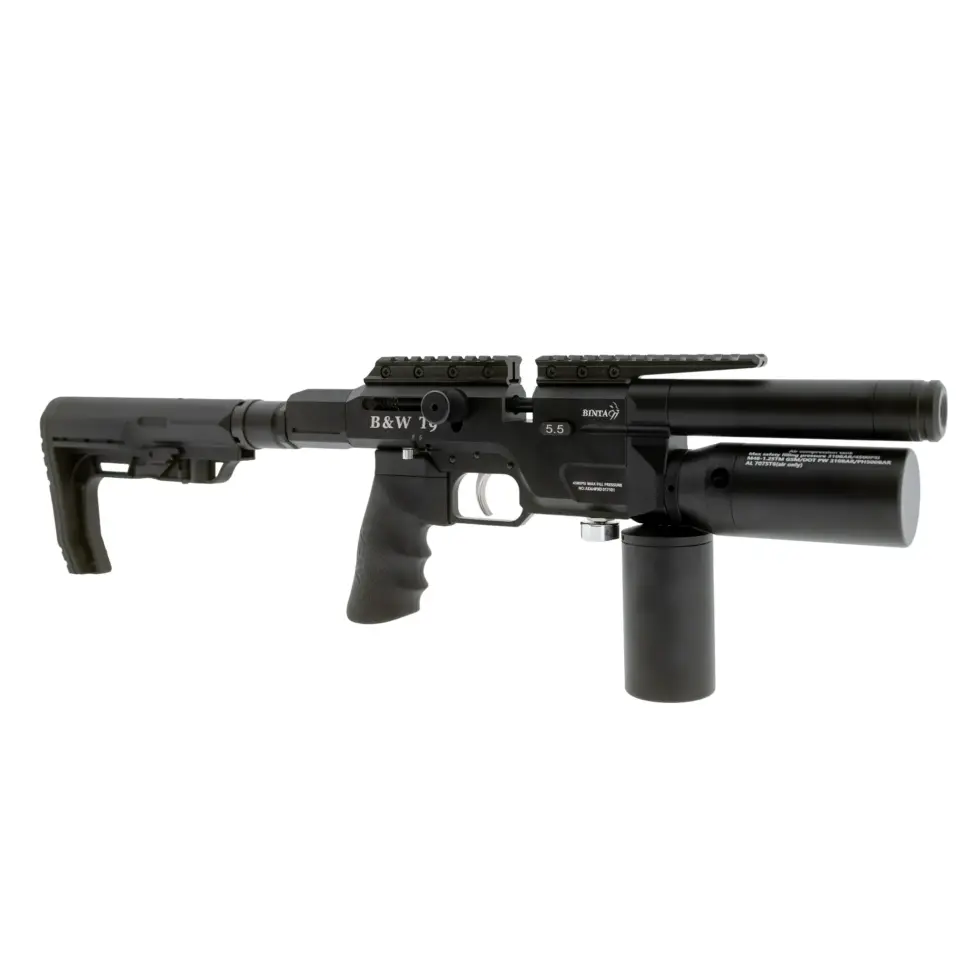
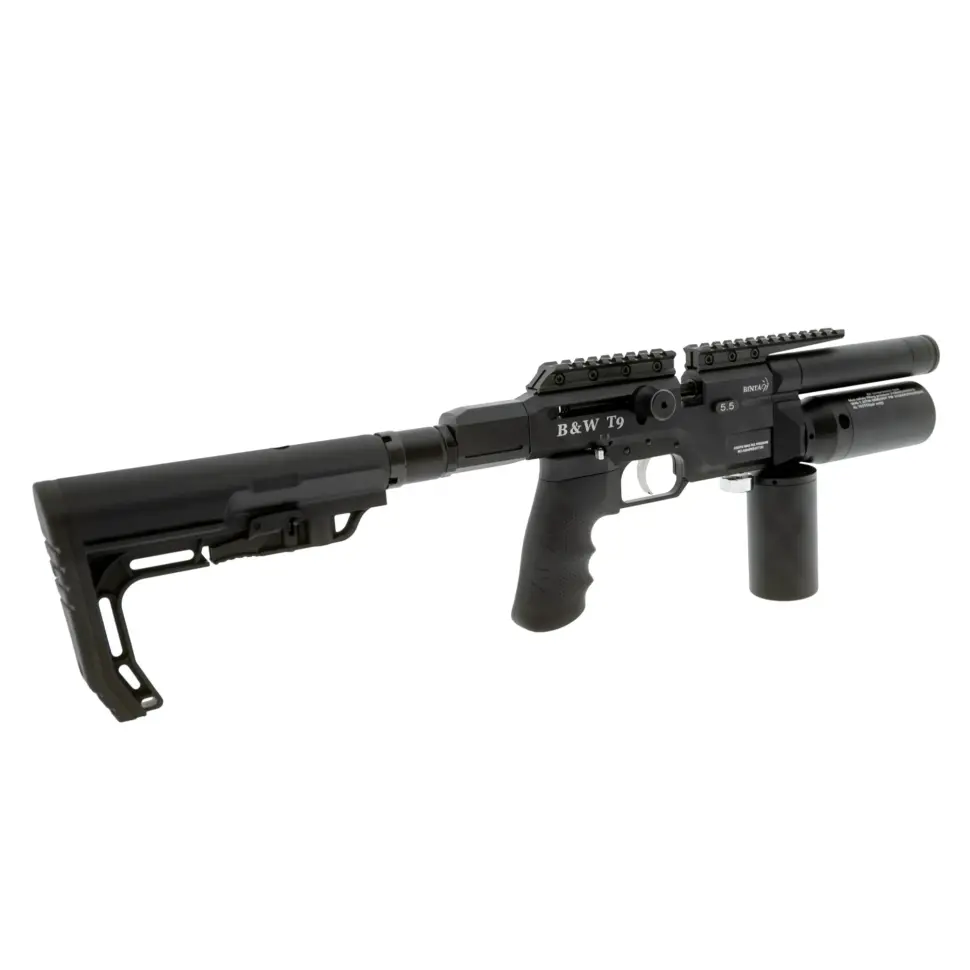
BinTac T9 Folding Stock Air Rifle Cal .35 16 Joule
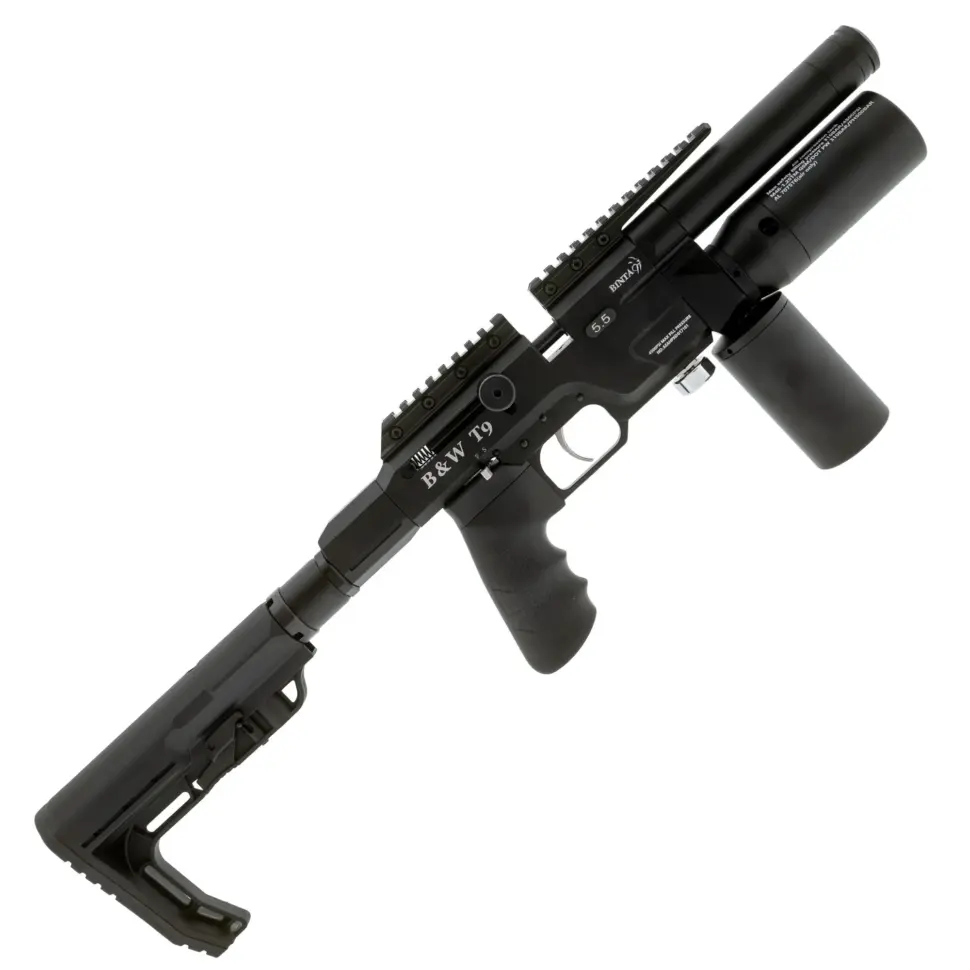
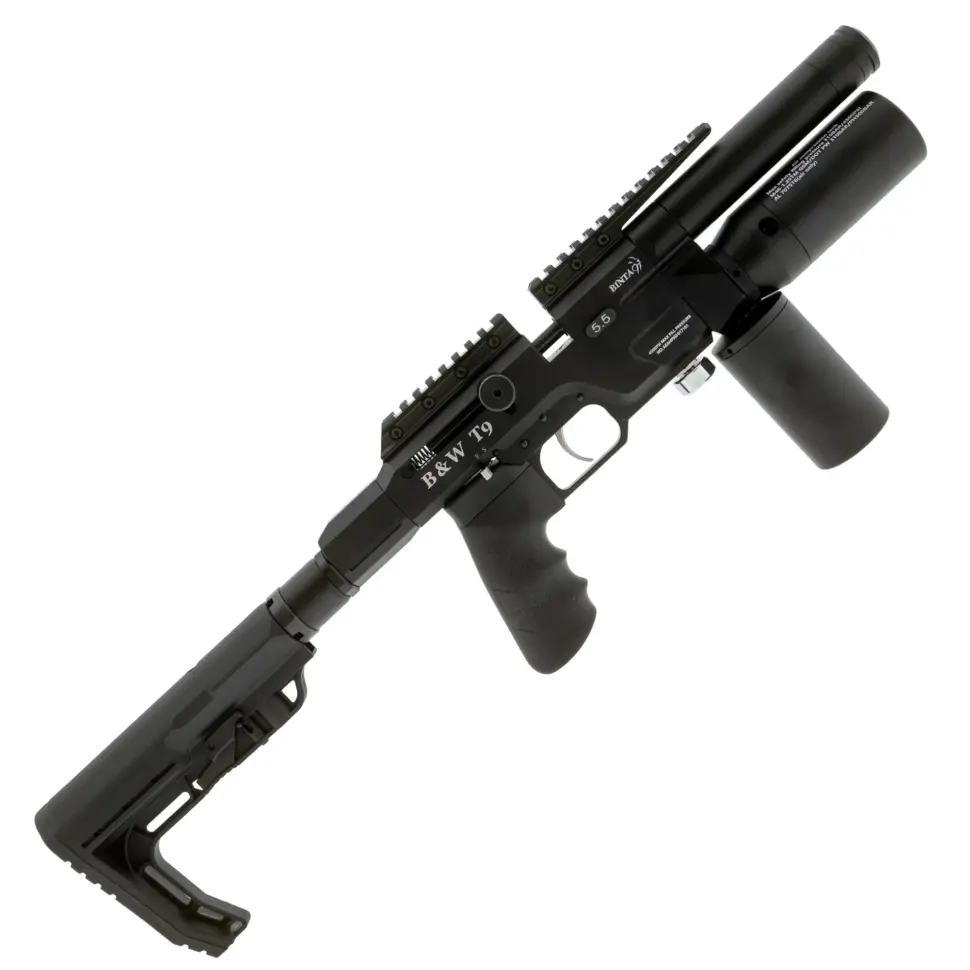
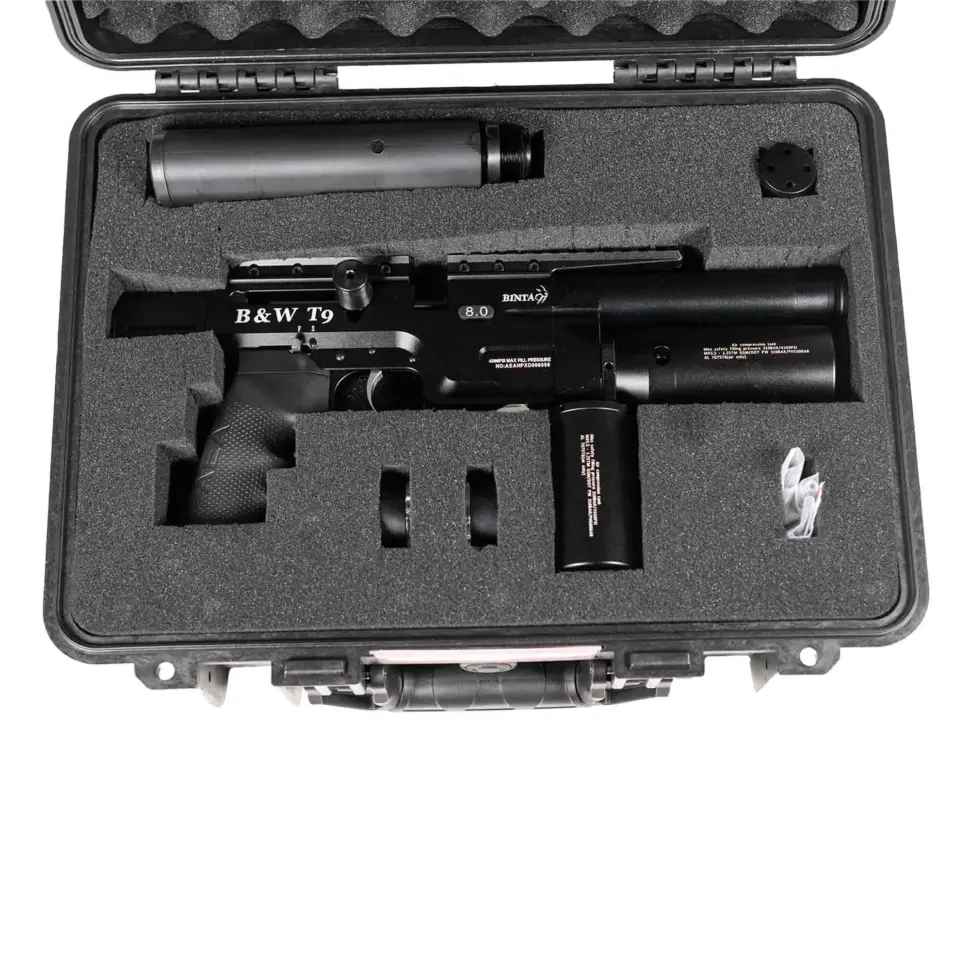
The BinTac T9 is an air rifle with great looks. This .35 caliber (9mm) air rifle combines precision, and advanced features, making it a standout choice for professional and recreational shooters alike. This model is limited on 16 Joule of power by means of an exchangeable transferport. A high power transfer port is optionally available converting the rifle into a high power (up to 135 Joule) air rifle with semi automatic shooting function.
The low weight and the compact size makes the rifle ultra short, perfect for “on the go” or in your backpack when you go out airgun hunting.
Specifications:
- Barrel Length: 20 cm (203 mm)
- Weight: 3.6 kg
- Length: 410 mm (folded)
- Total length 657-740
- Magazine Capacity: 8 shots
- Air Tube Capacity: 250cc
- Maximum Fill Pressure: 4500 PSI / 310 BAR
- Muzzle Energy: 16 Joules
The T9 is engineered for performance, providing consistent accuracy shot after shot. Produced by AEA Airguns
Enhanced Features for Versatile Use
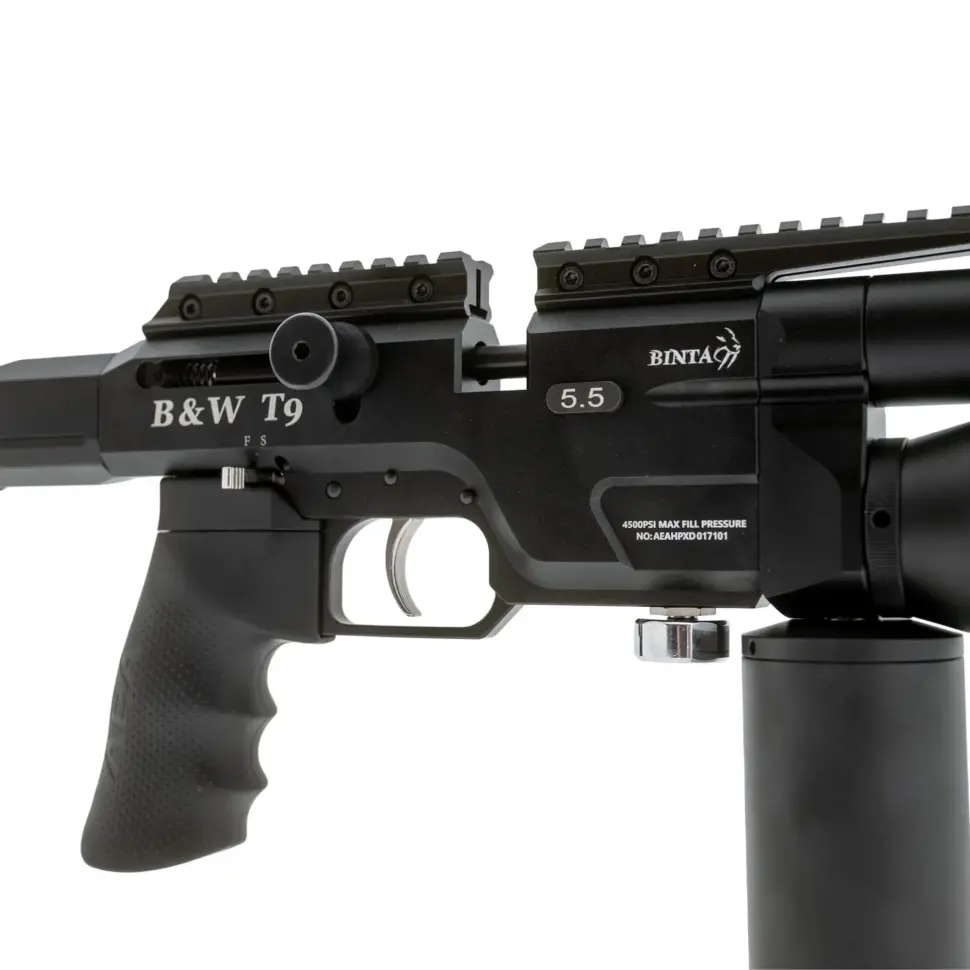
- Picatinny Rail System: Mount optics and accessories effortlessly for a customizable shooting experience.
- Lightweight and Compact Design: The absence of a rear stock enhances portability and maneuverability without sacrificing performance.
- Hot Swap Air Tube System: Features a 125cc front air tube for quick and convenient air reservoir changes during shooting sessions.
- Durable Build: Constructed with premium aluminum for long-lasting reliability.
Important note:
The semi-automatic mode is not available in the 16 Joule setup.
The nominal rating is approximately 16 Joules. Actual muzzle energy can vary with ammunition, rifle configuration and adjustment, so the rifle should be chronograph-tested after installation where a specific legal energy limit applies.
When you use the full power version, the semi automatic mode may not function optimally when a silencer is attached. This model is best used without suppressors to ensure consistent performance. If you want to use a moderator we would advice to use at least a .50 model like the Huma-Air Mod50
This item can only be sold to persons 18 years and older.
For this item we have to carry out an age check.
You can upload a copy/scan/photo of a legal identification document such as a passport, European ID or driver’s license in the order. Parts of the document may be made illegible or designated as a copy. However, your name, document number and place of issue must be legible. Your copy ID will only be used for verification purposes and will not be retained. If you are not able to upload it right now, we will contact you per email before shipping
We can ship these items only to the countries listed below:
Belgium, Bulgaria, Cyprus, Czechia, Denmark, Estonia, Finland, France, Germany, Greece, Hungary, Ireland, Italy, Kroatia, Latvia, Lithuania, Luxembourg, Monaco, Netherlands, Poland, Portugal, Romania, Slovakia, Slovenia, Spain, Austria, Sweden, United States, United Kingdom
Specifications
| Brand | BinTac |
|---|---|
| Model | .35 / 9,0 |
| Cocking system | Straight Pull |
| Magazine capacity | 8 (.35) |
| Mounting base | Weaver / Picatinny |
| Energy (Joule / ft.lbs) | 16/12 |
| Rifle Stock Type | Ambidextrous |
| Stock material | Synthetic |
| Weight (gram) | 3600 |
| Barrel length (mm) | 203 |
| Extra accessories included |
Fill probe, Magazine |
BinTac T9 Folding Stock PCP Air Rifle Cal. .35 – 16 Joule
BinTac T9 Folding Stock PCP Air Rifle Cal. .35 16 Joule Overview
The BinTac T9 Folding Stock PCP Air Rifle Cal. .35 16 Joule combines a compact folding-stock chassis with a regulated low-energy configuration designed around portability, precision-oriented recreational shooting, and responsible pneumatic ownership. Current dealer specifications identify the restricted version as a 9 mm/.35-caliber PCP, producing approximately 16 joules/12 ft-lb, using an 8-round magazine, a 203 mm barrel, Weaver/Picatinny mounting interface, synthetic ambidextrous stock construction, and an approximate weight of 3.6 kg.
One particularly important distinction concerns the operating system. Although unrestricted versions of this platform are associated with semi-automatic cycling, the dedicated 16-joule setup does not reliably provide semi-automatic operation because the reduced working pressure does not consistently generate enough energy to cycle the mechanism. Consequently, current dealer documentation identifies this configuration as a straight-pull manually cycled rifle.
bintac t9
The bintac t9 family is known for combining a compact receiver with a folding-stock layout, high-pressure pneumatic operation, and modern sporting ergonomics.
bintac
bintac offers several pneumatic platforms across different calibers, action types, stock configurations, and energy levels.
bintac lIc
The keyword bintac lIc commonly refers to BinTac LLC and the broader manufacturer and distributor ecosystem associated with these pneumatic platforms.
bintac m50
The bintac m50 belongs to another large-caliber family and should not be confused with this compact restricted-energy configuration.
bintac t9 price
A bintac t9 price search should account for caliber, stock design, market, and legal-energy configuration. Current European listings for the 16-joule folding-stock version are around €1,199–€1,249, although pricing can change.
aea harpoon
The aea harpoon is another pneumatic platform and uses a different architecture.
aea harpoon price
An aea harpoon price search concerns another product and should not determine the value of this model.
AEA Zeus MKII (Bullpup) Standard 18 Big Bore
The AEA Zeus MKII (Bullpup) Standard 18 Big Bore belongs to a substantially larger-bore platform family and uses a different chassis concept.
bin tac
bin tac is another common search variation used when looking for this manufacturer’s products.
bintac aea harpoon
The bintac aea harpoon phrase points toward another product in the wider AEA/BinTac ecosystem.
bintaclic
bintaclic appears as an alternative or misspelled brand-related search expression.
aea airguns
aea airguns cover numerous pneumatic systems, calibers, barrel lengths, and operating mechanisms.
bintac t 50
The bintac t 50 belongs to another product family and should be evaluated according to its own specifications.
aea megalodon
The aea megalodon follows a pump-operated architecture and differs mechanically from this compact straight-pull configuration.
bintac s45 aea
The bintac s45 aea represents another product line with different caliber and action characteristics.
harpoon for sale
A harpoon for sale search relates to another pneumatic platform and does not describe this rifle.
bintac mcar
The bintac mcar belongs to another rifle family within the manufacturer’s catalog.
bintac t50
The bintac t50 is another pneumatic platform and should not be confused with this model.
bintac m50 for sale
A bintac m50 for sale search concerns another large-caliber product family.
bintac mcar air rifle
The bintac mcar air rifle uses a different chassis and operating concept.
bintac t50 for sale
A bintac t50 for sale search relates to availability of another model family.
bintac mcar 457
The bintac mcar 457 operates in a larger caliber category and should be evaluated independently.
bintac s45 for sale
A bintac s45 for sale search concerns another pneumatic platform rather than this compact model.
aea harpoon magnum
The aea harpoon magnum belongs to another high-pressure pneumatic family.
b&w m50
The b&w m50 is another large-caliber rifle and does not share this model’s restricted-energy configuration.
aea megalodon 58 cal
The aea megalodon 58 cal represents a considerably larger-bore pump-operated platform.
aea megalodon 50 cal price
An aea megalodon 50 cal price search concerns another caliber and product line.
megalodon air rifle
The megalodon air rifle differs through its pump-action architecture.
bintac t9 full auto
The phrase bintac t9 full auto refers to searches concerning other configurations and should not describe this 16-joule model. Current documentation states that the restricted version operates manually rather than in an automatic cycling mode.
aea defender
The aea defender belongs to another compact pneumatic product category.
aea megalodon 58 cal bintac m50
The phrase aea megalodon 58 cal bintac m50 combines separate product families and should not be interpreted as one specification.
pistol
A pistol uses handgun-oriented ergonomics, whereas this model uses a shoulder stock and rifle-style layout.
bintac t9 amazon
A bintac t9 amazon search relates to marketplace availability and should not be relied upon as the primary specification source.
aea megalodon air rifle
The aea megalodon air rifle uses a different operating mechanism and substantially different large-bore configuration.
aea defender 2
The aea defender 2 belongs to another pneumatic platform family.
aea harpoon gun
The aea harpoon gun uses another large-caliber pneumatic architecture.
aea harpoon cartridge
An aea harpoon cartridge belongs to another platform and is unrelated to the standard magazine system used here.
aea terminator gen 3
The aea terminator gen 3 belongs to another pneumatic rifle family.
aea megalodon 50 caliber
The aea megalodon 50 caliber represents another considerably larger-bore platform.
aea guns
aea guns span numerous sporting pneumatic designs, so exact model identification remains important when comparing specifications.
bintac t50 extreme
The bintac t50 extreme belongs to another product line and should not be treated as mechanically identical.
aea .50 harpoon
The aea .50 harpoon is a separate .50-caliber pneumatic product.
aea bintac t50 extreme
The phrase aea bintac t50 extreme concerns another high-pressure rifle platform.
bintac m50 pump action
A bintac m50 pump action search points toward another model and cycling method.
harpoon air gun
A harpoon air gun belongs to a different pneumatic product category.
aea defender 3
The aea defender 3 is another compact pneumatic design with its own specifications.
aea terminator
The aea terminator represents another rifle family within the broader catalog.
anti air tanks
The search phrase anti air tanks should not be confused with the compressed-air reservoir and filling equipment used by sporting pneumatic rifles.
bee bee gun rifle
A bee bee gun rifle typically refers to a much smaller BB-firing platform, while this rifle uses 9 mm/.35-caliber ammunition.
zeus 72 cal air rifle price
A zeus 72 cal air rifle price search concerns an exceptionally larger-bore rifle family and has no direct relationship to this restricted model’s pricing.
air tank for pep airguns
An air tank for pep airguns refers to an external compressed-air source used for compatible PCP equipment. Any charging system must be appropriately pressure-rated and used according to manufacturer instructions.
aea harpoon air gun
The aea harpoon air gun belongs to another large-caliber family and should be compared independently.
airgun shotgun
An airgun shotgun follows a different barrel and projectile concept and should not be confused with this rifled pneumatic platform.
.35 Caliber and 16 Joule Configuration
The central specification is the combination of 9 mm/.35 caliber and approximately 16 joules of muzzle energy. Current documentation also notes that actual energy can vary with ammunition and individual setup, so compliance should be verified where a precise legal limit applies.
203 MM Barrel
The restricted model is listed with a 203 mm barrel, helping create the unusually compact proportions associated with the design.
Eight-Round Magazine
An 8-round magazine provides multi-shot capacity while the restricted version is manually cycled between shots.
Folding Stock
The folding shoulder stock significantly reduces storage and transport length. Current manufacturer-dealer material emphasizes portability as one of the main advantages of the design.
Weaver and Picatinny Mounting Interface
A standardized optics rail allows compatible sporting sights to be installed. Proper eye relief and secure mounting help maintain predictable sight alignment.
Why Choose This Configuration?
The primary reasons are compactness, regulated low-energy performance, large 9 mm caliber, folding-stock convenience, multi-shot capacity, and a substantial metal-based sporting chassis.
How Good Is the Precision?
Useful precision depends on stable pressure, consistent ammunition, secure stock lockup, correct optic mounting, barrel condition, and repeatable handling. The 16-joule configuration should therefore be judged by consistency and control rather than maximum energy.
Where Is It Best Used?
The rifle is most appropriate for lawful recreational target and precision shooting in controlled environments where its caliber, configuration, and energy level are permitted.
When Does Inspection Matter?
Inspection is especially important before charging, after transportation, following prolonged storage, and whenever unexpected pressure loss, action resistance, or stock movement is noticed.
Important Information
The most important purchasing detail is that the 16-joule version should not be advertised as functioning like the unrestricted semi-automatic configuration. Multiple current sources identify the restricted setup as straight-pull/manual because its lower operating pressure does not reliably cycle the action automatically.
Overall Engineering Character
The BinTac T9 Folding Stock .35 16 Joule combines a 203 mm barrel, folding shoulder stock, 8-round magazine, standardized optics rail, approximately 3.6 kg weight, 9 mm caliber, and restricted pneumatic output into a highly compact sporting package.
Its strongest qualities are portability, distinctive engineering, solid construction, manageable regulated output, and a format designed around controlled recreational precision. Proper charging equipment, regular pressure-system inspection, secure storage, and adherence to applicable law remain essential parts of responsible ownership.
Pressure Management, Folding-Stock Stability, Manual Operation, Ergonomic Control, and Long-Term Reliability
High-Pressure System Awareness
A compact pneumatic rifle depends on stable pressure, sound seals, clean charging equipment, secure fittings, and predictable valve behavior. Therefore, routine ownership should begin with careful attention to the pressure system before focusing on optics, stock adjustment, or external accessories.
A well-maintained pneumatic system usually delivers more consistent operation and is easier to inspect over time.
Reservoir Condition
The pressure vessel should remain free from dents, corrosion, deep scratches, impact damage, or damaged threads.
Because compressed air is stored inside the system, structural concerns should never be ignored.
If visible damage is suspected, filling should stop until the component has been checked by a qualified technician.
Pressure Retention
Stored pressure should remain reasonably stable during normal storage.
Unexpected loss can indicate a worn seal, damaged fitting, valve fault, or gauge problem.
Repeatedly adding air without identifying the cause of a leak can allow a small issue to develop into a more serious one.
Gauge Awareness
The pressure gauge should remain readable, secure, and consistent.
A sticking needle, irregular movement, or obviously inaccurate reading can make pressure management unreliable.
Any questionable gauge should be inspected before further charging.
Controlled Filling
Charging should be carried out gradually with correctly rated equipment.
Rapid filling can create unnecessary heat inside the reservoir and place additional stress on internal seals.
A steady pressure increase also makes abnormal behavior easier to identify.
Clean and Dry Air
Clean, dry compressed air helps preserve internal components.
Moisture can contribute to corrosion, while contamination can damage seals and interfere with valve function.
Suitable filtration therefore supports long-term reliability.
Fill Connection Care
The fill point should remain clean, dry, and protected from debris.
Dust, grit, or damaged sealing surfaces can cause leakage.
Before charging begins, both the rifle fitting and external connector should be inspected.
Charging Hose Condition
High-pressure hoses should remain free from cuts, crushing, cracked fittings, or worn threads.
Any damaged charging component should be replaced before use.
Only equipment rated for the required pressure should be connected.
Seal Condition
Seals should retain pressure without audible leakage.
Hissing, repeated pressure loss, or unstable gauge readings can indicate deterioration.
Replacement should use suitable components and approved servicing procedures.
Valve Behavior
The valve should operate predictably from one session to another.
Unexpected changes in sound, air consumption, or general operation can indicate wear or contamination.
Persistent irregularities should receive professional attention.
Manual Cycling
The restricted configuration relies on manual cycling, so the action should move smoothly and consistently.
Binding, grinding, roughness, or unusual resistance should not be forced.
Instead, the mechanism should be inspected for contamination, alignment issues, or mechanical wear.
Action Linkage Inspection
Pins, joints, screws, and moving components should remain secure.
Repeated cycling can gradually introduce play into the mechanism.
Periodic checks help identify looseness before feeding or alignment is affected.
Folding Mechanism Condition
The rear assembly should fold and extend smoothly.
The hinge should remain free from excessive side movement, visible damage, or contamination.
A stable folding mechanism is important for comfortable shoulder contact and predictable handling.
Stock Lock Stability
When extended, the rear assembly should lock positively.
It should not shift unexpectedly during normal use.
If the locking mechanism becomes unusually loose, sticky, or vague, it should be inspected.
Shoulder Contact
The stock should rest naturally against the shoulder.
Excessive pressure is unnecessary and can increase fatigue.
Consistent contact helps maintain a repeatable head position and more stable sight alignment.
Grip Comfort
The grip should allow the wrist to remain in a natural position.
If the hand must twist sharply or stretch excessively, trigger control can become less consistent.
A relaxed grip is generally easier to reproduce.
Trigger Reach
The trigger finger should contact the blade comfortably without requiring the hand to shift.
Correct reach reduces unnecessary movement and supports smoother control.
A consistent hand position also helps reduce fatigue.
Supporting-Hand Position
The forward hand should support the rifle without interfering with moving components or pressure fittings.
Because the platform is compact, careful hand placement is especially important.
The hand should remain clear of the action during cycling.
Balance Management
Compact pneumatic rifles can feel dense because the pressure vessel, receiver, barrel, and magazine system are concentrated into a shorter overall package.
A balanced stance and natural hand position can make this weight distribution easier to manage.
Magazine Condition
The magazine should remain clean, correctly aligned, and free from deformation.
Damage or contamination can interfere with feeding.
A magazine that becomes difficult to insert or remove should be inspected rather than forced.
Magazine Indexing
The feeding system should advance consistently.
Irregular indexing can cause feeding problems and unnecessary wear.
Repeated misalignment should be investigated before normal operation continues.
Feed Path Inspection
The feed path should remain clear of debris and damaged projectiles.
Contamination can interfere with smooth loading.
Recurring feeding issues should be evaluated methodically.
Trigger Familiarity
The trigger should feel consistent from one session to another.
Unexpected changes in resistance, travel, or release characteristics can indicate contamination or mechanical wear.
Random adjustment should not be the first troubleshooting step.
Safety Function
The safety should engage and disengage clearly.
It should not become unusually stiff, vague, or loose.
Any change in function should be investigated before continued use.
Optic Mount Stability
The top mounting surface and optic hardware should remain secure.
Loose rings or bases can create apparent consistency problems.
Fasteners should be checked periodically without overtightening.
Eye Relief
The optic should provide a complete sight picture from a natural head position.
If the user must stretch or tilt the head repeatedly, mount placement may need refinement.
Comfortable eye relief supports repeatability.
Ammunition Condition
Projectiles should remain clean, correctly formed, and free from visible damage.
Deformed ammunition can create feeding or consistency issues.
Dry, protected storage helps preserve condition.
Consistent Ammunition Selection
Using one suitable projectile type during evaluation provides clearer information about how the rifle is behaving.
Constantly changing ammunition can make it harder to identify whether variation comes from pressure, optics, feeding, or projectile differences.
Barrel Inspection
The barrel should remain protected from impact and bending forces.
Visible damage or unusual movement should be investigated before continued use.
The barrel should never be used as a leverage point.
Muzzle Protection
The muzzle and crown should remain clean and protected.
Damage in this area can influence consistency.
Cleaning tools should be handled carefully.
Exterior Cleaning
Dust, fingerprints, moisture, and light contamination can generally be removed with a soft cloth.
Strong household chemicals should be avoided unless specifically approved.
Keeping external surfaces clean also makes corrosion easier to identify.
Moisture Protection
After exposure to damp conditions, the rifle should be dried before storage.
Moisture should not remain around the reservoir, hinge, action, fill point, trigger area, barrel, or mounting hardware.
Extended moisture exposure can contribute to corrosion.
Temperature Management
Extreme heat should be avoided, especially while the system remains pressurized.
Hot vehicles and prolonged direct sunlight can affect seals, lubricants, optics, and pressure behavior.
Stable indoor storage generally provides better protection.
Transport Protection
A padded case helps protect the pressure vessel, folding mechanism, optic, barrel, and external controls.
The rifle should remain unloaded and securely positioned during transport.
Applicable local regulations should always be followed.
Safe Storage
Storage should remain dry, secure, and reasonably temperature stable.
The rifle should be protected from unauthorized access, excessive heat, moisture, and chemical vapors.
Long-term pressure condition should follow manufacturer guidance.
Monitoring Performance Changes
Unexpected changes in pressure retention, cycling resistance, magazine behavior, trigger feel, stock lockup, or optic alignment should be investigated systematically.
Several adjustments should not be made at once because doing so can hide the original cause.
Professional Servicing
Persistent leaks, damaged pressure components, valve faults, action binding, trigger problems, or folding-stock issues should be handled by qualified technicians.
High-pressure pneumatic systems require correct tools and safe servicing procedures.
Overall Long-Term Reliability
Long-term reliability depends on healthy pressure components, clean dry air, secure seals, smooth manual cycling, stable stock lockup, correct magazine function, sound optics, suitable ammunition, careful storage, and timely servicing.
When these areas are maintained consistently, the rifle remains easier to inspect, more predictable to operate, and more dependable throughout responsible and lawful sporting use.
Practical Handling, Range Consistency, Ergonomic Control, Inspection, and Everyday Ownership
Practical Handling
A compact pneumatic sporting rifle should feel controlled, stable, and predictable during lawful recreational use. Because the overall format is short, the balance can feel more concentrated around the receiver and pressure system than on a conventional long rifle. Therefore, comfortable body positioning becomes especially important during repeated use.
Good handling should come from a natural stance rather than excessive muscular effort.
Establishing a Repeatable Position
Consistent performance begins with repeatable body position.
The shoulder, cheek, trigger hand, and supporting hand should return naturally to approximately the same locations each time.
If the user constantly changes posture, sight alignment and overall control can become less consistent.
Shoulder Placement
The rear assembly should rest comfortably against the shoulder.
Excessive pressure is unnecessary and can increase fatigue.
A stable shoulder position also supports repeatable head placement and more consistent optic alignment.
Cheek Position
The head should settle naturally without forcing the neck forward or sideways.
A comfortable cheek position makes it easier to maintain the same sight picture.
If the user must repeatedly search for proper alignment, the setup may need refinement.
Grip Comfort
The grip should allow the wrist to remain relaxed.
If the hand must twist sharply, fatigue can develop quickly.
A natural grip generally supports more predictable trigger control and better comfort during longer sessions.
Trigger Reach
The trigger finger should contact the blade comfortably without requiring the hand to shift.
Correct reach reduces unnecessary movement.
A consistent hand position can also make the trigger feel more predictable from one shot to the next.
Supporting-Hand Position
The forward hand should support the rifle without interfering with moving components, pressure fittings, or controls.
Because the chassis is compact, deliberate hand placement is especially important.
The supporting hand should remain comfortable and clear of the action.
Balance Evaluation
Compact pneumatic rifles can feel dense because the reservoir, receiver, barrel, magazine, and hardware are concentrated into a shorter package.
Some users may appreciate this central balance.
Others may need additional familiarity before the rifle begins to feel completely natural.
Folding Mechanism Familiarity
The folding rear assembly should open and close smoothly.
When extended, the locking mechanism should engage positively.
Any excessive movement should be investigated before continued use.
Stock Lockup
A secure rear lock helps maintain consistent shoulder placement.
If movement develops at the hinge or locking point, comfort and alignment can be affected.
Periodic inspection therefore supports both reliability and handling consistency.
Manual Cycling Rhythm
The action should be operated smoothly and deliberately.
A consistent cycling rhythm helps reduce unnecessary mechanical stress.
Binding, grinding, or unusual resistance should never be forced.
Action Feel
The operating mechanism should feel similar from one cycle to the next.
Sudden changes in resistance can indicate contamination, wear, or alignment problems.
Any noticeable change deserves inspection.
Magazine Insertion
The magazine should seat correctly without excessive force.
Difficulty during insertion can indicate dirt, deformation, or misalignment.
Forcing the magazine can create additional wear.
Magazine Removal
Removal should also remain smooth.
If the magazine begins to stick, the interface should be inspected carefully.
Routine cleaning can prevent many simple feeding problems.
Magazine Indexing
The feeding system should advance consistently.
Irregular movement can create feeding issues and unnecessary mechanical wear.
Repeated indexing problems should be addressed before normal use continues.
Feed Path Condition
The feed path should remain clean and unobstructed.
Damaged projectiles or contamination can interfere with normal loading.
Recurring feeding issues should be investigated systematically rather than treated as one isolated problem.
Pressure Baseline
A useful ownership habit includes learning how the pressure system normally behaves.
Gauge readings should remain predictable during filling, storage, and use.
Unexpected pressure loss should be investigated rather than repeatedly corrected by adding more air.
Reservoir Retention
A healthy pressure system should retain air within normal expectations.
Slow leakage can indicate worn seals, fitting damage, or valve problems.
Monitoring pressure over time helps identify developing issues.
Fill Connection Condition
The fill point should remain clean, dry, and protected.
Dust or damaged sealing surfaces can create leaks.
Before charging, both the rifle connection and external fitting should be inspected.
Charging Equipment Care
Hoses, connectors, gauges, filters, and external cylinders should remain in good condition.
Any damaged component should be removed from service.
Correct pressure ratings are essential.
Clean Air Management
Only clean and dry compressed air should enter the system.
Moisture can contribute to corrosion, while contamination can affect seals and valve behavior.
Suitable filtration supports long-term internal reliability.
Seal Awareness
Seals should maintain pressure without audible leakage.
Hissing, recurring pressure loss, or unstable readings can indicate deterioration.
Seal replacement should follow proper servicing procedures.
Valve Consistency
The valve should behave predictably during normal operation.
Changes in sound, pressure use, or mechanical response can indicate wear or contamination.
Persistent changes should receive professional attention.
Trigger Feel
The trigger should remain consistent.
Unexpected changes in resistance, travel, or release characteristics can indicate mechanical wear or contamination.
Random adjustment should not be the first troubleshooting approach.
Safety Function
The safety should operate clearly and positively.
It should not become unusually stiff, loose, or vague.
Any change in function should be investigated before further use.
Optic Position
The optic should provide a full sight picture from a natural head position.
If the user must repeatedly stretch or tilt the head, mount placement may need refinement.
Comfortable eye relief supports repeatable alignment.
Mount Security
Optic rings and rail hardware should remain secure.
Loose mounting components can create apparent consistency problems even when the pneumatic system is functioning normally.
Periodic inspection helps prevent unnecessary troubleshooting.
Ammunition Condition
Projectiles should remain clean, correctly formed, and free from visible damage.
Deformed ammunition can contribute to feeding issues and inconsistent results.
Dry, protected storage helps preserve condition.
Consistent Ammunition Use
Using one suitable projectile type during evaluation provides clearer information about how the rifle is behaving.
Constantly switching ammunition can make it difficult to determine whether variation comes from pressure, feeding, optics, or projectile differences.
Barrel Condition
The barrel should remain protected from impact and bending forces.
Visible damage or unusual movement should be investigated before continued use.
The barrel should never be used as a leverage point.
Muzzle Protection
The muzzle and crown should remain clean and protected.
Damage in this area can influence consistency.
Cleaning tools should be handled carefully.
Exterior Cleaning
Dust, fingerprints, and light contamination can generally be removed with a soft cloth.
Strong household chemicals should be avoided unless specifically approved.
A clean exterior also makes developing corrosion easier to identify.
Moisture Management
After exposure to damp conditions, the rifle should be dried before storage.
Moisture should not remain around the pressure system, action, hinge, trigger area, barrel, or mounting hardware.
Extended moisture exposure can contribute to corrosion.
Temperature Stability
Extreme heat should be avoided.
Hot vehicles and prolonged direct sunlight can affect seals, lubricants, optics, and pressure behavior.
Stable indoor storage generally provides better protection.
Transport Preparation
Before transport, the rifle should be unloaded and secured inside a padded case.
The reservoir, folding mechanism, optic, barrel, and controls should be protected from impact.
Applicable local regulations should always be followed.
Post-Transport Inspection
After travel, the pressure reading, optic mounts, stock hardware, magazine fit, and visible fasteners should receive a quick check.
Transport vibration can occasionally loosen components.
Troubleshooting Methodically
When performance changes, only one variable should be evaluated at a time.
Pressure retention, magazine function, action movement, optic security, ammunition condition, and trigger feel should be checked systematically.
This makes the true cause easier to identify.
Overall Everyday Ownership
Reliable everyday ownership depends on stable pressure, clean charging equipment, healthy seals, smooth manual cycling, secure stock lockup, correct magazine function, stable optics, suitable ammunition, careful transport, and regular inspection.
When these areas are monitored consistently, the rifle remains easier to evaluate, more comfortable to handle, and more dependable throughout responsible and lawful sporting use.
Preventive Maintenance, Structural Care, Storage, Transport, and Long-Term Serviceability
Preventive Maintenance Routine
A compact high-pressure sporting rifle should be maintained through regular inspection rather than only after a problem appears. Preventive care should focus on the reservoir, fill connection, pressure gauge, seals, valve system, manual action, folding hinge, stock lock, trigger area, safety, optic mounting points, barrel, muzzle, and exterior finish.
Consistent maintenance helps identify gradual wear before it affects reliability.
Reservoir Inspection
The pressure vessel should remain free from dents, corrosion, deep scratches, thread damage, or impact marks.
Because compressed air is stored inside the system, any structural concern should be treated seriously.
If visible damage is suspected, the reservoir should not be filled until it has been checked by a qualified technician.
Pressure Retention
Stored pressure should remain reasonably stable during normal storage.
Unexpected loss can indicate a worn seal, damaged fitting, valve fault, or gauge problem.
Repeatedly adding air without identifying the cause of a leak can allow a minor issue to become more serious.
Gauge Condition
The pressure gauge should remain readable and secure.
A sticking needle, irregular movement, or obviously inaccurate reading can make pressure management unreliable.
Any questionable gauge should be inspected before further charging.
Fill Port Care
The fill connection should remain clean, dry, and protected from dust.
Contamination can damage sealing surfaces and create leakage.
Before charging begins, both the rifle fitting and external connector should be checked carefully.
Charging Hose Inspection
High-pressure hoses should remain free from cuts, crushing, cracking, worn fittings, or thread damage.
Any damaged component should be removed from service.
Only equipment designed for the required working pressure should be used.
Clean Air Management
Clean, dry compressed air helps preserve internal pneumatic components.
Moisture can contribute to corrosion, while contamination can damage seals and affect valve behavior.
Suitable filtration therefore supports long-term reliability.
Controlled Filling
Charging should be performed gradually.
Rapid filling can create unnecessary heat inside the reservoir and place additional stress on sealing components.
A steady pressure increase also makes abnormal behavior easier to identify.
Seal Condition
Seals should retain pressure without audible leakage.
Hissing, recurring pressure loss, or unstable gauge behavior can indicate deterioration.
Replacement should follow approved service procedures and use appropriate components.
Valve System Care
The valve should behave consistently from one session to another.
Changes in sound, air consumption, or general operation can indicate wear or contamination.
Persistent internal issues should receive professional inspection.
Manual Action Inspection
The cycling mechanism should move smoothly throughout its normal range.
Binding, grinding, roughness, or unusual resistance should never be forced.
Instead, the action should be inspected for dirt, alignment problems, or mechanical wear.
Linkage Condition
Pins, joints, screws, and connecting parts should remain secure.
Repeated cycling can gradually introduce play into these areas.
Periodic inspection helps identify developing looseness before feeding or alignment is affected.
Folding Hinge Inspection
The folding mechanism should open and close smoothly.
The hinge should remain free from excessive side movement, damage, or contamination.
A stable hinge supports predictable shoulder placement and overall handling.
Locking Mechanism Condition
When extended, the rear assembly should lock positively.
It should not shift unexpectedly during normal use.
If the lock becomes unusually loose, sticky, or vague, it should be inspected before further use.
Release Control Care
The release mechanism should move smoothly and return correctly.
Dust and debris can interfere with normal operation.
Cleaning should remain light and should not introduce excessive lubricant into the mechanism.
Grip Fastener Inspection
Grip hardware can loosen gradually through repeated handling and transport.
The grip should remain firm without movement.
Fasteners should be tightened only to appropriate specifications.
Trigger Area Maintenance
The trigger area should remain clean and protected from excessive lubricant.
Unexpected changes in travel, resistance, or release feel can indicate contamination or mechanical wear.
Random adjustment should not be the first troubleshooting method.
Safety Inspection
The safety should engage and disengage clearly.
It should not become unusually stiff, loose, vague, or difficult to operate.
Any noticeable change should be investigated before continued use.
Optic Rail Inspection
The mounting rail should remain secure and free from visible damage.
Loose hardware can create apparent consistency problems.
Periodic inspection helps prevent avoidable sighting issues.
Optic Mount Security
Rings and bases should remain firmly attached.
Repeated transport and normal use can gradually loosen mounting hardware.
Fasteners should be checked periodically without overtightening.
Barrel Exterior Care
The barrel should remain protected from impacts, dents, and bending forces.
Visible damage or unusual movement should be investigated before continued use.
The barrel should never be used as a leverage point.
Muzzle Protection
The muzzle and crown should remain clean and protected.
Damage in this area can influence consistency.
Cleaning equipment should be handled carefully to avoid striking or scratching the crown.
Bore Cleaning
Internal cleaning should be based on actual condition rather than performed excessively.
Aggressive rods, abrasive compounds, and unsuitable chemicals can create unnecessary wear.
Approved cleaning methods should remain the preferred approach.
Magazine Maintenance
The magazine should remain clean and free from deformation.
Dirt, damaged internal parts, or excessive lubricant can interfere with indexing.
If feeding becomes inconsistent, the magazine should be inspected before other adjustments are made.
Feed Path Inspection
The feed path should remain clear of debris and damaged projectiles.
Contamination can interfere with smooth loading.
Recurring feeding issues should be investigated methodically.
Exterior Surface Cleaning
Dust, fingerprints, and light contamination can generally be removed with a soft cloth.
Strong household chemicals should be avoided unless specifically approved.
A clean exterior also makes early corrosion easier to identify.
Fastener Checks
Visible screws, rail hardware, stock components, grip fasteners, and external fittings should be inspected periodically.
Repeated cycling and transport can gradually loosen hardware.
Correct tightening specifications should always be followed.
Moisture Protection
After exposure to damp conditions, the rifle should be dried before storage.
Moisture should not remain around the pressure system, hinge, fill point, trigger area, barrel, or mounting hardware.
Extended moisture exposure can contribute to corrosion.
Temperature Management
Extreme heat should be avoided, especially while the system remains pressurized.
Hot vehicles and prolonged direct sunlight can affect seals, lubricants, optics, and pressure behavior.
Stable indoor storage generally provides better protection.
Case Maintenance
A padded case should remain clean and dry.
Foam and fabric interiors can trap moisture after exposure to rain or humidity.
The case should be dried fully before long-term storage.
Long-Term Storage
For extended storage, the rifle should remain unloaded, dry, secure, and protected from unauthorized access.
Pressure condition should follow manufacturer guidance.
Excessive heat, chemical vapors, and prolonged moisture should also be avoided.
Periodic Storage Inspection
Equipment that remains unused for long periods should still be inspected occasionally.
Reservoir condition, seals, gauge behavior, hinge lockup, optics, and external hardware should all be reviewed.
Small problems are easier to manage when identified early.
Recognizing Developing Problems
Changes in pressure retention, cycling resistance, stock movement, trigger feel, magazine behavior, or gauge readings should be taken seriously.
Several adjustments should not be made simultaneously.
A methodical inspection is usually more effective.
Professional Servicing
Persistent leaks, damaged pressure components, valve faults, action binding, trigger problems, or folding mechanism issues should be handled by qualified technicians.
High-pressure pneumatic systems require correct tools and safe servicing procedures.
Long-Term Serviceability
Long-term reliability depends on healthy pressure components, clean dry air, sound seals, smooth manual cycling, stable stock lockup, secure optics, suitable ammunition, controlled storage, and timely servicing.
When preventive maintenance remains consistent, the rifle stays easier to inspect, easier to troubleshoot, and more dependable throughout responsible and lawful sporting use.
Be the first to review “BinTac T9 Folding Stock PCP Air Rifle Cal.35 16 Joule”
Related products





AEA Air Gun



AEA Air Gun

BinTac
AEA Air Gun
Reviews
There are no reviews yet.