
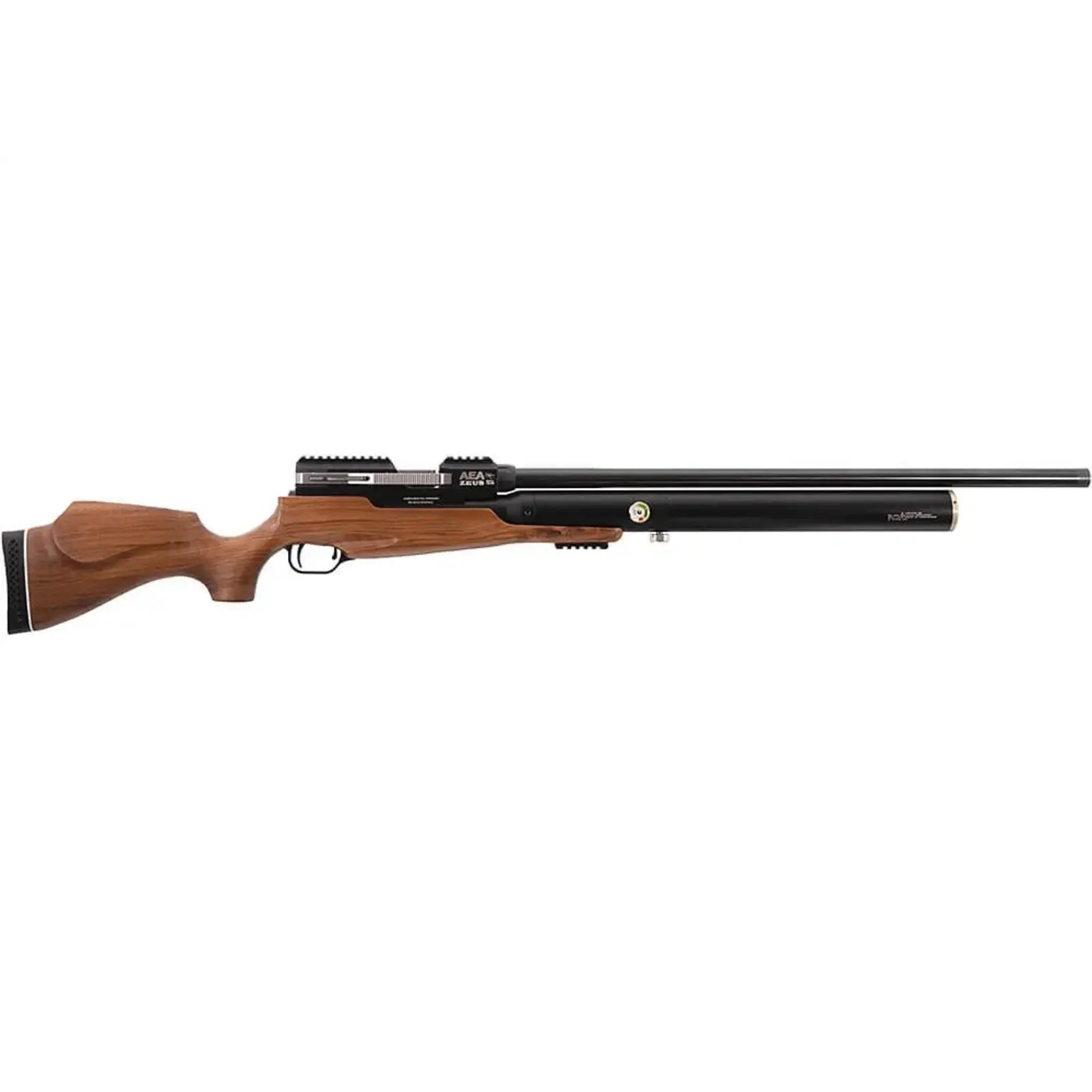
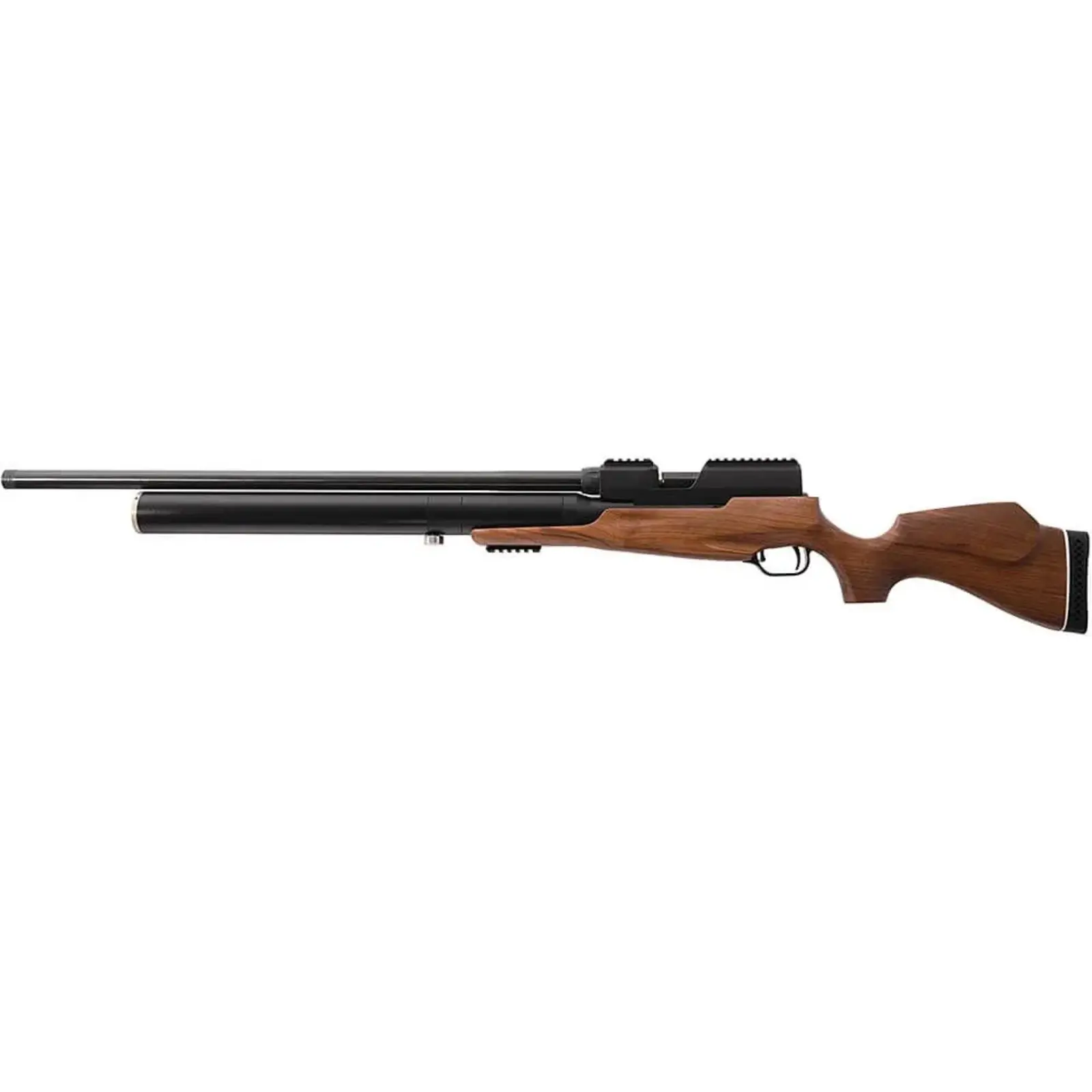

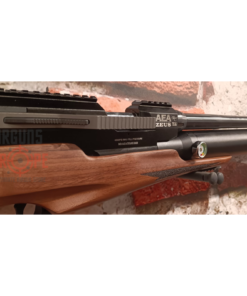
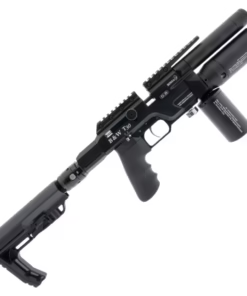
AEA Zeus PCP Rifle | .72 (18,3mm) | 32″ barrel

€1,000.00
The AEA Zeus currently carries the powerful title of being a powerful PCP air rifle in production.
And with a power of 2000 joules (yes really, that’s not a typo) this is certainly no toy!
This single-shot PCP air rifle has a barrel length of 813mm and has an air capacity of 660cc.
This cylinder can be filled up to a pressure of 300 bar. Please note: Never shoot below 150 bar. Otherwise the valve cannot handle the immense impact of the hammer.
The Zeus is placed in a beautifully finished wooden stock with rails for a bipod.
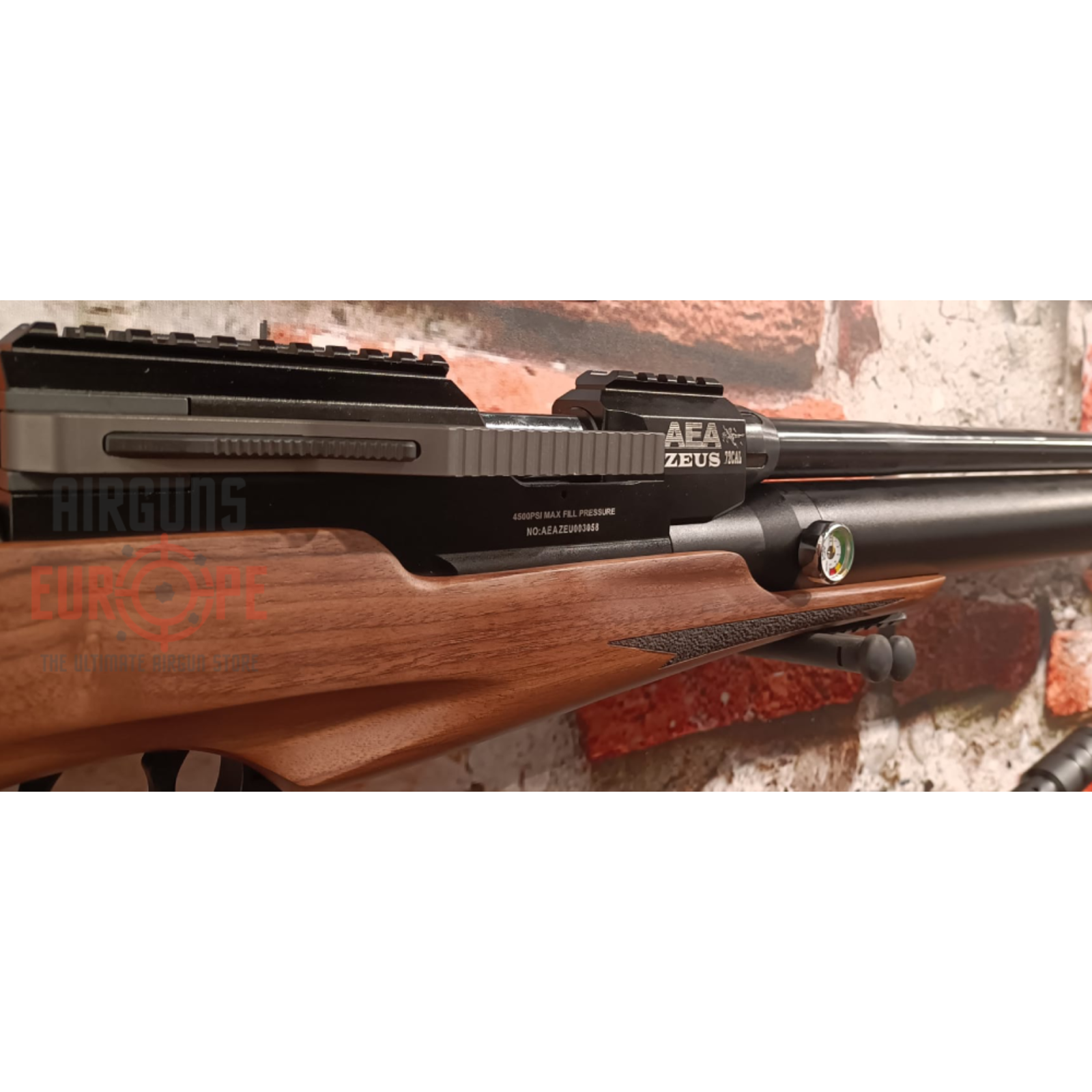
On top of the bolt housing is a two-piece rail for assembling a sturdy rifle scope.
Our opinion about the Zeus
The Zeus is an enormously powerful power that is perfect for the demolition enthusiasts among us.
The appearance is surprisingly beautifully finished and leaves little to be desired.
It is of course not a competition rifle, but it certainly has a lot of range (keep that in mind)!
But since this rifle does not have an internal regulator, an external regulator such as the Huma-Air Inline regulator is a useful accessory for consistency.
| Power source: | Pre compressed pneumatic (PCP) |
| Caliber: | 18.3mm (.72) |
| Muzzle energy: | +-2000 |
| Fill pressure: | 300 bar |
| Air capacity: | 660cc |
| Regulator: | No |
| Operating system: | Side lever |
| Magazine: | Single shot |
| Max. projectile length: | |
| Optic mounting: | Picatinny/weaver 22mm |
| Weight: | 5260gram |
| Length: | 1270mm |
| Barrel length: | 813mm |
| Muzzle: | M23x1 |
AEA Zeus PCP Rifle | .72 (18.3mm) | 32″ Barrel – Technical Big-Bore PCP Overview
AEA Zeus Engineering, .72-Caliber Architecture, Large-Bore PCP Design, and Related AEA/BinTac Terminology
AEA Airguns
aea airguns covers a broad family of PCP rifles ranging from compact and semi-automatic models to large-bore single-shot platforms. The Zeus occupies the extreme large-bore end of that spectrum and is currently listed by AEA’s European retailer alongside models such as the Element, Challenger, Megalodon, Terminator, and HP series.
AEA Guns
The phrase aea guns is broad terminology rather than one exact model designation. Within the current catalog, the Zeus is specifically categorized among bolt-action/side-lever large-bore airguns rather than semi-automatic models.
Zeus 72 Cal Air Rifle Price
The phrase zeus 72 cal air rifle price concerns current retail pricing, which can change. The current AEA Airguns Shop listing displays the 32-inch Zeus at €1,899, but that figure is time-sensitive and should not be treated as a permanent technical specification.
.72-Caliber Architecture AEA Zeus PCP Rifle |.72 (18 3mm) | 32 barrel
The .72 configuration uses approximately 18.28–18.29mm projectiles. The current 32-inch Zeus listing identifies this as one of the largest calibers available in the platform.
32-Inch Barrel
The barrel measures 813mm / 32 inches. Combined with the rifle’s approximately 50-inch overall length, this makes the Zeus a full-size large-bore PCP rather than a compact carbine or bullpup.
Side-Lever Action
The Zeus uses a side-lever cocking system and single-shot architecture. That means it differs mechanically from magazine-fed repeating or semi-automatic models.
660cc Air Reservoir
The 32-inch Zeus uses a 660cc air capacity. This large reservoir supports the platform’s high-volume pneumatic requirements.
4,500 PSI Maximum Fill Pressure
AEA lists the maximum filling pressure at 4,500 PSI / 300 BAR. Because that is substantial stored pressure, all charging equipment and fittings must be pressure-rated and compatible with the supplied system.
Walnut Stock
The current listing describes the stock as natural walnut. AEA notes that individual stocks can differ in grain, color, and shading because natural wood varies from piece to piece.
AEA Zeus MKII Bullpup Tactical
The AEA Zeus MKII Bullpup Tactical is a separate Zeus-family configuration. The current catalog lists a .72-caliber MKII Bullpup Tactical alongside the traditional 32-inch Zeus, so the two should not be treated as the same model.
AEA Zeus MKII (Bullpup) Standard 18 Big Bore
The phrase AEA Zeus MKII (Bullpup) Standard 18 Big Bore refers to a different bullpup-oriented Zeus configuration rather than the traditional 32-inch walnut-stock rifle described here.
Bintac
bintac is frequently associated in search terminology with large-bore AEA-derived or related pneumatic platforms, but it should not automatically be used as another name for the standard AEA Zeus.
Bin Tac
The phrase bin tac is simply a spacing variation of the same search term.
Bintac LLC
bintac llc is brand/company terminology and does not define the engineering specification of the 32-inch Zeus itself.
Bintaclic
bintaclic appears to be a search variation of the same brand-related terminology rather than an AEA Zeus model name.
Bintac T9
The bintac t9 is a separate platform and should not be confused with the single-shot Zeus.
Bintac T9 Price
The phrase bintac t9 price concerns a different model and does not provide technical information about the Zeus.
Bintac T9 Full Auto
The phrase bintac t9 full auto concerns a different operating architecture. The Zeus 32-inch model is single-shot, not full-auto.
Bintac T9 Amazon
The phrase bintac t9 amazon concerns a retail-search query for another product and is unrelated to the Zeus’s specifications.
Bintac M50
The bintac m50 is another large-bore platform name and should not be treated as an alternate designation for the Zeus.
Bintac M50 for Sale
The phrase bintac m50 for sale is commercial terminology for another model rather than an AEA Zeus specification.
Bintac M50 Pump Action
The phrase bintac m50 pump action describes another mechanical architecture and is unrelated to the Zeus’s single-shot side-lever layout.
B&W M50
The term b&w m50 concerns another platform designation and should not be mixed with the Zeus product specifications.
Bintac T50
The bintac t50 is another separate large-bore pneumatic model.
Bintac T50 Extreme
The phrase bintac t50 extreme identifies a different platform and configuration.
Bintac T50 for Sale
The phrase bintac t50 for sale is a purchasing-oriented search term for another model and does not describe the Zeus.
AEA Bintac T50 Extreme
The phrase aea bintac t50 extreme blends AEA and BinTac-related terminology but should not be treated as another name for the Zeus.
Bintac T 50
bintac t 50 is simply a spacing variation of the T50 search phrase.
Bintac S45 AEA
The phrase bintac s45 aea refers to another large-bore/semi-auto-related platform family.
Bintac S45 for Sale
The phrase bintac s45 for sale concerns availability of another product, not the Zeus.
Bintac MCAR
The bintac mcar is another distinct air-rifle platform.
Bintac MCAR Air Rifle
The phrase bintac mcar air rifle therefore describes a different model rather than the Zeus.
Bintac MCAR 457
The phrase bintac mcar 457 refers to another caliber/platform combination and should not be merged with the .72 Zeus specification.
AEA Harpoon
The aea harpoon is another AEA-family big-bore concept, but it is mechanically different from the single-shot Zeus.
AEA Harpoon Price
The phrase aea harpoon price concerns pricing for that separate product.
Bintac AEA Harpoon
The phrase bintac aea harpoon refers to the Harpoon-related ecosystem rather than the Zeus.
AEA Harpoon Magnum
The aea harpoon magnum is another separate configuration.
AEA Harpoon Gun
The phrase aea harpoon gun is common search terminology for that model family rather than this Zeus rifle.
AEA Harpoon Cartridge
The phrase aea harpoon cartridge concerns Harpoon-specific ammunition/component architecture, which is not the same as the Zeus’s single-shot large-bore pellet/slugs system.
AEA .50 Harpoon
The aea .50 harpoon belongs to a smaller-caliber Harpoon configuration than the .72 Zeus.
AEA Harpoon Air Gun
The phrase aea harpoon air gun refers to the same separate Harpoon platform.
Harpoon Air Gun
The phrase harpoon air gun is broad terminology and should not be used interchangeably with Zeus.
Harpoon for Sale
The phrase harpoon for sale concerns commercial availability and is unrelated to the engineering of the Zeus.
AEA Megalodon
The aea megalodon is another AEA large-bore airgun family. The current AEA catalog lists HP Megalodon models separately from the Zeus.
AEA Megalodon Air Rifle
The phrase aea megalodon air rifle therefore describes another large-bore platform.
Megalodon Air Rifle
Likewise, megalodon air rifle refers to that separate family.
AEA Megalodon 58 Cal
The phrase aea megalodon 58 cal concerns a .58-caliber Megalodon configuration rather than the .72 Zeus.
AEA Megalodon 50 Cal Price
The phrase aea megalodon 50 cal price concerns a different caliber and model family.
AEA Megalodon 50 Caliber
Likewise, aea megalodon 50 caliber is not a Zeus specification.
AEA Megalodon 58 Cal Bintac M50
This combined phrase mixes terminology from multiple large-bore platforms and should not be treated as a single AEA Zeus model designation.
AEA Defender
The aea defender belongs to another AEA platform family.
AEA Defender 2
The phrase aea defender 2 refers to another generation/configuration of that platform.
AEA Defender 3
Likewise, aea defender 3 concerns a different platform rather than the Zeus.
AEA Terminator
The aea terminator belongs to AEA’s semi-automatic category rather than the Zeus’s single-shot side-lever category. The current AEA catalog lists Terminator models separately under semi-auto products.
AEA Terminator Gen 3
The phrase aea terminator gen 3 refers to another generation of the Terminator family.
Pistol
The term pistol does not accurately describe the 32-inch Zeus, which is a full-length rifle approximately 50 inches overall.
Bee Bee Gun Rifle
The phrase bee bee gun rifle generally refers to a BB rifle. The Zeus is a large-bore PCP rifle and should not be confused with common steel-BB equipment.
Airgun Shotgun
The phrase airgun shotgun refers to a different projectile and barrel concept and does not accurately describe the Zeus.
Anti Air Tanks
The phrase anti air tanks is unrelated terminology and does not describe the Zeus’s onboard PCP reservoir.
Air Tank for PCP Airguns
The phrase air tank for pcp airguns relates generally to the high-pressure air supply used with PCP equipment. For the Zeus, AEA specifies a 660cc onboard reservoir and maximum fill pressure of 4,500 PSI / 300 BAR.
Why the 32-Inch Configuration Matters
The 32-inch version combines the longest barrel listed in the standard Zeus family with the 660cc reservoir and full-length walnut-stock architecture. AEA currently lists 16-inch, 24-inch, and 32-inch Zeus models separately.
Why the .72 Caliber Matters
The .72 configuration is unusually large for a PCP rifle and requires substantially more air volume than ordinary small-bore pneumatic rifles. That explains the combination of large reservoir capacity, high fill pressure, heavy overall weight, and single-shot design.
Why Single-Shot Operation Matters
The single-shot layout simplifies the projectile-feeding architecture compared with a magazine-fed system.
For a platform of this caliber, it also reflects the Zeus’s emphasis on large-bore pneumatic performance rather than rapid repeating fire.
Precision Considerations
Practical precision depends on more than the barrel length. Projectile consistency, barrel condition, pressure state, sight stability, stock fit, environmental conditions, and user technique can all influence results.
The 32-inch barrel provides a substantial internal bore length, but actual accuracy should be evaluated with the specific rifle and compatible ammunition rather than assumed from barrel length alone.
Important High-Pressure Information
Because the Zeus operates at up to 4,500 PSI, pressure-system condition deserves particular attention. Reservoir damage, suspected leakage, damaged fittings, or questionable gauges should be professionally assessed before continued use.
Overall Technical Perspective
The AEA Zeus PCP Rifle | .72 (18.3mm) | 32″ barrel is a full-size single-shot large-bore pneumatic rifle built around a 32-inch barrel, 660cc reservoir, 4,500 PSI maximum fill pressure, side-lever action, walnut stock, approximately 11.6-pound weight, and 50-inch overall length.
Its defining characteristics are caliber size, reservoir volume, long-barrel architecture, and high-pressure PCP operation. For responsible ownership, the key considerations are manufacturer-compatible ammunition, pressure-rated charging equipment, strict adherence to the supplied pressure limits, appropriate eye and hearing protection, a suitable controlled environment, secure storage, and qualified servicing whenever pneumatic integrity becomes uncertain.
Engineering Design, Construction Quality, Handling Characteristics, Pressure-System Reliability, Precision Factors, and Practical Ownership
A large-bore pre-charged pneumatic rifle represents a considerably different engineering challenge from a conventional small-caliber recreational air rifle. The larger projectile diameter, substantial air consumption, high reservoir pressure, long barrel, and increased overall mass place greater demands on structural integrity and component consistency. Consequently, evaluating this type of rifle requires attention to the complete mechanical system rather than focusing exclusively on headline power figures.
Overall Engineering Character
The platform is built around a straightforward large-bore pneumatic architecture.
A high-pressure reservoir stores the energy required for operation, while the action controls the release of compressed air for each shot.
Because substantial pressures are involved, component integrity and proper servicing are particularly important.
Long-Barrel Architecture
A 32-inch barrel creates a distinctly full-length configuration.
The additional length influences the rifle’s balance and handling while also providing an extended internal path through which expanding compressed air can act.
However, barrel length alone does not determine precision or overall performance.
Large-Bore Design
The unusually large bore diameter separates this platform from typical recreational pellet rifles.
Larger projectiles place different demands on the barrel, air-delivery system, reservoir capacity, and supporting structure.
Therefore, comparisons with ordinary small-bore equipment should be made cautiously.
Single-Shot Configuration
A single-shot action eliminates the need for a conventional multi-round magazine.
This simplifies the feeding arrangement and reduces the number of components involved in moving ammunition from a magazine into the chamber.
It also gives the platform a deliberately straightforward operating character.
Side-Lever Mechanism
The side-lever mechanism forms an important part of the action.
Its condition affects the mechanical feel of the rifle, so unusual resistance, looseness, or inconsistent movement should not be ignored.
Mechanical components should operate according to the manufacturer’s instructions rather than being forced.
Reservoir Construction
The onboard reservoir is one of the most safety-critical components.
It must repeatedly contain substantial internal pressure while remaining securely integrated with the rest of the system.
External damage, corrosion, deformation, or unexplained leakage warrants professional assessment.
Pressure Management
Correct pressure management is fundamental to reliable ownership.
The maximum pressure specified by the manufacturer should always be treated as an absolute limit rather than a target to exceed.
Only properly rated equipment should be connected to the pressure system.
Pressure Gauge Importance
A pressure gauge provides information about the reservoir’s current state.
Its readings should remain clear and believable.
A damaged, inconsistent, or questionable gauge should be inspected or replaced by a qualified technician rather than relied upon.
Seal Integrity
Seals help keep compressed air contained throughout the pneumatic system.
Gradual pressure loss can indicate deterioration, contamination, or another sealing problem.
Persistent leakage should be investigated rather than repeatedly compensated for through additional filling.
Air-System Consistency
Mechanical consistency contributes to predictable operation.
Changes in reservoir pressure can influence how the pneumatic system behaves over a sequence of shots.
Therefore, users should expect the operating characteristics of a large-volume pneumatic system to differ from those of lower-powered recreational equipment.
Precision Factors
Precision results from the interaction of several components.
Barrel quality, projectile consistency, mechanical alignment, sight stability, pressure consistency, stock fit, environmental conditions, and shooter technique can all affect where successive shots land.
No single specification guarantees accuracy.
Barrel Condition
The internal and external condition of the barrel deserves appropriate attention.
Corrosion, obstruction, significant damage, or improper modification can negatively affect reliability and precision.
Any suspected obstruction should be addressed according to the manufacturer’s servicing procedures.
Trigger Consistency
A predictable trigger can support repeatable shooting because the user can operate it without introducing unnecessary movement.
However, internal trigger mechanisms should not be casually altered.
Manufacturer-approved adjustment and professional servicing are preferable when changes are required.
Stock Design
A substantial wooden stock provides the primary interface between the rifle and user.
Its dimensions influence shoulder position, cheek placement, balance, and overall comfort.
Natural wood can also vary in grain and appearance between individual examples.
Overall Weight
A rifle of this scale is considerably heavier than many conventional air rifles.
That mass can contribute to a planted feeling when supported appropriately, although it also makes transportation and unsupported handling more demanding.
Individual physical comfort should therefore be considered.
Balance
Balance is influenced by the long barrel, reservoir, action, and stock.
A well-supported position can make substantial equipment easier to manage.
Conversely, prolonged unsupported handling may become tiring because of the rifle’s overall dimensions and mass.
Sight Installation Considerations
Any sighting equipment should be mechanically compatible with the provided mounting system and appropriate for the platform.
Secure mounting is important because movement between the sight and rifle can create apparent precision problems even when the barrel and ammunition remain consistent.
Environmental Conditions
Wind, temperature, precipitation, and changing light can influence real-world results.
Large projectiles are not immune to environmental effects.
Therefore, precision claims should always be interpreted in the context of actual test conditions.
Temperature Effects
Temperature can influence pneumatic equipment because gas behavior changes as environmental conditions change.
Moving equipment between significantly different temperatures may alter indicated pressure.
The manufacturer’s pressure limits should still be observed under all conditions.
Mechanical Inspection
Periodic inspection should cover the reservoir, barrel, action, stock, fasteners, pressure gauge, seals, and external fittings.
Loose or damaged components should receive attention before continued operation.
Used-Equipment Assessment
When evaluating a used example, appearance provides only part of the picture.
Scratches on a wooden stock may be cosmetic, whereas reservoir damage, corrosion, persistent leakage, damaged threads, or unauthorized internal modifications deserve substantially greater concern.
Service History
Documented servicing can provide useful information about previous ownership.
Records may indicate whether seals, gauges, valves, or other components have been replaced.
Unknown modifications should be professionally evaluated when they affect the pressure-bearing system.
Storage Requirements
Secure storage is particularly important for a platform of this size and capability.
It should be kept inaccessible to unauthorized users and children, with ammunition stored appropriately according to applicable requirements.
Local regulations may impose additional obligations.
Transportation
Transportation requirements vary between jurisdictions.
The rifle should be unloaded, protected from damage, and transported in accordance with applicable law.
A suitable case can also protect the long barrel, stock, sighting equipment, and pressure-system components from impacts.
Routine Exterior Care
Exterior surfaces should be kept reasonably clean and dry.
Moisture should not be allowed to remain on metal components for extended periods.
Likewise, wooden surfaces should be protected from prolonged exposure to excessive moisture or heat.
Professional Servicing
High-pressure components should not be treated as ordinary mechanical parts.
If the reservoir, valve system, gauge, or pressure fittings show signs of failure, qualified servicing is the appropriate response.
Improvised repairs can create unnecessary risk.
Responsible Use
This platform should only be handled in lawful, controlled environments with an appropriate backstop and adequate separation from people, animals, buildings, roads, and other unintended targets.
Eye and hearing protection should be considered essential safety equipment.
Why Mechanical Condition Matters
Large-bore pneumatic equipment places significant loads on multiple components.
Consequently, small warning signs should not be dismissed simply because the rifle still appears functional.
Maintaining structural and pneumatic integrity is more important than preserving cosmetic appearance.
Long-Term Reliability
Reliable ownership depends on respecting pressure limits, keeping the system clean, protecting the rifle during transportation, monitoring for leaks, and arranging appropriate servicing when required.
Unauthorized modifications should be avoided because they can change both reliability and safety characteristics.
Overall Practical Assessment
The engineering character of this platform is defined by its large bore, long barrel, substantial reservoir, considerable physical dimensions, and high-pressure pneumatic system. These characteristics create a specialized rifle that demands considerably more attention to pressure-system integrity and safe handling than an ordinary recreational airgun.
For long-term ownership, the most important considerations are straightforward: preserve the barrel and action, monitor the pressure system, maintain secure storage, use manufacturer-compatible components, avoid unauthorized modifications, and investigate any unusual leakage or mechanical behavior promptly. Precision and consistency ultimately depend on the condition of the entire system rather than one isolated specification.
Maintenance, Inspection, Cleaning, Storage, Pressure-System Care, and Long-Term Reliability
Long-term reliability depends heavily on preventive maintenance and disciplined inspection. A large-bore pneumatic rifle contains pressure-bearing components, seals, valves, a reservoir, a barrel assembly, mechanical controls, a stock, fittings, and sight-mounting hardware. Each component can experience wear differently. Therefore, routine care should focus on preserving structural integrity, identifying changes early, and avoiding improvised internal work, especially around high-pressure parts.
Routine Visual Inspection
A brief visual inspection should be completed before and after use.
Look for corrosion, cracks, loose hardware, dents, damaged fittings, unusual wear, or anything that appears different from the rifle’s normal condition.
Regular observation makes developing problems easier to identify.
Reservoir Condition
The air reservoir is one of the most important components to monitor.
Inspect accessible surfaces for deep scratches, substantial dents, corrosion, swelling, or deformation.
Any significant physical damage should be treated seriously because the reservoir stores compressed air at high pressure.
Pressure Retention
Unexpected pressure loss can indicate deterioration within a seal, valve, fitting, or another pneumatic component.
Persistent leakage should be investigated rather than repeatedly compensated for.
If the cause cannot be identified externally, qualified servicing is appropriate.
Gauge Inspection
Pressure indicators should remain readable, securely mounted, and free from obvious damage.
A cracked lens, unusual reading, condensation, or physical impact can reduce confidence in the gauge.
A questionable gauge should not be relied upon until its condition has been verified.
Seal Longevity
Seals are wear components and will gradually age.
Repeated pressure cycles, contamination, heat, storage conditions, and incompatible chemicals can influence their service life.
When replacement becomes necessary, manufacturer-compatible components should be used.
Fill Connection Care
The filling interface should remain clean and protected from dirt, grit, and moisture.
Contamination around pressure fittings can interfere with proper sealing.
Only compatible, pressure-rated charging equipment should be connected to the system.
External Surface Cleaning
Routine exterior cleaning should remain conservative.
A soft cloth is generally suitable for removing fingerprints, dust, and light contamination.
Harsh chemicals, abrasive compounds, and unknown solvents should be avoided unless specifically approved for the materials involved.
Barrel Exterior Care
The barrel should remain protected from corrosion and physical impact.
After exposure to damp conditions, accessible metal surfaces should be dried appropriately.
Particular care should be taken around the muzzle and any threaded area.
Internal Barrel Maintenance
Internal cleaning should follow manufacturer guidance.
Aggressive cleaning tools or excessive chemical use can damage internal surfaces.
Cleaning should preserve the bore rather than alter it.
Action Inspection
The side-lever and related mechanical components should maintain predictable movement.
New grinding, binding, scraping, or unexpectedly heavy resistance can indicate contamination or wear.
An abnormal mechanism should not be forced.
Trigger-System Condition
The trigger should retain consistent mechanical behavior.
Unexpected changes in resistance, movement, or engagement deserve attention.
Internal modification should not be used as the first response to a trigger problem.
Safety Mechanism
The mechanical safety should operate normally without binding or excessive looseness.
However, it should always be considered a secondary safeguard.
Responsible handling and secure storage remain essential regardless of safety position.
Stock Condition
The wooden stock should be inspected for cracks, impact damage, looseness, or excessive moisture exposure.
Natural wood can react to environmental changes, so prolonged dampness or extreme heat should be avoided.
Minor surface marks are generally less important than structural cracking.
Fastener Condition
Visible screws and mounting points should remain appropriately secure.
Overtightening can damage threads or surrounding material.
A fastener that repeatedly loosens may indicate a deeper mechanical issue.
Sight-Mounting Hardware
Sighting equipment should remain firmly attached.
Loose mounting hardware can create apparent precision problems even when the barrel and pressure system remain mechanically healthy.
Mounting stability should therefore form part of routine inspection.
Moisture Management
Moisture is a common long-term storage concern.
Wet equipment should not remain sealed inside a case.
Both the rifle and storage case should be allowed to dry before extended storage.
Corrosion Prevention
A dry environment offers effective protection against corrosion.
Salt, persistent humidity, and chemical exposure should be minimized.
Recessed metal areas should occasionally be checked because corrosion can develop where it is less visible.
Temperature Protection
Extreme temperatures can affect seals, lubricants, finishes, wood, and pressure behavior.
Long-term storage inside very hot vehicles should be avoided.
A stable indoor environment is generally preferable.
Case Maintenance
A protective case should remain clean and dry.
Foam and fabric interiors can trap moisture.
A damp case can create poor storage conditions even when the rifle initially appears dry.
Transportation Protection
A padded case can reduce vibration, scratches, and accidental impact.
Heavy accessories should be arranged so they cannot strike the reservoir, barrel, gauge, or sighting equipment during transport.
Applicable transport requirements should always be followed.
Secure Storage
When not in use, the rifle should remain unloaded and secured against unauthorized access.
Children and unauthorized individuals should not be able to reach it.
Local storage requirements should always be followed.
Recognizing Normal Wear
Minor scratches, finish changes, and ordinary handling marks can develop over time.
These should be distinguished from deep corrosion, structural cracking, deformation, or pressure-system damage.
Structural issues deserve substantially more attention.
Recognizing Abnormal Wear
Persistent pressure loss, severe corrosion, unusual mechanical resistance, trigger abnormalities, or visible reservoir damage should not be treated as routine aging.
Continued use can worsen an existing problem.
Avoiding Improvised Repairs
High-pressure systems should not be repaired with makeshift seals, adhesives, modified fittings, or hardware of uncertain rating.
Parts that appear similar may still differ significantly in dimensions, materials, and pressure suitability.
Qualified servicing is preferable when pressure-bearing components are involved.
Maintenance Records
A basic service history can be useful.
Professional inspections, seal replacement, recurring leaks, significant impacts, and major repairs can be documented.
This information helps identify recurring issues over time.
Professional Servicing
Pressure-system faults, structural damage, damaged gauges, persistent leakage, or abnormal control behavior should receive qualified technical attention.
Improvised internal work can create additional hazards.
Long-Term Reliability Perspective
Reliable long-term ownership depends primarily on preserving the original mechanical and pressure-bearing condition of the rifle. Regular inspection, conservative cleaning, dry storage, appropriate transportation, compatible components, and timely servicing can significantly extend usable life.
The most important principle is to treat any suspected pressure-system damage seriously. Persistent leakage, severe corrosion, reservoir deformation, structural cracking, or unexplained mechanical changes should result in use stopping until the equipment has been properly assessed.
Practical Handling, Ownership Considerations, Environmental Factors, Inspection, Reliability, and Responsible Use
A large-format pneumatic rifle requires a more deliberate approach to ownership than lightweight recreational equipment. Its physical dimensions, substantial weight, long barrel, high-pressure reservoir, and specialized construction affect transportation, storage, maintenance, and general handling. Consequently, practical quality should be evaluated through the complete system rather than through power or caliber alone. Mechanical integrity, pressure-system health, ergonomic suitability, and responsible use are equally important.
Overall Handling Experience
The rifle’s substantial proportions create a distinctly different handling experience from compact equipment.
Its length and weight require deliberate movement, particularly when carrying or repositioning it.
A stable, controlled grip becomes especially important whenever the rifle is being handled outside secure storage.
Weight Distribution
Overall weight does not explain balance by itself.
The position of the reservoir, barrel, action, stock, and mounted accessories determines where the center of gravity sits.
Different users may therefore experience the same configuration differently depending on body dimensions and handling position.
Long-Barrel Considerations
A long barrel increases the physical space required for transportation and storage.
Doorways, vehicles, cases, and confined areas require additional awareness to prevent accidental impacts.
Protecting the muzzle and barrel from hard contact helps preserve mechanical condition.
Ergonomic Fit
Stock geometry affects how naturally the rifle interfaces with the user.
Shoulder position, cheek placement, hand position, and overall reach can influence comfort.
An ergonomically unsuitable configuration may become tiring during extended handling.
Stock Comfort
Wood provides a traditional and substantial interface.
However, natural material can vary slightly between individual examples.
The stock should remain structurally sound, without major cracking or movement around important attachment areas.
Surface Finish
Finish condition is primarily cosmetic unless deterioration exposes underlying material to moisture or corrosion.
Minor marks can develop through ordinary ownership.
Deep damage, however, should be examined to determine whether it affects the underlying structure.
Mechanical Consistency
Mechanical controls should behave predictably from one use to another.
Sudden changes in resistance, unusual noises, looseness, or binding can indicate developing problems.
Abnormal behavior should be investigated rather than overcome through additional force.
Pressure-System Confidence
The pressure system deserves particular attention because substantial stored energy is involved.
Reservoir condition, fittings, seals, and gauges should remain within manufacturer requirements.
Visible damage or unexplained leakage should result in the equipment being taken out of service pending appropriate assessment.
Environmental Temperature
Temperature changes can influence compressed-gas behavior.
Equipment moved between significantly different environments may display pressure changes.
Manufacturer pressure limits remain applicable regardless of ambient conditions.
Hot-Weather Storage
Enclosed vehicles can become extremely hot in direct sunlight.
Extended storage under such conditions can place unnecessary stress on seals, finishes, wood, and other materials.
A moderate indoor environment is preferable for long-term storage.
Cold Conditions
Cold temperatures can influence pressure behavior and material characteristics.
Equipment that has been stored in very cold conditions should be handled carefully and allowed to acclimatize appropriately.
Sudden temperature changes may also encourage condensation.
Humidity
High humidity can encourage corrosion on exposed metal surfaces.
A dry storage environment therefore supports long-term preservation.
Storage cases should also be checked periodically because moisture can become trapped inside padding.
Rain Exposure
If the rifle becomes wet, external moisture should be removed before storage.
Particular attention should be given to metal interfaces, fasteners, and recessed areas.
Wet equipment should not simply be sealed inside a closed case.
Dust and Dirt
Dust can accumulate around moving controls and attachment points.
Routine exterior cleaning helps prevent contamination from becoming embedded.
Aggressive disassembly is generally unnecessary for ordinary surface cleaning.
Transportation
A rigid or appropriately padded case provides useful physical protection.
The rifle should be unloaded and secured during transportation.
Local requirements concerning transport and possession should always be followed.
Vehicle Handling
Inside a vehicle, equipment should be positioned so that it cannot move freely during braking or cornering.
Loose heavy objects can damage the stock, barrel, reservoir, gauge, or sighting equipment.
Proper restraint also improves general safety.
Storage Security
Secure storage should prevent access by children and unauthorized individuals.
The rifle should remain unloaded when stored, and ammunition should be managed according to applicable legal requirements and accepted safety practices.
Access Control
Ownership responsibility extends beyond preventing theft.
Anyone who can physically access the equipment should either be authorized and appropriately trained or prevented from reaching it.
Secure storage provides the most reliable form of access control.
Pre-Use Inspection
Before use, inspect the visible pressure-bearing components, barrel, action, stock, controls, and mounting hardware.
Anything significantly different from normal condition deserves attention.
This routine can reveal damage caused during previous transportation or storage.
Post-Use Inspection
A brief inspection after use can identify new scratches, impacts, loosened hardware, moisture, or mechanical changes.
Early detection generally makes servicing simpler and prevents minor issues from becoming larger problems.
Precision and Mechanical Condition
Consistent precision depends partly on mechanical stability.
Loose sighting hardware, damaged mounting interfaces, stock movement, barrel damage, or inconsistent pneumatic operation can all influence results.
Therefore, unexplained changes should prompt inspection of the complete system.
Used-Equipment Evaluation
For a previously owned example, condition matters more than cosmetic perfection.
Scratches or minor stock marks may indicate ordinary use. Conversely, corrosion, reservoir deformation, damaged threads, persistent leakage, structural cracks, or undocumented modifications deserve significantly greater concern.
Modification History
Unknown internal modifications complicate used-equipment assessment.
Changes to pressure-bearing or mechanical components can alter factory operating characteristics.
Where modification history cannot be verified, qualified inspection provides a safer approach than assumption.
Replacement Components
Replacement parts should be compatible with the specific model.
Similar appearance does not guarantee identical dimensions, material properties, or pressure ratings.
This becomes particularly important for pneumatic fittings and other pressure-bearing components.
Professional Inspection
Professional assessment is appropriate whenever structural or pneumatic integrity becomes uncertain.
A qualified technician can determine whether damaged components require repair or replacement.
This is especially important after significant impacts or unexplained pressure loss.
Long-Term Ownership
Good ownership practices are relatively straightforward.
Keep the equipment clean and dry, protect it during transportation, maintain secure storage, monitor pressure-system condition, avoid unauthorized alterations, and address abnormal mechanical behavior promptly.
Responsible Operating Environment
Use should occur only where possession and discharge are lawful and where the environment provides adequate control and separation from unintended targets.
A suitable backstop and appropriate personal protective equipment are fundamental considerations.
Why Regular Inspection Matters.
Small mechanical changes can provide early warning of larger problems.
A newly developing leak, loose component, unusual resistance, or corrosion spot may be easier to address when discovered early.
Regular inspection therefore supports both reliability and equipment preservation.
Why Secure Storage Matters
Secure storage protects more than the equipment itself.
It prevents unauthorized handling and reduces the possibility of accidents.
For equipment with substantial capability, access control should be treated as a fundamental ownership responsibility.
Overall Practical Assessment
The platform’s large dimensions and high-pressure architecture make responsible maintenance and storage particularly important. Long-term quality depends on structural condition, pneumatic integrity, predictable mechanical operation, and appropriate care rather than headline specifications alone.
A well-maintained example should remain clean, structurally sound, securely stored, and free from unexplained leakage or significant corrosion. Any suspected reservoir damage, pressure-system fault, structural cracking, or major mechanical irregularity should result in use being discontinued until qualified assessment has established that the equipment remains serviceable.
Be the first to review “AEA Zeus PCP Rifle | .72 (18,3mm) | 32″ barrel”
Related products



AEA Air Gun
AEA Air Gun


Reviews
There are no reviews yet.