
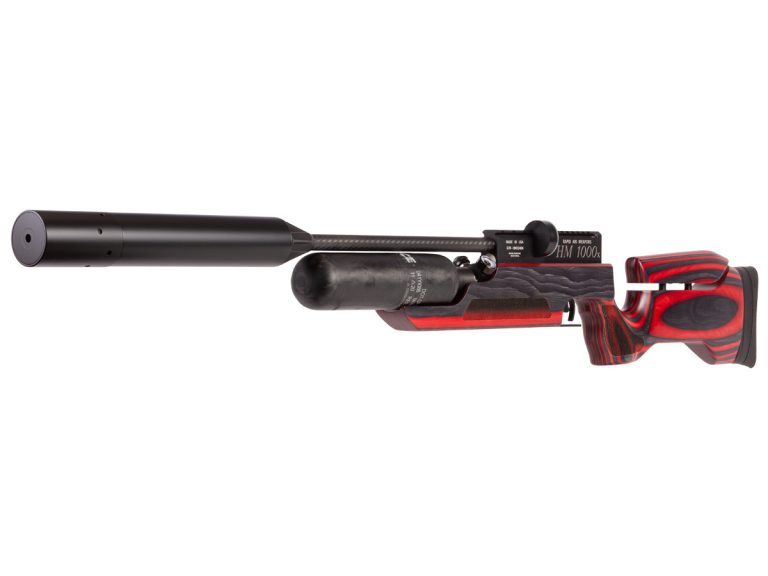
RAW HM1000x LRT PCP Air Rifle, Red Laminate Stock
€1,800.00
The RAW HM1000x LRT in red laminate stock is a top-tier American-made PCP built for precision at distance — LRT stands for Long Range Target, and that’s exactly what this rifle is designed for. Rapid Air Worx (RAW) machines these to remarkably tight tolerances out of their facility, and the result is a match-grade PCP platform that serious competition shooters and dedicated hunters rely on.
The side lever is set up right-handed from the factory but includes a left-hand magazine. Available in .22, .25, and .30 caliber.
- Three calibers: .22 at 950 fps, .25 at 900 fps, and .30 at 870 fps for versatile long-range application.
- Long Range Target (LRT) stock: Purpose-built geometry for precision positional shooting and benchrest work.
- Red laminate stock: Striking, dimensionally stable laminate construction for a premium look and consistent feel.
- American-made precision PCP: RAW rifles are machined to match-grade standards in the USA.
- Includes left-hand magazine: Side lever is right-hand configured; left-hand mag included in the box.
RAW HM1000x LRT PCP Air Rifle Red Laminate Stock – American Precision Engineering, Premium Craftsmanship and Long-Range Sporting Performance
RAW HM1000x LRT PCP Air Rifle Red Laminate Stock – American Engineering, Premium Construction and Precision Sporting Technology
The RAW HM1000x LRT PCP Air Rifle Red Laminate Stock combines sophisticated American manufacturing, premium wooden craftsmanship, and advanced pneumatic engineering within a full-length sporting platform.
Manufactured by RAW Rapid Air Worx, this precision-oriented rifle features a 24-inch Lothar Walther polygonal-rifled barrel, fully regulated compressed-air system, and 480cc carbon-fiber air reservoir.
Furthermore, its distinctive red-and-black laminated wooden stock provides a striking appearance while incorporating an adjustable cheekpiece, rubber buttpad, and flat-bottom fore-end.
Unlike the separately available unshrouded configuration, this standard version incorporates a carbon-fiber-wrapped barrel with a two-piece factory shroud.
Additionally, its adjustable match-grade trigger, precision side-lever action, and detachable rotary magazine demonstrate careful attention to mechanical construction.
The approximately 45.37-inch overall length and 8.85-pound unscoped weight contribute to its substantial long-range target profile.
Consequently, this model appeals to experienced enthusiasts who appreciate American craftsmanship, modern materials, traditional sporting furniture, and documented engineering quality.
RAW HM1000x, Rapid Air Weapons and American Manufacturing
The expressions raw hm1000x, rapid air weapons, rapid air worx, raw air, and american made air rifles relate to the manufacturer’s established engineering heritage.
RAW produces sophisticated pneumatic sporting equipment incorporating precision-machined actions, regulated pressure systems, and premium furniture.
Furthermore, raw air force reflects the company’s connection with AirForce Airguns.
Meanwhile, tm1000 identifies another target-oriented design within the manufacturer’s wider collection.
Although these models share manufacturing heritage, their dimensions and technical specifications differ.
RAW Micro Hunter and Compact Sporting Alternatives
The expressions RAW Micro Hunter, microhunter, micro hunter, RAW MicroHunter air rifle, and RAW MicroHunter PCP air rifle refer to a separate compact sporting platform.
Additional searches include RAW MicroHunter for sale, RAW MicroHunter review, RAW MicroHunter .25, RAW MicroHunter compact air rifle, RAW MicroHunter hunting rifle, and Best compact PCP air rifle.
The expression DAW MicroHunter 22 also appears in related searches, although its spelling differs from the manufacturer’s established product name.
Unlike compact sporting alternatives, the full-length configuration incorporates an extended barrel and substantial laminated wooden furniture.
Precision Regulation and Specialist Mechanical Engineering
The expressions pcpregulator, belleville washer stack, and belleville washer stack airgun regulato relate to pressure-regulation mechanisms and general pneumatic engineering terminology.
However, these expressions do not establish the exact internal construction of this particular model.
Similarly, grey ops cnc and gray ops onc concern specialist machining and aftermarket accessory research.
Customers should verify component compatibility through manufacturer documentation rather than relying on related search results.
Daystate Delta Wolf Performance and Alternative Premium Platforms
Enthusiasts comparing sophisticated sporting equipment may encounter Daystate Delta Wolf Performance, daystate delta wolf, delta wolf, daystate alpha wolf, and daystate redwolf.
Other related searches include daystate, day state, daystate blackwolf, huntsman daystate, alpha red wolf, and daystate wolverine sapphire.
Meanwhile, what is a delta wolf concerns a separate manufacturer’s sporting platform.
The expressions wolf battery and can wolverine go on planes address different technical and transportation questions.
These names should not be confused with components included in this American-manufactured configuration.
Sporting Accessories, Stock Comfort and Equipment Compatibility
The expressions enhanced rubber butt pad, puddy bottle cover, black snood, and day wolf m-lok to picatinny rail adapter concern broader sporting accessories.
Similarly, magpul moe si and how to put a gun sling on a rifle relate to equipment research.
The expression 177 magazine concerns another caliber-specific component, whereas the referenced model is commonly listed in .22, .25, and .30.
Consequently, customers should confirm accessory compatibility before purchasing additional components.
Target Shooting and Sporting Applications
The expression 10m rifle concerns specialized short-distance target equipment.
Meanwhile, air gun pc appears in broader searches involving pneumatic sporting products.
This Long Range Target design differs from equipment developed exclusively for formal ten-meter competition.
Its substantial stock, extended barrel, and regulated pneumatic architecture reflect its specialized mechanical construction.
However, actual precision depends on factory configuration, equipment condition, approved ammunition, environmental factors, and operator experience.
Specialist Retailers and Product Availability
Searches for rapid air dealers near me, air guns near me, and air gun dealers near me reflect customer interest in specialist sporting retailers.
Meanwhile, where is pyramyd air located concerns information about an established American equipment retailer.
The expression raw gear shirts relates to branded clothing rather than rifle components.
Customers should consider authorized servicing, warranty coverage, verified stock availability, and applicable purchasing regulations.
Barrel Shroud Construction and Muzzle Equipment
The expressions air gun suppressor and airgun moderator describe muzzle-noise reduction equipment.
The standard Red Laminate configuration incorporates a two-piece factory shroud surrounding the barrel assembly.
However, this does not establish that separate muzzle accessories are supplied.
Furthermore, equipment restrictions vary by jurisdiction.
Customers should therefore confirm the actual included components and relevant legal requirements.
RAW HM1000x LRT PCP Air Rifle Red Laminate Stock – Technical Specifications
- Manufacturer: RAW Rapid Air Worx
- Country of manufacture: United States
- Model: HM1000x LRT
- Stock: Red-and-black laminated wood
- Operating system: Regulated pre-charged pneumatic
- Available calibers: .22 (5.5mm), .25 (6.35mm), .30 (7.62mm)
- Barrel manufacturer: Lothar Walther
- Barrel length: 24 inches
- Barrel construction: Polygonal rifling, carbon-fiber wrapping
- Factory barrel shroud: Two-piece moderated assembly
- Overall length: Approximately 45.37 inches
- Unscoped weight: Approximately 8.85 pounds
- Air reservoir: 480cc carbon-fiber bottle
- Maximum filling pressure: 250 bar / approximately 3,625 PSI on the referenced retailer configuration
- Trigger: Adjustable two-stage match-grade
- Action: Side lever
- Breech: Ambidextrous with reversible side lever
- Magazine: Detachable rotary
- Magazine capacity: 12 rounds in .22/.25; 9 rounds in .30
- Cheekpiece: Adjustable
- Buttpad: Rubber
- Fore-end: Flat-bottom construction with M-LOK interfaces
- Optics mounting: Weaver/Picatinny
- Safety: Manual
- Air connection: Male quick-connect fitting
- Included equipment: One rotary magazine
- Warranty: One-year limited warranty on the referenced retailer listing
- Legal classification: Depends on caliber, factory configuration, and jurisdiction
Why Choose the RAW HM1000x LRT Red Laminate?
The standard Red Laminate configuration combines American manufacturing heritage, precision barrel construction, regulated pneumatic technology, and distinctive wooden craftsmanship.
Furthermore, its two-piece shrouded barrel assembly differentiates it from the separately available unshrouded version.
The striking laminated stock complements its metallic and composite components, while the adjustable match trigger and carefully manufactured action reflect the manufacturer’s engineering approach.
Additionally, the carbon-fiber reservoir, detachable magazine, and ergonomic furniture contribute to its recognizable target-oriented design.
For experienced enthusiasts who appreciate premium materials, traditional woodworking, and sophisticated mechanical construction, this model offers a distinctive combination of aesthetics and engineering.
Ultimately, its appeal lies in the integration of American craftsmanship, modern pneumatic technology, established component manufacturing, and premium laminated furniture.
Advanced American Engineering, Premium Red Laminate Construction, Precision Manufacturing, Mechanical Excellence and Long-Term Ownership
2.1 American Manufacturing Heritage and Engineering Excellence
The full-length sporting platform reflects a sophisticated combination of American craftsmanship, contemporary pneumatic technology, and traditional mechanical engineering. Its construction demonstrates the manufacturer’s emphasis on premium materials, carefully machined components, and consistent assembly standards.
Every major mechanical element serves an important purpose within the overall structure. The action accommodates the operating mechanisms, the wooden furniture provides structural support, and the pneumatic assembly incorporates the components required for its regulated configuration.
Furthermore, precision manufacturing contributes to consistent relationships between interconnected assemblies. Accurate machining, suitable materials, and controlled production processes help preserve the intended characteristics of the completed equipment.
However, manufacturing excellence involves more than attractive styling. Internal component integrity, dimensional accuracy, pressure-system safety, and long-term serviceability remain equally important.
The manufacturer’s American production heritage also contributes to its distinctive identity.
For enthusiasts who appreciate established industrial craftsmanship, this combination of traditional mechanical principles and contemporary manufacturing technology represents a significant part of the equipment’s appeal.
2.2 Premium Red Laminate Stock and Traditional Woodworking
The red-and-black laminated wooden stock represents one of the most recognizable characteristics of this configuration. Its layered appearance provides a distinctive alternative to conventional natural-wood furniture while preserving the familiar qualities associated with traditional sporting equipment.
Laminated construction involves bonding multiple wooden layers before shaping the completed material into the required exterior form. Consequently, the finished stock displays contrasting colors throughout its carefully manufactured surfaces.
Furthermore, the warm red coloration complements the darker metallic components and composite assemblies.
However, decorative finishing does not eliminate the need for appropriate maintenance. Moisture, excessive heat, accidental impacts, and unsuitable cleaning chemicals may affect the material or protective coating.
Routine inspection therefore remains important throughout ownership.
The finished furniture illustrates how traditional woodworking techniques can be combined with modern manufacturing methods.
Its distinctive coloration also contributes to the visual identity of the equipment without changing the fundamental mechanical architecture.
2.3 Laminated Wood Durability and Structural Integrity
The supporting wooden structure requires careful manufacturing to maintain its intended dimensions, structural integrity, and exterior appearance.
Multiple bonded layers form a composite material that can offer useful dimensional characteristics when produced using appropriate adhesives and controlled manufacturing processes.
Furthermore, the manufacturer must account for the relationship between wooden furniture and the connected metallic action.
Different materials respond differently to temperature changes, humidity, and mechanical loading.
Consequently, suitable manufacturing procedures help maintain the intended fit between interconnected assemblies.
However, laminated construction should not be considered completely unaffected by environmental exposure.
Prolonged moisture, excessive heat, and severe impacts may influence its condition.
The protective finish also requires attention because scratches or physical damage can expose underlying material.
Periodic visual inspection helps identify problems requiring professional assessment.
With appropriate care, laminated wooden furniture can preserve its appearance and structural characteristics throughout extended ownership.
2.4 Full-Length Sporting Architecture and Structural Balance
The substantial full-length construction represents an important distinction between this configuration and shorter sporting alternatives.
Its architecture combines an extended barrel assembly, laminated furniture, and a considerable pneumatic reservoir within a recognizable target-oriented design.
Furthermore, the arrangement reflects the manufacturer’s emphasis on substantial mechanical construction.
However, overall length alone cannot establish performance superiority.
Mechanical integrity, component alignment, appropriate materials, and factory specifications remain equally important.
Weight distribution also contributes to perceived physical balance.
Consequently, published dimensions should be considered alongside the complete equipment configuration.
Individual preferences vary considerably.
Some enthusiasts appreciate compact equipment, while others prefer full-length sporting designs.
The completed architecture demonstrates how traditional furniture and contemporary pneumatic technology can be integrated into one substantial mechanical platform.
2.5 Lothar Walther Barrel Manufacturing and Precision Construction
The specialized barrel represents an important component of the equipment’s mechanical design.
Its manufacturing heritage reflects established experience in producing precision-oriented components for sporting applications.
The documented configuration incorporates a 24-inch barrel, contributing to the full-length appearance.
Furthermore, the barrel must integrate accurately with the surrounding action and supporting assemblies.
Suitable materials, consistent internal dimensions, and appropriate manufacturing methods contribute to its intended construction characteristics.
However, barrel length and manufacturer reputation alone cannot guarantee any specific accuracy figure.
Actual sporting results depend on factory specifications, approved ammunition, equipment condition, and environmental influences.
Consequently, technical descriptions should distinguish verified engineering characteristics from unsupported performance claims.
Precision surfaces also require suitable maintenance.
Unsuitable cleaning methods or unauthorized alterations may compromise their condition.
Professional inspection remains appropriate whenever unusual wear or suspected damage becomes apparent.
2.6 Polygonal Rifling and Specialized Internal Geometry
The polygonal rifling represents a distinctive technical feature of the barrel assembly.
Its internal geometry differs from conventional arrangements and reflects a specialized manufacturing approach.
Furthermore, the construction requires appropriate materials and carefully controlled dimensions.
The manufacturer must maintain suitable internal characteristics throughout production.
However, a particular rifling profile should not automatically be described as universally superior.
Actual results depend on several interacting factors, including mechanical condition, manufacturing consistency, approved ammunition, and environmental influences.
Consequently, unsupported numerical precision claims should be avoided.
The internal surfaces also require suitable care.
Aggressive cleaning techniques may damage precision finishes.
The incorporation of specialized rifling demonstrates how contemporary manufacturing can apply different engineering approaches while preserving the importance of material integrity and quality control.
2.7 Carbon-Fiber Barrel Wrapping and Composite Technology
The carbon-fiber wrapping contributes to the contemporary material construction of the barrel assembly.
Composite materials have become increasingly important in industrial manufacturing because they can offer useful structural properties when incorporated into carefully developed components.
Furthermore, the relationship between composite wrapping and underlying metallic construction requires appropriate engineering consideration.
Different materials possess different thermal and mechanical characteristics.
Consequently, the manufacturer must account for their interaction during product development.
However, composite construction does not make a component immune to accidental damage.
Severe impacts, unsuitable handling, and unauthorized modifications may compromise structural integrity.
Routine inspection remains important whenever unusual marks or damage become apparent.
The combination of metallic and composite materials illustrates how modern manufacturing integrates different technologies within specialized mechanical equipment.
2.8 Two-Piece Barrel Shroud and Exterior Integration
The two-piece shroud assembly represents an important distinction between the standard configuration and its separately available exposed-barrel counterpart.
Its construction surrounds part of the barrel assembly and contributes to the equipment’s recognizable exterior appearance.
Furthermore, the shroud integrates with the surrounding components as part of the manufacturer’s intended mechanical design.
However, the presence of an exterior surrounding tube does not automatically establish the legality or inclusion of additional muzzle accessories.
Regional restrictions vary considerably.
Consequently, customers should verify the exact factory package and applicable regulations.
The exterior assembly also requires appropriate protection against accidental impacts.
Unusual movement, visible damage, or suspected defects may require qualified technical assessment.
The shroud demonstrates how exterior component construction contributes to the identity of a specialized sporting platform.
2.9 Regulated Pneumatic System and Pressure Management
The regulated pneumatic architecture forms an essential part of the equipment’s internal engineering.
Its purpose involves managing the relationship between stored reservoir pressure and the operating conditions established by the manufacturer.
Furthermore, the system incorporates specialized valves, seals, and other precision-manufactured components.
These elements must operate together within appropriate mechanical tolerances.
However, regulated operation should not be described as guaranteeing identical results under every possible circumstance.
Temperature changes, normal wear, and manufacturing variations may influence mechanical behavior.
Consequently, qualified servicing remains important whenever internal components require attention.
Unauthorized modifications should be avoided because high-pressure mechanisms can introduce serious hazards.
The pressure-management architecture demonstrates the importance of fluid dynamics, manufacturing quality, and responsible technical maintenance within contemporary pneumatic equipment.
2.10 Carbon-Fiber Reservoir and Pressure Vessel Construction
The carbon-fiber air reservoir represents a significant component of the pneumatic operating system.
Its construction combines modern composite materials with specialized pressure-vessel engineering.
Furthermore, the reservoir connects to carefully manufactured fittings and internal pneumatic assemblies.
These components must maintain appropriate structural integrity throughout their intended service life.
However, reservoir capacity alone cannot establish an exact number of usable discharges.
Actual operating characteristics depend on the approved factory configuration, component condition, and environmental influences.
Pressure-containing equipment requires particular care.
Excessive heat exposure, accidental damage, unauthorized modifications, and unsuitable repairs may introduce serious hazards.
Consequently, any indication of leakage or compromised structural integrity requires qualified professional assessment.
The reservoir illustrates how modern material technology contributes to sophisticated sporting equipment while reinforcing responsible ownership.
2.11 Precision-Machined Action and Mechanical Integration
The main action incorporates carefully manufactured metallic components designed to maintain appropriate mechanical relationships.
Its construction requires accurate machining, suitable materials, and consistent assembly standards.
Furthermore, the action integrates with the surrounding pneumatic mechanisms and supporting wooden structure.
From an engineering perspective, dimensional consistency contributes to maintaining the intended arrangement of moving and stationary components.
However, precision manufacturing does not eliminate normal mechanical wear.
Environmental contamination, accidental impacts, and unsuitable maintenance may affect component condition.
Consequently, periodic inspection remains valuable.
Unexpected resistance, visible damage, or abnormal movement should receive qualified professional attention.
The action demonstrates how traditional machining knowledge complements contemporary pneumatic technology within a premium sporting platform.
2.12 Side-Lever Action and Mechanical Controls
The side-lever mechanism contributes to the equipment’s recognizable operating architecture.
Its construction incorporates carefully manufactured moving components intended to function within the manufacturer’s approved specifications.
Furthermore, the mechanism integrates with the surrounding action through precisely defined mechanical interfaces.
However, moving assemblies remain subject to normal wear and environmental contamination.
Dust, moisture, and unsuitable cleaning products may affect exposed components over time.
Consequently, routine inspection remains important.
Any mechanism displaying unusual resistance should not be forced.
Qualified servicing provides the appropriate response to suspected malfunction or visible damage.
The arrangement demonstrates how contemporary sporting equipment can incorporate specialized mechanical controls while maintaining a cohesive structural design.
2.13 Adjustable Two-Stage Match Trigger and Mechanical Refinement
The adjustable two-stage trigger represents an important component of the precision-oriented construction.
Its internal mechanism incorporates carefully manufactured interacting parts intended to operate within the manufacturer’s specified conditions.
Furthermore, suitable materials, consistent surface finishing, and accurate alignment contribute to the intended mechanical characteristics.
However, trigger assemblies remain safety-critical components.
Unauthorized alterations may compromise their operating condition and introduce serious hazards.
Individual preferences concerning mechanical feel also vary considerably.
Consequently, subjective impressions should not replace objective considerations such as safe function, appropriate component condition, and professional maintenance.
Any unusual behavior requires qualified technical assessment.
The mechanism reflects the manufacturer’s emphasis on specialized mechanical engineering while reinforcing the importance of responsible ownership.
2.14 Rotary Magazine Construction and Component Compatibility
The detachable rotary magazine forms part of the equipment’s mechanical operating system.
Its construction requires appropriate dimensional accuracy, suitable materials, and consistent manufacturing quality.
Furthermore, the assembly must integrate correctly with the surrounding action.
However, magazines supplied for different factory configurations may not be interchangeable.
Similar exterior appearances do not guarantee identical internal dimensions or attachment requirements.
Consequently, customers should verify compatibility through official documentation.
The magazine also benefits from periodic inspection.
Visible damage, contamination, or abnormal movement may indicate the need for professional attention.
Improvised repairs should be avoided whenever they could compromise component integrity.
The assembly demonstrates how relatively compact mechanical components can involve sophisticated manufacturing requirements.
2.15 Adjustable Cheekpiece and Ergonomic Comfort
The adjustable cheekpiece contributes to the stock’s sophisticated ergonomic design.
Its construction recognizes that sporting enthusiasts differ in facial structure, physical proportions, and individual comfort requirements.
Furthermore, the component integrates with the laminated furniture while preserving its distinctive exterior appearance.
However, ergonomic suitability remains subjective.
A configuration appropriate for one individual may not provide an identical experience for another.
Consequently, personal comfort should be evaluated according to individual preferences.
The supporting adjustment mechanism also requires appropriate maintenance.
Loose hardware, damaged surfaces, or abnormal movement may affect structural integrity.
Routine inspection helps identify concerns requiring professional attention.
The cheekpiece illustrates how human-centered design principles can complement traditional woodworking and sophisticated mechanical engineering.
2.16 Rubber Buttpad and Rear Stock Comfort
The rubber buttpad contributes to the equipment’s rear stock construction and ergonomic characteristics.
Its material provides a distinct contact surface compared with the surrounding laminated furniture.
Furthermore, the assembly integrates with the wooden structure while preserving the intended exterior appearance.
However, physical comfort remains subjective.
Body proportions, personal preferences, and individual requirements vary.
Consequently, no single stock arrangement can guarantee identical suitability for everyone.
The rubber material also requires appropriate maintenance.
Prolonged heat exposure, unsuitable chemicals, and accidental damage may affect its condition.
Routine inspection helps identify deterioration requiring professional assessment.
The rear assembly illustrates how traditional sporting furniture can incorporate contemporary materials to support personal comfort considerations.
2.17 Flat-Bottom Fore-End and Sporting Stock Geometry
The flat-bottom fore-end represents a recognizable element of the target-oriented stock design.
Its geometry reflects careful furniture manufacturing, incorporating shaped surfaces within the laminated wooden structure.
Furthermore, the fore-end contributes to the overall visual identity of the equipment.
However, exterior geometry alone cannot establish mechanical superiority.
Material integrity, manufacturing consistency, and appropriate assembly remain essential considerations.
The wooden structure also requires protection against accidental impacts and excessive moisture exposure.
Consequently, responsible maintenance contributes to preserving its original condition.
The fore-end demonstrates how specialized furniture design can complement sophisticated mechanical construction while maintaining the familiar appearance of traditional sporting equipment.
2.18 Premium Red Laminate Appearance and Styling
The red-and-black laminated finish creates a distinctive contrast with the darker metallic assemblies and composite components.
Its layered construction highlights the craftsmanship involved in producing decorative sporting furniture.
Furthermore, the coloration provides a recognizable appearance that distinguishes the configuration from conventional monochromatic finishes.
However, exterior styling should remain separate from objective manufacturing quality.
Structural integrity, mechanical condition, and appropriate assembly remain more meaningful technical considerations.
Nevertheless, aesthetics contribute to overall customer satisfaction.
Some enthusiasts prefer traditional natural-wood finishes, while others appreciate contemporary colored laminate.
The distinctive appearance provides an attractive alternative to conventional sporting furniture.
Routine cleaning and responsible storage help preserve its original presentation throughout ownership.
2.19 Protective Finishing and Surface Preservation
Protective finishing contributes to maintaining the appearance of wooden and metallic components.
Depending on the treatment applied, coatings may reduce ordinary environmental deterioration.
Furthermore, consistent surface finishing creates a cohesive visual appearance.
However, no protective treatment offers unlimited resistance to scratches, abrasion, accidental impacts, or unsuitable chemicals.
Consequently, responsible maintenance remains important.
Ordinary fingerprints and light contamination can generally be removed using suitable nonabrasive materials.
Aggressive solvents should be avoided unless the manufacturer specifically approves them.
Humidity may also influence exposed components during extended storage.
For this reason, clean and dry conditions are preferable.
Routine care contributes to preserving the original appearance while reducing unnecessary surface deterioration.
2.20 Environmental Conditions and Material Stability
Environmental conditions influence the physical behavior of pneumatic, metallic, composite, and wooden components.
Compressed gas responds to temperature changes, while exposed metallic surfaces may experience condensation.
Furthermore, laminated furniture can react to prolonged moisture exposure.
Appropriate storage therefore deserves careful attention.
The equipment should not be exposed to excessive heat, particularly inside enclosed vehicles under direct sunlight.
Similarly, prolonged humidity may affect protective finishes and vulnerable components.
However, suitability for ordinary outdoor sporting activities does not automatically establish waterproof construction.
Specific environmental resistance ratings should not be assumed without official manufacturer documentation.
Responsible storage and inspection contribute to preserving mechanical integrity and exterior condition.
2.21 Manufacturing Tolerances and Component Alignment
Precision manufacturing depends on maintaining appropriate dimensional relationships between interconnected components.
Every manufactured part contains some degree of allowable variation.
The engineering challenge involves ensuring that these differences remain compatible throughout the completed assembly.
Furthermore, different materials respond differently to changes in temperature and mechanical loading.
Manufacturers must account for these characteristics during product development.
However, internal manufacturing quality cannot be established solely through promotional descriptions or exterior photographs.
Technical documentation, independent inspection, and long-term service experience provide more meaningful evidence.
Consequently, credible evaluations should avoid unsupported numerical tolerance claims.
A realistic assessment considers component integrity, material selection, and assembly standards.
These characteristics illustrate why manufacturing consistency remains important even when sporting equipment appears visually traditional.
2.22 Mechanical Reliability and Preventive Maintenance
Mechanical reliability depends on the condition of several interacting assemblies.
Seals, valves, springs, structural components, and pressure-containing elements must remain within their intended operating conditions.
Furthermore, manufacturing quality provides only part of the foundation for dependable ownership.
Normal wear, environmental exposure, accidental damage, and unsuitable maintenance may affect mechanical behavior.
Consequently, periodic visual inspection remains valuable.
Owners should remain attentive to unusual resistance, visible damage, or unexpected changes in component condition.
However, internal inspection should never involve unauthorized dismantling of pressurized assemblies.
Qualified professional assistance remains appropriate whenever suspected malfunction becomes apparent.
Responsible maintenance contributes to preserving the manufacturer’s intended mechanical characteristics.
2.23 High-Pressure Safety and Professional Servicing
The pressure-containing system represents an important safety consideration associated with sophisticated pneumatic equipment.
Its reservoir and connecting assemblies operate under substantial mechanical stress.
Therefore, the manufacturer’s published operating limits must always be respected.
Furthermore, pressure vessels should never be drilled, heated, structurally modified, or repaired using improvised techniques.
Replacement components must satisfy appropriate pressure and compatibility requirements.
A fitting that appears physically similar may not possess the necessary engineering characteristics.
Consequently, genuine manufacturer-approved parts and qualified servicing remain essential.
Any indication of leakage, visible damage, or compromised structural integrity requires professional assessment.
Technical sophistication must always be accompanied by responsible ownership.
High-pressure maintenance should never involve unauthorized modification or improvised repairs.
2.24 Secure Storage, Transportation and Long-Term Ownership
Secure storage forms an essential part of responsible sporting equipment ownership.
The equipment should remain inaccessible to unauthorized individuals when not in use.
A suitable locked cabinet or legally compliant storage arrangement can help meet this requirement.
Furthermore, protective cases may reduce ordinary transportation damage.
However, premium construction does not automatically make transportation legally unrestricted.
Local regulations may establish specific requirements concerning possession, licensing, storage, and movement between locations.
These conditions vary considerably between jurisdictions.
Consequently, customers should confirm applicable legislation before purchasing or transporting the equipment.
The manufacturer’s documentation also provides important information concerning authorized maintenance, technical support, and warranty requirements.
Retaining purchase records may simplify future service inquiries.
Long-term ownership value depends on manufacturing quality, maintenance requirements, access to genuine replacement components, and realistic expectations.
2.25 Final Assessment of Engineering Quality and Ownership Experience
The full-length red laminated configuration combines sophisticated American manufacturing, specialized barrel construction, and distinctive wooden furniture within a premium sporting platform Worked for 7s.
Its regulated pneumatic architecture, carbon-fiber reservoir, precision-machined action, and adjustable ergonomic components demonstrate the manufacturer’s emphasis on mechanical refinement.
Furthermore, the factory shroud contributes to the recognizable appearance of the standard configuration.
The striking laminated stock complements modern materials while preserving the appeal of traditional sporting craftsmanship.
The integration of composite materials and carefully manufactured metallic components contributes to the equipment’s distinctive technical identity.
However, responsible ownership remains essential.
High-pressure assemblies require qualified servicing, secure storage should always receive priority, and applicable legislation must be respected.
For enthusiasts who appreciate American craftsmanship, contemporary material technology, and precision-oriented mechanical construction, this configuration offers a distinctive combination of engineering characteristics and long-term ownership considerations.
Ultimately, its appeal lies in the integration of structural quality, premium exterior craftsmanship, specialized components, and thoughtful engineering within one sophisticated sporting platform.
Be the first to review “RAW HM1000x LRT PCP Air Rifle, Red Laminate Stock”
Related products
RAW Air Rifles
RAW Air Rifles

RAW Air Rifles
RAW Air Rifles

RAW Air Rifles
RAW Air Rifles

RAW Air Rifles
Reviews
There are no reviews yet.