
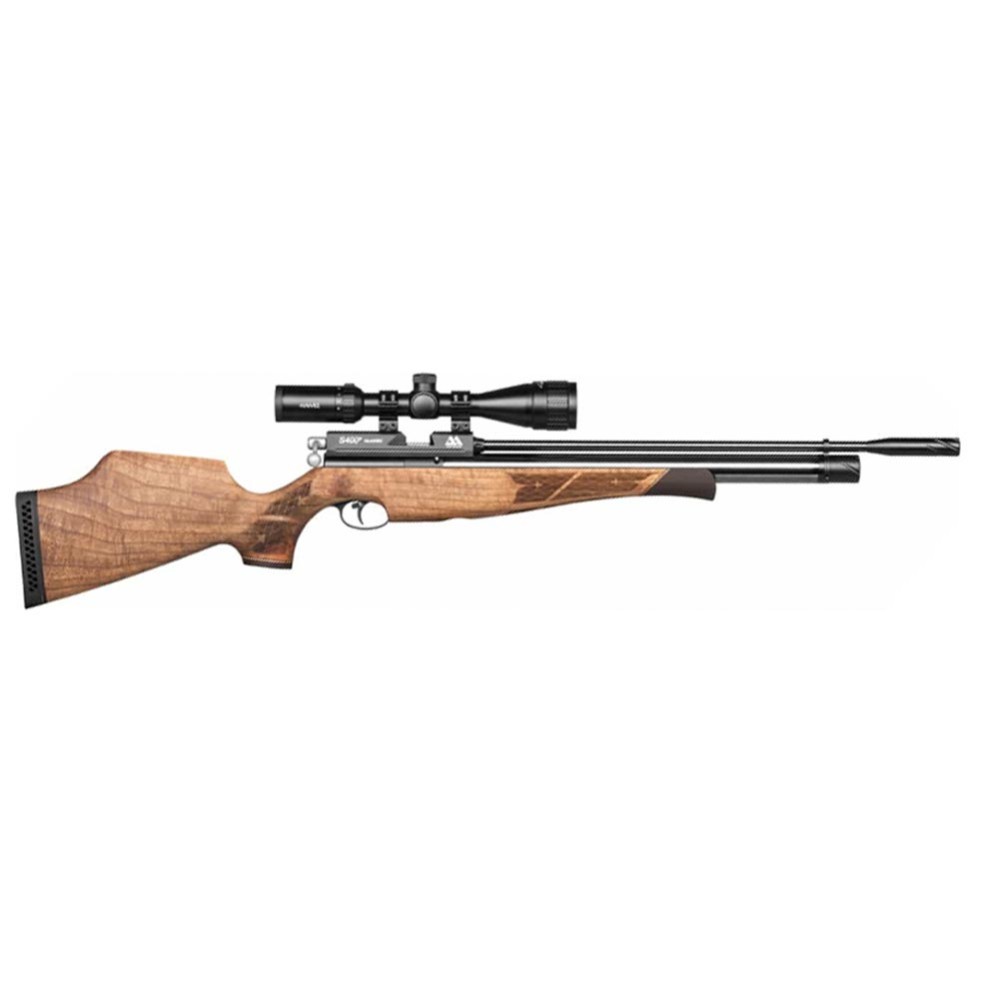


Air Arms S400 Classic Walnut
€733.00
-
Available in .177 & .22
-
Magazine Capacity – Single shot
-
Fill Pressure – 200 bar
-
Shots per fill – 20
-
Maximum Power – 11.5 ft/lbs /16j
-
Trigger – Two stage adjustable weight & length
-
Stock – Walnut
-
Overall Length – 1020mm
-
Barrel Length – 493mm
-
Weight – 3.0kg
Air Arms S400 Classic Walnut – Traditional PCP Simplicity, Walnut Craftsmanship and Precision Performance
The Air Arms S400 Classic Walnut is a traditional single-shot PCP air rifle designed around simplicity, precision, and dependable mechanical operation. Rather than relying on a magazine system or complicated electronic controls, it uses a straightforward bolt-action layout that gives the shooter direct control over every loading cycle. Air Arms currently describes the S400 as an unregulated single-shot rifle built around a Lothar Walther barrel, classic bolt action, and traditional sporter stock options in beech or walnut.
Within the broader world of air guns, air rifles, pellet guns, and modern airguns, the S400 has built a strong reputation because it keeps the operating system deliberately simple. The classic walnut configuration combines traditional styling with a smooth PCP action, adjustable trigger, and balanced full-length rifle proportions.
What Is an Air Rifle?
For anyone asking what is an air rifle, the term generally refers to a rifle that propels a pellet using stored compressed gas or mechanical energy rather than a conventional firearm cartridge.
People researching how do air guns work will encounter several different systems. A spring rifle stores mechanical energy, while a PCP rifle stores compressed air inside a reservoir before use.
The S400 belongs to the PCP category. Therefore, charging equipment such as a pcp hand pump or suitably rated air compressor rifle setup may be used depending on the owner’s filling arrangement.
Search variations such as air pisto, airgins, air riflery, and air arm sometimes appear in broader airgun research, although they do not describe separate operating systems.
Why the Single-Shot Design Matters
One of the defining characteristics of the S400 is its single-shot bolt action.
Instead of using a magazine, the shooter manually loads one pellet at a time. Air Arms specifically presents this design as simple, reliable, and well suited to shooters who prefer deliberate shot preparation.
This approach can be particularly useful during target air rifle shooting because every pellet can be inspected before loading.
It also removes magazine indexing as a variable.
For shooters who value simplicity over rapid cycling, this straightforward architecture remains one of the strongest characteristics of the platform.
Precision and Lothar Walther Barrel Engineering
Precision is central to the rifle’s design.
Air Arms equips the S400 with a Lothar Walther barrel and emphasizes repeatable accuracy as one of the platform’s defining characteristics.
However, barrel quality alone does not guarantee small groups.
Pellet consistency, optic stability, trigger technique, pressure condition, body position, and environmental factors all influence results.
Therefore, controlled testing remains important.
Anyone searching airgun shooting range near me should use an appropriate authorized range or another legally permitted location with a reliable backstop.
Walnut Stock and Traditional Handling
The walnut-stock configuration gives the rifle a distinctly traditional appearance.
Air Arms currently offers classic sporter stocks in both beech and premium walnut, with handed and ambidextrous options depending on configuration.
The stock geometry is designed around comfortable shoulder contact and natural handling.
Weight and balance also influence the shooting experience.
Current retailer specifications for the full-length walnut version commonly list an overall length of approximately 1020 mm with a barrel of about 493 mm. Published weight figures vary slightly by source and exact configuration, generally around 2.7 to 3.0 kg.
Understanding .177 and .22 Calibre Options
The S400 is offered in .177 and .22.
Searches involving 177 caliber, 177 air rifle, cal .177 pellets, 177 pellet vs.22 pellet, and 177 caliber vs 22 generally focus on differences in pellet weight, trajectory, and intended sporting use.
A .22 air rifle uses heavier pellets than a typical .177 setup, while .177 generally offers a flatter trajectory at comparable legal-energy limits.
Different air rifle calibers should therefore be considered according to the intended lawful activity rather than assuming one calibre is universally superior.
S400 and S410 Differences
The air arms s400 and air arms s410 share important engineering heritage, but their feeding systems differ.
Historically, the S400 was introduced as the single-shot version, while the S410 became the multi-shot counterpart.
This distinction remains important when comparing the two.
The S400 prioritizes deliberate single loading, while the multi-shot design provides a different shooting rhythm.
Both belong to the same broader Air Arms air rifle family.
Comparison With the S510 Family
The S400 should also be distinguished from the air arms s510, Air Arms S510 FAC, and Air Arms S510 XS FAC PCP Air Rifle.
The S510 uses a side-lever multi-shot architecture, while the S400 retains its simpler single-shot bolt-action arrangement.
Likewise, the Air Arms S510 XS Ultimate Sporter, Air Arms S510 XS Ultimate Sporter FAC, Air Arms S510 XS Ultimate Sporter FAC Walnut Stock, and air arms s510 ultimate sporter .177 sub 12 use different stock, action, and regulation configurations.
Therefore, buyers or researchers should compare the complete operating system rather than focusing only on calibre or brand name.
Comparison With Spring-Powered Models
The air arms tx200 and prosport air arms platforms operate differently because they use self-contained spring-powered underlever systems.
Anyone asking what is break barrel air rifle or researching a break barrel pellet gun is also looking at a mechanically powered design rather than PCP technology.
The S400 does not use a spring-piston firing cycle.
Instead, compressed air stored in the reservoir provides the energy needed for each shot.
This difference changes recoil characteristics, maintenance requirements, filling needs, and shooting behavior.
Why the Unregulated System Matters
Air Arms currently describes the S400 as unregulated by design. The manufacturer emphasizes that this reduces internal complexity and supports straightforward maintenance and reliability.
An unregulated PCP does not use a separate pressure regulator to maintain one fixed working pressure.
Instead, the valve system is designed to deliver consistent performance across a useful part of the fill.
This simpler architecture is one of the reasons the platform has remained popular for so long.
Cleaning and Routine Care
An Air rifle cleaning kit can be useful for sensible maintenance.
However, aggressive or unnecessary barrel cleaning should be avoided.
External surfaces should be kept clean and dry, optic mounts should be checked periodically, and filling connections should remain free of dirt.
Because the system operates under high pressure, internal reservoir and valve servicing should follow proper procedures.
Air Guns for Home Defense Search Intent
The phrase air guns for home defense may appear in search data, but a sporting air rifle should not be treated as a substitute for dedicated personal-safety planning.
Its appropriate context is lawful target, sporting, recreational, or other permitted airgun activity.
Safe storage, trigger discipline, correct muzzle direction, and a proper backstop remain essential.
Important Information About the S400 Classic Walnut
The defining characteristics of the S400 Classic Walnut are its single-shot bolt action, Lothar Walther barrel, unregulated PCP system, adjustable two-stage trigger, traditional walnut sporter stock, full-length rifle configuration, and straightforward mechanical design. Air Arms currently offers the S400 rifle in both .177 and .22, with sub-12 ft/lb versions forming the core UK specification.
For shooters studying traditional PCP engineering, the S400 remains notable because it emphasizes mechanical simplicity, deliberate operation, balance, and precision rather than complexity.
Engineering Design, Accuracy, Air Management, Ergonomics, and Practical Performance
Straightforward Pneumatic Engineering
A single-shot pre-charged pneumatic rifle depends on a relatively simple relationship between the reservoir, firing valve, hammer system, barrel, trigger, and stock. When those components work consistently, the shooter benefits from predictable performance without unnecessary mechanical complexity.
Compressed air is stored before shooting and released in a controlled amount during each firing cycle. Because there is no large spring piston moving through the action, internal movement is limited compared with traditional spring-powered systems.
That smoother behavior can help the shooter maintain a more stable sight picture.
However, mechanical simplicity does not remove the need for careful setup. Suitable ammunition, correct pressure management, secure optics, and consistent shooting technique still determine how well the rifle performs in practice.
Why an Unregulated System Can Still Be Consistent
An unregulated pneumatic system relies on the relationship between reservoir pressure, valve timing, hammer energy, and airflow rather than a separate pressure regulator.
As the reservoir empties, pressure gradually changes.
The design is intended to maintain useful consistency across the most effective part of that pressure range.
This means the shooter should understand how the rifle behaves throughout a fill.
Performance may be strongest within a particular pressure window rather than remaining identical from maximum pressure down to the lowest usable level.
For this reason, pressure monitoring becomes especially important.
Keeping basic notes can help identify where the rifle performs most consistently.
Barrel Quality and Precision Potential
The barrel is one of the most important components affecting accuracy.
Internal rifling stabilizes the pellet as it travels through the bore, while the crown influences how the pellet exits the muzzle.
Barrel quality alone, however, does not guarantee tight groups.
Different pellets can behave differently because of variations in head diameter, weight, skirt design, hardness, and manufacturing tolerance.
Systematic testing is therefore essential.
Several groups should be fired with one pellet type before changing to another.
The most useful ammunition is usually the one that performs consistently across multiple sessions rather than producing one unusually good group.
Single-Shot Loading and Precision
A single-shot design encourages a deliberate shooting rhythm.
The shooter manually loads each pellet, making it easier to inspect ammunition before it enters the barrel.
This can be useful during precision testing.
Damaged skirts, deformed heads, or visibly inconsistent pellets can be removed before use.
The single-loading process also removes magazine indexing as a potential variable.
As a result, the shooter can focus more directly on ammunition quality, sight alignment, and technique.
The slower rhythm can also encourage better concentration between shots.
Trigger Control and Shot Release
A predictable trigger helps the shooter release each shot without disturbing the rifle.
Pressure should be applied smoothly and gradually.
The trigger finger should move independently while the rest of the shooting hand remains relaxed.
If the whole hand tightens during the release, the rifle may move away from the intended aiming point.
Consistent finger placement is also important.
Using the same part of the finger each time helps maintain a more predictable pull direction.
After the shot, the shooter should remain in position briefly.
This follow-through improves consistency.
Stock Fit and Shooter Comfort
A traditional sporter stock can provide a natural shooting position when its dimensions suit the shooter.
Shoulder contact, cheek placement, grip angle, and trigger reach all influence stability.
If the stock feels uncomfortable, the shooter may compensate by changing head or shoulder position.
These adjustments can create inconsistency.
A natural fit allows the rifle to settle more comfortably.
This becomes particularly important during longer shooting sessions because fatigue can gradually affect group size.
Comfort and repeatability are closely connected.
Balance and Handling
Weight distribution can influence handling as much as total weight.
A rifle that balances close to the supporting hand can feel steady without becoming excessively front-heavy.
However, optics and accessories can change this balance.
A large scope can add weight above the action, while front-mounted equipment can shift the center of gravity forward.
Every accessory should therefore serve a clear purpose.
Adding unnecessary equipment can increase fatigue without improving practical performance.
A simple setup often complements a straightforward rifle design.
Optic Setup and Eye Alignment
A correctly mounted optic is essential for meaningful accuracy testing.
The mounts should remain secure, while the optic should sit at a height that allows a comfortable cheek position.
Eye relief should provide a full sight picture without forcing the shooter to stretch forward or backward.
Consistent head position reduces alignment errors.
Once the optic is installed, zero should be confirmed across several groups.
Transport, changes in ammunition, or movement in the mounts can shift the point of impact.
Periodic verification is therefore useful.
Reservoir Pressure Management
Pressure should be monitored throughout the shooting session.
An unregulated system can behave differently at various points in the fill.
The shooter can learn the most consistent pressure range by observing performance over several sessions.
Recording starting pressure, ending pressure, and group behavior can be especially useful.
The reservoir should never be filled beyond the manufacturer’s stated limit.
Charging equipment must also be rated for the required pressure.
Connections should remain clean, and filling should be performed carefully.
Real-World Accuracy
Practical accuracy is affected by more than mechanical specifications.
Wind, temperature, lighting, body position, fatigue, and ammunition quality can all influence group size.
Outdoor shooting introduces additional variation because wind can move pellets sideways during flight.
The effect becomes more noticeable as distance increases.
Temperature can also influence pressure behavior.
Lighting may affect target clarity through the optic.
Therefore, one poor group should not automatically be blamed on the rifle.
Several groups under similar conditions provide a better picture of performance.
Supported Shooting
A stable rest can help during ammunition testing and zero confirmation.
The rifle should sit securely without being forced into an unnatural position.
The same support point should be used throughout the test.
Changing the contact position can affect balance and sight alignment.
Supported shooting is useful because it reduces some of the movement created by the shooter.
This makes differences in pellet performance easier to evaluate.
Once consistent results are achieved, unsupported shooting can provide a better understanding of practical handling.
Managing Fatigue
Fatigue can reduce performance even when the rifle is functioning correctly.
Long sessions may change grip pressure, shoulder contact, breathing, and concentration.
The shooter may also begin to rush the trigger.
Short breaks can help restore consistency.
If group size increases late in a session, fatigue should be considered before mechanical adjustments are made.
This prevents unnecessary changes to a setup that may already be performing correctly.
Maintenance and Long-Term Performance
Reliable performance depends on regular inspection and sensible care.
External surfaces should remain clean and dry.
Visible screws, optic mounts, filling connections, and stock hardware should be checked periodically.
Excessive lubrication should be avoided because pneumatic systems require suitable products.
Internal high-pressure components should not be dismantled casually.
Ultimately, dependable performance comes from combining simple engineering, good barrel quality, deliberate single-shot loading, suitable ammunition, stable optics, sensible pressure management, and consistent shooting technique.
Accuracy Development, Shooting Technique, Setup Refinement, and Consistent Performance
Developing Repeatable Accuracy
Consistent accuracy comes from repeating the same shooting process as closely as possible from one shot to the next. Mechanical quality provides the foundation, but body position, cheek placement, grip pressure, breathing, trigger control, and follow-through determine how effectively that potential is used.
The shoulder should contact the stock in the same position each time. Likewise, the supporting hand should return to a consistent point beneath the fore-end.
Small changes in pressure or posture can influence the point of impact.
For this reason, accuracy should be judged across several groups rather than one unusually tight result.
A repeatable routine makes it easier to separate technique-related changes from mechanical or environmental influences.
Establishing a Natural Shooting Position
A natural position reduces muscular tension and makes consistency easier.
The rifle should settle toward the target without constant pushing or pulling.
If the shooter must force the rifle into alignment, fatigue can build quickly.
The shoulders should remain relaxed, while the cheek should settle naturally onto the stock.
When using a bench or rest, the rifle should sit securely without excessive pressure.
The goal is to create a position that can be repeated easily throughout the session.
Comfort is therefore closely linked with precision.
Cheek Placement and Eye Alignment
Consistent cheek placement is especially important when an optic is used.
If the head moves higher, lower, forward, or backward between shots, the eye may no longer remain properly aligned with the optical axis.
This can change the sight picture.
The stock and optic should therefore be positioned so a clear image appears naturally when the rifle is shouldered.
There should be no need to stretch the neck or shift the head excessively.
Comfortable alignment reduces strain and helps maintain concentration during longer sessions.
Trigger Control
Trigger technique directly influences shot placement.
Pressure should be applied smoothly rather than suddenly.
The trigger finger should move independently while the rest of the shooting hand remains relaxed.
If the whole hand tightens during release, the rifle may move away from the intended aiming point.
Consistent finger placement also helps maintain a predictable pull direction.
After the shot is released, the shooter should remain in position briefly.
This follow-through helps preserve stability during the final stage of the firing cycle.
Single-Shot Loading and Concentration
A single-loading routine encourages a more deliberate shooting rhythm.
Because each pellet is loaded individually, the shooter has an opportunity to inspect the ammunition before every shot.
This can help identify damaged skirts, deformed heads, or other visible inconsistencies.
The slower pace also gives the shooter more time to reset body position, breathing, and sight alignment.
As a result, every shot can be approached as a separate accuracy test.
This deliberate rhythm can be particularly useful during formal group testing.
Ammunition Testing
Different pellets can produce noticeably different results.
Weight, head diameter, skirt shape, hardness, and manufacturing consistency all influence how the pellet interacts with the barrel.
Testing should therefore be systematic.
One type should be used across several groups before another is introduced.
The same distance, shooting position, optic setting, and general conditions should remain unchanged.
Changing several variables at once makes it difficult to understand what caused the result.
Damaged pellets should also be removed from serious testing.
Understanding Group Size
Group size is one of the most useful ways to evaluate repeatability.
A tight cluster shows that several shots have landed close together.
However, one excellent group should not automatically be considered representative.
Several groups should be compared.
Average performance provides a more realistic picture.
It is also important to distinguish between precision and zero.
A tight group positioned away from the center may still indicate good precision.
In that case, the optic may simply require adjustment.
A wider group centered around the target usually indicates weaker consistency.
Confirming the Optic Setup
The optic should be checked before serious accuracy testing begins.
Mounting hardware must remain secure.
The scope should also sit at a comfortable height and distance.
If the optic shifts even slightly, the point of impact can change.
Therefore, mounting stability should be checked before changing anything else.
Once the optic is positioned correctly, zero can be established and confirmed through several groups.
Transport or a change in ammunition may justify another zero check.
Managing Pressure During Testing
Pressure should be monitored throughout the session.
An unregulated pneumatic system can behave differently at various points in the fill.
The shooter can learn the most consistent pressure range by observing performance over multiple sessions.
Recording pressure before and after groups can help reveal patterns.
For example, groups may remain tight through one portion of the fill and begin to open as pressure falls further.
This information becomes useful for planning future sessions.
The reservoir should always remain within the manufacturer’s stated limits.
Environmental Conditions
Outdoor conditions can affect pellet flight considerably.
Wind is one of the most important factors.
A crosswind can move the pellet sideways, while changing gusts may cause horizontal spread.
The effect becomes more noticeable as distance increases.
Temperature can also influence pressure behavior.
Lighting may affect how clearly the target appears through the optic.
Uneven ground can change body position.
Therefore, outdoor results should always be interpreted according to the conditions present during the session.
Supported Shooting Technique
A stable support can help reduce body movement during accuracy testing.
The rifle should rest securely without being forced into an unnatural position.
The same support point should be used throughout the test.
Changing the contact position may influence balance and sight alignment.
Supported shooting makes it easier to compare ammunition and confirm zero.
Once consistent groups are achieved, unsupported positions can be used to evaluate practical handling.
Breathing and Shot Timing
Breathing affects stability.
Trying to hold the breath for too long can create tension and increase sight movement.
A more controlled approach is to breathe naturally and release the shot during a brief comfortable pause.
The trigger should not be rushed.
If the sight picture becomes unstable, the shooter can reset rather than forcing the shot.
Patience usually produces better results than hurried shooting.
Managing Fatigue
Fatigue can reduce accuracy even when the rifle is functioning correctly.
Long sessions may change grip pressure, shoulder contact, breathing, and concentration.
The shooter may also begin to rush the trigger.
Short breaks can help restore consistency.
If group size suddenly increases late in a session, fatigue should be considered before mechanical changes are made.
This prevents unnecessary adjustments.
Recognizing Performance Changes
A sudden decline in accuracy does not automatically indicate a mechanical fault.
Simple causes should be checked first.
The optic may have shifted.
The ammunition may be inconsistent.
The support position may have changed.
Wind conditions may have become more difficult.
The shooter may also be tired.
A methodical approach is more effective than changing several settings at once.
One possible cause should be evaluated at a time.
Keeping Useful Shooting Records
Basic records can improve long-term consistency.
Useful details include shooting distance, pressure level, ammunition type, group size, temperature, wind conditions, and any changes made to the setup.
These notes can reveal patterns that are difficult to remember after several sessions.
For example, one pellet may consistently perform better at a certain pressure range.
Recording these details reduces guesswork and makes future testing more efficient.
Developing Long-Term Familiarity
Familiarity improves both confidence and consistency.
Over time, the shooter learns how the trigger feels, where the cheek naturally settles, how the rifle balances, and how performance changes across the air fill.
This knowledge also makes unusual behavior easier to recognize.
Ultimately, dependable precision develops through stable technique, careful ammunition testing, secure optics, sensible pressure management, deliberate shot timing, regular observation, and disciplined practice.
Mechanical quality creates the potential for accuracy, while repeatable technique allows that potential to be used consistently.
Reliability, Maintenance, Storage, Safety, and Long-Term Ownership
Long-Term Reliability
A precision pneumatic rifle can remain dependable for many years when it is maintained correctly, stored under suitable conditions, and operated within its intended pressure range. Mechanical quality provides the foundation, but long-term reliability also depends on how carefully the owner manages filling, cleaning, transport, storage, and routine inspection.
Several areas deserve regular attention, including the reservoir, valve system, seals, barrel, trigger assembly, stock hardware, optic mounts, filling connections, and external metal surfaces.
Small changes in normal behavior should not be ignored. Unusual pressure loss, a different firing sound, inconsistent grouping, changes in trigger feel, or unexpected resistance may indicate that inspection is needed.
Becoming familiar with normal operation helps the owner recognize these changes early.
Why Preventive Maintenance Matters
Preventive maintenance helps preserve both consistency and mechanical life.
Dust, moisture, loose hardware, worn seals, dirty filling connectors, and poor storage conditions can gradually affect performance. Because many of these issues develop slowly, they may not become obvious until accuracy or pressure behavior begins to change.
External surfaces should be wiped after use, especially when the rifle has been exposed to humidity, rain, dust, or fingerprints.
At the same time, excessive maintenance should be avoided.
Repeated disassembly can introduce contamination or create wear that was not previously present.
Routine inspection is usually more valuable than unnecessary mechanical intervention.
Reservoir and Pressure System Care
The compressed-air system requires careful attention because it operates under high pressure.
The reservoir should never be filled beyond the manufacturer’s stated maximum.
Overfilling can place unnecessary stress on seals, threads, valves, and pressure-bearing components.
Charging equipment must also be rated for the required pressure.
Before filling, connectors should be inspected and kept clean.
Dirt entering the system can damage seals or interfere with normal operation.
Filling should generally be carried out gradually so the pressure can be monitored carefully.
Monitoring Pressure During Storage
Pressure behavior can provide useful information about system condition.
The gauge should be checked before use and occasionally during storage.
If pressure drops much faster than expected, a seal, valve, or fitting may require attention.
However, internal high-pressure components should not be dismantled casually.
Reservoirs and valve systems can remain under significant pressure even when the rifle is not being used.
If servicing is required, correct technical procedures and suitable tools should be used.
Professional servicing may be preferable when the cause of pressure loss is uncertain.
Barrel Care and Cleaning
The barrel should be treated as a precision component.
Frequent aggressive cleaning is not always necessary.
If grouping remains stable and no contamination is suspected, repeated deep cleaning may provide little benefit.
When cleaning does become necessary, suitable tools should be used.
Hard or abrasive materials can damage the rifling or muzzle crown.
The crown is particularly important because it influences how the pellet exits the barrel.
Even minor damage may affect consistency.
Therefore, barrel care should focus on removing contamination while preserving the internal surfaces.
Trigger and Bolt Inspection
The trigger should remain predictable from one shooting session to the next.
If the release point changes noticeably or the trigger begins to feel irregular, the rifle should be inspected before continued use.
The bolt should also move smoothly.
Unexpected stiffness can indicate contamination, alignment issues, or another mechanical problem.
Forcing a stiff action can create unnecessary wear.
The mechanism should be checked carefully if its operation changes.
A smooth action contributes to both reliability and a consistent shooting routine.
Stock Care
A walnut stock requires sensible care to preserve both appearance and structure.
Excessive moisture can affect the finish, while strong heat may dry the wood unevenly.
The stock should be wiped gently after handling or outdoor use.
Strong household chemicals should be avoided unless they are specifically suitable for the finish.
The rifle should also not be stored close to heaters or inside extremely hot vehicles.
Stable temperature and humidity conditions help protect the wood over time.
Optic and Mounting Inspection
A secure optic is essential for consistent point of impact.
Mounts should be inspected periodically to make sure nothing has shifted.
However, screws should not be tightened excessively.
Over-tightening can damage threads, mounts, or the optic itself.
If zero changes unexpectedly, the mounting system should be checked before assuming that the barrel or internal air system is responsible.
Transport can also affect alignment.
For this reason, zero confirmation after long journeys can be useful.
Hardware and Fastener Checks
Visible screws and stock fasteners can loosen gradually through repeated use and transportation.
Even a small amount of movement can affect handling or accuracy.
For this reason, hardware should be checked periodically.
The goal is not to apply excessive force.
Fasteners should remain secure without damaging threads or surrounding components.
Correct tension helps maintain mechanical alignment.
Proper Storage Conditions
Storage has a major influence on long-term reliability.
The rifle should be kept in a dry environment away from excessive humidity, direct sunlight, extreme heat, and locations where it may be knocked or dropped.
If the rifle has been used outdoors in wet conditions, visible moisture should be removed before storage.
Placing damp equipment inside a closed case for long periods can trap moisture around metal components.
A protective case can still be useful because it reduces scratches and impact damage.
However, the rifle should be clean and dry before extended storage.
Environmental Conditions
Temperature, rain, humidity, and dust can influence long-term condition.
Very high temperatures may affect pressure behavior and stock finishes.
Cold conditions can change how seals and other components feel during use.
Rain and humidity increase the importance of drying external surfaces after shooting.
Dust can also collect around the bolt, filling connector, and trigger area.
Environmental awareness therefore contributes directly to dependable operation.
Transport and Protection
Transport should be approached carefully.
The rifle should be unloaded and secured so that it cannot move freely inside a vehicle or case.
A protective case can reduce vibration, scratches, and impact damage.
Local regulations may also specify how sporting rifles must be transported.
Because these requirements vary between countries and regions, owners should confirm the rules that apply where they live or travel.
Responsible transport protects both the equipment and the people around it.
Safe Handling Habits
Safe handling should remain consistent at all times.
The muzzle should always point in a safe direction.
The trigger should remain untouched until the shooter is ready to fire.
Before cleaning, transporting, storing, or handing the rifle to another person, its condition should be checked.
A mechanical safety can provide additional protection, but it should never replace correct muzzle control and trigger discipline.
Choosing a Suitable Shooting Area
A safe shooting area requires a reliable backstop and a clear understanding of what lies beyond the target.
Open space alone does not automatically make a location safe.
Pellets can travel farther than inexperienced users may expect.
Approved ranges provide controlled firing directions and designated target areas.
Private land may also be suitable where local law allows it and permission has been granted.
People, animals, roads, buildings, and neighboring property should always remain outside the possible line of fire.
Building a Strong Ownership Routine
A consistent routine helps preserve performance.
Before shooting, pressure can be checked, the optic inspected, the action tested, and the shooting area confirmed safe.
During use, unusual sounds, pressure changes, or changes in accuracy should be noted.
Afterward, the rifle can be inspected, wiped clean when necessary, and stored correctly.
Ultimately, dependable long-term performance comes from combining careful maintenance, proper storage, safe pressure management, secure optics, regular inspection, and disciplined handling.
When these habits become routine, the rifle is more likely to remain predictable, reliable, and consistent across many shooting sessions.
Be the first to review “Air Arms S400 Classic Walnut”
Related products









Air Arms
Reviews
There are no reviews yet.