







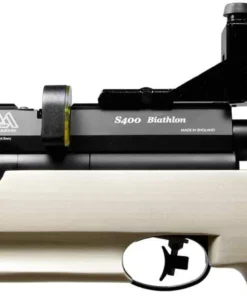



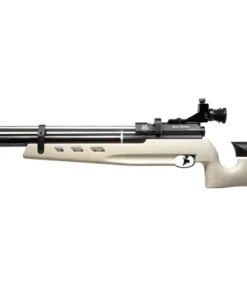
Air Arms S400 Biathlon Air Rifle


€1,250.00
Description
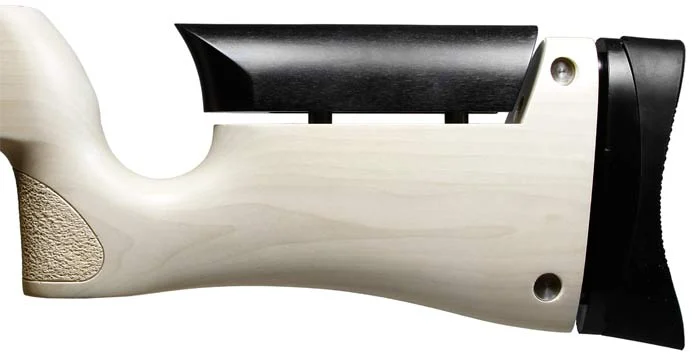
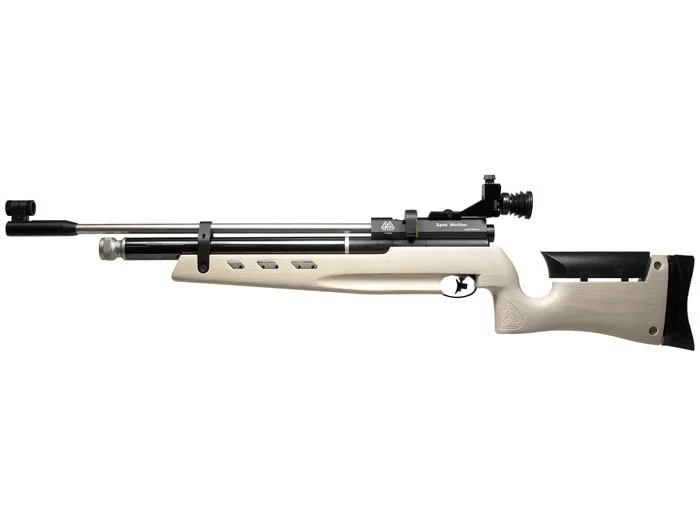
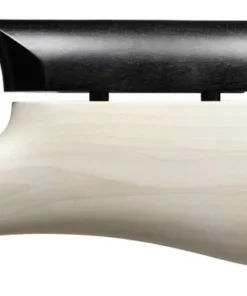
The Air Arms Precision Biathlon rifle delivers world-class accuracy. Air Arms is known for making extremely accurate guns, and the Biathlon is no exception. This air rifle is dressed in a unique white poplar stock with adjustable black cheekpiece and rubber buttpad. If you don’t shoot competitively and just want a very accurate repeater, install a compact scope on the 11mm dovetail. Because the dovetail is very short, you’ll need to use a 2-piece mount.
Keep your extra rotary clips in the slots of the right-hand forearm. Load them before each match so there’s no fumbling when the pressure is on
- Air Arms S400 Biathlon air rifle
- Precharged pneumatic (200 bar max fill pressure)
- Bolt-action
- 5-shot repeater (self-indexing rotary clip)
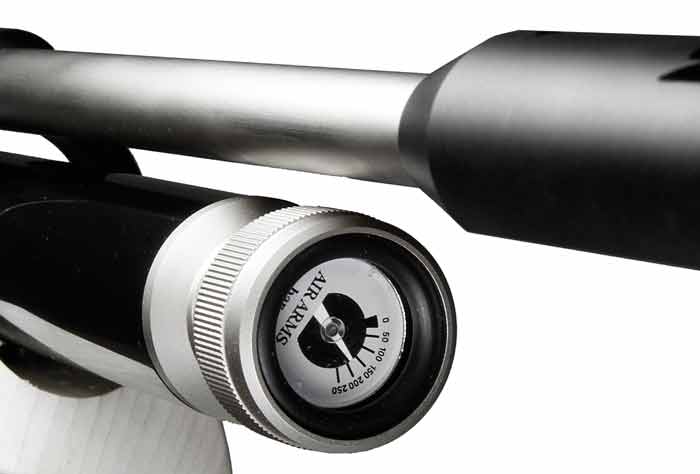
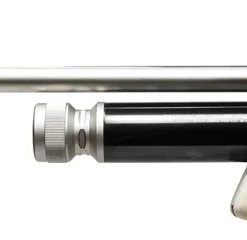
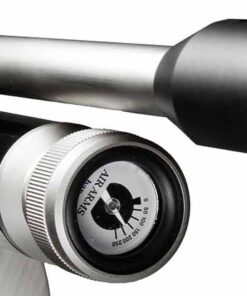
- Removable air reservoir
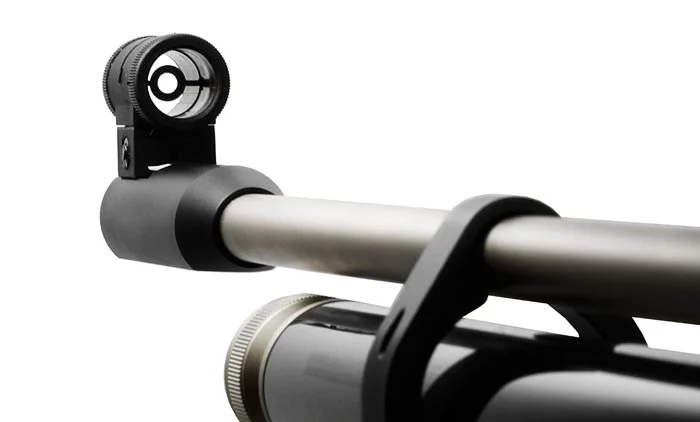
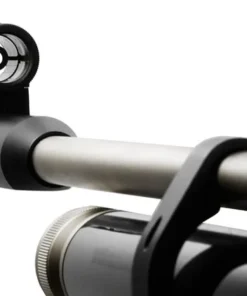
- Match sights: globe front accepts inserts, rear diopter (not included)
- 11mm dovetail
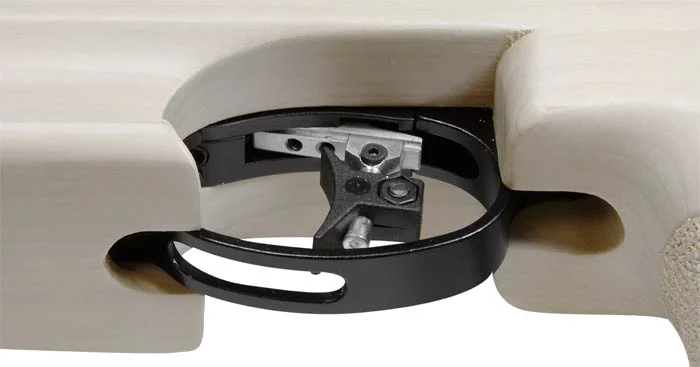
- 5-way adjustable match trigger
- Lothar Walther barrel
- White poplar stock
- Cheekpiece adjusts vertically and horizontally
- Buttpad adjusts vertically
- 4 rotary clips fit in slots in right-hand forearm
- Beautiful deep bluing
- Stock is flawlessly executed
- 29.875″ between front & rear sight positions
- 10.25″ long accessory rail
- 12.12″ to 12.50″ length of pull (LOP)
- 5.15 ft-lbs.
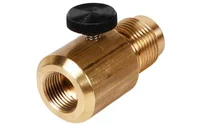
- Includes owner’s manual, 7 Allen keys, four 5-shot clips, fill adapter & spanner (to remove reservoir)
Specifications
BrandAir Arms
Caliber.177 (4.5mm)Max Velocity564 fps Muzzle Energy5.15 ft/lbsSuggested forCompetitionPowerplantPre-charged pneumaticLoudness2-Low-MediumWeight6.99 lbsFunctionRepeaterMax Shots per Fill120ActionBolt-actionScopeable11mm dovetailFront SightsGlobe w/Aperture InsertsRear SightsnoneSafetynoneTriggerFive-way adjustable matchBarrelRifledBarrel Length20.5″Overall Length41.0″Capacity5 round(s)Body TypeRifleButtplateAdjustableOperating Pressure2900 PSI / 200 BARRegulatedNoIs Safe To Dry FireYes
Air Arms S400 Biathlon Air Rifle – Competition-Focused PCP Precision with Match-Grade Control
Air Arms S400 Biathlon Air Rifle Overview
The Air Arms S400 Biathlon Air Rifle is a specialized competition-oriented pneumatic rifle developed around precision, repeatable handling, and deliberate shot control. Current retailer specifications list a .177-caliber pre-charged pneumatic system, 200 BAR maximum fill pressure, bolt-operated 5-shot self-indexing rotary clips, a Lothar Walther rifled barrel, an 11mm dovetail, vertically and horizontally adjustable cheekpiece, vertically adjustable buttpad, and a highly adjustable match trigger. It produces approximately 5.15 ft-lb and is intended primarily for competition use.
Air Arms now places the original Biathlon model among its discontinued rifles, so availability may depend on remaining dealer inventory or the used market.
Why Choose the Air Arms S400 Biathlon?
The main reason to choose this platform is control. Unlike general-purpose air rifles or ordinary pellet guns, the Biathlon configuration emphasizes repeatable head position, trigger management, sight alignment, and rapid but controlled loading.
Anyone researching an air rifle, air gun, air arms, airguns, airgins, air arm, or an Air Arms air rifle will find that this model sits closer to specialized match equipment than a conventional sporting rifle.
Its five-way adjustable match trigger, adjustable stock geometry, light competition power, and precise barrel system make it especially appropriate for target air rifle shooting, air riflery, and structured range training.
How Accurate Is the S400 Biathlon?
The Lothar Walther barrel forms the foundation of the rifle’s accuracy, while the adjustable trigger allows shooters to refine shot release. Retailer specifications also list a globe front sight compatible with aperture inserts, with the rifle prepared for competition-style sighting equipment.
Shooters searching for an airgun shooting range near me can use a suitable range environment to develop consistent stance, breathing, trigger control, and follow-through.
Why .177 Caliber?
The Biathlon configuration is listed in 177 caliber, making cal .177 pellets and a 177 air rifle directly relevant.
When comparing 177 pellet vs.22 pellet, 177 caliber vs 22, .22 air rifle, and broader air rifle calibers, .177 is commonly favored for precision target disciplines because of its lighter projectile and flatter trajectory characteristics.
The Biathlon is therefore fundamentally different from heavier-caliber sporting rifles designed primarily around field energy.
What Is a PCP Airgun?
Anyone asking what is a pcp airgun, what is an air rifle, or how do air guns work should understand that this rifle stores compressed air inside an onboard reservoir.
It is not a break barrel pellet gun, so people asking what is break barrel air rifle should note that no barrel-breaking action is required.
Instead, the reservoir is charged with a suitable pcp hand pump or compatible air compressor rifle filling system.
The listed operating pressure is 200 BAR / 2,900 PSI.
How Does It Compare With Sporting Air Arms Models?
Buyers researching the air arms s510, air arms s410, air arms tx200, or prosport air arms are looking at very different styles of rifle.
The Air Arms S510 XS Ultimate Sporter FAC, Air Arms S510 XS Ultimate Sporter, Air Arms S510 FAC, Air Arms S510 XS FAC PCP Air Rifle, and Air Arms S510 XS Ultimate Sporter FAC Walnut Stock are sporting PCP platforms designed around different power, magazine, stock, and field-use priorities.
Likewise, air arms s510 ultimate sporter .177 sub 12 refers to a sporting configuration rather than a dedicated low-energy biathlon setup.
The standard S400 family itself remains a bolt-action PCP platform, although current production sporting S400 rifles are described by Air Arms as single-shot and unregulated, with .177 and .22 versions available.
Match Handling and Adjustable Ergonomics
The Biathlon stock is designed to help the shooter establish a repeatable position.
Its cheekpiece can be adjusted vertically and horizontally, while the buttpad can be moved vertically. Four five-shot clips can also be stored in dedicated slots on the right side of the forearm.
These features make the platform especially useful for shooters who want deliberate competition ergonomics rather than general-purpose sporting furniture.
Maintenance and Filling
Routine ownership should include clean filling practices, pressure monitoring, careful barrel maintenance, and occasional inspection of seals and the bolt mechanism.
A suitable Air rifle cleaning kit can help with periodic maintenance, although excessive cleaning should be avoided when accuracy remains stable.
Because the rifle is pneumatic, there is no spring-piston recoil cycle to manage.
Important Use Considerations
Searches for air guns for home defense concern a completely different use case. This rifle is designed around competition and precision shooting rather than defensive application.
Likewise, legal requirements for ownership, transport, storage, and range use vary by jurisdiction and should always be followed.
Other Pneumatic Products Buyers May Encounter
Broad searches sometimes mix the S400 Biathlon with unrelated products such as Snowpeak PP750L, Snowpeak Air Pistol, PCP Pistol, Airgun Pistol, High power PCP air pistol, Snowpeak PP750L PCP Air Pistol for sale, and pistolet pcp arcea-snowpeak onix sport.
These are separate pistol-oriented products and are not direct alternatives to the S400 competition rifle.
Similarly, snow peak customer service and snow peak brand origin concern another manufacturer.
Search phrases such as air pisto, t rex 6000, and how much did the m60 weigh may appear in broad search data but do not describe this rifle’s specifications or intended purpose.
Why the Air Arms S400 Biathlon Stands Out
The Air Arms S400 Biathlon Air Rifle combines a precision-oriented .177 platform, adjustable match ergonomics, five-shot rotary feeding, Lothar Walther rifling, 200 BAR pneumatic operation, and a sophisticated match trigger into a purpose-built competition package.
For shooters interested in a highly specialized Air Arms design with a strong emphasis on repeatability, sight alignment, and disciplined target shooting, the Biathlon remains an interesting legacy platform even though Air Arms now lists the original model among its discontinued rifles.
Precision Shooting, Trigger Control, Ergonomics, Air Efficiency, and Competition Handling
The Air Arms S400 Biathlon Air Rifle is designed around controlled, repeatable shooting rather than raw power. Its competition-focused layout places emphasis on trigger quality, consistent head position, stable stock fit, precise loading, balanced handling, and efficient use of compressed air. For shooters who value technical discipline, the rifle offers a platform that rewards careful breathing, body control, and repeatable technique.
Competition-Oriented Shooting Character
The rifle is intended to feel deliberate and predictable.
Instead of encouraging fast, casual shooting, its configuration supports a methodical rhythm in which the shooter establishes position, checks alignment, controls breathing, and completes the trigger press without unnecessary movement.
This type of setup is especially useful for developing repeatability.
A rifle that behaves the same way from one shot to the next makes it easier to identify whether accuracy changes are coming from the shooter, the ammunition, the sighting setup, or environmental conditions.
Adjustable Match Trigger
The trigger is one of the most important components of the rifle.
A competition-oriented trigger allows the shooter to separate preparation from final shot release.
The first stage can be taken up deliberately, while the final stage can be completed with a controlled increase in pressure.
This helps reduce sudden movement at the moment of firing.
The goal is not simply to create the lightest possible trigger.
A good setup should feel predictable, safe, and repeatable.
Trigger Technique
The trigger finger should press smoothly toward the rear.
Sideways movement can disturb the rifle and shift the sight picture.
The finger should move independently while the rest of the hand remains relaxed.
The shooter should avoid snatching the trigger when the aim appears perfect.
A controlled release is more reliable than trying to force the shot during a brief moment of visual alignment.
Adjustable Cheekpiece
The adjustable cheekpiece helps establish a repeatable head position.
Consistent head placement matters because sight alignment can change if the shooter lifts, lowers, or rotates the head differently between shots.
The cheekpiece should be positioned so that the eye naturally aligns with the chosen sighting system.
Once a comfortable position is found, it should remain consistent.
This reduces the need for unnecessary head movement during each shooting sequence.
Buttpad Adjustment
The adjustable buttpad helps refine how the rifle sits against the shoulder.
Small changes in vertical position can affect overall posture and balance.
A properly adjusted buttpad should allow the rifle to settle naturally without forcing the shoulder upward or downward.
Comfort matters because muscular tension can reduce stability.
A relaxed position is easier to reproduce over long sessions.
Body Position and Natural Alignment
The rifle should point toward the target naturally.
If the shooter must twist the torso or use excessive arm strength to keep the sights aligned, the position should be adjusted.
Natural alignment reduces fatigue and improves repeatability.
This principle becomes especially important during longer training sessions.
The more relaxed the body position, the easier it is to maintain a stable sight picture.
Breathing Control
Breathing creates unavoidable body movement.
The shooter should maintain a calm rhythm rather than holding the breath for too long.
After a normal exhale, there is often a brief pause when movement is reduced.
This can provide a stable moment for final trigger release.
If the sight picture is not correct, the shooter should restart the breathing cycle instead of rushing.
Consistency is more important than speed.
Follow-Through
Follow-through should continue after the trigger releases.
The shooter should remain in position and maintain sight alignment briefly.
The head should stay on the stock.
The trigger finger should not immediately jump away.
This helps preserve the complete shooting sequence and provides useful visual feedback about the shot.
Good follow-through also reduces unnecessary movement during the final part of the firing cycle.
Five-Shot Clip Operation
The rotary clip system helps maintain a steady shooting rhythm.
It allows several shots to be prepared without handling individual pellets after every cycle.
However, convenience should not lead to rushed shooting.
Each shot should still be treated as a separate precision event.
The shooter should confirm position, breathing, and sight alignment before completing the trigger press.
The feeding system should operate smoothly and should never be forced.
Bolt Operation
The bolt should be cycled smoothly and fully.
A deliberate loading motion helps maintain reliability.
If unusual resistance develops, the shooter should stop and inspect the clip, pellet position, and loading path.
Forcing the bolt can damage ammunition or create unnecessary wear.
A smooth loading process contributes to the refined feel expected from a competition-oriented platform.
Barrel Performance
The rifled barrel provides the foundation for projectile stability.
Even with a high-quality barrel, ammunition selection still matters.
Different pellet weights and head dimensions can behave differently.
The shooter should test several suitable options under similar conditions.
Repeated group performance is more valuable than one unusually good result.
Consistency across several sessions is the strongest indicator of a good ammunition match.
Ammunition Testing
Testing should be organized carefully.
The same distance, sight setting, position, and pressure range should be used whenever possible.
Only one major variable should be changed at a time.
If ammunition and sight settings are changed together, it becomes difficult to identify which change affected the result.
Several groups should be fired before a final decision is made.
Sight Alignment
The rifle can be used with competition-style sighting equipment.
Correct sight alignment should feel natural rather than forced.
The shooter should be able to mount the rifle and immediately find the same visual relationship between eye, rear sight, front sight, and target.
A repeatable head position makes this much easier.
If the shooter must constantly search for alignment, the stock or sight position may need adjustment.
Stable Standing Position
Standing is one of the most demanding shooting positions.
The feet should create a stable base.
The upper body should remain relaxed.
The supporting arm should rely as much as possible on skeletal structure rather than pure muscle tension.
The rifle should rest naturally rather than being held up with excessive force.
This reduces fatigue and improves steadiness.
Kneeling Position
Kneeling can provide more stability than standing.
The shooter should create a comfortable base with the lower body and use the supporting arm efficiently.
The stock should come naturally into the shoulder.
The head should remain upright enough to maintain consistent sight alignment.
If the position causes strain, it should be adjusted before continuing.
Sitting and Supported Practice
Supported practice can be useful for isolating mechanical performance.
A stable rest allows the shooter to focus on trigger control and sight alignment.
However, support pressure should remain consistent.
Changing how the rifle contacts the rest can affect point of impact.
Supported practice can also help evaluate ammunition performance before moving back to more demanding competition positions.
Air Pressure Management
The rifle should be operated within its useful pressure range.
The pressure gauge should be monitored during longer sessions.
Once reservoir pressure drops too far, performance may begin to change.
Serious group testing is most useful when conducted within the rifle’s stable operating window.
Learning the practical shot count between fills can make training more efficient.
Filling Discipline
Clean, dry compressed air should be used.
The fill connection should remain free from dust and moisture.
The rifle should only be filled to the correct pressure.
Overfilling provides no useful advantage and may place unnecessary stress on the system.
Careful filling habits help protect seals and internal components over the long term.
Managing Long Training Sessions
Precision training can be mentally and physically demanding.
As fatigue increases, posture, breathing, and trigger control often deteriorate.
Short breaks can help restore concentration.
The shooter should also monitor shoulder, neck, and lower-back tension.
Once position quality begins to decline, continuing to shoot may produce results that reflect fatigue rather than actual rifle performance.
Recording Performance
Simple training records can be valuable.
The shooter can note ammunition type, distance, pressure, sight settings, group size, and shooting position.
These records make it easier to identify patterns.
Over time, they can show whether performance changes are linked to ammunition, position, equipment adjustments, or technique.
Practical Competition Value
The strongest advantage of the Air Arms S400 Biathlon Air Rifle is the way its systems support disciplined shooting.
The trigger encourages controlled release.
The adjustable stock helps create repeatable body positioning.
The rotary clip supports efficient loading.
The barrel provides a stable foundation for accuracy.
The compressed-air system delivers smooth operation with minimal recoil.
When these features are combined with careful breathing, stable sight alignment, good follow-through, and consistent training habits, the rifle becomes a highly refined platform for precision-focused competition and structured target practice.
Maintenance, Air-System Care, Barrel Condition, Stock Adjustment, Storage, and Long-Term Reliability
The Air Arms S400 Biathlon Air Rifle is a precision-focused pneumatic platform, so long-term reliability depends on keeping its major systems clean, correctly adjusted, and protected from unnecessary wear. Its reservoir, fill connection, trigger, bolt, rotary clips, barrel, stock hardware, sights, seals, and pressure system all contribute to consistent performance. A disciplined maintenance routine can help preserve smooth operation and make it easier to notice developing problems before they begin affecting accuracy.
Building a Regular Maintenance Routine
Maintenance should begin with simple visual checks.
After each serious shooting session, the rifle should be examined for dust, moisture, loose screws, unusual movement, or changes in loading feel.
The exterior can be wiped with a clean soft cloth.
If the rifle has been exposed to damp conditions, it should be dried thoroughly before storage.
A short inspection performed consistently is usually more useful than occasional excessive maintenance.
Caring for the Air Reservoir
The reservoir should be treated as a critical pressure-bearing component.
Its exterior should remain free from obvious damage, heavy corrosion, or unusual marks.
The pressure gauge should be checked before and after longer shooting sessions.
If the rifle loses pressure more quickly than expected while stored, the system should be inspected.
Persistent pressure loss may indicate a seal or valve issue that deserves attention.
Monitoring Fill Pressure
The reservoir should only be filled to the recommended pressure.
Overfilling does not improve practical performance.
Instead, it can place unnecessary stress on the pressure system.
The shooter should watch the gauge carefully during filling.
A controlled approach is safer and more consistent than relying entirely on the charging equipment.
Keeping the Fill Connection Clean
The fill connection should remain free from dirt, dust, and moisture.
Contamination introduced during charging can gradually affect seals and internal components.
Before attaching a filling source, both connections should be inspected.
Any protective cover should be replaced after filling where applicable.
Clean filling habits can significantly reduce the chance of problems developing later.
Using Dry Compressed Air
Moisture inside a pneumatic system can create long-term problems.
The charging source should therefore provide clean, dry air.
In humid environments, moisture management becomes especially important.
Filters, pumps, compressors, and filling equipment should be maintained properly.
Water should not be allowed to enter the reservoir through poorly managed charging equipment.
Seal Condition
Seals keep the pressure system airtight.
Over time, they can be affected by age, contamination, temperature changes, or unsuitable lubricants.
The rifle should hold pressure predictably when stored correctly.
If a leak develops, the source should be identified rather than repeatedly refilling the reservoir.
Incorrect lubrication should be avoided because some products can damage sealing materials.
Bolt Maintenance
The bolt should move smoothly through the loading cycle.
Its normal feel should remain consistent.
If operation becomes rough or unusually resistant, the loading path should be inspected before the mechanism is forced.
Dust, damaged ammunition, or a poorly seated clip can all interfere with smooth operation.
A clean bolt system helps preserve reliable feeding.
Rotary Clip Care
The rotary clips should be handled carefully and stored in a clean place.
Pellets should be loaded without forcing them.
If a clip becomes dirty, feeding consistency may suffer.
Debris can also interfere with indexing.
Each clip should be inspected periodically for wear, damage, or unusual resistance.
A damaged clip should not be used simply because it still fits.
Barrel Maintenance
The barrel does not require aggressive cleaning after every session.
If accuracy remains consistent, unnecessary cleaning should be avoided.
However, if grouping performance begins to change without another obvious cause, barrel condition should be considered.
Suitable cleaning equipment should be used.
Harsh abrasives and materials that could damage the bore should be avoided.
Protecting the Muzzle
The muzzle area should be protected from impact.
Damage at the crown can influence projectile stability.
The rifle should never be rested directly on the front of the barrel.
During transport, the muzzle should remain protected inside a suitable case.
If any front accessory is fitted, it should remain correctly aligned and secure.
Trigger Care
The match-style trigger is one of the rifle’s most important control components.
Once a safe and comfortable adjustment has been found, constant changes are unnecessary.
The trigger should remain clean and predictable.
If it begins to feel rough, unusually heavy, unusually light, or inconsistent, the rifle should be inspected.
A predictable trigger contributes directly to shooting confidence.
Avoiding Unnecessary Internal Adjustment
Internal pneumatic and trigger components should not be altered casually.
If the rifle develops a serious mechanical issue, professional service is often the better option.
Unnecessary disassembly can introduce new problems.
Precision equipment usually performs best when adjustments are made deliberately and only when there is a clear reason.
Adjustable Stock Hardware
The cheekpiece and buttpad should remain secure once properly adjusted.
Adjustment screws should be checked periodically.
If either component moves during shooting, head position and shoulder placement can change.
This may appear to be an accuracy problem when the real issue is simply stock movement.
Secure hardware helps preserve repeatable positioning.
Sight System Inspection
Competition sights should remain securely mounted.
Any movement can alter zero.
The front and rear assemblies should be checked periodically.
Adjustment controls should move correctly without excessive looseness.
If point of impact changes unexpectedly, the sight hardware should be inspected before more complicated troubleshooting begins.
Keeping Optical Surfaces Clean
If optical or aperture components are used, they should be kept free from dust and fingerprints.
Cleaning should be gentle.
A dirty sighting surface can reduce visual clarity and make aiming more difficult.
Harsh chemicals should not be used unless they are specifically suitable for the component being cleaned.
Stock Protection
The stock should be kept dry and protected from impact.
Moisture should not be allowed to remain on the surface for long periods.
The rifle should not be stored where heavy objects can press against the stock.
Cracks, movement, or damaged adjustment areas should be inspected immediately.
The stock directly influences shooting position, so its condition matters.
Managing Moisture After Outdoor Use
Outdoor training can expose the rifle to rain, fog, condensation, or sweat.
After use, exposed surfaces should be dried.
The rifle should not be placed directly into long-term storage while damp.
A wet soft case can hold moisture against the metalwork.
Allowing the rifle and case to dry separately is a better approach.
Temperature Management
Extreme temperatures should be avoided.
A closed vehicle can become very hot.
Heat can affect seals, lubricants, pressure, sights, and stock materials.
Cold conditions can also change how some components feel.
When the rifle is moved between very different temperatures, it should be allowed to stabilize gradually.
This also helps reduce condensation.
Safe Transport
A padded case provides protection during travel.
The barrel, sights, stock, and reservoir should remain supported.
Loose accessories should be secured separately.
The rifle should not move excessively inside the case.
Good transport habits help preserve both zero and cosmetic condition.
Storage Between Sessions
Storage should be dry, secure, and compliant with local regulations.
Unauthorized access should be prevented.
The rifle should not be placed where the sights or barrel are under constant pressure.
The storage area should remain reasonably stable in temperature and humidity.
Before the next session, the rifle should be inspected again.
Recognizing Changes in Performance
Owners gradually become familiar with how the rifle normally behaves.
The bolt, trigger, pressure gauge, clip system, and sight adjustments all develop a familiar feel.
Changes in any of these areas should be noted.
A sudden drop in consistency, increased air loss, rough loading, or unexplained zero shift may indicate that something requires attention.
Keeping Maintenance Records
Simple maintenance notes can be useful.
The owner can record filling dates, pressure observations, barrel cleaning, clip replacement, sight adjustments, and professional servicing.
These records make it easier to identify trends.
They are also useful if the rifle later requires technical inspection.
Long-Term Reliability
The Air Arms S400 Biathlon Air Rifle can remain highly dependable when care is consistent.
Clean filling practices protect the pneumatic system.
Dry storage helps reduce corrosion.
Secure stock adjustments preserve shooting position.
Careful clip handling supports smooth loading.
Thoughtful barrel maintenance protects precision.
Regular sight checks help maintain zero.
When these habits are followed, the rifle remains easier to understand, easier to troubleshoot, and more reliable across repeated training and competition sessions.
Competition Workflow, Position Management, Environmental Control, Training Efficiency, and Performance Optimization
The Air Arms S400 Biathlon Air Rifle is best understood as a precision training platform that rewards consistency. Its greatest strengths become more apparent when the shooter develops a repeatable routine around stance, sight alignment, pressure management, loading, breathing, and recovery between shots. Competition performance is rarely determined by one feature alone. Instead, success depends on how effectively the rifle, the shooter, the sighting system, and the surrounding conditions are managed together.
Creating a Repeatable Pre-Shooting Routine
A structured routine helps reduce avoidable mistakes.
Before shooting begins, the shooter should check reservoir pressure, loading components, sight position, stock adjustments, and general condition.
The same sequence should be followed every time.
This creates familiarity and makes unusual behavior easier to notice.
When equipment preparation becomes automatic, more attention can be directed toward shooting technique.
Establishing Consistent Body Position
Body position should be stable without becoming rigid.
The shooter should avoid using excessive muscular tension to hold the rifle in place.
A position that depends too heavily on muscle strength becomes harder to repeat as fatigue develops.
Instead, the body should be arranged so that skeletal structure provides as much support as possible.
This creates a more stable platform and reduces unnecessary movement.
Natural Point of Aim
The rifle should naturally align with the target.
If the shooter must constantly pull or push the rifle into position, accuracy can suffer.
A better approach is to adjust foot placement, shoulder angle, and body orientation until the sight naturally settles toward the intended point.
Natural alignment reduces strain and improves repeatability.
It also makes longer training sessions more productive.
Managing Standing Stability
Standing is one of the most demanding positions because there is limited external support.
The feet should create a balanced base.
Weight distribution should feel stable rather than forced.
The supporting arm should help carry the rifle without excessive tension.
Small movements are unavoidable, so the shooter should learn to work within a controlled aiming area rather than expecting the sight to remain perfectly still.
Efficient Kneeling Position
Kneeling can provide greater stability than standing.
The lower body should form a solid base.
The supporting elbow can rest against the knee or thigh where appropriate.
The rifle should come naturally into the shoulder.
The head should remain upright enough to preserve comfortable sight alignment.
A position that creates joint or muscle strain should be adjusted before serious shooting begins.
Developing a Stable Sitting Position
Sitting can provide excellent support during training.
The shooter can use the knees and elbows to create a stable structure.
This reduces the amount of muscular effort required.
The rifle should remain balanced rather than clamped tightly.
The more relaxed the position, the easier it becomes to repeat from shot to shot.
Breathing Rhythm
Breathing should remain calm and controlled.
Trying to hold the breath for too long can create tension.
A normal breathing cycle is usually more effective.
After a relaxed exhale, there is often a brief pause when body movement is reduced.
This is commonly the best moment to complete the shot.
If alignment is not correct, the shooter should simply restart the breathing sequence.
Trigger Preparation
Trigger preparation should begin before the final aiming moment.
The first stage can be taken up gradually while the shooter confirms alignment.
Once the sight picture becomes stable, the final pressure can be applied smoothly.
The finger should move directly backward.
Any sideways movement can disturb the rifle.
A deliberate trigger press is more reliable than a rushed release.
Maintaining Follow-Through
After the shot, the shooter should remain in position.
The head should stay aligned with the sight.
The trigger finger should remain controlled.
The rifle should not be lowered immediately.
This continuation helps preserve the complete shooting sequence and allows the shooter to evaluate how the sight moved at the moment of release.
Good follow-through improves awareness and consistency.
Building a Smooth Loading Rhythm
The loading process should be efficient but deliberate.
The bolt should be cycled smoothly.
The rotary clip should index correctly.
The shooter should avoid rushing the loading sequence simply because the system allows several shots to be prepared quickly.
A steady rhythm reduces handling errors and helps preserve concentration.
Managing Clip Rotation
The shooter should periodically confirm that each clip is indexing correctly.
If the clip begins to feel rough or inconsistent, it should be inspected.
A loading issue should be addressed before it affects a training session.
Spare clips should be stored where they can be accessed easily without disturbing the shooting position.
Good organization supports a smoother competition workflow.
Pressure Planning
Reservoir pressure should be checked before serious shooting begins.
The shooter should understand how many useful shots are available before performance begins to change.
Planning fills in advance reduces interruptions.
It also prevents the shooter from continuing to test accuracy while operating near the lower end of the stable pressure range.
Consistency is easier to evaluate when pressure conditions remain similar.
Managing Refill Timing
Refilling should be incorporated into the training routine.
The shooter should avoid waiting until pressure is unexpectedly low.
A predictable refill schedule makes sessions more efficient.
Charging equipment should remain clean and properly maintained.
The connection should be made carefully.
After filling, the system should be checked before the next shooting sequence begins.
Ammunition Organization
Pellets should be kept clean and protected.
Damaged ammunition can create inconsistent results.
The shooter should avoid mixing different types during a serious accuracy test.
Each batch should be evaluated separately.
Containers should be labeled clearly if several options are being tested.
Good organization makes performance comparisons more reliable.
Tracking Group Performance
Group size provides useful information, but it should not be judged from a single attempt.
Several groups should be recorded.
The same distance and position should be used when comparing results.
Large changes may indicate environmental effects, sight movement, ammunition differences, or technique issues.
Patterns become more meaningful when they are observed repeatedly.
Wind Observation
Wind becomes increasingly important as distance increases.
The shooter should watch vegetation, flags, or other indicators.
Conditions may change between the firing point and the target.
A sudden horizontal shift does not necessarily indicate a mechanical problem.
Wind data should be considered before sight adjustments are made.
Light Conditions
Changing light can influence how sights appear against the target.
Bright sunlight, overcast conditions, and indoor lighting may all affect visual perception.
The shooter should pay attention to these changes.
Stable sight alignment is easier when lighting conditions are understood.
Training under different lighting conditions can help improve adaptability.
Temperature Changes
Temperature can influence pressure and overall equipment behavior.
A rifle moved from a warm environment into cooler conditions should be given time to stabilize.
Likewise, equipment exposed to direct sunlight can warm quickly.
For consistent training, the shooter should avoid making immediate judgments about performance after a major temperature change.
Humidity and Moisture
Humidity can affect both comfort and equipment.
Moist conditions may make stock surfaces feel different.
Condensation can also develop when moving between environments.
After damp sessions, the rifle should be dried before storage.
Training gear should also be allowed to dry separately.
Moisture management protects both performance and long-term condition.
Managing Fatigue
Precision shooting requires concentration.
As fatigue develops, body position and trigger control often deteriorate.
The shooter may begin to rush shots or apply more muscular force.
Short breaks can prevent this decline.
A training session should focus on quality rather than simply total shot count.
Once technique becomes inconsistent, continued shooting provides less useful feedback.
Mental Routine
A consistent mental process can improve performance.
Before each shot, the shooter can confirm position, breathing, sight alignment, trigger preparation, and follow-through.
This creates a repeatable sequence.
If something feels wrong, the shot should be delayed.
Developing the discipline to restart the sequence is more valuable than forcing a poor shot.
Using Training Records
A simple training log can help identify long-term improvement.
The shooter can record distance, position, pressure, ammunition, weather, and group results.
Notes about physical condition or equipment changes can also be useful.
Over time, these records can reveal patterns that are difficult to remember.
They also make troubleshooting more systematic.
Evaluating Equipment Changes
Only one major change should be tested at a time.
If the shooter changes sights, ammunition, stock position, and technique simultaneously, it becomes difficult to identify what caused the result.
A better approach is to make one adjustment and evaluate it across several groups.
This creates more reliable information.
Competition Preparation
Before competition, equipment should already be familiar.
Major adjustments should not be made at the last moment unless necessary.
The shooter should verify pressure, clip condition, sight settings, stock position, and ammunition.
A predictable setup reduces uncertainty.
Confidence usually comes from repetition rather than constant equipment changes.
Safe Range Practice
Every training session should take place in an appropriate shooting environment.
A safe backstop is essential.
Range rules should be followed.
The rifle should remain pointed in a safe direction.
The trigger should only be touched when the shooter is prepared to fire.
Safe habits should remain consistent regardless of experience level.
Practical Performance Optimization
The Air Arms S400 Biathlon Air Rifle performs best when the shooter builds a disciplined system around it.
Natural body alignment improves stability.
Controlled breathing reduces unnecessary movement.
Smooth trigger pressure protects sight alignment.
Follow-through supports consistency.
Organized loading improves workflow.
Pressure planning reduces interruptions.
Environmental awareness helps explain changes in point of impact.
When these habits are practiced together, the rifle becomes a highly predictable training platform that supports precision, repeatability, and efficient competition preparation.
Be the first to review “Air Arms S400 Biathlon Air Rifle”
Related products


Air Arms
Air Arms



Air Arms
Reviews
There are no reviews yet.