
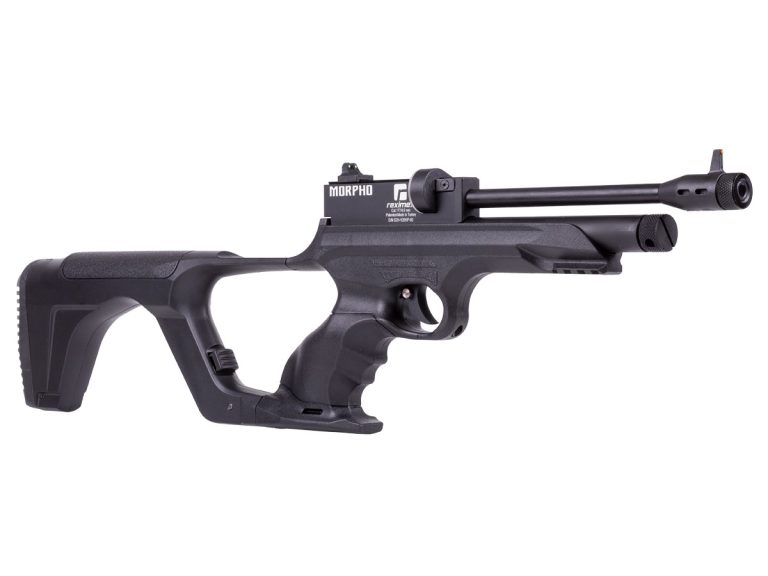

Reximex Morpho Air Pistol

€100.00
The Reximex Morpho is a compact PCP air pistol available in both .177 and .22 caliber — tested with JSB pellets for consistent, reliable results. At 400 fps in .177 and 350 fps in .22, it’s calibrated for accuracy and control at pistol distances rather than raw power, making it well suited for indoor target shooting and precision practice.
- .177 Cal — 400 fps, tested with 8.44gr JSB pellets for consistent performance.
- .22 Cal — 350 fps, tested with 18.13gr JSB pellets for a heavier, slower delivery at short range.
- PCP-powered pistol — no CO2 cartridge swaps, just fill and shoot for consistent pressure.
- Two-caliber availability — choose the caliber that fits your shooting style and application.
Reximex Morpho Air Pistol – Convertible CO₂ Pistol/Carbine with Detachable Stock, Multi-Shot Magazine and Fiber-Optic Sights
The Reximex Morpho Air Pistol is a compact CO₂-powered platform designed around versatility, simple operation and recreational target shooting. Unlike the manufacturer’s high-pressure pneumatic models, the Morpho uses a conventional 12-gram CO₂ cartridge, which eliminates the need for a separate high-pressure air bottle, compressor or hand pump.
Its most distinctive feature is the detachable synthetic shoulder stock. Therefore, the platform can provide compact pistol-style handling or a shoulder-supported configuration when greater stability is preferred. Reximex also combines this convertible layout with an index magazine, fiber-optic sights, Picatinny accessory mounting space and trigger safety.
Current factory literature lists the Morpho in .177 / 4.5mm and .22 / 5.5mm, with maximum velocities of approximately 400 fps in .177 and 350 fps in .22. Magazine capacities are 14 and 12 respectively.
Why Choose the Morpho?
The main reason to consider this platform is straightforward usability.
Rather than dealing with a large external charging system, the shooter installs the appropriate 12g CO₂ cartridge according to the manufacturer instructions. Consequently, the Morpho can be particularly convenient for controlled recreational shooting sessions.
Additionally, the removable stock changes the way the platform can be supported. The stock provides a third contact point against the shoulder, which can improve stability compared with unsupported pistol shooting.
This combination makes the design useful for shooters who appreciate configurable ergonomics.
How Good Is the Morpho for Precision Shooting?
Precision depends on far more than maximum velocity.
Ammunition quality, sight alignment, grip consistency, trigger technique, temperature and shooting position all influence practical grouping.
The Morpho includes fiber-optic sights, which provide a clear aiming reference for recreational target use. Furthermore, the upper Picatinny rail offers mounting flexibility for compatible sighting equipment where appropriate.
With the detachable stock fitted, a more stable shoulder-supported position can also be established.
Therefore, controlled group testing with several suitable pellet types provides a better indication of real accuracy than velocity alone.
.177 and .22 Caliber Options
The Morpho is offered in two popular pellet calibers.
The .177 configuration is factory-rated at approximately 400 fps, while the .22 configuration is listed around 350 fps.
These moderate velocities reinforce the platform’s recreational orientation rather than placing it in the same performance category as many full-power high-pressure pneumatic rifles.
Pellet weight and environmental temperature can also influence actual velocity because CO₂ pressure is temperature-sensitive.
12-Gram CO₂ Power System
Instead of a refillable high-pressure reservoir, the pistol uses a 12g CO₂ cartridge.
This simplifies the supporting equipment required for operation.
CO₂ cartridges are compact and convenient to transport where local regulations permit. However, the manufacturer’s operating instructions should always be followed when installing or removing one.
CO₂ systems are also sensitive to temperature. Consequently, velocity and useful shot count may change in colder or warmer environments.
Shot Count Per Cartridge
Factory information lists approximately:
- 40 shots in .177
- 36 shots in .22
from the specified CO₂ system.
Actual results can differ with temperature, firing cadence, ammunition and cartridge condition.
Therefore, published shot count should be understood as a reference rather than an absolute guarantee for every session.
Multi-Shot Index Magazine
Magazine capacity is another practical advantage.
The .177 version provides a 14-shot magazine, while the .22 version provides 12 shots.
Multi-shot operation reduces the need to manually handle a pellet after every discharge.
Nevertheless, ammunition should be loaded carefully. Damaged skirts or incorrectly seated pellets can interfere with smooth feeding and may reduce grouping consistency.
Detachable Shoulder Stock
The detachable stock is central to the Morpho’s adaptable design.
With the stock fitted, overall support can be improved through shoulder contact. Without it, the platform becomes more compact.
The stock is constructed from synthetic material, which provides a practical surface for regular recreational use.
The manufacturer’s catalogue lists an overall length of approximately 612mm / 24.09 inches in the specified configuration.
Fiber-Optic Sight System
Fiber-optic sights provide a bright visual reference that can assist sight acquisition under suitable lighting.
They are especially useful for straightforward recreational target shooting where a large optical system may not be necessary.
However, sight consistency remains essential.
The shooter should maintain the same relationship between front sight, rear sight and target for every shot.
Picatinny Rail
A Picatinny mounting rail is incorporated into the design.
This provides mounting flexibility for compatible accessories.
Any equipment added to the platform should be installed securely and should not interfere with safe operation.
Optic weight and placement can also alter balance, so unnecessary accessories may not always improve practical handling.
Trigger Safety
A trigger safety is listed among the factory features.
However, mechanical safety devices should always be treated as supplementary protection.
The muzzle should remain directed toward a safe area, and the trigger should remain untouched until the shooter is prepared to fire.
Safe handling remains essential regardless of the mechanical safety configuration.
Barrel Length and Overall Weight
The Morpho uses a 201mm / 7.9-inch barrel and weighs approximately 1.3kg / 2.9lb in the manufacturer’s listed configuration.
These dimensions create a relatively compact platform while leaving enough mass to provide a stable feel.
The exact balance changes depending on whether the shoulder stock and additional sighting equipment are installed.
When Should You Consider This Platform?
This design makes particular sense for controlled recreational target shooting where compact dimensions and simple CO₂ operation are priorities.
It can also be attractive to users who do not want the additional infrastructure required by high-pressure pneumatic equipment.
For informal paper-target practice at suitable distances, the multi-shot magazine and fiber-optic sights provide a straightforward shooting experience.
Reximex and Related Product Searches
The broader reximex and reximex airguns catalogue covers several different operating systems and configurations.
Consequently, searches for reximex throne gen2, reximex throne gen 2, reximex mito, reximex mitos, reximex гр, reximex rра, and reximex lieva should not be interpreted as Morpho specifications.
For example, the manufacturer’s Throne Gen2 is a high-pressure pneumatic platform with an adjustable regulator and pre-chamber, which is mechanically very different from a 12g CO₂ system.
Reximex Accura PCP Air Rifle Comparison
The phrase reximex accura pcp air rifle describes another type of platform entirely.
The key distinction is the power source.
The Morpho operates from replaceable CO₂ cartridges, whereas a PCP system relies on a refillable high-pressure air reservoir.
Therefore, charging equipment, output characteristics, weight, shot behavior and ownership requirements should not be confused between the two.
Reximex Lyra K Related Searches
The Reximex Lyra K belongs to the manufacturer’s rifle range rather than this compact CO₂ category.
Search phrases such as Reximex Lyra-K PCP air rifle, Reximex Lyra-K airgun, Reximex Lyra-K review, Reximex Lyra-K PCP rifle, Reximex Lyra-K regulated PCP, and Reximex Lyra-K compact PCP rifle represent research into another product family.
Likewise, Reximex Lyra-K tactical air rifle, Reximex Lyra-K hunting rifle, Reximex Lyra-K pellet gun, and Reximex Lyra-K scope package should not be used as Morpho specifications.
Energy Conversion Search Terms
People comparing air-powered platforms frequently encounter a tps to joules calculator, Tps joule calculator, fps to ft Ibs, or airgun joules calculator.
These tools may help convert units when projectile weight and measured velocity are known.
However, conversion results are only as accurate as the information entered.
Actual velocity should therefore be measured rather than inferred when precise output matters.
The current Reximex catalogue also appears to contain an internal mismatch between some printed joule and foot-pound figures for the Morpho, so velocity and caliber data should be treated as the more dependable published reference until the manufacturer clarifies the energy table.
Buyer-Intent Searches
Terms such as buy Reximex Lyra-K online, best price Reximex Lyra-K, gunseek, roxy max, and mx rex may occur while shoppers compare different products.
However, buyers interested in the Morpho should concentrate on its actual specifications: caliber, CO₂ cartridge requirement, magazine capacity, stock configuration, included accessories and legal availability.
Product identity should never be inferred solely from related search phrases.
Accuracy Testing Search Intent
The phrase Reximex Lyra-K accuracy test concerns a different model.
For the Morpho, practical evaluation should instead focus on consistent groups using suitable pellets, stable sights and a repeatable shooting position.
Because CO₂ pressure changes with temperature, testing under similar environmental conditions produces more meaningful comparisons.
Hunting and Pest-Control Search Terms
Search phrases including Reximex Lyra-K for pest control and Reximex Lyra-K small game hunting refer to another product and should not be treated as intended Morpho applications.
Given the Morpho’s modest manufacturer-listed velocities and recreational configuration, it is more appropriately described here as a target and recreational platform.
Any live-quarry application must separately meet local law, appropriate energy requirements and humane standards.
Important Specifications
- CO₂-powered operating system
- 12g CO₂ cartridge
- .177 / 4.5mm caliber option
- .22 / 5.5mm caliber option
- Approximately 400 fps in .177
- Approximately 350 fps in .22
- 14-shot .177 magazine
- 12-shot .22 magazine
- Approximately 40 shots in .177
- Approximately 36 shots in .22
- Detachable synthetic shoulder stock
- Fiber-optic sights
- Picatinny mounting rail
- Trigger safety
- 201mm barrel
- Approximately 612mm overall length
- Approximately 1.3kg weight
These specifications are based on Reximex’s current manufacturer catalogue.
Why the Morpho Offers Practical Value
The Morpho’s appeal comes from simplicity and versatility rather than extreme output.
A 12g cartridge removes the need for high-pressure charging equipment. Meanwhile, the detachable stock creates two distinct handling configurations, and the multi-shot magazine supports convenient recreational shooting.
Fiber-optic sights provide a straightforward aiming system, while the accessory rail leaves room for compatible sighting upgrades.
As a result, the Reximex Morpho Air Pistol offers a practical combination of compact dimensions, convertible ergonomics, easy CO₂ operation and multi-shot convenience for lawful recreational and target-focused use.
Accuracy, Handling, CO₂ Efficiency, Trigger Control, and Practical Shooting Performance
Developing Consistent Accuracy
Consistent performance depends on controlling the variables that influence every shot.
A compact CO₂-powered platform can deliver useful accuracy when grip pressure, sight alignment, ammunition choice, trigger movement, temperature, and shooter technique remain stable.
Rather than changing several factors at once, the shooter should establish a repeatable routine.
This makes it easier to understand whether an improvement comes from ammunition, sight adjustment, grip technique, or environmental conditions.
A controlled approach also prevents unnecessary changes to a setup that may already be working well.
Building a Stable Shooting Position
A stable shooting position should feel natural rather than forced.
The shooter should use a balanced stance or a supported seated position that reduces unnecessary movement.
The firing hand should hold the grip securely, while the supporting hand should add stability without squeezing too tightly.
Excessive muscular tension usually increases movement as fatigue develops.
For that reason, repeatable pressure is more useful than maximum grip strength.
Using the Shoulder Support
When the detachable rear support is fitted, the shooter gains an additional point of contact.
This can improve stability by linking the hands, shoulder, and sighting system more consistently.
The rear section should sit naturally against the shoulder rather than being pulled in with excessive force.
A light and repeatable contact point is generally more effective.
The added support can also make sight alignment easier during deliberate target shooting.
Grip Consistency
Grip pressure has a noticeable effect on lightweight platforms.
A grip that is too tight can cause unwanted movement during trigger release.
A grip that is too loose can reduce control.
The best approach is usually firm enough for stability but relaxed enough to let the trigger finger move independently.
The same hand position should be repeated for every shot.
Small grip changes can cause larger differences at greater distances.
Trigger-Finger Placement
The trigger finger should contact the trigger naturally.
Too much finger can pull the platform sideways.
Too little contact can make the movement feel awkward.
The finger should move independently from the rest of the hand.
This allows the grip to remain stable during release.
A smooth rearward movement generally produces more repeatable results.
Trigger Control
The trigger should be pressed progressively rather than jerked.
The shooter should become familiar with the point at which the mechanism releases.
Once this becomes predictable, attention can remain focused on sight alignment.
A sudden movement can disturb the platform at the most important moment.
Smooth trigger pressure supports smaller and more consistent groups.
Breathing Technique
Breathing naturally creates movement through the upper body.
The shooter should avoid holding the breath for an unnecessarily long period.
A brief pause after exhalation can provide a stable moment for firing.
If the position begins to feel strained, the shooter should reset instead of forcing the shot.
Comfortable breathing supports concentration and reduces unnecessary tension.
Sight Alignment
Sight alignment should remain identical from one shot to the next.
When open sights are used, the front element should remain centered within the rear reference.
The relationship between the sights and target should also remain consistent.
Small alignment errors can cause significant point-of-impact changes.
For this reason, consistency is more important than trying to hold the sights perfectly motionless.
Fiber-Optic Sight Use
Bright sight elements can make aiming easier under suitable lighting.
However, the shooter should avoid focusing only on the brightness of the sight.
The front and rear references still need to remain correctly aligned.
The same aiming point should be used for each shot during group testing.
If light conditions change significantly, sight appearance may also change.
Optic Setup
If a compatible optic is installed, its position should allow a clear sight picture without forcing the head into an awkward angle.
Mounting hardware should remain secure.
Loose mounts can create unexpected changes in zero.
However, screws should not be over-tightened.
A properly positioned optic should improve alignment rather than make the setup harder to handle.
Magazine Feeding
The magazine should rotate smoothly and feed ammunition without resistance.
Pellets should be loaded carefully so their skirts remain undamaged.
Bent skirts or distorted heads can affect both feeding and accuracy.
If unusual resistance develops, the magazine should be inspected instead of forced.
Keeping it clean helps maintain reliable indexing.
Ammunition Selection
Different barrels can prefer different pellet weights and profiles.
Several suitable options should therefore be tested.
Each type should be fired under similar conditions.
Distance, temperature, shooting position, and sight settings should remain as consistent as possible.
A pellet that produces more speed is not automatically the one that groups best.
Target results should remain the main reference.
Pellet Inspection
Pellets should be checked before loading.
Damaged skirts, irregular heads, or contamination can reduce consistency.
A quick visual inspection is usually enough.
Obviously defective pellets should be removed from the test batch.
This simple step helps prevent poor ammunition from distorting the results.
Group Testing
Several-shot groups provide more useful information than individual impacts.
One accurate shot may happen by chance.
Likewise, one poor shot may result from shooter error.
Multiple groups reveal whether the setup is genuinely repeatable.
The shooter should look for patterns rather than focusing on isolated shots.
Managing CO₂ Temperature
Temperature has a direct influence on CO₂ performance.
Cold conditions can reduce pressure and therefore lower velocity.
Warmer conditions may increase pressure within the normal operating range.
For this reason, groups fired at significantly different temperatures should be compared carefully.
A setup that performs well indoors may behave differently outside in cold weather.
Temperature should therefore be recorded during serious accuracy testing.
Firing Cadence
Rapid firing can cool the cartridge and reduce pressure temporarily.
This may cause velocity to drop during fast strings.
A more measured firing cadence allows the system to recover between shots.
For accuracy testing, the shooter should avoid rushing.
A steady rhythm provides more meaningful results and better represents normal practical use.
Cartridge Efficiency
A fresh cartridge normally provides its best performance early in the session.
As pressure decreases, velocity may begin to fall.
The shooter should learn approximately how many consistent shots are available before noticeable performance changes occur.
Continuing until the cartridge is completely depleted may not be useful when precision is the priority.
Changing Cartridges
Cartridges should be installed and removed according to the manufacturer’s instructions.
The sealing area should remain clean.
Damaging or contaminating the seal can cause gas loss.
If a new cartridge leaks immediately, the system should be checked rather than repeatedly tightening components with excessive force.
Supported Shooting
A stable rest can help reveal the mechanical capability of the platform.
The support should steady the hands without forcing the setup into an unnatural position.
The same contact points should be used for every shot.
Supported testing is especially useful when comparing pellets or adjusting the sights.
Unsupported Practice
Unsupported shooting requires more balance and muscle control.
Short practice strings are usually more productive than very long ones.
As fatigue develops, grip pressure and sight alignment may become less consistent.
Stopping before technique deteriorates helps preserve useful practice.
Standing Position
A balanced stance should support the upper body naturally.
The feet should provide stability without creating unnecessary tension.
The arms should support the platform without being locked rigidly.
A small amount of sight movement is normal.
The objective is controlled movement and a clean trigger release rather than complete stillness.
Environmental Conditions
Wind can influence lightweight projectiles significantly at longer distances.
Temperature can alter gas pressure.
Changing light can affect sight perception.
Therefore, environmental conditions should be considered before making unnecessary sight adjustments.
What appears to be a mechanical problem may actually be caused by changing conditions.
Managing Fatigue
Fatigue affects grip, breathing, concentration, and trigger control.
The shooter may begin changing technique without noticing.
Regular breaks help maintain consistency.
A poor group late in a session should not automatically be treated as evidence of an equipment problem.
Recording Results
A simple shooting log can improve long-term understanding.
Useful details include pellet type, distance, temperature, cartridge age, group size, sight settings, and shooting position.
Over time, patterns become easier to identify.
This reduces unnecessary experimentation and helps the shooter make more informed adjustments.
Long-Term Practical Performance
A compact CO₂ platform performs best when the shooter develops a consistent routine.
Stable grip, careful ammunition selection, measured firing cadence, temperature awareness, smooth trigger control, secure sighting equipment, and proper maintenance all contribute to predictable results.
When these factors are managed together, the platform becomes easier to understand and more dependable during lawful recreational and precision-focused target shooting.
Stability, Shooting Technique, Accuracy Development, Setup Refinement, and Consistent Performance
Building a Repeatable Shooting Position
A repeatable shooting position is essential when the goal is consistent target performance.
The relationship between the hands, shoulders, head, sights, and trigger should remain as similar as possible from one shot to the next.
Small changes in posture can alter sight alignment and increase group size.
Therefore, the shooter should build a natural position that does not require excessive muscular effort.
A comfortable setup also helps reduce fatigue and makes longer practice sessions easier to manage.
Hand Placement
Hand placement should remain consistent throughout the session.
The firing hand should sit naturally around the grip without excessive pressure.
The supporting hand should add stability without twisting the platform or forcing it upward.
If the hands change position between shots, balance can also change.
That can influence sight alignment and trigger movement.
Once a comfortable grip is found, it should be repeated as closely as possible.
Grip Pressure
Grip pressure should remain firm enough for control but relaxed enough to avoid unnecessary movement.
An excessively tight grip can create unwanted tension through the wrist and forearm.
A grip that is too loose can reduce stability.
The best approach is usually consistent pressure rather than maximum strength.
This becomes especially important during precision-focused sessions where even small movements can affect grouping.
Wrist Position
The wrist should remain in a natural and comfortable position.
Excessive bending can create tension through the hand and forearm.
A neutral wrist angle generally makes trigger movement easier and helps reduce fatigue.
The shooter should also avoid changing wrist position between shots.
Consistency in this area helps preserve the same relationship between the sighting system and target.
Shoulder-Supported Stability
When a rear support is fitted, the shooter gains an additional contact point.
This can improve stability by creating a more repeatable relationship between the hands, shoulder, and sights.
The rear support should sit naturally against the shoulder.
Excessive pressure is unnecessary.
A light and consistent contact point is usually more effective than pulling the platform tightly into the body.
Head Position
Head position should remain stable when a shoulder-supported configuration is used.
The eye should align naturally with the sighting system.
If the shooter must stretch forward or tilt the head excessively, the setup may require adjustment.
A comfortable head position helps reduce neck strain and makes the sight picture easier to reproduce.
Trigger-Finger Placement
The trigger finger should contact the trigger naturally.
Too much finger can pull the platform sideways.
Too little contact can make the movement feel awkward.
The finger should move independently from the rest of the hand.
This allows the grip to remain stable while pressure is applied.
A smooth rearward movement generally supports more repeatable results.
Trigger Release
The trigger should be pressed progressively rather than pulled suddenly.
The shooter should become familiar with the point where the mechanism releases.
Once that point becomes predictable, more attention can remain on sight alignment and breathing.
Jerking the trigger can disturb the platform at the most important moment.
A smooth release usually produces better consistency.
Breathing Technique
Breathing naturally creates movement through the upper body.
The shooter should avoid holding the breath for an unnecessarily long period.
A short pause after exhalation can provide a stable moment for releasing the shot.
If the position begins to feel strained, the shooter should reset instead of forcing the attempt.
Comfortable breathing supports concentration and reduces unnecessary tension.
Sight Alignment
Sight alignment should remain identical from one shot to the next.
When open sights are used, the front and rear elements should maintain the same relationship.
If an optic is installed, the eye should return to the same position.
Small alignment errors can create noticeable differences in impact.
For this reason, consistency is more important than trying to hold the sights perfectly motionless.
Visual Focus
The shooter should develop a consistent visual reference.
Changing focus repeatedly between the sight and target can make alignment less predictable.
A stable aiming routine helps the shooter recognize when a shot is ready to be released.
This improves confidence and reduces unnecessary hesitation.
Follow-Through
Follow-through should continue briefly after firing.
The shooter should maintain grip, sight alignment, and body position rather than moving immediately.
This helps preserve consistency through the complete firing cycle.
It also makes technique easier to evaluate.
Moving too quickly after the shot can hide errors that occurred during release.
Establishing a Shooting Rhythm
A consistent rhythm can improve practical accuracy.
The sequence may include building the position, confirming sight alignment, controlling breathing, applying trigger pressure, firing, maintaining follow-through, cycling the action, and resetting.
Rushing this process can introduce mistakes.
A deliberate rhythm helps the shooter recognize when one part of the sequence feels different from normal.
Magazine Handling
The magazine should rotate smoothly and remain clean.
Pellets should be inserted carefully so their skirts are not damaged.
If resistance develops, the cause should be checked rather than forcing the mechanism.
A clean and properly functioning magazine supports reliable feeding and consistent shooting.
Ammunition Testing
Different pellet designs can perform differently in the same barrel.
Several suitable weights and profiles should therefore be compared.
Each type should be tested under similar conditions.
Temperature, distance, support method, and sight settings should remain unchanged where possible.
Changing one variable at a time produces more useful information.
Pellet Inspection
Pellets should be checked before loading.
Bent skirts, damaged heads, or visible contamination can affect performance.
A quick visual inspection is usually enough.
Defective ammunition should be removed from accuracy testing.
This helps ensure that poor results are not caused by damaged pellets.
Group Evaluation
A group of several shots provides more useful information than a single impact.
One accurate shot can happen by chance.
Likewise, one poor shot may result from shooter error.
Multiple groups reveal whether the combination of equipment, ammunition, and technique is genuinely repeatable.
The shooter should look for patterns rather than focusing on isolated results.
Temperature Management
Gas-powered systems can be affected noticeably by temperature.
Cold conditions can reduce pressure and velocity.
Warmer conditions can change operating behavior.
For this reason, groups fired under very different temperatures should not always be compared directly.
A consistent testing environment provides more meaningful information.
Managing Firing Cadence
Rapid shooting can cool the gas system.
This may temporarily reduce pressure and affect consistency.
A measured firing rhythm allows the system to recover between shots.
For precision testing, the shooter should avoid unnecessary rapid firing.
A steady pace provides more reliable data.
Cartridge Performance
Performance may change as the cartridge approaches the end of its useful charge.
The shooter should learn to recognize when velocity or point of impact begins to decline.
Continuing far beyond the most consistent portion of the cartridge may reduce the value of accuracy testing.
Replacing the cartridge at an appropriate point keeps results more predictable.
Supported Testing
A stable rest can help reveal the mechanical capability of the platform.
The support should steady the hands without forcing the setup into an unnatural position.
The same contact points should be used for every shot.
Supported shooting is especially useful when comparing ammunition or refining the sights.
Unsupported Practice
Unsupported shooting requires more balance and muscular control.
Short practice strings are usually more productive than very long ones.
As fatigue develops, grip pressure and sight alignment may become less consistent Reximex Morpho Air Pistol.
Stopping before technique deteriorates helps preserve useful practice Reximex Morpho Air Pistol.
Standing Position
A balanced stance should support the body naturally.
The feet should provide stability without creating excessive tension.
The arms should support the platform without being locked rigidly Reximex Morpho Air Pistol.
Some sight movement is normal Reximex Morpho Air Pistol.
The objective is controlled movement and a smooth trigger release rather than complete stillness.
Seated Position
A seated position can provide additional stability.
The shooter can use body support to reduce arm movement.
The same grip, trigger technique, and follow-through should still be maintained.
This position can be useful when a full bench setup is unavailable.
Environmental Awareness
Wind can influence lightweight projectiles at longer distances.
Temperature can alter gas pressure.
Changing light can affect how the sights appear.
Environmental conditions should therefore be considered before unnecessary mechanical adjustments are made.
What appears to be an equipment problem may actually be caused by changing conditions.
Recognizing Fatigue
Fatigue can affect grip, breathing, sight alignment, and trigger control.
The shooter may begin changing technique without noticing.
Regular breaks can help restore concentration.
If groups begin opening up late in the session, fatigue should be considered before assuming there is a mechanical problem.
Keeping Shooting Records
A simple shooting log can improve long-term consistency.
Useful details include pellet type, temperature, distance, cartridge condition, group size, sight settings, and shooting position.
Over time, patterns become easier to identify.
This reduces unnecessary experimentation and makes future adjustments more informed.
Developing Long-Term Familiarity
Consistent performance develops gradually.
The shooter learns how the platform balances, how the trigger feels, which ammunition performs best, and how temperature and cartridge condition affect results.
This familiarity improves confidence and makes unusual behavior easier to recognize.
When technique, ammunition selection, sight setup, firing rhythm, and maintenance are handled consistently, the platform becomes increasingly predictable and effective for lawful recreational and precision-focused target shooting.
Be the first to review “Reximex Morpho Air Pistol”
Related products

Reximex

Reximex

Reximex

Reximex

Snowpeak Airguns

Reviews
There are no reviews yet.