
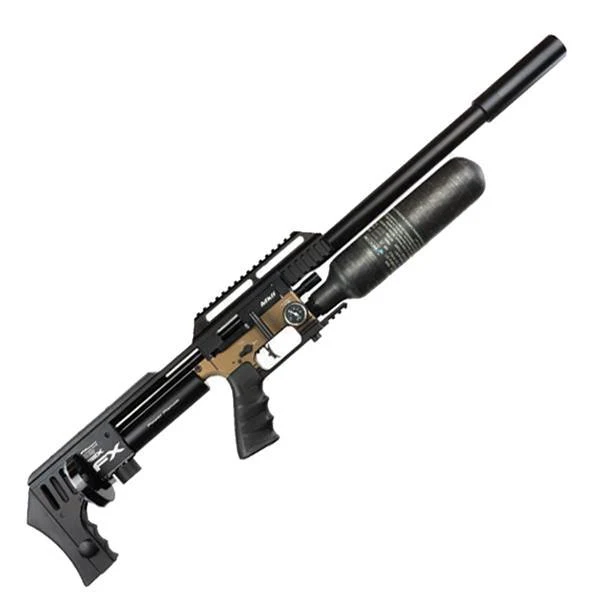
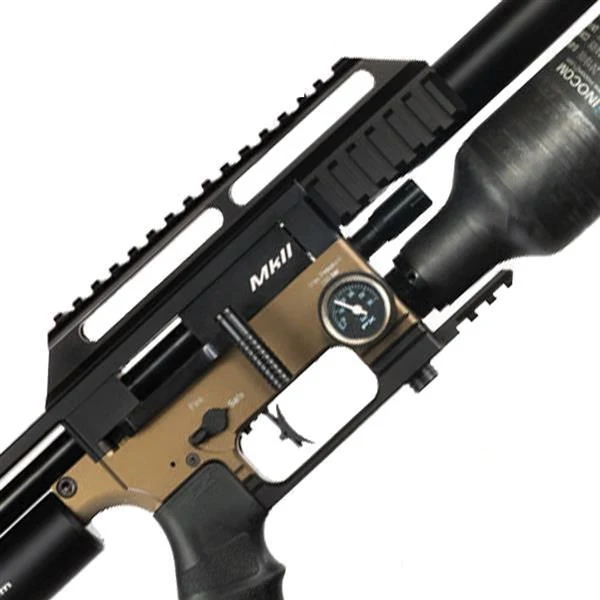
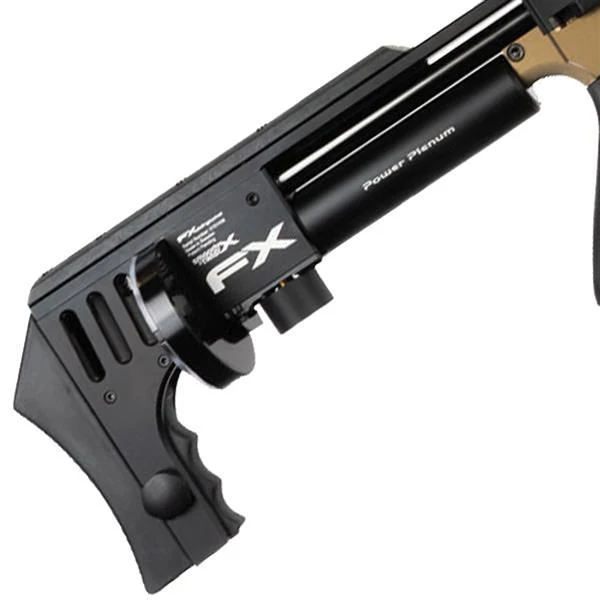
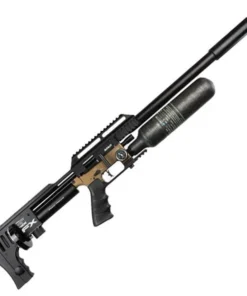
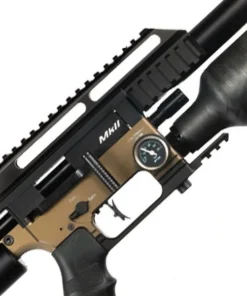
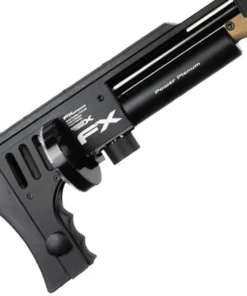
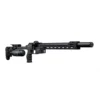
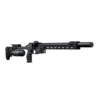
FX Impact MKII Bronze FAC
€1,890.00
THE FX IMPACT MKII
Every so often there are leaps forward in technology that forever change our perception of what is possible. The FX Impact is such a phenomenon and has permanently pushed forward the boundaries of what to expect from an air rifle.
This all-in-one air rifle has been engineered to satisfy the most demanding airgun shooter with high-performance features. The Impact is completely adjustable: air valve control, hammer spring tension, and even regular adjustments can be made externally to allow for various shooting scenarios.
The Impact now incorporates the new FX Smooth Twist X Barrel which is a fully rifled barrel liner. FXs proprietary process of imparting the inner rifling of the barrel from the outside of the steel tubing, is an outstanding upgrade in airgun accuracy. This Smooth Twist X Barrel is housed in the Interchangeable Barrel Liner System allowing the shooter to swap and change barrel liners of various twist rates, bore specifications and more; all to tailor the barrel to different projectile sizes. The breech and barrel assembly also incorporate a quick-change system that allows for any of the four calibers (.177, .22, .25 or .30) to be used. All that is required is an extra barrel and pellet probe for each caliber.
Other notable features of this bullpup include a unique match grade trigger system that does not rely on connection rods or linkages. The smooth side cocking lever is placed perfectly above the trigger to allow for the quickest possible follow-up shot. This high powered and tactical, yet lightweight and compact airgun is a sensational piece of cutting-edge technology. With all these features wrapped into one rifle, the FX Impact will continue to be the benchmark for air rifles worldwide.
- Completely Adjustable
- Features the FX Smooth Twist X Barrel
- High Powered, Compact & Lightweight
| COCKING SYSTEM | Forward positioned sidelever |
|---|---|
| MAGAZINE TYPE | Removable high capacity 38 shot when Cal .177 28 shot when Cal .22 28 shot when Cal .25 23 shot when Cal .30 |
| STOCK | AR15 style grip Tactical rubber grip delivered as standard Adjustable recoilpad (height) |
| CALIBRE | 4,5 (.177)
5,5 (.22) 6,35 (.25) 7,62 (.30) |
| BARREL | FX Smooth Twist X Match grade Free floating Length 500 mm 4.5 (.177) Length 600 mm 5.5 (.22) *500mm if sub 12ft for UK. Length 600 mm 6.35 (.25) Length 600 mm 7.62 (.30) |
| SHOT CAPACITY | 4,5 (.177) 325 shots 18ft/lbs. 670 shots 12ft/lbs 5,5 (.22): 225 shots 30ft/lbs. 640 shots 12ft/lbs 6,35 (.25): 110 shots 47ft/lbs 7,62 (.30): 70 shots 77ft/lbs |
| FILL PRESSURE | Max 250 bar (3600 psi) |
| SAFETY | Switch style |
| OPTICS | Picatinny rail |
| MUZZLE | Built-In Shroud system with additional moderator.(variations may occur depending on country). |
| PRESSURE GAUGE | One for airtube pressure
One for regulator pressure |
| TRIGGER | Adjustable Match Trigger (variations may occur) |
| VELOCITY | 4,5 (.177): 290 m/s 950 ft/s with 8,44 gr pellet 5,5 (.22): 280 m/s 920 ft/s with 16gr pellet 6,35 (.25): 270 m/s 900 ft/s with 25,4gr pellet 7,62 (.30): 265 m/s 870 ft/s with 46,3gr pelletNote: above figures is factory recommended FAC Power output, but can be turned higher/lower if needed. |
| ENERGY | 4,5 (.177): 24 J 18 ft/lbs 5,5 (.22): 41 J 30 ft/lbs 6,35 (.25): 65 J 47 ft/lbs 7,62 (.30): 105 J 77 ft/lbsNote: above figures is factory recommended FAC Power output, but can be turned higher/lower if needed. |
| AIR CAPACITY | Standard480cc Compact 300cc |
| AIR CYLINDER | Carbon fiber tank |
| LENGTH | Depends on barrel |
| WEIGHT | 3,2 kg |
| CHARGING | Foster Quick Disconnect |
| MORE FEATURES | Power adjuster (hammer spring tension), Valve adjuster (valveflow tuning), Interchangeable Caliber System, Multiple Accessory rails (picatinny) sides and bottom, Match Trigger, AMP Regulator Externally Adjustable,Plenum Power Plenum *not available on sub 12ft versions. |
| ACCESSORIES | Ergo tactical grip, deluxe. Barrel Kit (pellet probe and barrel with shroud). 700 mm Barrel Kit (pelletprobe and barrel with fixed shroud). |
FX Impact MKII Bronze FAC – Premium High-Power PCP Air Rifle
The FX Impact MKII Bronze FAC represents an important stage in the evolution of the FX Impact platform, combining distinctive Bronze styling with the modular engineering for which fx airguns became widely recognized. Designed in Sweden, this high-performance air rifle combines a bullpup-inspired configuration, regulated PCP powerplant, adjustable match trigger, high-capacity magazine system, and FX Smooth Twist X barrel technology in one compact platform.
For buyers researching FX Panthera MkII, fx airguns sverige, fx airguns sweden, fxairguns, fx usa, or fx airguns usa, the Impact MKII remains particularly relevant because many of the tuning and modularity concepts associated with modern FX rifles were already central to this generation.
Why Choose the FX Impact MKII Bronze FAC?
A major reason to consider the fx impact MKII is its adjustability. Unlike a basic pellet gun, the rifle was engineered around user-controlled power management. The hammer-spring power wheel, valve-flow adjustment and externally adjustable regulator allow the platform to be configured for different ammunition and approved power requirements.
This tuning-focused philosophy later continued through rifles such as the fx impact m3, f x impact m3, fx m3, fx impact m3 air rifle, fx m3 airgun, fx impact m4, fx m4, and current impact m4 platforms. Searches for impact m4 500mm, impact m4 air rifle, impact m4 ballistic coefficient, or fx impact m4 for sale therefore often come from shooters comparing newer generations with an earlier Impact MKII.
Precision and Barrel Engineering
Precision begins with the FX Smooth Twist X barrel system. The MKII was produced in multiple calibres, including .177, .22, .25 and .30, with barrel configuration varying by calibre and market. This interchangeable approach gives the fx impact air rifle much greater flexibility than many conventional air guns.
The system also explains why enthusiasts researching fx impact m3 .22cal air rifle, fx impact m3 .22cal air rifle. 600mm barrel, fx pellets, fx halo slugs, pcp airguns, pcp air gun, fx pcp, or other high end air rifles frequently encounter the Impact family.
For responsible accuracy testing, an fx chronograph or fx pocket chronograph can be useful for measuring velocity and checking consistency rather than relying solely on advertised figures.
How and Where the FX Impact MKII Performs Best
The MKII is designed primarily for experienced PCP users who value adjustability, precision shooting and configuration flexibility. Its compact architecture, Picatinny optics rail, adjustable recoil pad and ergonomic grip support controlled shooting from stable positions.
Within fx outdoors discussions, it may be compared with the fx wildcat, fx wildcat mk3, fx maverick, fx dreamline, fx dreamline classic, fx crown, fx crown mk2, fx crown mkii, fx crown mkll, fx king, fx panthera, fxpanthera, fx dynamic, fx dynamics, fx leopard, and fx leopard air rifle.
Other modern configurations attracting comparison searches include fx drs, fx drs classic, fx drs pro, fx drs tactical, and fx drs air rifle. These are separate models and should not be confused with the MKII’s specifications.
Swedish Engineering and FAC Performance
The FX Impact MKII Bronze FAC uses a carbon-fibre air bottle, Foster quick-disconnect filling system, dual pressure monitoring for bottle and regulator pressure, an adjustable match trigger, and a forward-positioned sidelever. Maximum fill pressure is commonly specified at 250 bar. FAC output varies according to calibre, barrel configuration, projectile and tuning, so applicable local licensing and power regulations should always be checked.
Whether buyers search fx air rifle, fx air guns, simply fx, air gun, luftgevær, or performance PCP rifles, this model stands out principally for its adjustable architecture rather than a single fixed specification.
Comparison Search Terms: FX and Reximex Platforms
Shoppers comparing competing PCP platforms may also encounter Reximex Lyra K, reximex, reximex airguns, reximex throne gen2, reximex throne gen 2, reximex гр, reximex mito, reximex mitos, reximex rра, reximex lieva, reximex accura pcp air rifle, Reximex Lyra-K PCP air rifle, Reximex Lyra-K airgun, and Reximex Lyra-K review.
Related research terms such as tps to joules calculator, Tps joule calculator, fps to ft Ibs, airgun joules calculator, gunseek, roxy max, and mx rex generally reflect buyers comparing velocity, energy, specifications and different PCP platforms. They should be treated as comparison topics rather than specifications of the FX Impact MKII itself.
Overall, the FX Impact MKII Bronze FAC remains a technically sophisticated PCP platform whose combination of regulated performance, modular calibre architecture, external adjustability and precision-oriented barrel system explains why the Impact family continues to attract serious airgun enthusiasts.
Engineering, Performance, Handling and Real-World Use
Engineering Philosophy and Overall Design
This rifle was developed around a clear engineering philosophy: give the shooter meaningful control over performance while maintaining a compact and highly functional platform. Instead of relying on a fixed factory setup, the design allows several major operating characteristics to be adjusted and refined. That makes it particularly attractive to experienced users who understand how air pressure, projectile weight, barrel configuration, regulator pressure, hammer tension, and airflow interact.
The architecture is compact because the action sits farther rearward than it would on a conventional sporting rifle. As a result, a relatively long barrel can be fitted without producing an unnecessarily long overall package. This balance between barrel length and overall dimensions is one of the strongest practical benefits of the layout.
Another important design advantage is modularity. Rather than treating the rifle as a single fixed configuration, the platform was created so that key components can be replaced, serviced, adjusted, or changed. This approach allows owners to adapt the rifle to different types of target shooting, approved hunting applications, recreational precision shooting, or different projectile choices where local law allows.
The design therefore appeals strongly to shooters who enjoy understanding the mechanical relationship between each component instead of simply loading and firing.
Precision-Focused Construction
Accuracy in a pre-charged pneumatic rifle depends on far more than the barrel alone. Consistent air delivery, stable projectile seating, predictable valve behavior, good trigger control, secure optics mounting, and repeatable handling all contribute to the final point of impact.
The system was engineered to reduce unnecessary variation between shots. The regulated air supply helps ensure that each firing cycle receives a more predictable amount of pressure. When a rifle releases wildly different amounts of air from one shot to the next, velocity can fluctuate considerably. Those fluctuations may eventually translate into vertical dispersion at distance.
A regulated system helps minimize this effect by controlling the pressure delivered to the firing valve. When properly configured, this provides a more stable operating environment for repeated shots.
The barrel system is also central to practical accuracy. A well-designed barrel must guide the projectile consistently while maintaining the correct relationship between bore dimensions, rifling geometry, projectile fit, and muzzle behavior. Even high-quality projectiles can perform poorly when they do not match the barrel correctly.
For this reason, serious users often test multiple projectile weights and designs. One option may produce excellent grouping at moderate range, while another may remain more stable at greater distance. Careful testing helps identify the combination that best suits the individual rifle.
Consistency and Shot-to-Shot Stability
One of the most important qualities in any precision air rifle is consistency.
A powerful first shot is not particularly useful if the second, third, and fourth shots behave differently. Precision shooting depends on repeatability. The rifle must perform in a similar manner each time the trigger is pressed, assuming the shooter maintains consistent technique.
A regulated pneumatic platform attempts to create this repeatability by managing air pressure before each shot. Instead of allowing the firing system to use whatever pressure remains in the main reservoir, the regulator meters air into a secondary chamber at a controlled pressure.
This creates a more stable firing cycle.
However, regulator pressure is only one part of the equation. Valve timing, hammer energy, projectile resistance, transfer-port flow, and barrel length also influence the final velocity. A well-balanced setup brings these elements together rather than simply maximizing one of them.
For example, excessive hammer force can waste air without producing a meaningful increase in performance. Similarly, excessive pressure may produce unnecessary noise or reduce efficiency when the barrel and projectile combination cannot make effective use of it.
Proper setup is therefore about balance rather than maximum numbers.
Trigger Control and Shooter Input
A quality trigger plays a major role in practical accuracy because every shot begins with human input.
When trigger movement is heavy, unpredictable, or inconsistent, the shooter may disturb the rifle just before the projectile leaves the barrel. Even small movements can significantly alter the final impact point, particularly at longer distances.
A refined adjustable trigger helps reduce this disturbance by allowing the release characteristics to be configured more precisely.
Experienced shooters generally benefit from a trigger that breaks predictably and provides enough feedback to maintain safe and deliberate control. The goal is not simply to make the trigger as light as possible. Instead, the objective is to create a consistent release that complements the intended shooting style.
A controlled trigger pull should move smoothly to the break point without forcing the shooter to grip the rifle excessively. This allows the supporting hand and shoulder position to remain stable.
With practice, the shooter can build a repeatable firing sequence that includes breathing control, sight alignment, trigger preparation, release, and follow-through.
Ergonomics and Handling
A high-performance rifle still needs to feel manageable in real-world use.
The compact architecture gives the shooter a relatively short package while retaining useful barrel length. This can make the rifle easier to transport, reposition, and operate from a bench, shooting rest, hide, or other controlled environment.
Weight distribution is also important. A rifle that feels excessively front-heavy can become tiring during extended sessions. Conversely, a design with too much weight concentrated at the rear may feel unstable during unsupported shooting.
This platform places significant mass around the central action and air reservoir area. That arrangement can provide a stable feel when the rifle is properly supported.
The adjustable rear support also helps shooters achieve a comfortable shoulder position. Small changes in rear height and positioning can influence cheek placement, eye alignment, and overall stability.
A consistent shoulder position is especially valuable when using magnified optics because the shooter’s eye must return to the same position behind the scope.
Optics and Sight Setup
Optical setup deserves careful attention on any precision-oriented platform.
A good scope cannot compensate for poor mounting. Rings must be correctly sized, aligned, securely fitted, and tightened to appropriate specifications. Excessive tightening can damage components, while insufficient tightening may allow movement.
The shooter’s eye relief should be established before the final tightening process. This ensures that the full field of view is visible when the rifle is held naturally.
Scope height should also be considered. If the optic is mounted too high, the shooter may struggle to maintain consistent cheek contact. If it is mounted too low, physical interference may prevent proper positioning.
Once the scope is mounted, the rifle should be zeroed using a safe target area and a suitable backstop.
It is generally useful to begin at a shorter range to confirm that the point of impact is reasonably close to the aiming point before moving farther away. This reduces wasted ammunition and makes the adjustment process easier.
After the initial zero, the shooter can confirm performance at multiple distances to better understand trajectory behavior.
Understanding Air Pressure and Filling
The rifle operates using compressed air stored at high pressure.
Because these pressures are substantial, correct filling equipment and safe procedures are essential. Only components designed and rated for the required working pressure should be used.
A compatible hand pump, high-pressure compressor, or diving cylinder may be used depending on the owner’s equipment and local availability. Whatever filling source is selected, the connection should be clean and properly maintained.
Contaminants such as dirt, moisture, or oil should never be allowed to enter the high-pressure system.
The fill process should be controlled rather than rushed. Rapid filling can generate heat, and pressure readings may change as the air cools. Slow, deliberate filling usually provides more predictable results.
Users should also monitor the condition of hoses, seals, fittings, and connectors. Damaged high-pressure equipment should be replaced rather than improvised or temporarily repaired.
Air Efficiency
Efficiency describes how effectively the rifle converts stored compressed air into useful projectile velocity.
A highly efficient setup can provide a useful number of consistent shots without consuming excessive air. Efficiency is affected by several factors, including projectile weight, barrel length, regulator setting, valve opening time, and hammer energy.
When a system is poorly balanced, much of the compressed air may escape after the projectile has already gained most of the acceleration it can use.
This wasted air can increase noise and reduce the number of useful shots available from a fill.
A properly balanced configuration typically uses enough air to achieve the desired performance while avoiding unnecessary waste.
This is one reason why adjustment should be approached methodically. Changing several settings at the same time makes it difficult to understand which change actually influenced the result.
A better approach is to adjust one variable, record the result, and then evaluate whether the change improved consistency, efficiency, or accuracy.
Projectile Selection
Projectile choice has an enormous influence on performance.
Two projectiles with similar weights can behave differently because of differences in diameter, shape, skirt design, head profile, surface finish, or manufacturing tolerance.
Testing is therefore essential.
Shooters should avoid assuming that the heaviest or most expensive projectile will automatically perform best. The correct projectile is the one that produces stable, repeatable groups from the particular barrel and configuration being used.
When testing, it is useful to shoot several groups rather than judging performance based on a single impressive result.
Environmental conditions should also be considered. Wind can influence lightweight projectiles considerably, particularly over longer distances.
At the same time, heavier projectiles may require different power settings to achieve efficient performance.
The best setup therefore depends on the intended shooting distance and application.
Barrel Length and Practical Performance
Barrel length influences the amount of time compressed air can continue accelerating the projectile.
A longer barrel can often make more efficient use of available air, especially at higher performance levels. However, a longer barrel also affects balance, handling, and overall dimensions.
Shorter barrels may provide a more compact feel but can require different tuning to achieve similar energy.
There is no universally perfect barrel length because the ideal configuration depends on how the rifle will be used.
A compact arrangement may be preferable for shooters working in restricted spaces or carrying the rifle frequently. A longer setup may appeal to those prioritizing efficiency and stable performance from a supported position.
This adaptability is one of the reasons the platform remains highly regarded among enthusiasts.
Noise and Muzzle Behavior
Sound level is influenced by several factors, including air pressure, projectile velocity, valve timing, barrel length, and the amount of unused air exiting the muzzle.
A poorly balanced high-power setup may produce more muzzle blast than necessary.
Reducing wasted air can therefore improve both efficiency and sound behavior.
Local laws regarding sound moderators and similar accessories vary considerably. Owners should always verify what is legally permitted in their jurisdiction before fitting any additional muzzle device.
Muzzle behavior can also affect the shooter’s perception of stability. Although a pneumatic rifle produces far less recoil than many firearm systems, internal mechanical movement and rapid air release can still create movement during the firing cycle.
Maintaining consistent grip pressure and follow-through remains important.
Why Follow-Through Matters
Many shooters relax immediately after the trigger breaks.
However, the projectile still requires a brief period to travel through the barrel. Movement during this time can influence the final result.
Follow-through means maintaining the same aiming position immediately after firing. The shooter should continue looking through the optic, maintain shoulder contact, and avoid lifting the head abruptly.
This technique is particularly useful when shooting at longer distances, where small errors become more noticeable.
Good follow-through also helps the shooter observe the point of impact and identify whether poor results came from wind, technique, or equipment setup.
Bench Shooting
The rifle performs particularly well when used from a stable bench or supported rest.
A solid rest reduces unnecessary movement and makes it easier to evaluate the true mechanical accuracy of the system.
However, the rifle should not be clamped rigidly in a way that creates unnatural pressure on the stock, barrel, or air reservoir.
Instead, the front support should provide stability while allowing the rifle to recoil and move naturally.
Rear support can also be useful for fine elevation adjustments.
Bench testing is particularly valuable when comparing different projectile types, regulator settings, or power configurations.
By removing as much shooter movement as possible, the user can more accurately determine which setup produces the most consistent groups.
Field Use and Supported Positions
Outside the bench environment, stability becomes more challenging.
A bipod, shooting sticks, bag, tree support, or other safe rest can dramatically improve accuracy.
The compact architecture makes the rifle relatively convenient when repositioning around supported shooting areas.
However, users should remain aware of the rifle’s total weight once optics, mounts, and accessories have been installed.
A rifle that feels manageable for several minutes may become tiring after extended unsupported use.
Therefore, practical users often develop several supported shooting positions rather than relying entirely on standing shots.
Maintenance and Routine Care
A precision pneumatic rifle benefits from regular inspection and sensible maintenance.
External surfaces should be kept clean and dry. Dust and debris should not be allowed to accumulate around moving parts, fill ports, adjustment controls, or magazine components.
The barrel may require occasional cleaning, particularly when accuracy begins to deteriorate unexpectedly. Excessive cleaning should be avoided because unnecessary mechanical contact can damage sensitive surfaces.
Only suitable cleaning materials should be used.
Seals should also be monitored over time. A slow pressure loss can indicate an O-ring or sealing issue.
When a leak develops, the exact source should be identified before parts are replaced unnecessarily.
High-pressure internal servicing should be performed only by competent persons who understand the system.
Magazine Handling
Correct magazine loading contributes to reliability.
Projectiles should be inserted carefully to avoid deformation. A damaged skirt or misshapen projectile can produce poor accuracy even if the rifle itself is functioning correctly.
The magazine should rotate smoothly and should not require excessive force.
If feeding becomes difficult, the shooter should stop and inspect the magazine rather than forcing the action.
Forcing damaged or incorrectly positioned ammunition may create additional mechanical problems.
Keeping magazines clean also helps maintain smooth feeding.
Temperature and Environmental Conditions
Compressed air systems can respond to changes in temperature.
Pressure may change when the rifle moves from a warm indoor environment into colder outdoor conditions. Similarly, a bottle filled while warm may show a lower pressure once it cools.
These changes are normal consequences of gas behavior.
For precision testing, it is useful to allow the rifle and ammunition to reach the ambient outdoor temperature before making final performance judgments.
Wind, humidity, and changing light conditions can also affect real-world results.
A group fired on a calm morning may look very different from one fired during strong crosswinds.
The shooter should therefore separate equipment performance from environmental influence.
Long-Range Precision Considerations
As distance increases, consistency becomes increasingly important.
Small velocity variations that are barely visible at short range may produce noticeable vertical dispersion farther away.
Wind also becomes a major factor.
The projectile’s shape, velocity, and ballistic efficiency influence how strongly crosswinds affect the point of impact.
For this reason, successful longer-range shooting requires more than raw power.
The shooter must understand trajectory, wind, projectile behavior, and the limitations of the chosen setup.
Accurate distance measurement is equally important. An incorrect range estimate can produce significant vertical error.
Users who shoot across varied distances often rely on a rangefinder and carefully verified ballistic information.
Power Versus Accuracy
More power does not automatically produce better accuracy.
Increasing output can sometimes reduce consistency, efficiency, or projectile stability.
Every barrel and projectile combination has an operating range where performance tends to be most predictable.
The objective should therefore be to find the most accurate and efficient setting appropriate for the intended application rather than simply maximizing velocity.
This is especially important with lightweight ammunition, which may become unstable when driven too fast.
Careful testing almost always provides better results than blindly pursuing the highest reading on a measuring device.
Safety and Responsible Ownership
High-performance pneumatic rifles must be treated with the same seriousness given to other powerful projectile-launching equipment.
The muzzle should always remain pointed in a safe direction.
The rifle should be considered loaded whenever ammunition may be present.
A suitable backstop is essential because projectiles can travel significant distances and retain substantial energy.
Eye protection is advisable during shooting and maintenance.
The rifle should also be stored securely and kept inaccessible to unauthorized users.
Local ownership, power, licensing, hunting, transportation, and storage laws differ by region. Owners are responsible for understanding the requirements that apply where they live and shoot.
Who This Rifle Is Best Suited For
This platform is best suited to shooters who appreciate mechanical adjustability and are prepared to learn how different settings interact.
Someone seeking an extremely simple rifle that requires no experimentation may prefer a more basic fixed-configuration design.
By contrast, experienced users often value the ability to fine-tune performance.
Target shooters can benefit from the predictable trigger and regulated air supply.
Enthusiasts who enjoy testing different ammunition can take advantage of the adaptable barrel and power system.
Users who frequently change shooting applications may also appreciate the modular architecture.
Why Experience Makes a Difference
The rifle offers substantial control, but that control is most valuable when the user understands what each adjustment actually does.
Randomly turning adjustment controls can create an inefficient or inconsistent setup.
Experienced shooters generally work methodically.
They establish a baseline, measure performance, change one parameter, record the result, and then compare.
This disciplined process transforms adjustability from a marketing feature into a practical advantage.
Importance of Recording Settings
Keeping notes is one of the easiest ways to improve setup efficiency.
A simple record can include projectile type, weight, regulator pressure, power setting, fill pressure, average velocity, extreme spread, group size, and weather conditions.
Over time, this creates a useful performance history.
If a previously successful setup is changed, the shooter can quickly return to the earlier configuration.
Documentation also makes troubleshooting easier because changes can be compared rather than guessed.
Final Practical Assessment
The strongest characteristic of this rifle is not one isolated component.
Its real strength comes from the interaction between regulated air delivery, adjustable power, modular construction, quality barrel technology, stable optics mounting, refined trigger control, and a compact overall architecture.
When these systems are configured properly, the rifle can provide excellent consistency and highly repeatable accuracy.
However, the platform rewards careful setup.
Owners who take the time to understand pressure management, projectile selection, trigger technique, barrel behavior, and environmental conditions are more likely to achieve the level of precision the system was designed to deliver.
It should therefore be viewed as a serious precision platform rather than merely a powerful air rifle.
For disciplined users, that distinction matters. The ability to tune, evaluate, refine, and repeat a successful configuration creates a level of flexibility that simpler systems cannot easily match.
That combination of engineering control, modularity, practical handling, and precision potential is what makes the platform especially compelling for experienced shooters seeking a sophisticated pre-charged pneumatic system.
Section 3 – Advanced Accuracy, Tuning Logic, Reliability and Ownership Experience
Advanced Accuracy Begins With System Balance
High-level accuracy is rarely produced by a single component. Instead, it develops when the barrel, regulator, firing valve, hammer system, projectile, trigger, optic, and shooter technique all work together consistently.
A precision-oriented pneumatic rifle can be mechanically capable of extremely tight groups, yet poor setup may prevent the shooter from seeing that potential. This is why experienced owners generally focus first on balance rather than maximum output.
A balanced system delivers enough compressed air to accelerate the projectile efficiently while avoiding excessive turbulence, wasted pressure, and unnecessary mechanical stress. When the pressure setting, hammer energy, and airflow are properly matched, the rifle tends to operate more smoothly and predictably.
This relationship becomes particularly important at longer distances. Small inconsistencies that appear insignificant at short range can become much more noticeable as the projectile travels farther.
For example, a minor velocity spread may have little visible effect at a close target. At greater distance, however, that same variation can cause measurable vertical movement in the group.
Therefore, serious accuracy work should begin with repeatability.
Establishing a Reliable Baseline
Before making adjustments, it is useful to establish a baseline configuration.
This baseline should represent the rifle in a known, stable condition. The shooter should use one projectile type, one consistent fill procedure, a clean and properly mounted optic, and a repeatable shooting position.
Several groups should then be fired under similar conditions.
The goal is not to chase one exceptionally small group. Instead, the shooter should look for patterns.
If five groups produce similar results, that information is far more valuable than a single unusually good group.
The average result provides a realistic indication of current performance.
Once this baseline is known, individual changes can be evaluated properly.
Changing the projectile, pressure, hammer setting, optic position, and shooting rest all at once creates confusion. If accuracy improves or becomes worse, the shooter may not know which change caused the difference.
A disciplined testing process changes one variable at a time.
Understanding Velocity Consistency
Velocity consistency is one of the clearest indicators of how smoothly the firing system is operating.
A chronograph can be used to measure individual shots and calculate an average velocity. It can also reveal the extreme spread between the fastest and slowest shots.
For precision work, a narrow spread is generally desirable because it indicates that the rifle is releasing similar energy from shot to shot.
However, a narrow velocity spread alone does not guarantee excellent accuracy.
A projectile can leave the barrel at very consistent speeds and still group poorly if it does not stabilize correctly or interact well with the barrel.
This is why chronograph data should always be considered alongside actual target results.
The target ultimately determines whether the configuration is useful.
Why Maximum Velocity Is Not Always Better
Many shooters initially assume that faster automatically means better.
In reality, excessive velocity can sometimes reduce precision.
A projectile is designed to operate within a certain aerodynamic range. Driving it too fast may increase instability or produce less predictable behavior.
Additional velocity can also require significantly more air, reducing shot count.
The extra energy may create more noise without delivering a meaningful accuracy advantage.
For these reasons, the most useful performance level is often found below the mechanical maximum.
The goal should be to identify the speed range where the projectile groups consistently and retains enough energy for the intended lawful application.
Once that range is identified, the rifle can be configured to operate efficiently within it.
Matching Projectiles to the Barrel
Projectile testing is one of the most important parts of precision setup.
Even ammunition from the same manufacturer can behave differently across weights and diameters.
Some projectiles fit the bore more tightly. Others may engage the rifling differently.
Small manufacturing variations may also influence consistency.
Testing should therefore involve several suitable options rather than assuming that one popular choice will automatically perform best.
Each projectile type should be tested under the same conditions whenever possible.
Using similar distances, rest positions, fill pressures, and weather conditions makes comparisons more meaningful.
Groups should be large enough to reveal patterns.
A three-shot group may appear excellent simply because of chance. A larger sample provides a clearer picture of actual performance.
Barrel Conditioning and Cleaning
Barrel condition can influence grouping.
Some barrels perform best after a small amount of projectile material has coated the internal surface. Others may begin to lose consistency when too much residue accumulates.
This means cleaning schedules should be based on performance rather than a rigid number of shots.
If accuracy remains excellent, unnecessary cleaning may provide no benefit.
When groups suddenly begin to open without another obvious cause, barrel inspection and careful cleaning may be appropriate.
Cleaning should be performed gently.
Aggressive tools, inappropriate solvents, or excessive force can damage sensitive internal surfaces.
After cleaning, the first several shots may not group exactly like later shots because the barrel is being conditioned again.
This is normal in many precision airgun systems.
The Importance of a Stable Optic
The optic is one of the most common sources of unexplained accuracy problems.
A rifle can be mechanically perfect, yet loose rings or shifting mounts can make it appear inconsistent.
Before changing internal settings, the shooter should confirm that the optical system is secure.
Mounting screws should be checked using appropriate torque rather than excessive force.
The optic itself should also be inspected for internal movement or unreliable adjustment.
If the point of impact shifts repeatedly without a clear pattern, the scope and mounting system should be included in the troubleshooting process.
A reliable optic should maintain zero after normal handling and repeated firing.
Parallax and Precision Shooting
Parallax error can create significant inconsistency during precision work.
When the shooter’s eye is not positioned perfectly behind the optic, the reticle may appear to move across the target even though the rifle has not changed position.
This apparent movement can produce different points of impact.
Scopes with adjustable parallax allow the shooter to reduce this effect at the chosen distance.
The adjustment should be made carefully.
A clear image does not always mean parallax has been completely removed.
The shooter can check by keeping the rifle stationary while moving the eye slightly behind the optic.
If the reticle appears to shift across the target, further adjustment may be required.
Scope Magnification and Practical Accuracy
Higher magnification can help reveal small aiming errors, but it can also exaggerate movement.
At very high magnification, natural body movement can appear dramatic.
This may encourage the shooter to overcorrect constantly.
For many situations, moderate magnification provides a better balance between target detail and visual stability.
Benchrest shooting may benefit from higher magnification because the rifle is heavily supported.
Field shooting often favors lower settings because the target can be acquired more quickly.
The ideal magnification depends on range, target size, stability, and personal preference.
Understanding Point of Impact Changes
A shifting point of impact does not always indicate a mechanical fault.
Temperature, wind, support pressure, shoulder position, optic settings, and ammunition can all influence the result.
Even changing the way the rifle sits on a front bag can move the group slightly.
This is why troubleshooting should be systematic.
If groups remain tight but move together, the issue may be related to zero, mounting, environmental conditions, or position.
If groups become larger and irregular, the problem may involve ammunition, barrel condition, inconsistent air delivery, or shooter technique.
Recognizing the difference saves time.
Regulator Behavior and Performance
The regulator plays an important role in maintaining consistent pressure for each shot.
However, regulators are mechanical components and require correct operating conditions.
If the pressure is set incorrectly for the chosen configuration, efficiency and consistency may suffer.
A regulator should not be treated as an isolated performance control.
Its setting must work together with hammer energy and valve behavior.
If pressure is increased without a corresponding reason, the firing system may struggle to use the available air efficiently.
Likewise, insufficient pressure may limit performance.
The best setting is therefore the one that supports the desired projectile velocity while maintaining reliable shot-to-shot consistency.
Hammer Energy and Valve Timing
The hammer provides the mechanical force needed to open the firing valve.
If the hammer strike is too weak, the valve may not remain open long enough to release sufficient air.
If it is excessively strong, the valve may remain open longer than necessary.
That can waste air.
The goal is to use enough hammer energy to operate the valve efficiently at the selected regulator pressure.
This balance is one of the most important concepts in pneumatic tuning.
Experienced users often identify a point where increasing hammer energy produces little or no meaningful increase in velocity.
That plateau indicates that the system has reached a practical limit under the current settings.
Continuing to increase force beyond that point usually offers little benefit.
Air Consumption and Shot Count
Shot count is influenced heavily by configuration.
Lower-power settings usually consume less air per shot.
Higher output generally requires more air.
Barrel length, projectile weight, regulator pressure, valve timing, and reservoir capacity all contribute to total efficiency.
A shooter who values maximum shot count may choose a moderate setup.
Someone prioritizing higher energy may accept fewer shots between fills.
Neither approach is automatically better.
The correct choice depends on the intended use.
What matters most is consistency throughout the useful portion of the fill.
Identifying the Useful Pressure Range
A rifle does not always perform identically from maximum fill pressure down to nearly empty.
The regulated system is intended to maintain consistent operation across much of the pressure range.
However, once reservoir pressure approaches the regulator setting, performance can begin to change.
Shooters should learn where this change occurs.
Chronograph testing can help identify the point where velocity begins to fall.
Once this pressure level is known, the shooter can refill before reaching it.
This prevents unexpected changes during an important shooting session.
Proper Filling Habits
Consistent filling habits support consistent performance.
The rifle should be filled slowly enough to avoid excessive heat.
The pressure gauge should be observed carefully.
The owner should never exceed the manufacturer-approved pressure rating.
After filling, the system may cool slightly, causing the displayed pressure to settle lower.
This behavior is normal.
If absolute consistency is required for testing, the shooter can allow the rifle to rest briefly after filling before beginning the session.
Using the same procedure each time improves data quality.
Avoiding Contamination
Compressed-air systems should remain clean and dry.
Oil, grease, moisture, dust, and debris can create serious problems inside high-pressure equipment.
Only products specifically approved for the relevant application should be used during maintenance.
Ordinary petroleum-based lubricants should never be introduced into high-pressure air systems unless specifically approved by the manufacturer.
Fill connectors should be kept clean.
Protective caps should be used when available.
The end of a filling hose should never be placed on dirty surfaces where debris can enter the connection.
These small habits contribute significantly to long-term reliability.
Seal Condition and Air Retention
Seals are critical to pneumatic operation.
A small damaged seal can cause gradual pressure loss.
If the rifle loses air while stored, the user should determine whether the pressure loss is normal or excessive.
A minor gauge change caused by temperature is not necessarily a leak.
However, continuous pressure reduction over time may indicate a sealing problem.
Potential leak points may include fill connections, regulator components, valve areas, bottle seals, or other O-rings.
Replacing seals should be done carefully using the correct size and material.
Incorrect seals can fail quickly or cause additional problems.
Reliability Through Preventive Maintenance
Preventive maintenance is generally more effective than waiting for complete failure.
The shooter should periodically inspect external screws, mounting points, air connections, magazine components, and visible seals.
Loose components should be corrected before they create larger problems.
Dust should be removed from moving parts.
The rifle should also be stored in a dry environment.
Long-term exposure to moisture can affect metal surfaces, optics, and accessories.
A good storage routine reduces the likelihood of corrosion or seal deterioration.
Magazine Reliability
A magazine must present each projectile correctly to the breech.
If projectiles are damaged or inserted incorrectly, feeding resistance may increase.
The user should never force the sidelever if unusual resistance is felt.
Instead, the magazine should be removed and inspected.
A damaged projectile can cause poor accuracy or create a blockage.
Keeping spare magazines organized and protected can also reduce handling damage.
Loose magazines placed in pockets with dirt or metal objects may become contaminated.
A small protective case is often useful.
Sidelever Operation
A smooth sidelever is beneficial because it allows the shooter to cycle the rifle without significantly disturbing the shooting position.
The action should move with controlled pressure.
It should not require violent force.
If resistance suddenly increases, the user should stop and investigate.
Possible causes include an incorrectly loaded projectile, magazine alignment issue, debris, or internal mechanical problem.
Forcing the mechanism can turn a minor issue into expensive damage.
Smooth handling also improves shooting rhythm.
Repeating a Consistent Shooting Position
Mechanical precision can only be fully exploited when the shooter uses repeatable technique.
The rifle should contact the shoulder in the same place for each shot.
The cheek should rest consistently against the stock.
Grip pressure should remain similar.
The supporting hand should also remain in the same position.
These details may seem minor, but small changes can alter the way the rifle moves during firing.
A consistent position reduces unexplained variation.
Breathing and Trigger Timing
Breathing naturally causes body movement.
Most precision shooters therefore fire during a brief natural pause in breathing.
The breath should not be held for an excessively long period.
Doing so may create tension.
Instead, the shooter can inhale, exhale naturally, pause briefly, refine the sight picture, and complete the trigger press.
If the shot does not feel correct within a reasonable time, it is often better to relax and restart the process.
Forcing a shot usually produces worse results.
Trigger Technique
The trigger finger should move independently of the rest of the hand.
Excessive gripping can rotate or disturb the rifle.
The finger should generally contact the trigger in a position that allows a straight rearward movement.
The shooter should increase pressure gradually until the shot releases.
Jerking or slapping the trigger is a common cause of unexplained flyers.
Proper trigger control becomes especially important when shooting small targets.
Recognizing Shooter-Induced Errors
One of the most valuable skills in precision shooting is identifying when an error came from the shooter rather than the equipment.
A shooter may sometimes feel the rifle move at the moment the shot breaks.
When that happens, the resulting impact should not automatically be blamed on ammunition or tuning.
Calling shots means predicting where the projectile probably went based on what the shooter observed during firing.
This skill develops with practice.
It helps separate mechanical problems from technique errors.
Reading Groups Correctly
Group shape can provide useful information.
A vertical group may suggest velocity variation, inconsistent elevation control, or distance-related effects.
A horizontal group may indicate wind or inconsistent shoulder pressure.
Random dispersion can have many possible causes, including ammunition variation, optic problems, mechanical instability, or poor technique.
However, group shape should not be treated as absolute proof of one specific problem.
Instead, it should be considered alongside other evidence.
Repeating the test can confirm whether the pattern is genuine.
Environmental Effects
Wind is often the largest external influence on projectile flight.
Even a mild breeze can move a projectile noticeably at distance.
Wind may also vary between the shooter and target.
Flags, grass, leaves, dust, and vegetation can provide visual clues.
Temperature also matters because it can influence air density and reservoir pressure.
Bright sunlight can create changing visual conditions.
Rain may affect comfort, visibility, and equipment handling.
A serious shooter learns to consider the environment before blaming the rifle.
Distance Measurement
Accurate distance information becomes increasingly important as range increases.
A small distance estimation error can change the required hold point.
A rangefinder can provide precise measurement.
Known-distance targets are also valuable during testing because they allow repeatable comparison.
Once the trajectory has been confirmed at several distances, the shooter can build a reliable reference for future use.
This reduces guesswork.
Ballistic Data and Real-World Verification
Ballistic calculators can be useful planning tools.
They can estimate trajectory based on projectile weight, velocity, sight height, ballistic coefficient, and atmospheric conditions.
However, calculated results should always be verified in the real world.
Actual projectile performance may differ from published estimates.
Chronograph data may also vary depending on the rifle.
The most reliable ballistic information is created by combining measured velocity with confirmed target impacts.
Transport and Equipment Protection
A quality rifle should be protected during transport.
A rigid case provides strong physical protection.
A padded soft case may be convenient for shorter trips where impact risk is limited.
The rifle should be unloaded during transport.
Local transport laws should always be followed.
Optics deserve particular attention because heavy impacts can damage internal components or shift zero.
Magazines, filling equipment, tools, and ammunition should also be organized securely.
Good organization prevents small accessories from being lost.
Long-Term Storage
For extended storage, the rifle should be kept in a clean, dry, secure location.
External metal surfaces can be wiped carefully using an appropriate protective product.
The optic should be covered or stored where lenses will not become scratched.
Humidity control can be useful in damp environments.
The rifle should never be stored where unauthorized persons can access it.
High-pressure system storage should follow manufacturer recommendations.
Ownership Experience
A sophisticated precision platform demands more involvement than a simple entry-level rifle.
For some shooters, that involvement is exactly what makes ownership enjoyable.
They can experiment with different configurations, track performance, improve technique, and gradually build a setup suited to their own shooting style.
Others may prefer a rifle that requires fewer decisions.
Understanding this distinction is important before purchase.
The greatest value of an adjustable platform appears when the owner is willing to learn how the system works.
The Value of Methodical Tuning
Methodical tuning prevents frustration.
Instead of making random changes, the shooter should define a clear goal.
For example, the objective may be improved grouping, better air efficiency, smoother operation, or consistency with a specific projectile.
One change can then be made.
Results should be measured.
If performance improves, the setting can be retained.
If it becomes worse, the earlier configuration can be restored.
This process may appear slow, but it usually reaches a successful result much faster than random experimentation.
Building Confidence Through Repeatability
Confidence develops when the shooter knows what the rifle will do.
That confidence comes from repeated evidence.
A rifle that consistently produces similar groups under similar conditions allows the user to trust the equipment.
Once mechanical confidence is established, the shooter can focus more attention on reading conditions and improving personal technique.
This is one of the most satisfying stages of precision shooting.
Final Evaluation of Advanced Performance
A well-designed adjustable pneumatic platform offers a combination of precision, flexibility, efficiency, and control that can satisfy demanding shooters.
Its potential becomes most apparent when the owner approaches setup systematically.
Reliable results come from understanding the interaction between air pressure, valve timing, projectile selection, barrel behavior, optics, environmental conditions, and shooter technique.
Power alone does not define performance.
Neither does one impressive target group.
True performance is demonstrated through repeatability.
When the rifle can return similar results session after session, confidence grows.
When the shooter understands why a particular configuration works, adjustments become easier.
When maintenance is performed correctly, reliability improves.
This combination of mechanical knowledge and disciplined shooting technique allows the platform to deliver the level of performance expected from a serious precision air rifle.
Ultimately, the most rewarding ownership experience comes from learning the system rather than simply chasing specifications.
The rifle provides the mechanical foundation.
Careful testing provides the data.
Consistent technique provides the control.
Responsible maintenance preserves reliability.
When all four elements come together, the result is a highly capable and adaptable precision shooting system.
Be the first to review “FX Impact MKII Bronze FAC”
Related products
FX Air Gun

FX Air Gun

FX Air Gun
FX Air Gun


FX Air Gun
FX Air Gun

FX Air Gun
FX Air Gun
Reviews
There are no reviews yet.