
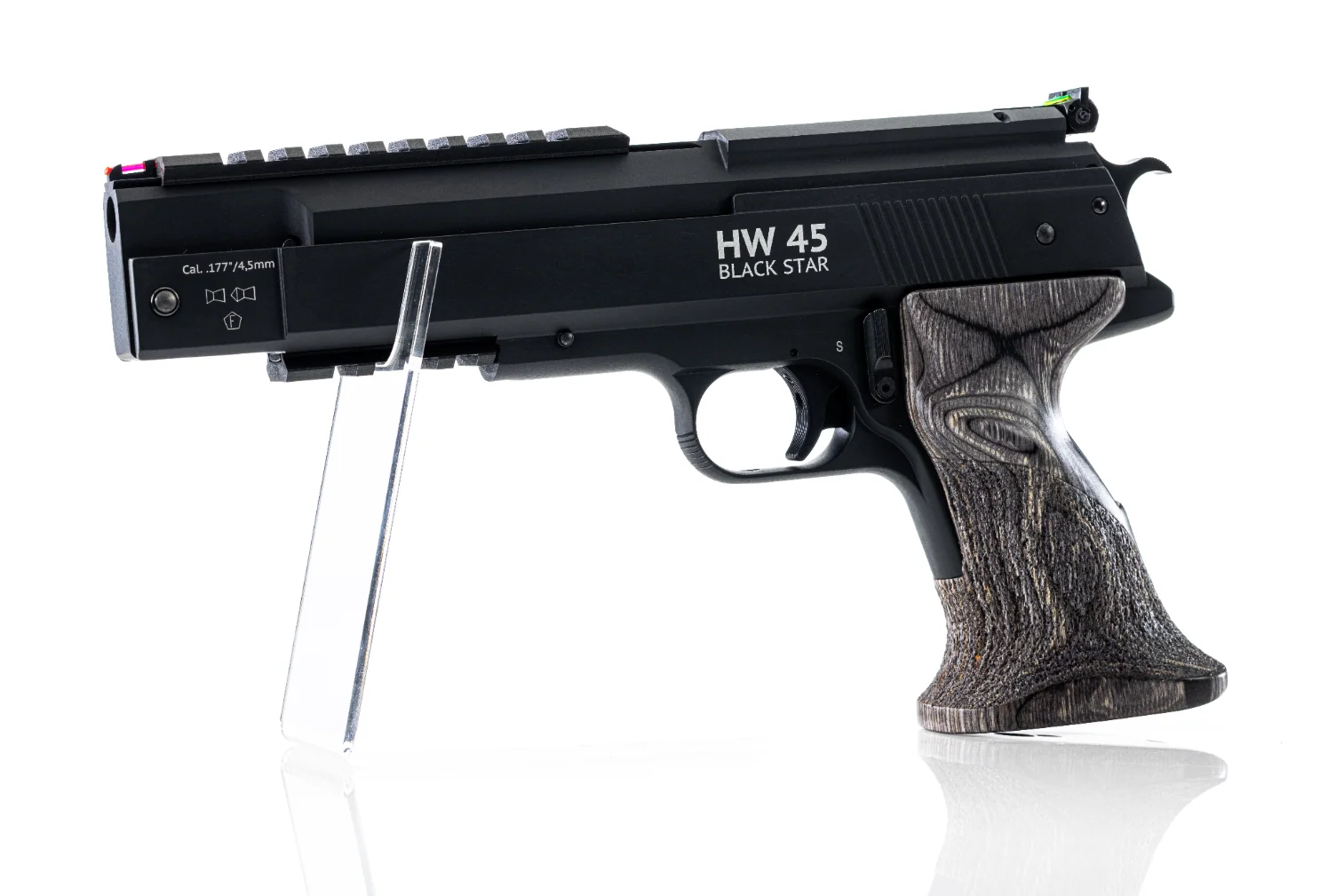

Weihrauch HW45 Black Star Laminate – Air Pistol
€400.00
HW45 Black Star One of the most powerful air pistols.
Its modern and compact design relates to one of the famous service pistols in the world.
Two position cocking stroke for selecting power level Precision adjustable two stage trigger
Fixed front and micrometer rear sight adjustable for windage and elevation ( NEW! Fiber Optic )
Dovetail rail to accept scope
Checkered walnut grips equally suited for right- and left-handed shooters.
Heavy Duty metal construction Mild recoil imitates a small caliber handgun when fired
TRUGLO Available in .22 & .177 Cal
WEIHRAUCH HW45 AIR PISTOL SPECS
CALIBER: .22 Cal (5.5mm) pellet / .177 (4.5mm) Pellet
TRIGGER: 2 stage
CAPACITY: Single Shot ( pellet only )
SYSTEM: Single Stroke Spring Piston
SIGHTS: Fixed Front and adjustable rear sight ( Fiber Optic )
SAFETY: Manual Safety BARREL:
Rifled Barrel BARREL LENGTH : 6.7″ (170mm)
OVERALL LENGTH: 11″ (275mm)
WEIGHT: 2.6lbs
MAX VELOCITY : .22/ 460 fp/s
MUZZLE ENERGY: 6 ft.lb..
Weihrauch HW45 Black Star Laminate Air Pistol – Premium German Spring-Piston Precision
The Weihrauch HW45 Black Star Laminate Air Pistol is a premium single-shot spring-piston pistol designed for shooters who appreciate mechanical engineering, substantial build quality, adjustable sights and deliberate precision shooting.
Unlike a PCP pistol, the HW45 does not require a compressor, bottle or external air source. Its overlever cocking system compresses the internal spring-piston mechanism before each shot, making the pistol completely self-contained.
The Black Star version adds a distinctive black-anodized action and black-grey laminated grip panels, giving the platform a premium appearance while maintaining the familiar mechanical architecture of the HW45.
Current factory information lists approximately 280 mm overall length, a 170 mm barrel, and a weight around 1.16 kg. The pistol is offered in .177, .20 and .22, depending on market availability. It also provides two selectable velocity levels through its cocking system.
The current design uses fiber-optic sights, an adjustable two-stage match trigger, an 11 mm prism rail, a supplied Picatinny adapter and an additional Picatinny mounting rail beneath the barrel.
Weihrauch HW45 Black Star Laminate
The Black Star configuration combines the proven HW45 spring-piston action with premium laminate grips and a dark anodized finish.
Its key qualities include:
Single-shot operation
Overlever cocking
Two selectable power levels
Two-stage adjustable trigger
Fiber-optic sights
Black-grey laminate grip panels
Black anodized finish
11 mm optic rail
Picatinny adapter
Under-barrel Picatinny rail
Spring-Piston Operation
The pistol uses an internal spring and piston to generate power.
Why This System Matters
No external charging equipment is required.
Every shot is mechanically prepared through the cocking cycle.
Overlever Cocking
The upper assembly is used as the cocking lever.
Why Overlever Design Matters
It allows a relatively powerful spring-piston system to be packaged into a compact handgun format.
Two Power Levels
One of the most distinctive features is the availability of two cocking positions.
The first provides a lower output, while the second provides higher performance.
Why Two Levels Matter
The shooter can choose a softer firing cycle for short-range practice or the higher setting where lawful and appropriate.
Single-Shot Loading
One pellet is loaded for each firing cycle.
Why Single-Shot Operation Can Be Useful
It encourages deliberate shooting and allows every pellet to be inspected before use.
Black Anodized Finish
The Black Star uses a dark anodized exterior finish.
Why the Finish Matters
It gives the pistol a distinctive premium appearance while providing a durable surface.
Black-Grey Laminate Grip
The grip panels are made from black-grey laminated material.
Why Laminate Matters
Layered laminate provides a rigid, attractive and dimensionally stable grip material.
Fiber-Optic Sights
The current pistol uses fiber-optic elements in the sighting system.
Why Fiber Optics Help
The bright reference points can be easier to acquire under varying lighting conditions.
Adjustable Rear Sight
The rear sight can be adjusted to refine point of impact.
Why Sight Adjustment Matters
Different pellets and shooting distances can require small corrections.
Two-Stage Adjustable Trigger
The trigger is designed around a two-stage match-style release.
Why Trigger Quality Matters
A predictable release helps the shooter fire without unnecessarily disturbing the sight picture.
11 mm Prism Rail
The current design includes an 11 mm rail for optical accessories.
Why This Matters
A compact optic can be fitted for shooters who prefer an alternative to open sights.
Picatinny Adapter
A Picatinny adapter is included in the updated platform.
Why Mounting Flexibility Matters
Different accessories use different mounting standards.
Under-Barrel Picatinny Rail
The updated design also includes a rail beneath the barrel.
Why This Matters
It expands mounting flexibility while keeping the main sighting rail available.
Approximate 280 mm Overall Length
The pistol measures about 280 mm overall.
Why Compact Dimensions Matter
The size keeps the platform manageable while still providing enough mass and sight radius for controlled shooting.
170 mm Barrel
The barrel measures approximately 170 mm.
Why Barrel Quality Matters
Consistent pellet guidance through the bore is essential for precision.
Approximate 1.16 kg Weight
The pistol is relatively heavy compared with lightweight recreational air pistols.
Why Weight Can Help
Additional mass can steady the sight picture during deliberate target shooting.
Why Weight Can Also Be Demanding
Extended one-handed shooting may produce fatigue.
.177 Caliber
The .177 configuration is particularly suitable for target-oriented shooting.
.20 Caliber
The .20 option provides an intermediate projectile diameter.
Availability may vary by region.
.22 Caliber
The .22 version uses heavier pellets and produces a different firing character.
Precision Potential
The pistol combines several features that support accuracy:
Quality barrel
Adjustable sights
Two-stage trigger
Substantial weight
Rigid action
Deliberate single-shot operation
Why Technique Matters
The pistol is spring powered.
Therefore, internal movement occurs before the pellet leaves the barrel.
A consistent grip and follow-through are important.
Grip Consistency
The pistol should be held in a repeatable manner.
Why Excessive Grip Pressure Can Hurt
Changing hand tension can influence how the pistol moves during the firing cycle.
Trigger Technique
Pressure should be applied smoothly.
Why Jerking the Trigger Hurts Accuracy
Sudden movement can pull the sights away from the intended point of aim.
Follow-Through
The sight picture should be maintained after trigger release.
Why This Matters
Spring-powered pistols reward disciplined technique.
Pellet Selection
Different pellets can perform differently.
Several quality options should be tested.
Why Maximum Velocity Is Not Everything
The fastest pellet is not necessarily the most accurate.
Repeatability matters more.
Where the Pistol Performs Best
The platform is particularly suitable for lawful:
Target shooting
Indoor range practice
Recreational precision shooting
Skill development
Plinking with a safe backstop
When the Lower Power Level Makes Sense
The lower setting can be useful for shorter-distance practice where maximum output is unnecessary.
When the Higher Level Makes Sense
The second setting provides greater performance where legal and appropriate.
Why the Pistol Is Self-Contained
No external charging equipment is required.
The shooter only needs suitable pellets and a safe shooting environment.
Weihrauch HW90
The Weihrauch HW90 is a gas-ram air rifle and belongs to a very different product category.
weihrauch
weihrauch is the German manufacturer responsible for the HW45 family and many established sporting airguns.
weihrauch
The repeated weihrauch phrase refers to the manufacturer generally, although every model should be evaluated according to its own operating system.
hw 30
The hw 30 is a lightweight break-barrel spring rifle rather than an air pistol.
weihrauch hw45
The weihrauch hw45 is the underlying spring-piston pistol platform represented by the Black Star special edition.
weihrauch hw100
The weihrauch hw100 is a multi-shot PCP rifle and operates very differently from the HW45.
weihrauch hw 95
The weihrauch hw 95 is a traditional break-barrel spring rifle.
weihrauch hw44
The weihrauch hw44 is a PCP air pistol.
It requires an external compressed-air source, unlike the self-contained spring-powered HW45.
german air rifle
The phrase german air rifle normally refers to shoulder-fired airguns made in Germany.
The HW45 is instead a German-manufactured air pistol.
air rifles
air rifles use shoulder stocks and longer rifle-format actions.
This product belongs to the handgun category.
weihrauch hw95 hw100 airgun air pistols
The phrase weihrauch hw95 hw100 airgun air pistols combines spring rifles, PCP rifles and pistols.
The HW45 should be distinguished as a spring-piston air pistol.
hw100 airgun
The hw100 airgun is a regulated, magazine-fed PCP rifle.
It should not be confused with this single-shot spring-powered pistol.
air pistols
air pistols are compact handgun-format air-powered platforms.
They may use spring-piston, pneumatic or CO₂ operation.
rifles de aire
rifles de aire means air rifles in Spanish.
The HW45 Black Star is instead an air pistol.
hw50
The hw50 is a conventional spring-powered break-barrel rifle.
what are air pistols
For what are air pistols, they are handgun-style air-powered platforms designed for applications such as target shooting, training and recreational use.
weihrauch hw50
The weihrauch hw50 is a shoulder-fired spring rifle rather than a pistol.
sk x rifles
The phrase sk x rifles does not describe this pistol or any confirmed HW45 specification.
air shot gun
An air shot gun belongs to a different category of air-powered equipment.
The HW45 fires pellets through a rifled barrel.
air rifle makes
Among established air rifle makes, Weihrauch is also well known for premium air pistols.
weihrauch hw97k
The weihrauch hw97k is a fixed-barrel underlever spring rifle.
compressed air rifles
compressed air rifles usually refers to PCP rifles with onboard reservoirs.
The HW45 does not use a refillable air cylinder.
hw97
The hw97 belongs to the underlever spring-rifle category.
weihrauch hw50s
The weihrauch hw50s is a break-barrel spring rifle.
weihrauch englisch
The phrase weihrauch englisch is often used when searching for English-language Weihrauch product information.
hw50 s
The hw50 s is another way of writing the HW50S designation.
hw35 air rifle
The hw35 air rifle is one of Weihrauch’s classic break-barrel platforms.
hw 97k
The hw 97k uses an underlever rifle action rather than overlever pistol cocking.
weihrauch hw80
The weihrauch hw80 is a large break-barrel spring rifle.
weihrauch hw30
The weihrauch hw30 is a lightweight spring-powered rifle.
hw35e for sale
A search for hw35e for sale relates to a different rifle model.
hw97k
The hw97k is a precision spring rifle rather than an air pistol.
accurate air rifles
accurate air rifles depend on barrel quality, good ammunition, reliable sights and correct technique.
The same basic principles also apply to precision air pistols.
hw35
The hw35 is a traditional break-barrel rifle.
weihrauch revolvers
weihrauch revolvers are separate handgun products and do not share the same spring-piston architecture.
hw 50
The hw 50 belongs to the break-barrel rifle range.
hw 100 bullpup
The hw 100 bullpup refers to a compact PCP rifle layout.
It is unrelated to the overlever pistol mechanism.
hw75
The hw75 is another precision air pistol but uses a different pneumatic operating system.
hw95
The hw95 is a spring-powered break-barrel rifle.
weirauch
weirauch is a common misspelling of Weihrauch.
weihrauch hw30s
The weihrauch hw30s is a lightweight spring-powered rifle.
hw50s
The hw50s is another sporting break-barrel model.
Weihrauch HW90 air rifle
The Weihrauch HW90 air rifle uses gas-ram power.
HW90 gas ram air rifle
The HW90 gas ram air rifle stores its firing energy in a sealed gas ram rather than a coil spring.
Weihrauch gas ram rifle
A Weihrauch gas ram rifle normally refers to the HW90 family.
Weihrauch pellet gun
A Weihrauch pellet gun can refer broadly to the company’s rifles and pistols.
The HW45 Black Star represents one of the company’s premium spring-powered handgun platforms.
CARABINA HATSAN PCP BT65 SB ELITE
The CARABINA HATSAN PCP BT65 SB ELITE is a PCP rifle made by Hatsan.
Its compressed-air system should not be confused with the self-contained spring system of the HW45.
hatsan air rifle
A hatsan air rifle belongs to another manufacturer’s range.
hatsan sortie
The hatsan sortie is a semi-automatic PCP pistol.
hatsan velox
The hatsan velox is another pneumatic pistol design.
hatsan jet 2
The hatsan jet 2 is a compact PCP pistol/carbine platform.
hatsan model 95
The hatsan model 95 is a break-barrel air rifle.
hatsan flash
The hatsan flash is a PCP rifle that requires compressed-air filling.
hatsanusa
hatsanusa refers to Hatsan’s U.S. distribution operation.
hatsan usa
hatsan usa is another search variation referring to the same company’s American-market presence.
hatsan harpoon
The hatsan harpoon belongs to a separate specialized pneumatic platform.
hatsan mod 95
The hatsan mod 95 is another common term for the Hatsan Model 95.
hatsan sortie tact
The hatsan sortie tact is a semi-automatic pneumatic pistol.
hatsan hercules
The hatsan hercules belongs to a large-capacity PCP rifle family.
hatsan
hatsan is a Turkish manufacturer with its own rifle and pistol lineup.
Snowpeak PP750L PCP Air Pistol
The Snowpeak PP750L PCP Air Pistol is a compressed-air pistol/carbine platform.
Unlike the HW45, it requires high-pressure filling equipment.
snowpeak airguns
snowpeak airguns includes many spring and PCP products from another manufacturer.
snowpeak sports
snowpeak sports is associated with the Snowpeak airgun range.
snowpeak ap900
The snowpeak ap900 belongs to a separate product family.
snowpeak max
snowpeak max refers to Snowpeak products rather than this German pistol.
snowpeak pp750
The snowpeak pp750 is a PCP pistol.
pp750
The pp750 uses compressed air and has a completely different firing system.
snowpeak p35x
The snowpeak p35x is a bullpup PCP rifle.
pr900 gen 3
The pr900 gen 3 is a PCP rifle with its own cylinder and magazine system.
snow peak pp750
The snow peak pp750 is another spelling variation for the compact pneumatic pistol platform.
snowpeak p35
The snowpeak p35 belongs to the bullpup PCP category.
snowpeak m60b
The snowpeak m60b belongs to another pneumatic rifle family.
Why the Two-Power System Matters
The selectable power system gives the pistol unusual flexibility.
The lower stage can provide a softer firing cycle for controlled practice.
The higher stage provides greater performance where legally permitted.
Why the Overlever Mechanism Matters
The overlever arrangement allows the spring-piston system to remain compact.
It also gives the pistol its distinctive mechanical feel.
Why the Black Star Finish Matters
The black anodized appearance makes this version visually different from the standard and Silver Star variants.
It also pairs naturally with the black-grey laminate grips.
Why Laminate Grips Matter
The grip panels offer a premium feel while remaining rigid and stable.
They also contribute strongly to the visual identity of the Black Star.
Why the Trigger Matters
A good trigger is particularly important on a handgun because the shooter has fewer contact points than with a rifle.
A predictable two-stage release helps reduce unwanted movement.
Why Fiber-Optic Sights Matter
The bright sight elements provide a clear visual reference.
This can make the sights easier to acquire quickly.
Why the Updated Rail System Matters
The updated 11 mm rail and Picatinny options increase accessory compatibility.
Shooters who prefer compact optical sights have more flexibility than on older configurations.
Why Weight Helps Precision
The pistol’s substantial mass can help steady the sight picture.
However, the shooter should avoid excessive fatigue.
Why Grip Technique Matters
Spring-powered pistols can be sensitive to grip pressure.
A consistent hold is therefore essential.
Why Follow-Through Matters
The internal spring and piston are still moving during the firing sequence.
Maintaining the sight picture helps prevent unnecessary disturbance.
Scope and Optic Selection
Any optic fitted should be suitable for the pistol and securely mounted.
The accessory should not interfere with safe cocking or handling.
Pellet Selection
Several quality pellet types should be tested.
The best choice is the pellet that produces repeatable groups rather than simply the highest velocity.
Target Practice
The pistol is particularly rewarding when used for deliberate paper-target shooting.
Its single-shot design encourages careful shot preparation.
Recreational Shooting
It can also be enjoyable for informal plinking where a proper pellet trap and safe backstop are available.
Indoor Use
Indoor range use can remove wind from the accuracy equation.
This makes technique and ammunition differences easier to evaluate.
Outdoor Use
Wind and changing light can introduce additional variables.
Routine Maintenance
Normal care should include:
Checking sight screws
Checking grip screws
Protecting the barrel
Keeping external metal surfaces clean
Monitoring trigger feel
Keeping the cocking mechanism clean
Lubrication
Only suitable airgun lubricants should be used.
Excessive oil should be avoided.
Why Excess Lubrication Is Unhelpful
Oil inside a spring-piston compression system can ignite under pressure and create inconsistent firing behavior.
Storage
The pistol should be stored unloaded and uncocked.
It should also be secured against unauthorized access.
Why It Should Not Be Stored Cocked
There is no benefit in leaving the spring compressed between sessions.
Legal Considerations
Air-pistol laws, energy limits, age requirements, transport rules and permitted places of use vary by jurisdiction.
The exact legal requirements should always be checked locally.
Why This Pistol Offers Premium Value
Its appeal comes from the combination of:
German manufacturing
Spring-piston independence
Two selectable power levels
Premium laminate grips
Black anodized finish
Adjustable match trigger
Fiber-optic sights
Updated optic mounting system
Substantial build quality
Who May Appreciate This Pistol Most
It may particularly suit shooters who value:
Mechanical independence
Single-shot precision
Premium construction
Traditional spring-powered operation
Adjustable sights
Distinctive laminate styling
Who May Prefer a PCP Pistol
A PCP platform may suit someone who prioritizes:
Very low firing disturbance
Multi-shot capability
Reduced cocking effort
Who May Prefer a Lightweight Pistol
A lighter platform may suit someone who intends to shoot extensively one-handed.
Final Section 1 Assessment
The Weihrauch HW45 Black Star Laminate Air Pistol combines the classic HW45 overlever spring-piston architecture with one of the most distinctive finishes in the range.
Current Weihrauch information confirms a black-anodized action, black-grey laminated grip, fiber-optic sights and spring-piston operating system. All current HW45 variants use a two-stage adjustable trigger and two selectable velocity levels. The factory lists approximately 280 mm overall length, 170 mm barrel length and about 1.16 kg weight for the special-edition format.
The current HW45 family has also received an important mounting update. Weihrauch now provides a parallel 11 mm prism rail, included Picatinny adapter and an additional Picatinny rail beneath the barrel, increasing accessory flexibility.
Its greatest practical advantage is mechanical independence.
No compressor is needed.
No high-pressure cylinder is required.
No charging hose or external air bottle needs to be transported.
The pistol is cocked mechanically, loaded with one pellet and fired using its self-contained spring-piston system.
Precision depends heavily on technique because internal movement occurs during firing.
For that reason, a repeatable grip, smooth trigger release and careful follow-through are especially important.
The substantial weight can help stabilize the sight picture, while the adjustable rear sight and fiber-optic elements support deliberate target work.
The laminate grip adds both visual appeal and rigidity, while the black finish gives the Black Star its distinctive identity.
For shooters who want a premium German air pistol with traditional spring-powered operation, two selectable power levels, refined sights and a high-quality trigger, the Black Star remains a distinctive choice.
Used with suitable pellets, a proper backstop, appropriate eye protection and full compliance with local laws, it provides a highly engaging platform for recreational and precision-oriented air-pistol shooting.
Real-World Handling, Spring-Piston Performance, Precision, Ergonomics, Maintenance and Ownership
Overall Character of the Pistol
The Weihrauch HW45 Black Star Laminate is a substantial spring-piston air pistol designed for deliberate shooting rather than rapid-fire use.
Its operating system gives it a unique character.
Unlike a PCP pistol, it does not rely on an external reservoir, pump or charging cylinder.
Instead, the shooter prepares every shot mechanically through the overlever cocking system.
That makes the pistol fully self-contained.
The firing cycle is also very different from that of a pneumatic pistol because the internal piston and spring move during discharge.
As a result, technique matters significantly.
Grip pressure, trigger release, wrist position and follow-through all influence how consistently the pistol performs.
For shooters who enjoy mechanical involvement and want a platform that rewards careful technique, this type of design can be very satisfying.
Why the Weight Matters
The pistol is relatively heavy for a handgun-format airgun.
That mass can be helpful during deliberate target shooting.
Why Extra Mass Can Improve Stability
A heavier platform tends to move less abruptly than an extremely light one.
This can make the sight picture feel steadier.
Why Weight Can Also Be Demanding
Extended one-handed shooting may cause fatigue.
Managing Fatigue
Shorter, focused practice sessions are often more productive than long sessions performed with tired arms.
Two-Handed Shooting
A supported two-handed stance can reduce fatigue.
Why This Helps
More muscle groups share the load.
One-Handed Shooting
Traditional one-handed pistol shooting can still be used.
Why It Is More Demanding
The shooter must stabilize the full mass with one arm.
Balance
Balance is just as important as total weight.
Why Balance Matters
A well-balanced pistol can feel more manageable even when it is relatively heavy.
Laminate Grip
The grip panels provide a firm and substantial contact surface.
Why Grip Shape Matters
The hand should return to the same position for each shot.
Black-Grey Laminate Construction
The layered grip material gives the pistol a distinctive premium appearance.
Why Laminate Is Practical
It is dimensionally stable and less likely to change shape than many untreated natural materials.
Grip Pressure
A consistent grip is important.
Why Excessive Grip Pressure Can Hurt Accuracy
Strong muscular tension can cause the pistol to move unpredictably during the firing cycle.
Why a Repeatable Grip Is Better
Consistency matters more than force.
Wrist Position
The wrist should remain stable.
Why Wrist Angle Matters
A changing wrist angle changes sight alignment.
Support-Hand Position
If a two-handed grip is used, the support hand should also return to the same location.
Why This Matters
Different support pressure can change the way the pistol reacts.
Overlever Cocking
The upper assembly acts as the cocking lever.
Why This Design Matters
It allows the internal spring-piston system to be compressed while keeping the overall pistol compact.
Cocking Effort
The action requires deliberate effort.
Why Good Technique Matters
Correct body position can make cocking easier and safer.
Controlled Cocking
The lever should be operated smoothly.
Why Rushing Is Unhelpful
Fast or careless movement can reduce control.
Two Selectable Power Levels
The pistol can be cocked to one of two positions.
Why This Adds Flexibility
The lower setting can provide a softer firing cycle.
The higher setting can provide greater performance where lawful.
Lower Setting
The lower power position can be useful for shorter distances and relaxed target practice.
Why It Can Improve Comfort
The firing cycle may feel milder.
Higher Setting
The second position provides more energy.
Why More Power Is Not Always Better
Higher output does not automatically produce better accuracy.
Choose the Setting to Suit the Session
The best option depends on distance, target type and applicable law.
Single-Shot Operation
Only one pellet is loaded for each firing cycle.
Why Single-Shot Design Can Be Valuable
The shooter is encouraged to slow down.
Deliberate Rhythm
Each shot becomes a sequence:
Cock
Load
Settle
Aim
Fire
Follow through
Why This Can Improve Technique
There is less temptation to rush.
Pellet Inspection
Every pellet can be examined before loading.
Why This Helps
Damaged ammunition can be rejected.
Barrel Loading
The pellet should be inserted carefully.
Why Deformation Matters
Bent skirts or damaged heads can reduce consistency.
Trigger System
The adjustable two-stage trigger is one of the most important precision features.
Why Two Stages Help
The first stage provides preparation.
The second stage provides a defined release.
Trigger Finger Placement
Use the same portion of the finger each time.
Why Finger Position Matters
Too much or too little finger can move the pistol sideways.
Smooth Trigger Pressure
Pressure should increase gradually.
Why Jerking Hurts Accuracy
A sudden pull can disturb the sights.
Trigger Adjustment
Adjustment should remain within approved limits.
Why Extremely Light Is Not Necessarily Better
A predictable trigger is more useful than one set dangerously light.
Trigger Consistency
The release should feel the same from session to session.
Why Changes Need Attention
Unexpected creep or a changing break can indicate the need for inspection.
Open Sights
The fiber-optic sights provide a clear aiming reference.
Why Bright Elements Help
They can be easier to see under varying light conditions.
Front-Sight Focus
The shooter should focus carefully on sight alignment.
Why Sight Alignment Matters
Small errors are magnified at distance.
Rear-Sight Adjustment
The rear sight can be adjusted.
Why This Matters
Different pellets or distances may require small corrections.
Zeroing
Adjust the sights under stable conditions.
Why One Group Is Not Enough
A single group can be misleading.
Confirm With Several Groups
Repeated results provide better evidence.
Optic Mounting
The pistol can also accommodate compatible optics.
Why Mounting Flexibility Matters
Some shooters prefer a compact red-dot or scope.
Optic Weight
Any mounted accessory adds mass.
Why This Matters
The pistol is already substantial.
Keep the Setup Balanced
A large optic can make the platform top-heavy.
Rail Security
Mounts should remain tight.
Why Loose Hardware Causes Problems
A moving optic can create unexplained point-of-impact shifts.
Spring-Piston Recoil
The firing cycle produces movement in more than one direction.
Why This Is Different From PCP Recoil
The internal piston accelerates and then stops abruptly.
Why Optic Durability Matters
Any optic used should be suitable for the recoil characteristics of a spring-piston airgun.
Follow-Through
The shooter should maintain the sight picture after trigger release.
Why This Is Especially Important
The pellet leaves the barrel after the firing cycle has already begun.
Grip Consistency
The same hold should be repeated for every shot.
Why a Changing Grip Changes Results
The pistol can react differently under different hand pressure.
Breathing Control
Use a calm breathing rhythm.
Why Holding the Breath Too Long Is Unhelpful
It increases muscle tension and movement.
Natural Pause
A brief natural pause can help steady the sight picture.
Sight Picture
The same visual relationship should be maintained shot after shot.
Why This Matters
Consistency is the basis of precision.
Pellet Selection
A quality barrel still needs suitable ammunition.
Why Different Pellets Behave Differently
Pellets vary in:
Weight
Head size
Skirt profile
Manufacturing consistency
Test Several Options
Compare them under the same conditions.
Keep Constant
Distance
Power setting
Grip
Sight setup
Why This Makes Testing Better
The pellet becomes the main changing variable.
Pellet Weight
Different weights can change point of impact.
Why Heavier Is Not Automatically Better
The best pellet is the one that groups consistently.
Why Faster Is Not Automatically Better
Maximum speed does not guarantee precision.
Pellet Condition
Inspect each pellet.
Reject Pellets With
Bent skirts
Dented heads
Visible contamination
Why Damaged Pellets Matter
They may not engage the rifling consistently.
Pellet Storage
Keep ammunition dry and clean.
Why This Supports Reliability
Dust can affect both loading and barrel condition.
Barrel Condition
The barrel should remain protected.
Why Bore Condition Matters
The pellet depends on the bore for guidance.
Cleaning Frequency
Clean only when performance suggests a need.
Why Overcleaning Can Be Harmful
Aggressive cleaning can damage the bore.
Use Suitable Tools
Only appropriate airgun-cleaning equipment should be used.
Muzzle Protection
The front of the barrel should be protected from impact.
Why This Matters
Damage can influence pellet exit.
Indoor Target Use
The pistol is well suited to controlled indoor target work where permitted.
Why Indoor Conditions Help
Wind is removed from the accuracy equation.
Outdoor Target Use
Outdoor shooting introduces additional variables.
Wind
Pellets can drift noticeably.
Why Wind Can Mislead
A poor group may be caused by conditions rather than the pistol.
Lighting Conditions
Different light can affect sight perception.
Why Fiber Optics Can Help
Bright sight elements may remain easier to acquire.
Target Distance
Distance should match the power level and shooting purpose.
Why Consistent Distance Matters
Performance is easier to compare.
Paper-Target Practice
Paper targets are useful for measuring group size.
Why Measured Groups Help
They provide objective feedback.
Plinking
Informal target shooting can also be enjoyable.
Why a Safe Backstop Is Essential
Every pellet needs to be contained.
Hard Surfaces
Avoid unsuitable metal, stone or concrete surfaces.
Why Ricochets Are Dangerous
Pellets can rebound unpredictably.
Eye Protection
Protective eyewear is recommended.
Why This Matters
Fragments can occur.
External Cleaning
Wipe the pistol after use.
Why Fingerprints Matter
Skin oils can remain on metal surfaces.
Black Anodized Finish
The dark finish is durable but should still be cared for.
Why Gentle Cleaning Is Better
Harsh chemicals are unnecessary.
Laminate Grip Care
The grip panels should be kept clean and dry.
Why This Helps
The finish remains attractive and secure.
Grip Screws
Grip hardware should be checked periodically.
Why Loose Grip Panels Matter
Movement can affect comfort and handling.
Cocking Mechanism
The overlever should operate smoothly.
Why Feel Matters
The owner becomes familiar with normal resistance.
Warning Signs
Grinding
Unexpected stiffness
Irregular movement
Why These Changes Need Attention
They may indicate wear or contamination.
Avoid Forcing the Mechanism
Unexpected resistance should be investigated.
Why Force Can Cause Damage
Excessive pressure can stress parts.
Internal Lubrication
Only suitable products should be used.
Why Too Much Oil Is Harmful
Excess lubricant can migrate into the compression chamber.
Dieseling
Oil can ignite under compression.
Why Dieseling Is Undesirable
It can create inconsistent velocity and harsh firing behavior.
Avoid General-Purpose Oils Internally
Not every lubricant is suitable.
Trigger Maintenance
The trigger should remain clean and predictable.
Why Internal Trigger Work Requires Care
It is a safety-critical mechanism.
Major Internal Service
Deep mechanical work should be handled by someone familiar with the platform.
Why Specialist Experience Matters
Spring systems store significant mechanical energy.
Storage
The pistol should be stored unloaded and uncocked.
Why It Should Not Be Stored Cocked
There is no benefit in keeping the spring compressed.
Dry Environment
The storage area should be reasonably dry.
Avoid
Wet cases
High humidity
Extreme heat
Chemical fumes
Why Moisture Matters
It can affect both metal and grip hardware.
Protective Case
A padded case can protect the pistol.
Why a Wet Case Is a Problem
Foam can trap moisture.
Long-Term Storage
Before extended storage:
Unload the pistol
Confirm it is uncocked
Wipe metal surfaces
Inspect the sights
Store securely
Why Periodic Inspection Helps
Small issues can develop even while the pistol is unused.
Return to Use After Storage
Check:
Cocking movement
Trigger feel
Sight security
Grip screws
Barrel condition
Why the First Session Should Be Controlled
It allows normal function to be confirmed gradually.
Pre-Shooting Inspection
Before each session:
Check the sights
Inspect the grip
Confirm the bore is clear
Check trigger feel
Confirm the backstop
Why Routine Inspection Helps
Simple problems can be identified early.
During the Session
Monitor:
Cocking feel
Firing sound
Sight position
Trigger behavior
Why Sudden Changes Matter
They may indicate a developing issue.
Post-Shooting Routine
After use:
Confirm unloaded condition
Confirm the pistol is uncocked
Wipe the exterior
Inspect the grip
Store securely
Why Routine Care Works
Small habits help prevent neglect.
Accuracy Troubleshooting
Start with the simplest possible causes.
Check
Pellets
Sights
Optic mounts
Grip technique
Power setting
Why This Order Makes Sense
External variables are easier to correct.
Poor Groups
One bad target does not necessarily indicate a mechanical problem.
Why Several Groups Matter
Repeated behavior is more meaningful.
Pellet Troubleshooting
Return to a known good pellet.
Why This Helps
It removes one major variable.
Sight Troubleshooting
Check for loose screws.
Why Sight Movement Matters
Even slight movement can shift point of impact.
Grip Troubleshooting
Use a repeatable hold.
Why Technique Can Mimic Mechanical Problems
Spring-piston pistols are sensitive to inconsistent hand pressure.
Power-Level Consistency
Use the same cocking position during a test.
Why This Matters
Mixing the two settings makes comparison difficult.
Firing Sound
The pistol should develop a familiar normal sound.
Why Sound Can Be Useful
A sudden change may indicate a mechanical issue.
Cocking Resistance
The action should feel consistent.
Why Changes Matter
Unexpected stiffness or looseness deserves inspection.
Used-Pistol Evaluation
A second-hand example should be inspected carefully.
Check the Finish
Look for:
Corrosion
Deep scratches
Poor repair work
Check the Grip
Inspect for:
Cracks
Loose panels
Damaged screws
Check the Cocking System
The lever should move smoothly.
Why This Is Important
Roughness can indicate wear.
Check the Trigger
The trigger should feel predictable.
Why Extremely Light Is Not Automatically Better
Safety and consistency matter more.
Check the Sights
Confirm they remain secure.
Check the Barrel
Inspect the bore condition where possible and look for obvious damage.
Ask About Service History
Useful questions include:
Has the spring been replaced?
Has the piston seal been replaced?
Has the trigger been altered?
Has the pistol been modified?
Why Modification History Matters
Unapproved changes can affect:
Safety
Reliability
Legality
Chronograph Testing
Where lawful, velocity testing can help assess consistency.
Why Several Shots Matter
A pattern is more useful than one reading.
Cosmetic Condition
Minor finish wear may not affect function.
Why Mechanical Condition Matters More
Cocking, trigger behavior and barrel condition are more important.
Included Accessories
A package may include:
Case
Optic
Mounts
Pellets
Why Accessories Need Separate Evaluation
An included optic may not be suitable for spring-piston recoil.
Replacement Parts
Use components intended for the exact platform.
Why Exact Fit Matters
Small dimensional differences can affect reliability.
Service Documentation
Keep records of major work.
Useful Entries
Spring replacement
Seal replacement
Trigger service
Sight replacement
Why Records Add Value
They help with future maintenance and resale.
Long-Term Ownership Cost
Typical expenses can include:
Pellets
Cleaning supplies
Optics
Mounts
Occasional servicing
Why Ownership Can Remain Simple
There is no need for external high-pressure filling equipment.
No Compressor
A compressor is unnecessary.
No Charging Bottle
A high-pressure bottle is unnecessary.
No Pump
A hand pump is unnecessary.
Why Mechanical Independence Matters
The pistol can be used without arranging an external air source.
Transport
The pistol should be unloaded and securely cased where required.
Why a Protective Case Helps
It protects:
Sights
Grip
Barrel
Finish
Avoid Rough Handling
Impacts can damage the sighting system.
Legal Compliance
Air-pistol laws vary significantly by location.
Possible Requirements
Power restrictions
Age limits
Licensing
Transport rules
Storage rules
Why Exact Local Rules Matter
Pistol classifications can differ from rifle classifications.
Responsible Storage
Unauthorized access should be prevented.
Why This Is Important
Air pistols can cause serious injury.
Responsible Use
Only shoot where a safe backstop is available.
Why Property Boundaries Matter
A missed pellet must still be contained safely.
Range Discipline
Follow all local procedures.
Why Routine Safety Matters
Experience does not eliminate risk.
Precision Baseline
Establish normal group performance.
Why This Helps
Future changes become easier to recognize.
Keep the Same Pellet
Use a known pellet for comparison.
Why This Matters
Changing ammunition constantly makes troubleshooting harder.
Keep the Same Power Setting
Use one setting when evaluating accuracy.
Why This Helps
The firing cycle remains comparable.
Keep the Same Grip
Use a repeatable hand position.
Why This Matters
Technique strongly influences spring-piston pistol performance.
Long-Term Reliability Strategy
Reliable ownership depends on simple habits.
Keep the Mechanism Clean
Reduce unnecessary wear.
Protect the Barrel
Maintain precision.
Keep the Sights Secure
Preserve zero.
Monitor Cocking Feel
Notice mechanical changes early.
Keep the Pistol Dry
Reduce corrosion.
Avoid Unnecessary Internal Work
Reduce the risk of damage.
Precision Strategy
The strongest results come from consistency.
Keep Consistent
Pellet type
Power setting
Grip pressure
Sight alignment
Trigger technique
Why This Works
Changes in performance become easier to interpret.
Avoid Constant Adjustment
Practice usually provides more benefit than repeatedly altering the pistol.
Practical Strengths
The main strengths include:
Self-contained operation
No filling equipment
Premium laminate grips
Adjustable sights
Two power settings
Refined trigger
Strong mechanical feel
Practical Limitations
Potential compromises include:
Single-shot operation
Noticeable spring-piston movement
Substantial weight
Cocking effort
Sensitivity to grip technique
Why These Are Characteristics Rather Than Defects
They result directly from the mechanical operating system.
Who May Appreciate the Pistol Most
It may suit shooters who value:
Deliberate target practice
Mechanical independence
Premium construction
Single-shot discipline
Spring-powered shooting
Who May Prefer Another System
A PCP pistol may suit someone who wants:
Less firing disturbance
Lower cocking effort
Higher shot volume
Who May Prefer a Lighter Pistol
A lighter design may suit someone who plans to shoot extensively one-handed.
Why Understanding the Platform Matters
The pistol is designed to reward technique.
Its mechanical character is part of the experience rather than something hidden from the shooter.
New Owner Setup
A new owner should begin by:
Reading the manual
Learning safe cocking technique
Selecting one power setting for initial practice
Testing quality pellets
Zeroing the sights
Developing a consistent grip
Why Baseline Testing Comes First
Normal performance should be understood before changes are made.
Why This Helps Troubleshooting
A known reference makes future comparison easier.
Final Section 2 Assessment
The Weihrauch HW45 Black Star Laminate provides a very different shooting experience from a modern PCP pistol.
Its appeal comes from mechanical independence, deliberate single-shot operation and a firing cycle that rewards good technique.
The overlever mechanism allows every shot to be prepared without external air equipment.
The two selectable power levels give the shooter useful flexibility, while the adjustable trigger and sight system support controlled target work.
The pistol’s substantial weight can help stabilize the sight picture, although extended one-handed shooting may become tiring.
Grip consistency is especially important because spring-piston movement occurs during the shot.
A repeatable wrist position, smooth trigger release and disciplined follow-through are therefore essential.
Ammunition selection should also be approached carefully.
Several quality pellets should be tested under the same conditions, and the best-performing option should be identified through repeated groups rather than maximum velocity.
Long-term maintenance is relatively straightforward when handled conservatively.
The cocking mechanism should remain smooth.
The sights and grip screws should remain secure.
The barrel should be protected.
The exterior finish should be wiped after use.
Excessive lubrication should be avoided.
The pistol should also be stored unloaded and uncocked in a dry, secure location.
For shooters who enjoy a substantial, mechanically engaging and precision-oriented air pistol, the Black Star offers a distinctive experience.
Its combination of laminate grips, adjustable sights, refined trigger and self-contained spring-piston operation makes it particularly rewarding for deliberate recreational and target shooting when used responsibly and within applicable local laws.
Section 3 – Long-Term Reliability, Spring-Piston Care, Precision Management, Storage, Servicing and Buyer Guidance
Long-Term Ownership Perspective
The Weihrauch HW45 Black Star Laminate is a mechanically self-contained air pistol, and that simplicity is one of its strongest long-term advantages.
There is no external high-pressure cylinder to inspect, no charging bottle to maintain, and no compressor required for normal use.
However, the pistol still contains precision components that need proper care.
The spring, piston seal, cocking system, trigger, sights, barrel, laminate grips and mounting rails all contribute to the way the pistol performs.
If one area changes, the whole shooting experience can change with it.
A loose grip screw can affect handling.
A damaged pellet can open up a group.
A sight screw can shift zero.
An ageing piston seal can alter the firing cycle.
For that reason, reliable ownership depends on regular inspection and a clear understanding of what normal operation feels like.
Why Preventive Maintenance Matters
Mechanical air pistols reward owners who notice small changes early.
A loose fastener is easier to correct before it damages a thread.
A worn seal is easier to address before performance declines heavily.
A dirty barrel is easier to manage before accuracy becomes inconsistent.
Preventive maintenance is therefore less about constant servicing and more about observing the pistol carefully.
Areas Worth Monitoring
Important areas include:
Cocking movement
Spring behavior
Piston seal condition
Trigger feel
Sight security
Grip hardware
Barrel condition
Mounting rails
External finish
Cocking Mechanism
The overlever system should remain smooth and predictable.
Why Cocking Feel Matters
The shooter quickly becomes familiar with normal resistance.
A sudden change can be an early warning sign.
Possible Warning Signs
Unexpected stiffness
Grinding
Rough movement
Unusual looseness
Why These Changes Matter
They can indicate wear, contamination or developing mechanical issues.
Avoid Forcing the Mechanism
If resistance feels abnormal, stop and inspect the pistol.
Why Force Is a Bad Solution
Excessive pressure can damage internal or external components.
Spring Condition
The internal spring is central to the powerplant.
Why Spring Health Matters
Its behavior influences:
Cocking effort
Firing cycle
Consistency
Velocity
Possible Signs of Spring Wear
Reduced performance
Different firing sound
Changing recoil character
Inconsistent velocity
Why One Symptom Is Not Enough
Similar symptoms can also come from:
Piston seal wear
Pellet variation
Sight movement
Shooter technique
Piston Seal Condition
The piston seal should remain serviceable.
Why Seal Condition Matters
The seal helps the system compress air efficiently during firing.
Possible Signs of Wear
Reduced velocity
Harsh or inconsistent firing
Changes in sound
Lower efficiency
Why Seal Replacement Should Be Done Carefully
The powerplant stores significant mechanical energy.
Internal work should be handled by someone familiar with spring-piston systems.
Internal Service
Deep servicing should not be treated as routine owner maintenance.
Why Specialist Knowledge Matters
The spring remains under mechanical preload.
Correct disassembly requires suitable tools and experience.
Trigger Reliability
The two-stage trigger should remain predictable.
Why Trigger Consistency Matters
A stable release point supports both accuracy and safety.
Warning Signs
Unexpected creep
Changing release weight
Rough movement
Unusual second-stage behavior
Why Trigger Changes Need Attention
The trigger is a safety-critical mechanism.
Trigger Adjustment
Adjustment should remain conservative.
Why Extremely Light Is Not Always Better
A predictable release is more useful than a dangerously light one.
Safety Check
Before each session, confirm that all controls behave normally.
Why Mechanical Controls Are Only One Layer
Safe handling habits remain essential.
Muzzle Discipline
Keep the pistol pointed in a safe direction.
Trigger Discipline
Keep the finger away from the trigger until ready to shoot.
Barrel Condition
The barrel should remain protected and reasonably clean.
Why Barrel Health Matters
The pellet depends on the bore for consistent guidance.
Cleaning Frequency
Clean only when performance suggests a need.
Why Overcleaning Can Be Harmful
Aggressive cleaning can damage the bore or muzzle area.
Use Suitable Cleaning Equipment
Only proper airgun-cleaning tools should be used.
Muzzle Protection
Avoid impact damage.
Why This Matters
Pellet exit consistency can be affected by damage.
Pellet Quality
Precision depends heavily on ammunition.
Why Pellet Condition Matters
A damaged pellet may not engage the rifling consistently.
Inspect Before Loading
Look for:
Bent skirts
Dented heads
Visible contamination
Reject Damaged Pellets
Do not force poor ammunition into the barrel.
Pellet Storage
Keep pellets clean and dry.
Why This Helps
Dust and moisture can affect performance.
Establish a Baseline Pellet
Once a reliable pellet is found, use it as a reference.
Why This Matters
Future changes become easier to diagnose.
Power-Setting Consistency
Use the same cocking position when comparing groups.
Why This Matters
Mixing power settings makes accuracy testing less meaningful.
Lower Setting
The lower setting can provide a softer firing cycle.
Why This Can Be Useful
It may help during close-range practice and technique work.
Higher Setting
The higher setting provides greater output where lawful.
Why More Power Does Not Guarantee Better Accuracy
Pellet compatibility and technique still matter more.
Grip Consistency
The pistol should be held the same way for every shot.
Why This Is Especially Important
Spring-piston pistols react to changes in hand pressure.
Avoid Excessive Grip Force
A very tight hold can increase muscular tension.
Why Relaxed Control Helps
A stable but not excessive grip is easier to repeat.
Wrist Position
Keep the wrist stable.
Why Wrist Angle Matters
Changing wrist angle changes sight alignment.
One-Handed Shooting
Traditional one-handed shooting is demanding.
Why Fatigue Matters
Tired muscles create movement.
Two-Handed Shooting
A two-handed stance can improve support.
Why This Helps
Load is shared between both arms.
Follow-Through
Maintain the sight picture after trigger release.
Why This Matters
The internal firing cycle continues after the trigger breaks.
Trigger Finger Placement
Use the same finger position.
Why This Helps
It reduces unwanted side pressure.
Breathing
Use a natural rhythm.
Why Excessive Breath-Holding Is Unhelpful
It increases tension and instability.
Sight Alignment
Sight alignment should remain consistent.
Why Small Errors Matter
Pistol sighting errors are magnified at distance.
Fiber-Optic Sight Care
The sight elements should remain clean.
Why Clean Sights Matter
Dust or damage can reduce visibility.
Rear-Sight Security
The rear sight should remain firmly attached.
Why This Matters
A loose sight can create unexplained point-of-impact changes.
Zero Retention
The pistol should maintain zero under normal use.
Why Zero Can Shift
Possible causes include:
Loose sight screws
Transport impact
Pellet changes
Grip changes
Check Hardware Before Readjusting
This prevents unnecessary corrections.
Optic Mounting
If an optic is used, the mounting system should remain secure.
Why Mount Security Matters
Movement can shift zero.
Optic Suitability
Any optic should be suitable for spring-piston recoil.
Why This Matters
The recoil impulse differs from that of a low-recoil pneumatic pistol.
Rail Inspection
Check the mounting surfaces periodically.
Why This Helps
Loose hardware can be detected early.
Laminate Grip Care
The grip panels should remain clean and dry.
Why Laminate Is Durable
Layered construction is dimensionally stable.
Why It Still Needs Care
Finish damage and prolonged moisture can still affect appearance.
Grip Screw Inspection
Grip screws should remain secure.
Why This Matters
Loose panels can change handling.
Avoid Over-Tightening
Too much force can damage threads or grip material.
Exterior Finish Care
The black anodized surface should be wiped after use.
Why Fingerprints Matter
Skin oils and moisture can remain on metal.
Use Gentle Cleaning Products
Harsh chemicals are unnecessary.
Why This Matters
Strong solvents can damage finishes or grip materials.
Internal Lubrication
Only suitable airgun lubricants should be used.
Why Excess Oil Is Harmful
Lubricant can migrate into the compression area.
Dieseling
Oil can ignite under compression.
Why This Is Undesirable
It can create:
Harsh firing behavior
Inconsistent velocity
Unnecessary mechanical stress
Avoid General-Purpose Oils Internally
Not every lubricant is appropriate.
Storage
The pistol should be stored unloaded and uncocked.
Why It Should Not Be Left Cocked
There is no benefit in keeping the spring compressed between sessions.
Dry Storage Environment
The storage area should be reasonably dry.
Avoid
High humidity
Wet cases
Extreme heat
Chemical fumes
Why Humidity Matters
Moisture can affect metal and hardware.
Why Heat Matters
Extreme temperatures can affect lubricants and seals.
Protective Case
A padded case can protect the pistol.
Why a Wet Case Is a Problem
Foam can hold moisture against metal.
Long-Term Storage
Before extended storage:
Unload the pistol
Confirm it is uncocked
Wipe exposed metal
Inspect sights
Check grip screws
Store securely
Why Periodic Inspection Helps
Small problems can develop while the pistol is unused.
Return to Use After Storage
Check:
Cocking movement
Trigger feel
Sight security
Grip condition
Barrel condition
Why the First Session Should Be Controlled
It allows normal function to be confirmed gradually.
Pre-Shooting Inspection
Before every session:
Inspect the bore
Check the sights
Check grip screws
Check trigger feel
Confirm the backstop
Why Routine Inspection Helps
Simple faults can be found before firing.
During the Session
Monitor:
Cocking resistance
Firing sound
Trigger behavior
Point of impact
Why Sudden Changes Matter
They may indicate a developing issue.
Post-Shooting Routine
After use:
Confirm unloaded condition
Confirm uncocked condition
Wipe surfaces
Inspect the grip
Store securely
Why Small Habits Matter
Simple routines preserve long-term reliability.
Accuracy Troubleshooting
Start with the easiest variables.
Check
Pellet quality
Power setting
Sight security
Grip pressure
Trigger technique
Why This Order Helps
External causes are easier to correct than internal faults.
Poor Groups
One poor group does not automatically mean a mechanical problem exists.
Why Repeated Groups Matter
Patterns are more useful than single results.
Pellet Troubleshooting
Return to a known good pellet.
Why This Helps
It removes one major variable.
Grip Troubleshooting
Use a consistent hold.
Why Grip Can Mimic Mechanical Problems
Spring-piston pistols are sensitive to hand pressure.
Sight Troubleshooting
Check screws and adjustment mechanisms.
Why This Matters
A small sight movement can shift zero considerably.
Power-Setting Troubleshooting
Use the same setting throughout the test.
Why This Helps
Performance can be compared fairly.
Chronograph Use
Where lawful, a chronograph can help assess consistency.
Why Velocity Data Is Useful
It can reveal unusual variation.
Why Several Shots Are Needed
One number does not show a pattern.
Legal Compliance
Chronograph testing can also help confirm that the pistol remains within local legal limits.
Why This Matters
Air-pistol regulations vary by jurisdiction.
Indoor Accuracy Testing
Indoor shooting removes wind.
Why This Helps
Mechanical and technique variables become easier to evaluate.
Outdoor Accuracy Testing
Outdoor conditions add more variables.
Wind
Pellets can drift.
Why Wind Can Mislead
A wide group may not indicate a pistol fault.
Light Conditions
Different lighting can affect sight perception.
Why This Matters
Fiber-optic sights can appear different under changing light.
Paper Targets
Paper targets are useful for group analysis.
Why Measured Groups Help
They provide objective evidence.
Plinking
Informal target shooting can be enjoyable where permitted.
Why Backstop Quality Matters
Every shot must be safely contained.
Hard Surfaces
Avoid unsuitable metal, stone or concrete surfaces.
Why Ricochets Are Dangerous
Pellets can rebound unpredictably.
Eye Protection
Protective eyewear is recommended.
Why This Matters
Fragments and ricochets can occur.
Used-Pistol Evaluation
A second-hand example should be checked carefully.
Inspect the Exterior
Look for:
Corrosion
Deep scratches
Impact damage
Tool marks
Why Tool Marks Matter
They can indicate prior disassembly.
Check the Grip
Inspect for:
Cracks
Loose panels
Damaged screws
Why Grip Condition Matters
The grip is the primary interface between shooter and pistol.
Check the Cocking System
The mechanism should operate smoothly.
Why Rough Cocking Matters
It may indicate wear or poor servicing.
Check the Trigger
The release should feel predictable.
Why Very Light Is Not Automatically Better
Safety matters more than minimal pull weight.
Check the Sights
Confirm they remain secure and adjustable.
Check the Barrel
Inspect for obvious damage and signs of poor maintenance.
Ask About Service History
Useful questions include:
Has the spring been replaced?
Has the piston seal been replaced?
Has the trigger been modified?
Has the pistol been internally tuned?
Why Modification History Matters
Unapproved changes can affect:
Reliability
Safety
Performance
Legality
Test Mechanical Consistency
If safe and lawful, compare several shots.
Why This Helps
Abnormal behavior becomes easier to identify.
Cosmetic Condition
Minor finish wear may not affect function.
Why Mechanical Condition Matters More
Cocking behavior, trigger condition, barrel health and sight security are more important.
Included Accessories
A used package may include:
Case
Optic
Mounts
Pellets
Why Accessories Need Separate Evaluation
An included optic may not be suitable for spring-piston recoil.
Replacement Parts
Use components intended for the exact platform.
Why Exact Fit Matters
Small dimensional differences can affect reliability.
Spring Replacement
Spring replacement is a normal long-term service possibility.
Why It Should Be Done Correctly
The system stores significant mechanical energy.
Seal Replacement
The piston seal may eventually require service.
Why Correct Parts Matter
Seal dimensions and materials influence performance.
Trigger Service
Trigger work should be conservative and precise.
Why This Matters
The trigger is a safety-critical component.
Service Documentation
Keep records of major work.
Useful Entries
Spring replacement
Seal replacement
Trigger service
Sight replacement
Why Records Add Value
They simplify future maintenance and resale.
Long-Term Ownership Cost
Typical ongoing expenses may include:
Pellets
Cleaning equipment
Optic accessories
Replacement seals
Spring servicing
Why Ownership Remains Simple
No high-pressure charging infrastructure is required.
No Compressor
A compressor is unnecessary.
No Charging Cylinder
There is no need for a separate high-pressure bottle.
No Hand Pump
A PCP hand pump is unnecessary.
Why Mechanical Independence Matters
The pistol can remain operational without arranging an external compressed-air source.
Transport
The pistol should be unloaded and securely cased.
Why a Protective Case Helps
It protects:
Sights
Grip
Barrel
Finish
Avoid Rough Handling
Impact can damage sight alignment or cosmetic surfaces.
Legal Transport Requirements
Rules vary by location.
Why Local Law Must Be Checked
Air pistols can be regulated differently from rifles.
Secure Storage
Unauthorized access should be prevented.
Why Responsible Storage Matters
Air pistols can cause serious injury.
Pellet Storage
Keep ammunition dry and protected.
Why This Supports Precision
Damaged pellets create unnecessary variation.
Safe Backstop
Every shot needs a suitable stopping area.
Why Knowing What Is Behind the Target Matters
A missed pellet must still be safely contained.
Range Discipline
Follow all local procedures.
Why Routine Safety Matters
Experience does not eliminate the need for consistent habits.
Long-Term Precision Strategy
The strongest results come from controlling variables.
Keep Consistent
Pellet type
Power setting
Grip pressure
Sight picture
Trigger technique
Why This Works
Performance changes become easier to interpret.
Avoid Constant Adjustment
Too many changes make diagnosis harder.
Establish a Known Baseline
Record normal group performance.
Why Baselines Matter
A genuine decline becomes easier to identify.
Long-Term Reliability Strategy
Reliable ownership depends on straightforward habits.
Monitor Cocking Feel
Notice changes early.
Keep the Barrel Protected
Preserve precision.
Keep Sights Secure
Maintain zero.
Keep Grip Screws Secure
Maintain handling consistency.
Keep the Pistol Dry
Reduce corrosion.
Avoid Excess Lubrication
Protect firing consistency.
Avoid Unnecessary Internal Disassembly
Reduce the risk of damage.
Practical Ownership Strengths
The main long-term strengths include:
Self-contained operation
No external air equipment
Premium laminate grips
Two selectable power levels
Adjustable trigger
Fiber-optic sights
Robust mechanical construction
Practical Ownership Limitations
Potential compromises include:
Single-shot operation
Cocking effort
Spring-piston movement
Substantial weight
Grip sensitivity
Need for suitable optics if accessories are fitted
Why These Are Normal Characteristics
They come directly from the mechanical operating system.
Who May Appreciate Long-Term Ownership
The pistol may especially suit shooters who enjoy:
Deliberate target practice
Mechanical shooting systems
Single-shot discipline
Premium construction
Self-contained operation
Who May Prefer Another Platform
A PCP pistol may be more suitable for someone who wants:
Lower firing disturbance
Reduced cocking effort
Higher shot volume
Who May Prefer a Lighter Platform
A lightweight pistol may be easier for extended one-handed sessions.
Why Understanding the Pistol Matters
This platform is designed to reward careful technique rather than hide the mechanical firing cycle.
Its character is part of its appeal.
Final Section 3 Assessment
The Weihrauch HW45 Black Star Laminate offers a distinctive long-term ownership experience because it combines premium construction with a completely self-contained spring-piston operating system.
Its strongest practical advantage is independence from external filling equipment.
No compressor, pressure bottle or hand pump is required.
Every shot is prepared mechanically through the overlever cocking action.
Long-term reliability depends on maintaining the areas that influence repeatability.
The cocking mechanism should remain smooth.
The spring and piston seal should maintain consistent behavior.
The trigger should remain predictable.
The sights should stay secure.
The barrel should remain protected, and the laminate grips should be kept clean and firmly mounted.
Because the pistol uses a moving spring-piston system, technique remains especially important.
Grip pressure, wrist position, trigger control and follow-through should be repeated as consistently as possible.
Changes in these factors can affect group size even when the pistol is mechanically healthy.
Ammunition should also be tested methodically.
A known good pellet and a consistent power setting provide a reliable baseline.
If accuracy begins to decline, pellets, grip technique and sight security should be checked before major internal service is considered.
Used examples should be judged primarily on mechanical condition.
Cocking smoothness, trigger behavior, sight security, barrel condition, grip integrity and service history are more important than minor cosmetic marks.
Any evidence of poorly executed modification should be investigated carefully.
Internal service should be conservative.
Spring and piston-seal work involve stored mechanical force and should be completed with suitable tools and experience.
Excess lubrication should also be avoided because it can affect firing consistency and create undesirable combustion inside the compression system.
For shooters who enjoy deliberate single-shot precision, substantial construction and mechanical independence, the HW45 Black Star Laminate remains a highly engaging platform.
When maintained correctly, stored unloaded and uncocked, used with suitable pellets and operated within applicable local laws, it can provide a durable and rewarding foundation for recreational and precision-oriented air-pistol shooting.
Be the first to review “Weihrauch HW45 Black Star Laminate – Air Pistol”
Related products

WEIHRAUCH

WEIHRAUCH

WEIHRAUCH

WEIHRAUCH
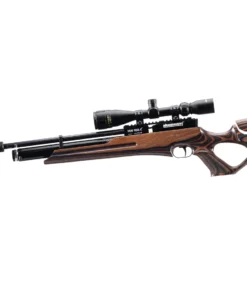

WEIHRAUCH
Reviews
There are no reviews yet.