


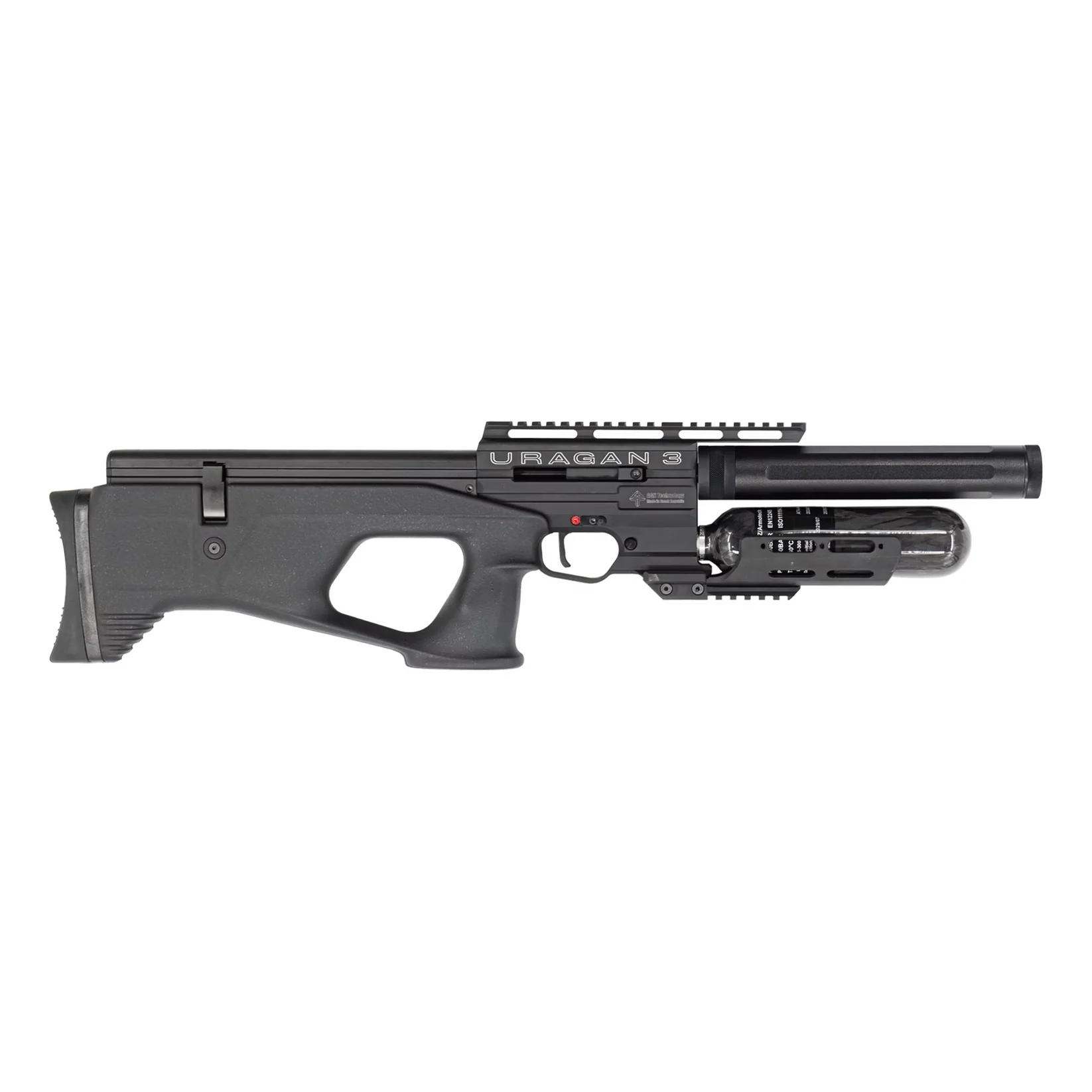


Airgun Technology Uragan 3 Compact – Air Rifle.
Price range: €1,800.00 through €2,000.00
AGT URAGAN 3 Compact Synthetic PCP Bullpup Air Rifle
The AGT URAGAN 3 Compact takes the advanced engineering of the URAGAN 3 and condenses it into a lighter, shorter, and more manoeuvrable package. Designed for shooters who demand the same cutting-edge performance in a portable format, the URAGAN 3 Compact is perfect for tight spaces, dynamic shooting scenarios, and those who value mobility without sacrificing precision.
Revolutionary Internal Upgrades
- Enhanced Block and Receiver: The compact version retains the redesigned receiver and trigger mechanism for unmatched precision and reliability.
- Improved Firing Valve Assembly: Built for durability, the updated valve system simplifies maintenance, ensuring effortless upkeep.
- Simplified Power Plenum: Optimized for efficient airflow and consistent shot performance.
- New Air Pressure Regulator: Ensures steady performance even under the stress of high-pressure conditions.
- Upgraded Hammer System: Features a stronger hammer spring and precise spring tension adjustments.
- Depinger: The added depinger reduces noise, making this compact model quieter than ever.
Compact Ergonomics and Versatility
- Shortened Top Picatinny Rail: Still long enough for advanced optics, including night vision add-ons, while maintaining a more streamlined profile.
- Colder Weather Adaptation: The updated trigger guard offers superior usability with gloves, ideal for cold-weather conditions.
- Swappable Side Lever: Fully ambidextrous for left or right-handed operation.
Optimized Specifications for Compact Performance
- Barrel: A 400mm shrouded barrel system with an integral silencer and M14CW threading for additional moderators.
- Stock: Adjustable butt pad for customized ergonomics.
- Trigger: Two-stage adjustable trigger for a personalized shooting experience.
- Rails: Built-in 20MOA top Picatinny rail and a lower Picatinny rail with a bottle guard attachment, including a forward Keymod mount.
Technical Data
- Length: 700mm
- Weight: ~3.2Kg
- Max Fill Pressure: 300BAR
- Operational Pressure Range: ~200-100BAR (varies by calibre)
- Shot Count: Approximately 120 shots per fill (calibre-dependent)
- Safety: Ambidextrous slide safety
The AGT URAGAN 3 Compact is the ultimate balance of portability and power. With its shortened profile and lightweight design, it’s perfect for shooters who need a rifle that performs flawlessly in tight spaces or during mobile scenarios. Whether you’re hunting, target shooting, or just enjoying some plinking, the URAGAN 3 Compact delivers top-tier performance and ease of use in a compact, efficient design.

Airgun Technology Uragan 3 Compact – Regulated Compact PCP Air Rifle with Ambidextrous Side Lever, 250cc Air Cylinder, and Precision-Focused Engineering
Engineering, Compact Design, Precision, Air Management, Handling, and Practical Performance
The Airgun Technology Uragan 3 Compact is a premium regulated PCP platform designed around portability, mechanical consistency, and efficient air management.
Its compact architecture combines a 400mm barrel, 250cc air cylinder, side-lever repeating action, adjustable trigger, regulated pressure system, and optic-ready top rail. Current specifications also indicate a maximum fill pressure of up to 300 bar, with magazine capacity varying according to caliber.
The third-generation design introduces meaningful internal changes compared with earlier versions. These include a redesigned receiver and firing system, simplified power plenum construction, a revised pressure regulator, an improved valve assembly, and an updated hammer system. Together, these changes are intended to improve consistency, durability, and serviceability.
AGT Uragan air rifle
The AGT Uragan air rifle family is known for compact pneumatic engineering, regulated air delivery, and precision-oriented construction.
AGT Uragan
The AGT Uragan name covers several generations and configurations, including longer and more compact variants.
Uragan air rifle
A Uragan air rifle uses pre-charged pneumatic operation rather than a conventional spring or gas-ram powerplant.
AGT Uragan 3
The AGT Uragan 3 introduces revised internal architecture, including an updated regulator, valve assembly, hammer system, and simplified plenum design.
AGT Uragan Compact
The AGT Uragan Compact configuration reduces overall size while preserving the key regulated pneumatic systems of the larger platform.
AGT Uragan air rifle for sale
Buyers searching AGT Uragan air rifle for sale should verify caliber, regional legal requirements, included magazines, warranty coverage, and exact factory configuration before purchasing.
Best AGT Uragan review
A Best AGT Uragan review should examine air efficiency, regulator consistency, ergonomics, trigger feel, magazine function, balance, and practical accuracy rather than focusing only on headline velocity.
AGT Uragan price
The AGT Uragan price varies by region, caliber, retailer, included accessories, taxes, and legal configuration.
Buy AGT Uragan air rifle
Anyone intending to Buy AGT Uragan air rifle should confirm local ownership rules, approved filling equipment, warranty terms, and the exact variant being offered.
AGT Uragan hunting
The phrase AGT Uragan hunting appears frequently in online searches, although any field use depends entirely on local laws, the approved configuration, suitable ammunition, and responsible use.
AGT Uragan .22
The AGT Uragan .22 configuration provides a balance between magazine capacity, air efficiency, and recreational target performance.
Current dealer specifications commonly list a 12-shot magazine in this caliber.
AGT Uragan .25
The AGT Uragan .25 configuration uses a larger projectile and a lower magazine capacity than smaller-caliber versions.
Current listings commonly show approximately 10 to 11 rounds depending on magazine configuration.
AGT Uragan high power
The phrase AGT Uragan high power generally refers to market-specific higher-output configurations.
Power levels and legal classification vary by country, so buyers should always use the rifle only in the approved factory configuration for their jurisdiction.
AGT Uragan PCP air rifle
As an AGT Uragan PCP air rifle, the platform stores compressed air in an onboard cylinder and releases a controlled amount for each shot.
AGT Uragan accuracy
AGT Uragan accuracy depends on regulator consistency, barrel quality, pellet compatibility, optic setup, environmental conditions, and shooter technique.
AGT Uragan vs FX Impact
An AGT Uragan vs FX Impact comparison involves two premium PCP platforms with different engineering philosophies, adjustment systems, ergonomics, and modularity.
AGT Uragan review 2026
An AGT Uragan review 2026 should pay particular attention to the third-generation regulator, revised valve system, improved hammer assembly, simplified plenum, and compact ergonomics.
AGT Uragan PCP
The AGT Uragan PCP platform relies on regulated compressed-air delivery for consistent recreational shooting behavior.
AGT Uragan vs FX Impact
A second AGT Uragan vs FX Impact search generally reflects buyers comparing compact bullpup-style handling with a more highly modular PCP system.
Uragan air rifle
The Uragan air rifle remains a premium choice for shooters who value compact dimensions, regulated operation, and strong mechanical refinement.
AGT Uragan accuracy
Consistent AGT Uragan accuracy is best evaluated through repeatable group testing with suitable ammunition under controlled conditions.
Air Venturi Alpha
The Air Venturi Alpha belongs to a completely different manufacturer and platform family.
Air Venturi Alpha PCP Rifle
The Air Venturi Alpha PCP Rifle should not be confused with the Uragan platform because the engineering, air system, controls, and pricing are different.
Air Venturi Alpha Air Rifle
The phrase Air Venturi Alpha Air Rifle represents an alternative PCP product rather than a variant of this rifle.
Air Venturi Alpha Hunting Rifle
The Air Venturi Alpha Hunting Rifle search term concerns a different product category and should be evaluated independently according to local regulations.
Air Venturi Alpha Tactical PCP
The Air Venturi Alpha Tactical PCP refers to another platform with different ergonomics and equipment compatibility.
Air Venturi Alpha Regulated PCP
An Air Venturi Alpha Regulated PCP also uses controlled air delivery, although its regulator and internal architecture are different.
Air Venturi Alpha Multi Shot Rifle
The Air Venturi Alpha Multi Shot Rifle search reflects buyer interest in repeating pneumatic rifles.
Air Venturi Alpha Precision Air Rifle
The phrase Air Venturi Alpha Precision Air Rifle should be treated as a comparison search rather than an alternative name for this product.
air venturi
air venturi is a separate airgun brand and distributor with its own rifles, accessories, tanks, and compressors.
air venturi avenger
The air venturi avenger is another regulated PCP rifle with a different price point and design philosophy.
airventuri
The spelling airventuri commonly refers to the same separate manufacturer and distributor.
air venturi avenger
A second air venturi avenger search may be useful for buyers comparing regulated pneumatic platforms.
air venturi avenge
The term air venturi avenge is commonly used as a shortened or misspelled reference to another rifle platform.
air venturi compressor
An air venturi compressor belongs to the filling-equipment category rather than the rifle itself.
venturi air
The phrase venturi air commonly appears in searches related to pneumatic rifles, compressors, tanks, and accessories.
air venturi air compressor
An air venturi air compressor may be used as part of a PCP charging setup when its rated pressure and connector system are compatible.
air rifle and air pistol
The phrase air rifle and air pistol covers two distinct categories with different ergonomics, dimensions, and intended recreational use.
air venturi rovair 4500 portable compressor
The air venturi rovair 4500 portable compressor is a separate high-pressure charging product and should only be used according to its manufacturer instructions.
air ventur avenge
The phrase air ventur avenge is another common search variation for a different regulated PCP rifle.
air venturi microstrike
The air venturi microstrike belongs to another product family and should not be treated as part of this platform.
dragon claw
The dragon claw is a completely different large-bore air rifle platform.
air venturi rovair
The air venturi rovair name is associated with portable PCP charging equipment.
air venturi tank
An air venturi tank belongs to the high-pressure air storage category rather than the rifle itself.
air venturi air tank
An air venturi air tank may form part of a PCP filling setup when correctly rated and compatible.
air venturi omnistorm
The air venturi omnistorm represents another product search unrelated to the Uragan family.
air venturi pcp compressor
An air venturi pcp compressor provides compressed air for compatible pneumatic equipment and should always be operated within its rated limits.
air venturi avenger 25
The air venturi avenger 25 is a .25-caliber version of another PCP platform.
seneca dragon claw
The seneca dragon claw is a separate large-bore pneumatic rifle and should not be confused with this compact regulated design.
ventur air compressor
The phrase ventur air compressor commonly refers to high-pressure charging equipment used with compatible PCP systems.
seneca air rifles
seneca air rifles form another product family with different engineering and caliber options.
air bolt gun
The term air bolt gun refers to a specialized pneumatic category rather than the pellet-rifle platform described here.
50 caliber dragon
The phrase 50 caliber dragon usually concerns a large-bore pneumatic platform and is unrelated to this compact rifle.
claw air gun
The term claw air gun generally refers to another large-bore product family.
air venturi
A second air venturi search may cover compressors, air tanks, rifles, pistols, and general PCP accessories.
avenger price
The phrase avenger price reflects purchase research for another regulated pneumatic rifle.
air rifle compressor
An air rifle compressor can provide the high-pressure air required by compatible PCP rifles when operated according to its manufacturer ratings.
pcp airguns
pcp airguns use stored compressed air and can offer low recoil, multi-shot capability, regulated operation, and high mechanical consistency.
pcp air rifles
Modern pcp air rifles range from lightweight recreational models to premium regulated precision platforms.
Compact Bullpup-Style Architecture
The rifle’s compact architecture places much of its mechanism behind the trigger area.
This creates a short overall package while retaining a 400mm barrel.
The result is a rifle that feels maneuverable without requiring an unusually short barrel.
250cc Air Cylinder
The compact configuration uses an approximately 250cc air cylinder.
This provides useful onboard air capacity without requiring the larger reservoir used by full-length models.
300-Bar Maximum Fill Pressure
Current specifications list a maximum fill pressure of up to 300 bar.
Only properly rated filling equipment should be used, and the manufacturer’s pressure limit should never be exceeded.
New Pressure Regulator
The third-generation regulator is designed to maintain consistent air delivery across the usable pressure range.
Stable regulated pressure helps reduce shot-to-shot variation and supports predictable target performance.
Simplified Power Plenum
The redesigned plenum simplifies access and maintenance while supporting efficient airflow.
This represents one of the important engineering changes introduced with the third generation.
Improved Valve Assembly
The revised firing valve assembly is designed for greater durability and easier access during servicing.
This can reduce the amount of disassembly required during qualified maintenance.
Ambidextrous Side Lever
The cocking lever can be positioned for left- or right-handed operation.
This improves accessibility and makes the rifle more adaptable to different users.
Two-Stage Adjustable Trigger
A two-stage adjustable trigger allows the shooter to establish a predictable release point.
A controlled trigger can support better consistency because less unnecessary movement is introduced during the final stage of the shot.
Multi-Shot Magazine
Magazine capacity varies according to caliber.
Current listings commonly indicate approximately 15 shots in .177, 12 in .22, and around 10–11 in .25.
400mm Barrel
The compact model uses a 400mm barrel, providing a useful balance between overall size and precision-oriented barrel length.
Optics Rail
The top rail provides mounting space for suitable optics.
Current listings describe a 20-MOA Picatinny arrangement, although exact rail configuration should be confirmed on the specific regional model.
Why Choose the Uragan 3 Compact?
The strongest reasons include compact dimensions, regulated air delivery, ambidextrous controls, multi-shot convenience, substantial air capacity, and a refined third-generation internal system.
It is particularly appealing to shooters who want premium PCP engineering without moving to a long full-size configuration.
How Good Is the Precision?
Practical precision is supported by the regulated air system, stable barrel assembly, crisp trigger, secure optic mounting, and low-recoil PCP operation.
However, final accuracy still depends on ammunition compatibility, environmental conditions, optic setup, and shooter technique.
Where Is It Best Used?
The rifle is best suited to lawful recreational target shooting, controlled range practice, and other legal sporting applications.
Its compact size can make it easier to transport and handle than a full-length platform.
When Does It Make Sense?
This platform makes sense for shooters who already have access to suitable high-pressure filling equipment and want a compact, regulated, multi-shot PCP.
It also suits users who value ambidextrous controls and a short overall package.
How Good Is the Handling?
The shortened layout keeps the rifle compact while preserving a useful barrel length.
Current listings place overall length around 660–700mm depending on configuration, with weight figures varying from roughly 2.7kg to just over 3kg.
Precision and Consistency
Regulator stability, controlled air delivery, a quality barrel, and a predictable trigger provide a strong foundation for consistent target shooting.
The best results come from pairing the rifle with suitable ammunition and maintaining a repeatable shooting technique.
Important Technical Information
Current dealer specifications commonly list a 400mm barrel, 250cc air cylinder, up to 300-bar fill pressure, regulated PCP operation, two-stage adjustable trigger, ambidextrous swappable side lever, multi-shot magazine, approximately 660–700mm overall length, and roughly 2.7–3.2kg unscoped weight depending on configuration.
Because regional models can differ in caliber, legal power, barrel setup, included accessories, and dimensions, buyers should confirm the exact specification of the rifle being purchased.
Final Section 1 Summary
The Airgun Technology Uragan 3 Compact combines premium regulated PCP engineering, compact dimensions, multi-shot operation, a substantial air supply, ambidextrous controls, and modern third-generation internal improvements.
For shooters who value portability, mechanical refinement, repeatable air delivery, and precision-oriented recreational performance, it provides a sophisticated compact platform with strong long-term ownership potential.
Engineering Design, Regulated Air System, Compact Handling, Trigger Control, and Precision Performance
Engineering Design
The rifle is built around a compact pre-charged pneumatic platform that combines a short overall layout with a full working action, regulated air delivery, and repeating capability.
Its architecture keeps the rifle relatively short without sacrificing the barrel length needed for consistent recreational target use.
The design also places important controls close to the shooter, helping create a practical and balanced shooting position.
Regulated Air Delivery
A regulator helps control the amount of compressed air released for each shot.
This reduces large pressure-related variations and supports more predictable performance across the useful portion of the fill.
Consistent air delivery also makes it easier to evaluate ammunition and shooter technique because one major variable is better controlled.
High-Pressure Air System
The onboard reservoir stores compressed air at high pressure.
The owner should always use filling equipment that is correctly rated for the system.
Filling should be carried out carefully and within the manufacturer’s stated pressure limits.
Controlled Filling
A slow and controlled fill is preferable to rushing the process.
Rapid filling can create heat and temporarily affect the pressure reading.
Allowing the system to stabilize helps the shooter judge the actual fill level more accurately.
Compact Reservoir Capacity
The compact configuration uses a smaller air reservoir than many full-length platforms.
This helps reduce overall size and weight while still providing a useful number of shots between fills.
The balance between reservoir size and portability is one of the main design strengths.
Side-Lever Operation
The side-mounted cocking system allows the shooter to cycle the action without significantly changing shoulder position.
This helps maintain a steady rhythm during target sessions.
Smooth cycling also reduces unnecessary movement between shots.
Ambidextrous Control
The operating lever can be configured for either side.
This makes the rifle more adaptable for different users and can improve comfort for both right- and left-handed shooters.
A correctly positioned lever also makes repeated operation feel more natural.
Multi-Shot Convenience
The repeating magazine reduces the need to manually load every pellet.
This makes longer sessions more efficient and allows the shooter to focus more on sight alignment and trigger control.
However, the shooting pace should still remain deliberate.
Magazine Handling
The magazine should be kept clean and loaded carefully.
Damaged pellets or debris can interfere with smooth feeding.
Correct handling helps preserve reliability and reduces the chance of misfeeds.
Barrel Stability
A stable barrel assembly contributes to practical accuracy.
The barrel should remain correctly aligned with the action and sighting system.
Good structural rigidity helps support repeatable pellet release.
Compact Handling
The short overall layout makes the rifle easier to maneuver and transport than many full-length platforms.
This can be especially useful when moving between shooting positions or working in limited space at the range.
The compact format also reduces the amount of forward weight the shooter must manage.
Weight Distribution
Balanced weight distribution helps improve comfort.
A rifle that feels centered in the hands requires less corrective movement while aiming.
This can reduce fatigue during longer practice sessions.
Shoulder Position
The rifle should settle naturally into the shoulder.
A consistent contact point helps maintain the same sight picture and body alignment.
Repeatable shoulder placement also improves control during supported and unsupported shooting.
Grip Control
Grip pressure should remain relaxed and consistent.
Holding too tightly can introduce unnecessary movement.
A stable but natural grip usually supports better precision.
Trigger Characteristics
The two-stage trigger provides a controlled release.
The first stage allows the shooter to prepare carefully, while the second stage gives a more defined break point.
This helps reduce sudden trigger movement.
Trigger Control Technique
Trigger pressure should be applied gradually.
A sharp pull can disturb the aim before the shot is released.
Smooth technique is one of the most important factors in practical consistency.
Low-Recoil Shooting
Pre-charged pneumatic operation produces very little felt recoil compared with spring-powered systems.
This helps the shooter maintain sight alignment and observe the target more easily.
Low movement also makes the rifle less sensitive to changes in hold.
Supported Shooting
A stable rest can help during ammunition testing and optic setup.
Supported shooting reduces body movement and allows the shooter to focus on the mechanical performance of the rifle.
This is useful when establishing a baseline.
Unsupported Shooting
When shooting without a rest, balance and posture become more important.
The compact layout can make unsupported use easier because less weight extends forward.
Good body position still remains essential.
Sight Alignment
A clear sight picture is necessary for repeatable results.
The optic should be positioned so the shooter can view it naturally without stretching or excessive head movement.
Correct setup reduces fatigue.
Optic Mount Stability
The mounting system should remain secure.
Any movement between the optic and rifle can change point of impact.
Regular hardware checks help maintain stable alignment.
Precision Potential
Practical precision depends on several factors working together.
Regulator consistency, barrel quality, ammunition compatibility, optic setup, environmental conditions, and shooter technique all influence results.
The rifle provides a strong mechanical foundation for repeatable recreational target use.
Ammunition Selection
Different pellets can perform differently in the same barrel.
Weight, shape, fit, and manufacturing consistency all matter.
Testing several suitable options under similar conditions helps identify the most reliable choice.
Group Evaluation
Shot groups provide useful feedback about the complete setup.
Tight, repeatable groups suggest that the rifle, ammunition, optic, and shooter are working together effectively.
Irregular results may indicate that one of these factors requires attention.
Follow-Through
The shooter should remain in position briefly after the shot.
Maintaining aim helps reinforce good technique and makes results easier to evaluate.
Consistent follow-through is valuable even with a low-recoil platform.
Breathing Control
Breathing affects body movement and sight stability.
Many shooters find that a natural pause provides the best moment for trigger release.
Relaxed control usually produces better results than excessive tension.
Environmental Conditions
Outdoor performance can be influenced by wind, temperature, humidity, and changing light.
These factors should be considered when comparing results between sessions.
Stable conditions provide the best baseline.
Wind Awareness
Lightweight pellets can be affected by crosswinds.
Even moderate wind may move the point of impact.
Observing direction and strength helps the shooter interpret group movement more accurately.
Temperature Influence
Temperature can affect compressed-air behavior and pressure readings.
Very hot or cold conditions may produce slightly different results.
Testing under similar conditions creates more meaningful comparisons.
Routine Reliability
A regulated repeating platform can remain dependable when properly maintained.
Clean magazines, careful filling, secure mounts, and regular inspection all contribute to reliable operation.
Simple maintenance habits make a significant difference over time.
Maintenance Simplicity
Routine care should focus on external cleaning, pressure monitoring, connection inspection, magazine care, and proper storage.
Complex internal work should be handled by a qualified technician.
Unnecessary disassembly should be avoided.
Long-Term Ownership
A well-maintained pneumatic rifle can remain dependable for many years.
Careful transport, correct filling, secure storage, and regular inspection all contribute to long service life.
The owner’s habits have a direct effect on long-term condition.
Overall Section Summary
The rifle combines regulated air delivery, compact dimensions, side-lever operation, multi-shot convenience, low recoil, and precision-focused handling.
Its design supports deliberate target shooting, efficient air use, and reduced interruption during longer sessions.
With suitable ammunition, responsible pressure management, secure optics, and disciplined technique, it can provide reliable and satisfying recreational performance over long-term ownership.
Practical Shooting Experience, Accuracy Development, Compact Handling, and Real-World Performance
Practical Shooting Experience
The rifle delivers a smooth, controlled shooting experience that emphasizes balance, consistency, and efficient operation.
Its compact layout, low-recoil pneumatic system, repeating action, and regulated air delivery work together to create a platform that feels stable and easy to manage during recreational target sessions.
Because the rifle is short overall, the shooter can move between positions with less effort than with many traditional full-length designs.
Accuracy Development
Practical accuracy depends on several factors working together.
A stable barrel, suitable ammunition, consistent regulator behavior, secure optic mounting, correct body position, and disciplined trigger technique all influence the final result.
Regular practice helps the shooter understand how these variables interact and how to reproduce the best results.
Compact Handling
The short overall layout is one of the rifle’s strongest practical advantages.
Less length in front of the shooter can make the platform easier to control in confined areas, on a bench, or during position changes.
This compact balance can also reduce fatigue during longer sessions.
Shoulder Position
The rifle should settle naturally into the shoulder.
A repeatable contact point helps maintain the same sight picture and body alignment from one shot to the next.
Consistent shoulder placement also improves stability when shooting from unsupported positions.
Grip Control
Grip pressure should remain relaxed and consistent.
A tight or inconsistent grip can introduce unnecessary movement.
A natural hold allows the shooter to concentrate more on sight alignment and trigger control.
Head Position
A comfortable and repeatable head position is important when using an optic.
The shooter should be able to see a full sight picture without stretching or twisting the neck.
Correct positioning improves comfort and makes the aiming process easier to repeat.
Sight Picture
A stable sight picture is essential for reliable target performance.
The optic should remain firmly mounted and aligned with the rifle.
Any movement in the mounting system can alter point of impact and make group evaluation less useful.
Trigger Technique
Trigger pressure should be applied smoothly and progressively.
A sudden movement can disturb aim just before the shot is released.
A predictable two-stage trigger helps the shooter prepare the shot carefully without unnecessary tension.
Breathing Control
Breathing affects body movement and sight stability.
Many shooters find that a natural pause provides the best moment for releasing the shot.
Relaxed breathing generally produces better results than attempting to hold the body completely rigid.
Follow-Through
The shooter should remain in position briefly after the shot.
Even though recoil is minimal, maintaining the sight picture helps reinforce good technique.
Consistent follow-through also makes it easier to observe performance and diagnose mistakes.
Multi-Shot Rhythm
The repeating system reduces interruptions between shots.
However, convenience should not lead to rushed shooting.
A controlled rhythm allows the shooter to concentrate on breathing, grip, trigger control, and sight alignment.
Magazine Use
The magazine makes longer sessions more efficient.
The shooter can complete several shots before stopping to reload.
Careful loading and clean magazine components help maintain smooth feeding throughout the session.
Ammunition Testing
Different pellets can produce noticeably different results.
Weight, shape, fit, and manufacturing consistency all influence grouping.
Testing several suitable options under similar conditions helps identify the most reliable match for the barrel.
Group Analysis
Shot groups provide useful information about the entire setup.
Tight and repeatable groups suggest that the rifle, ammunition, optic, and shooter technique are working well together.
Irregular groups may indicate that one of these factors needs attention.
Pressure Awareness
The onboard air supply gradually changes during use.
A regulated system helps maintain consistent air delivery, but the shooter should still monitor pressure throughout the session.
Understanding normal pressure behavior also helps with planning.
Session Planning
Longer shooting sessions are easier to manage when the shooter understands the normal number of useful shots available per fill.
Keeping simple notes can help identify patterns in air use and performance.
This makes range preparation more predictable.
Supported Shooting
A stable rest can help reveal the rifle’s mechanical consistency.
Supported shooting reduces body movement and makes it easier to compare ammunition or confirm optic settings.
This is especially useful when establishing a performance baseline.
Unsupported Shooting
When shooting without a rest, body position becomes more important.
The compact layout can make unsupported shooting easier because there is less forward weight to manage.
Good posture still remains essential for consistent performance.
Range Practice
Regular range practice builds familiarity.
The shooter gradually learns the rifle’s balance, trigger feel, magazine operation, pressure behavior, and preferred ammunition.
These details become easier to manage with experience.
Skill Development
A predictable platform can support steady improvement.
Newer shooters can focus on basic fundamentals, while experienced users can refine group consistency and control.
Stable equipment makes progress easier to evaluate.
Outdoor Shooting
Outdoor conditions introduce additional variables.
Wind, temperature, humidity, and changing light can influence practical accuracy.
Understanding these factors helps the shooter interpret group movement more accurately.
Wind Influence
Lightweight projectiles can be affected by crosswinds.
Even moderate wind may move the point of impact.
Observing direction and strength helps explain why groups may shift.
Temperature Influence
Temperature can affect compressed-air behavior and pressure readings.
Cold and hot conditions may produce slightly different results.
Comparisons are most meaningful when testing is carried out under similar conditions.
Low-Recoil Advantage
Minimal recoil makes the rifle easier to manage during target practice.
The shooter can maintain sight alignment more easily and observe the target immediately after the shot.
This can also make technique easier to evaluate.
Comfort During Longer Sessions
Comfort becomes increasingly important during extended shooting.
The compact layout and balanced weight distribution help reduce unnecessary strain.
Regular breaks still help maintain concentration and prevent posture from deteriorating.
Transport Convenience
The short overall package is easier to transport than many traditional full-length rifles.
A protective case should still be used to protect the barrel, stock, optic, magazine system, and air components.
Secure transport also helps preserve cosmetic condition.
Storage Between Sessions
The rifle should be stored in a dry, secure, and stable environment.
Moisture, excessive heat, and accidental impact should be avoided.
Proper storage supports long-term reliability and pressure-system condition.
Routine Inspection
Before and after shooting, the owner should check for loose hardware, optic movement, unusual pressure loss, or visible damage.
Small issues are easier to address when found early.
Routine inspection helps maintain confidence in the platform.
Confidence Through Familiarity
Repeated use allows the shooter to understand how the rifle feels and responds.
Knowing the preferred hold, pressure behavior, trigger feel, and optic position makes operation more predictable.
This familiarity can improve practical consistency.
Recreational Value
For recreational target use, the rifle offers a strong combination of compact handling, repeating convenience, low recoil, and regulated performance.
The shooting process remains efficient without feeling rushed.
This makes the platform well suited to longer practice sessions.
Practical Ownership Experience
The rifle combines compact dimensions with a sophisticated pneumatic system and straightforward controls.
This balance can appeal to shooters who want a premium platform without the length of a conventional rifle.
The overall ownership experience is centered on precision, efficient air use, and practical handling.
Overall Practical Value
Practical value comes from the combination of compact design, regulated operation, low recoil, repeating capability, and manageable handling.
A rifle that behaves predictably is easier to understand and more enjoyable to use consistently.
Final Performance Summary
In real-world use, the rifle provides stable handling, efficient air delivery, smooth repeating operation, minimal recoil, and strong practical precision.
Its compact layout makes movement and transport easier, while the regulated system supports consistent target performance.
With suitable ammunition, responsible pressure management, secure optics, regular maintenance, and disciplined technique, it can provide dependable recreational performance across many future shooting sessions.
Maintenance, Storage, Protection, and Long-Term Reliability
Importance of Regular Maintenance
Routine care plays an important role in preserving dependable operation, pressure stability, smooth cycling, and long-term ownership value.
A compact pneumatic rifle contains a reservoir, regulator, valve system, seals, trigger components, magazine parts, barrel assembly, stock hardware, and optic mounts that all benefit from regular inspection.
Good maintenance does not mean frequent disassembly. In most cases, careful cleaning, sensible pressure management, proper storage, and early attention to changes in performance provide the best long-term results.
Pre-Use Inspection
Before every shooting session, the rifle should be checked for visible damage or unusual changes.
The owner should inspect the reservoir, pressure gauge, stock, barrel, magazine area, side lever, trigger, safety, optic mounts, and major fasteners.
Any unexpected pressure loss, unusual stiffness, or visible damage should be investigated before normal use continues.
Post-Use Inspection
After shooting, another brief inspection can help identify loosened hardware, dirt, moisture, or changes in mechanical feel.
The exterior should be wiped clean before storage.
This simple routine also makes it easier to notice gradual changes before they become larger problems.
Exterior Cleaning
External surfaces should be cleaned with a soft, dry cloth.
Harsh chemicals and abrasive materials should be avoided unless they are specifically suitable for the rifle’s finish.
Gentle cleaning helps protect the stock, barrel, receiver, and other visible components.
Reservoir Care
The onboard air reservoir is one of the most important components in the system.
It should be protected from impacts, corrosion, excessive heat, and incorrect filling practices.
The reservoir should never be opened or dismantled while pressurized.
Pressure Monitoring
The shooter should understand the rifle’s normal pressure behavior.
Unexpected pressure loss may indicate a seal, fitting, or valve issue.
Repeatedly refilling without identifying the cause of a leak should be avoided.
Safe Filling Practices
Only properly rated filling equipment should be used.
Filling should be performed slowly and within the stated pressure range.
A controlled fill reduces unnecessary heat and allows the pressure reading to stabilize more accurately.
Connector Inspection
The filling connection should remain clean and free from dust or debris.
Damaged seals, contaminated connectors, or worn fittings can interfere with proper sealing.
Any unusual resistance should be investigated rather than forced.
Regulator Care
The regulator helps maintain consistent air delivery.
It should not be dismantled casually or adjusted without proper technical knowledge.
If performance becomes irregular, professional inspection is usually the better option.
Valve System Care
The internal valve controls the release of compressed air.
Because it operates under high pressure, internal servicing should be left to a qualified technician.
Unnecessary disassembly can create sealing problems and affect reliability.
Magazine Maintenance
The magazine should be kept clean and protected from impacts.
Dust, damaged pellets, or debris can interfere with smooth feeding.
Regular inspection helps maintain dependable cycling.
Loading Area Inspection
The loading area should remain free from fragments and contamination.
If the side lever becomes difficult to operate or feeding feels abnormal, the mechanism should not be forced.
The cause should be identified before normal use continues.
Side-Lever Care
The side lever should move smoothly through its normal range.
Any grinding sensation, sudden stiffness, or unusual resistance may indicate that inspection is required.
Forcing the lever can damage feeding components or internal parts.
Trigger Protection
The trigger mechanism should remain clean and dry.
Unnecessary adjustment should be avoided unless carried out by someone familiar with the system.
A predictable trigger depends on correct condition and proper setup.
Safety Mechanism
The safety should be checked periodically for normal operation.
It should never be treated as the only safety measure.
Correct muzzle direction and responsible handling remain essential at all times.
Fastener Inspection
Stock screws, rail screws, and optic-mount hardware should be checked periodically.
Although pneumatic rifles generate relatively little recoil, normal use and transport can still loosen hardware.
Secure fasteners help preserve consistency.
Optic Mount Inspection
The optic should remain firmly attached to the rail.
Any movement can change point of impact.
Regular inspection helps ensure that alignment remains stable throughout long-term use.
Barrel Care
The barrel should be cleaned only when necessary.
Excessive cleaning can create more wear than benefit if unsuitable tools are used.
A careful and minimal approach is generally preferable for routine ownership.
Muzzle Protection
The muzzle should be protected from impacts.
Damage around the barrel exit can affect consistency.
A padded case provides useful protection during transport and storage.
Correct Lubrication
Only suitable lubricants should be used where recommended.
High-pressure pneumatic systems require products compatible with seals and pressure components.
Incorrect oils or greases can damage materials or interfere with normal operation.
Avoiding Excess Lubrication
More lubricant does not automatically improve reliability.
Excess application can attract dirt and contaminate moving components.
A minimal and appropriate approach is usually best.
Moisture Management
Moisture can affect metal surfaces and connectors over time.
After use in damp conditions, the rifle should be dried before storage.
Areas around screws, fittings, and joints should not be overlooked.
Corrosion Prevention
Regular wiping and dry storage help reduce the risk of corrosion.
Any early signs of rust should be addressed carefully before they spread.
Protective products should be suitable for the original finish.
Temperature Management
The rifle should not be stored in extreme heat or rapidly changing temperatures.
Hot vehicles and damp storage areas are poor choices.
A stable indoor environment is preferable for the pressure system, seals, and external finish.
Transportation Protection
A padded case is recommended during transport.
The case should protect the barrel, stock, optic, magazine system, and air reservoir from accidental impact.
The rifle should also be secured so it cannot move excessively inside the case.
Safe Storage
The rifle should be stored securely and in accordance with local regulations.
Unauthorized access should be prevented.
A dry and stable storage environment helps preserve both mechanical reliability and cosmetic condition.
Storage Position
The rifle should be supported so that it cannot fall.
Heavy objects should not rest against the barrel, optic, stock, or pressure system.
A stable position reduces unnecessary stress.
Monitoring Performance Changes
Changes in accuracy, pressure retention, trigger feel, cycling, air consumption, or sound can provide early warning of a developing issue.
Owners who understand the rifle’s normal behavior are more likely to notice these changes quickly.
Professional Servicing
Complex work involving the reservoir, regulator, valve system, trigger unit, or internal action should be handled by a qualified technician.
Professional servicing helps preserve safe operation and long-term reliability.
Avoiding Unauthorized Modifications
Unapproved internal changes can affect consistency, reliability, and legal compliance.
The rifle is best maintained within its intended design parameters.
Responsible ownership focuses on dependable operation rather than unnecessary modification.
Developing a Maintenance Routine
A simple maintenance routine can be highly effective.
Inspect before use, monitor pressure, wipe the rifle after shooting, check the magazine and side lever, inspect hardware, protect the reservoir, and store the rifle correctly.
These habits require little time but provide meaningful long-term benefits.
Long-Term Reliability
A well-maintained pneumatic rifle can provide dependable service for many years.
Careful filling, clean connections, correct storage, and regular inspection all contribute to long-term reliability.
The owner’s maintenance habits have a direct effect on overall condition.
Final Maintenance Summary
Long-term reliability depends on responsible pressure management, routine inspection, sensible cleaning, secure transport, and proper storage.
Protecting the reservoir, regulator, valve system, barrel, magazine, trigger, side lever, optic mounts, and stock helps preserve consistent operation.
With careful ownership and qualified servicing when necessary, the rifle can remain dependable, accurate, and enjoyable across many future shooting sessions.
Be the first to review “Airgun Technology Uragan 3 Compact – Air Rifle.”
Related products




AGT URAGAN
AGT URAGAN
Reviews
There are no reviews yet.