

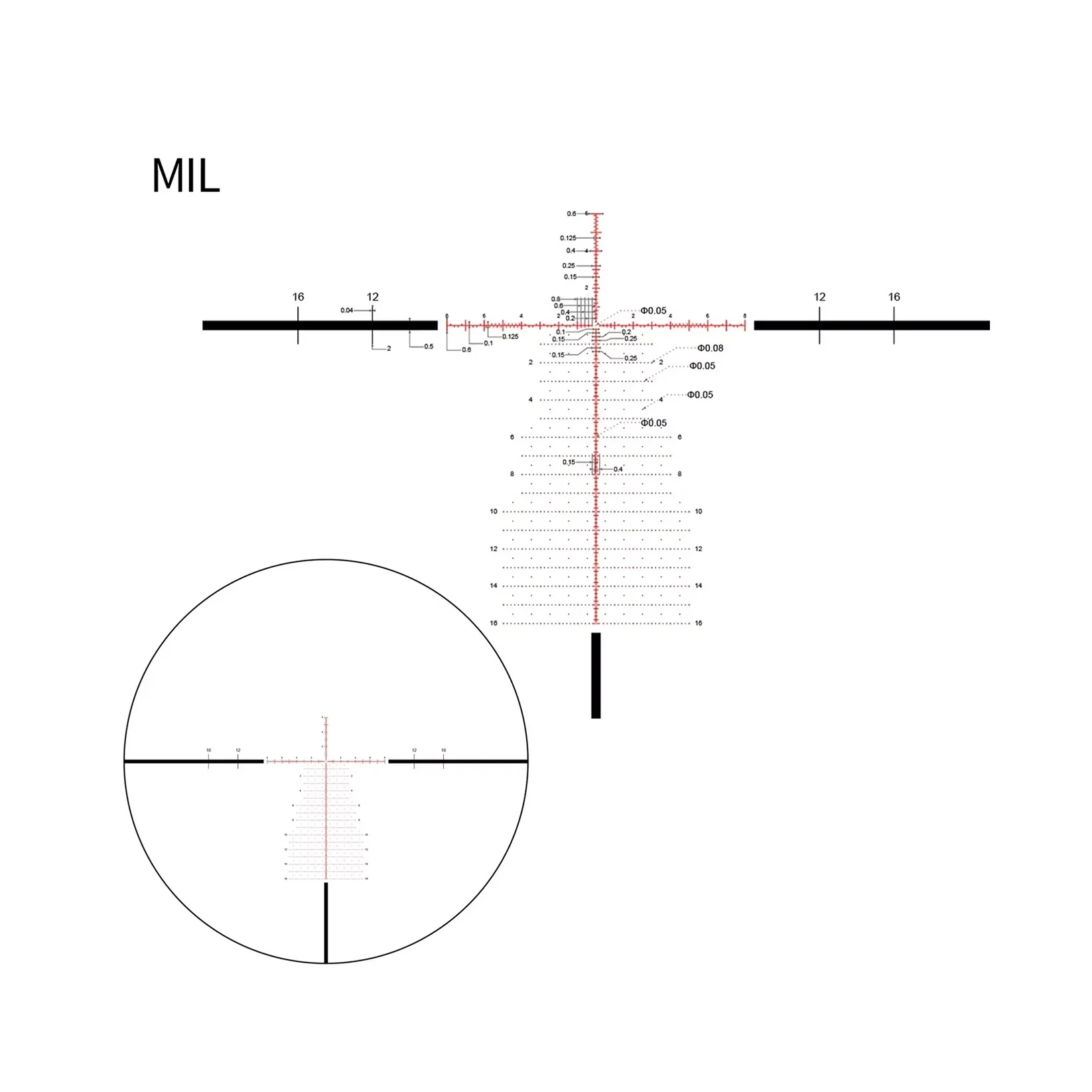

DNT Optics TheOne 7-35×56 FFP IR MIL TOR 34mm Rifle Scope.

€630.00
DNT Optics TheOne 7-35×56 FFP IR MIL TOR – Long-Range Precision Without the Price Tag
Built for the shooter who demands more from their optic, the DNT Optics TheOne 7-35×56 FFP IR MIL TOR is a purpose-driven, long-range rifle scope with serious performance credentials. With its first focal plane (FFP) reticle, broad 7x to 35x magnification, and rugged 34mm tube, this is a professional-grade scope priced for the real world.
Designed to compete with the big-name optics at a fraction of the cost, TheOne delivers pin-sharp clarity, dependable tracking, and long-range capability—ideal for precision rifle shooters, varmint hunters, and anyone stretching the limits of their marksmanship.
🔍 Key Features:
- First Focal Plane (FFP) Reticle
MIL-based TOR (The One Reticle) remains accurate throughout the zoom range—perfect for holdovers and ranging at any magnification. - Illuminated Reticle with 6 Brightness Settings
Centre dot illumination powered by a CR2032 battery for low-light shooting, dusk till dawn. - 34mm Monotube Construction
Maximises strength and internal adjustment range while increasing light transmission. - Zero Stop & Zero Reset Turrets (CCW)
Dial with confidence—reset to zero in seconds after sighting in, and return easily after dialing for elevation. - Side Focus Parallax from 25 Yards to Infinity
Crisp focus from close to extreme ranges, ideal for versatile field or bench shooting. - .50 BMG Rated
Fully recoil-proof and nitrogen-purged, making it fogproof and waterproof. Built for real-world abuse. Just make sure you have Recoil Proof Mounts - Sunshade, Throw Lever & Lens Covers Included
Everything you need to keep shooting comfortably in any conditions.
Specifications:
- Magnification: 7–35x
- Objective Lens Diameter: 56mm
- Reticle: TOR MIL – First Focal Plane (FFP)
- Tube Diameter: 34mm
- Turret Adjustment: 0.1 MRAD (Counter-Clockwise Rotation)
- Elevation Adjustment Range: 32 MRAD
- Windage Adjustment Range: 16 MRAD
- Parallax Adjustment: 25 yards to infinity (Side Focus)
- Reticle Illumination: Yes – 6 brightness levels (Red)
- Eye Relief: 88.9mm (3.5 inches)
- Field of View at 100m: 5.55 metres (7x) to 1.1 metres (35x)
- Recoil Resistance: Rated for .50 BMG
- Waterproof/Fogproof: Nitrogen-purged
- Length: 406.4mm (16 inches)
- Weight: 1190g (42oz)
- Finish: Matte Black
- Battery Type: CR2032 (Included)
- Mounting Rail Type: None (standard 34mm rings required)
- Extras Included: Sunshade, Flip-Up Lens Covers, Throw Lever, Lens Cloth
🎁 What’s Included:
- DNT TheOne 7-35×56 FFP Rifle Scope
- Sunshade
- Throw Lever
- Flip-Up Lens Covers
- Lens Cloth
- User Manual
💬 The Final Word:
The DNT Optics TheOne 7-35×56 isn’t just about zooming in—it’s about tracking true, dialling back to zero, and seeing clearly when it matters. If you’re after premium features at a competitive price, TheOne might just be the only scope you’ll ever need.
Lifetime Manufacturer Warranty – DNT Optics offers a lifetime warranty for optics products & a 2-year night vision and thermal products.
DNT Optics TheOne 7-35×56 FFP IR MIL TOR 34mm Rifle Scope – Premium Precision Optics with Japanese X-ED Glass, Illuminated Reticle, Zero Stop and Advanced Optical Engineering
DNT Optics TheOne 7-35×56 FFP IR MIL TOR 34mm Rifle Scope – Technical Specifications, Premium Glass Technology, Optical Precision and Product Comparisons
DNT Optics TheOne 7-35×56 FFP IR MIL TOR 34mm Rifle Scope – Advanced Optical Technology
The DNT Optics TheOne 7-35×56 FFP IR MIL TOR 34mm Rifle Scope combines Japanese X-ED optical glass, five-times magnification flexibility and precision mechanical engineering within a substantial 34mm housing.
Developed for experienced sporting enthusiasts, this conventional daytime optic features a 56mm objective lens, first focal plane reticle and six levels of red illumination.
Furthermore, its TOR reticle incorporates finely graduated angular references that maintain their proportions throughout the magnification range.
The mechanical zero-stop system and adjustable side-focus assembly contribute additional technical features.
Unlike digital or thermal imaging instruments, TheOne uses conventional optical glass to form its image.
Consequently, its clarity depends on lens quality, optical alignment, lighting conditions and the instrument’s overall condition.
The manufacturer also specifies nitrogen purging, waterproof construction and recoil resistance.
However, these features do not eliminate the need for careful handling and appropriate maintenance.
DNT Optics Global+1
DNT Optics TheOne – Technical Specifications
The following specifications describe the manufacturer-listed MIL/TOR configuration.
-
Manufacturer: DNT Optics
-
Model: TheOne
-
Product code: TO7351TOR
-
Magnification: 7–35x
-
Objective lens: 56mm
-
Main tube diameter: 34mm
-
Focal plane: First focal plane
-
Optical glass: Japanese X-ED
-
Reticle: Illuminated TOR, MIL configuration
-
Adjustment graduation: 0.1 MRAD
-
Elevation adjustment range: Manufacturer lists 30 MRAD
-
Windage adjustment range: Manufacturer lists 15 MRAD
-
Side focus: 25 yards to infinity
-
Eye relief: Approximately 3.5 inches
-
Field of view: 16.66–3.34 feet at 100 yards
-
Illumination: Red, six brightness settings
-
Battery: CR2032
-
Zero stop and zero reset: Included
-
Length: Approximately 406mm
-
Weight: Approximately 1,191g
-
Internal protection: Nitrogen-purged
-
Environmental protection: Waterproof and fog-resistant
-
Manufacturer recoil rating: Up to .50 BMG
Some retailer listings report 32 MRAD of elevation and 16 MRAD of windage rather than the manufacturer’s 30/15 MRAD specifications. Confirm the exact production version before publishing adjustment limits.
DNT Optics Store+2
Japanese X-ED Glass – Why Premium Optical Quality Matters
Japanese X-ED glass forms an important part of the instrument’s optical construction.
Furthermore, specialized glass materials help manufacturers manage color fringing, contrast and image definition.
The large objective contributes to the optical design, while the 7–35x magnification range provides different viewing perspectives.
However, higher magnification does not automatically guarantee greater visible detail.
Consequently, image quality should be evaluated through the complete optical system rather than enlargement alone.
First Focal Plane, Zero Stop and Parallax Technology
The first focal plane arrangement preserves angular reticle relationships throughout changes in magnification.
Furthermore, the zero stop scope system provides a defined mechanical reference.
Customers researching what is zero stop on a scope, what is parallax in optics, what is parallax in a scope and what is parallax in a rifle scope are exploring fundamental optical concepts.
Related educational searches include what is the moa of a scope, ballistic solver and scope illumination.
Importantly, the featured MIL configuration uses MRAD graduations, while a separate MOA version is available.
DNT Optics Global
Picatinny Rail, Scope Mount and Compatible Accessories
A suitable scope mount requires consideration of the optical housing and the approved mounting interface.
Buyers researching picatinny, 1913 rail, tactical rail, picatinny scope base, picatinny dimensions and what is a picatinny rail encounter common mechanical standards.
Furthermore, difference between weaver and picatinny rail, parker hale scope rings for sale and scope torque wrench concern accessory compatibility and professional maintenance.
Mounting components should be selected according to verified manufacturer specifications.
Premium Optical Brands and Product Comparisons
Alternative optical research includes minotaur 10-50×60, vector minotaur 10 50×60, delta stryker, delta optics, element optics, falcon optics, zco optics, tpo scopes and schmidt and bender scopes.
Additional comparisons include swfa ss 10×42, swfa scope review, dnt optics review, tnc225r review and march riflescope adjustments argon filled d42hv56wfml g2.
These expressions refer to separate products, reviews or technical questions.
Consequently, their specifications should not be confused with TheOne.
Optical Retailers and Related Sporting Equipment
Customers researching optical products may visit optics warehouse, optic warehouse, optics planet and red dot uk.
Furthermore, searches involving prs spotting scope setups, chrony chronograph, best scope for air rifle, bipod for rifle and best rifle bipod for long range shooting concern separate equipment categories.
However, these searches do not establish accessory compatibility.
Thermal, Digital and Night-Vision Technology Comparisons
Conventional optical instruments differ from electronic imaging technologies.
Consequently, hikmicro stellar sx60l thermal scope, best digital night vision scope, best night vision scope, dnt thermal scope review and ir illuminator represent alternative equipment categories.
Similarly, sniper hider is an unrelated search expression rather than a verified feature of this product.
Why Consider DNT Optics TheOne 7-35×56 FFP IR MIL TOR 34mm Rifle Scope?
TheOne combines Japanese X-ED glass, a substantial objective lens, an illuminated first focal plane reticle and a mechanical zero-stop system.
Furthermore, its manufacturer-listed nitrogen purging and environmental protection contribute to its outdoor equipment specifications.
The official package includes a sunshade, lens cover, cleaning cloth and user manual; battery inclusion should be verified with the individual retailer.
DNT Optics Store+1
DNT Optics TheOne delivers a comprehensive combination of premium glass technology, sophisticated optical construction and precision-manufactured mechanical features for discerning sporting enthusiasts.
Advanced Optical Engineering, Exceptional Clarity, Precision Performance, Durability and Real-World Shooting Experience
2.1 Advanced Optical Engineering for Exceptional Visual Performance
The DNT TheOne 7-35×56 represents a sophisticated approach to modern optical engineering, bringing together high-quality glass, carefully designed internal components, and an exceptionally versatile magnification system. Every major feature contributes to a viewing experience that prioritizes image definition, mechanical consistency, and practical usability across demanding observation environments.
At the heart of its optical architecture lies Japanese extra-low dispersion glass, a material selected for its ability to reduce unwanted color separation and preserve finer image details. When light passes through conventional optical materials, different wavelengths may bend at slightly different angles. Consequently, contrasting edges can display unwanted color fringes, particularly under intense illumination or against bright backgrounds.
The specialized glass formulation helps minimize these visual distortions, allowing observers to distinguish subtle differences in texture, shape, and contrast. Furthermore, the optical assembly incorporates multiple lens elements that work together to form a coherent image across the available viewing range.
This construction becomes particularly important when observing distant targets, where small visual imperfections can significantly influence the perceived definition of fine details.
Rather than relying exclusively on magnification, the engineering places considerable emphasis on maintaining usable image quality as viewing conditions change.
Additionally, its design balances brightness, contrast, and resolution, recognizing that successful observation depends on more than simply making distant objects appear larger.
A well-engineered optical instrument should reproduce fine details naturally while minimizing distracting artifacts. Therefore, this model offers an appealing combination of visual capability and practical functionality for enthusiasts who value precise target identification and consistent image presentation.
2.2 Japanese Extra-Low Dispersion Glass and Superior Color Reproduction
The quality of optical glass influences nearly every aspect of a viewing instrument’s performance. Light transmission, color fidelity, edge definition, and contrast are all affected by how accurately the internal elements direct incoming light toward the observer.
Japanese X-ED glass serves as one of the defining components of this design. Its primary benefit lies in controlling chromatic dispersion, which can otherwise produce purple, blue, or green fringes around sharply contrasting subjects.
For example, when observing a dark target against a bright background, lower-quality optical systems may display noticeable color distortion near the edges. By reducing this effect, specialized dispersion-control materials help preserve the appearance of natural boundaries.
Furthermore, improved color separation can make different surfaces easier to distinguish when environmental lighting becomes complicated.
The practical benefit extends beyond visual attractiveness. An image with better-controlled aberrations can appear more detailed and comfortable to examine, especially during extended observation sessions.
Nevertheless, premium glass alone cannot guarantee perfect image quality. Lens geometry, manufacturing tolerances, coatings, internal alignment, and environmental conditions also influence the final result.
Consequently, the overall optical design matters as much as the quality of any individual component.
The manufacturer emphasizes Japanese glass as a central element of the product’s performance. However, standardized independent measurements would be necessary to establish its precise optical ranking against more expensive alternatives.
For buyers seeking a balance between visual refinement and accessible engineering, this choice of material contributes meaningful value.
2.3 Multi-Coated Lens Surfaces and Improved Light Transmission
Every time light encounters an uncoated glass surface, a portion of that light can reflect away rather than continue through the optical assembly.
Because sophisticated viewing instruments contain several lens elements, these reflections can accumulate and reduce overall brightness.
Modern multilayer coatings help address this challenge by controlling reflections across selected portions of the visible spectrum.
As a result, more useful light can travel through the assembly, potentially improving contrast and reducing distracting internal reflections.
This becomes especially noticeable when viewing subjects under mixed lighting conditions, including bright overcast skies, shaded backgrounds, and situations involving strong directional sunlight.
In addition, coating quality influences resistance to flare and unwanted ghost images.
Flare occurs when scattered or reflected light reduces overall image contrast. Ghosting, meanwhile, may appear as faint secondary reflections from bright objects within or near the viewing field.
Carefully engineered coatings help minimize these effects, although no conventional optical instrument can eliminate every lighting-related artifact.
The large front lens also contributes to overall light collection, while the internal optical design determines how efficiently that available light reaches the viewer.
Importantly, objective diameter should not be confused with guaranteed low-light performance. Transmission efficiency, magnification, exit pupil, and the observer’s eyesight all influence perceived brightness.
Accordingly, this design combines its substantial front element with treated optical surfaces to provide a capable viewing platform across varied daylight environments.
2.4 Versatile Magnification and Detailed Target Observation
One of the most recognizable characteristics of this instrument is its broad magnification range.
At the lower end, the image presents a comparatively wider viewing area, making it easier to observe larger sections of a target field.
As magnification increases, distant objects occupy more of the visible image, revealing smaller features that might otherwise remain difficult to distinguish.
This flexibility supports several observation preferences without requiring a different optical instrument for every activity.
For instance, recreational enthusiasts may prefer moderate magnification when examining a series of targets across a broad area. Alternatively, higher settings can assist with studying fine printed markings or smaller details on stationary objects.
However, increased magnification introduces important optical considerations.
The field of view becomes narrower, the apparent influence of vibration increases, and atmospheric disturbances may become more noticeable.
Heat shimmer, particularly above sunlit ground, can distort distant images even when the internal glass performs exceptionally well.
Therefore, higher magnification should be understood as an available capability rather than a guarantee of improved visibility in every situation.
The most useful setting depends on viewing distance, environmental conditions, available light, and the amount of detail the observer needs to examine.
Ultimately, the broad adjustment range gives users substantial flexibility while preserving the familiar operating characteristics of a conventional optical viewing system.
2.5 First Focal Plane Construction and Consistent Angular References
The internal reticle occupies the first focal plane, meaning its apparent size changes proportionally with the magnified image.
This arrangement differs from systems in which the reticle appears approximately the same thickness regardless of magnification.
In a first focal plane design, angular reference markings preserve their relationship to the observed image across the magnification range.
This characteristic makes the reticle especially relevant to technical observation, measurement-oriented activities, and structured target evaluation.
Furthermore, it removes the need to associate the reticle’s angular scale with only one predetermined magnification setting.
The practical viewing experience nevertheless changes as magnification varies.
At lower settings, the finer markings can appear relatively small and may be less visually prominent. At higher settings, the same pattern becomes easier to examine, although its lines also appear thicker.
This behavior represents an inherent characteristic of the optical configuration rather than a manufacturing defect.
Consequently, familiarity with the reticle’s appearance at different settings contributes to a more comfortable user experience.
The design also offers a useful balance between detailed reference information and an unobstructed central viewing area.
For technically minded buyers, this construction represents an important distinction because it influences how measurement markings appear throughout the available magnification range.
2.6 Reticle Design, Visual Organization and Fine Reference Markings
The internal reference pattern incorporates a structured arrangement of markings intended to support detailed visual evaluation.
Rather than presenting only a simple central intersection, the design includes additional angular references distributed across the viewing field.
These elements provide a more information-rich image, which may appeal to users familiar with technical optical instruments.
Importantly, the usefulness of a detailed pattern depends on its visual organization.
Excessively thick markings can obscure small objects, while extremely fine lines may become difficult to distinguish against complex backgrounds.
A successful design must therefore balance visibility, precision of presentation, and overall image cleanliness.
This reticle uses fine references intended to maintain a relatively detailed appearance without unnecessarily dominating the central field.
Additionally, the manufacturer’s published material describes a graduated layout with closely spaced reference elements.
Such a configuration may be especially attractive to enthusiasts interested in measurement concepts and consistent visual references.
Nevertheless, the perceived clarity of these markings depends on magnification, illumination, eyesight, and background contrast.
For this reason, potential buyers should examine the manufacturer’s actual reticle diagram instead of relying exclusively on product photographs.
A diagram provides a more reliable explanation of line thickness, spacing, and visual arrangement than a conventional exterior image of the instrument.
2.7 Illuminated Reticle Performance in Challenging Lighting
The integrated illumination system enhances the visibility of selected reference markings by introducing controlled red lighting.
Six brightness levels allow the user to select an appropriate degree of illumination for different ambient conditions.
Unlike an independent light source, this feature does not illuminate surrounding objects or transform the instrument into an electronic night-viewing device.
Instead, it changes the appearance of the internal pattern.
This distinction matters because a bright reticle cannot compensate for insufficient environmental light reaching the objective lens.
Nevertheless, illumination can make the reference pattern easier to recognize when the background creates limited contrast.
For example, dark markings may become less distinct when viewed against shadowed surfaces. Controlled red lighting can improve their visibility without changing the fundamental optical image.
Furthermore, adjustable brightness helps accommodate differences in observer preference.
An excessively bright setting may create visual distraction, while a lower setting can offer a more subtle appearance.
The system operates using a replaceable CR2032 battery, a widely available power source commonly used in compact electronic accessories.
Battery life will depend on operating conditions and the selected brightness level. Because an authoritative runtime figure is not provided in the published specifications, a fixed endurance estimate should not be assumed.
When the battery becomes depleted, the underlying etched reticle remains available for conventional viewing.
2.8 Mechanical Adjustment Engineering and Operational Consistency
Beyond image quality, the internal mechanical system plays a significant role in defining the overall character of this product.
The elevation and horizontal adjustment assemblies contain precision-engineered components designed to produce controlled movement within the optical mechanism.
Each external adjustment corresponds to a defined angular increment, allowing the instrument to maintain a consistent relationship between its mechanical controls and internal reference system.
The specified metric version uses 0.1 milliradian increments.
From an engineering perspective, repeatability is particularly important because adjustment controls must maintain predictable mechanical behavior over repeated operating cycles.
A properly constructed assembly should resist excessive looseness, inconsistent engagement, and unintended movement.
Furthermore, tactile feedback allows the operator to recognize individual adjustment increments without relying entirely on visual inspection.
Mechanical performance, however, cannot be established solely through a manufacturer’s specification sheet.
Independent tracking evaluations, repeated adjustment testing, and long-term ownership reports provide additional evidence about consistency.
Therefore, buyers interested in mechanical precision should distinguish between advertised engineering characteristics and performance established through controlled testing.
The overall construction reflects the expectations of modern precision-oriented optical equipment, where reliable mechanical feedback complements image clarity and exterior durability.
2.9 Mechanical Return Reference and Repeatable Settings
An integrated mechanical return-reference feature provides a convenient way to identify an established adjustment position.
This construction is particularly relevant to users who value predictable control operation and a clearly recognizable mechanical baseline.
The mechanism creates a physical reference point within the adjustment system.
Consequently, users can distinguish their intended reference position from other available settings without depending exclusively on printed numerical markings.
The manufacturer describes the design as incorporating a dedicated red-screw arrangement.
This feature forms part of the instrument’s mechanical architecture and represents an additional convenience compared with simpler adjustment systems.
However, the presence of a return-reference mechanism should not be interpreted as a guarantee that all external variables remain constant.
Mounting stability, temperature changes, mechanical wear, and equipment condition can influence overall consistency.
Accordingly, the mechanism should be viewed as one component within a larger precision-engineered system.
Its main benefit is organizational: it provides a recognizable reference that supports clear and predictable adjustment management.
The feature also contributes to the premium character of the product by demonstrating attention to control usability rather than concentrating exclusively on optical magnification.
2.10 Large-Diameter Main Tube and Internal Structural Design
The main housing uses a substantial cylindrical construction intended to accommodate the internal optical and mechanical assemblies.
Its larger diameter provides engineering space for the adjustment mechanism and associated components.
However, a larger housing does not automatically produce a brighter image. Brightness depends primarily on the optical design, transmission characteristics, objective geometry, and selected magnification.
The mechanical advantages relate instead to available internal space and structural design flexibility.
Furthermore, the central housing acts as the primary supporting structure for the optical assembly.
Manufacturing accuracy matters because the alignment of internal elements must remain consistent throughout the instrument’s intended operating conditions.
A robust exterior also protects the more delicate mechanisms from ordinary environmental exposure.
The matte-black finish offers a restrained appearance suitable for technical equipment and helps reduce distracting reflections from exposed exterior surfaces.
In addition, the design follows a conventional layout that places the main controls within reach while maintaining a recognizable profile.
Although its substantial proportions contribute to a solid appearance, they also increase total equipment weight.
Consequently, buyers should evaluate the complete dimensions rather than assuming that larger construction always produces a more convenient instrument.
2.11 Environmental Protection and Nitrogen-Purged Construction
Outdoor optical equipment may encounter moisture, temperature changes, dust, and ordinary environmental contamination.
For this reason, weather resistance is an important consideration in the overall engineering process.
The manufacturer describes this model as waterproof and fogproof, with nitrogen purging intended to reduce internal moisture-related problems.
Nitrogen is a dry gas commonly used within sealed optical assemblies.
When properly incorporated into an effective sealing system, it helps limit the formation of internal condensation during temperature changes.
However, nitrogen purging should not be confused with a guarantee that external lens surfaces will never fog.
External condensation remains possible when the temperature of the glass and surrounding humidity create suitable conditions.
Additionally, waterproof construction should not automatically be interpreted as permission for prolonged immersion.
Unless the manufacturer supplies a specific immersion-depth rating, users should avoid assuming that the instrument meets a particular underwater protection standard.
The combination of sealing, purging, and protective construction nevertheless improves suitability for routine outdoor use.
Whether employed during cool mornings, humid afternoons, or changing weather conditions, these features demonstrate an emphasis on environmental reliability.
2.12 Shock Resistance and Mechanical Durability
Precision optical instruments must protect delicate internal components while retaining structural stability.
This model carries a manufacturer-stated recoil-resistance rating extending to powerful rifle platforms, reflecting an emphasis on mechanical durability.
Nevertheless, such a rating should be understood as a published product claim rather than proof of unlimited resistance to every impact.
Recoil tolerance and accidental drop resistance involve different loading conditions.
Likewise, damage caused by improper installation, severe impact, or unauthorized modification may fall outside normal product expectations.
The robust housing provides physical protection for the enclosed optical system, while the internal construction must maintain alignment under the conditions specified by the manufacturer.
Durability also depends on smaller details, including the sealing of adjustment controls, the integrity of moving components, and resistance to repeated handling.
In real-world ownership, careful storage and routine inspection can contribute significantly to service life.
A premium viewing instrument should therefore be evaluated as a complete mechanical assembly, not simply as a set of glass elements.
The emphasis on structural stability makes this product appealing to users who want reliable optical equipment for repeated outdoor and recreational use.
2.13 Eye Relief, Viewing Comfort and Visual Accessibility
Comfort plays a major role in the practical value of any magnified optical instrument.
The published eye-relief specification is approximately 3.5 inches, representing the intended distance between the observer’s eye and the rear optical element for a full viewing image.
A suitable viewing position helps minimize dark peripheral shadows and encourages a more natural visual experience.
However, the usable viewing area can become less forgiving as magnification increases.
This effect is common in high-powered optical designs because magnification influences exit-pupil diameter and perceived positional tolerance.
Furthermore, differences in facial anatomy, eyesight, eyewear, and personal preference can affect individual comfort.
Some users may find the viewing position immediately intuitive, while others may require a period of familiarization.
The focus of ergonomic design is not merely to provide technically accurate specifications but to ensure that everyday interaction remains manageable.
During extended observation, an uncomfortable viewing arrangement may contribute to unnecessary physical strain.
For this reason, buyers should consider their individual requirements and the complete equipment configuration.
The overall optical layout offers the expected characteristics of a high-magnification viewing system while retaining the familiar appearance and operating principles of traditional external optics.
2.14 Field of View and Image Composition
Field of view describes the width of the visible area at a specified observation distance.
At its lowest magnification, this model provides a comparatively broad image, making it easier to examine a larger section of the surrounding target field.
As magnification increases, the visible area narrows substantially.
This change is a normal consequence of optical enlargement.
A narrow field can reveal additional detail within a small portion of the scene, while a wider image provides more surrounding context.
Neither characteristic is universally preferable.
Instead, the value of each depends on the observer’s immediate purpose.
For example, someone examining a detailed stationary object may appreciate the ability to concentrate on a relatively small area.
Another observer studying the arrangement of several objects may prefer a broader perspective.
Atmospheric conditions can also influence apparent image quality.
Dust, humidity, heat distortion, and reflected sunlight may all reduce the amount of detail visible at considerable distances.
Therefore, practical optical performance always reflects an interaction between equipment capability and environmental limitations.
The adjustable viewing range accommodates these differing requirements within a single instrument.
2.15 Optical Focus, Image Definition and Viewing Accuracy
Achieving a visually sharp image involves more than changing magnification.
The instrument contains separate optical functions that influence perceived clarity, including adjustment of the reticle’s apparent sharpness and compensation for target-distance-related focusing differences.
These functions serve different purposes within the viewing system.
A correctly perceived reticle should appear distinct to the observer, while the target image should display appropriate definition.
Individual eyesight plays an important role because two users may perceive the same optical configuration differently.
Furthermore, the ability to observe fine detail depends on contrast and atmospheric stability as much as apparent enlargement.
In bright sunlight, for instance, strong heat currents may produce visible shimmer that cannot be completely eliminated by optical adjustments.
Similarly, low-contrast objects may remain difficult to distinguish even when the lens assembly provides excellent resolution.
These limitations are characteristics of real-world observation rather than evidence of poor construction.
Consequently, the most meaningful measure of optical quality is consistent usability across realistic conditions.
A sophisticated viewing system should produce a detailed image while limiting unnecessary distortion, excessive flare, and distracting color artifacts.
2.16 Exterior Design, Surface Finish and Control Accessibility
The exterior presents a technical appearance defined by a matte finish, substantial adjustment controls, and a traditional cylindrical profile.
Visual design is not merely decorative.
Control size, surface texture, spacing, and accessibility all influence the overall ownership experience.
Clearly distinguished adjustment components can make the instrument easier to understand, especially for users familiar with conventional optical equipment.
The matte surface also reduces conspicuous reflections compared with highly polished finishes.
Furthermore, the overall construction creates a sense of mechanical solidity that corresponds with the product’s relatively substantial weight.
Its approximately 16-inch length should be considered when evaluating storage requirements and the dimensions of associated equipment.
Although the design prioritizes capability over minimal size, its exterior arrangement remains recognizable and straightforward.
The result is an instrument that communicates its technical purpose through practical construction rather than unnecessary decoration.
Buyers who prefer compact, lightweight equipment may find the dimensions less appealing.
However, those who prioritize expansive magnification capability and substantial mechanical controls may appreciate this engineering approach.
2.17 Understanding Weight, Balance and Equipment Portability
At approximately 42 ounces, the product belongs to a relatively substantial category of traditional magnified optics.
Weight contributes to the overall ownership experience in several ways.
A heavier instrument requires more storage consideration and adds to the mass of the complete equipment system.
For enthusiasts who transport their equipment frequently, these differences can become noticeable over time.
However, weight alone should not determine the perceived quality of an optical product.
Internal lens dimensions, housing construction, adjustment mechanisms, and protective components all contribute to overall mass.
A larger optical assembly may require additional structural material, particularly when the design incorporates extensive mechanical functionality.
Accordingly, the physical dimensions reflect a series of engineering priorities.
Users whose activities center on stationary observation may consider additional weight a reasonable compromise.
Others who place a higher value on portability may prefer smaller alternatives.
The most appropriate choice depends on practical expectations rather than any universal relationship between mass and performance.
This distinction encourages buyers to evaluate equipment according to how it will actually be used.
2.18 Image Quality Under Bright and Overcast Conditions
Lighting conditions can change dramatically throughout a single day.
Direct sunlight produces strong contrast, while overcast weather often creates softer illumination and reduced shadows.
The optical assembly must accommodate these differences without introducing excessive reflections or distracting image artifacts.
Under bright conditions, well-controlled internal reflections help maintain visual contrast.
Meanwhile, accurate color reproduction can improve the natural appearance of objects with subtly different surface tones.
During overcast weather, transmission efficiency becomes particularly relevant because the amount of available illumination may decrease.
The front optical element provides a substantial light-gathering aperture, although overall brightness remains influenced by magnification and transmission losses.
Importantly, the instrument should not be described as providing unrestricted nighttime visibility.
Its performance remains dependent on available ambient light.
Consequently, potential buyers should distinguish between enhanced daylight observation and specialized electronic imaging technologies.
The product’s strongest optical appeal lies in combining detailed magnification with traditional glass-based image formation.
2.19 Real-World Applications for Recreational and Technical Observation
The versatility of this optical design supports several lawful recreational and technical activities.
At supervised target facilities, observers may appreciate the ability to examine printed patterns, compare fine visual features, and evaluate target surfaces from an established viewing position.
Likewise, enthusiasts involved in optical equipment testing can study image definition, color fidelity, and the behavior of mechanical controls.
The instrument may also appeal to collectors who enjoy comparing traditional viewing technologies and understanding the engineering differences between optical systems.
Its graduated internal references provide additional opportunities for learning about angular measurement principles.
Furthermore, the broad range of enlargement settings allows users to experience how field width, image brightness, and visual detail change within the same optical platform.
These applications illustrate the product’s educational value beyond its outward appearance.
However, its suitability for any particular activity depends on local regulations, user competence, and the nature of the surrounding environment.
Optical equipment should always be handled responsibly and used only within appropriate settings.
The manufacturer positions the model primarily within precision shooting and long-range observation markets, where clarity and mechanical consistency receive significant attention.
2.20 Practical Maintenance and Long-Term Optical Care
Maintaining optical equipment requires consistent attention to cleanliness, moisture exposure, and storage conditions.
Dust and fingerprints can reduce image clarity, while abrasive particles may damage protective lens coatings when handled improperly.
Therefore, appropriate cleaning materials are an important part of responsible ownership.
A clean air blower can help remove loose particles before any contact cleaning takes place.
When necessary, a suitable optical cleaning solution and clean microfiber cloth can address remaining contamination.
However, excessive pressure and unsuitable household chemicals should be avoided because they may damage sensitive treated surfaces.
Protective covers provide a practical way to reduce accidental contamination during storage.
Furthermore, keeping the instrument in a dry, temperature-stable environment can help preserve exterior finishes and electronic components.
If the illumination system will remain unused for an extended period, removing the battery can reduce the risk of leakage.
Users should also examine exposed controls periodically for signs of unusual resistance, looseness, or physical damage.
Internal disassembly should be left to qualified service personnel because opening sealed components may compromise environmental protection.
With appropriate maintenance, the optical assembly can remain in good condition throughout extended ownership.
2.21 Included Accessories and Ownership Convenience
The manufacturer lists several accessories intended to support everyday ownership.
A protective lens cover helps shield exposed optical surfaces when the instrument is not in use.
The included sunshade offers an additional way to manage unwanted oblique light entering the front element.
Furthermore, a cleaning cloth provides a convenient maintenance accessory, although heavily contaminated glass should always receive appropriate preliminary cleaning.
The supplied battery supports the electronic illumination feature, while the instruction manual explains the instrument’s controls and maintenance requirements.
These inclusions improve the overall ownership package by reducing the need to purchase certain basic accessories separately.
Nevertheless, included items may differ between regional distributors or retail bundles.
For this reason, customers should confirm the exact package contents shown on the seller’s current product listing.
Mounting equipment, additional protective cases, and other optional accessories should not automatically be assumed to be included.
A clearly documented accessory package helps buyers understand what they will receive and prevents unnecessary confusion after purchase.
2.22 Evaluating Optical Performance Against Purchase Expectations
A premium-looking specification sheet does not always communicate how an instrument will perform for a particular user.
Resolution, color fidelity, distortion control, image brightness, and mechanical consistency each contribute differently to practical satisfaction.
For example, some buyers prioritize clarity near the center of the image, while others place greater importance on edge definition.
Similarly, an enthusiast interested in extended observation may value comfortable viewing characteristics more than maximum available magnification.
These differences explain why product selection should begin with realistic expectations.
The manufacturer’s technical specifications establish important design characteristics, but they do not replace independent measurements or personal evaluation.
Published customer feedback can provide useful context, although individual impressions depend heavily on experience and testing conditions.
Furthermore, direct comparisons are meaningful only when environmental conditions and evaluation methods are sufficiently consistent.
TheOne’s central appeal is its combination of substantial magnification, specialized optical glass, detailed reference markings, and comprehensive mechanical features.
These characteristics create a competitive feature package, although objective superiority over another product requires controlled comparative evidence.
2.23 Manufacturing Quality and Long-Term Reliability Considerations
The reliability of sophisticated optical equipment depends on manufacturing precision across numerous internal and external components.
Lens alignment, mechanical tolerances, sealing integrity, and material quality all influence service life.
Even small variations in assembly can affect performance, particularly in devices containing multiple moving optical elements.
Quality control therefore plays an essential role in ensuring consistent production.
From the buyer’s perspective, useful indicators include published technical documentation, warranty coverage, authorized distribution, and the availability of after-sales support.
DNT advertises lifetime warranty coverage for this product family, although the applicable terms, exclusions, and procedures should be confirmed for the buyer’s location.
Furthermore, warranty protection should not be confused with a guarantee against every possible type of damage.
Conditions involving accidental impact, unauthorized alterations, and improper handling may be treated differently depending on the governing policy.
A credible purchasing decision considers both the technical equipment and the support available throughout ownership.
The manufacturer’s willingness to publish detailed specifications and user documentation provides useful information for evaluating these considerations.
2.24 Value, Engineering Priorities and Customer Satisfaction
The value of an optical instrument should be assessed through its complete collection of capabilities rather than one headline specification.
High enlargement alone does not establish premium performance.
Likewise, an impressive exterior finish cannot compensate for poor image clarity or inconsistent mechanical construction.
TheOne brings together several characteristics frequently associated with more specialized optical equipment.
Its refined glass materials, first-plane reference architecture, adjustable illumination, substantial housing, and mechanical features create a comprehensive package.
As a result, the design may appeal to buyers seeking advanced functionality without immediately entering the highest-priced segment of the market.
Nevertheless, overall value also depends on regional pricing, warranty conditions, service availability, and individual priorities.
A customer who rarely requires high magnification may not benefit from every available feature.
Conversely, someone who regularly evaluates fine visual details may find the expansive viewing capability particularly attractive.
The most meaningful purchasing decision therefore considers both performance expectations and actual ownership requirements.
2.25 Final Assessment: Precision Engineering and Optical Versatility
The DNT TheOne 7-35×56 offers a distinctive combination of sophisticated optical materials, mechanical functionality, and substantial viewing flexibility.
Its Japanese extra-low dispersion glass supports improved control of chromatic aberration, while treated lens surfaces help maintain useful light transmission and visual contrast.
Additionally, the extensive enlargement range accommodates different observation preferences, from broader target-field inspection to more detailed examination of distant stationary subjects.
The internal reference system emphasizes consistent angular relationships, and the illumination feature provides adjustable visibility under varying ambient conditions.
Meanwhile, the robust housing, environmental sealing, and published recoil-resistance characteristics reflect an emphasis on durability.
Its relatively substantial dimensions should be considered carefully, particularly by customers who prioritize lightweight equipment.
Nevertheless, the overall design provides an appealing range of features for enthusiasts who appreciate detailed observation and precision mechanical engineering.
Ultimately, this instrument stands out through the integration of capable optical components and practical control features into one comprehensive viewing platform.
For customers seeking a sophisticated traditional optical system, it represents an option worthy of consideration, with final suitability determined by verified specifications, individual expectations, and intended lawful use DNT Optics TheOne 7-35×56 FFP IR MIL TOR 34mm Rifle ScopeDNT Optics TheOne 7-35×56 FFP IR MIL TOR 34mm Rifle ScopeDNT Optics TheOne 7-35×56 FFP IR MIL TOR 34mm Rifle ScopeDNT Optics TheOne 7-35×56 FFP IR MIL TOR 34mm Rifle ScopeDNT Optics TheOne 7-35×56 FFP IR MIL TOR 34mm Rifle ScopeDNT Optics TheOne 7-35×56 FFP IR MIL TOR 34mm Rifle
ScopeDNT Optics TheOne 7-35×56 FFP IR MIL TOR 34mm Rifle ScopeDNT Optics TheOne 7-35×56 FFP IR MIL TOR 34mm Rifle ScopeDNT Optics TheOne 7-35×56 FFP IR MIL TOR 34mm Rifle ScopeDNT Optics TheOne 7-35×56 FFP IR MIL TOR 34mm Rifle Scope.
Be the first to review “DNT Optics TheOne 7-35×56 FFP IR MIL TOR 34mm Rifle Scope.”
Related products


Reviews
There are no reviews yet.