
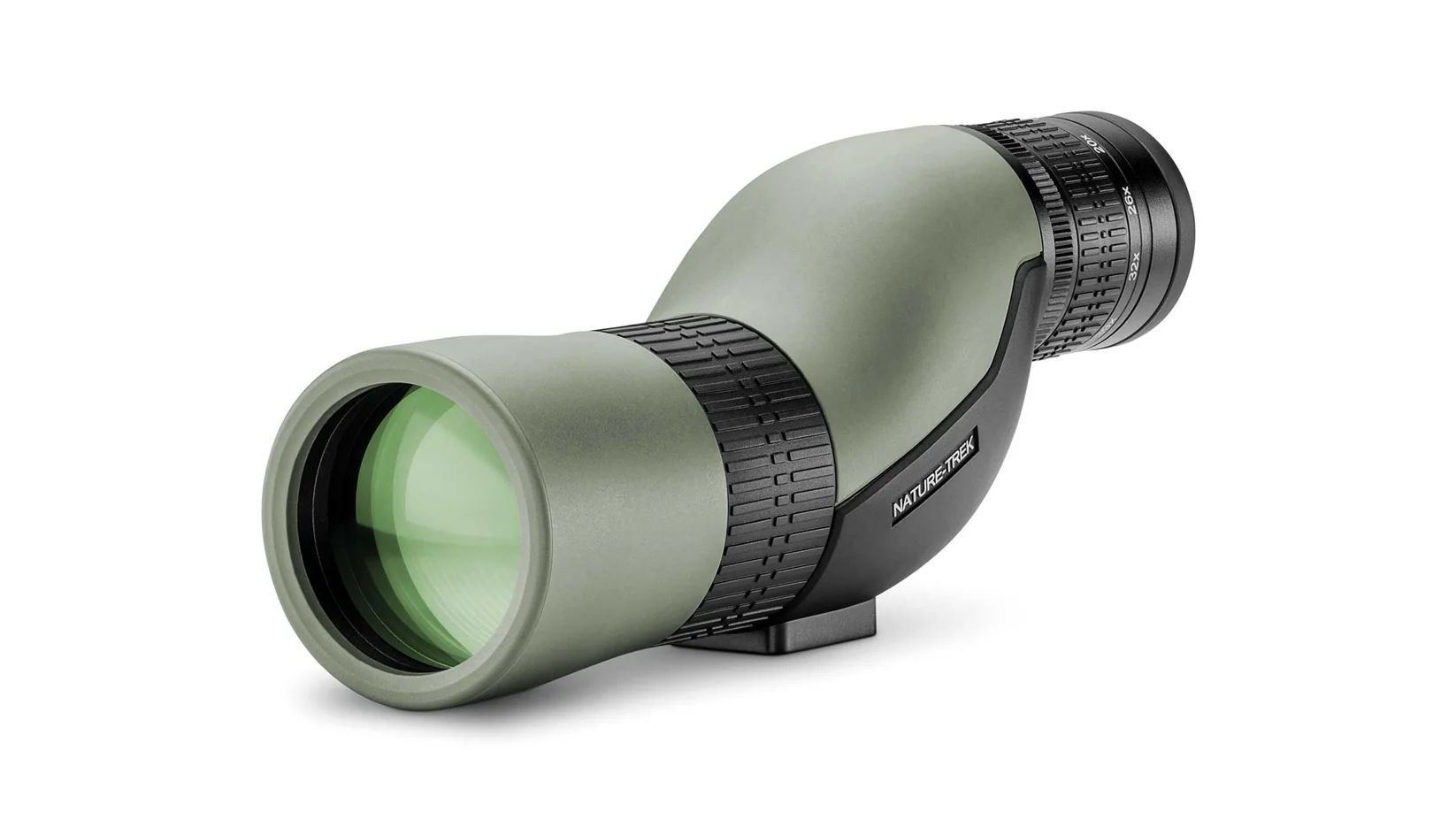
Hawke Nature-Trek Compact 13-39×56 Spotting Scope
€300.00
The Nature-Trek spotting scope family offers exceptional optical performance in a lightweight and waterproof modern design.
A Fully Multi-Coated optical system combined with BAK-4 Porro prisms produce extremely clear and sharp images.
The new ultra compact 56mm features barrel focussing with twist-up eye piece, delivering 39x magnification in a scope the size of your hand. Supplied with neoprene stay-on case.
- Ultra compact and lightweight construction
- Fully Multi-Coated optics to produce sharp images
- Close focus — see detail from 13.1ft/4.0m
- BAK-4 Porro prisms for intense colour and contrast
- Barrel Focus To Achieve Ultra Fine Focusing
- Stay-on soft scope cover for maximum protection
- Twist-up eye cup
- Digi-scope compatible for use with your camera
- Nitrogen purged — water and fog proof
Hawke Nature-Trek Compact 13-39×56 Spotting Scope
Hawke Nature-Trek Compact 13-39×56 Spotting Scope – Optical Performance, Construction, Versatility and Outdoor Applications
1. Introduction to the Hawke Nature-Trek Compact 13-39×56 Spotting Scope
The Hawke Nature-Trek Compact 13-39×56 Spotting Scope has been designed for outdoor enthusiasts seeking a practical combination of optical clarity, adjustable magnification, portability and dependable construction. Developed for nature observation, wildlife watching, birdwatching and landscape viewing, this compact spotting scope provides a versatile optical solution for users who appreciate detailed observation without carrying unnecessarily large equipment.
Featuring variable magnification from 13x to 39x and a 56mm objective lens, this spotting scope offers flexibility across different outdoor viewing situations. Furthermore, its compact design makes transportation and storage more convenient.
The Hawke Nature-Trek range is associated with accessible outdoor optics, combining practical construction with optical features intended for recreational observation.
2. Advanced Optical Performance and Magnification
One of the most important characteristics of this spotting scope is its variable magnification system.
The 13-39x magnification range provides flexibility when observing wildlife, birds, distant landscapes and other outdoor subjects.
At lower magnification, a wider viewing area can be appreciated. Meanwhile, increased magnification provides a closer visual presentation of distant details.
Furthermore, the 56mm objective lens contributes to the optical system’s light-gathering capability.
The combination of objective diameter, optical coatings and lens construction influences overall image quality.
3. The Importance of the 56mm Objective Lens
The objective lens is responsible for collecting incoming light.
A 56mm objective provides a substantial optical opening for a compact spotting scope.
Consequently, it contributes to the instrument’s ability to present useful images under different outdoor lighting conditions.
However, brightness also depends on magnification, optical transmission, exit pupil and environmental conditions.
4. Why Choose a Compact Spotting Scope?
Portability is particularly important for people who regularly travel with outdoor equipment.
A compact spotting scope can be transported more conveniently than many larger observation instruments.
Furthermore, its practical dimensions make it suitable for nature excursions, hiking, outdoor trips and general recreational observation.
5. Wildlife Observation and Birdwatching
Birdwatchers frequently require optical equipment that can present useful details without unnecessary bulk.
The adjustable magnification provides flexibility when observing birds at different distances.
Furthermore, the compact construction makes the instrument attractive for people who prefer lightweight outdoor equipment.
Wildlife enthusiasts can also appreciate the opportunity to observe animals while maintaining a respectful distance.
6. Optical Clarity and Lens Coatings
Optical coatings are important because they influence how light interacts with glass surfaces.
Multi-coated optical surfaces help manage reflections and improve light transmission.
Furthermore, optical clarity depends on the quality of the glass and the precision of the complete lens assembly.
These characteristics contribute to a more comfortable viewing experience.
7. Understanding Parallax in Optical Instruments
Parallax describes apparent displacement between visual references when the observer changes viewing position.
It is an important optical concept when comparing different instruments.
Customers researching what is parallax in optics, what is parallax in a scope, or what is parallax in a rifle scope may encounter the term when studying other optical products.
However, spotting scopes and riflescopes have different intended applications and should not be treated as interchangeable products.
8. Outdoor Durability and Practical Construction
Outdoor optical equipment may be exposed to dust, changing temperatures, humidity and occasional rainfall.
Consequently, suitable construction and responsible storage are important.
The instrument should be protected against accidental impacts and unnecessary exposure to harsh environmental conditions.
Furthermore, suitable protective cases can help preserve its exterior.
9. Why the Hawke Nature-Trek Is Worth Considering
This spotting scope offers a practical combination of variable magnification, a substantial objective lens and compact construction.
It is particularly appealing to customers who require an optical instrument for recreational observation, nature exploration and outdoor activities.
Its compact format also makes it a convenient alternative to carrying larger observation equipment.
10. Understanding Other Optical Products and Related Search Terms
Customers researching outdoor optics may encounter several other products and technical terms. The following are useful comparison and research topics, although they are not accessories or specifications of this spotting scope.
Other spotting scopes and optical products:
- minotaur 10-50×60
- vector minotaur 10 50×60
- swfa ss 10×42
- delta stryker
- delta optics
- element optics
- schmidt and bender scopes
- march riflescope adjustments argon filled d42hv56wfml g2
- falcon optics
- zco optics
- tpo scopes
- hikmicro stellar sx60l thermal scope
- best digital night vision scope
- best night vision scope
- dnt optics review
- dnt thermal scope review
- tnc225r review
- swfa scope review
Optical retailers and shopping research:
- optics warehouse
- optic warehouse
- optics planet
- red dot uk
Mounting and accessory terminology:
- picatinny
- picatinny dimensions
- picatinny scope base
- 1913 rail
- tactical rail
- scope mount
- parker hale scope rings for sale
- difference between weaver and picatinny rail
- what is a picatinny rail
Other optical and equipment terminology:
- sniper hider
- bipod for rifle
- best rifle bipod for long range shooting
- ir illuminator
- scope illumination
- zero stop scope
- what is zero stop on a scope
- ballistic solver
- chrony chronograph
- scope torque wrench
- what is the moa of a scope
- prs spotting scope setups
- best scope for air rifle
These terms belong to broader optics and equipment research. They should not be interpreted as included features of the Hawke Nature-Trek Compact.
Optical Quality, Image Clarity, Construction, Outdoor Performance, Maintenance, Durability and Frequently Asked Questions
Understanding Optical Quality and Image Clarity
The Importance of Clear Observation
Optical clarity is one of the most important characteristics of any observation instrument. Whether an individual is exploring natural landscapes, watching birds, observing wildlife or enjoying distant scenery, a clear image contributes significantly to the overall experience.
A good optical system should provide a balanced combination of sharpness, contrast, colour reproduction and brightness. These characteristics work together to make visual information easier to interpret.
Furthermore, image quality should remain comfortable during extended observation. Excessive glare, poor contrast and inconsistent sharpness can make viewing less enjoyable.
Consequently, optical performance should be considered as a complete system rather than judged by one specification.
Understanding Image Sharpness
Sharpness describes how clearly the edges and details of an observed subject are presented.
Several factors influence this characteristic, including glass quality, lens alignment, optical coatings and manufacturing precision.
Additionally, environmental conditions can influence perceived sharpness.
For example, atmospheric haze, airborne dust and heat distortion may reduce the visibility of distant subjects.
Therefore, even a well-designed optical instrument cannot completely eliminate environmental limitations.
Contrast and Visual Definition
Contrast describes the difference between light and dark areas within an image.
Good contrast helps distinguish individual details, particularly when subjects have similar colours to their surroundings.
Furthermore, balanced contrast can improve the overall appearance of an observed landscape.
However, excessively high contrast is not always desirable because subtle details may become difficult to distinguish.
A natural balance is therefore important.
Colour Accuracy and Natural Appearance
Accurate colour reproduction contributes to a realistic observation experience.
Natural colours make it easier to distinguish different elements in an environment.
For example, birdwatchers may appreciate the ability to observe variations in feather colour, while nature enthusiasts may value realistic landscape tones.
Furthermore, optical materials and surface treatments influence how light is transmitted.
Colour reproduction may nevertheless vary according to surrounding light and weather conditions.
Understanding Light Transmission
Light transmission describes the proportion of incoming light that passes through an optical system.
Every optical surface can introduce some reflection or light loss.
Consequently, the quality of the glass and the coatings applied to it can influence the final image.
Furthermore, the number of optical elements and their arrangement contribute to the overall result.
Good optical engineering seeks to manage these factors to provide a balanced viewing experience.
Lens Coatings and Their Importance
Optical coatings are applied to glass surfaces to manage unwanted reflections.
They can also contribute to improved contrast and image transmission.
However, coatings must be manufactured and applied consistently.
Furthermore, their effectiveness depends on the complete optical design.
Careful handling is essential because even high-quality optical surfaces can be scratched by unsuitable cleaning materials.
Observing Fine Details
Fine-detail observation can be particularly rewarding when exploring natural environments.
The ability to distinguish small visual features can improve the experience of birdwatching and wildlife observation.
However, perceived detail depends on several factors.
Distance, illumination, atmospheric conditions and image stability all contribute.
Consequently, realistic expectations should always be maintained.
Understanding Viewing Comfort
The Importance of Comfortable Observation
Comfort is an essential consideration when using optical equipment for extended periods.
An uncomfortable viewing position can cause unnecessary fatigue.
Furthermore, prolonged observation without breaks may result in eye strain.
A suitable seating or standing position can help improve the overall experience.
Users should also avoid pressing their eyes unnecessarily against optical surfaces.
Eye Position and Viewing Consistency
Maintaining a comfortable eye position helps establish a consistent viewing experience.
Different individuals may have different facial characteristics and viewing preferences.
Consequently, the instrument should be positioned naturally rather than forcing an uncomfortable posture.
Furthermore, appropriate positioning can reduce unnecessary movement.
Diopter Considerations
Some optical instruments incorporate individual eyesight adjustment.
Such systems are designed to accommodate differences in vision.
However, adjustment mechanisms should only be used according to the manufacturer’s instructions.
They do not replace prescription eyewear or professional eye care.
Reducing Eye Fatigue
Extended observation should be interrupted by regular breaks.
Furthermore, adequate lighting can contribute to a more comfortable experience.
Users should avoid unnecessarily prolonged viewing under difficult conditions.
A comfortable observation routine can make outdoor activities more enjoyable.
Performance in Different Outdoor Environments
Nature Observation in Open Landscapes
Open landscapes provide excellent opportunities for recreational observation.
Mountains, forests, lakes and coastal environments offer varied subjects.
Furthermore, distant scenery can reveal details that are difficult to appreciate with unaided vision.
An observation instrument provides a convenient way to explore these surroundings.
However, visibility can vary considerably according to atmospheric conditions.
Birdwatching in Natural Habitats
Birdwatching requires patience and respect for wildlife.
Birds may move unpredictably, making observation an engaging activity.
Furthermore, maintaining a suitable distance helps avoid disturbing natural behaviour.
An optical instrument can support responsible observation without requiring unnecessary physical proximity.
Woodland Observation
Woodland environments present different viewing conditions from open landscapes.
Trees, vegetation and changing light can influence visibility.
Furthermore, darker surroundings may reduce the amount of available light.
Choosing appropriate observation times can improve the experience.
Coastal Observation
Coastal environments provide opportunities to observe seabirds, marine landscapes and distant shoreline features.
However, salt spray and moisture can affect outdoor equipment.
Consequently, suitable cleaning and storage practices are particularly important after coastal use.
Mountain and Highland Observation
Mountain environments offer wide views and changing atmospheric conditions.
However, temperature differences, wind and reduced visibility may influence the observation experience.
Furthermore, equipment should be carried securely during outdoor excursions.
Observation During Overcast Conditions
Cloud cover changes the amount and distribution of natural light.
Images may appear less bright than under direct sunlight.
Nevertheless, overcast conditions can sometimes reduce harsh reflections and provide comfortable viewing.
The result depends on the surrounding environment.
Observation During Early Morning
Early morning can provide excellent opportunities for wildlife observation.
Many animals are active during particular morning periods.
Furthermore, cooler temperatures may produce different atmospheric conditions from those experienced later in the day.
However, available light should always be considered.
Observation During Evening Hours
Evening observation can provide opportunities to appreciate changing landscapes and wildlife activity.
Nevertheless, declining natural light may influence visibility.
Furthermore, users should ensure that they can safely navigate their surroundings.
Portability and Everyday Convenience
Why Compact Equipment Is Practical
Compact equipment is easier to transport than many larger alternatives.
This can be especially useful during outdoor excursions involving walking or hiking.
Furthermore, smaller equipment may require less storage space.
These characteristics contribute to everyday convenience.
Carrying Equipment During Hiking
When travelling on foot, equipment weight becomes an important consideration.
Carrying unnecessary items may increase fatigue.
Consequently, selecting equipment according to the planned activity is beneficial.
Protective storage arrangements can also help prevent accidental damage.
Storage Between Outdoor Activities
Appropriate storage contributes to product preservation.
Equipment should be kept in a clean and dry environment.
Furthermore, direct sunlight and excessive heat should be avoided.
A suitable protective case can help reduce dust accumulation.
Travelling With Optical Equipment
Transportation introduces opportunities for accidental impacts.
Consequently, equipment should be secured properly.
Protective padding can help reduce movement during travel.
Furthermore, delicate optical surfaces should remain covered when the instrument is not being used.
Understanding Weather and Environmental Protection
Protection Against Dust
Dust can accumulate on external surfaces and around moving components.
Furthermore, airborne particles may become particularly noticeable in dry outdoor environments.
Regular visual inspection can help identify contamination.
Appropriate cleaning methods should be used rather than wiping dry particles aggressively across optical surfaces.
Managing Moisture
Moisture can accumulate during outdoor activities.
Rainfall, humidity and condensation may affect equipment.
Consequently, equipment should be dried appropriately before long-term storage.
Temperature Changes
Moving between warm and cold environments may produce temporary condensation.
Furthermore, sudden temperature changes can influence the appearance of optical surfaces.
Allowing equipment to adjust gradually may help reduce unnecessary condensation.
Protecting Against Direct Sunlight
Prolonged direct sunlight can influence some exterior materials.
Furthermore, leaving equipment inside a hot vehicle may expose it to excessive temperatures.
Suitable storage practices help protect the original finish.
Responsible Outdoor Use
Outdoor observation should always be conducted responsibly.
Wildlife should not be disturbed unnecessarily.
Furthermore, users should respect restricted areas and local environmental regulations.
Appropriate clothing and general outdoor safety precautions are also important.
Cleaning and Maintenance
Establishing a Maintenance Routine
Regular maintenance helps preserve the appearance and functionality of optical equipment.
However, excessive cleaning can be unnecessary.
A simple routine involving inspection, appropriate cleaning and suitable storage is generally preferable.
Cleaning the Exterior
External surfaces may accumulate dust, fingerprints and other contaminants.
A soft, suitable cleaning cloth can be used to maintain appearance.
Furthermore, abrasive materials should be avoided.
Cleaning Optical Surfaces
Optical surfaces require additional care.
Loose particles should be removed using an appropriate optical cleaning tool before wiping.
Otherwise, small particles may cause scratches.
Manufacturer-approved cleaning products should be preferred.
Avoiding Harsh Chemicals
Certain cleaning chemicals can damage protective coatings and exterior finishes.
Consequently, household solvents should not be used unless expressly approved by the manufacturer.
Maintaining Protective Accessories
Carrying cases and protective covers should also be inspected.
Damaged padding may provide reduced protection.
Furthermore, contaminated covers should be cleaned appropriately.
Checking for Visible Damage
Routine inspection can help identify changes in the exterior condition.
Cracks, unusual marks, loose components or deformation should be investigated.
Equipment suspected of having internal damage should receive professional assessment.
Professional Inspection
Professional inspection may be appropriate if the instrument has experienced a significant impact.
Furthermore, unexplained changes in image quality may indicate a problem requiring specialist attention.
Attempting unauthorized internal repairs should be avoided.
Understanding the Value of Quality Outdoor Equipment
Why Construction Quality Matters
Construction quality influences durability, consistency and overall ownership satisfaction.
Furthermore, suitable materials can contribute to long-term reliability.
However, even well-manufactured equipment requires responsible handling.
The Importance of Manufacturing Consistency
Manufacturing consistency helps ensure that products meet their intended specifications.
Furthermore, quality-control procedures can reduce unwanted variation.
Customers should consider manufacturer documentation when evaluating product specifications.
Long-Term Ownership
Long-term ownership involves more than the initial purchase.
Maintenance, storage and transportation all contribute to the condition of equipment over time.
Furthermore, responsible ownership can help preserve its appearance and usefulness.
Pre-Owned Equipment Considerations
When purchasing previously owned equipment, customers should inspect its condition carefully.
Visible damage, missing accessories and previous repairs should be disclosed.
Furthermore, current photographs should accurately represent the actual product.
Understanding Resale Value
Resale value depends on several factors.
These include condition, product age, demand, originality and the availability of newer alternatives.
Furthermore, the presence of original accessories may influence buyer interest.
However, future resale prices cannot be guaranteed.
Responsible Observation and Outdoor Enjoyment
Respecting Wildlife
Wildlife observation should always be conducted responsibly.
Animals should not be approached unnecessarily.
Furthermore, observers should avoid disturbing nesting sites and sensitive habitats.
Maintaining a respectful distance helps protect natural behaviour.
Protecting Natural Environments
Outdoor enthusiasts have a responsibility to protect the environments they visit.
Litter should be removed, vegetation should be respected, and local access regulations should be followed.
Furthermore, environmentally responsible behaviour helps preserve natural spaces for future visitors.
Observation as an Educational Activity
Outdoor observation can support learning about wildlife, geography and the natural environment.
Furthermore, it can encourage patience and curiosity.
Children and beginners may particularly benefit from supervised outdoor observation activities.
Family Outdoor Activities
Nature observation can be enjoyed individually or as a family activity.
Furthermore, sharing observations can encourage interest in wildlife and environmental protection.
Suitable supervision should always be provided for younger participants.
Frequently Asked Questions
1. What is a spotting scope primarily used for?
A spotting scope is designed for observing distant subjects in greater visual detail. It is commonly used for birdwatching, wildlife observation, landscape viewing and outdoor recreation.
2. Is a spotting scope suitable for beginners?
Yes. A compact observation instrument can be a useful introduction to outdoor optics. Beginners should take time to understand focusing, viewing comfort and proper handling.
3. Can it be used for birdwatching?
Spotting scopes are commonly used for birdwatching because they provide magnified views of distant birds.
4. Can it be used for wildlife observation?
Yes. It can support responsible wildlife observation by allowing viewers to maintain a respectful distance.
5. Why is optical clarity important?
Optical clarity helps distinguish details and contributes to a more enjoyable viewing experience.
6. Does magnification determine overall quality?
No. Magnification is only one characteristic. Glass quality, contrast, light transmission and image stability are also important.
7. What influences image brightness?
Objective diameter, optical transmission, magnification and surrounding light conditions all contribute.
8. Can weather influence observation?
Yes. Rain, humidity, atmospheric haze and heat distortion can influence visibility.
9. Is outdoor storage recommended?
Outdoor storage without protection is generally not recommended. A clean, dry and secure indoor location is preferable.
10. How should the instrument be cleaned?
Appropriate optical cleaning materials should be used. Manufacturer instructions should always be followed.
11. Can ordinary tissues damage optical surfaces?
Yes. Some tissues and paper products may contain fibres or particles that can scratch delicate surfaces.
12. Why should equipment be stored in a protective case?
A suitable case helps reduce accidental impacts, dust accumulation and cosmetic damage.
13. Can the instrument be transported during hiking?
Yes. Its compact format makes transportation more convenient than carrying many larger observation instruments.
14. Why is a stable viewing position useful?
A stable position can improve comfort and reduce unwanted movement during observation.
15. Can it be used near the coast?
Outdoor observation near the coast is possible, but salt spray and moisture should be managed through appropriate cleaning and storage.
16. Does compact construction mean reduced quality?
Not necessarily. Compactness describes physical dimensions rather than automatically indicating lower optical quality.
17. Why should optical surfaces be protected?
They are delicate components that influence image quality and can be damaged through unsuitable handling.
18. Can condensation develop?
Yes. Changes in temperature and humidity can cause temporary condensation.
19. What should be done if image quality suddenly changes?
The exterior should be inspected for contamination or damage. If the problem continues, professional assessment may be appropriate.
20. Is regular maintenance necessary?
Yes. Appropriate cleaning, inspection and storage contribute to long-term preservation.
21. Can the instrument be used during cloudy weather?
Yes. However, available light may influence image brightness.
22. Is it suitable for landscape observation?
Yes. Landscape observation is one of the common recreational applications of spotting scopes.
23. Can children use optical equipment?
Children can participate in supervised observation activities. Appropriate handling and adult guidance are recommended.
24. How can equipment be protected during transportation?
A suitable protective case and secure positioning can help reduce accidental impacts.
25. Does good maintenance improve resale appeal?
Proper maintenance can help preserve appearance and may contribute positively to resale interest.
26. What should be checked when buying used equipment?
Buyers should inspect the exterior, optical surfaces, focusing mechanism, included accessories and any available ownership documentation.
27. Why should the original specifications be verified?
Manufacturer documentation provides a reliable reference for understanding the product’s intended features and capabilities.
28. Can optical equipment be repaired?
Some issues can be addressed by qualified technicians, depending on the nature of the damage.
29. Is protective packaging important?
Yes. Appropriate packaging helps reduce the risk of damage during transportation.
30. What contributes most to long-term product preservation?
Responsible handling, suitable storage, careful cleaning and routine inspection are among the most important factors.
Final Product Assessment
A compact observation instrument can provide considerable convenience for people who enjoy exploring nature and appreciating distant scenery.
Its usefulness extends beyond a single outdoor activity. Birdwatching, wildlife observation, landscape appreciation and general recreational viewing can all benefit from suitable optical equipment.
Furthermore, proper maintenance and responsible handling help preserve its condition.
Customers should always verify the exact model specifications, included accessories and product condition before purchasing.
Ultimately, a satisfying ownership experience depends on selecting equipment that matches individual observation requirements, maintaining realistic expectations and caring for the instrument appropriately.
Be the first to review “Hawke Nature-Trek Compact 13-39×56 Spotting Scope”
Related products

Reviews
There are no reviews yet.