
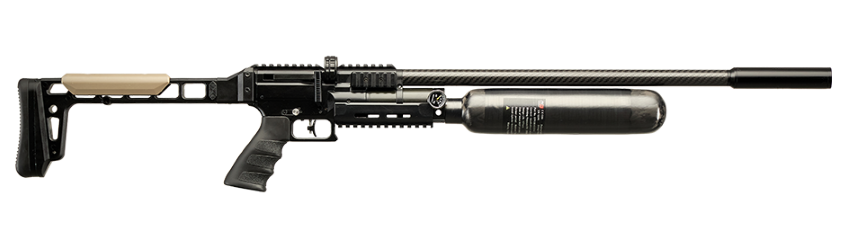
Snowpeak AP1000B

€380.00
The Snowpeak AP1000B gives you full sized PCP performance in a portable, reliable setup. It uses a smooth regulated system with a 500cc carbon bottle that fills to 250 bar which keeps your shots consistent and stable.
The 500mm rifled barrel delivers excellent accuracy and the folding synthetic stock lets the rifle pack down for easy transport without losing strength or comfort. Available in .177 and .22 calibres, the AP1000B offers solid power, a dependable action and a practical design that works equally well for hunting, pest control or long relaxed plinking sessions.
Snowpeak AP1000B Features
- Compact, light and versatile
- Folding synthetic stock
- Picatinny rail for optics
- Side-lever
- 3 way adjustable trigger
- Steel barrel with integrated moderator
Sowpeak AP1000B Specifications
| Type | PCP |
| Scope Rail | Picatinny |
| Power Output | 10.8 – 11.8 ft lbs |
| Shots Per Fill Approx
.177 |
160 |
| Magazine Capacity
.177 |
12 |
| Number of Magazines | 1 |
| Overall Length | 725mm ( Adjusted) – 945mm (Total) |
| Barrel Length | 500mm |
| Cylinder Capacity | 500cc |
| Max Fill Pressure | 250 Bar |
| Weight | 2.15kg |
| Warranty | 1 Year |
| Rifle Comes With | Fill Probe |
Snowpeak AP1000B – Technical Full-Size PCP Carbine Overview
AP1000B Engineering, PCP Architecture, Precision, and Related Snowpeak Platforms
Snowpeak Airguns
snowpeak airguns covers a broad range of PCP pistols, carbines, bullpups, and full-size rifles. Because the catalog contains many closely related model names, technical specifications should always remain tied to the exact platform being discussed.
Snowpeak Sports
snowpeak sports is the manufacturer’s official product catalog. The AP1000B is listed there as a full-size carbine with a 500 mm barrel, folding stock, and 250 cc or 500 cc air-capacity options.
Snowpeak AP1000B
The AP1000B is a full-size PCP carbine with a long barrel, folding stock, manual safety, and multiple caliber choices. Its current listed weight is approximately 2.6 kg.
Full-Size Carbine Architecture
The design prioritizes a longer overall platform than the compact models in the same family.
This provides a different handling character, more traditional shoulder positioning, and a longer structural layout around the barrel and stock.
500 mm Barrel
The AP1000B uses a 500 mm barrel, giving it a longer barrel than the AP900B’s 310 mm configuration.
Folding Stock
The folding-stock architecture reduces the overall length from approximately 945 mm to 725 mm for storage and transportation.
Air Capacity
Snowpeak lists 250 cc and 500 cc air-capacity options for the platform. This allows the same general design to be configured with different onboard air-storage volume.
.177 Configuration
The 4.5 mm/.177 version is manufacturer-rated at approximately 1000 fps.
.22 Configuration
The 5.5 mm/.22 version is listed at approximately 950 fps.
.25 Configuration
The 6.35 mm/.25 version is listed at approximately 850 fps.
Trigger Characteristics
Snowpeak lists a trigger-pull range of approximately 2–5 lbf. Trigger consistency can support predictable recreational target use, provided adjustment and maintenance remain within the intended operating range.
Manual Safety
The AP1000B uses a manual safety. This should always be treated as an additional mechanical safeguard rather than a substitute for responsible handling.
PCP Pellet Rifle
The AP1000B belongs to the pcp pellet rifle category because compressed air is stored onboard before operation.
What Is a PCP Airgun?
For what is a pcp airgun, PCP means pre-charged pneumatic.
Compressed air is stored in a reservoir and then released through the internal valve system during operation.
Snowpeak AP900
The snowpeak ap900 is the compact member of this family. Snowpeak lists a 310 mm barrel, approximately 855 mm overall length, and lighter construction.
AP900B PCP Air Rifle
The ap900b pcp air rifle is the shorter B-series sibling. It uses a 310 mm barrel and a folded length of approximately 600 mm, compared with the AP1000B’s 500 mm barrel and 725 mm folded length.
Snowpeak PP750L PCP Air Pistol
The Snowpeak PP750L PCP Air Pistol belongs to a compact pistol/carbine family rather than a full-size carbine.
Snowpeak PP750L
The Snowpeak PP750L should therefore remain technically separate from the AP1000B.
Snowpeak PP750
The snowpeak pp750, pp750, and snow peak pp750 terms refer to another compact PCP platform.
Snowpeak Air Pistol
The phrase Snowpeak Air Pistol describes a different form factor from the AP1000B.
PCP Pistol
A PCP Pistol uses the same broad compressed-air principle but differs substantially in barrel length, ergonomics, reservoir layout, and handling.
Airgun Pistol
An Airgun Pistol is broader terminology and can include PCP, spring, and CO₂-powered designs.
High Power PCP Air Pistol
The phrase High power PCP air pistol does not describe the AP1000B because this model is a carbine-format rifle.
Snowpeak PP750L PCP Air Pistol for Sale
The phrase Snowpeak PP750L PCP Air Pistol for sale concerns another product family and should remain separate from AP1000B technical information.
Snowpeak P35
The snowpeak p35, p35, and pcp p 35 terms refer to a compact bullpup PCP rifle family rather than a conventional full-size carbine.
Snowpeak P35X
The snowpeak p35x, p35x, and p35x pcp terms refer to another bullpup platform with its own barrel, reservoir, and stock architecture.
Snowpeak P35 vs P35X
The phrase snowpeak p35 vs p35x concerns comparison within that bullpup family and should not be used as AP1000B specification data.
PR900 Gen 3
The pr900 gen 3 belongs to another PCP rifle family and should be evaluated separately.
Snowpeak PP20
The snowpeak pp20 and snow peak pp20 terms refer to a precision-oriented PCP pistol rather than a full-size carbine.
Snowpeak M25
The snowpeak m25 is a larger conventional PCP rifle. Snowpeak lists it with a 550 mm barrel, 245 cc air capacity, 25 MPa maximum pressure, and caliber options extending to 9 mm.
M25 Rifle
The phrase m25 rifle therefore refers to another larger PCP platform.
M25 Weapon
The phrase m25 weapon may appear in search queries, although exact model terminology provides more useful technical information.
Snowpeak M60
The snowpeak m60 belongs to another rifle family and should not be treated as an AP1000B variant.
Snowpeak M60B
The snowpeak m60b is another separate pneumatic platform.
How Much Did the M60 Weigh?
The phrase how much did the m60 weigh is ambiguous because the M60 designation is used for unrelated products.
Exact manufacturer context should therefore be confirmed before quoting specifications.
M50 Rifle
The phrase m50 rifle is similarly ambiguous and should remain separate from AP1000B technical content.
Snowpeak Max
The term snowpeak max belongs to another product family.
Snowpeak Max 1 Price
The phrase snowpeak max 1 price concerns another model. The current MAX 1 is listed with 550 cc air capacity, a 700 mm barrel, 30 MPa fill pressure, and regulator.
HP300
The term hp300 is ambiguous and should not be incorporated into AP1000B technical specifications without exact model confirmation.
Pellet 9mm
The phrase pellet 9mm does not describe the AP1000B. Snowpeak currently lists the AP1000B only in 4.5, 5.5, and 6.35 mm.
Snow Peak Equipment
The phrase snow peak equipment is broad and can produce results for unrelated outdoor brands.
Exact product names help prevent brand confusion.
Snowpeaks
The term snowpeaks is a broad spelling variation and should not replace exact model terminology.
Air Gun Accessories
The phrase air gun accessories can include compatible optics, protective cases, maintenance supplies, fill equipment, and manufacturer-approved replacement components.
Compatibility should always be confirmed for the exact platform.
Snowfall Gun
The phrase snowfall gun is not a verified technical synonym for the AP1000B.
Snow Peak Customer Service
The phrase snow peak customer service may produce results for unrelated companies using similar branding.
Technical support should therefore be obtained from the correct pneumatic-equipment manufacturer or authorized distributor.
Snow Peak Brand Origin
The phrase snow peak brand origin can also create confusion because similar company names exist in other industries. Snowpeak’s official airgun catalog lists its operations in Shaoxing City, Zhejiang Province, China.
Pistolet PCP Arcea-Snowpeak Onix Sport
The phrase pistolet pcp arcea-snowpeak onix sport reflects regional distributor terminology for other pneumatic equipment and should not be treated as an AP1000B designation.
T Rex 6000
The term t rex 6000 does not represent a verified AP1000B specification.
Why the 500 mm Barrel Matters
The longer barrel distinguishes the AP1000B from the compact AP900B and helps define its full-size carbine character.
The overall platform remains foldable despite the longer barrel.
Why the Folding Stock Matters
The stock reduces overall storage length by roughly 220 mm when folded.
That can simplify protected transportation and storage while retaining a full-size shoulder-supported configuration when extended.
Why Air Capacity Matters
The choice between 250 cc and 500 cc changes how much compressed air the platform can carry onboard.
Reservoir condition, seals, fittings, and pressure-system integrity remain important regardless of capacity.
Why Precision Depends on More Than Velocity
Maximum velocity does not independently determine precision.
Barrel condition, pellet uniformity, sight stability, pressure behavior, trigger consistency, environmental conditions, and user technique all contribute to repeatability.
Overall Technical Perspective
The Snowpeak AP1000B is best understood as a full-size PCP carbine offered in 4.5, 5.5, and 6.35 mm, with a 500 mm barrel, folding stock, 250 cc or 500 cc air-capacity options, manual safety, 2–5 lbf trigger pull, approximately 945 mm extended length, 725 mm folded length, and roughly 2.6 kg listed weight.
Its technical identity should remain clearly separate from the AP900B, P35, PP750, PP20, M25, M60, MAX, and other Snowpeak families. For a neutral technical assessment, the most meaningful considerations are verified manufacturer specifications, reservoir condition, barrel integrity, trigger consistency, sight stability, suitable ammunition, careful transportation, dry storage, and qualified servicing whenever pressure-bearing components require attention.
Engineering Quality, Full-Size Handling, Precision Factors, Air-System Consistency, and Practical Performance
A full-size pre-charged pneumatic carbine should be evaluated as a complete mechanical system rather than through one headline performance figure. Barrel construction, reservoir condition, valve behavior, trigger consistency, stock geometry, sight stability, ammunition uniformity, and overall structural integrity work together to determine practical performance. Furthermore, a folding-stock configuration introduces additional considerations involving balance, transportation, storage, and mechanical rigidity. When these elements remain properly maintained, the result can be a predictable and comfortable platform for responsible recreational target use.
Full-Size Engineering Design
A longer platform creates a noticeably different handling character from a compact configuration.
The extended structure provides additional space between the main contact points, while the longer barrel contributes to the overall balance.
Consequently, the equipment may feel more traditionally proportioned when supported from the shoulder.
Folding Stock Architecture
A folding stock adds practical flexibility without requiring the complete platform to remain at its maximum length during storage.
When extended, the stock provides the intended rear support.
When folded for appropriate storage or transportation, the overall footprint becomes substantially more manageable.
Stock Hinge Condition
The folding mechanism should remain structurally secure.
Excessive movement at the hinge can affect the overall feeling of rigidity.
Therefore, this area deserves periodic visual inspection for wear, looseness, or accidental damage.
Extended Stock Stability
Once fully extended, the stock should provide a stable mechanical connection.
Unexpected movement can interfere with consistent positioning.
A damaged locking mechanism should be inspected rather than repeatedly forced into operation.
Overall Balance
Balance depends on where the barrel, reservoir, action, grip, and stock position the equipment’s mass.
A longer configuration may feel different from a short carbine even when overall weight remains moderate.
Good distribution can reduce unnecessary fatigue during controlled recreational sessions.
Shoulder Position
Comfortable shoulder support helps establish a repeatable posture.
However, individual body proportions influence how naturally any particular stock design fits.
Sight height can also affect head and neck positioning.
Grip Ergonomics
Grip geometry determines wrist angle and trigger reach.
A natural position can help reduce unnecessary muscular tension.
Because hand dimensions vary, comfort should be evaluated individually rather than assumed from specifications.
Barrel Construction
A long barrel represents an important structural and functional component.
It should remain protected against impact, contamination, and improper maintenance.
The mounting area and muzzle deserve particular attention during inspection.
Barrel Stability
A secure barrel helps maintain predictable mechanical alignment.
Unexpected movement should not be considered normal.
Significant looseness requires inspection before continued recreational use.
Bore Condition
The internal barrel surface should remain unobstructed and appropriately maintained.
Cleaning should be performed only when necessary and according to manufacturer guidance.
Aggressive cleaning techniques can introduce avoidable wear.
Understanding Precision
Precision is the result of multiple variables interacting successfully.
Barrel condition, ammunition consistency, pressure behavior, sight stability, trigger predictability, environmental conditions, and user technique all contribute.
Therefore, maximum velocity alone provides an incomplete picture.
Ammunition Uniformity
Uniform projectiles generally provide a stronger foundation for repeatable performance.
Variations in dimensions, mass, or physical condition can influence consistency.
Only ammunition matching the manufacturer’s specified caliber should be considered.
Trigger Predictability
A predictable trigger can support consistent recreational target use.
The most important quality is repeatability rather than simply minimal resistance.
Unexpected changes in movement or engagement deserve attention.
Trigger Maintenance
Routine ownership should not require frequent internal trigger work.
If the mechanism begins behaving differently, inspection is preferable to repeated adjustment.
Complex servicing should be performed by appropriately qualified personnel.
Manual Safety
A mechanical safety provides an additional safeguard.
It should engage and disengage positively.
Nevertheless, safe handling practices remain necessary regardless of the position of any mechanical safety.
Air Reservoir
The reservoir stores compressed air and therefore represents a pressure-bearing component.
Its exterior should remain free from serious corrosion, deformation, or significant impact damage.
Questionable structural condition requires professional assessment.
Reservoir Capacity and Handling
A larger reservoir can alter both onboard air volume and weight distribution.
Consequently, different reservoir configurations may slightly change the way the platform balances.
Condition remains more important than capacity alone.
Pressure Retention
A healthy pneumatic system should retain pressure according to its intended design.
Persistent unexplained pressure loss may indicate deterioration in seals, fittings, valves, or related components.
Repeated leakage should be investigated.
Seal Condition
Seals naturally age.
Temperature, contamination, storage environment, and repeated pressure cycles can influence their service life.
Correct replacement materials should always be used when servicing becomes necessary.
Valve Reliability
The internal valve controls compressed-air release.
Predictable valve behavior contributes to mechanical consistency.
Because the valve forms part of the pressure system, complex internal work requires appropriate knowledge.
Pressure Monitoring
A readable pressure indicator helps the owner observe reservoir condition.
The gauge should remain physically protected.
Unexpected readings should be investigated rather than ignored.
Sight Stability
Installed sighting equipment should remain mechanically secure.
Even minor movement can create apparent changes in precision.
Therefore, mounting integrity should be checked whenever performance appears unexpectedly different.
Mounting Interfaces
Accessory mounting areas should remain clean and structurally sound.
Excessive tightening can damage hardware or mounting surfaces.
Only compatible equipment should be installed.
Consistency During Recreational Use
Mechanical consistency becomes easier to evaluate under controlled conditions.
Using comparable ammunition and environmental conditions allows changes to be recognized more easily.
One isolated result should not be treated as a complete performance assessment.
Environmental Conditions
Temperature, humidity, and wind can influence practical results.
Temperature changes may affect pressure behavior, while wind can influence projectile movement.
Environmental variables should therefore be considered when comparing different sessions.
Exterior Construction
External surfaces protect underlying structural materials.
Minor cosmetic marks may develop through normal handling.
However, deep corrosion, cracking, or deformation deserves considerably more attention.
Routine Cleaning
Cleaning should focus on preservation rather than unnecessary intervention.
Fingerprints, dust, and moisture can be removed from accessible exterior surfaces.
Complete internal disassembly is rarely necessary for ordinary routine care.
Moisture Protection
Persistent moisture can encourage corrosion.
Equipment should therefore be reasonably dry before being placed into storage.
This becomes particularly important in humid environments.
Appropriate Lubrication
Lubrication should follow manufacturer recommendations.
Excessive quantities can attract contamination, while unsuitable products may affect seals or finishes.
More lubricant does not automatically improve reliability.
Fastener Inspection
Accessible fasteners should remain secure and undamaged.
Damaged threads or worn fastener heads should be addressed with correctly specified replacement components.
Overtightening should be avoided.
Transportation
A properly fitted protective case can reduce accidental damage.
The barrel, sights, pressure system, and stock hinge deserve protection during movement.
Applicable transportation regulations should always be followed.
Storage With a Folding Stock
The folding mechanism can reduce the amount of storage space required.
However, the platform should still be supported properly inside its case.
Heavy objects should not place unnecessary pressure against the stock or hinge.
Long-Term Storage
Before extended storage, external surfaces should be clean and dry.
The environment should remain secure, reasonably temperature-stable, and protected from excessive humidity.
Pressure-system storage should follow manufacturer guidance.
Inspection After Storage
A basic visual inspection is appropriate after prolonged inactivity.
The reservoir, barrel, stock hinge, grip, controls, pressure indicator, sights, and accessible hardware can all be checked.
Significant deterioration deserves attention.
Avoiding Unnecessary Modification
Mechanical components are designed to operate within specific relationships.
Unverified modifications can affect reliability and component life.
Maintenance should prioritize preserving the intended mechanical condition.
Professional Servicing
Persistent leakage, pressure-system concerns, valve problems, substantial structural damage, or unreliable trigger behavior may require specialized attention.
High-pressure components should be treated with particular care.
Qualified servicing is preferable to improvised internal repairs.
Long-Term Durability
Durability depends heavily on ownership practices.
Careful transportation, dry storage, appropriate cleaning, periodic inspection, and timely servicing can significantly extend useful life.
Neglect can accelerate deterioration even when the original construction is robust.
Overall Practical Assessment
A full-size pneumatic carbine with a folding-stock architecture can provide a useful combination of traditional handling, manageable storage dimensions, stable shoulder support, and predictable recreational performance. Its longer configuration influences balance and ergonomics, while the folding mechanism provides additional practicality when the equipment is being stored or transported appropriately.
Long-term consistency ultimately depends on the complete system remaining healthy. Barrel integrity, reservoir condition, seal quality, valve reliability, trigger predictability, sight stability, structural rigidity, and appropriate ammunition all contribute to practical results. When combined with careful transportation, sensible maintenance, dry storage, and qualified attention to significant pressure-system problems, these characteristics can support dependable mechanical performance and extended recreational service life.
Real-World Usability, Comfort, Mechanical Reliability, Maintenance, and Long-Term Ownership
A full-size pneumatic carbine should provide more than strong specifications on paper. Practical value develops from the way the equipment handles during controlled recreational use, how consistently its mechanical systems operate, and how easily its condition can be preserved between sessions. The combination of a longer barrel, folding rear support, onboard compressed-air system, adjustable mechanical components, and durable exterior construction creates a platform that deserves careful evaluation as a complete system. Therefore, long-term satisfaction depends on ergonomics, structural condition, pressure integrity, sensible maintenance, and appropriate storage rather than any single performance figure.
Practical Handling Experience
Overall dimensions influence how equipment feels during ordinary handling.
A full-size configuration provides a more extended profile than a compact platform, creating a traditional relationship between the grip, shoulder contact point, and forward section.
This can provide a stable and familiar handling character.
Comfortable Shoulder Position
Consistent shoulder placement can improve comfort during recreational target sessions.
The rear support should remain mechanically secure when extended.
Individual body proportions, clothing, and sighting equipment can influence the ideal position.
Folding Mechanism Practicality
A folding rear section provides flexibility when the equipment is not being used.
Reducing overall storage length can make protective transportation more convenient.
However, the hinge and locking mechanism should always remain clean and structurally sound.
Hinge Durability
A folding mechanism experiences repeated mechanical movement.
Consequently, the hinge deserves periodic inspection.
Unexpected looseness, deformation, or unusual resistance should be investigated before the condition becomes more significant.
Locking Stability
Once extended, the rear section should lock securely.
Unwanted movement can affect the overall feeling of rigidity.
A worn locking interface should receive appropriate servicing rather than improvised adjustment.
Weight Distribution
Overall weight does not independently determine comfort.
The location of that mass matters equally.
Reservoir size, barrel length, action position, and rear construction all influence balance.
Grip Comfort
A naturally positioned hand can reduce unnecessary tension.
Trigger reach should feel manageable without requiring an awkward wrist angle.
Because users have different hand dimensions, comfort remains partly individual.
Head Position
Sight height influences head and neck posture.
A properly arranged sighting system should support a comfortable viewing position.
Poorly positioned equipment can make an otherwise balanced platform feel unnecessarily difficult to manage.
Mechanical Consistency
Predictable behavior is one of the strongest indicators of good mechanical condition.
Controls should feel familiar between sessions.
Sudden changes may indicate wear, contamination, loose hardware, or another maintenance issue.
Pressure-System Health
The compressed-air system requires particular attention because several components work together to retain and control pressure.
Reservoir integrity, seals, fittings, valves, and pressure-monitoring components should remain in appropriate condition.
Persistent abnormalities deserve investigation.
Reservoir Inspection
The reservoir exterior should be checked periodically.
Serious corrosion, deformation, or significant impact damage should not be dismissed as cosmetic wear.
Questionable pressure-bearing components require qualified professional assessment.
Pressure Retention
Stable pressure retention can provide useful information about system health.
Unexpected loss may indicate seal deterioration or another pneumatic problem.
Repeatedly compensating for leakage without identifying its source is not appropriate maintenance.
Seal Service Life
Seals gradually age even when the surrounding equipment remains structurally healthy.
Temperature changes, pressure cycles, contamination, and storage conditions can affect longevity.
Correct replacement materials help preserve intended performance.
Valve Condition
The internal valve plays an important role in controlling compressed air.
Its behavior should remain predictable.
Complex internal servicing should be handled by someone familiar with high-pressure pneumatic equipment.
Barrel Protection
The barrel should remain protected against accidental impact.
Particular attention should be given to the muzzle and mounting areas.
Damage in these locations can affect mechanical alignment and consistency.
Bore Maintenance
Internal cleaning should be based on actual condition rather than an arbitrary schedule.
Excessive cleaning can introduce unnecessary wear.
Appropriate materials and manufacturer recommendations should guide maintenance.
Precision and Repeatability
Practical precision develops through several interacting variables.
Barrel condition, ammunition uniformity, sight stability, trigger behavior, pressure consistency, environmental conditions, and user technique all contribute.
Therefore, isolated velocity figures cannot provide a complete assessment.
Consistent Ammunition
Uniform ammunition provides a stronger foundation for repeatability.
Physical damage or significant dimensional variation can influence performance.
Only suitable ammunition matching the manufacturer’s specified caliber should be considered.
Trigger Predictability
A consistent trigger can support repeatable recreational target use.
Predictability matters more than simply reducing resistance.
Unexpected changes in movement or engagement deserve inspection.
Trigger Care
Frequent internal adjustment is unnecessary for ordinary ownership.
If the trigger begins behaving differently, the cause should be identified.
Complex work is better left to qualified personnel.
Safety Mechanism Condition
The mechanical safety should operate positively and consistently.
Changes in engagement should receive attention.
Nevertheless, responsible handling remains essential regardless of mechanical safeguards.
Sight Mounting Stability
Loose sighting equipment can create apparent consistency problems.
Mounting hardware should therefore remain secure without being excessively tightened.
Damaged interfaces should be corrected before compatible equipment is installed.
Exterior Surface Protection
Metal and synthetic surfaces benefit from basic routine care.
Fingerprints, moisture, dust, and contamination should not remain unnecessarily.
Gentle cleaning can help preserve the exterior finish.
Moisture Management
Humidity can accelerate deterioration of exposed metal components.
Equipment should therefore be reasonably dry before extended storage.
This is particularly important in warm, humid climates.
Temperature Exposure
Extreme heat can affect seals, finishes, and other materials.
Prolonged storage inside a vehicle exposed to direct sunlight should be avoided.
A reasonably stable indoor environment is preferable.
Dust Control
Dust can accumulate around controls, mounting areas, and mechanical interfaces.
A suitable protective case can reduce contamination.
However, equipment should not be enclosed while wet.
Protective Transportation
A case should provide adequate internal padding.
The barrel, sighting equipment, reservoir, and folding mechanism should remain protected from hard impacts.
The equipment should not move freely inside the case.
Storage Preparation
Before extended storage, accessible surfaces should be cleaned and dried.
Visible damage should be addressed rather than left unnoticed.
Pressure-system storage should follow manufacturer guidance.
Inspection After Storage
Equipment that has remained unused for an extended period should receive a basic visual inspection.
The barrel, reservoir, stock mechanism, controls, sights, pressure indicator, and accessible fasteners can all be examined.
Significant deterioration deserves attention.
Routine Fastener Checks
Accessible hardware should remain structurally sound.
Worn fastener heads or damaged threads can complicate future maintenance.
Correct replacement components should be used when necessary.
Avoiding Overtightening
Excessive tightening can damage threads and mounting surfaces.
More force does not automatically produce a more secure assembly.
Manufacturer specifications should guide mechanical servicing.
Appropriate Lubrication
Only compatible maintenance products should be used.
Excess lubricant can attract dust and contamination.
Incorrect materials can also affect seals or finishes.
Avoiding Unnecessary Disassembly
Routine maintenance generally does not require complete internal disassembly.
Repeatedly opening complex mechanisms can introduce contamination or create reassembly problems.
Internal servicing should have a clear mechanical purpose.
Replacement Components
Replacement parts should match the exact mechanical specification.
Similar appearance does not guarantee identical dimensions or material properties.
Compatibility should be confirmed before installation.
Professional Inspection
Certain problems deserve specialized attention.
Persistent leakage, reservoir damage, valve malfunction, significant structural deterioration, or unreliable controls may require professional servicing.
High-pressure components deserve particular caution.
Maintenance Documentation
Recording major maintenance can improve long-term ownership.
Seal replacement, professional inspection, structural repair, or component changes can be documented.
These records become useful during future servicing or ownership transfer.
Previously Owned Condition
A used example should be evaluated through mechanical and structural condition rather than appearance alone.
Minor scratches may be largely cosmetic.
Pressure retention, component integrity, and maintenance history provide more meaningful information.
Recognizing Significant Damage
Serious corrosion, reservoir deformation, persistent leakage, structural cracking, damaged hinges, or unreliable controls should not be treated as ordinary wear.
These conditions require further assessment.
Cosmetic appearance should never override structural concerns.
Long-Term Reliability
Reliable service results from sound construction combined with appropriate ownership practices.
Regular visual inspection, moisture control, impact protection, correct maintenance, and timely professional servicing can preserve the platform for an extended period.
Overall Ownership Assessment
A full-size pneumatic carbine with folding construction can provide a practical balance between traditional handling and manageable storage dimensions. Stable shoulder support, comfortable ergonomics, predictable mechanical controls, and careful pressure management all contribute to a satisfactory recreational experience.
Long-term reliability ultimately depends on preservation. Protecting the reservoir and barrel, maintaining the folding mechanism, keeping sights and mounting interfaces secure, controlling moisture exposure, using appropriate maintenance products, avoiding unnecessary internal modification, and seeking professional assistance for significant pneumatic problems can preserve structural integrity and mechanical consistency. With responsible care, the equipment can remain comfortable, dependable, and practical throughout many years of recreational ownership.
Be the first to review “Snowpeak AP1000B”
Related products

Snowpeak Airguns
Snowpeak Airguns
Snowpeak Airguns


Snowpeak Airguns


Snowpeak Airguns
Snowpeak Airguns

Snowpeak Airguns
Snowpeak Airguns
Reviews
There are no reviews yet.