
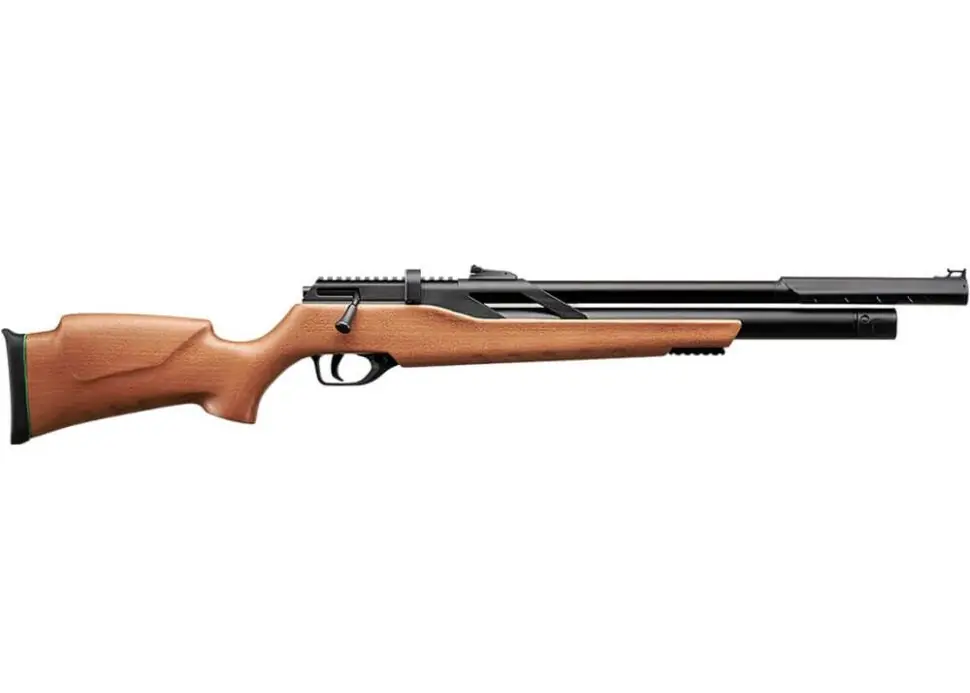

Snowpeak T-Rex Wood Air rifle

€185.00
Snowpeak T-Rex Wood Airrifle
The Snowpeak T-Rex Wood is a powerful and reliable PCP air rifle that combines precision engineering with a beautifully crafted wooden stock. Designed for accuracy, consistency, and shooting comfort, this air rifle is perfect for both target practice and small game hunting.
Equipped with a regulated PCP system, the T-Rex delivers consistent power and shot to shot accuracy. Its side lever action can be adjusted for left or right handed shooters, making it versatile and easy to use. The multi shot magazine allows fast follow up shots, while the integrated moderator ensures quieter shooting sessions.
The bolt lever can be mounted on the left and right side to suit both left and right handed shooters. Besides this, the trigger pressure can be adjusted from 2 to 5 lbf (900 to 2300 grams).
Key Features
Regulated PCP System
consistent velocity and accuracy
Multi shot magazine
12 (.177), 10 (.22), 9 (.25)
Side lever action
AmbidextrouS left & right setup
Integrated silencer & shrouded barrel
This item can only be sold to persons 18 years and older.
For this item we have to carry out an age check.
You can upload a copy/scan/photo of a legal identification document such as a passport, European ID or driver’s license in the order. Parts of the document may be made illegible or designated as a copy. However, your name, document number and place of issue must be legible. Your copy ID will only be used for verification purposes and will not be retained. If you are not able to upload it right now, we will contact you per email before shipping
We can ship these items only to the countries listed below:
Belgium, Bulgaria, Cyprus, Czechia, Denmark, Estonia, Finland, France, Germany, Greece, Hungary, Ireland, Italy, Kroatia, Latvia, Lithuania, Luxembourg, Monaco, Netherlands, Poland, Portugal, Romania, Slovakia, Slovenia, Spain, Austria, Sweden, United States
Specifications
| Brand | Snowpeak |
|---|---|
| Model | .177 / 4,5, .22 / 5,5, .25 / 6,35 |
| Energy (Joule / ft.lbs) | 26/19, 46/34, 62/46 |
| Cocking system | Bolt action |
| Magazine capacity | 10 (.22), 12 (.177), 9 (.25) |
| Weight (gram) | 3150 |
| Barrel length (mm) | 480 |
| Length (mm) | 1048 |
| Mounting base | Weaver / Picatinny |
| Rifle Stock Type | Ambidextrous |
| Stock material | Wood |
| Extra accessories included |
Fill probe, Magazine, O-ring kit, Tools |
Snowpeak T-Rex Wood Air Rifle – Detailed Technical Product Guide
Snowpeak T-Rex Wood PCP Engineering, Precision, and Model Context
Snowpeak Airguns and Snowpeak Sports
snowpeak airguns sit within a broad sporting catalog that includes rifles, bullpups, pistols, and accessories. Search terms such as snowpeak sports, snowpeaks, snow peak equipment, snow peak customer service, and snow peak brand origin often appear around the same manufacturer.
The important point is that Snowpeak produces many mechanically different products. Air capacity, barrel length, regulator design, stock material, magazine format, and dimensions can vary considerably from one model to another, so specifications should always be checked against the exact product.
Snowpeak T-Rex Wood Engineering
The T-Rex Wood is officially described as a multi-shot PCP rifle with an adjustable cheekpad, 140 cc air capacity, and pressure regulator.
Its 530 mm barrel is relatively substantial for a platform weighing only about 2.3 kg. Snowpeak lists overall dimensions of approximately 790 mm in length, 180 mm in height, and 50 mm in width.
This combination supports a balance between compact handling and full-sized sporting functionality.
What Is a PCP Airgun?
The search what is a pcp airgun refers to the operating technology used by the T-Rex Wood.
PCP means pre-charged pneumatic. Compressed air is stored before use and supplies the energy for the firing cycle.
Unlike a conventional spring-driven design, a PCP platform does not rely on a large moving spring during each discharge.
That generally results in a smoother mechanical response, although practical consistency still depends on pressure behavior, seals, barrel condition, ammunition quality, and maintenance.
Pressure Regulator and Air Capacity
Snowpeak lists a regulator as standard equipment on the T-Rex Wood.
A regulator forms part of the pressure-management system and is intended to help control air delivery as reservoir pressure changes.
The model’s 140 cc air capacity is smaller than the reservoirs used on some larger PCP platforms, which contributes to its lighter overall character.
However, reservoir size alone does not determine quality. Consistency, efficiency, mechanical condition, and overall system design are more useful indicators during practical evaluation.
Caliber Options
Snowpeak lists the T-Rex Wood in three calibers:
4.5 mm/.177 – approximately 950 fps
5.5 mm/.22 – approximately 850 fps
6.35 mm/.25 – approximately 750 fps.
These are manufacturer figures rather than guarantees for every pellet or regional configuration.
Projectile weight, shape, temperature, equipment condition, and local power restrictions can influence measured velocity.
Barrel Length and Practical Precision
The T-Rex Wood uses a 530 mm barrel.
Barrel length contributes to the overall architecture, but precision depends on more than length alone.
Barrel condition, pressure consistency, suitable pellets, sighting equipment, environmental conditions, and user technique all influence repeatability.
For that reason, maximum velocity should never be treated as a complete measure of technical quality.
Adjustable Cheekpad
The adjustable cheekpad is one of the model’s key ergonomic features.
A properly positioned cheek support can help the user establish a natural relationship between head position and appropriately installed sighting equipment.
This can improve comfort and repeatability during lawful recreational use.
Adjustments should remain within the manufacturer’s intended range rather than being altered structurally.
Trigger and Manual Safety
Snowpeak lists a 2–5 lbf trigger pull and a manual safety on the T-Rex Wood.
These features form part of the user interface and should remain mechanically predictable.
If controls become unusually stiff, loose, or inconsistent, inspection should occur before further use.
Snowpeak P35 and P35X
The terms snowpeak p35, p35, pcp p 35, snowpeak p35x, p35x, and p35x pcp refer to separate compact PCP platforms.
The P35X, for example, uses a 280 cc air tank, 65 cc plenum, regulator, 531 mm barrel, wood stock, and 11/9/8-shot magazines.
That architecture differs significantly from the T-Rex Wood’s 140 cc system and 530 mm barrel.
The search snowpeak p35 vs p35x therefore concerns comparison between related but distinct platforms, not the T-Rex Wood.
Snowpeak PP750 and PP750L
The Snowpeak PP750L PCP Air Pistol, Snowpeak PP750L, snowpeak pp750, pp750, and snow peak pp750 refer to pistol-format products.
The current PP750L is listed in .177 and .22, with a 66 cc air capacity, 25 MPa fill pressure, 9- or 7-shot magazines, and approximately 1.60 kg weight.
The standard PP750 is also a distinct pistol platform with a 66 cc capacity and more than 30 shots per charge under manufacturer conditions.
Therefore, Snowpeak Air Pistol, PCP Pistol, Airgun Pistol, High power PCP air pistol, and Snowpeak PP750L PCP Air Pistol for sale should remain separate from T-Rex Wood technical specifications.
Snowpeak MAX and MAX 1 Price
The terms snowpeak max and snowpeak max 1 price relate to another performance-oriented family.
Pricing depends on region, distributor, taxes, availability, and package contents, so it should not be treated as a permanent technical specification.
Likewise, larger platforms in that family should not be assumed to share the same reservoir, barrel, or magazine system as the T-Rex Wood.
Snowpeak M25 and Pellet 9mm
Searches for snowpeak m25, m25 rifle, and m25 weapon concern another PCP platform.
The standard M25 is listed by Snowpeak in calibers ranging from .177 through 9 mm/.35, with a 245 cc air capacity, 550 mm barrel, 25 MPa maximum pressure, and caliber-dependent magazine capacities of 12/10/9/8/6 shots.
That explains why pellet 9mm may appear in broader Snowpeak searches.
However, 9 mm should not be associated with the T-Rex Wood, which is officially listed only in 4.5, 5.5, and 6.35 mm.
Snowpeak M60 and M60B
The terms snowpeak m60, snowpeak m60b, and how much did the m60 weigh refer to another product family or broader search context.
Because “M60” can also refer to unrelated equipment, exact manufacturer identification matters.
No M60 specification should be transferred into a T-Rex Wood product description without model-specific confirmation.
Snowpeak AP900, AP900B, PR900 Gen 3, and PP20
The terms snowpeak ap900, ap900b pcp air rifle, pr900 gen 3, snow peak pp20, and snowpeak pp20 refer to other Snowpeak models or regional products.
Likewise, hp300, m50 rifle, and t rex 6000 are either separate products or too ambiguous to establish T-Rex Wood specifications reliably.
Search-engine association should never replace exact technical confirmation.
Snowfall Gun and Regional Search Terminology
The term snowfall gun is ambiguous and should not be treated as a verified Snowpeak model.
Similarly, pistolet pcp arcea-snowpeak onix sport appears to represent distributor-specific or regional naming and should not be presented as another name for the T-Rex Wood unless confirmed by manufacturer documentation.
Air Gun Accessories
The phrase air gun accessories covers items such as pumps, compressors, cases, cleaning equipment, pellets, sights, air tanks, and target equipment.
Compatibility should always be checked against the exact platform.
For practical ownership, important supporting equipment includes appropriate eye protection, secure storage, suitable maintenance products, and dependable target containment.
Why Choose the T-Rex Wood?
The T-Rex Wood is appealing because it combines a relatively light 2.3 kg overall weight with a 530 mm barrel, regulator, 140 cc reservoir, adjustable cheekpad, and three common airgun calibers.
Its value therefore lies in balance rather than one extreme specification.
It provides a traditional wood-stock feel while retaining modern PCP engineering and manageable dimensions.
Overall Technical Perspective
The Snowpeak T-Rex Wood is best understood as a lightweight regulated PCP platform built around 140 cc of air capacity, a 530 mm barrel, adjustable cheek support, manual safety, multi-shot functionality, and .177/.22/.25 caliber options.
Its practical strengths are best evaluated through pneumatic consistency, stock ergonomics, barrel stability, equipment condition, compatible ammunition, and responsible maintenance rather than maximum velocity alone.
Secure storage, suitable eye protection, reliable target containment, adherence to manufacturer pressure limits, and compliance with applicable local regulations remain essential throughout lawful recreational ownership.
Engineering Quality, Precision, Handling, and Practical Performance
The Snowpeak T-Rex Wood combines traditional material character with modern pneumatic engineering in a relatively lightweight sporting configuration. Technical figures provide an important introduction to the platform, but they cannot fully describe how the equipment behaves during regular ownership. Practical quality depends on the relationship between structural stability, pressure consistency, barrel condition, balance, ergonomic fit, environmental influences, and maintenance. Therefore, overall performance should be evaluated through repeatability, predictable operation, comfortable handling, and long-term reliability rather than focusing exclusively on maximum output.
Engineering Quality and Structural Integration
Engineering quality begins with the way individual components work together.
The receiver, barrel assembly, air-storage system, wooden structure, operating controls, magazine interface, and mounting areas should maintain proper alignment throughout normal recreational ownership.
A stable structure reduces unnecessary movement between components and contributes to predictable mechanical behavior.
As familiarity develops, unusual changes become easier to identify. Unexpected looseness, visible deformation, unusual gaps, or significant differences in operating resistance deserve inspection rather than being dismissed as normal characteristics.
Pneumatic Performance
The compressed-air system provides the foundation for the platform’s operating characteristics.
When correctly maintained, the system should behave reasonably predictably under comparable conditions. However, pneumatic behavior can be influenced by temperature, seal condition, maintenance history, equipment age, and general environmental conditions.
Persistent leakage or substantial unexplained changes deserve attention.
Because the system contains pressurized components, specialized servicing should be performed by appropriately qualified personnel rather than through improvised internal repair.
Regulated Consistency
Pressure regulation contributes to predictable operation by managing air delivery within the pneumatic system.
This can support more controlled behavior as reservoir pressure changes.
Nevertheless, regulation should be considered one element within the complete system.
Ammunition consistency, barrel condition, mechanical wear, temperature, sighting equipment, and user technique can still influence practical results.
Therefore, repeatable performance across comparable sessions provides a more meaningful indication of quality than one isolated measurement.
Practical Precision
Precision should primarily be considered in terms of consistency.
One particularly good result does not automatically establish the normal capability of the platform. Similarly, one poor result does not necessarily indicate a mechanical problem.
Several variables influence practical precision.
Projectile uniformity, barrel condition, pneumatic consistency, sighting equipment, environmental conditions, and user technique all contribute.
For this reason, controlled and repeatable evaluation provides a more useful picture than relying exclusively on maximum velocity or another single specification.
Barrel Stability
The barrel is an important part of the overall precision system.
It should remain securely positioned and protected from significant physical impacts.
External condition can be checked during routine inspection.
Internal maintenance should follow manufacturer guidance rather than relying on aggressive cleaning after every recreational session.
If practical consistency changes, barrel condition should be considered alongside pneumatic behavior, ammunition quality, sighting equipment, environmental influences, and overall mechanical condition.
Lightweight Handling Character
Relatively low overall weight can influence how the equipment feels during extended handling.
A lighter platform may be easier to carry and transport, while also requiring less effort from the support arm.
However, weight alone does not determine comfort.
The location of the mass, stock geometry, individual proportions, and accessory configuration all contribute.
Consequently, balance should be considered alongside overall weight when assessing everyday handling quality.
Wooden Stock Feel
The wooden structure provides a distinctive tactile and visual character.
Natural grain patterns, tonal variations, and texture can make individual examples slightly different in appearance.
More importantly, the stock forms a major physical interface between the equipment and the user.
Its geometry affects shoulder placement, hand position, head alignment, and overall balance.
Appropriate surface care and environmental protection help preserve both appearance and structural condition.
Shoulder Position
Comfortable shoulder placement contributes to stable handling.
The platform should settle naturally without requiring excessive stretching or compression of the upper body.
Height, arm length, shoulder width, and individual posture influence this relationship.
If discomfort develops consistently, the complete ergonomic arrangement should be considered.
Grip position, cheek support, accessory placement, and balance can all influence how naturally the equipment interfaces with the shoulder.
Cheek Support and Head Position
A comfortable cheek position helps establish a natural relationship between the user’s head and appropriately installed sighting equipment.
The neck should not need to remain excessively tilted or stretched.
Small ergonomic problems can become more noticeable during longer sessions.
Where adjustment is available, changes should remain within the intended mechanical range.
Once a suitable position has been selected, the relevant component should remain stable during ordinary handling.
Grip and Hand Comfort
Grip geometry influences wrist position and overall hand comfort.
Different hand sizes can create noticeably different experiences with the same configuration.
A comfortable grip should not require excessive muscular pressure.
If wrist fatigue occurs repeatedly, shoulder position and overall balance should also be evaluated.
Ergonomic quality results from several contact points working together rather than from one isolated component.
Balance and Weight Distribution
Total mass provides only part of the handling picture.
Where that mass is positioned can matter equally.
A well-balanced configuration can feel manageable even during longer recreational sessions.
However, accessories can alter the original weight distribution considerably.
Components installed farther from the natural center of mass may increase support-arm fatigue.
Therefore, accessory selection should prioritize practical value while preserving comfortable balance whenever possible.
Accessory Configuration
Additional equipment should complement the original platform rather than unnecessarily complicate it.
Every accessory introduces some combination of weight, bulk, and changed balance.
A relatively simple setup may therefore provide greater handling comfort than a heavily equipped configuration.
Compatibility should always be confirmed before installation.
Components that merely appear similar should not automatically be assumed suitable because mounting dimensions and structural requirements can differ between products.
Mechanical Controls
Predictable controls contribute significantly to everyday confidence.
After repeated recreational use, normal movement and mechanical resistance become familiar.
This familiarity makes unusual changes easier to recognize.
Sudden stiffness, excessive movement, unfamiliar sounds, or substantially different resistance should receive inspection.
Applying excessive force to a mechanism that suddenly behaves differently can worsen an existing problem.
Persistent abnormalities should receive qualified technical attention.
Magazine Convenience
A multi-shot system can reduce interruptions during organized recreational sessions.
However, dependable operation requires magazines to remain clean and physically undamaged.
They should be protected from dirt, moisture, crushing, deformation, and substantial impacts.
During transportation, magazines should be stored securely rather than left loose beside heavier equipment.
If irregular operation develops, magazine condition should form part of the initial inspection process.
Environmental Influences
Outdoor environments introduce temperature variation, humidity, moisture, dust, and wind.
These factors can influence both practical performance and equipment condition.
Temperature may affect pneumatic characteristics, while wind can influence projectile movement.
After exposure to damp surroundings, external surfaces should be appropriately dried before storage.
Understanding environmental variables helps distinguish temporary performance changes from persistent mechanical concerns.
Reliability During Extended Ownership
Reliability becomes easier to evaluate after repeated use.
A dependable platform should maintain reasonably predictable mechanical characteristics when properly maintained.
However, seals, moving components, and adjustment mechanisms naturally experience service-related wear.
Routine observation makes gradual changes easier to identify.
Preventive maintenance should concentrate on preserving normal condition rather than repeatedly altering components that already function correctly.
Maintenance and Practical Care
Everyday maintenance should remain straightforward and purposeful.
External dust, fingerprints, moisture, and light contamination can generally be removed using appropriate materials.
Wooden and metallic surfaces may require different care methods.
Internal disassembly should not become routine simply because the equipment has been used.
Manufacturer recommendations should determine appropriate servicing, while specialized pneumatic or mechanical work should be handled by qualified personnel.
Overall Performance Perspective
The T-Rex Wood combines lightweight construction, traditional material character, regulated pneumatic operation, ergonomic adaptability, multi-shot convenience, and manageable dimensions within a distinctive recreational platform.
Its practical strengths are best evaluated through pressure consistency, structural stability, comfortable handling, barrel condition, predictable controls, and dependable long-term behavior.
Ultimately, responsible ownership preserves these qualities. Routine inspection, suitable surface care, environmental protection, careful transportation, secure storage, and professional servicing when necessary can help maintain reliable performance and overall condition throughout an extended period of lawful recreational ownership.
Build Quality, Durability, Maintenance, and Long-Term Care
The Snowpeak T-Rex Wood combines natural wooden components with a lightweight mechanical structure and a pressurized pneumatic system. While initial performance is important, long-term ownership depends just as heavily on construction quality, material preservation, pressure integrity, mechanical condition, and sensible maintenance. Regular care can protect the original appearance while helping the major components remain dependable. Therefore, preventive maintenance should focus on inspection, cleanliness, environmental protection, careful transportation, and professional servicing when a problem extends beyond ordinary external care.
Overall Construction Quality
Construction quality depends on how securely the main components work together.
The wooden structure, receiver, barrel assembly, pressure-bearing components, magazine interface, operating controls, and mounting areas should remain properly integrated throughout ordinary ownership.
Stable construction helps preserve alignment and predictable mechanical behavior.
As familiarity with the platform develops, changes become easier to notice. Unexpected looseness, visible deformation, unusual gaps, or significantly different mechanical resistance should receive attention rather than being automatically considered normal wear.
Wooden Stock Durability
Natural wood contributes considerably to the platform’s traditional appearance and handling character.
However, wood responds to environmental conditions differently from synthetic materials. Excessive humidity can influence its condition, while prolonged exposure to moisture may eventually affect the surface finish.
Extreme heat should also be avoided.
Small differences in grain, shade, and texture are natural characteristics rather than manufacturing defects.
Appropriate protection helps preserve both the appearance and structural condition of the wooden components over time.
Protecting the Wood Finish
Routine handling naturally introduces fingerprints, dust, moisture, and minor surface contamination.
Cleaning should remain gentle and purposeful.
A soft material suitable for the existing finish is preferable to harsh abrasive products.
Strong household chemicals should generally be avoided because they may alter the appearance or protective surface.
If specialized wood-care products are considered, compatibility with the existing finish should be confirmed first.
The objective should be preservation rather than repeated cosmetic treatment.
Structural Integrity
A relatively lightweight platform should still be protected from significant physical impacts.
A fall onto a hard surface can potentially affect several interconnected components even when visible cosmetic damage appears minor.
After a substantial impact, accessible areas should be inspected for cracking, deformation, looseness, or unusual movement.
When structural integrity cannot be confidently determined through normal observation, professional inspection provides the appropriate solution.
Continued use should never substitute for proper evaluation of suspected structural damage.
Pressure-System Condition
The pneumatic system requires particular care because its components contain stored pressure.
Pressure-bearing parts should remain within manufacturer-defined limits and should be protected from substantial impacts, corrosion, and unsuitable environmental conditions.
External surfaces can be inspected periodically for visible deterioration.
Persistent unexplained pressure loss deserves attention.
Because specialized pneumatic servicing requires suitable technical knowledge and equipment, improvised internal repair should be avoided when the concern extends beyond routine owner-level maintenance.
Reservoir Protection
The air-storage component should remain protected during handling, transportation, and storage.
Heavy objects should not be allowed to press against important areas when the equipment is inside a case.
Likewise, the platform should not remain unsecured where it could fall.
Excessive heat, persistent moisture, and corrosive surroundings should be avoided.
Preventing damage is considerably easier than attempting to correct physical deterioration after it has already developed.
Seal Condition and Aging
Sealing components play an important role in maintaining pneumatic integrity.
Like many service components, seals can gradually age or wear.
Environmental temperature, contamination, storage conditions, equipment age, and repeated use may influence their condition.
Persistent leakage should be investigated, although the exact cause should be diagnosed rather than assumed.
Unnecessary internal disassembly can introduce contamination or disturb components that were previously functioning correctly.
Pressure-Management Components
Internal pressure-management components contribute to predictable pneumatic behavior.
When the system operates correctly, unnecessary adjustment should generally be avoided.
Repeated intervention can make later diagnosis more complicated and may disturb an otherwise stable configuration.
If significant inconsistency develops, several possible factors should be considered.
Seal condition, environmental temperature, maintenance history, and mechanical wear may all contribute.
Professional servicing becomes appropriate when specialized diagnosis is necessary.
Barrel Preservation
The barrel is an important structural component and deserves protection from significant impacts.
Its external condition can be checked during routine inspection.
Internal cleaning should follow manufacturer guidance rather than being performed aggressively after every recreational session.
More frequent cleaning does not automatically provide better preservation.
If practical consistency changes, barrel condition should be considered alongside pressure behavior, equipment condition, environmental factors, and the general maintenance history.
External Metal Components
Metal surfaces naturally encounter fingerprints, moisture, dust, and environmental contamination.
Regular light cleaning helps preserve their appearance while making corrosion easier to detect.
After exposure to damp conditions, visible moisture should be removed before storage.
Particular attention should be given to areas where moisture or contamination could remain trapped.
Abrasive materials should generally be avoided because they can damage protective finishes and create unnecessary cosmetic wear.
Mechanical Wear
Moving components naturally experience gradual service-related wear.
Normal aging generally develops progressively, while sudden mechanical changes deserve closer attention.
Unexpected stiffness, excessive movement, unfamiliar sounds, or substantially different resistance should not simply be overcome by applying greater force.
Inspection should occur first.
If the underlying cause cannot be identified safely, qualified servicing can prevent unnecessary additional damage and help restore predictable mechanical behavior.
Magazine Care
The magazine is comparatively small, but its condition contributes to reliable operation.
It should remain protected from dirt, moisture, crushing, deformation, and significant impacts.
During transportation, magazines should be organized separately from heavier equipment.
A dedicated compartment can provide useful protection.
If irregular operation develops, magazine condition provides a sensible starting point for inspection before a more complicated internal mechanical problem is assumed.
Adjustable Components
Ergonomic adjustment mechanisms should move smoothly through their intended range and remain secure once positioned.
If a component begins slipping, becomes unexpectedly difficult to move, or develops excessive play, inspection should occur.
Improvised modifications should be avoided.
When replacement becomes necessary, components intended specifically for the platform provide a more dependable solution than alternatives selected simply because they appear physically similar.
Mounting Areas
Accessory interfaces should remain clean, structurally sound, and free from visible damage.
Mounted equipment adds weight and can introduce additional stress during transportation.
Therefore, accessories should serve a genuine practical purpose.
After a significant impact, mounting areas should be inspected alongside the main structure.
Correct compatibility should always be confirmed before accessories are installed because similar appearance does not necessarily indicate identical mechanical fit.
Routine Inspection
Regular visual inspection provides one of the simplest forms of preventive maintenance.
Accessible components can be checked for corrosion, contamination, cracking, looseness, deformation, or unusual wear.
Equipment returning from extended storage deserves similar attention.
Additional inspection is sensible after harsh environmental exposure or a significant transportation incident.
Routine observation cannot replace technical servicing, but it can identify developing concerns before they become more serious.
Cleaning After Use
Everyday cleaning should remain controlled and straightforward.
Dust, fingerprints, moisture, and light contamination can generally be removed without dismantling the platform.
Wooden and metallic surfaces may require different care materials.
Internal components should remain undisturbed unless genuine servicing is necessary.
Manufacturer recommendations should determine appropriate maintenance procedures, while complex pneumatic or mechanical work should be handled by appropriately qualified personnel.
Secure Storage and Transportation
Secure storage protects both the equipment and surrounding people.
The platform should remain in a clean, dry, stable location inaccessible to unauthorized individuals, particularly children.
A properly fitted protective case can reduce scratches, contamination, impacts, and unnecessary movement during transportation.
Magazines and accessories should also be organized appropriately.
Applicable local requirements concerning possession, storage, transportation, and recreational use should always be respected.
Long-Term Durability Perspective
Long-term durability depends on both original construction quality and responsible care.
Wood protection, routine inspection, appropriate cleaning, pressure-system preservation, environmental awareness, careful transportation, and secure storage all contribute to maintaining dependable condition.
Ultimately, effective maintenance should preserve the original engineering rather than continually alter it. With consistent preventive care and qualified servicing when required, the platform can retain its structural integrity, attractive wooden finish, predictable mechanical characteristics, pneumatic reliability, and overall usability throughout an extended service life.
Everyday Usability, Comfort, Reliability, and Ownership Experience
The Snowpeak T-Rex Wood combines a lightweight structure, natural wooden components, pneumatic operation, multi-shot convenience, and adjustable ergonomic features within a practical recreational platform. While technical specifications establish its engineering foundation, everyday ownership involves much more than numbers. Comfort, balance, portability, mechanical consistency, environmental conditions, routine care, transportation, and secure storage all influence the overall experience. Therefore, its practical qualities are best considered through natural handling, predictable operation, manageable upkeep, and the ability to maintain dependable condition throughout extended ownership.
Everyday Handling Experience
The relatively compact configuration gives the platform a manageable physical character.
Its proportions can make transportation and general handling less cumbersome than particularly long or heavy sporting equipment. At the same time, the wooden construction provides a more traditional tactile experience.
Handling preference remains personal, however.
Height, arm length, shoulder width, hand size, experience, and accessory configuration can influence whether the platform feels naturally balanced. For that reason, practical comfort should be considered through individual fit rather than dimensions alone.
Lightweight Design Advantages
Reduced weight can provide noticeable benefits during longer recreational sessions.
Less mass generally means the support arm carries a smaller physical load. Consequently, some users may experience less fatigue during extended handling.
A lighter platform can also be easier to place into a suitable protective case and transport responsibly.
Nevertheless, reduced weight does not mean reduced care requirements.
The wooden structure, pressure-bearing components, barrel assembly, and mechanical controls still require appropriate protection from impacts and environmental exposure.
Wooden Stock Experience
Natural wood contributes strongly to the character of the platform.
Variations in grain, tone, and texture can give individual examples a distinctive appearance.
More importantly, the wooden structure forms a major contact point between the equipment and the user.
Its shape influences shoulder placement, hand position, cheek support, and overall balance.
Because wood can react to prolonged moisture and temperature extremes, appropriate environmental care is important for preserving both its appearance and structural condition.
Comfort During Extended Sessions
Comfort becomes increasingly important as recreational sessions become longer.
Shoulder position, wrist angle, head placement, arm extension, and support-hand location all influence fatigue.
A position that initially feels acceptable may become uncomfortable when maintained repeatedly.
Therefore, users should prioritize a natural posture rather than forcing themselves into an awkward position.
Reducing unnecessary muscular tension can make extended handling more comfortable while also contributing to a more consistent overall experience.
Shoulder Fit
A comfortable shoulder position allows the platform to settle naturally against the body.
The upper body should not need to stretch excessively or remain compressed simply to maintain a suitable position.
Individual proportions influence this relationship considerably.
If repeated discomfort occurs, several ergonomic factors should be evaluated together.
Grip position, cheek support, accessory placement, support-hand location, and overall balance may all influence how naturally the platform interfaces with the shoulder.
Cheek Support and Head Position
Adjustable cheek support can help accommodate different body proportions and accessory configurations.
A natural head position is important because the neck should not remain excessively tilted or stretched during extended use.
Small ergonomic problems can become increasingly noticeable over time.
Adjustments should remain within the intended mechanical range.
Once a comfortable position has been established, the component should remain stable without unwanted movement during normal handling.
Grip Comfort
Grip geometry influences wrist angle and general hand comfort.
Because hand sizes differ, the same grip may feel different from one person to another.
A comfortable position should not require excessive gripping pressure.
If wrist fatigue develops repeatedly, shoulder placement and overall balance should also be considered.
Good ergonomics result from several physical contact points working together rather than from one isolated feature.
Balance and Weight Distribution
Total weight provides only part of the handling picture.
Where that weight is located can matter equally.
A well-balanced lightweight configuration may feel particularly manageable because less effort is required to maintain a comfortable position.
However, additional equipment can alter the original balance considerably.
Therefore, accessory selection should consider both usefulness and weight distribution.
Preserving comfortable balance can be more valuable than adding unnecessary components simply because mounting space is available.
Accessory Selection
Accessories should provide a clear practical benefit.
Every additional component introduces some combination of weight and bulk.
Furthermore, the location of an accessory determines how strongly it influences handling.
Equipment positioned farther from the natural center of mass can become surprisingly noticeable during longer sessions.
A relatively simple configuration may therefore provide greater everyday comfort.
Compatibility should always be confirmed because visually similar components do not necessarily share identical mounting requirements.
Mechanical Controls
Predictable controls contribute to confidence during everyday ownership.
After repeated recreational use, normal movement and resistance become familiar.
This familiarity makes unusual mechanical changes easier to recognize.
Unexpected stiffness, excessive movement, unfamiliar sounds, or substantially different resistance should receive inspection.
Applying additional force to a mechanism that suddenly behaves differently can potentially worsen an existing problem.
Persistent abnormalities should receive qualified technical attention.
Multi-Shot Convenience
A multi-shot arrangement can reduce unnecessary interruptions during organized recreational sessions.
However, dependable operation partly depends on maintaining magazines correctly.
They should remain protected from dirt, moisture, crushing, deformation, and significant impacts.
During transportation, magazines should be stored securely rather than left loose alongside heavier equipment.
If irregular operation develops, magazine condition should form part of the initial inspection before a more complicated internal problem is assumed.
Pneumatic Reliability
Reliable pressure retention contributes significantly to everyday convenience.
A properly maintained pneumatic system should provide reasonably predictable behavior under comparable conditions.
However, environmental temperature, seal condition, equipment age, storage history, and maintenance can influence pressure characteristics.
Persistent leakage or substantial unexplained changes deserve attention.
Because pressure-bearing components contain considerable stored energy, specialized servicing should be completed by appropriately qualified personnel rather than through improvised repairs.
Environmental Considerations
Outdoor environments introduce moisture, humidity, dust, temperature variation, and wind.
These conditions can influence both practical performance and long-term equipment preservation.
After exposure to damp surroundings, external surfaces should be appropriately dried before storage.
Dust and contamination should also be removed using suitable materials.
Extreme temperatures should be avoided during prolonged transportation or storage.
Environmental awareness is particularly valuable when both wooden and metallic components are present.
Routine Ownership and Maintenance
Everyday maintenance should remain simple and purposeful.
External inspection and appropriate cleaning generally provide greater value than unnecessary internal disassembly.
Wooden and metallic surfaces may require different care materials.
More maintenance does not automatically produce greater reliability.
Manufacturer recommendations should determine appropriate servicing procedures, while specialized pneumatic or mechanical concerns should receive professional attention whenever they extend beyond normal external maintenance.
Storage Convenience and Security
The relatively manageable dimensions can simplify secure storage.
However, convenience should never replace safety.
The equipment should remain in a clean, dry, stable location inaccessible to unauthorized individuals, particularly children.
The storage environment should protect it from excessive humidity, corrosive substances, accidental impacts, and extreme temperatures.
Applicable local requirements concerning secure storage should always be followed.
Transportation Experience
A properly fitted protective case can improve organization while reducing avoidable damage.
The platform should remain securely positioned instead of moving freely inside the case.
Magazines and accessories should also be arranged so they cannot strike the wooden or mechanical components.
After a substantial transportation impact, inspection should occur before normal recreational use resumes.
Careful transportation directly supports long-term structural and cosmetic preservation.
Long-Term Ownership Satisfaction
Long-term satisfaction depends heavily on predictability.
Equipment that remains comfortable, mechanically consistent, straightforward to maintain, and convenient to transport securely generally creates a more manageable ownership experience.
Preventive care should therefore concentrate on preserving normal condition rather than continually altering functioning components.
Routine observation helps identify gradual changes, while professional servicing can address genuine technical concerns before they develop into more significant problems.
Overall Ownership Perspective
The T-Rex Wood combines lightweight construction, traditional material character, comfortable proportions, pneumatic operation, ergonomic adaptability, and multi-shot convenience within a distinctive recreational platform.
Its everyday strengths are best appreciated through manageable handling, comfortable balance, practical portability, predictable mechanical behavior, straightforward maintenance, and dependable long-term condition.
Ultimately, responsible ownership preserves these qualities. Routine inspection, suitable surface care, environmental protection, careful transportation, secure storage, responsible handling, and qualified servicing when required can help maintain its appearance, structural integrity, pneumatic reliability, and overall usability throughout an extended service life.
Be the first to review “Snowpeak T-Rex Wood Air rifle”
Related products

Snowpeak Airguns

Snowpeak Airguns
Snowpeak Airguns
Snowpeak Airguns
Snowpeak Airguns
Snowpeak Airguns

Snowpeak Airguns

Snowpeak Airguns
Reviews
There are no reviews yet.