
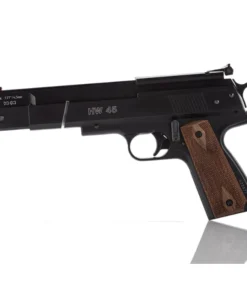
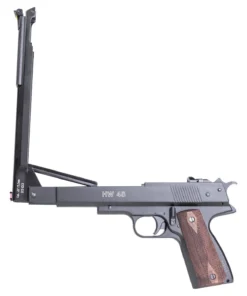
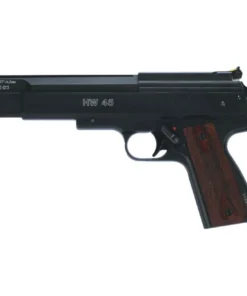
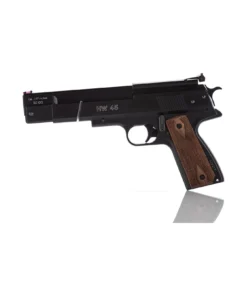
Weihrauch HW45 Walnut – Air Pistol
€400.00
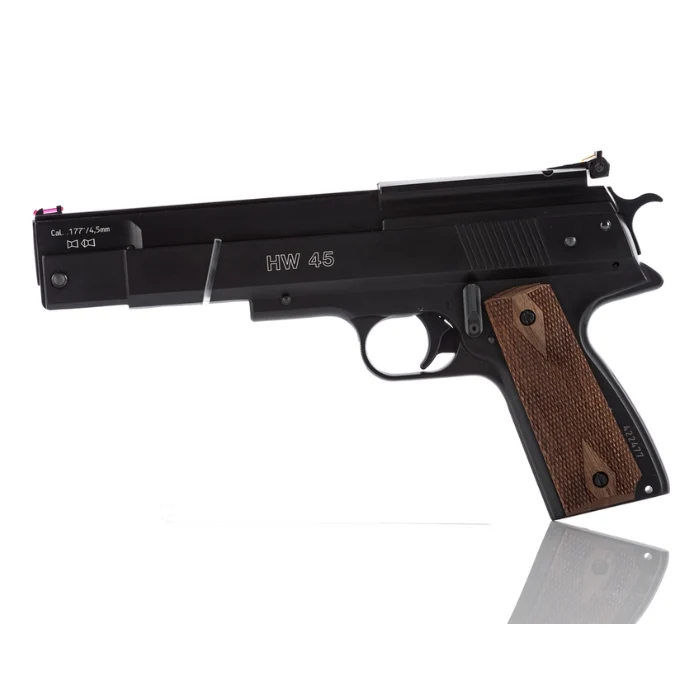
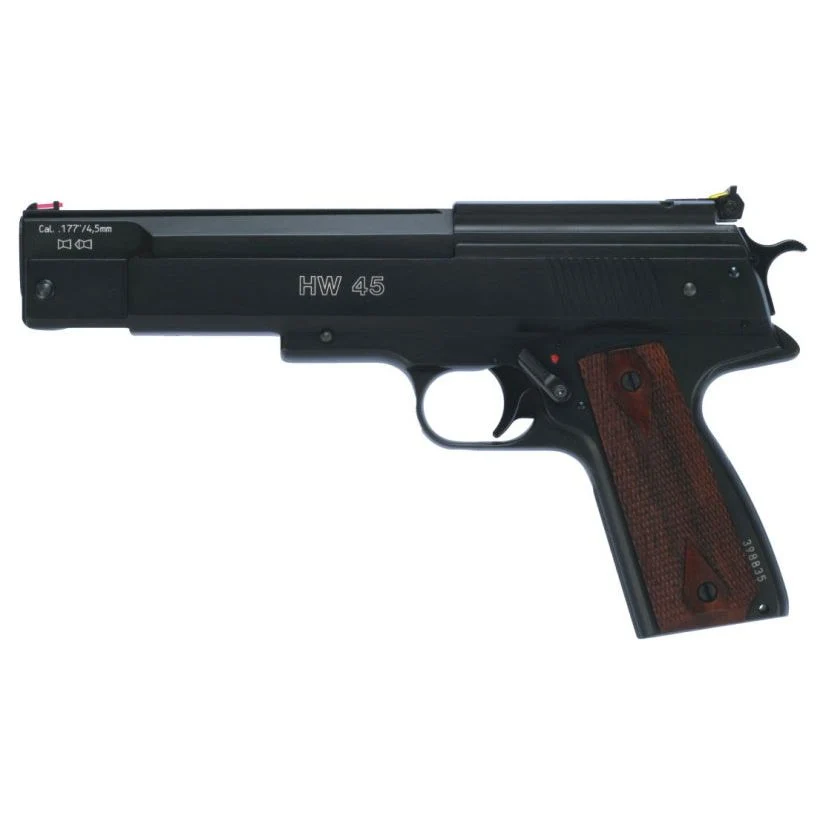
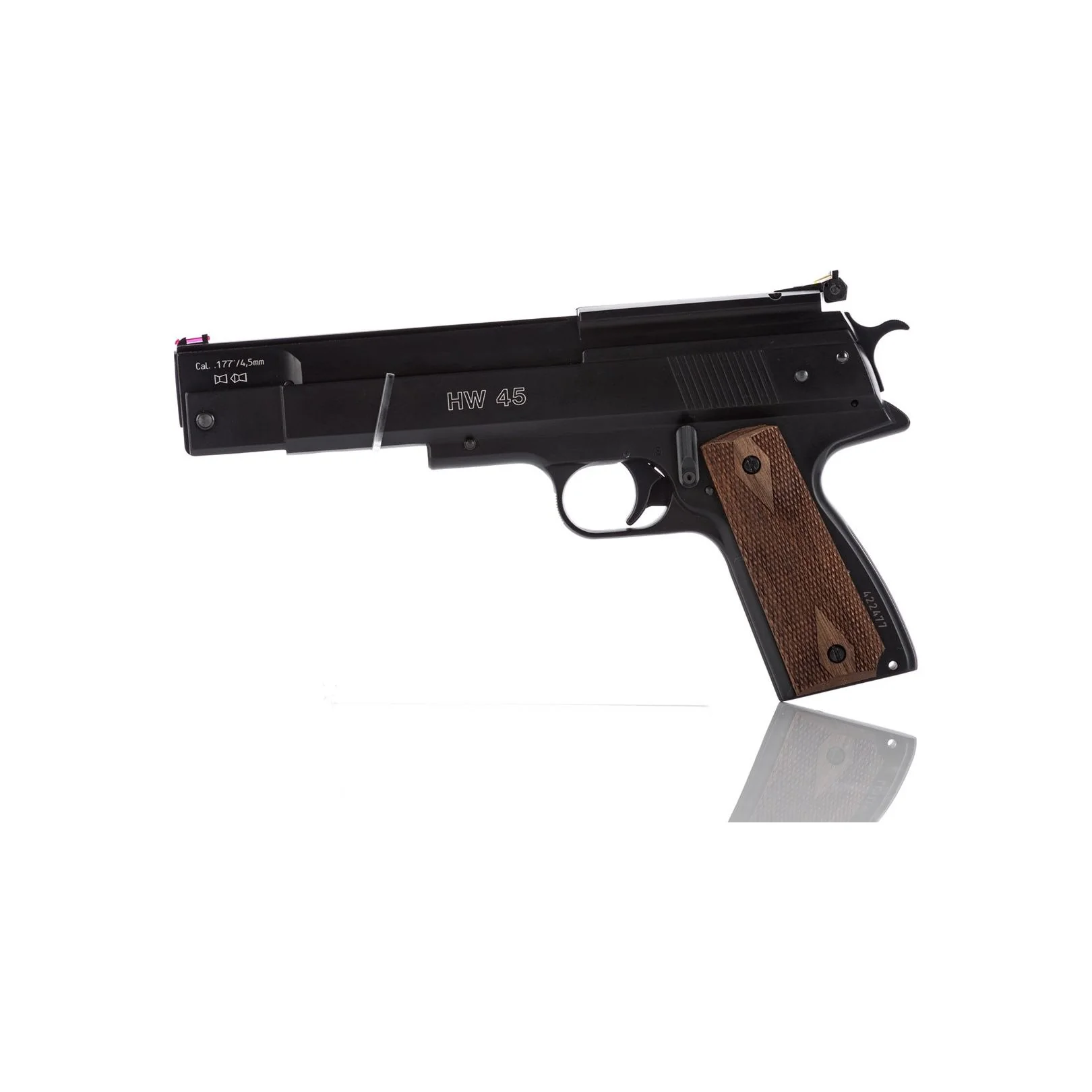
HW 45 ·Air Pistol.
One of the most powerful air pistols.
Its modern and compact design relates to one of the famous service pistols in the world.
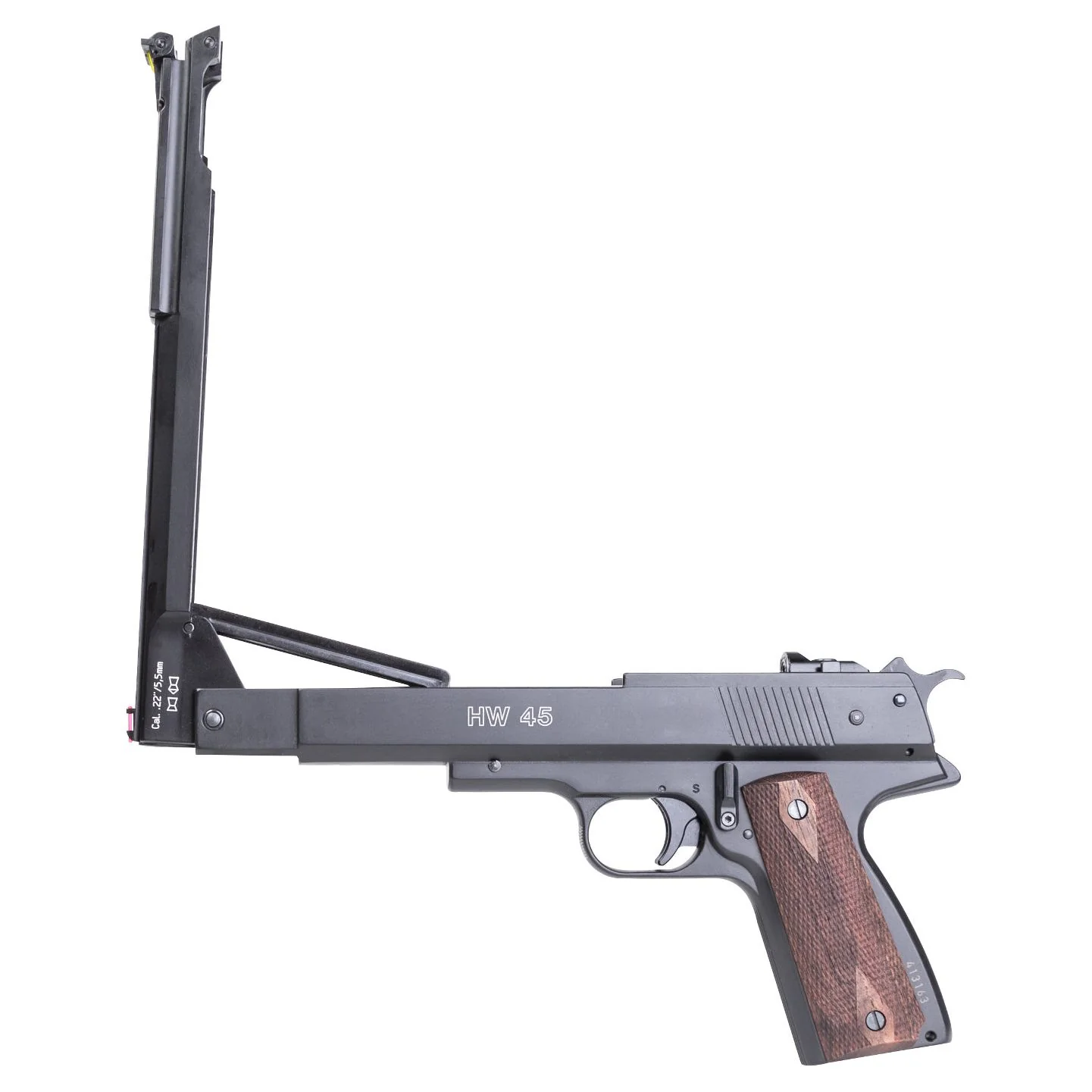
Two position cocking stroke for selecting power level
Precision adjustable two stage trigger
Fixed front and micrometer rear sight adjustable for windage and elevation ( NEW! Fiber Optic )
Dovetail rail to accept scope
Checkered walnut grips equally suited for right- and left-handed shooters.
Heavy Duty metal construction
Mild recoil imitates a small caliber handgun when fired
TRUGLO
Available in .22 & .177 Cal
WEIHRAUCH HW45 AIR PISTOL SPECS
CALIBER: .22 Cal (5.5mm) pellet or .177 (4.5mm) pellet
TRIGGER: 2 stage
CAPACITY: Single Shot ( pellet only )
SYSTEM: Single Stroke Spring Piston
SIGHTS: Fixed Front and adjustable rear sight ( Fiber Optic )
SAFETY: Manual
Safety BARREL:
Rifled Barrel BARREL LENGTH : 6.7″ (170mm)
OVERALL LENGTH: 11″ (275mm)
WEIGHT: 2.6lbs
MAX VELOCITY : .22/ 460 fp/s MUZZLE ENERGY: 6 ft.lb..
Weihrauch HW45 Walnut Air Pistol – German Spring-Piston Precision, Walnut Grips and Two-Level Performance
The Weihrauch HW45 Walnut Air Pistol is a premium spring-piston pistol designed for shooters who appreciate mechanical simplicity, distinctive styling, traditional walnut grips and a highly engaging single-shot shooting experience.
Rather than relying on CO2 capsules or a pre-charged air cylinder, the HW45 stores its firing energy mechanically. The upper assembly is cocked before each shot, compressing the internal spring-piston system. This self-contained design makes the pistol especially attractive to users who prefer an airgun that can be prepared for use without pumps, compressors or disposable gas cartridges.
The current platform combines a compact pistol format with a precision barrel of about 170 mm, an adjustable two-stage trigger, manual safety, adjustable open sights, optic-mounting provision and checkered walnut grips. One of its most distinctive engineering features is the use of two selectable cocking levels, allowing the shooter to choose between a lower and higher performance setting.
Premium Walnut Grip Panels
The walnut grips are one of the defining features of this version.
They give the pistol a traditional appearance while providing a textured contact surface for the hand.
Because walnut is a natural material, grain pattern, shade and contrast can vary slightly from one example to another.
That means each pistol can display its own visual character.
The checkering also provides practical grip support without requiring excessive hand pressure.
Why Walnut Grips Matter
Walnut does not increase velocity or mechanical power.
Its value comes from ergonomics, appearance and ownership experience.
A well-shaped grip allows the hand to return to the same position more easily.
That repeatability can support better trigger control and sight alignment.
Two Selectable Cocking Levels
A particularly distinctive feature of the pistol is its two-level cocking system.
The shooter can choose between a lower and higher setting.
This gives the pistol more flexibility than a conventional single-level spring-powered design.
The lower level can be useful for controlled short-range practice.
The higher level provides the pistol’s stronger factory-rated performance.
Actual suitability always depends on the legal configuration, ammunition and shooting environment.
Why the Two-Level System Matters
The ability to select between two cocking positions allows the shooter to adapt the firing cycle to the session.
A lower setting can produce a gentler shooting experience.
The higher level produces greater velocity.
However, the strongest setting is not automatically the most accurate.
Practical grouping should guide the final preference.
Spring-Piston Powerplant
The pistol uses a traditional spring-piston operating system.
No external air tank is required.
No compressor is needed.
No hand pump is required.
No disposable CO2 capsule is necessary.
The pistol is prepared mechanically before every shot.
This makes the system highly self-contained.
Single-Shot Operation
The HW45 is a single-shot pistol.
One pellet is loaded for each firing cycle.
This naturally slows the shooting rhythm.
For precision practice, that can be beneficial.
The shooter is encouraged to concentrate on cocking, loading, grip, sight alignment, trigger release and follow-through before beginning the next shot.
Precision Barrel
The barrel provides the mechanical foundation for projectile guidance.
However, barrel quality alone does not guarantee small groups.
Pellet compatibility matters.
Grip consistency matters.
Trigger control matters.
Sight alignment matters.
Follow-through matters.
A premium barrel can only show its full potential when the rest of the shooting process remains consistent.
Adjustable Two-Stage Trigger
The trigger uses a two-stage design.
The first stage allows initial take-up.
The second stage provides a more defined release point.
This allows the shooter to build pressure gradually instead of pulling suddenly.
A predictable trigger can significantly improve practical precision.
Why Trigger Control Matters
A pistol has a relatively short sight radius and is held without shoulder support.
Therefore, even small movements can shift the point of impact.
A smooth trigger press helps prevent the muzzle from moving at the moment of release.
Manual Safety
A manual safety is incorporated into the platform.
However, mechanical safeties should always be supported by correct handling.
The muzzle should remain pointed in a safe direction.
The pistol should remain unloaded until ready for lawful use.
Secure storage should also be maintained.
Adjustable Open Sights
The pistol uses adjustable open sights.
The rear sight allows windage and elevation correction.
This means the shooter can establish a practical zero without fitting an optic.
Open sights also preserve the traditional character of the pistol.
Why Open Sights Matter
Open sights require no battery.
They add almost no additional weight.
They also help develop fundamental pistol-shooting skills.
The shooter must align the front and rear sight consistently before every shot.
This can strengthen basic marksmanship technique.
Optic-Mounting Capability
The current platform provides mounting provision for compatible optics.
This allows a suitable compact sight to be fitted if desired.
The optic should remain lightweight enough to preserve the pistol’s natural balance.
Mounts should also remain secure.
Why Optic Weight Matters
A heavy optic changes the balance of the pistol.
The upper section can become noticeably heavier.
This may affect grip comfort and cocking feel.
A compact sight is generally more suitable when the goal is to retain the original handling characteristics.
How Good Is the Precision?
The HW45 has a strong reputation as a precision-oriented spring pistol.
However, it requires good technique.
Unlike a PCP pistol, the internal spring and piston move during the firing cycle.
This makes grip consistency especially important.
The shooter should avoid squeezing excessively hard.
The same hand position should be repeated.
The same wrist angle should be maintained.
The trigger should be pressed smoothly.
Several groups should be compared before judging accuracy.
Why Grip Consistency Matters
Changing grip pressure can alter the way the pistol moves during the shot.
A very tight grip may create unnecessary muscular tension.
A very loose grip may reduce control.
The most useful grip is one that feels comfortable and can be repeated consistently.
How to Evaluate Accuracy Properly
Choose one suitable pellet.
Select one cocking level.
Use the same shooting distance.
Maintain the same grip.
Keep the sight setting unchanged.
Fire several groups.
Record the results.
Then change only one variable.
This is much more reliable than changing ammunition, grip and sight settings at the same time.
Why Pellet Selection Matters
Different pellets can behave differently in the same barrel.
Weight affects velocity.
Head diameter affects fit.
Skirt condition influences sealing.
Projectile shape can influence how smoothly the pellet loads.
The best choice should therefore be determined through controlled testing.
When the Lower Setting Makes Sense
The lower cocking level can be useful for shorter-distance recreational target practice.
It can also provide a milder firing cycle.
For some shooters, this may make it easier to concentrate on trigger control and sight alignment.
When the Higher Setting Makes Sense
The higher cocking level provides stronger factory-rated performance.
It may be preferred when the shooter wants to use the pistol at its full intended output.
However, higher velocity should not automatically be treated as better precision.
Where the Pistol Performs Best
The pistol is particularly well suited to controlled target environments.
It can be used for deliberate one-handed practice.
A two-handed grip can provide additional stability.
A stable rest can also be used when evaluating mechanical precision.
Why Choose the Walnut Version
The strongest reasons include:
Premium walnut grip panels.
Distinctive traditional appearance.
Self-contained mechanical operation.
Two selectable cocking levels.
Single-shot precision.
Adjustable two-stage trigger.
Manual safety.
Adjustable open sights.
Optic-mounting capability.
German manufacturing quality.
Together, these features create a pistol that emphasizes refinement and deliberate shooting rather than rapid-fire convenience.
Important Information Before Buying
Confirm the calibre.
Check the exact legal specification in your market.
Inspect the walnut grips.
Confirm both cocking positions operate correctly.
Evaluate the trigger.
Check the safety.
Inspect the barrel and muzzle.
Check the sights.
Verify optic compatibility if a sight will be fitted.
If purchasing used, mechanical condition should be considered more important than cosmetic appearance alone.
Weihrauch HW90
The Weihrauch HW90 is a gas-ram rifle rather than a spring-piston pistol.
Its dimensions, powerplant and handling are very different.
weihrauch
The weihrauch name covers a broad range of German-made sporting airguns.
The HW45 represents the manufacturer’s spring-piston pistol category.
weihrauch
A second search for weihrauch may return rifles, pistols and several different powerplant designs.
Exact model identification is therefore important.
hw 30
The hw 30 is a lightweight break-barrel spring rifle.
It is a shoulder-fired platform rather than a pistol.
weihrauch hw45
The weihrauch hw45 is the central model discussed here.
It combines single-shot operation, spring-piston power, two cocking levels and walnut grips in one compact design.
weihrauch hw100
The weihrauch hw100 belongs to the PCP rifle family.
It relies on a compressed-air reservoir and multi-shot magazine rather than mechanically stored spring energy.
weihrauch hw 95
The weihrauch hw 95 is a traditional break-barrel spring rifle.
Its shoulder-fired configuration differs significantly from this pistol.
weihrauch hw44
The weihrauch hw44 is a PCP air pistol.
It offers a useful comparison because it uses stored compressed air, a magazine and a side lever instead of spring-piston operation.
german air rifle
The phrase german air rifle usually refers to shoulder-fired sporting airguns produced in Germany.
The HW45 is instead a German-made air pistol.
air rifles
The phrase air rifles covers shoulder-fired platforms using spring, gas-ram, CO2 or PCP power.
The HW45 belongs to the pistol category.
weihrauch hw95 hw100 airgun air pistols
The phrase weihrauch hw95 hw100 airgun air pistols combines several product families.
The HW95 is a spring rifle.
The HW100 is a PCP rifle.
The HW45 is a spring-piston pistol.
hw100 airgun
The phrase hw100 airgun refers to a regulated multi-shot PCP rifle rather than this single-shot spring pistol.
air pistols
Air pistols can use spring-piston, pneumatic, PCP or CO2 operation.
The HW45 belongs specifically to the spring-piston category.
rifles de aire
The phrase rifles de aire broadly means air rifles.
The HW45 is not a rifle, although it uses the same general airgun principle of propelling a pellet without conventional firearm ammunition.
hw50
The hw50 is a break-barrel spring rifle.
what are air pistols
For buyers asking what are air pistols, they are hand-held air-powered sporting guns that can use spring, pneumatic, PCP or CO2 systems.
weihrauch hw50
The weihrauch hw50 is a shoulder-fired break-barrel spring rifle.
sk x rifles
The phrase sk x rifles may appear in broader airgun searches but does not describe a defining feature of this pistol.
air shot gun
An air shot gun belongs to another sporting-airgun category and should not be confused with this rifled pellet pistol.
air rifle makes
Buyers comparing air rifle makes should consider manufacturing quality, trigger design, barrel quality, ergonomics, powerplant and service support.
Many of the same principles also apply to premium air pistols.
weihrauch hw97k
The weihrauch hw97k is a fixed-barrel underlever spring rifle.
It is much larger and designed to be shoulder fired.
compressed air rifles
Compressed air rifles normally refers to PCP rifles that store high-pressure air.
The HW45 does not use a PCP reservoir.
hw97
The hw97 belongs to the fixed-barrel spring-rifle family.
weihrauch hw50s
The weihrauch hw50s is a traditional break-barrel spring rifle.
weihrauch englisch
The phrase weihrauch englisch is commonly used by buyers looking for English-language manufacturer information and manuals.
hw50 s
The hw50 s is a conventional spring-powered rifle.
hw35 air rifle
The hw35 air rifle is a classic break-barrel spring-powered platform.
hw 97k
The hw 97k belongs to the fixed-barrel underlever category.
weihrauch hw80
The weihrauch hw80 is a full-size break-barrel spring rifle.
weihrauch hw30
The weihrauch hw30 belongs to the lighter spring-rifle range.
hw35e for sale
The phrase hw35e for sale generally relates to a traditional spring rifle rather than an air pistol.
hw97k
The hw97k offers a different interpretation of spring-powered precision through a shoulder-fired fixed-barrel platform.
accurate air rifles
People researching accurate air rifles should focus on barrel quality, trigger control, ammunition consistency and shooter technique.
The same principles also influence pistol accuracy.
hw35
The hw35 belongs to the classic break-barrel family.
weihrauch revolvers
The phrase weihrauch revolvers relates to a different handgun category and should not be confused with the single-shot HW45.
hw 50
The hw 50 is a spring-powered rifle rather than a pistol.
hw 100 bullpup
The hw 100 bullpup is a compact PCP rifle layout.
Its magazine, stock, air reservoir and shoulder-fired design are completely different.
hw75
The hw75 is another air pistol in the manufacturer’s range.
However, it uses a different pneumatic operating system and produces a different firing experience.
hw95
The hw95 belongs to the break-barrel spring-rifle category.
weirauch
The term weirauch is a common misspelling of Weihrauch.
Using the correct spelling generally produces more reliable technical information.
weihrauch hw30s
The weihrauch hw30s is a lightweight spring-powered rifle.
hw50s
The hw50s is another conventional break-barrel spring model.
Weihrauch HW90 air rifle
The Weihrauch HW90 air rifle uses gas-ram technology rather than a conventional coil spring.
HW90 gas ram air rifle
The HW90 gas ram air rifle stores energy inside a gas-ram system.
The HW45 uses a conventional spring-piston arrangement.
Weihrauch gas ram rifle
A Weihrauch gas ram rifle is self-contained like the HW45 but uses a different internal energy-storage system.
Weihrauch pellet gun
The broad phrase Weihrauch pellet gun can refer to many rifles and pistols.
Exact model identification is important when comparing specifications.
Air Arms S510 XS Ultimate Sporter FAC
The Air Arms S510 XS Ultimate Sporter FAC is a premium PCP rifle.
Its reservoir, stock, magazine and side-lever action make it mechanically very different from the HW45.
air rifle
An air rifle is a shoulder-fired sporting platform that uses compressed gas or mechanically stored energy to propel compatible airgun ammunition.
air gun
The phrase air gun is broader and can include both rifles and pistols.
The HW45 fits within this wider category.
air arms
Air Arms is a separate manufacturer known primarily for sporting PCP rifles.
air rifles
Modern air rifles can use spring-piston, gas-ram, CO2 or PCP operation.
pellet guns
The phrase pellet guns broadly describes air-powered platforms designed to fire compatible pellets.
The HW45 belongs to this wider category.
cal .177 pellets
cal .177 pellets are commonly selected for target shooting.
The HW45 is available in .177, and actual precision depends on finding a pellet that performs consistently in the individual barrel.
break barrel pellet gun
A break barrel pellet gun normally uses the barrel itself as the cocking lever.
The HW45 uses a different overlever-style cocking arrangement integrated into the pistol’s upper assembly.
airguns
The term airguns includes rifles and pistols powered by several different systems.
air pisto
The phrase air pisto is commonly a shortened or misspelled search for an air pistol.
The HW45 fits directly within that category.
177 caliber
177 caliber is one of the platform’s available calibre options.
It generally produces the highest factory-listed velocity because of its lighter projectile weight.
177 pellet vs.22 pellet
When comparing 177 pellet vs.22 pellet, buyers should consider projectile weight, trajectory, velocity, availability and intended lawful use.
Practical grouping should also influence the final decision.
air arms s510 ultimate sporter .177 sub 12
The air arms s510 ultimate sporter .177 sub 12 belongs to the PCP rifle category.
Its reservoir, regulator, stock and repeating system are mechanically different.
what is an air rifle
For someone asking what is an air rifle, it is a shoulder-fired sporting platform that uses compressed gas or mechanically stored energy to propel compatible ammunition.
The HW45 is instead a hand-held pistol.
airgins
The term airgins is a common misspelling of airguns.
Accurate model names are preferable when researching specifications.
.22 air rifle
A .22 air rifle uses 5.5 mm-class pellets in a shoulder-fired platform.
The HW45 is also available in .22, but in pistol form.
air arms s510
The air arms s510 belongs to another premium PCP rifle family.
It uses a different reservoir, magazine and side-lever system.
air riflery
The phrase air riflery broadly refers to recreational or sporting shooting with air-powered rifles.
Many fundamentals such as sight alignment, trigger control and follow-through also apply to precision pistol shooting.
airgun shooting range near me
A search for airgun shooting range near me can help identify an appropriate controlled facility for lawful target practice.
Before attending, confirm that air pistols in the relevant calibre and performance class are accepted.
Why the Self-Contained System Matters
One of the strongest practical advantages is independence from external charging equipment.
There is no PCP reservoir to fill.
There is no CO2 capsule to replace.
There is no pump to carry.
The pistol is prepared through mechanical cocking.
Why Single-Shot Operation Matters
Single-shot operation encourages deliberate shooting.
Each shot becomes a complete sequence.
Cock.
Load.
Aim.
Press.
Follow through.
This slower rhythm can be highly valuable for precision practice.
Why the Trigger Matters
A predictable two-stage trigger helps the shooter release the shot without disturbing the sights.
Because a pistol is unsupported by the shoulder, this control becomes especially important.
Why Open Sights Matter
Open sights preserve simplicity.
No optic is required.
The pistol remains lighter.
Fundamental sight-alignment skills can also be developed.
Why the Walnut Grips Matter
The walnut grips contribute both appearance and handling.
Natural grain gives the pistol a premium traditional character.
Checkering provides useful hand contact.
Each grip set can look slightly different.
Why Technique Matters More Than Maximum Power
Maximum velocity does not guarantee the smallest groups.
Precision comes from repeatability.
A consistent grip, suitable pellet, smooth trigger press and stable sight picture are more important than chasing speed.
How to Maintain Precision Over Time
Use consistent ammunition.
Keep the sights secure.
Protect the muzzle.
Maintain a repeatable grip.
Keep the trigger mechanism clean.
Store the pistol in a dry environment.
Protect the walnut grips from prolonged moisture.
These habits contribute directly to long-term reliability.
How to Inspect a Used Example
Inspect the walnut grips.
Check for cracks.
Confirm both cocking positions operate correctly.
Inspect the barrel and muzzle.
Test the safety.
Evaluate the trigger.
Check the open sights.
Inspect the optic-mounting surface.
Look for abnormal looseness or roughness.
Mechanical condition should always be considered more important than appearance alone.
Final Section 1 Assessment
The Weihrauch HW45 Walnut Air Pistol combines a self-contained spring-piston system, two selectable cocking levels, single-shot loading, a precision barrel, adjustable two-stage trigger, manual safety, open sights, optic-mounting capability and premium walnut grip panels in one distinctive German sporting pistol.
Its biggest strengths are mechanical independence, shooting character and craftsmanship.
No compressed-air tank is required.
No CO2 capsule is needed.
The shooter can choose between two performance levels.
The single-shot design encourages deliberate technique.
The trigger supports controlled release.
The sights provide straightforward aiming.
The walnut grips add both tactile quality and visual appeal.
However, practical precision depends heavily on consistency.
Grip pressure should remain repeatable.
The same pellet should be used during testing.
Trigger movement should remain smooth.
Sight alignment should be repeated carefully.
The muzzle should be protected.
The walnut grips should be kept dry.
For shooters who value traditional mechanical operation, premium materials and a challenging precision-oriented firing cycle, the HW45 Walnut offers a highly distinctive platform for lawful recreational target shooting and other permitted sporting applications.
Section 2 – Precision Technique, Cocking Control, Trigger Management, Sighting and Long-Term Ownership
Understanding the Pistol as a Complete Shooting System
The Weihrauch HW45 Walnut performs best when the pistol, pellet, shooter, grip, trigger, sight picture, cocking level, and shooting routine are treated as one connected system.
Because the pistol uses a spring-piston powerplant, internal movement takes place before the pellet leaves the barrel. That makes consistency especially important.
The same pellet should be used during testing.
The same cocking level should be selected.
The same grip pressure should be repeated.
The same wrist position should be maintained.
The same sight picture should be used.
The trigger should be pressed in the same controlled way.
Only one variable should be changed at a time.
This approach makes the pistol easier to understand and makes accuracy testing far more meaningful.
Establishing a Baseline Setup
Before experimenting with different pellets or sight settings, establish a reliable reference configuration.
Choose one pellet that already produces reasonable groups.
Use one cocking level.
Keep the rear sight at a known setting.
Use the same grip position.
Shoot from the same distance.
Use the same target type.
Fire several groups.
Record the results.
This becomes the baseline.
If performance changes later, the pistol can be returned to this known setup before deeper conclusions are made.
Why One Variable at a Time Matters
Changing several things at once creates confusion.
A different pellet may be used.
The cocking level may change.
Grip pressure may change.
The sights may be adjusted.
The shooting distance may also be different.
If groups improve or become worse, the reason becomes difficult to identify.
A better process is simple.
Change one thing.
Test again.
Record the result.
Then decide whether another change is necessary.
Pellet Selection
Pellet choice can strongly influence practical precision.
Different weights behave differently.
Head size can affect barrel fit.
Skirt condition can influence sealing.
Projectile shape can affect loading.
Manufacturing consistency also matters.
Several suitable pellets should therefore be compared under similar conditions.
Pellet Weight
Lighter pellets generally produce higher velocity.
Heavier pellets tend to move more slowly.
However, the fastest pellet is not automatically the most accurate.
The preferred pellet is the one that produces repeatable groups.
Pellet Shape
Projectile geometry can influence how smoothly the pellet enters the chamber and how consistently it travels through the barrel.
Some designs may load more easily.
Others may group better at a particular cocking level.
Actual target results should determine the final choice.
Inspecting Pellets
Damaged pellets can produce misleading results.
Bent skirts may affect sealing.
Visible deformation can influence fit.
Dirty pellets can introduce inconsistency.
For serious testing, damaged pellets should be removed before loading.
Pellet Batch Variation
Different manufacturing batches can sometimes behave differently.
If a new tin suddenly changes group size, the sights should not immediately be adjusted.
The ammunition itself may be responsible.
Comparing the new batch with a proven batch can help identify the cause.
Understanding the Two Cocking Levels
One of the most distinctive characteristics of the pistol is its two-level cocking system.
The lower setting provides reduced performance.
The higher setting provides the stronger factory-rated level.
Each setting can also produce a different firing feel.
That means accuracy should be evaluated separately at each level.
Why the Lower Setting Can Be Useful
The lower setting can be useful for shorter-range target practice.
It can also provide a milder firing cycle.
For some shooters, that can make it easier to focus on grip, trigger movement, and sight alignment.
The correct setting should always match the shooting environment and applicable rules.
Why the Higher Setting Feels Different
The higher setting stores more mechanical energy in the spring system.
As a result, the firing cycle can feel more pronounced.
The shooter may notice greater internal movement.
Because of this, grip consistency becomes especially important.
Avoiding Constant Switching During Testing
When evaluating accuracy, one cocking level should be used for the entire test.
Switching between the two during the same comparison introduces another variable.
A cleaner test uses one level, one pellet, one distance, and one grip style.
Safe Cocking Technique
The pistol should be cocked carefully and according to manufacturer guidance.
The upper assembly should remain controlled throughout the movement.
Hands should stay clear of areas where they could be trapped.
The mechanism should never be forced.
If cocking resistance changes unexpectedly, the pistol should be inspected before continued use.
Why Smooth Cocking Matters
Smooth cocking reduces unnecessary stress on the mechanism.
It also creates a repeatable preparation routine.
A deliberate sequence can improve concentration before every shot.
Cocking Rhythm
A repeatable routine helps.
Cock the pistol.
Load the pellet carefully.
Close the action.
Settle the grip.
Align the sights.
Take up the trigger.
Release the shot.
Follow through.
Repeating the same sequence reduces unnecessary variation.
Loading the Pellet
The pellet should be inserted carefully.
The skirt should not be damaged.
The pellet should sit correctly.
Forcing an unsuitable pellet can create inconsistent results.
Why Pellet Fit Matters
A consistent pellet fit helps create repeatable sealing and acceleration.
A pellet that feels unusually loose or unusually tight may behave differently from the rest.
This should be noted during serious accuracy testing.
Barrel Performance
The barrel provides the mechanical foundation for projectile stabilization.
However, barrel quality alone does not guarantee accuracy.
Pellet compatibility, grip consistency, sight alignment, trigger control, and firing-cycle management all matter.
Barrel Cleaning
The barrel should not be cleaned automatically after a fixed number of shots.
If accuracy remains stable, unnecessary cleaning may provide no benefit.
Cleaning should be based on actual performance.
Gentle Barrel Care
When cleaning becomes necessary, the process should remain careful.
The bore should be protected.
The muzzle should not be damaged.
Suitable airgun cleaning equipment should be used.
Barrel Conditioning
A freshly cleaned barrel may require several shots before normal grouping returns.
The sights should not be adjusted immediately unless the new point of impact remains stable.
Muzzle Condition
The muzzle should remain clean and protected from impact.
Damage can influence projectile release.
A sudden accuracy change should include a visual inspection.
Trigger Control
Trigger technique is one of the most important factors in pistol accuracy.
The trigger should be pressed smoothly.
The finger should move mainly rearward.
The rest of the hand should remain as relaxed as possible.
A sudden pull can disturb sight alignment.
Trigger Finger Position
Too much finger can introduce sideways pressure.
Too little contact may reduce control.
The ideal position allows a straight and predictable press.
Using the Two-Stage Trigger
The first stage should be taken up smoothly.
The shooter should then pause at the second stage.
Final pressure should be added gradually.
This helps reduce movement during release.
Trigger Adjustment
Trigger adjustment should prioritize safety and predictability.
An extremely light release is not automatically better.
The second stage should remain easy to identify.
Grip Pressure
Grip pressure is especially important with a spring-piston pistol.
Excessive tension can make the pistol react differently from shot to shot.
A firm but not crushing grip is generally easier to repeat.
Why Over-Gripping Can Reduce Precision
Very tight grip pressure introduces muscular tension.
That tension can cause the muzzle to move during trigger release.
It can also make the pistol react less naturally during the firing cycle.
Consistency matters more than maximum force.
Walnut Grip Contact
The walnut panels should provide a stable and comfortable interface with the hand.
The checkering helps create tactile reference points.
This can make it easier for the shooter to place the hand in the same position before every shot.
One-Handed Grip
A one-handed stance can be used for deliberate target practice.
The arm should remain controlled but not rigid.
The wrist should remain stable.
The same grip should be repeated each time.
Two-Handed Grip
A two-handed grip can provide additional stability.
However, both hands should contact the pistol consistently.
Changing support-hand pressure can alter point of impact.
Wrist Position
The wrist should remain in a natural and repeatable position.
Excessive bending can create strain.
A consistent wrist angle supports repeatable sight alignment.
Follow-Through
The shot does not end at trigger release.
The shooter should continue watching the sights.
The grip should remain unchanged.
The trigger movement should finish naturally.
This helps the shooter evaluate what happened during the shot.
Shot Calling
Shot calling is a useful skill.
The shooter watches the sights during release.
Any movement is noted.
The likely impact is predicted.
The target is then checked.
This helps separate shooter movement from equipment problems.
Understanding the Firing Cycle
A spring-piston pistol moves internally as the spring and piston complete their cycle.
The shooter should allow this movement to occur naturally.
Trying to overpower the firing cycle with excessive grip tension can create inconsistency.
Why Consistency Matters More Than Strength
The pistol does not need to be held as tightly as possible.
It needs to be held the same way every time.
That repeatability is one of the most important foundations of practical precision.
Sight Alignment
The front sight should be centered in the rear notch.
The visible space on each side should appear equal.
The top of the front sight should remain level with the rear reference.
Consistent alignment matters more than rushing the shot.
Sight Picture
Once the sights are aligned, the complete sight picture should be placed consistently relative to the target.
The same aiming reference should be used during group testing.
Rear-Sight Adjustment
The rear sight can be adjusted for windage and elevation.
Adjustments should be small.
One direction should be changed at a time.
Several shots should be fired before deciding whether another correction is necessary.
Why Excessive Sight Adjustment Causes Confusion
If the sight is adjusted after every shot, normal shooter variation can be mistaken for a mechanical zero problem.
Groups should be evaluated first.
The center of the group is more useful than the location of one isolated pellet hole.
Lighting Effects
Lighting changes how the sights and target appear.
Bright light can increase contrast.
Low light can make alignment more difficult.
Accuracy comparisons are more meaningful when lighting remains reasonably consistent.
Using an Optic
A compatible optic can provide another aiming option.
The mounting system should remain secure.
The sight should be positioned so the shooter can acquire the image naturally.
An excessively large optic can make the pistol unnecessarily heavy or unbalanced.
Optic Mounting
Mounts should fit the rail correctly.
Fasteners should remain secure.
The optic should not move during the firing cycle.
Any movement can cause a change in point of impact.
Why Optic Weight Matters
Adding an optic changes the pistol’s balance.
A heavy sight can make the upper assembly feel different during aiming and cocking.
A compact optic may be more appropriate when the goal is to preserve the original handling.
Confirming Zero
Zero should be checked periodically.
If groups remain tight but shift, the sights or optic mounting should be inspected.
A shifted group is different from a larger group.
Range Verification
Point of impact changes with distance.
The shooter should confirm performance at the actual distances used for target practice.
Real target data is more useful than assumptions.
Creating a Personal Range Reference
A simple notebook can record point of impact at different distances.
The record should include the pellet and cocking level used.
This creates information specific to the pistol rather than generic estimates.
Bench Testing
A stable bench can help evaluate mechanical consistency.
However, the pistol should not be clamped rigidly in a way that changes its normal firing behavior.
The support method should remain consistent from shot to shot.
Rested Shooting
The hands can be supported without locking the pistol unnaturally.
The same contact points should be used.
This reduces movement while preserving a realistic grip.
Unsupported Practice
Unsupported shooting develops balance, grip consistency, and trigger control.
Groups will usually be larger than from a stable rest.
That does not automatically indicate a mechanical problem.
Standing Position
The body should remain balanced.
The shoulders should be relaxed.
The pistol should be raised naturally.
Excessive muscular tension can increase movement.
Natural Point of Aim
The pistol should settle toward the target without the shooter constantly forcing the arm sideways.
If the sights repeatedly settle away from the target, the stance should be adjusted.
Breathing Control
Breathing moves the upper body and arm.
A comfortable pause after exhaling can provide a stable moment for the shot.
The pause should remain natural.
Long forced breath holds can increase tension.
Avoiding Excessive Hold Time
Holding the pistol on target for too long can increase movement.
The arm becomes tired.
Visual focus decreases.
If the shot does not develop naturally, lowering the pistol and restarting is often better.
Managing Fatigue
Pistol shooting can tire the wrist, forearm, shoulder, and eyes.
Short breaks help restore consistency.
A sudden decline in group quality late in a session may come from fatigue rather than the pistol.
Chronograph Testing
A chronograph can provide useful information about velocity consistency.
Testing should use the same pellet and cocking level.
Several shots should be recorded.
Average velocity can then be compared across different ammunition choices.
Average Velocity
Average velocity provides a useful reference.
If it changes significantly without an intentional change, ammunition, mechanical condition, temperature, or cocking consistency may deserve attention.
Extreme Spread
Extreme spread shows the difference between the fastest and slowest measured shot.
A smaller spread can suggest more consistent behavior.
However, chronograph numbers should always be compared with actual target results.
Why Good Numbers Do Not Guarantee Small Groups
A pistol can produce consistent velocity while still grouping poorly if the grip or trigger technique is inconsistent.
Likewise, excellent technique cannot fully compensate for unsuitable ammunition.
Both mechanical and shooter consistency matter.
Evaluating Group Shape
Group shape can provide useful information.
Vertical spread may suggest inconsistent sight alignment or hold.
Horizontal spread may indicate trigger or grip influence.
Irregular groups may come from several causes at once.
Several groups should be compared before conclusions are made.
Tight Groups That Shift
If groups remain tight but move, the pistol may still be mechanically consistent.
Possible causes include sight adjustment, optic movement, lighting, grip position, or a change in cocking level.
Groups That Become Larger
If groups suddenly become larger, check the pellet.
Check sight security.
Review grip pressure.
Consider fatigue.
Inspect the barrel.
Confirm the same cocking level is being used.
The simplest causes should be reviewed first.
Accuracy Troubleshooting
A logical sequence helps.
Check the pellet.
Check the cocking level.
Check the sights.
Check optic mounts if fitted.
Check grip pressure.
Check trigger technique.
Check distance.
Check lighting.
Check shooter fatigue.
Inspect the barrel and muzzle.
Only after these factors are considered should deeper mechanical causes be suspected.
Returning to the Baseline
When troubleshooting becomes confusing, return to the known reference setup.
Use the proven pellet.
Use the usual cocking level.
Restore the normal sight settings.
Use the same grip.
Shoot at the reference distance.
Then evaluate the result again.
Exterior Maintenance
The pistol should remain clean and dry.
Fingerprints and moisture should be wiped from metal surfaces.
Dust should not be allowed to build up around moving parts.
Excess lubricant should be avoided.
Walnut Grip Care
The walnut grip panels should be treated as natural wood.
Prolonged moisture should be avoided.
Harsh cleaning products should not be used unnecessarily.
A soft dry cloth is usually sufficient for routine care.
Checking Grip Screws
Grip screws should remain secure.
Excessive tightening should be avoided because unnecessary force can damage the wood.
If looseness develops repeatedly, the cause should be investigated.
Cocking Mechanism Inspection
The cocking mechanism should operate smoothly.
Unexpected grinding, roughness, or looseness should be investigated.
The pistol should not be forced if the movement suddenly changes.
Hinge and Pivot Areas
The pivot areas involved in cocking should be kept clean.
Visible damage should not be ignored.
Maintenance should follow manufacturer guidance.
Trigger Mechanism Care
The trigger should feel predictable from session to session.
A sudden change in first-stage travel or release quality should be investigated.
Unnecessary internal adjustment should be avoided.
Safety Function
The safety should operate correctly.
Any unusual behavior should be addressed before further use.
Mechanical safeties should always be supported by correct handling.
Seal Wear
Seals are normal service components.
Their lifespan depends on age, use, lubrication practices, and storage conditions.
If performance declines significantly, worn seals may be one possible cause.
Spring and Internal Wear
The internal spring and piston system will experience normal mechanical wear over time.
A gradual change in firing behavior may eventually indicate servicing is required.
Internal work should be carried out by someone familiar with the mechanism.
Avoiding Unnecessary Internal Disassembly
A correctly functioning pistol does not need constant internal work.
Unnecessary disassembly can introduce problems.
Fasteners can be damaged.
Settings can be disturbed.
Seals can be affected.
Routine external inspection is usually enough until a genuine issue appears.
Professional Servicing
If the pistol develops significant mechanical problems, professional servicing is generally the best approach.
Spring-powered systems contain stored mechanical energy.
Correct tools and knowledge are important.
Storage
The pistol should be stored securely.
Unauthorized access should be prevented.
The environment should remain dry.
Extreme heat and moisture should be avoided.
Protecting the Walnut
Wood can react to prolonged moisture and extreme environmental conditions.
The pistol should not be stored in a damp case.
If the grips become wet, they should be dried gently before long-term storage.
Heat Exposure
Excessive heat can affect lubricants, optics, seals, and wooden components.
The pistol should not be left unnecessarily in a hot vehicle or similar environment.
Transport Protection
A padded case can protect the sights, barrel, walnut grips, and metal finish during transport.
The pistol should remain unloaded and be transported according to applicable law.
Evaluating a Used Example
A used pistol should be inspected systematically.
Inspect the walnut grips.
Check the cocking mechanism.
Confirm both cocking levels operate correctly.
Inspect the barrel.
Check the muzzle.
Evaluate the trigger.
Test the safety.
Inspect the sights.
Check the mounting rail.
Look for excessive looseness.
Ask about service history where available.
Cocking Condition in a Used Example
The cocking movement should feel smooth and controlled.
Unexpected roughness should be investigated.
Any difficulty engaging one of the cocking positions should be treated carefully.
Trigger Condition in a Used Example
The trigger should have a predictable first stage and release.
Unexpected roughness, excessive creep, or inconsistent behavior may indicate servicing is needed.
Sight Condition in a Used Example
The rear sight should adjust correctly.
The front sight should remain secure.
Damaged sight components can affect usability.
Walnut Condition in a Used Example
Small handling marks may be cosmetic.
Cracks, deep damage, or loose grip panels are more important.
The wood should be inspected around the screw areas.
Barrel Condition in a Used Example
The muzzle should remain clean and undamaged.
The bore should not show obvious neglect.
Any impact damage should be investigated.
Cosmetic Wear Versus Mechanical Condition
Cosmetic wear does not automatically mean poor mechanical condition.
A used pistol can show normal handling marks and still function very well.
Likewise, a visually clean example may have internal wear.
Function matters more than appearance.
Ownership Costs
Long-term ownership includes more than the purchase price.
Pellets, target equipment, replacement seals, occasional servicing, optic mounts, storage equipment, and walnut care should all be considered.
However, the self-contained powerplant eliminates the need for PCP filling equipment or disposable gas capsules.
Why the Self-Contained System Matters
One of the pistol’s strongest practical advantages is independence from external air supplies.
There is no high-pressure bottle to refill.
There is no CO2 capsule to replace.
There is no pump to carry.
The mechanical system is prepared through cocking.
Why Single-Shot Operation Matters
Single-shot loading slows the shooting process.
For many users, this can improve concentration.
Each shot becomes a separate sequence.
Cock.
Load.
Aim.
Press
Follow through That deliberate rhythm can be valuable for precision practice.
Why the Two Cocking Levels Matter
The two-level system gives the shooter flexibility.
One setting can be used for lower-intensity target work.
The other provides stronger factory-rated performance.
This allows the pistol to adapt to different lawful shooting situations without changing the powerplant.
Why the Trigger Matters
A predictable two-stage trigger is essential for precision pistol shooting.
The shooter can prepare for the release rather than being surprised by it.
This reduces unnecessary movement.
Why the Sights Matter
Good sights allow the pistol to be used effectively without additional equipment.
The adjustable rear sight provides control over windage and elevation.
A clear, repeatable sight picture supports precise shooting.
Why the Walnut Grips Matter
The walnut grips contribute more than appearance.
Their checkering provides tactile contact.
The wood gives the pistol a traditional premium feel.
Natural grain also makes each example slightly different.
Why Technique Matters More Than Maximum Power
The strongest cocking level cannot compensate for poor sight alignment, inconsistent grip pressure, or a rough trigger pull.
Precision comes from repetition.
A moderate setting used consistently can produce better groups than a stronger setting used poorly.
Who Will Appreciate This Pistol
The pistol is best suited to shooters who enjoy deliberate single-shot target practice, mechanical airgun operation, traditional walnut details, and the challenge of mastering a spring-piston firing cycle.
It can also appeal to owners who prefer a self-contained system without external filling equipment.
Final Practical Assessment
The Weihrauch HW45 Walnut combines a self-contained spring-piston mechanism, selectable cocking levels, single-shot loading, a precision barrel, adjustable two-stage trigger, open sights, optic-mounting capability, and traditional walnut grip panels in one distinctive platform.
Its greatest strengths are mechanical independence, craftsmanship, precision potential, and shooting character.
However, the pistol rewards disciplined technique.
The same pellet should be used during testing.
The same cocking level should be maintained.
Grip pressure should remain consistent.
Trigger movement should remain smooth.
Sight alignment should be repeated carefully.
The barrel and muzzle should be protected.
The walnut grips should be kept dry.
The cocking mechanism should remain smooth.
The safety should function correctly.
Unnecessary internal work should be avoided.
When these principles are followed, the pistol can provide a refined, challenging, and rewarding target-shooting experience with the mechanical character that makes high-quality spring-piston pistols so distinctive.
Be the first to review “Weihrauch HW45 Walnut – Air Pistol”
Related products

WEIHRAUCH

WEIHRAUCH

WEIHRAUCH
WEIHRAUCH
WEIHRAUCH
Reviews
There are no reviews yet.