


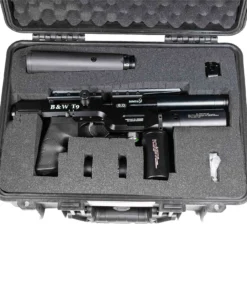

BinTac T9 PCP Carbine | 9mm | Semi-Auto

€1,000.00
The BinTac T9 is a powerful PCP air rifle that can shoot semi-automatic.
This means that the T9 shoots the impressive 9mm pellets and slugs as quickly as you can pull the trigger.
Compact power
The most striking thing about the BinTac T9 is its compact design.
The T9 has a relatively short barrel (203mm) and also has a folding stock making the T9 as short as 42cm when folded!
But appearances can be deceiving! The small T9 shoots with a muzzle energy of 110 joules.
Combined with the 8-shot magazine, this semi-automatic powerhouse is very impressive!
Update on the new T9: The T9 has recently received an updated 5.5mm transferport.
This transferport reduces the power slightly from 135 joules to 110 joules, but allows for a wider range of 9mm pellets to work reliably in the T9.
Complete package
The BinTac T9 comes with a sturdy TSA-approved case, 2 magazines and T9 also comes with the folding stock.
This is important to mention because the T9 was originally offered without the stock/adapter.
This stock is adjustable in length and has an adapter for a QD sling adapter.
Silencing the T9
Even with the shroud, the BinTac T9 has quite the bark.
It is possible to mount a suppressor on the T9 using this adapter by DonnyFL.
Please note that mounting a suppressor might cause the T9 to have cycling issues.
An oversized moderator/suppressor is recommended and the user will need to experiment with ammunition to see which combination cycles the best in his/her T9.
Filling the BinTac T9
The T9 comes with the fill probe to fill the rifle to the maximum of 300 bar.
This fill probe does not have the usual thread, but a male foster connection.
Your filling source therefore requires a female foster coupling.
| Power source: | Pre compressed pneumatic (PCP) |
| Caliber: | 9mm (.35) |
| Muzzle energy: | 110 joule |
| Fill pressure: | 310 bar |
| Air capacity: | 250cc |
| Regulator: | No |
| Operating system: | Semi-automatic |
| Magazine: | 8 schots |
| Max. projectile length: | 12mm |
| Optic mounting: | Picatinny/weaver 22mm |
| Weight: | 3.63kg |
| Length: | |
| Barrel length: | 203mm |
| Muzzle: | Not threaded shroud (adapters available) |
| Accessories: | Case, probe, magazines |
BinTac T9 PCP Carbine 9mm Semi-Auto – Compact Big-Bore Power, Folding-Stock Control and Rapid Follow-Up Performance
BinTac T9 PCP Carbine 9mm Semi-Auto Overview
Compact Semi-Automatic Big-Bore Engineering
The bintac t9 is a compact, semi-automatic PCP carbine chambered in .357 calibre, commonly marketed as 9mm. BinTac lists an eight-inch barrel, an eight-round magazine, a 250 cc air system and a maximum filling pressure of 4,500 PSI. The manufacturer also states that the platform can produce more than 24 shots per fill and reach up to 740 FPS with 82-grain projectiles, generating over 100 foot-pounds of muzzle energy.
This short air rifle uses compressed air rather than firearm cartridges. Its semi-automatic mechanism prepares the next projectile after each discharge, although every shot still requires a separate trigger press. Consequently, the shooter can maintain shoulder contact and optic alignment between carefully controlled shots.
The bintac t9 full auto phrase is misleading for the standard retail model because BinTac identifies the T9 as semi-automatic. Likewise, bintac t9 amazon may return unrelated marketplace results rather than an authorised listing.
Folding Stock, Air Capacity and Sight Mounting
The compact receiver can be combined with a folding, adjustable shoulder stock. Retail specifications list approximately 41–42 cm in the folded configuration and an eight-inch or 203 mm barrel. Some European listings show a total weight near 3.63 kg.
A Picatinny rail supports a suitable optic, while the detachable front air section provides a hot-swap arrangement. BinTac specifies a 125 cc front tube as part of the overall 250 cc capacity. Because the working pressure reaches approximately 310 bar, all charging components must be correctly rated. Ordinary anti air tanks or an incorrectly selected air tank for pep airguns must never be connected.
BinTac Brand, Pricing and Related Platforms
Searches for bintac, bin tac, bintac lIc, bintaclic and BINTAC LLC generally refer to the company selling its own equipment while also distributing AEA products. The official storefront currently lists the bintac t9 price at $949 before tax and shipping, although regional pricing can differ.
Other product searches include bintac m50, bintac m50 for sale, bintac m50 pump action, b&w m50, bintac t50, bintac t 50, bintac t50 for sale, bintac t50 extreme, aea bintac t50 extreme, bintac mcar, bintac mcar air rifle, bintac mcar 457, bintac s45 aea and bintac s45 for sale. These models use different actions, pressure systems, magazines and projectile sizes, so their parts should not be assumed interchangeable.
AEA Harpoon and Compact Alternatives
The aea harpoon, aea harpoon price, bintac aea harpoon, harpoon for sale, aea harpoon magnum, aea .50 harpoon, aea harpoon gun, aea harpoon air gun, harpoon air gun and aea harpoon cartridge phrases refer to a separate compact big-bore platform.
Likewise, the aea defender, aea defender 2 and aea defender 3 belong to another family. Although these products may share compressed-air technology, they differ in loading method, capacity, calibre and intended sporting configuration.
AEA Megalodon and Pump-Action Models
The aea megalodon, aea megalodon air rifle, megalodon air rifle, aea megalodon 50 caliber, aea megalodon 50 cal price, aea megalodon 58 cal and aea megalodon 58 cal bintac m50 searches relate to larger pump-action equipment.
The T9 instead uses a compact semi-automatic mechanism and eight-shot magazine. Buyers choosing between these designs should compare legal classification, handling, air consumption, ammunition availability and supported service rather than concentrating only on energy.
AEA Zeus and Other Large-Bore Platforms
The AEA Zeus MKII (Bullpup) Standard 18 Big Bore, zeus 72 cal air rifle price, aea airguns, aea guns, aea terminator, aea terminator gen 3 and airgun shotgun searches cover several substantially different platforms.
These products should not be confused with a pistol, a conventional pellet gun, a bee bee gun rifle or a small-calibre pcp air gun. The T9 uses heavy .357 projectiles and produces far more energy than ordinary recreational air guns.
FX Airguns Comparison
The fx airguns, fxairguns, fx air guns, fx pcp, fx air rifle, fx airguns usa, fx usa, fx airguns sverige, fx airguns sweden, fx outdoors and fx phrases refer to a separate Swedish premium-airgun manufacturer.
Popular searches include fx impact, f x impact, fx impact m3, f x impact m3, fx m3, fx m3 airgun, fx impact m3 air rifle, fx impact m3 .22cal air rifle, fx impact m3 .22cal air rifle. 600mm barrel, fx impact air rifle, fx impact m4, fx m4, impact m4, impact m4 air rifle, impact m4 500mm, fx impact m4 for sale and impact m4 ballistic coefficient.
These highly adjustable precision rifles are different from the T9’s compact big-bore semi-automatic concept. Likewise, fx halo slugs and fx pellets should not be assumed suitable for the T9 because projectile diameter, length and magazine fit must match the manufacturer’s requirements.
FX Panthera, Dynamic and DRS Families
The FX Panthera MkII, fx panthera, fxpanthera, fx dynamics, fx dynamic, fx drs, fx drs tactical, fx drs classic, fx drs pro and fx drs air rifle searches generally target precision-oriented platforms.
Additional alternatives include fx leopard, fx leopard airgun, fx leopard air rifle, fx king, fx crown, fx crown mk2, fx crown mkii, fx crown mkll, fx wildcat, fx wildcat mk3, fx dreamline, fx dreamline classic and fx maverick.
Those models usually emphasise regulated consistency, tuning flexibility or long-range precision. The T9 instead prioritises compactness, heavy-projectile energy and semi-automatic operation.
Chronographs, Accessories and Precision Testing
A fx chronograph or fx pocket chronograph can be used to measure projectile speed when operated according to its instructions. Velocity data helps confirm consistency, but energy calculations require the correct projectile weight.
The T9 should be filled only with clean, dry compressed air from appropriately rated equipment. In addition, its magazine should be loaded only with projectiles that meet the stated calibre and maximum-length requirements.
Why Choose the BinTac T9?
The strongest reasons to choose the T9 are its compact structure, folding-stock capability, eight-shot magazine, semi-automatic action and big-bore output. It provides a different ownership experience from conventional pcp airguns, high end air rifles and lightweight target equipment.
However, it also demands specialised filling equipment, careful ammunition selection, a substantial backstop and strict compliance with local law. With the correct 4,500 PSI air source, compatible .357 projectiles and responsible handling, the BinTac T9 offers distinctive engineering and controlled semi-automatic performance in an unusually compact PCP carbine.
Engineering, Handling, Accuracy and Practical Ownership
Semi-Automatic Pneumatic Operation
The carbine uses stored compressed air to propel each projectile and cycle the action for the next shot. After the trigger is pressed, the operating system releases a measured amount of air and prepares the following round from the magazine. This allows the shooter to maintain a consistent shoulder position without manually operating a bolt between shots.
Even though the action cycles automatically, every discharge still requires a separate trigger press. The shooter must therefore maintain deliberate control and avoid treating the system as a rapid-fire recreational device. Careful shot placement, secure muzzle direction and awareness of the loaded condition remain essential throughout use.
Compact Carbine Configuration
The short overall layout makes the platform easier to transport and handle than many full-length large-calibre pneumatic rifles. A folding or adjustable stock can further reduce storage length while allowing the shoulder position to be adapted to the individual shooter.
However, compact dimensions can also change the balance. Much of the weight may remain close to the receiver and air system, creating a rear-heavy feel compared with a traditional sporting rifle.
Before mounting accessories, the shooter should practise shouldering the unloaded carbine. This helps establish the most natural stock length, cheek position and supporting-hand location.
High-Pressure Air System
The onboard air system operates at a significantly higher pressure than many entry-level pneumatic platforms. Therefore, all pumps, cylinders, hoses, gauges and connectors must be rated for the required working pressure.
Clean, dry compressed air should be used exclusively. Moisture, oil and debris may damage valves, seals and internal surfaces.
Before filling, inspect the hose, connector and charging port. Air should be introduced gradually while both pressure gauges are monitored. Rapid filling creates heat and may cause the displayed pressure to fall after the reservoir cools.
The approved pressure limit must never be exceeded.
Bleeding and Disconnecting the Fill Line
After charging, pressure trapped inside the filling hose must be released before the connector is removed.
The bleed valve should be opened slowly while hands and face remain away from the fitting. A brief discharge of air is normal.
Attempting to remove a pressurised connection may damage seals or cause the hose to move suddenly. Once the line has been depressurised, the fitting can be disconnected carefully and protected from contamination.
The charging port should remain covered when not in use.
Detachable Air Components
A removable air section can make refilling and replacement more convenient. Nevertheless, it must be handled as a high-pressure component rather than an ordinary accessory.
Before installation or removal, the user must follow the manufacturer’s procedure exactly. Threads, sealing surfaces and connectors should be inspected for dirt or damage.
A pressurised component should never be dismantled, modified or forced into position. If the unit does not attach smoothly, stop and inspect the alignment.
Replacement cylinders or tubes must match the correct model and pressure rating.
Magazine Loading
The multi-shot magazine should be loaded only with clean, undamaged projectiles of the correct diameter and length.
Each round should be inspected before insertion. Deformation, debris or excessive length may interfere with feeding and action movement.
The projectiles should be seated evenly without being forced. Once loaded, the magazine must be inserted in the correct orientation and secured fully.
If resistance is felt, remove the magazine and inspect it rather than applying extra pressure. Forceful installation may damage the magazine, loading mechanism or ammunition.
Managing the Semi-Automatic Firing Rhythm
The action may be capable of quick follow-up shots, but the shooter should maintain a controlled rhythm.
After each discharge, the sights should return to the intended aiming area before the trigger is pressed again. This pause also gives the shooter time to detect an unusual sound, incomplete cycle or change in recoil behaviour.
Fast firing increases air consumption and may cause pressure to drop more quickly. It may also heat or stress operating components.
Deliberate shooting generally improves accuracy, conserves air and reduces the risk of feeding problems.
Preventing Double Feeding and Obstructions
If the action does not cycle normally, stop shooting immediately. Repeated trigger presses or manual attempts to force the mechanism may place more than one projectile inside the barrel.
The magazine should be removed only when it can be done safely. The chamber and bore should then be inspected according to the approved procedure.
Another round must never be fired to clear a suspected obstruction. Doing so may damage the barrel or create an unpredictable discharge.
When the blockage cannot be removed safely, professional assistance should be obtained.
Barrel Performance and Ammunition Testing
A rifled barrel stabilises the projectile through controlled rotation. However, barrel quality alone does not guarantee precision.
Projectile weight, diameter, shape, air pressure and shooting technique all influence accuracy. Several compatible options should be tested at a measured distance from a stable support.
Each type should be evaluated through multiple groups. One unusually accurate result may occur by chance, while repeated grouping provides a stronger basis for comparison.
The most useful ammunition should feed reliably, fit the magazine correctly and maintain a stable point of impact.
Optic Selection and Mounting
A compact variable-power optic or durable reflex sight may complement the carbine’s short design. Oversized equipment can add unnecessary weight and make the platform feel unbalanced.
The mounting system must match the rail. Screws should be tightened gradually and evenly, while excessive force should be avoided.
Eye relief should be set from the natural shoulder position. The shooter should see a complete sight picture without stretching the neck or moving the head repeatedly.
After transportation, the optic should be checked with a confirmation group.
Trigger Control
The trigger finger should contact the blade at the same point during each shot. Pressure should increase smoothly and move directly toward the rear.
The remaining fingers should maintain steady grip pressure without squeezing excessively. Tightening the entire hand can move the muzzle and widen groups.
After discharge, the trigger should remain pressed briefly before being allowed to reset. This supports follow-through and helps the shooter avoid sudden finger movement.
Any adjustment should remain within the manufacturer’s approved limits.
Managing Air Consumption
Large projectiles and semi-automatic cycling require substantial air. Actual shot count depends on projectile weight, fill pressure, firing pace, temperature and mechanical condition.
The owner should record the starting pressure and count each discharge during several sessions. Changes in sound, impact location or cycling behaviour can indicate that pressure has fallen outside the dependable range.
Refilling before performance declines supports more consistent operation and reduces the chance of a weak shot.
Routine Inspection and Maintenance
After use, remove the magazine and confirm that the chamber is clear. Wipe the exterior to remove moisture, dirt and fingerprints.
The barrel should be cleaned only when accuracy declines or contamination is present. A soft pull-through system helps protect the rifling and muzzle crown.
Magazine components, seals, mounting screws and stock hardware should be inspected regularly.
Internal valve or pressure-system repairs should be completed by a qualified technician.
Secure Storage and Transportation
The carbine should be stored unloaded inside a locked cabinet or secure case. Magazines, projectiles, charging equipment and access keys should remain controlled.
During transportation, use a padded case that protects the stock, optic, barrel, reservoir and pressure fittings.
The case should remain out of public view and should not be left inside a hot vehicle.
With compatible ammunition, correctly rated filling equipment, disciplined trigger control and responsible maintenance, the platform can provide smooth operation, practical precision and dependable long-term performance for lawful sporting use.
Advanced Accuracy, Troubleshooting, Safety and Long-Term Reliability
Establishing a Controlled Pre-Shooting Routine
Consistent performance begins with a careful inspection before every session. Check the reservoir pressure, magazine, stock, trigger area, optic mounts, muzzle, charging connection and visible fasteners. Each part should appear secure, clean and free from obvious damage.
Keep the muzzle directed toward a reliable backstop throughout preparation. The trigger finger must remain outside the guard until the shooter has identified the target, confirmed the surrounding area and made a deliberate decision to fire.
A fixed sequence improves safety and consistency. Follow the same order for checking pressure, loading the magazine, adjusting the stock, shouldering the carbine and confirming the sight picture.
Confirming an Unloaded Condition
Removing the magazine does not automatically confirm that the chamber is empty. A projectile may already have entered the barrel before the magazine was taken out.
Before cleaning, adjusting, transporting or storing the carbine, inspect the chamber according to the manufacturer’s procedure. Avoid repeatedly operating the action when the chamber condition is uncertain because additional cycling may create a double feed.
When there is any doubt, stop immediately. Never attempt to clear an obstruction by firing another projectile behind it.
Developing Natural Point of Aim
Natural point of aim describes where the sights settle when the shooter relaxes. A correct position reduces muscular tension and makes follow-up shots easier to control.
Assume the intended stance, close the eyes briefly and allow the upper body to settle. Reopen the eyes and observe where the optic rests.
When the sight picture settles beside the target, move the feet, hips or torso instead of forcing the carbine sideways with the arms. Muscle tension may hold the sights temporarily, but it often creates movement during trigger release.
Improving Supported Accuracy Testing
A padded rest can help separate mechanical performance from shooter movement. Support the fore-end or stock without allowing the barrel or pressure system to contact a hard surface directly.
Use the same support point for every shot. Moving the carbine forward or backward on the rest may change balance and point of impact.
The rear of the stock may receive light support, although the carbine should not be clamped rigidly. Fire several groups before judging performance. One unusually small group may occur by chance, while repeated results provide a more reliable assessment.
Managing Follow-Up Shots
The self-loading action allows another shot to be prepared without manual cycling. However, the shooter should not rush.
After each discharge, allow the sights to return to the intended aiming area. Confirm that the action sounded and felt normal before pressing the trigger again.
A controlled rhythm conserves air, reduces heat and lowers the chance of feeding problems. It also helps the shooter recognise weak shots, incomplete cycling or changes in recoil behaviour.
Recording Pressure and Shot Count
A written log can reveal the most reliable operating range.
Begin with a known fill pressure and count every discharge. At regular intervals, record the gauge reading, point of impact, firing sound and cycling behaviour.
After several sessions, a pattern should become clear. The owner can then refill before performance begins to decline.
A sudden reduction in usable shot count may indicate leakage, valve inefficiency, seal wear or another developing problem.
Recognising Pressure-Related Changes
Vertical movement on the target may occur when the reservoir falls outside its most consistent pressure range. However, changing cheek pressure, loose mounts and inconsistent trigger control can produce similar results.
Check external causes first. Confirm the pressure, inspect the ammunition and verify that the optic remains secure.
Internal adjustments should not be attempted without the correct tools and technical knowledge. Improper changes may reduce efficiency, damage seals or create unsafe operating conditions.
Responding to a Weak Shot
A noticeably weak discharge requires immediate attention.
Stop firing and inspect the pressure gauge. If the sound was unusually soft or the expected impact did not appear, a projectile may remain inside the barrel.
Do not load or fire another one until the bore has been confirmed clear. Low pressure, damaged ammunition, incomplete cycling or an obstruction may be responsible.
Repeated weak shots should be assessed by a qualified technician.
Diagnosing Incomplete Cycling
Incomplete cycling may occur when pressure is too low, ammunition is unsuitable, the magazine is damaged or internal components require service.
Keep the muzzle pointed toward the backstop and remove the finger from the trigger. Do not repeatedly press the trigger or force the action.
Remove the magazine only when it can be done safely. Then inspect the loading area according to the approved procedure.
Persistent cycling problems should not be ignored because continued use may damage components or create uncertainty about the chamber condition.
Detecting Air Leakage
A slow leak may cause the pressure reading to fall during storage. Temperature changes also affect displayed pressure, so comparisons should be made under similar conditions.
Record the gauge reading after filling and check it again later. Continued pressure loss may indicate a damaged seal, charging-valve fault, gauge problem or internal leak.
Never dismantle the reservoir, valve or other pressurised components while air remains inside the system. High-pressure repair requires specialist tools and experience.
Maintaining Magazine Reliability
Keep magazines clean, dry and protected from impact. Dirt, wear or damaged indexing components may interfere with feeding.
Inspect every projectile before loading. Deformation, debris and incorrect dimensions can reduce both reliability and accuracy.
If the magazine becomes difficult to rotate, insert or remove, do not force it. A damaged unit should be serviced or replaced before use continues.
Protecting Optic Zero
Transport, impact and loose hardware can shift the point of impact.
After travelling, fire a confirmation group before beginning serious target work. If the group remains tight but has moved, a minor optic correction may be required. If it has widened, inspect the rings, rail, stock hardware and ammunition.
Mounting screws should be tightened evenly. Excessive force can damage threads or distort the optic body.
Cleaning the Barrel Safely
The barrel does not require cleaning after every session. Cleaning becomes appropriate when accuracy declines, contamination appears or foreign material enters the bore.
A soft pull-through system is generally safer than a rigid metal rod. The rifling and muzzle crown must be protected from scratches.
After cleaning, several settling shots may be needed before normal grouping returns.
Maintaining Charging Equipment
Inspect the hose, seals, connector, filter and bleed valve before every fill.
A compressor must provide clean, dry air and adequate cooling. A storage cylinder must remain within its inspection period and should always be secured against falling luftgevær.
After charging, release pressure from the hose before disconnection. Damaged or incorrectly rated equipment must not be used.
Safe Storage and Transportation
Store the carbine unloaded inside a locked cabinet or secure container. Remove the magazine and restrict access to ammunition, charging equipment and keys.
The storage area should remain dry and temperature-stable. Excessive heat may affect pressure and sealing components.
During transportation, use a padded case that protects the stock, optic, barrel, reservoir and charging fittings.
Long-Term Reliability Assessment
Long-term performance depends on clean compressed air, compatible ammunition, careful pressure management and regular inspection.
Retain the manual, purchase receipt and service records. Avoid unauthorised modifications that may reduce reliability, invalidate warranty coverage or alter legal classification.
With disciplined handling, secure storage and professional servicing when required, the carbine can remain accurate, efficient and dependable throughout many years of lawful sporting ownership.
Be the first to review “BinTac T9 PCP Carbine | 9mm | Semi-Auto”
Related products

BinTac
Reviews
There are no reviews yet.