

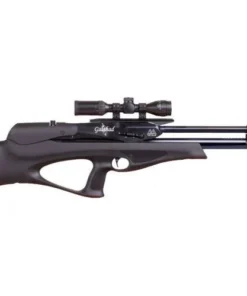
Air Arms Galahad R Soft-Touch Black

€1,600.00
Air Arms Galahad Black Soft Touch Regulated
The Bullpup format has long been loved by airgunners for its compact size, whilst still retaining a full size cylinder and barrel to create a flexible rifle. The Air Arms Galahad is built upon this format and incorporates a wealth of features which ensure it is very refined and will last for many years to come.
The stock is totally ambidextrous by incorporating a thumbhole design which is just as comfortable from either side. This stock is finished in a black soft touch rubber which is very warm to the touch, and grippy as well which is ideal in damp conditions. An accessory rail is built into the underside to add on a bipod or sling which makes this rifle more flexible.
The action is cocked and loaded by a side lever action which works in a vertical plane, and can be reversed from either side to allow total ambidexterity on this rifle. This lever loads pellets via the same 10 shot magazine as found on Air Arms other multi shot rifles.
The barrel comes from Walther Lothar and is totally shrouded to reduce the muzzle report. This shroud is also threaded to fit a silencer which is ideal for stealthy target shooting or hunting. The cheek piece is also covered in the same soft touch material as the stock which is a very nice feature.
Scope and mounts not included.
Safety – Manual
Trigger – Two stage adjustable weight & length
Total Length – Carbine: 698 mm | Rifle: 798 mm
Loading – 10-Shot magazine system
Barrel Length – Carbine: 395 mm | Rifle: 493.5 mm
Weight – Carbine: 3.6 kg | Rifle: 3.7 kg
Shot Count Regulated – Carbine: 110 | Rifle: 130+
Shot Count Non-Regulated – Carbine: 80 | Rifle: 100
Air Arms Galahad R Soft-Touch Black – Regulated Bullpup Precision, Ambidextrous Handling and Compact PCP Performance
The Air Arms Galahad R Soft-Touch Black is a compact regulated bullpup designed for shooters who want precision, short overall length, ambidextrous operation, and refined British engineering in one platform. Air Arms describes the Galahad as using the same proven powerplant and magazine architecture associated with the S410/S510 family while moving the action rearward into a bullpup layout. The result is a highly compact rifle that retains a full-length barrel and useful air capacity.
For buyers researching an air rifle, air gun, air arms, air rifles, pellet guns, airguns, airgins, air riflery, air arm, or Air Arms air rifle, the Galahad stands out because it combines familiar PCP engineering with a radically shorter layout.
Regulated PCP System and Shot-to-Shot Consistency
The “R” designation identifies the regulated version.
Air Arms confirms that the Galahad uses its regulator and valve system to improve shot-to-shot consistency. That means air is delivered to the firing system in a more controlled way across the useful portion of the fill.
This is especially valuable for precision-oriented shooting because stable velocity supports predictable trajectory and repeatable point of impact.
Compact Bullpup Design
One of the biggest advantages of the Galahad R is its compactness.
Current carbine specifications list an overall length of approximately 698mm with a 395mm barrel. That allows the rifle to retain useful barrel length while remaining significantly shorter than many conventional sporters.
The rearward action also places the center of gravity close to the pistol-grip area, helping the rifle feel stable and controlled despite its short overall dimensions.
Soft-Touch Black Stock
The Soft-Touch Black version uses an ambidextrous synthetic stock with a tactile black finish.
The cheekpiece is also covered in soft-touch material, while the distinctive pistol-grip area gives the shooter several comfortable supporting positions. The finish provides a secure grip and is especially practical in damp conditions.
For shooters who prefer durability and easy maintenance over traditional wood, this configuration offers a practical all-weather option.
Ambidextrous Forward-Mounted Cocking Lever
The Galahad uses a unique forward-mounted cocking lever.
Air Arms designed the lever so it can be transferred to either side of the rifle. This makes the platform genuinely useful for both left- and right-handed shooters.
The forward cocking motion also helps the shooter remain behind the optic while cycling the action.
As a result, unnecessary body movement can be reduced between shots.
10-Shot Multi-Shot Magazine
The rifle uses the established Air Arms 10-shot magazine system.
Current UK product listings commonly include two 10-shot magazines with the Galahad package.
The multi-shot system is especially useful during longer target sessions because the shooter can maintain a steady rhythm without loading every projectile directly into the breech.
Adjustable Two-Stage Trigger
An adjustable two-stage trigger is fitted as standard.
A predictable first stage followed by a controlled release helps the shooter apply pressure without disturbing the sight picture.
The rifle also includes a manual safety.
This combination supports both precision and responsible handling.
Lothar Walther Barrel and Accuracy
The Galahad uses a Lothar Walther rifled barrel, a major component behind the rifle’s accuracy potential. Current specifications also describe the barrel as fully shrouded, with the shroud threaded for a compatible moderator where lawful.
Practical accuracy still depends on ammunition selection, optic quality, air consistency, environmental conditions, and shooter technique.
However, the regulated action and precision barrel provide a strong mechanical foundation.
.177 and .22 Calibre Options
The Galahad R has commonly been offered in .177 and .22, while higher-powered international versions have also appeared in .25.
Search phrases such as cal .177 pellets, 177 caliber, 177 air rifle, 177 pellet vs.22 pellet, 177 caliber vs 22, .22 air rifle, and air rifle calibers commonly appear when buyers compare these choices.
The best calibre depends on local regulations and intended lawful sporting use.
Air Arms S510 XS Ultimate Sporter Comparison
Buyers researching the Galahad may also encounter Air Arms S510 XS Ultimate Sporter FAC, Air Arms S510 XS Ultimate Sporter FAC Walnut Stock, Air Arms S510 XS Ultimate Sporter, Air Arms S510 FAC, Air Arms S510 XS FAC PCP Air Rifle, air arms s510, and air arms s510 ultimate sporter .177 sub 12.
These belong to the conventional rifle-format S510 family rather than the Galahad bullpup platform.
Although the Galahad shares core engineering ideas and magazine architecture with the S410/S510 family, its layout, balance, cocking system, and stock design are different.
Air Arms S410, TX200 and Pro Sport Comparison
Searches for air arms s410, air arms tx200, and prosport air arms commonly appear alongside the Galahad.
The S410 is another PCP platform.
The TX200 and Pro Sport use spring-piston systems.
Therefore, they differ significantly in recoil behavior, loading method, air management, and overall shooting feel.
Searches such as what is an air rifle, how do air guns work, what is break barrel air rifle, break barrel pellet gun, air compressor rifle, and pcp hand pump generally come from buyers comparing these different operating systems.
Target and Range Shooting
The regulated action, compact balance, adjustable trigger, and precision barrel make the Galahad particularly well suited to lawful target air rifle shooting.
Searches such as airgun shooting range near me are also relevant for users looking for a controlled environment to practice.
An Air rifle cleaning kit can be useful for appropriate periodic maintenance, although unnecessary over-cleaning should be avoided when the rifle continues to group consistently.
Broader Airgun Search Terms
Other searches such as air pisto, air guns, metal bb gun, Legends M3 Grease Gun S, and air guns for home defense cover very different categories.
The Galahad is primarily a sporting PCP platform and should be used, stored, and transported responsibly in accordance with applicable law.
Umarex Comparison Searches
Broader research may also include umarex, umarex usa, umarexusa, umerex, umarex airguns, umarex air rifles, umarex notos, umarex gauntlet, umarex zelos, umarex hammer, umarex t4e, umarex tr50, umarex hdr 50, umarex smith, umarex t4e smith, glock bb gun, glock 19 bb gun, umarex glock 19, umarex glock 17 gen 5, and airsoft glock.
These products range from PCP rifles to CO₂ replicas and training platforms.
Their specifications should not be mixed with those of the Galahad.
Why Choose the Air Arms Galahad R Soft-Touch Black?
The strongest reason to choose this configuration is the combination of compact dimensions, regulated performance, ambidextrous controls, and refined ergonomics.
The bullpup layout keeps the rifle short.
The regulator supports consistent air delivery.
The forward cocking lever minimizes movement between shots.
The 10-shot magazine improves convenience.
The adjustable two-stage trigger gives the shooter controlled input.
The soft-touch stock provides a secure, practical grip.
The adjustable butt pad improves fit.
The precision barrel supports strong accuracy potential.
Together, these features make the Air Arms Galahad R Soft-Touch Black a distinctive choice for shooters who want a compact, highly refined PCP without giving up the precision and build quality associated with a premium British sporting rifle.
Practical Accuracy, Bullpup Handling, Air Management and Everyday Performance
Built for Controlled, Repeatable Shooting
A compact precision rifle should feel predictable every time it is shouldered. The trigger should break consistently, the cocking lever should operate smoothly, the magazine should feed correctly, and the point of impact should remain stable when the shooter does their part.
This configuration brings several modern design ideas together in one compact package.
The bullpup layout reduces overall length.
The regulated pneumatic system supports more consistent air delivery.
The forward-mounted cocking lever helps the shooter stay behind the optic.
The multi-shot magazine keeps the shooting sequence efficient.
The soft-touch stock provides practical grip and weather resistance.
When these systems work together properly, the result is a rifle that feels refined rather than complicated.
Why Repeatability Matters
One tight group is encouraging, but repeated groups tell the real story.
A rifle becomes trustworthy when similar results can be produced under similar conditions.
Repeatability depends on several things.
The ammunition must suit the barrel.
The optic needs to remain secure.
The air system needs to stay within its useful operating range.
The shooter must maintain consistent body position and trigger control.
When those variables remain stable, performance becomes much easier to understand.
Establishing a Baseline
Before making adjustments, the shooter should establish a baseline.
One suitable projectile should be selected.
The rifle should be filled in the same way.
The optic should remain unchanged.
Several groups should be fired from a stable support.
Velocity data can also be recorded if suitable equipment is available.
This gives the shooter a dependable reference.
If a later change improves performance, the difference becomes easier to identify.
If performance becomes worse, the original setup can be restored.
Change One Variable at a Time
Changing several things together makes testing difficult.
If ammunition, optic settings, support position, and filling routine are all altered at once, the cause of any change becomes unclear.
A better method is simple.
Change one variable.
Test the rifle.
Record the result.
Then decide whether another change is necessary.
This process may take longer, but the information is far more useful.
Projectile Selection
Projectile choice has a major influence on accuracy.
Weight matters.
Diameter matters.
Shape matters.
Length matters.
Manufacturing consistency matters.
Two projectiles with similar weights can behave very differently in the same barrel.
For this reason, several suitable options should be tested before one is chosen for regular use.
Repeating Ammunition Tests
One unusually tight group should not determine the final choice.
Chance can produce a good result.
Several groups should be fired with each option.
Repeated performance matters more than one exceptional target.
If one projectile consistently produces smaller and more predictable groups, confidence in that choice increases.
Inspecting Ammunition
Damaged projectiles can create misleading results.
Bent skirts, dents, contamination, or inconsistent shape may affect flight.
For serious testing, ammunition should be inspected before loading.
Damaged pieces should be removed.
This reduces unnecessary variation and makes the rifle easier to evaluate.
Barrel Condition
The barrel provides the mechanical foundation for accuracy.
However, constant cleaning is not always beneficial.
If the rifle continues to group well, there may be no reason to clean it frequently.
When accuracy begins to decline, barrel condition can be investigated.
Suitable cleaning materials should be used.
Aggressive methods should be avoided.
Conditioning After Cleaning
The first few shots after cleaning may behave differently.
The barrel can require a short conditioning period before performance stabilizes.
The shooter should therefore avoid making immediate conclusions.
Once groups return to a normal pattern, testing can continue.
Understanding the Regulated Air System
The regulated pneumatic system is one of the most important parts of the rifle.
A regulator helps control the pressure delivered to the firing mechanism.
This can help keep shot velocity more consistent as reservoir pressure gradually falls.
That consistency supports a more predictable trajectory.
At shorter distances, small differences may be difficult to notice.
At longer distances, they can become more obvious.
Why Regulation Matters in Practice
A regulated system does not remove every variable.
Ammunition still matters.
Temperature still matters.
Shooter technique still matters.
However, regulation helps reduce one important source of variation.
That makes testing easier.
It also helps the shooter understand the rifle more quickly because the pressure delivered to each shot is more consistent through the useful portion of the fill.
Fill Consistency
Starting a serious test from a similar fill condition makes comparisons more meaningful.
If one group is fired near the top of the pressure range and another much lower, the results may not be directly comparable.
Using a repeatable filling routine removes one unnecessary variable.
Shot Count
The useful number of shots depends on several factors.
Calibre matters.
Projectile weight matters.
Power level matters.
Temperature can influence air pressure.
The important figure is not the absolute maximum.
The shooter should determine how many shots remain consistent before performance begins to change.
Recognizing the End of the Useful Fill
As reservoir pressure falls, the rifle eventually reaches a point where the regulator can no longer maintain the same working pressure.
Velocity may begin to drop.
The sound can change.
The point of impact can also move.
The shooter should learn where this transition occurs.
Once it does, the rifle should be refilled rather than continuing through a less consistent portion of the charge.
Safe Filling
Only suitable high-pressure equipment should be used.
Connections should remain clean.
The fill process should be controlled rather than rushed.
Rapid filling can generate heat.
After cooling, the gauge may show slightly lower pressure.
This is normal.
The approved maximum pressure should never be exceeded.
Clean Air Supply
Clean, dry compressed air helps protect the internal system.
Moisture can create long-term problems.
Dust and debris can damage seals.
Fill fittings should remain protected.
Hoses and connectors should be inspected periodically.
Damaged equipment should be replaced.
Compact Bullpup Handling
The bullpup layout changes the way the rifle feels.
Much of the action sits farther to the rear than on a conventional sporter.
This shortens the overall package while preserving useful barrel length.
The result is a rifle that can feel more compact and responsive.
It is easier to reposition around benches, shooting bags, and other supports.
It is also easier to transport.
Balance and Center of Gravity
The rearward action places more mass closer to the shooter.
This changes the balance compared with a conventional rifle.
A well-balanced bullpup can feel shorter and easier to move.
However, accessory choice can change that balance.
A large optic can add noticeable weight above the action.
Other accessories can also shift the center of gravity.
The shooter should therefore configure the rifle around practical balance rather than adding unnecessary equipment.
Soft-Touch Stock Ergonomics
The stock is designed to provide a secure and comfortable interface.
The soft-touch finish gives the shooter additional grip.
This can be especially useful when hands are damp or conditions are less than ideal.
The synthetic material also requires relatively little cosmetic maintenance.
The stock should feel secure without requiring excessive grip pressure.
Ambidextrous Handling
The rifle is designed to work well for both left- and right-handed shooters.
The transferable cocking lever is one of the most important features in that regard.
A control that can be positioned on either side allows the action to be tailored more closely to individual preference.
This improves comfort and can reduce unnecessary movement during the firing sequence.
Forward Cocking Lever
The forward-mounted cocking lever is unusual compared with many conventional pneumatic rifles.
Its position allows the shooter to operate the action without moving the hand far to the rear.
That can help preserve head position and shoulder contact.
The lever should still be operated smoothly.
Aggressive cycling is unnecessary.
If resistance suddenly increases, the shooter should stop and investigate.
Magazine Loading
The magazine should be loaded carefully.
Projectiles should sit correctly.
Damaged ammunition should not be forced into place.
The magazine should rotate smoothly.
Keeping it clean helps maintain reliable feeding.
Shooting Rhythm
A multi-shot magazine can help maintain a consistent rhythm.
However, faster cycling should not encourage rushed shooting.
The shooter should still rebuild the firing sequence carefully.
Breathing, trigger control, sight alignment, and follow-through should remain consistent.
Trigger Control
The trigger is one of the most important connections between the shooter and rifle.
A predictable trigger allows pressure to be applied smoothly.
A sudden jerk can disturb the sight picture.
The goal is a controlled rearward press.
The lightest possible trigger is not always the best.
A safe and predictable setting usually provides better practical control.
Trigger Finger Position
The trigger finger should move mainly rearward.
Too much finger can pull the rifle sideways.
Too little contact may reduce control.
The ideal position varies between shooters.
Consistency matters more than copying another person’s technique.
Grip Pressure
The firing hand should control the rifle without excessive tension.
A very tight grip can introduce movement through the wrist and forearm.
A relaxed grip allows the trigger finger to work more independently.
The same general pressure should be used from shot to shot.
Shoulder Contact
The rifle should meet the shoulder in a consistent location.
Different pressure can change how the rifle settles.
Although recoil is mild, movement still occurs during the firing cycle.
Consistent shoulder contact helps make that movement predictable.
Cheek Position
The eye should return to the same location behind the optic for every shot.
The cheek should settle naturally on the stock.
If the shooter has to move the head around to find the sight picture, the optic or cheek position may need adjustment.
A repeatable cheek position improves comfort and precision.
Adjustable Butt Pad
The rear pad can be adjusted to improve shoulder fit.
Small changes can influence how naturally the rifle mounts.
The goal is not to force the rifle into position.
The goal is to create a comfortable and repeatable relationship between shoulder, cheek, optic, and trigger.
Scope Mounting
The optic should be mounted securely.
Eye relief should be correct.
The full image should appear without stretching the neck.
The mounts should be tightened evenly.
Loose mounts can create confusing point-of-impact changes.
Overtightening should also be avoided.
Parallax Control
Parallax can create aiming error.
If the shooter’s eye moves and the reticle appears to shift across the target, parallax is present.
The optic should be adjusted for the target distance when possible.
This becomes increasingly important at higher magnification.
Magnification Choice
Higher magnification can make small targets easier to see.
However, it also makes natural movement appear larger.
This can cause the shooter to overcorrect.
Moderate magnification may provide better practical control.
Higher settings are most useful when the rifle is supported securely.
Zeroing
Zeroing should be performed from a stable position.
The shooter should fire groups rather than adjusting after every shot.
A group shows the average point of impact.
Once the group is consistent, the optic can be adjusted.
Another group should confirm the result.
Confirming Zero
Zero should be checked periodically.
Transport, accidental contact, temperature changes, or optic movement can shift the point of impact.
A short confirmation session can prevent surprises.
Bench Shooting
A bench provides an excellent environment for evaluating mechanical accuracy.
The rifle should be supported consistently.
A front rest or bag can reduce movement.
A rear bag can provide fine elevation control.
The rifle should sit naturally.
Excessive clamping should be avoided.
Front Support Position
The front support should remain in the same location.
Changing the support point can alter balance.
The rifle should rest naturally.
A stable support is useful, but excessive pressure should be avoided.
Rear Bag Technique
A rear bag allows fine elevation control.
Gentle squeezing can raise or lower the aiming point.
The shooter should use similar pressure for every shot.
Inconsistent pressure can change the rifle’s orientation.
Supported Field Positions
A shooting bag or sticks can significantly improve practical accuracy.
The shooter should choose a position that creates a natural point of aim.
Good support often provides more practical improvement than unnecessary mechanical changes.
Standing Position
Standing is one of the least stable positions.
The rifle will move naturally.
The shooter should not try to eliminate all movement.
A balanced stance and relaxed upper body help.
The shot should be released during the most stable part of the natural movement.
Kneeling Position
Kneeling provides greater stability.
The shooter can use body structure instead of relying entirely on muscle.
The position should feel natural.
A strained posture is difficult to repeat.
Sitting Position
Sitting can provide excellent support.
The arms can rest against the legs.
Different arrangements may be tested.
The best position is the one that provides stability without excessive tension.
Breathing Control
Breathing naturally moves the upper body.
Many shooters release the shot during the pause after exhaling.
The pause should remain comfortable.
If the shot is not ready, the shooter should breathe normally and restart.
Long breath holds create unnecessary tension.
Follow-Through
The shooting sequence continues after the trigger releases.
The eye should remain behind the optic.
The cheek should stay in position.
Shoulder pressure should remain stable.
Moving immediately after the shot can reduce consistency.
Calling the Shot
Experienced shooters can often recognize when a shot was poorly executed.
If the reticle moved during the trigger break, the shooter may predict the direction of the error.
This helps separate shooter mistakes from equipment problems.
Wind Effects
Wind becomes increasingly important as distance increases.
A crosswind can move the projectile sideways.
The shooter should observe grass, leaves, vegetation, dust, and flags.
Conditions may differ between the firing point and target.
Wind reading improves through practice.
Distance Measurement
Knowing the true distance improves precision.
A rangefinder can reduce uncertainty.
Known-distance practice is also useful.
Once trajectory is understood at several distances, corrections become easier.
Ballistic Verification
Ballistic software can provide useful estimates.
Measured velocity, projectile weight, sight height, and zero distance can be entered.
However, calculated information should always be confirmed on actual targets.
Real impacts provide the final reference.
Temperature Effects
Compressed air pressure changes with temperature.
A rifle filled in warm conditions may display lower pressure after cooling.
This does not automatically indicate a leak.
For careful testing, the rifle should be allowed to stabilize in the environment where it will be used.
Chronograph Testing
A chronograph can provide useful information.
Several shots should be measured.
Average velocity provides a reference.
Variation between shots can also be observed.
The data should be interpreted as a pattern rather than by focusing on one unusual reading.
Extreme Spread
Extreme spread is the difference between the fastest and slowest shot in a measured string.
A smaller spread generally indicates better velocity consistency.
This can help reduce vertical dispersion.
However, low spread does not guarantee small groups.
Projectile compatibility still matters.
Standard Deviation
Standard deviation shows how closely individual velocity readings cluster around the average.
Lower values can be useful when evaluating consistency.
However, small numerical improvements should not be overvalued if actual target results do not improve.
Air Efficiency
Efficiency means achieving useful performance without wasting compressed air.
A well-balanced setup provides stable accuracy and sensible shot count.
There is little benefit in changing the rifle simply to consume more air without improving practical results.
Recognizing an Efficient Setup
A good setup generally produces stable velocity, consistent groups, sensible air consumption, and predictable behavior.
If further changes produce very little improvement, the rifle may already be near its practical optimum.
Additional adjustment may provide no meaningful benefit.
Avoiding Constant Adjustment
The presence of advanced features does not mean the rifle should be changed constantly.
Once a reliable configuration has been found, leaving it alone often improves long-term consistency.
Changes should have a clear purpose.
Random experimentation can make a good setup difficult to understand.
Keeping Detailed Records
A shooting log can save considerable time.
The shooter can record projectile type, fill pressure, velocity, group size, distance, environmental conditions, and optic settings.
This creates a useful performance history.
If the setup changes later, a successful configuration can be restored.
Regulator Behavior
A regulator should help maintain consistent working pressure through most of the useful fill.
If velocity changes unexpectedly while reservoir pressure remains adequate, the system may deserve investigation.
However, ammunition, temperature, optic movement, or shooter technique can create similar symptoms.
Troubleshooting should remain systematic.
Seal Monitoring
The air system depends on seals.
If pressure drops continuously during storage, a seal may require attention.
Temperature changes should first be considered.
If pressure continues falling under stable conditions, the source should be identified appropriately.
Barrel Cleaning
Cleaning should be based on performance.
If the rifle continues to group well, frequent cleaning may not be necessary.
If accuracy declines unexpectedly, barrel condition can be investigated.
Suitable cleaning materials should be used.
Aggressive methods should be avoided.
Accuracy Troubleshooting
Accuracy problems should be investigated systematically.
Check the optic first.
Then inspect the mounts.
Confirm the ammunition.
Check barrel condition.
Review air pressure.
Review shooter technique.
Only after these steps should more complex causes be considered.
Tight Groups That Shift
If groups remain tight but move to another part of the target, the rifle may still be mechanically accurate.
Possible causes include wind, optic movement, support changes, temperature, or zero shift.
A moved group is different from a larger group.
Groups That Open Up
If group size increases significantly, ammunition, barrel condition, pressure variation, optic stability, or technique may be responsible.
Returning to the known baseline can help isolate the issue.
Soft-Touch Stock Care
The synthetic stock requires relatively little maintenance.
Dust and dirt can usually be removed with a soft cloth.
Harsh chemicals should be avoided.
The soft-touch finish should be kept clean without aggressive scrubbing.
Grip areas and adjustment points should also be inspected periodically.
Protecting the Exterior
Metal surfaces should be kept clean and dry.
Fingerprints and moisture should be wiped away after use.
Suitable protective products can be used where appropriate.
Excess lubricant should not be allowed to migrate into areas where it does not belong.
Transport
The rifle should be transported unloaded.
A suitable case should protect the optic and exterior.
Accessories should be secured.
Applicable transport requirements should always be followed.
Storage
The rifle should be stored in a dry and secure location.
Unauthorized persons should not have access.
Humidity should be controlled where possible.
The air system should be maintained according to appropriate guidance.
Long-Term Reliability
Reliability comes from sensible maintenance.
The fill system should remain clean.
The magazine should be kept free of debris.
The barrel should be cleaned only when necessary.
The optic should remain secure.
The air system should be monitored for pressure changes.
These basic habits help preserve performance.
Avoiding Unnecessary Disassembly
A rifle that performs correctly does not need constant internal work.
Repeated disassembly can introduce new problems.
Routine external inspection, sensible cleaning, and pressure monitoring are usually sufficient.
Internal high-pressure work should be performed only when necessary.
Professional Servicing
Regulator work, valve repair, seal replacement, and other internal servicing require suitable knowledge and tools.
If the owner is not qualified, professional servicing is the sensible option.
Correct maintenance supports reliability and safety.
Who Will Appreciate This Configuration Most
This configuration is particularly suitable for shooters who value compact dimensions, regulated performance, ambidextrous handling, and practical synthetic furniture.
It appeals to users who prefer a short bullpup layout rather than a conventional long sporter.
It also suits shooters who want a rifle that is easy to handle, straightforward to maintain, and adaptable to different body positions.
Why the Bullpup Layout Works
The bullpup arrangement allows useful barrel length to be retained while reducing overall length.
The action is moved rearward.
The rifle becomes shorter.
The center of mass stays closer to the shooter.
For many users, this creates a compact platform that is easier to reposition without sacrificing the mechanical advantages of a full-length barrel.
Why the Forward Lever Matters
The forward-mounted lever reduces the distance the hand needs to travel between shots.
This can help preserve cheek position and shoulder contact.
It also gives the rifle a distinctive operating feel.
For shooters who value minimal movement between shots, this feature can be particularly appealing.
Why Regulation Improves Confidence
A regulated action creates a more predictable operating window.
Velocity can remain more stable.
Trajectory becomes easier to understand.
Group testing becomes more meaningful.
This does not remove every variable, but it reduces one important source of inconsistency.
Why Simplicity Still Matters
Even with a technically advanced platform, the best results often come from finding one reliable setup and keeping it.
Once suitable ammunition, a dependable zero, a comfortable stock position, and stable optic placement are established, unnecessary changes should be avoided.
Familiarity improves confidence.
Final Practical Assessment
The overall strength of this configuration comes from the way compact handling and regulated pneumatic performance are combined.
The bullpup layout keeps overall length short.
The regulator supports consistent air delivery.
The precision barrel provides a strong foundation for accuracy.
The forward cocking lever reduces unnecessary movement.
The magazine improves shooting rhythm.
The adjustable trigger provides controlled input.
The soft-touch stock gives the shooter secure handling.
The adjustable rear section improves fit.
The compact design makes the rifle easier to transport and reposition.
Together, these features create a refined and practical precision platform.
However, the best results still depend on disciplined use.
Suitable ammunition should be selected through repeated testing.
A reliable baseline should be established.
Changes should be made one at a time.
The useful pressure range should be understood.
The optic should be checked before mechanical problems are assumed.
Wind and temperature should be considered.
Maintenance should remain sensible.
When these habits are combined with stable shooting technique, the rifle can provide strong repeatability, comfortable handling, smooth multi-shot operation, and dependable precision.
For shooters who want a compact regulated bullpup with ambidextrous controls, practical synthetic construction, refined ergonomics, and strong long-term usability, this configuration offers an excellent balance of precision, maneuverability, and modern PCP engineering.
Section 3 – Advanced Accuracy, Regulator Consistency, Reliability and Long-Term Ownership
Precision Is Built on Repeatability
A premium compact pneumatic rifle should be judged by how consistently it performs across many shooting sessions, not by one unusually tight group.
One impressive target can be encouraging, but repeated performance reveals the real capability of the rifle and shooter working together.
Several factors contribute to that consistency.
The barrel must remain stable.
The regulator must deliver air predictably.
The magazine needs to feed correctly.
The cocking lever should operate smoothly.
The trigger should break consistently.
The optic must remain secure.
The shooter must also maintain repeatable shoulder contact, cheek position, grip pressure, breathing, and trigger control.
When all of these elements stay stable, the rifle becomes easier to understand and easier to trust.
Establishing a Dependable Baseline
Before advanced testing begins, a baseline should be created.
One suitable projectile should be selected.
The rifle should start from a consistent fill condition.
The optic should remain unchanged.
Several groups should be fired from a stable support.
Velocity data may also be recorded if suitable equipment is available.
This gives the shooter a dependable reference.
If performance improves after a change, the difference becomes easier to identify.
If performance becomes worse, the original setup can be restored.
Mechanical Accuracy Versus Practical Accuracy
Mechanical accuracy describes what the rifle can achieve when shooter movement is minimized.
A stable bench, secure optic, consistent ammunition, and repeatable support position help reveal this.
Practical accuracy describes what can be achieved from normal positions.
A rifle may perform extremely well from a bench while producing larger groups from standing, kneeling, or seated positions.
That does not automatically indicate a mechanical problem.
The practical position simply introduces more movement.
Understanding this difference helps prevent unnecessary adjustment.
Reading Group Patterns
Group shape can provide useful information.
Vertical spread may suggest one type of inconsistency.
Horizontal spread may suggest another.
Random dispersion may involve several possible causes.
However, one target should not be treated as final proof.
Several groups should be compared.
Repeated patterns provide much more useful information.
Vertical Dispersion
Vertical movement can be influenced by velocity variation.
If one projectile leaves the barrel faster than another, the two may follow slightly different trajectories.
At shorter distances, the difference may be difficult to notice.
Farther away, it becomes more obvious.
Vertical movement can also come from breathing, rear-support variation, changing shoulder pressure, or inconsistent head position.
Several possible causes should therefore be considered before the rifle itself is blamed.
Horizontal Dispersion
Horizontal spread is often influenced by wind.
A crosswind can move the projectile sideways.
Trigger movement can create a similar effect.
Grip tension, rifle cant, or inconsistent support may also contribute.
Environmental conditions and shooter technique should therefore be checked first.
Long-Range Performance
As distance increases, small errors become larger.
Velocity variation becomes more visible.
Wind has more time to influence the projectile.
Distance estimation becomes more important.
Small aiming errors become magnified.
For this reason, long-range performance depends on reliable data, repeatable technique, and a predictable rifle setup.
The rifle provides the mechanical foundation.
The shooter still needs to manage the environment correctly.
Projectile Stability
Every projectile has a performance range where it behaves best.
Weight matters.
Diameter matters.
Length matters.
Shape matters.
Manufacturing consistency matters.
A projectile may perform extremely well at moderate distance but become less predictable farther away.
Testing should therefore continue beyond the initial zero distance.
If groups remain stable, confidence in that ammunition increases.
If accuracy deteriorates sharply, another option may perform better.
Aerodynamic Efficiency
Aerodynamic efficiency affects how well a projectile retains speed.
A more efficient shape may resist wind better and lose velocity more slowly.
However, theoretical efficiency does not guarantee practical accuracy.
The projectile still has to suit the barrel.
A design with impressive published figures can perform poorly if it does not stabilize correctly.
Real target performance remains the final reference.
Confirming Ballistic Data
Ballistic software can provide useful trajectory estimates.
Measured velocity, projectile weight, sight height, zero distance, and environmental information can be entered.
The software can then estimate drop and drift.
This information is useful as a starting point.
However, it should always be confirmed on actual targets.
Real impacts provide the most trustworthy information.
Creating a Personal Range Reference
Once the shooter has confirmed point of impact at several distances, a personal reference can be created.
This may include holdover information or elevation adjustments.
The reference should be based on the actual rifle and selected ammunition.
Generic charts are less reliable because every setup behaves slightly differently.
A verified personal reference reduces guesswork.
Accurate Distance Measurement
Distance errors become more important as range increases.
A small estimation mistake may have little effect at short range.
Farther away, the same error can create noticeable vertical displacement.
A rangefinder can reduce uncertainty.
Known-distance practice is also useful.
Once true distance is known, trajectory corrections become easier to understand.
Wind Reading
Wind is one of the most difficult variables in precision shooting.
Its strength can change quickly.
Its direction can change.
Conditions near the shooter may not match those near the target.
The projectile may pass through several different air movements during one flight.
The shooter should observe visible indicators.
Grass, leaves, vegetation, dust, and flags can all provide useful information.
Experience gradually improves wind-reading ability.
Crosswind Effects
A direct crosswind generally produces more sideways movement than wind arriving at an angle.
A headwind or tailwind usually produces less horizontal drift.
Understanding this relationship helps estimate correction.
However, actual impacts should always be used to confirm the estimate.
Waiting for Better Conditions
Highly variable wind can make accuracy testing misleading.
The shooter may believe the rifle or ammunition is inconsistent when the real cause is changing air movement.
If conditions become unstable, waiting for a calmer period can produce more useful data.
This is especially important when comparing ammunition.
Temperature Effects
Compressed air pressure changes with temperature.
A rifle filled in warm conditions may show lower pressure after cooling.
Likewise, pressure may rise as the system warms.
This does not automatically indicate a leak.
For careful testing, the rifle should be allowed to stabilize in the environment where it will be used.
Atmospheric Conditions
Air density, humidity, altitude, and temperature can influence projectile behavior.
For many practical distances, wind remains the dominant factor.
However, advanced shooters may record environmental conditions.
This can help explain small changes between different sessions.
Regulator Consistency
The regulator is one of the most important parts of the rifle’s precision-oriented design.
Its job is to help provide a more controlled pressure supply to the firing system.
This supports more consistent velocity through the useful portion of the fill.
A regulator does not remove every variable, but it reduces one important source of inconsistency.
That makes the rifle easier to evaluate.
Understanding Regulator Behavior
A regulated system should behave predictably while reservoir pressure remains above the regulator’s operating threshold.
As the main reservoir approaches that lower limit, the system may eventually begin to behave differently.
Velocity can change.
Point of impact may begin to shift.
The shooter should learn where this transition occurs.
Useful Pressure Window
The practical pressure window is the portion of the fill where the rifle maintains consistent performance.
This can be identified through normal target testing and velocity data.
Once the useful range is understood, the shooter can manage fills more intelligently.
There is little benefit in continuing far beyond the point where performance becomes less consistent.
Chronograph Interpretation
Chronograph data should be evaluated as a pattern.
Average velocity provides a useful reference.
Extreme spread and standard deviation can provide additional information.
However, one unusual reading should not dominate the analysis.
The target remains the final measure.
Extreme Spread
Extreme spread is the difference between the fastest and slowest shot.
A smaller spread generally suggests more consistent velocity.
This can help reduce vertical dispersion.
However, ammunition compatibility remains equally important.
Standard Deviation
Standard deviation shows how closely individual velocity readings cluster around the average.
Lower values can be useful for longer-distance shooting.
However, small numerical improvements should not be overvalued if actual groups do not improve.
Scope Reliability
A precision rifle depends heavily on a reliable optic.
The scope must hold zero.
The internal mechanism should remain stable.
The turrets should behave predictably.
The mounting system must remain secure.
If point of impact changes unexpectedly, the optic should always be checked before the rifle is heavily adjusted.
Scope Mount Inspection
Mounting screws should be checked periodically.
Loose rings can allow movement.
Overtightened rings can also damage the optic.
Suitable tools should be used.
If the mount manufacturer provides torque guidance, it should be followed.
Turret Tracking
Shooters who dial elevation regularly should verify turret tracking.
A known adjustment should move the point of impact by the expected amount.
Returning the turret to zero should also return the rifle to the original point of impact.
Tracking problems can create confusing long-range errors.
Reticle Holds
Reticle reference marks can provide a quick alternative to dialing.
The shooter can use known hold points for different distances.
However, these holds must be verified.
Depending on the optic design, magnification may affect the relationship between the reticle and target.
Understanding the scope is essential.
Controlling Rifle Cant
Cant occurs when the rifle is tilted sideways.
At short range, a small amount may have limited effect.
At greater distances, the error becomes more noticeable.
The shooter should try to keep the rifle upright.
A small level can help.
With practice, correct alignment becomes increasingly natural.
Bullpup Balance at Distance
A compact bullpup can feel very stable because much of the mass is concentrated closer to the shooter.
This can reduce the sensation of front-heavy movement.
However, the shorter overall layout also changes how the rifle reacts to small body movements.
The shooter should learn how much pressure is required to stabilize the platform without introducing tension.
Benchrest Technique
A bench provides an excellent environment for evaluating precision.
The rifle should be supported consistently at the front and rear.
The support should stabilize the rifle without forcing it.
The same contact points should be used for every shot.
Consistency matters more than extreme rigidity.
Front Support Position
The front support should remain in the same location.
Moving the support point can alter balance.
The rifle should rest naturally.
A stable support is useful, but excessive pressure should be avoided.
Rear Support Control
A rear bag provides fine elevation control.
Gentle pressure can move the aiming point.
The shooter should apply similar pressure for every shot.
Inconsistent rear support can create vertical movement.
Practice improves repeatability.
Supported Shooting
A suitable support can significantly improve practical accuracy.
The shooter should choose a position that creates a natural point of aim.
Good support often provides more practical improvement than unnecessary mechanical adjustment.
Standing Technique
Standing is one of the least stable positions.
The rifle will move naturally.
The shooter should not try to eliminate all movement.
A balanced stance and relaxed upper body help.
The shot should be released during the most stable part of the natural movement.
Kneeling Technique
Kneeling provides greater stability.
The shooter can use body structure instead of relying entirely on muscle.
The position should feel natural.
A strained posture is difficult to repeat.
Sitting Technique
Sitting can provide excellent stability.
The arms can rest against the legs.
Different arrangements may be tested.
The best position is the one that provides stability without excessive tension.
Trigger Control
The trigger should be pressed smoothly.
The finger should move mainly rearward.
A sudden jerk can disturb the sight picture.
Pressure should increase gradually until the trigger releases.
A predictable trigger makes this easier.
Trigger Weight and Feel
A lighter trigger can reduce the amount of physical input required.
However, lighter is not automatically better.
The trigger should remain predictable and safe.
A slightly heavier setting with a clean break may provide better practical control for some shooters.
Grip Consistency
Grip pressure should remain similar from shot to shot.
The firing hand should guide the rifle without squeezing aggressively.
Excessive tension can influence the sight picture.
The trigger finger should remain independent.
Pistol-Grip Ergonomics
The compact layout creates a more vertical grip relationship than many traditional sporters.
This can provide a comfortable wrist position.
The shooter should allow the hand to settle naturally rather than gripping too tightly.
Repeatable hand placement helps improve trigger control.
Shoulder Contact
The rear of the rifle should meet the shoulder in the same general location.
Too much pressure can create tension.
Too little may reduce stability.
A natural and repeatable position is ideal.
Cheek Position
The eye should return to the same location behind the optic.
The cheek should settle naturally.
If the shooter needs to move the head around to find the sight picture, optic placement or cheek position may need adjustment.
A repeatable cheek position improves precision.
Be the first to review “Air Arms Galahad R Soft-Touch Black”
Related products


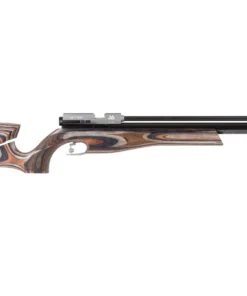
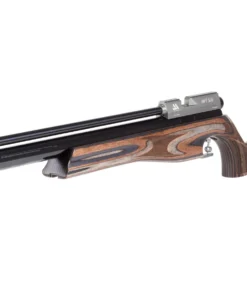
Air Arms
Air Arms

Air Arms


Air Arms

Reviews
There are no reviews yet.