




Hatsan Blitz Full Automatic Air Rifle

€600.00
Hatsan Blitz Full Automatic PCP
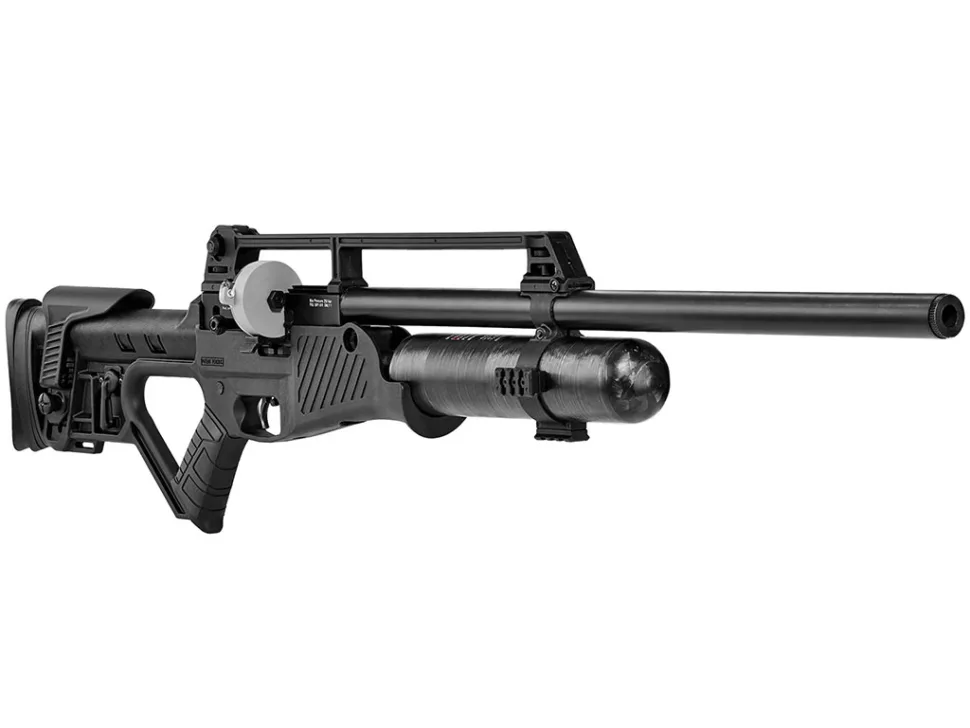
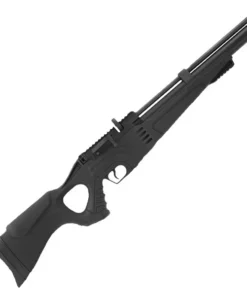
The Hatsan Blitz is a fully automatic air rifle with tons of features. With its big 580 cc cylinder this rifle is capable of shooting up to 100 shots with 1 fill. The rifle is equipped with a completely shrouded barrel and has internal threads on the end of the barrel. Shooting 80 meters is a no brainer for this air rifle, we have attached some recommended scopes in the product line down below.
This rifle has a 11 mm dovetail and a 22 mm weaver/picatinny rail so you can install your favorite scope at any time. The rifle also has a carry handle which has iron sights on top, this rail can be removed using a screwdriver if preferred.
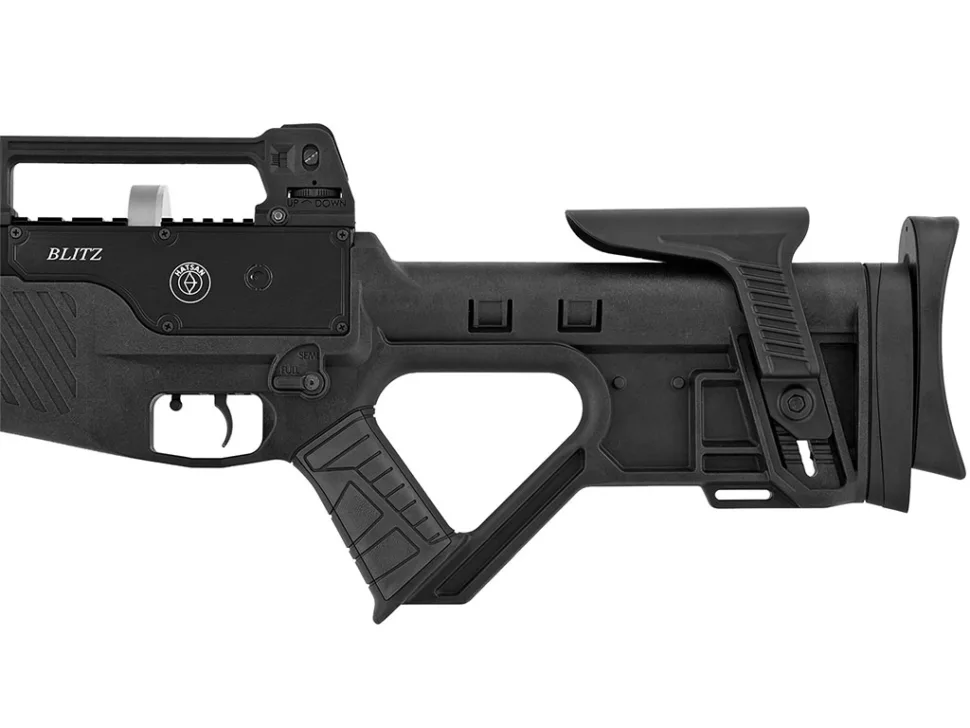
The buttstock has multiple options in regards to adjustments. You can adjust the height of the buttstock itself and you can change the height of the cheek piece. The fire selector can be found on the left side of the air rifle. You can choose between Full Auto or Semi Automatic. The safety can be found right in front of the trigger.
There is also an extra 22 mm Weaver/Picatinny rail attached to the bottom side of the bottle, which allows you to install a bipod and increase accuracy even more.
PS: You will need an adaptor to be able to use a moderator, you can not use full auto whilst having a moderator equipped.
| Brand | Hatsan |
|---|---|
| Model | .22 / 5,5, .25 / 6,35, .30 / 7,62 |
| Energy (Joule / ft.lbs) | 49/36, 56/41, 72/53 |
| Cocking system | Automatic, Semi Automatic |
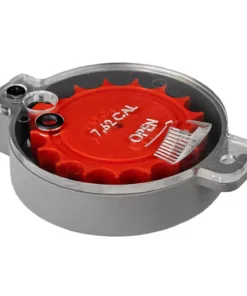
| Magazine capacity | 16 (.30), 19 (.25), 21 (.22) |
| Weight (gram) | 4000 |
| Barrel length (mm) | 585 |
| Length (mm) | 1150 |
| Mounting base | Dovetail (11 mm), Weaver / Picatinny |
| Rifle Stock Type | Ambidextrous |
Hatsan Blitz Full Automatic Air Rifle – Select-Fire PCP Performance, High-Capacity Air System and Tactical Precision
The Hatsan Blitz Full Automatic Air Rifle is one of the most distinctive PCP platforms in the modern Hatsan lineup. Designed around a patented air-operated action, the Blitz gives the shooter selectable semi-automatic and full-automatic firing modes while retaining the compressed-air architecture associated with a high-capacity Hatsan PCP air rifle. Hatsan currently lists the standard Blitz in .22, .25 and .30 calibre, with a 580cc carbon-fiber air bottle, 250-bar fill pressure, a 23-inch precision rifled barrel and an overall length of about 45.2 inches.
Selectable Semi-Auto and Full-Auto Operation
The defining feature of the Hatsan Blitz is its selectable firing system.
A selector allows the shooter to choose between semi-automatic and full-automatic operation. Hatsan describes the action as an efficient patented air-operated system, and the rifle requires adequate cylinder pressure for the self-loading mechanism to function correctly.
This separates the Blitz from a conventional Hatsan sidelever air rifle, Hatsan break barrel air rifle, Hatsan spring air rifle, or Hatsan gas ram air rifle, where each shot is cycled manually.
.22, .25 and .30 Calibre Options
The standard rifle is currently listed in .22, .25 and .30 calibre.
Magazine capacity changes with calibre: 21 rounds in .22, 19 rounds in .25 and 16 rounds in .30. Manufacturer figures list maximum energy around 36 ft-lb in .22, 41 ft-lb in .25 and 53 ft-lb in .30, although real output varies with pellet weight, projectile shape, temperature and other conditions.
Searches for Hatsan .22 air rifle, Hatsan .25 air rifle, and Hatsan .30 air rifle therefore directly relate to available Blitz configurations. By contrast, Hatsan .177 air rifle, Hatsan .35 air rifle, and Hatsan .45 air rifle usually refer to other Hatsan platforms or different product generations.
580cc Carbon-Fiber Air Bottle
A 580cc carbon-fiber bottle supplies the rifle with compressed air.
The manufacturer specifies a 250-bar fill pressure and approximately 130 useful semi-auto or full-auto shots in .22, 110 in .25 and 100 in .30 under optimal conditions.
This large reservoir is one of the main reasons the rifle can support rapid multi-shot operation without constant refilling.
Precision Rifled and Choked Barrel
The Blitz uses a fully shrouded, precision rifled and choked barrel.
This design is intended to support accuracy while also reducing the sharpness of the discharge. Hatsan lists a 585mm, or 23-inch, barrel across the standard Blitz range.
Although the rifle is known for its rapid-fire capability, precision still depends on suitable pellets, consistent pressure, a properly mounted optic and disciplined technique.
Tactical Synthetic Stock and Adjustable Fit
The rifle uses an all-weather tactical synthetic stock with an ergonomic pistol grip, thumbhole design and elevation-adjustable cheek rest.
An adjustable rubber butt pad allows the rear fit to be tuned for height and angle. Textured gripping surfaces are also incorporated for greater control.
These features give the rifle a very different feel from more traditional Hatsan air rifles.
Picatinny Rails and Optics Compatibility
The receiver incorporates a mounting rail designed to accommodate both 11mm and 22mm scope mounts.
In addition, three Picatinny accessory rails are fitted around the forearm area.
The rifle also includes a detachable carry handle with adjustable fiber-optic sights.
This gives the platform substantial flexibility for lawful sporting accessories.
Safety Systems and Pressure Monitoring
A manual safety and patented anti-knock system are included.
The anti-knock design is intended to reduce the chance of discharge if the rifle is bumped or bounced. A built-in pressure gauge allows the shooter to monitor cylinder pressure.
Hatsan’s manual also specifies that only clean, dry compressed air should be used and warns against using other gases.
Hatsan PCP and Airgun Range Comparison
Buyers researching Hatsan airguns, Hatsan PCP, Hatsan pellet gun, and the broader Hatsan air rifles range may also encounter Hatsan BullBoss, Hatsan BT65, Hatsan Flash, Hatsan Flash QE, Hatsan Factor, Hatsan Factor RC, Hatsan Hercules, Hatsan Hercules Bully, Hatsan Invader Auto, Hatsan Nova, Hatsan NovaStar, Hatsan PileDriver, Hatsan Sortie, Hatsan Galatian, Hatsan Gladius, Hatsan Vectis, and Hatsan AT44.
These are separate platforms with different actions, capacities, stocks and performance characteristics.
For example, the Sortie is a semi-automatic PCP rather than a selectable full-auto design.
Break-Barrel and Vortex Alternatives
Searches may also include Hatsan Mod 125, Hatsan Mod 135, Hatsan 95, Hatsan 87, Hatsan 80, Hatsan 65, Hatsan Torpedo, Hatsan Dominator, Hatsan Carnivore, Hatsan QE, Hatsan QuietEnergy, and Hatsan Vortex gas piston.
These cover spring-powered, gas-piston, big-bore and moderated models rather than the Blitz’s select-fire PCP architecture.
For instance, current Hatsan break-barrel products use completely different powerplants and manual loading systems.
Why Choose the Hatsan Blitz?
The strongest reason to choose this platform is its unusual combination of rapid-fire operation, substantial air capacity and tactical ergonomics.
The selectable action provides both semi-auto and full-auto modes.
The 580cc bottle supports extended shooting.
The rifled and choked barrel provides a precision-oriented foundation.
The large-capacity magazines reduce interruptions.
The adjustable cheek rest and butt pad improve fit.
The Picatinny mounting system supports flexible optics and accessory placement.
For shooters seeking a distinctive PCP platform with very high shot capacity and a mechanically unusual select-fire action, the Blitz stands apart from most conventional pneumatic rifles.
Its strongest qualities come from combining high-capacity compressed-air engineering, durable synthetic construction, practical adjustability and one of the most unusual operating systems in the Hatsan lineup.
Section 2 – Practical Accuracy, Handling, Air Management and Real-World Performance
Built Around a Distinctive Operating System
The most noticeable characteristic of this platform is the way its rapid-fire action changes the overall shooting experience.
Unlike a conventional manually cycled pneumatic rifle, the action is designed to continue operating automatically while sufficient air pressure remains available.
That gives the rifle a very different personality.
However, rapid operation does not remove the importance of deliberate shooting technique.
Accuracy still depends on stable body position, reliable ammunition, a secure optic, consistent air pressure, and controlled trigger use.
The rifle may be mechanically capable of very fast operation, but good precision still comes from discipline.
Why Consistency Still Matters
Fast operation can be impressive, but repeatability is more important when evaluating practical performance.
A single small group tells only part of the story.
Several groups should be compared.
The shooter should also consider whether the point of impact remains stable as the air supply decreases.
Consistent results show that the entire system is working properly.
That includes the barrel, magazine, air bottle, action, optic, and shooter.
Establishing a Baseline
A baseline should be created before making comparisons.
One suitable projectile should be selected.
The rifle should begin from a consistent fill condition.
The optic should remain unchanged.
Several controlled groups should be fired from a stable position.
This establishes a reference.
Later changes can then be compared against that known setup.
Without a baseline, it becomes difficult to know whether a difference is meaningful.
Change One Variable at a Time
Several factors can affect performance.
Changing multiple things together can create confusion.
If the shooter changes ammunition, optic settings, support position, and filling routine simultaneously, the cause of any improvement or decline becomes difficult to identify.
A better method is simple.
Change one factor.
Observe the result.
Record it.
Then decide whether another change is necessary.
Projectile Selection
Ammunition choice can strongly influence group size and consistency.
Weight matters.
Diameter matters.
Shape matters.
Manufacturing consistency matters.
Two projectiles with similar published weights may still behave very differently in the same barrel.
For serious testing, several suitable options should be compared.
The preferred choice should be based on repeated results rather than appearance or packaging.
Repeating Ammunition Tests
One excellent target can happen by chance.
Repeated performance provides more useful information.
The shooter should fire several groups with each projectile.
If one option continues to produce stable groups, confidence in that choice increases.
Ammunition that performs consistently is usually more valuable than one that produces one outstanding group followed by several poor ones.
Inspecting Ammunition
Damaged projectiles can create misleading results.
Dents, contamination, or inconsistent shape may affect flight.
For controlled testing, ammunition should be inspected before loading.
Damaged pieces should be removed.
This reduces unnecessary variation and makes performance easier to evaluate.
Barrel Condition
The barrel provides the mechanical foundation for accuracy.
However, constant cleaning is not always necessary.
If the rifle continues to perform well, excessive cleaning may offer no benefit.
If groups begin to deteriorate, barrel condition can be investigated.
Suitable cleaning materials should be used.
Aggressive methods should be avoided.
Conditioning After Cleaning
The first shots after cleaning may not represent normal performance.
A barrel can require a short conditioning period before group size stabilizes again.
The shooter should therefore avoid making immediate conclusions.
Once the pattern returns to normal, meaningful testing can continue.
Understanding the Air Supply
The rifle depends on compressed air for both projectile propulsion and action operation.
That makes air management especially important.
The bottle should remain within the approved operating range.
The shooter should monitor the gauge and become familiar with how the rifle behaves as pressure gradually decreases.
The goal is not simply to shoot until the bottle is nearly empty.
The goal is to remain within the range where operation stays reliable and predictable.
Why Large Air Capacity Matters
A substantial air bottle provides practical advantages.
The shooter can complete longer sessions without frequent refilling.
This is especially useful with a platform designed for rapid multi-shot use.
Longer intervals between fills also make group testing more convenient.
However, air capacity should still be managed carefully rather than treated as unlimited.
Shot Count
The number of useful shots depends on several variables.
Calibre matters.
Projectile weight matters.
Temperature matters.
The chosen firing mode also affects how quickly air is consumed.
The important figure is not the absolute maximum number of shots.
The more useful figure is the number of shots that remain consistent and reliable.
Recognizing the End of the Useful Pressure Range
As pressure falls, action behavior may eventually begin to change.
Velocity can decrease.
The report may sound different.
The point of impact can move.
Cycling may also become less consistent.
Once these changes appear, the rifle should be refilled rather than pushed farther through the pressure range.
Safe Filling
Only suitable high-pressure equipment should be used.
Connections should remain clean.
The fill process should be controlled and gradual.
Rapid filling can generate heat.
After cooling, gauge pressure may appear slightly lower.
This is normal.
The approved maximum pressure should never be exceeded.
Clean and Dry Air
Clean, dry compressed air is especially important in a complex pneumatic system.
Moisture can create long-term problems.
Dust and debris can damage seals.
Fill fittings should remain protected when not in use.
Hoses and connectors should also be inspected periodically.
Damaged filling equipment should be replaced.
Handling and Balance
The rifle has a tactical configuration that feels different from a traditional sporter.
Its large air bottle, synthetic stock, long receiver, and accessory rails influence balance.
The shooter should take time to understand how the rifle settles naturally.
A balanced stance reduces fatigue.
Accessories should also be chosen carefully because a heavy optic or additional equipment can alter handling significantly.
Adjustable Cheek Support
A properly positioned cheek rest helps the eye align naturally with the optic.
The shooter should not need to lift or lower the head excessively.
The full sight picture should appear when the rifle is shouldered normally.
Correct cheek position supports a more repeatable head position.
That can improve comfort and consistency.
Adjustable Butt Pad
The rear pad can be adjusted to improve shoulder contact.
Small changes can influence how the rifle sits.
The goal is a natural fit rather than forcing the rifle into position.
A comfortable shoulder relationship helps reduce muscular tension.
Reduced tension generally improves control.
Grip Pressure
The firing hand should control the rifle without excessive squeezing.
A very tight grip can introduce unnecessary movement.
The trigger finger should move independently.
The remaining fingers should maintain only enough pressure to keep the rifle stable.
Consistency matters more than force.
Trigger Control
The trigger remains one of the most important connections between the shooter and rifle.
Even on a platform capable of rapid operation, trigger control affects accuracy.
A sudden or aggressive pull can disturb the sight picture.
The shooter should apply pressure smoothly when precision is the goal.
Controlled trigger use remains important regardless of firing mode.
Semi-Automatic Use for Precision Work
Semi-automatic operation is generally easier to evaluate from an accuracy perspective because each shot can be treated as a separate firing cycle.
The shooter can rebuild the sight picture after every shot.
Breathing can be reset.
Trigger pressure can be controlled.
Follow-through can be evaluated.
This makes semi-automatic operation especially useful for deliberate target work.
Full-Automatic Operation and Control
Full-automatic capability changes the emphasis from single-shot precision toward action management and control.
The rifle can cycle rapidly, so muzzle movement and ammunition consumption increase quickly.
For this reason, full-auto use is best understood as a distinctive operating feature rather than an accuracy advantage.
Precision still improves when the shooter uses controlled, deliberate technique.
Magazine Loading
The magazine should be loaded carefully.
Projectiles should sit correctly.
Damaged ammunition should not be forced into place.
The magazine should rotate smoothly.
Keeping the magazine clean helps maintain reliable feeding.
Rapid cycling makes consistent magazine function especially important.
Magazine Reliability
A feeding problem can interrupt the entire shooting sequence.
For this reason, the magazine should be inspected periodically.
Debris should be removed.
Damaged components should not be used.
The shooter should also avoid forcing the action if abnormal resistance appears.
Scope Mounting
The optic should be mounted securely.
Eye relief should be correct.
The full image should appear without stretching the neck.
The rings should be tightened evenly.
Loose mounts can create confusing point-of-impact movement.
Overtightening should also be avoided.
Choosing Practical Magnification
Higher magnification can make small targets easier to see.
However, it also makes natural movement appear larger.
That can encourage overcorrection.
Moderate magnification may provide better control during general use.
Higher settings are more useful when the rifle is supported securely.
Parallax Control
Parallax can create aiming error.
If the shooter’s eye moves and the reticle appears to shift across the target, parallax is present.
The optic should be adjusted for the intended distance when possible.
This becomes increasingly important at higher magnification.
Zeroing
Zeroing should be performed from a stable position.
The shooter should fire groups rather than adjusting after every shot.
A group shows the average point of impact.
Once the group is consistent, the optic can be adjusted.
Another group should then confirm the result.
Confirming Zero
Zero should be checked periodically.
Transport, accidental contact, temperature changes, or optic movement can shift the point of impact.
A short confirmation session can prevent confusion later.
Bench Shooting
A bench provides an excellent environment for evaluating mechanical accuracy.
The rifle should be supported consistently.
A front rest or bipod can reduce movement.
A rear support can help control elevation.
The rifle should sit naturally.
Excessive clamping should be avoided.
Bipod Use
A bipod can provide strong front support.
The shooter should apply consistent pressure.
Too much pressure can affect how the rifle settles.
Too little can allow unnecessary movement.
The same technique should be repeated from shot to shot.
Rear Support
A rear bag or similar support can help refine elevation.
Gentle pressure can move the aiming point.
The shooter should use similar pressure for every shot.
Inconsistent rear support can produce vertical movement.
Supported Shooting Positions
A stable support can improve practical accuracy significantly.
The shooter should choose a position that creates a natural point of aim.
Good support often provides more practical improvement than making unnecessary mechanical changes.
Standing Position
Standing is one of the least stable positions.
The rifle will move naturally.
The shooter should not try to eliminate all movement.
A balanced stance and relaxed upper body help.
The shot should be released during the most stable part of the natural movement.
Kneeling Position
Kneeling provides greater stability.
The shooter can use body structure instead of relying entirely on muscle.
The position should feel natural.
A strained posture is difficult to repeat.
Sitting Position
Sitting can provide excellent support.
The arms can rest against the legs.
Different arrangements may be tested.
The best position is the one that provides stability without excessive tension.
Breathing Control
Breathing naturally moves the upper body.
Many shooters release the shot during the pause after exhaling.
The pause should remain comfortable.
If the shot is not ready, the shooter should breathe normally and restart.
Long breath holds create unnecessary tension.
Follow-Through
The shooting sequence continues after the trigger is pressed.
The eye should remain behind the optic.
The cheek should remain in place.
Shoulder pressure should stay stable.
Moving immediately after the shot can reduce consistency.
Calling the Shot
Experienced shooters can often recognize when a shot was poorly executed.
If the sight picture moved during the trigger press, the shooter may predict the direction of the error.
This helps separate shooter mistakes from mechanical issues.
Wind Effects
Wind becomes increasingly important as distance increases.
A crosswind can move a projectile sideways.
The shooter should observe grass, leaves, dust, vegetation, and flags.
Conditions may differ between the firing point and target.
Wind reading improves through practice.
Distance Measurement
Knowing the true distance improves precision.
A rangefinder can reduce uncertainty.
Known-distance practice is also useful.
Once trajectory is understood at several distances, corrections become easier to apply.
Ballistic Verification
Ballistic software can provide useful estimates.
Measured velocity, projectile weight, sight height, and zero distance can be entered.
However, calculated information should always be confirmed on actual targets.
Real impacts provide the final reference.
Temperature Effects
Compressed air pressure changes with temperature.
A bottle filled in warm conditions may show lower pressure after cooling.
This does not automatically indicate a leak.
For careful testing, the rifle should be allowed to stabilize in the environment where it will be used.
Chronograph Testing
A chronograph can provide useful information about consistency.
Several shots should be measured.
Average velocity provides a reference.
Variation between shots can also be observed.
The important point is to interpret the data as a pattern rather than focusing on one unusual reading.
Extreme Spread
Extreme spread is the difference between the fastest and slowest shot in a measured string.
A smaller spread generally indicates better velocity consistency.
That can help reduce vertical dispersion.
However, low spread does not guarantee small groups.
Projectile compatibility still matters.
Standard Deviation
Standard deviation shows how closely individual velocity readings cluster around the average.
Lower values can be useful for evaluating consistency.
However, small numerical improvements should not be overvalued if actual target results do not improve.
Efficient Air Use
Efficiency means obtaining useful performance without wasting compressed air.
Rapid-fire operation can consume air quickly.
The shooter should therefore pay attention to how different shooting styles affect bottle pressure.
A balanced approach helps preserve useful shot count.
Recognizing an Efficient Session
A good shooting session should combine stable operation, reliable feeding, consistent groups, and sensible air use.
If the rifle continues to perform predictably without unnecessary interruption, the setup is working well.
There is no need to make changes simply because adjustment is possible.
Avoiding Constant Adjustment
A technically complex platform can tempt owners to change things frequently.
However, unnecessary adjustment can make troubleshooting harder.
Once the rifle is performing reliably, the best approach is often to leave the setup alone.
Changes should have a clear purpose.
Keeping Records
A shooting log can save time.
The shooter can record projectile type, fill pressure, shot count, group size, distance, environmental conditions, and optic settings.
This creates a useful performance history.
If performance changes later, previous results can provide a reference.
Action Feel
The action should operate consistently.
If the sound or feel changes suddenly, the shooter should stop and inspect the system.
Unexpected resistance, unusual cycling, or feeding problems should not be ignored.
Forcing the action can create further problems.
Seal Monitoring
The air system depends on seals.
If pressure drops continuously during storage, a seal may require attention.
Temperature changes should first be considered.
If pressure continues falling under stable conditions, the rifle should be inspected appropriately.
Detecting Air Loss
A slow pressure decrease is not always a leak.
Cooling can reduce pressure.
However, repeated pressure loss under stable temperature conditions deserves attention.
The source should be identified before components are replaced.
Barrel Cleaning
Cleaning should be based on performance.
If the rifle continues to group well, frequent cleaning may not be necessary.
If accuracy declines unexpectedly, barrel condition can be investigated.
Suitable cleaning materials should be used.
Aggressive methods should be avoided.
Accuracy Troubleshooting
Accuracy problems should be investigated systematically.
Check the optic first.
Then inspect the mounts.
Confirm the ammunition.
Check barrel condition.
Review pressure.
Review shooter technique.
Only after these steps should more complex causes be considered.
Tight Groups That Shift
If groups remain tight but move to another part of the target, the rifle may still be mechanically accurate.
Possible causes include wind, optic movement, support changes, temperature, or zero shift.
A moved group is different from a larger group.
Groups That Open Up
If group size increases significantly, ammunition, barrel condition, pressure variation, optic stability, or technique may be responsible.
Returning to the known baseline can help isolate the issue.
Synthetic Stock Care
The synthetic stock requires relatively little maintenance.
Dust and dirt can usually be removed with a soft cloth.
Harsh chemicals should be avoided.
Grip areas and adjustment points should still be inspected periodically.
Protecting Metal Components
Metal components should be kept clean and dry.
Fingerprints and moisture should be wiped away after use.
A suitable protective product can be used where appropriate.
Excess lubricant should not be allowed to migrate into areas where it does not belong.
Transport
The rifle should be transported unloaded.
A suitable case should protect the optic and exterior.
Accessories should be secured.
Applicable transport requirements should always be followed.
Storage
The rifle should be stored in a dry and secure location.
Unauthorized persons should not have access.
Humidity should be controlled where possible.
The air system should be maintained according to appropriate guidance.
Long-Term Reliability
Reliability comes from sensible maintenance.
The fill system should remain clean.
The magazine should be kept free of debris.
The barrel should be cleaned only when necessary.
The optic should remain secure.
The air system should be monitored for pressure changes.
These basic habits help preserve performance.
Avoiding Unnecessary Disassembly
A rifle that performs correctly does not need constant internal work.
Repeated disassembly can introduce new problems.
Routine external inspection, sensible cleaning, pressure monitoring, and correct storage are usually sufficient.
Internal high-pressure servicing should be left to properly qualified technicians.
Professional Servicing
Complex pneumatic components should be serviced by someone with appropriate knowledge and tools.
This is especially important for a platform with an automatic action and high-pressure air system.
Correct servicing supports reliability and safety.
Who Will Appreciate This Configuration
This platform is particularly suitable for shooters who value unusual engineering, high-capacity air storage, tactical ergonomics, and rapid multi-shot operation.
It appeals to users who want something substantially different from a conventional manual-action pneumatic rifle.
It also suits shooters who enjoy technical platforms and distinctive mechanical design.
Why the High-Capacity Bottle Matters
A large air supply is essential for practical rapid-fire operation.
It reduces interruptions.
It supports longer sessions.
It gives the action enough reserve to continue functioning through a useful portion of the fill.
For this type of platform, air capacity is a central part of the design rather than simply a convenience feature.
Why Tactical Ergonomics Matter
The adjustable stock components help the rifle fit different shooters.
The pistol grip creates a familiar control position.
The cheek support improves optic alignment.
Accessory rails provide flexibility.
Together, these features help the shooter configure the rifle around comfort and control.
Why Precision Still Matters
Rapid-fire capability does not replace accuracy.
A platform becomes more useful when it can combine reliable action cycling with predictable point of impact.
That is why ammunition selection, optic stability, barrel condition, and consistent technique remain important.
Why Simplicity in Use Still Matters
Even though the rifle is mechanically unusual, the shooter benefits from keeping the setup simple.
Once suitable ammunition, a dependable zero, and a comfortable stock position have been established, unnecessary changes should be avoided.
Familiarity improves confidence.
Final Practical Assessment
The overall strength of this platform comes from the combination of unusual action design, substantial air capacity, durable synthetic construction, and tactical adjustability.
The large bottle supports extended shooting.
The multi-shot magazines reduce interruptions.
The precision barrel provides a strong foundation for accuracy.
The stock offers useful adjustment.
The optic rail provides mounting flexibility.
The rapid-fire action creates a shooting experience that differs significantly from conventional pneumatic rifles.
However, the best results still depend on disciplined use.
Suitable ammunition should be selected through repeated testing.
A reliable baseline should be established.
Changes should be made one at a time.
Air pressure should be monitored carefully.
The optic should be checked before mechanical problems are assumed.
Wind and temperature should be considered.
Maintenance should remain sensible.
When these habits are combined with stable technique, the rifle can provide dependable multi-shot operation, consistent recreational accuracy, practical air management, and a distinctive shooting experience.
For shooters who value technical innovation, high-capacity compressed-air operation, tactical ergonomics, and an unusual select-fire platform, this configuration offers a very different ownership experience from a traditional sporting pneumatic rifle.
Section 3 – Advanced Accuracy, Reliability, Air Efficiency and Long-Term Ownership
Precision Still Depends on Discipline
A mechanically advanced rifle can offer unusual operating features, but precision still depends on repeatable fundamentals.
The barrel must remain consistent.
The air system should behave predictably.
The magazine needs to feed smoothly.
The optic must hold zero.
The stock should fit the shooter correctly.
The trigger should be used with control.
The shooter also needs to maintain stable shoulder contact, grip pressure, cheek position, breathing, and follow-through.
When these elements work together, the rifle becomes easier to understand.
That understanding builds confidence.
A shooter who knows how the rifle normally behaves can recognize real changes much more quickly.
Establishing a Reliable Baseline
Before evaluating advanced performance, a baseline should be created.
One suitable projectile should be selected.
The rifle should begin from a consistent fill condition.
The optic should remain unchanged.
Several groups should be fired from a stable position.
Shot count and pressure changes can also be recorded.
This provides a dependable reference.
If performance improves after a change, the difference becomes easier to identify.
If performance becomes worse, the original setup can be restored.
Mechanical Accuracy and Practical Accuracy
Mechanical accuracy describes what the rifle can produce when shooter movement is minimized.
A stable bench, secure optic, consistent ammunition, and repeatable support position help reveal this.
Practical accuracy describes what the shooter can achieve under normal conditions.
The two are not always identical.
A rifle may group tightly from a bench and produce larger groups while standing or kneeling.
That does not automatically indicate a problem.
The practical position simply introduces more movement.
Understanding Group Patterns
Group shape can provide useful information.
Vertical spread may suggest one kind of inconsistency.
Horizontal spread may suggest another.
Random dispersion may involve several possible causes.
However, one target should never be treated as final proof.
Several groups should be compared.
Repeated patterns are more useful than isolated results.
Vertical Dispersion
Vertical movement can be influenced by changing velocity.
If one projectile leaves the barrel faster than another, the two may follow slightly different trajectories.
At shorter distances, this difference may be difficult to notice.
Farther away, it becomes more visible.
Vertical movement can also come from breathing, rear-support variation, shoulder pressure, or changing head position.
Several possible causes should therefore be considered.
Horizontal Dispersion
Horizontal spread is often influenced by wind.
A crosswind can move the projectile sideways.
Trigger movement can create a similar effect.
Grip tension or rifle cant can also contribute.
Environmental conditions and shooter technique should therefore be checked before assuming a mechanical issue.
Long-Range Performance
As distance increases, small errors become larger.
Velocity variation becomes more visible.
Wind has more time to affect the projectile.
Distance estimation becomes more important.
Small aiming errors become magnified.
For this reason, long-range performance depends on reliable data, consistent technique, and a predictable rifle setup.
The rifle provides the mechanical foundation.
The shooter still needs to manage the environment correctly.
Projectile Stability
Every projectile has a performance range where it behaves best.
Weight matters.
Diameter matters.
Length matters.
Shape matters.
Manufacturing consistency matters.
A projectile may perform very well at moderate distance but become less predictable farther away.
Testing should therefore continue beyond the initial zero distance.
If groups remain stable, confidence in the projectile increases.
If accuracy deteriorates sharply, another option may perform better.
Aerodynamic Efficiency
Aerodynamic efficiency affects how well a projectile retains speed.
A more efficient shape may resist wind better and lose velocity more slowly.
However, theoretical efficiency does not guarantee practical accuracy.
The projectile still has to suit the barrel.
A design with impressive published figures can still perform poorly if it does not stabilize correctly.
Real target performance remains the final reference.
Confirming Ballistic Data
Ballistic software can provide useful trajectory estimates.
Measured velocity, projectile weight, sight height, zero distance, and environmental information can be entered.
The software can then estimate drop and drift.
This information is useful as a starting point.
However, it should always be confirmed on actual targets.
Real impacts provide the most trustworthy information.
Creating a Personal Range Reference
Once the shooter has confirmed point of impact at several distances, a personal reference can be created.
This may include holdover information or elevation adjustments.
The reference should be based on the actual rifle and selected ammunition.
Generic charts are less reliable because every setup behaves slightly differently.
A verified personal reference reduces guesswork.
Accurate Distance Measurement
Distance errors become more important as range increases.
A small estimation mistake may have little effect at short range.
Farther away, the same error can create noticeable vertical displacement.
A rangefinder can reduce uncertainty.
Known-distance practice is also useful.
Once true distance is known, trajectory corrections become easier to understand.
Wind Reading
Wind is one of the most difficult variables in precision shooting.
Its strength can change quickly.
Its direction can change.
Conditions near the shooter may not match those near the target.
The projectile may pass through several different air movements during one flight.
The shooter should observe visible indicators.
Grass, leaves, vegetation, dust, and flags can all provide useful information.
Experience gradually improves wind-reading ability.
Crosswind Effects
A direct crosswind generally produces more sideways movement than a wind arriving at an angle.
A headwind or tailwind usually produces less horizontal drift.
Understanding this relationship helps estimate correction.
However, actual impacts should always be used to confirm the estimate.
Waiting for Better Conditions
Highly variable wind can make accuracy testing misleading.
The shooter may believe the rifle or ammunition is inconsistent when the real cause is changing air movement.
If conditions become unstable, waiting for a calmer period can produce more useful data.
This is especially important when comparing ammunition.
Temperature Effects
Compressed air pressure changes with temperature.
A bottle filled in warm conditions may show lower pressure after cooling.
Likewise, pressure may rise as the system warms.
This does not automatically indicate a leak.
For careful testing, the rifle should be allowed to stabilize in the environment where it will be used.
Atmospheric Conditions
Air density, humidity, altitude, and temperature can influence projectile behavior.
For many practical distances, wind remains the dominant factor.
However, advanced shooters may record environmental conditions.
This can help explain small changes between different sessions.
Scope Reliability
A precision rifle depends heavily on a reliable optic.
The scope must hold zero.
The internal mechanism should remain stable.
The turrets should behave predictably.
The mounting system must remain secure.
If point of impact changes unexpectedly, the optic should always be checked before the rifle is heavily adjusted.
Scope Mount Inspection
Mounting screws should be checked periodically.
Loose rings can allow movement.
Overtightened rings can also damage the optic.
Suitable tools should be used.
If the mount manufacturer provides torque guidance, it should be followed.
Turret Tracking
Shooters who dial elevation regularly should verify turret tracking.
A known adjustment should move the point of impact by the expected amount.
Returning the turret to zero should also return the rifle to the original point of impact.
Tracking problems can create confusing long-range errors.
Reticle Holds
Reticle reference marks can provide a quick alternative to dialing.
The shooter can use known hold points for different distances.
However, these holds must be verified.
Depending on optic design, magnification may affect the relationship between the reticle and target.
Understanding the scope is essential.
Controlling Rifle Cant
Cant occurs when the rifle is tilted sideways.
At short range, a small amount may have limited effect.
At greater distances, the error becomes more noticeable.
The shooter should try to keep the rifle upright.
A small level can help.
With practice, correct alignment becomes increasingly natural.
Benchrest Technique
A bench provides an excellent environment for evaluating precision.
The rifle should be supported consistently at the front and rear.
The support should stabilize the rifle without forcing it.
The same contact points should be used for every shot.
Consistency matters more than extreme rigidity.
Front Support Position
The front support should remain in the same location.
Moving the support point can alter balance.
The rifle should rest naturally.
A stable support is useful, but excessive pressure should be avoided.
Rear Support Control
A rear bag or similar support can provide fine elevation control.
Gentle pressure can move the aiming point.
The shooter should apply similar pressure for every shot.
Inconsistent rear support can create vertical movement.
Practice improves repeatability.
Supported Shooting
A suitable support can significantly improve practical accuracy.
The shooter should choose a position that creates a natural point of aim.
Good support often provides more practical improvement than unnecessary mechanical adjustment.
Standing Technique
Standing is one of the least stable positions.
The rifle will move naturally.
The shooter should not try to eliminate all movement.
A balanced stance and relaxed upper body help.
The shot should be released during the most stable part of the natural movement.
Kneeling Technique
Kneeling provides greater stability.
The shooter can use body structure instead of relying entirely on muscle.
The position should feel natural.
A strained posture is difficult to repeat.
Sitting Technique
Sitting can provide excellent stability.
The arms can rest against the legs.
Different arrangements may be tested.
The best position is the one that provides stability without excessive tension.
Trigger Control
The trigger should be used smoothly.
A sudden or aggressive press can disturb the sight picture.
The shooter should apply pressure with control when precision is the goal.
This remains important regardless of firing mode.
Rapid action operation does not remove the value of good trigger technique.
Grip Consistency
Grip pressure should remain similar from shot to shot.
The firing hand should guide the rifle without squeezing aggressively.
Excessive tension can influence the sight picture.
The trigger finger should remain independent.
Shoulder Contact
The rear of the rifle should meet the shoulder in the same general location.
Too much pressure can create tension.
Too little may reduce stability.
A natural and repeatable position is ideal.
Cheek Position
The eye should return to the same location behind the optic.
The cheek should settle naturally on the adjustable support.
If the shooter needs to move the head around to find the sight picture, the cheekpiece or optic position may need adjustment.
A repeatable cheek position improves precision.
Breathing Control
Breathing naturally moves the upper body.
Many shooters release the shot during the pause after exhaling.
The pause should remain comfortable.
If the shot is not ready, the shooter should breathe normally and restart.
Long breath holds create unnecessary tension.
Follow-Through
The shooter should maintain position after the trigger is pressed.
The eye stays behind the optic Hatsan Blitz Full Automatic Air RifleHatsan Blitz Full Automatic Air RifleHatsan Blitz Full Automatic Air RifleHatsan Blitz Full Automatic Air RifleHatsan Blitz Full Automatic Air Rifle.
The cheek remains in place.
Shoulder pressure remains stable Hatsan Blitz Full Automatic Air RifleHatsan Blitz Full Automatic Air RifleHatsan Blitz Full Automatic Air RifleHatsan Blitz Full Automatic Air RifleHatsan Blitz Full Automatic Air RifleHatsan Blitz Full Automatic Air RifleHatsan Blitz Full Automatic Air Rifle.
Be the first to review “Hatsan Blitz Full Automatic Air Rifle”
Related products
Hatsan




Hatsan



Reviews
There are no reviews yet.