
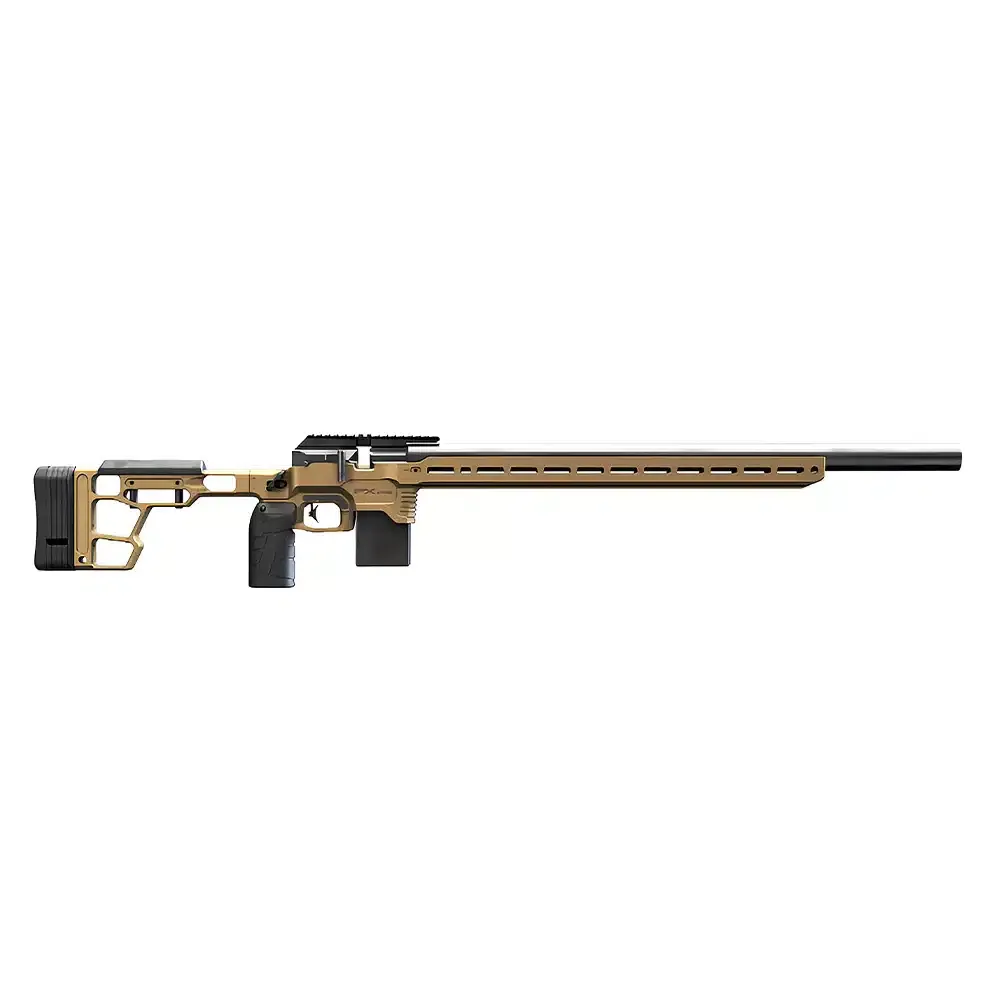
FX DRS Pro MDT 700


€2,100.00
FX DRS Pro MDT 700 Airgun
Introducing the FX DRS Pro – a new platform built from the ground up with precision shooting in mind. The FX DRS sets a new standard in the world of air rifles. Designed for those who demand excellence, the FX DRS Pro is not just a contender against .22lr rifles; it’s a game changer for any precision shooter looking to dominate competitions or hone their skills.
With that goal in mind, it has been designed with the air tank wrapped around the barrel, eliminating the large air tank needed for air pressure and lowering the profile of the overall rifle – resulting in a very slim front end and an overall more balanced rifle with perfect ergonomics. The FX DRS is designed with enough power to compete with the 22lr. However, it can also be configured to a lower, more economical power, making it the perfect rifle to practice and perfect your shooting skills in a cost-effective way (considering the ever-increasing prices of firearms ammunition.
Performance meets perfection with the modular plenum design, cleverly disguised as a traditional magazine. It is large enough to handle the task at hand, yet blends seamlessly with the sleek look and feel of a traditional competition rifle.
To create a rifle like the FX DRS Pro and compete in PRS 22 and NRL22 competitions, it needed to be put onto a strong and reliable base. Therefore, we partnered up with MDT, who is renowned for their top-tier chassis designed by pro shooters for pro shooters. This ensures a robust and reliable base for the FX DRS Pro, making it a force to be reckoned with in PRS .22 and NRL .22 competitions.
The FX DRS Pro Model comes fully equipped with everything you need, including:
- A one-piece Picatinny rail with a 30 MOA incline, providing the perfect base for your optic.
- A new mini magazine, just as robust and easy to use as the standard one, allowing for a lower scope mount while still holding enough shots to clear a competition range.
- A fully adjustable, true match-grade trigger with unmatched crispness and featherweight pull.
- A large magazine-style power plenum delivering maximum power.
- A 700mm liner system with a superior heavy liner.
- A pre-installed slug power kit.
- The latest AMP regulator version ensures unrivaled consistency in velocity and giving you the edge you need in any shooting scenario.
And if that isn’t enough, you can still go one step further with one of the available accessories.
Don’t settle for just an air rifle. The FX DRS Pro is not another air rifle; it’s a game-changer that will dominate your next competition or be the perfect training companion to practice your skills.
The FX DRS Pro
FX DRS Pro MDT 700 – Competition-Ready Precision PCP Air Rifle with 700mm Barrel and MDT Elite Chassis
FX DRS Pro MDT 700 Overview
The FX DRS Pro MDT 700 is a premium precision-focused PCP platform engineered around stability, repeatability, ergonomic adjustment, and competition-style shooting. FX developed the DRS Pro around its streamlined over-barrel air-cylinder concept and combined it with a purpose-built MDT Elite chassis, a 700mm barrel system, large power plenum, externally adjustable AMP MkII regulator, match-grade trigger, and 30 MOA optics rail. FX positions the platform specifically toward precision shooting and positional competition-style use.
Unlike a conventional air rifle with a prominent external bottle, its compressed-air cylinder surrounds the barrel. Consequently, the rifle maintains a slim front profile while providing a substantial air supply. This architecture distinguishes the DRS family within modern pcp airguns and gives the rifle a visual character closer to a traditional precision rifle.
Why Choose the FX DRS Pro MDT 700?
The primary reason to consider the DRS Pro MDT 700 is its combination of mechanical rigidity and extensive ergonomic adjustment.
The MDT chassis was adapted specifically for the platform and provides adjustable cheek support, length of pull, grip position, thumb rest, and multiple accessory mounting points. Furthermore, its balance has been optimized for positional shooting, where stability from barricades, bags, or unsupported positions can matter greatly.
Among high end air rifles, this configuration is aimed at shooters who value a competition-oriented chassis rather than a traditional sporting stock.
700mm Superior Heavy Barrel System
The 700 configuration uses FX’s interchangeable liner architecture. FX documentation identifies a 700mm Superior Heavy liner in .177 and .22 configurations, while other caliber-specific liner options exist within the platform.
The long barrel is intended to support efficient use of compressed air and stable projectile acceleration within approved configurations.
This makes the model relevant to shooters who have previously considered an fx impact m3 .22cal air rifle. 600mm barrel, impact m4 500mm, or other long-barrel precision platforms.
APB Over-Barrel Air System
The DRS design places the air cylinder around the barrel assembly.
FX refers to this architecture as its APB system on newer versions. The concept creates a lower-profile front end while also providing substantial barrel support. FX states that the arrangement contributes to barrel rigidity and overall balance.
This engineering direction separates the DRS from bottle-based models such as the fx impact, f x impact, fx impact m3, and f x impact m3.
307cc Air Cylinder and 230-Bar Fill
Current 700mm Pro listings specify an approximately 307cc aluminum air cylinder with a 230-bar maximum fill pressure. One current .22 listing also specifies a 67cc SHP plenum.
Therefore, the rifle combines meaningful air capacity with a streamlined exterior.
For buyers comparing a premium pcp air gun, fx pcp, or other modern air guns, the hidden-cylinder arrangement is one of the most distinctive design features.
AMP MkII Regulator
The rifle uses the AMP MkII regulator with external adjustment. FX specifically highlights the regulator as a major contributor to consistent velocity.
Consistent regulated pressure is important in precision shooting because it helps minimize velocity variation throughout the useful portion of the fill.
Large Power Plenum
The DRS Pro uses a large magazine-shaped power plenum that blends into the rifle’s traditional precision-rifle appearance.
This design provides the regulated air volume required by the platform without requiring a bulky external chamber.
Consequently, the rifle retains a clean profile while preserving the performance architecture expected from an advanced fx air rifle.
MDT Elite Competition Chassis
The chassis is one of the defining differences between the Pro and more traditional configurations.
FX partnered with MDT to adapt its competition-proven chassis architecture specifically for the DRS platform. The result includes adjustable ergonomics, M-LOK interfaces, positional-shooting balance, and a rigid aluminum foundation.
This makes the fx drs pro considerably different in purpose from the more traditionally styled fx drs classic or the modular fx drs tactical.
Match-Grade Adjustable Trigger
The DRS Pro uses a fully adjustable match-grade trigger.
Current product information describes adjustment of both stages, while the trigger blade can be repositioned to suit individual reach and preference.
A predictable trigger is especially important when small disturbances can affect group consistency.
30 MOA Optics Rail
A one-piece Picatinny rail with 30 MOA inclination is supplied on the Pro configuration.
The inclined rail provides additional elevation flexibility for compatible optics and reinforces the competition-oriented nature of the platform.
Mini Magazine Design
The supplied mini magazine has a reduced vertical profile, allowing an optic to be mounted lower than with some larger-capacity magazine designs.
Current .22 specifications list a 14-shot mini magazine, although capacity varies by caliber and configuration.
The lower magazine profile can improve scope placement and cheek alignment.
FX DRS Pro Versus FX Impact M4
Shooters comparing the DRS with the fx impact m4, fx m4, impact m4, or impact m4 air rifle should recognize that the platforms pursue different ergonomic philosophies.
The Impact family uses a highly modular bullpup-style architecture, whereas the DRS Pro mimics the balance and handling of a modern precision rifle.
Searches such as fx impact m4 for sale or impact m4 ballistic coefficient therefore relate to a different product family and should not be treated as DRS specifications.
FX DRS Pro Versus FX Panthera
The fx panthera, fxpanthera, and FX Panthera MkII are also precision-oriented platforms.
Likewise, the fx dynamic, fx dynamics, and related competition designs target shooters seeking high adjustability.
However, the DRS Pro distinguishes itself through its over-barrel cylinder and MDT-based chassis configuration.
FX Leopard Comparison
The fx leopard, fx leopard airgun, and fx leopard air rifle emphasize compact bullpup handling.
By comparison, the DRS Pro uses a conventional precision-rifle layout.
Both demonstrate the modular engineering philosophy associated with modern fxairguns, but they serve different ergonomic preferences.
FX Wildcat, Maverick, and Dreamline Families
Other established models include the fx wildcat, fx wildcat mk3, fx maverick, fx dreamline, and fx dreamline classic.
These platforms remain important parts of the wider FX ecosystem, yet the DRS Pro is much more explicitly designed around competition-style positional shooting.
FX Crown and King Alternatives
Shooters who prefer traditional sporting ergonomics may also encounter the fx crown, fx crown mk2, fx crown mkii, fx crown mkll, or fx king.
Those rifles use different stock and reservoir arrangements.
The DRS Pro instead favors an aluminum competition chassis with extensive positional adjustment.
FX Airguns Sweden Engineering
The brand behind fx airguns, fx airguns sverige, fx airguns sweden, fx air guns, fx usa, and fx airguns usa is headquartered in Mariestad, Sweden, with a U.S. operation in California.
This Swedish engineering background has produced an increasingly modular lineup covering sporting, target, and competition use.
Projectile and Chronograph Compatibility
The rifle is designed to work with appropriate caliber-specific pellets and slugs within the manufacturer’s recommended setup. Shooters researching fx pellets, fx halo slugs, or a premium pellet gun platform should match ammunition carefully to the installed liner and lawful configuration.
An fx chronograph or fx pocket chronograph can also be used for legal velocity and consistency monitoring.
Broader FX Platform Context
The DRS Pro sits alongside models and search terms such as fx drs, fx drs air rifle, fx drs tactical, fx impact air rifle, fx impact m3 air rifle, fx m3, fx m3 airgun, fx outdoors, and the broader fx product family.
For Scandinavian shoppers, luftgevær is another commonly used term when researching this category of compressed-air rifle.
Why the FX DRS Pro MDT 700 Stands Out
The FX DRS Pro MDT 700 combines a 700mm interchangeable barrel system, 307cc over-barrel reservoir, approximately 230-bar fill pressure, large power plenum, AMP MkII regulator, 30 MOA optics rail, match-grade trigger, M-LOK-equipped MDT chassis, and smooth sidelever action.
For shooters comparing the latest fx airguns platforms, it stands out as a purpose-built precision system that prioritizes chassis rigidity, repeatable ergonomics, controlled air delivery, and competition-style balance rather than simply maximum compactness or traditional sporting aesthetics.
Precision Performance, Air Efficiency, Chassis Stability, Trigger Control, Ergonomics, and Real-World Shooting Use
The rifle is designed around precision, consistency, and repeatable handling rather than simple compactness. Its long barrel, regulated air system, competition-style chassis, adjustable rear section, and stable accessory interfaces work together to create a platform suited to disciplined target shooting. In real-world use, the rifle performs best when the shooter establishes a consistent setup, uses quality ammunition, maintains stable pressure, and avoids unnecessary changes between shooting sessions.
Precision-Oriented Design
The rifle’s overall architecture is intended to minimize movement between the shooter, chassis, optic, and barrel.
A rigid platform matters because even small shifts in position can influence point of impact.
The aluminum chassis helps provide a stable foundation.
As a result, the rifle feels planted when used from a bench, barricade, tripod, or supported field position.
Long Barrel Performance
The 700mm barrel gives the system substantial length for efficient projectile acceleration.
A longer barrel can allow compressed air to work over a greater distance before the projectile exits.
However, barrel length alone does not guarantee accuracy.
Projectile quality, barrel condition, velocity consistency, and shooter technique remain equally important.
Regulated Air Delivery
The regulator helps control the pressure supplied to the firing system.
Instead of allowing reservoir pressure to vary directly from shot to shot, a regulated amount of air is delivered to the plenum.
This supports more consistent velocity across the useful portion of the fill.
Why Consistent Velocity Matters
Velocity variation can affect vertical point of impact.
At shorter distances, small differences may be difficult to notice.
At longer distances, however, even modest changes can become more visible.
Therefore, consistent air delivery is an important part of precision shooting.
Power Plenum Function
The plenum stores regulated air before each shot.
This gives the firing system access to a controlled air volume.
The design helps support repeatable performance without requiring the main reservoir to discharge directly into the barrel system.
Efficient Air Use
Good air efficiency means more than simply maximizing shot count.
The objective is to use enough air for consistent performance without wasting unnecessary volume.
A well-balanced setup produces predictable shots throughout the useful pressure range.
Pressure Monitoring
Reservoir pressure should be monitored regularly.
The shooter should know the useful operating range of the rifle rather than waiting until performance changes noticeably.
Refilling at a consistent point can make testing more repeatable.
Stable Chassis Construction
The competition-oriented chassis provides a rigid connection between the action, grip, rear support, and accessory mounting areas.
This reduces unwanted flex.
A stable chassis also helps the rifle behave more predictably when supported against bags or barricades.
Adjustable Rear Support
The rear section can be configured to match different body dimensions and optic heights.
Proper adjustment helps the shooter place the head naturally behind the scope.
Comfort is important because an awkward position can create inconsistent pressure.
Cheek Support
A repeatable cheek position makes sight alignment more consistent.
The shooter should be able to shoulder the rifle and see through the optic without moving the head excessively.
Once the correct position has been found, it should remain unchanged.
Length of Pull
Length of pull influences shoulder position, trigger reach, and overall body posture.
A setup that is too long can force the shooter backward.
A setup that is too short may feel cramped.
The ideal setting should allow relaxed control.
Grip Position
The grip should allow the trigger finger to move independently.
Excessive wrist tension can influence trigger control.
A natural hand position usually provides better consistency during longer sessions.
Thumb Position
A comfortable thumb rest can reduce tension in the firing hand.
The shooter should not need to squeeze the grip tightly.
A relaxed hold makes it easier to press the trigger straight to the rear.
Trigger Control
A match-oriented two-stage trigger allows the shooter to prepare for the shot before reaching the final break.
The first stage should be taken up smoothly.
The second stage should then be pressed deliberately.
Why Trigger Consistency Matters
A poor trigger press can move the rifle before the projectile leaves the barrel.
This becomes especially noticeable during small-group testing.
A clean, predictable break helps the shooter maintain sight alignment.
Optic Mounting
The integrated rail provides a stable base for a suitable optic.
Mounting rings should be tightened evenly.
The scope should be positioned so that eye relief remains comfortable in the shooter’s normal position.
Scope Height
Scope height should match cheek position.
If the optic is too high, the shooter may lose a consistent cheek reference.
If it is too low, clearance may become uncomfortable.
Proper alignment reduces unnecessary head movement.
Inclined Rail Advantage
An inclined rail gives the optic additional elevation flexibility.
This can be useful when the shooter needs more adjustment range at extended distances.
However, correct scope setup remains essential.
Benchrest Shooting
The rifle is particularly well suited to supported shooting.
A stable front rest or bipod helps reduce movement.
A rear bag can provide fine elevation control.
The rifle should sit naturally rather than being forced onto the target.
Barricade Shooting
A rigid fore-end can provide a stable contact point against bags or barricades.
The shooter should avoid applying inconsistent downward pressure.
Repeatable support pressure produces more meaningful results.
Tripod Use
A tripod can be useful in some competition or field environments.
The mounting position should keep the rifle balanced.
If the rifle becomes excessively front-heavy, handling may become slower.
Prone Position
Prone shooting provides a stable platform when terrain allows it.
The body should remain aligned naturally behind the rifle.
Twisting the torso can create inconsistent pressure against the stock.
Kneeling Position
Kneeling offers more stability than standing while remaining relatively mobile.
The shooter should use skeletal support rather than excessive muscle tension.
Comfort helps maintain a consistent sight picture.
Standing Position
Standing is the least stable common position.
The rifle’s weight and chassis balance become especially noticeable here.
The shooter should avoid holding the rifle longer than necessary before each shot.
Natural Point of Aim
The rifle should naturally point toward the target when the shooter is relaxed.
If constant muscular effort is required to keep the reticle centered, body position should be adjusted.
Natural alignment reduces fatigue.
Breathing Control
Breathing causes movement.
A short natural respiratory pause can provide a stable moment for the shot.
Holding the breath for too long can create tension.
Follow-Through
The shooter should maintain position after the trigger breaks.
Immediate head movement can make it difficult to evaluate what happened during the shot.
Good follow-through also improves consistency.
Ammunition Selection
Different projectile designs can behave differently.
The shooter should test several suitable options under controlled conditions.
Changing only one variable at a time makes comparisons more meaningful.
Projectile Quality
Damaged skirts, inconsistent weights, or deformed projectiles can reduce accuracy.
Ammunition should be stored carefully.
Visual inspection before loading can prevent obvious problems.
Magazine Feeding
The magazine should rotate smoothly.
If resistance becomes unusual, it should be inspected.
Forcing a damaged or dirty magazine can deform ammunition.
Chronograph Testing
Velocity measurements can help identify consistency.
A useful test includes several shots rather than one reading.
Average velocity and spread provide more meaningful information.
Accuracy Testing
Accuracy should be evaluated through repeated groups.
A single good shot does not prove consistency.
Several groups under the same conditions provide a better picture of rifle performance.
Wind Effects
Wind can influence projectile flight considerably.
Variable crosswinds can enlarge groups even when the rifle is performing correctly.
Calm conditions are preferable when testing mechanical accuracy.
Temperature Effects
Temperature can affect compressed air behavior.
Large environmental changes may alter pressure slightly.
Allowing the rifle to acclimate before testing can improve repeatability.
Barrel Cleanliness
The barrel should remain clean enough to maintain consistency.
However, excessive cleaning is unnecessary.
A proper cleaning routine should follow manufacturer guidance.
Optic Verification
If point of impact changes unexpectedly, the optic and mounts should be checked before assuming the rifle is at fault.
Loose rings can create inconsistent results.
Accessory Weight
Adding too many accessories can change balance.
Only useful equipment should be installed.
A lighter, simpler configuration can sometimes be easier to control.
Pre-Session Routine
Before shooting, check pressure, optic security, magazine condition, chassis hardware, and general mechanical function.
A short inspection can prevent avoidable problems.
Post-Session Review
After shooting, note any changes in accuracy, pressure behavior, or cycling.
Unexpected changes should be investigated before the next session.
Overall Real-World Performance
The rifle offers a strong combination of chassis rigidity, regulated air delivery, long-barrel efficiency, adjustable ergonomics, and supported-shooting stability.
Its precision-focused design rewards consistent technique.
Its adjustable rear section helps different shooters achieve a natural position.
Its trigger supports controlled shot release.
Its air system promotes repeatable performance.
When pressure, ammunition, optic placement, body position, and support technique are kept consistent, the platform can deliver excellent accuracy and a highly refined shooting experience across a wide range of lawful target and competition-style environments.
Build Quality, Reservoir Care, Barrel Protection, Seal Condition, Hardware Inspection, Maintenance, and Long-Term Reliability
The rifle is built around a rigid precision chassis, high-pressure air system, regulated firing cycle, long barrel assembly, and multiple adjustable interfaces. Because these systems work together, long-term reliability depends on more than basic exterior cleaning. Correct filling practices, clean air, secure hardware, proper storage, and regular inspection all contribute to consistent performance. A well-maintained example can remain accurate and dependable for a long period, while neglected seals, contaminated fill equipment, damaged threads, or loose mounting components can gradually reduce reliability.
Overall Construction Quality
A precision rifle should remain structurally rigid.
The chassis provides the foundation for the action, barrel, optic, grip, rear support, and accessory interfaces.
If any of these mounting areas develop looseness, the shooter may notice changes in balance or point of impact.
For that reason, general hardware inspection should be part of routine ownership.
Inspecting the Chassis
The aluminum chassis should be checked for deep impact marks, cracks, damaged threads, or deformation around mounting points.
Small surface scratches are generally cosmetic.
However, any area that has suffered a hard impact should be examined more closely.
The chassis should remain straight and free from visible distortion.
Air Reservoir Condition
The air reservoir operates under substantial pressure, so its condition is especially important.
It should not show deep scratches, dents, corrosion, or signs of impact.
Any concern about structural damage should be evaluated by a qualified technician before the rifle is filled again.
Fill Port Care
The fill port should remain clean and protected.
Dust and grit can enter the pneumatic system during charging.
Before connecting a fill probe or hose, the area should be checked visually.
A clean connection helps protect internal seals.
Using Clean, Dry Air
Only clean, dry compressed air from suitable equipment should be used.
Moisture inside a high-pressure pneumatic system can contribute to corrosion.
Oil contamination can also create serious problems.
A properly maintained compressor, certified cylinder, or suitable hand pump is therefore important.
Controlled Filling
Filling should be performed steadily.
Rapid charging can generate additional heat.
The pressure gauge should be watched carefully throughout the process.
The approved maximum fill pressure should never be exceeded.
Pressure Gauge Inspection
The gauge should remain easy to read.
Cracks, fogging, or obviously inaccurate readings deserve attention.
If indicated pressure appears abnormal, the filling process should stop until the gauge and air source are checked.
Regulator Condition
The regulator controls the air pressure supplied to the firing system.
Consistent regulator behavior supports repeatable velocity.
If shot speed begins changing more than expected, the regulator may need inspection.
However, ammunition, temperature, and fill pressure should also be considered.
Identifying Possible Regulator Problems
Possible signs include unexplained velocity shifts, irregular point of impact, or pressure behavior that changes after the rifle has been left unused.
These symptoms do not automatically confirm a regulator fault.
A systematic inspection is preferable to guessing.
Plenum Integrity
The plenum stores regulated air before each shot.
Its seals and connections must remain secure.
A persistent leak or unusual pressure loss should be investigated.
Because this area is part of the high-pressure system, internal servicing should be carried out by someone with suitable experience.
Seal Maintenance
Seals are essential to pressure retention.
Over time, they can wear or become damaged.
A rifle that gradually loses pressure while stored may have a sealing problem.
Correct replacement parts should always be used.
Lubrication
Only products suitable for high-pressure pneumatic equipment should be applied where appropriate.
Excess lubricant can attract dirt.
Incorrect lubricants can damage seals or create safety concerns.
Manufacturer guidance should determine what is used and where.
Barrel Protection
The long barrel assembly should be protected from hard impact and bending forces.
Transporting the rifle carelessly can place pressure on the barrel or surrounding structure.
A padded case helps reduce this risk.
Barrel Exterior
The outside of the barrel should remain clean and free from severe impact damage.
Dirt and moisture should be wiped away.
If anything appears misaligned after a hard knock, the rifle should be inspected before further use.
Bore Maintenance
The bore generally requires only occasional cleaning.
Over-cleaning can be unnecessary.
When cleaning is required, suitable tools should be used carefully.
The internal surface and muzzle crown should not be scratched.
Protecting the Crown
The muzzle crown influences how consistently the projectile leaves the barrel.
Damage here can affect accuracy.
Cleaning rods and accessories should therefore be used with care.
Barrel Liner Condition
If the installed system uses a removable liner, it should remain correctly seated.
Improper installation can reduce consistency.
Any disassembly should follow the manufacturer’s procedure.
Magazine Inspection
The magazine should rotate smoothly.
It should remain free from debris and damaged ammunition.
If feeding resistance develops, the magazine should be cleaned and checked instead of being forced.
Loading Mechanism Care
The sidelever and loading system should move smoothly.
Increasing resistance can indicate dirt, damaged ammunition, or mechanical wear.
Excessive force should not be used.
Trigger Mechanism
The trigger should remain clean and predictable.
Dust, contamination, or loose adjustment screws can affect operation.
Unnecessary internal disassembly should be avoided.
Trigger Adjustment Screws
Once a comfortable setting has been established, adjustment screws should remain secure.
If the trigger suddenly changes feel, the rifle should be inspected.
A stable trigger contributes to repeatable shooting.
Safety Mechanism
The safety should engage and disengage positively.
Any unusual looseness or stiffness should be corrected before use.
The safety should never be relied upon as a replacement for proper handling practices.
Optic Rail Condition
The optics rail should remain secure.
Loose mounting hardware can cause apparent accuracy problems.
The rail and scope rings should be checked if point of impact changes unexpectedly.
Scope Mount Screws
Scope-ring screws should be tightened evenly.
Excessive torque can damage hardware or the scope tube.
Correct tension is more important than maximum force.
M-LOK Interfaces
Accessory mounting slots should remain clean and undamaged.
Any accessories fitted to them should be installed correctly.
Loose hardware can create unwanted movement or noise.
Rear Chassis Adjustments
The adjustable rear section should move smoothly and lock firmly.
A loose cheek piece or length-of-pull adjustment can create inconsistent shooting positions.
Adjustment mechanisms should be checked periodically.
Grip Attachment
The grip should remain firmly attached.
Any looseness can change trigger-hand position.
Mounting hardware should be secure without being overtightened.
Bipod Mounting
If a bipod is used, its mounting interface should be checked regularly.
Repeated loading can gradually loosen screws.
The bipod should not rock or shift under normal pressure.
Bag-Rider Surfaces
Areas that regularly contact shooting bags may develop cosmetic wear.
This is usually harmless.
However, mounting screws and chassis interfaces should remain tight.
Cleaning Exterior Metal
Exterior metal surfaces should be wiped after use.
Fingerprints, sweat, and moisture can remain on the finish.
A clean, dry cloth is usually sufficient for routine care.
Moisture After Outdoor Use
Rain or high humidity can leave moisture in small recesses.
The rifle should be dried before storage.
Sealing a damp rifle inside a case can encourage corrosion.
Case Storage
A padded case is excellent for transport.
However, long-term storage in damp foam should be avoided.
The rifle should be completely dry before being enclosed.
Heat Exposure
Extreme heat should be avoided.
A closed vehicle in direct sunlight can become very hot.
Higher temperatures can increase internal air pressure and stress seals.
Cold Conditions
Cold temperatures can affect pressure behavior and seal flexibility.
Moving the rifle quickly from cold outdoor conditions into a warm room may also cause condensation.
Allowing the rifle to acclimate gradually can help.
Long-Term Storage
For extended storage, the rifle should remain clean, dry, and secure.
The storage environment should be stable.
Pressure condition should follow manufacturer recommendations.
Pre-Session Inspection
Before shooting, check reservoir pressure, mounting hardware, optic security, magazine condition, trigger operation, and general mechanical function.
A brief inspection can identify problems early.
Post-Session Inspection
After shooting, check for fresh marks, loose accessories, pressure changes, or unusual mechanical behavior.
Problems are easier to diagnose when the session is still fresh in memory.
Monitoring Pressure Loss
A noticeable pressure drop during storage can indicate a leak.
Pressure should be observed over time.
Persistent loss should not be ignored.
Listening for Air Leaks
A faint hiss may help identify the location of a leak.
However, high-pressure components should not be dismantled casually.
Professional service is the safer option when the cause is unclear.
Monitoring Velocity Changes
Unexpected velocity variation can result from ammunition, pressure, temperature, regulator condition, or sealing issues.
Several shots should be measured before conclusions are drawn.
Monitoring Accuracy Changes
If accuracy changes suddenly, the first checks should include ammunition, optic mounts, support setup, and hardware.
Not every accuracy problem originates inside the rifle.
Used-Rifle Inspection
A second-hand example should be inspected carefully.
Look for air loss, rough cycling, damaged threads, loose chassis components, worn magazines, or signs of poor maintenance.
A clean exterior does not guarantee mechanical health.
Service History
A documented maintenance record can increase buyer confidence.
Information about seal changes, regulator servicing, or major repairs helps establish the rifle’s condition.
Cosmetic Versus Mechanical Wear
Minor scratches generally affect appearance more than function.
Mechanical issues matter more.
Air leaks, unstable pressure, damaged threads, and unreliable loading deserve greater attention.
Professional Servicing
Complex internal repairs should be completed by experienced technicians.
High-pressure pneumatic systems require proper tools and knowledge.
Incorrect disassembly can cause damage or create safety risks.
Preserving Long-Term Value
Good ownership habits protect both performance and resale value.
Keep the rifle dry.
Use clean air.
Protect the reservoir and barrel.
Check the seals.
Inspect mounting hardware.
Address faults early.
Overall Long-Term Reliability
The rifle can remain highly dependable when maintained correctly.
A clean air supply protects internal components.
Healthy seals preserve pressure.
A secure barrel supports consistent accuracy.
Stable chassis hardware maintains alignment.
Correct storage reduces corrosion and unnecessary wear.
With routine inspection, careful filling, controlled transport, and qualified servicing when required, a well-maintained example can continue delivering smooth operation, stable pressure, and reliable precision over many future shooting sessions.
Real-World Shooting Scenarios, Setup Balance, Accuracy Management, Positional Use, Shooter Progression, and Performance Optimization
The rifle is most effective when the complete setup is tailored carefully to the shooter, intended discipline, optic position, ammunition choice, support equipment, and legal power configuration. Its long barrel, rigid chassis, regulated air system, adjustable ergonomics, and precision-oriented layout give it a strong foundation for supported and positional target shooting. However, excellent mechanical capability only produces consistent results when the shooter also develops repeatable technique. Proper body position, trigger control, sight alignment, pressure management, and equipment balance are therefore just as important as the rifle itself.
Matching the Rifle to the Shooter
The first step toward consistent performance is making the rifle fit the shooter naturally.
Length of pull, cheek height, grip position, optic height, and rear support should work together.
If the rifle is uncomfortable, the shooter may compensate with unnecessary muscle tension.
That tension can reduce consistency.
Establishing a Natural Shoulder Position
The butt section should contact the shoulder in approximately the same place for every shot.
Too much pressure can create tension.
Too little contact may make the platform feel unstable.
A firm but relaxed position usually provides the best control.
Adjusting Length of Pull
Length of pull affects trigger reach, shoulder placement, and head position.
If the rear section is too long, the shooter may stretch forward.
If it is too short, the firing arm may become cramped.
The ideal setting allows the trigger finger to reach comfortably while the shoulder remains relaxed.
Cheek Support Adjustment
A repeatable cheek position helps maintain the same eye alignment behind the scope.
The cheek piece should support the head without forcing it upward or downward.
Once the proper height is found, it should remain securely locked.
Grip Position
The grip should allow the hand to remain relaxed.
The shooter should not need to twist the wrist unnaturally.
A comfortable grip also allows the trigger finger to move independently from the rest of the hand.
Trigger Finger Placement
The finger should contact the trigger in a repeatable position.
The trigger should then be pressed directly toward the rear.
Sideways pressure can disturb the sight picture immediately before the shot.
Optic Position
The scope should be mounted where the shooter can achieve a full field of view without moving the head excessively.
Correct eye relief improves comfort and repeatability.
A stable optic position is especially important during longer shooting sessions.
Optic Height
Scope height should correspond closely with cheek position.
An optic that sits too high can make the shooter lift the head.
An optic that sits too low can cause an uncomfortable head angle.
Natural alignment is the objective.
Establishing a Natural Point of Aim
The rifle should rest naturally on target.
If the shooter must constantly push or pull it sideways, body position should be changed.
A natural point of aim reduces muscular effort and improves shot-to-shot consistency.
Benchrest Shooting
Supported bench shooting is one of the best ways to evaluate mechanical precision.
A stable front rest or bipod reduces movement.
A rear bag can then be used for small elevation adjustments.
The shooter should allow the rifle to settle rather than forcing it into position.
Using a Bipod Correctly
The bipod should be positioned where the rifle remains balanced.
Moving it farther forward generally increases stability.
However, excessive front weight can make repositioning slower.
A balanced position should be chosen according to the shooting style.
Rear Bag Control
A rear bag helps control vertical movement.
Small amounts of hand pressure can raise or lower the point of aim.
Large adjustments should be avoided once the rifle is settled.
Barricade Shooting
The rigid fore-end can provide excellent support on bags or barricades.
However, the shooter should use consistent pressure.
Changing how hard the rifle is pressed into a support can influence point of impact.
Positional Shooting
Competition-style shooting often requires quick movement between different positions.
The rifle’s adjustable chassis helps the shooter adapt while maintaining consistent ergonomics.
Practice is essential because every position changes balance and body support.
Standing Position
Standing is one of the least stable positions.
The shooter should rely on skeletal support where possible rather than holding the full rifle weight with muscle tension.
Short aiming periods can help prevent fatigue.
Kneeling Position
Kneeling provides more support than standing.
The support arm can rest against the leg to create a stronger structure.
The shooter should avoid unstable contact between the elbow and kneecap.
Sitting Position
A seated position can provide excellent stability when allowed.
Both elbows can often be supported against the legs.
The goal is to create a solid structure without excessive muscle effort.
Prone Position
Prone shooting offers strong stability.
The shooter should position the body naturally behind the rifle.
Twisting the torso can create inconsistent shoulder pressure.
Tripod-Supported Use
A compatible tripod can provide a stable shooting platform.
The mounting position should keep the rifle reasonably balanced.
If the mounting point sits too far forward or backward, the rifle may become harder to control.
Shooting Bag Placement
Bag position can significantly affect stability.
A bag placed near the center of balance generally makes directional movement easier.
A more forward position may feel steadier but less maneuverable.
Breathing Control
Breathing naturally moves the rifle.
The shooter should allow normal breathing and use a brief natural pause for the shot.
Holding the breath too long can create muscle tension and visual disturbance.
Trigger Control
The trigger should be pressed smoothly.
A sudden pull can shift the rifle away from the aiming point.
The shooter should gradually increase pressure until the shot releases.
Follow-Through
After the shot, the shooter should maintain position.
Immediately lifting the head or moving the rifle can make it difficult to evaluate technique.
Proper follow-through encourages consistency.
Ammunition Consistency
Projectile quality has a major influence on group size.
Bent, damaged, or visibly inconsistent ammunition should be avoided.
Testing several suitable options can reveal which performs most consistently.
Testing One Ammunition Type at a Time
Meaningful testing requires control.
Shoot several groups with one projectile before changing to another.
Changing ammunition after only a few shots provides very little useful information.
Building a Performance Baseline
Before changing rifle settings, establish a baseline.
Record group sizes, velocity consistency, pressure range, and environmental conditions.
This creates a reference for later comparisons.
Avoiding Excessive Adjustment
A highly adjustable rifle can tempt owners to change settings constantly.
That usually makes evaluation harder.
Once a reliable configuration is found, it should remain unchanged unless there is a specific reason to modify it.
Change One Variable at a Time
If an adjustment is necessary, change only one thing.
Test the result.
Record the outcome.
Then decide whether another change is worthwhile.
This method prevents confusion.
Pressure Management
The rifle should be filled within its approved pressure range.
The shooter should also identify the pressure range where performance remains most consistent.
Operating within that window helps produce repeatable results.
Knowing When to Refill
Waiting until performance noticeably deteriorates is not ideal.
A refill routine should be established based on observed pressure and shot consistency.
This helps maintain predictable behavior.
Velocity Monitoring
A chronograph can provide useful information about consistency.
The most important figure is not necessarily maximum velocity.
Shot-to-shot variation often provides more useful diagnostic information.
Group Testing
Groups should be used rather than individual shots.
A single accurate shot may be accidental.
Several repeatable groups reveal much more about both rifle and shooter performance.
Evaluating Horizontal Spread
Horizontal dispersion can be influenced by wind, trigger technique, support pressure, or inconsistent body alignment.
Several groups should be observed before drawing conclusions.
Evaluating Vertical Spread
Vertical dispersion may relate to velocity variation, breathing, inconsistent support, or changing shoulder pressure.
Again, repeated testing is necessary.
Wind Management
Wind can have a significant effect on projectile flight.
Variable wind makes precision testing difficult.
Calm conditions are preferable when evaluating mechanical accuracy.
Temperature Changes
Compressed air behavior can change slightly with temperature.
The rifle should be allowed to acclimate when moving between very different environments.
This helps make testing more repeatable.
Indoor Shooting
Indoor ranges can provide excellent conditions for evaluating basic consistency.
Wind is removed from the equation.
However, range rules, ventilation, and suitable backstops remain essential.
Outdoor Target Shooting
Outdoor use introduces wind, temperature changes, and variable lighting.
These conditions require more awareness from the shooter.
Mechanical performance should not be judged without considering the environment.
Longer Sessions
Comfort becomes increasingly important during extended shooting.
Poor cheek height, awkward trigger reach, or excessive front weight can create fatigue.
Ergonomic adjustment can reduce these problems.
Recognizing Shooter Fatigue
Fatigue often causes group size to increase.
The shooter may begin gripping harder or disturbing the trigger.
Taking a short break can restore concentration.
Accessory Balance
Every accessory changes the rifle’s weight distribution.
Large optics, bipods, weights, and other equipment should only be added when they serve a clear purpose.
A heavier rifle can be stable, but excessive weight can slow movement between positions.
Transport Preparation
Before transport, the rifle should be unloaded and secured according to local regulations.
A padded case protects the optic, chassis, barrel, and pressure system.
Accessories should not be able to strike the rifle inside the case.
Setup After Transport
Once at the shooting location, inspect the optic, hardware, pressure, and magazine before use.
Transport can occasionally loosen external components.
A short check can prevent unnecessary accuracy problems.
Progression for New Precision Shooters
Newer shooters should focus first on consistency.
Body position, trigger control, breathing, and sight alignment are more important than advanced adjustments.
A stable factory-style configuration provides a useful learning platform.
Progression for Experienced Shooters
Experienced users can make greater use of the adjustable chassis and competition-oriented layout.
Small ergonomic refinements can help improve speed between positions and reduce fatigue.
The most effective adjustments are usually those that solve a specific problem.
Pre-Session Routine
Before shooting, confirm reservoir pressure, scope security, magazine condition, chassis hardware, trigger operation, and general mechanical condition.
A consistent pre-session routine reduces avoidable issues.
Post-Session Review
After shooting, consider both equipment and technique.
Was the rifle balanced comfortably?
Was trigger control consistent?
Did group size change as pressure dropped?
These observations can guide future setup decisions.
Overall Practical Performance
The rifle combines a rigid chassis, long barrel, regulated air delivery, adjustable ergonomics, and competition-oriented balance into a highly capable precision platform.
Its strengths are most noticeable when the shooter uses disciplined technique and keeps the setup consistent.
With proper optic positioning, suitable ammunition, controlled fill pressure, stable support, and repeatable body mechanics, the rifle can provide excellent accuracy, dependable handling, and a refined shooting experience across benchrest, positional, and other lawful precision-target environments.
Be the first to review “FX DRS Pro MDT 700”
Related products


FX Air Gun

FX Air Gun
FX Air Gun

FX Air Gun
FX Air Gun

FX Air Gun
FX Air Gun

FX Air Gun
Reviews
There are no reviews yet.