
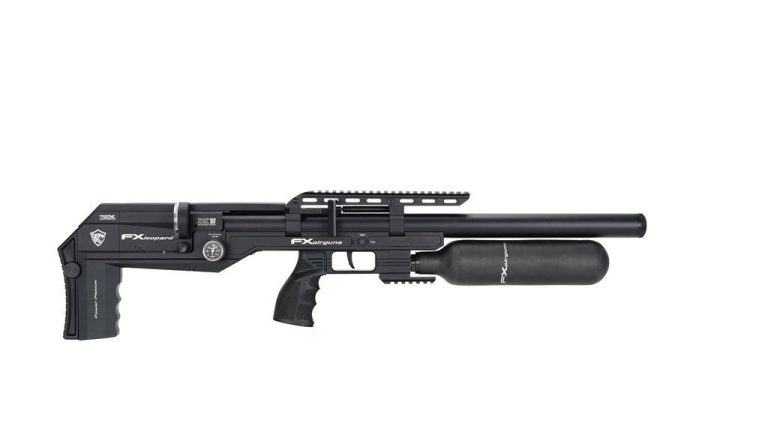


FX Leopard Standard Bottle


€1,700.00
FX Leopard Standard Bottle
The FX Leopard is a precision-engineered bullpup air rifle that embodies power and adaptability. This high-performance platform integrates the latest FX innovations, offering shooters an unparalleled experience and fantastic looks! The rifle has an integrated regulator plenum in the buttstock of the rifle.
The Leopard is available in both bottle and tube variants to cater to different shooting preferences. The Standard Bottle variant is particularly suited for long-range and benchrest shooting, offering an additional 480 cc carbon fiber bottle that increases shot capacity. This results in a total of 740 cc of pressurized air, reducing the need for frequent refills. Additionally, a Weaver/Picatinny accessory rail is included for easy attachment of shooting accessories.
Key Features:
- 54 cc Power Plenum: Concealed within the butt stock, this plenum acts as a buffer between the regulator and the valve, delivering consistent, regulated compressed air for each shot.
- AMP MkII Regulator: This externally adjustable regulator allows shooters to fine-tune the compressed air entering the power plenum, optimizing pressure for various ammunition types to achieve superior accuracy.
- Quick Tune System: Enables users to make macro and micro adjustments to hammer strength, allowing for precise airflow control tailored to individual shooting preferences.
- Over-Barrel PCP Reservoir: The shrouded air tank design minimizes bulk, enhancing shooting ergonomics and ease of transport. With a pressurized air capacity of 310 cc, it ensures extended shooting sessions.
- STX Superior Heavy Liner: Featuring a modified choke and groove optimized for heavier pellets and slugs, this liner’s smooth 1:18 rifling minimizes friction and maximizes the seal around the ammunition, ensuring consistent accuracy.
- 20 MOA Mounting Rail: The forward-inclined rail provides an expanded adjustment range for rifle scopes, facilitating precise long-distance shooting.
- Adjustable Two-Stage Trigger: Customizable to match the shooter’s ergonomic preferences, this trigger ensures a tailored shooting experience.
- FX UG1 Grip: Designed with a soft, grippy surface and finger grooves, the UG1 grip offers optimal ergonomics and is compatible with other AR-style grips for further customization.
- Adjustable Butt Pad: Easily adjustable without tools, the butt pad can be moved up or down to achieve a perfect shoulder fit.
- Rotary Magazine: Designed to cycle smoothly, the magazine accommodates projectiles up to 13 mm in length, making it suitable for heavier slugs.
- 1/2UNF-20″ Muzzle Thread: Allows for the attachment of a sound moderator to reduce muzzle noise, enhancing the shooting experience.
- Dual-Sided Safety Switch: Engages the trigger safety mechanism to prevent accidental discharge, ensuring safe handling.
Specifications:
- Weight: Compact: 3.4 kg; Standard: 4 kg; Sniper: 4.2 kg
- Total Length: Compact: 690 mm; Standard: 805 mm; Sniper: 905 mm
- Fill Pressure: Up to 230 bar (3,335 psi)
- Magazine Capacity: 13 rounds (.30 cal), 15 rounds (.25 cal), 18 rounds (.22 cal), 22 rounds (.177 cal)
- Caliber Options: .177 (4.5 mm), .22 (5.5 mm), .25 (6.35 mm), .30 (7.62 mm)
FX Leopard Standard Bottle – 600mm Bullpup PCP Air Rifle with 740cc Total Air Capacity and Advanced FX Tuning
FX Leopard Standard Bottle Overview
The FX Leopard Standard Bottle is a premium bullpup PCP designed for shooters who want high air capacity, compact handling, precision-oriented engineering, and extensive adjustability in one streamlined platform. The Standard Bottle configuration combines a 600mm barrel, 260cc over-barrel air reservoir, and additional 480cc carbon-fiber bottle, providing approximately 740cc of total onboard air capacity. It also incorporates a 54cc Power Plenum, externally adjustable AMP MkII regulator, Quick Tune System, adjustable two-stage trigger, 20 MOA optics rail, and accessory mounting interfaces.
Unlike the Standard Tube model, the Bottle configuration adds considerable air capacity. Therefore, fewer interruptions for refilling may be required during extended target sessions. This configuration is specifically positioned by FX toward longer-range and benchrest-oriented use.
Why Choose the FX Leopard Standard Bottle?
The strongest reason to choose the fx leopard Bottle configuration is its combination of compact dimensions and substantial air storage. A conventional bottle-equipped air rifle can become bulky, whereas the Leopard combines its rear carbon bottle with an over-barrel reservoir.
Consequently, users looking at high end air rifles receive a sophisticated platform that balances air capacity, adjustability, barrel length, and bullpup maneuverability.
600mm STX Superior Heavy Barrel
The Standard Bottle uses a 600mm STX Superior Heavy Liner. Current European specifications describe a 1:18 twist and a profile optimized around heavier compatible pellets and slugs.
This makes the rifle particularly relevant to shooters comparing an fx impact m3 .22cal air rifle. 600mm barrel or other medium-length precision configurations.
740cc Total Air Capacity
Air storage is one of the defining characteristics of the Bottle model.
The rifle combines:
- 260cc over-barrel reservoir
- 480cc carbon-fiber bottle
- 740cc combined air capacity
This large reserve is one of the primary distinctions between the Bottle and Tube configurations.
For anyone comparing modern pcp airguns, an fx pcp, or another premium pcp air gun, this capacity can be valuable during extended shooting sessions.
54cc Power Plenum
A 54cc Power Plenum is integrated into the butt section.
The plenum sits between the regulator and valve, holding regulated compressed air for the firing cycle.
Placing it inside the rear section also helps preserve the rifle’s compact exterior.
AMP MkII Regulator
The externally adjustable AMP MkII regulator controls the pressure supplied to the plenum.
Consistent regulated pressure contributes to repeatable velocity and predictable performance.
Current Leopard specifications pair the regulator directly with the 54cc plenum and Quick Tune architecture.
Quick Tune System
The Quick Tune System provides external macro and micro hammer adjustments.
This gives experienced users a controlled way to match approved configurations to suitable ammunition while remaining within manufacturer specifications and applicable local laws.
FX Leopard Airgun Ergonomics
The fx leopard airgun uses a bullpup arrangement that places much of the action behind the trigger.
As a result, the full 600mm barrel is packaged into an overall layout considerably shorter than many conventional rifle designs.
For shooters researching the fx leopard air rifle, this compact handling is one of the platform’s primary advantages.
FX Airguns Swedish Engineering
The Leopard forms part of the broader fx airguns family from Sweden.
Search terms such as fx airguns sverige, fx airguns sweden, fxairguns, fx air guns, fx usa, and fx airguns usa all relate to the same Swedish manufacturer and its international distribution network.
The broader fx lineup now spans conventional rifle, bullpup, competition, and tactical-style PCP designs.
FX Leopard Versus FX Impact M4
Many buyers compare the Leopard with the fx impact m4, fx m4, impact m4, and impact m4 air rifle.
The Impact uses FX’s established rear-bottle modular architecture, whereas the Leopard combines an over-barrel reservoir with an additional bottle.
Someone searching impact m4 500mm is also considering a considerably shorter-barreled configuration.
Likewise, impact m4 ballistic coefficient relates primarily to projectile characteristics rather than a fixed rifle specification.
FX Impact M3 Comparison
Earlier platforms such as the fx impact m3, f x impact m3, fx m3, fx m3 airgun, fx impact m3 air rifle, and fx impact air rifle remain closely associated with FX’s adjustable PCP design philosophy.
However, the Leopard represents a different mechanical layout.
A buyer comparing an fx impact m3 .22cal air rifle with the Leopard should therefore focus on ergonomics, reservoir architecture, barrel configuration, and intended use rather than assuming identical specifications.
FX Panthera and Dynamic Comparison
The fx panthera, fxpanthera, FX Panthera MkII, fx dynamic, and fx dynamics are more competition-oriented designs within the wider product family.
The Leopard instead emphasizes compact versatility.
Its bullpup configuration makes it particularly attractive to users who want performance without the full length of a conventional competition chassis.
FX DRS Family Comparison
The fx drs, fx drs tactical, fx drs classic, fx drs pro, and fx drs air rifle use a more traditional rifle format.
Those platforms integrate air storage differently and provide a handling experience closer to a conventional stock or chassis rifle.
The Leopard’s bullpup layout makes it substantially different ergonomically.
FX Wildcat and Maverick Alternatives
The fx wildcat, fx wildcat mk3, and fx maverick are other well-known compact PCP models.
However, the Leopard introduces the 54cc rear plenum, over-barrel reservoir architecture, and high-capacity Bottle configuration in a newer package.
FX Dreamline Family
The fx dreamline and fx dreamline classic represent another highly modular branch of the manufacturer’s catalog.
Those rifles helped establish the flexible configuration philosophy that continues across newer products.
The Leopard takes that versatility into a more modern bullpup chassis.
FX Crown and King Alternatives
Traditional rifle enthusiasts may also compare the fx crown, fx crown mk2, fx crown mkii, fx crown mkll, and fx king.
These rifles have more conventional ergonomics.
The Leopard provides a significantly more compact alternative while preserving premium PCP engineering.
Pellet and Slug Compatibility
The Leopard’s redesigned rotary magazine accepts projectiles up to approximately 13mm long, according to current European product specifications.
Consequently, users researching fx pellets, fx halo slugs, or a precision pellet gun platform have considerable ammunition flexibility within the appropriate caliber and manufacturer recommendations.
Caliber Options
Current Standard Bottle listings offer the platform in common configurations including .177, .22, .25, and .30, depending on market.
Power levels and legal requirements vary substantially by jurisdiction, so buyers should always confirm their local rules before purchasing.
Chronograph Monitoring
An fx chronograph or fx pocket chronograph can be used to measure velocity and monitor consistency during lawful target use.
Chronograph data can help identify ammunition variation or changes in mechanical performance without relying solely on perceived shot feel.
Accessory Mounting
The Bottle version includes a lower Picatinny-compatible accessory rail, while current specifications also identify M-LOK interfaces and a 20 MOA optics rail.
These mounting options help shooters configure the rifle for supported target use without permanently modifying the chassis.
Trigger and Grip
The adjustable two-stage trigger allows the shooter to refine trigger feel, while the interchangeable FX UG1 grip provides a modern ergonomic interface.
A predictable trigger and comfortable grip can improve repeatability during precision shooting.
FX Outdoors and Practical Use
Within the broader fx outdoors ecosystem, the Standard Bottle is particularly suited to users who prioritize extended air capacity and precision-oriented supported shooting.
It remains an air gun, so lawful use, secure transport, proper backstops, and compliance with local requirements remain essential.
For Scandinavian shoppers, the term luftgevær is also commonly used when researching this category.
Why the Standard Bottle Configuration Stands Out
The FX Leopard Standard Bottle combines a 600mm STX Superior Heavy barrel, 480cc carbon-fiber bottle, 260cc over-barrel reservoir, 740cc total air capacity, 54cc plenum, AMP MkII regulator, Quick Tune System, 20 MOA optics rail, adjustable trigger, and compact bullpup architecture.
For shoppers moving between an fx impact m4 for sale, the established Impact platforms, Panthera family, DRS series, Crown, Wildcat, Maverick, Dreamline, King, or Leopard, this Standard Bottle configuration stands out by delivering unusually high onboard air capacity in a compact precision-focused package.
Precision Performance, Air Efficiency, Balance, Trigger Control, Handling, and Real-World Shooting Use
The FX Leopard Standard Bottle is designed to combine compact handling with unusually generous onboard air capacity. In practical use, this gives the rifle a distinct character: it remains relatively short and maneuverable while still supporting long shooting sessions, stable regulated performance, and a substantial number of consistent shots between fills. The platform rewards careful setup, clean ammunition, good body position, and disciplined target-shooting technique.
Compact Handling with High Air Capacity
One of the strongest advantages of this configuration is that large air capacity does not automatically result in an excessively long rifle.
The rear bottle and integrated air system allow the rifle to remain compact.
This is useful when shooting from benches, confined range positions, or supported field setups where a full-length rifle may feel awkward.
Weight Distribution
The added rear bottle shifts some mass toward the back of the rifle.
This can improve balance compared with a heavily front-weighted setup.
However, the exact feel depends on optic size, bipod placement, and accessories.
A well-balanced rifle is easier to hold consistently.
Long Shooting Sessions
The large air reserve is especially useful during extended target sessions.
Fewer interruptions for refilling can make practice more efficient.
The shooter can concentrate on technique, group size, and ammunition performance rather than stopping frequently to recharge the system.
Regulated Air Delivery
The regulator controls the pressure supplied to the firing system.
Consistent regulated pressure helps stabilize velocity.
This matters because repeatable projectile speed contributes to repeatable point of impact.
Why Pressure Consistency Matters
Small velocity differences may have little visible effect at short range.
At longer distances, however, vertical variation can become more noticeable.
A stable pressure cycle therefore supports precision shooting.
Plenum Performance
The plenum stores regulated air immediately before the shot.
This gives the firing system access to a controlled volume of compressed air.
The result is a more predictable shot cycle when the rifle is operating correctly.
Efficient Use of Stored Air
A large air supply is most useful when the system uses that air efficiently.
The goal is not simply to hold more compressed air.
The rifle should deliver enough air for consistent performance without unnecessary waste.
Monitoring Fill Pressure
The pressure gauge should be checked regularly.
The shooter should know the useful operating range rather than waiting until performance becomes noticeably unstable.
A consistent refill routine makes testing easier.
Controlled Filling
The air system should be filled gradually and within the manufacturer’s approved pressure limit.
Very rapid filling can create unnecessary heat.
Careful filling also gives the shooter more time to monitor pressure accurately.
Trigger Feel
The adjustable two-stage trigger plays an important role in precision shooting.
A clear first stage allows the shooter to prepare for the shot.
The second stage can then be pressed smoothly.
This reduces unnecessary movement immediately before firing.
Trigger Finger Placement
The finger should contact the blade in the same place for each shot.
Pressure should move directly to the rear.
Sideways pressure can disturb the rifle.
Grip Pressure
A relaxed grip often produces better consistency.
Excessive hand pressure can pull the rifle away from the aiming point.
The firing hand should guide rather than clamp the rifle.
Shoulder Position
The rear section should contact the shoulder consistently.
Changing pressure from shot to shot can influence stability.
A firm but comfortable position is preferable.
Cheek Position
Head placement should remain repeatable.
The shooter should be able to mount the rifle and immediately see a full sight picture.
This helps reduce unnecessary movement.
Optic Height
The optic should sit at a height that works naturally with the shooter’s head position.
A scope that is too high can weaken cheek contact.
A scope that is too low may create discomfort.
Eye Relief
Correct eye relief allows the shooter to maintain a natural posture.
The head should not need to move forward or backward after the rifle is shouldered.
Benchrest Use
The rifle is particularly well suited to supported shooting.
A solid bench, bipod, or front rest can reduce movement significantly.
A rear bag can then provide fine elevation control.
Bipod Placement
Moving the bipod farther forward can improve stability.
However, it can also change how quickly the rifle can be repositioned.
The best position depends on the shooter’s preferred balance.
Rear Bag Technique
A rear bag should support the rifle without forcing it.
Small squeezes can provide precise vertical adjustment.
Large corrections are less efficient once the rifle is settled.
Prone Shooting
Prone provides excellent stability.
The shooter should remain naturally aligned behind the rifle.
Twisting the body can create uneven shoulder pressure.
Kneeling Position
Kneeling offers a useful compromise between stability and mobility.
The support arm can be braced against the leg.
A relaxed posture reduces fatigue.
Standing Position
Standing is naturally less stable.
The rifle’s weight and rear bottle become more noticeable without support.
Shorter aiming periods can help preserve control.
Natural Point of Aim
The rifle should point naturally toward the target.
If constant muscle pressure is needed to keep the reticle centered, body position should be adjusted.
Natural alignment improves repeatability.
Breathing Control
Breathing creates movement.
A short natural pause provides a stable moment for the shot.
Holding the breath too long often increases tension.
Trigger Control
The trigger should be pressed smoothly rather than pulled suddenly.
The goal is to release the shot without disturbing sight alignment.
A controlled press is one of the most important fundamentals of precision shooting.
Follow-Through
The shooter should remain in position after the shot.
Lifting the head immediately can interrupt consistency.
Good follow-through also makes it easier to evaluate technique.
Ammunition Selection
Different projectiles can behave differently in the same barrel.
Weight, shape, diameter, and manufacturing consistency all influence results.
Testing should therefore be systematic.
Projectile Condition
Damaged ammunition should be avoided.
Bent skirts, flattened noses, or irregular surfaces can affect both feeding and accuracy.
Careful storage helps preserve quality.
Magazine Reliability
The magazine should rotate smoothly.
If resistance develops, it should be inspected rather than forced.
Dirt or damaged projectiles can cause feeding problems.
Loading Consistency
Projectiles should be loaded carefully.
Consistent loading reduces the chance of deformation.
The breech area should remain clean.
Chronograph Testing
Velocity testing can provide useful information.
Several shots should be recorded.
A single reading does not provide enough information to judge consistency.
Evaluating Velocity Spread
A narrow spread usually indicates stable air delivery and consistent ammunition.
A larger spread can come from pressure changes, ammunition variation, temperature, or maintenance issues.
Group Testing
Accuracy should be evaluated through repeated groups.
One good shot can happen by chance.
Several consistent groups provide much more useful information.
Short-Range Testing
Initial testing should be done at a manageable distance.
This helps confirm that the optic, ammunition, and rifle are working correctly.
Once consistency is established, distance can be increased.
Longer-Range Testing
At longer distances, small inconsistencies become more visible.
Wind, velocity variation, and shooter technique all have greater influence.
Conditions should therefore be considered carefully.
Wind Effects
Wind can move projectiles significantly.
Variable wind can make an accurate rifle appear inconsistent.
Calmer conditions are preferable when evaluating mechanical precision.
Temperature Effects
Compressed air behavior changes slightly with temperature.
Large temperature changes can influence pressure and velocity.
Allowing the rifle to acclimate can improve repeatability.
Indoor Range Use
Indoor ranges remove wind as a variable.
This makes them useful for testing ammunition and basic consistency.
Appropriate backstops and range rules remain essential.
Outdoor Target Use
Outdoor shooting introduces wind, changing light, and temperature.
The shooter should separate environmental effects from mechanical performance.
Barrel Cleanliness
The barrel should remain clean enough to maintain consistency.
However, excessive cleaning is unnecessary.
Cleaning should be performed only when needed and with suitable materials.
Muzzle Protection
The muzzle should remain free from impact damage.
The rifle should not be rested directly on the muzzle or transported where hard objects can strike it.
Optic Stability
Scope mounts should remain secure.
Loose hardware can produce unexplained point-of-impact shifts.
Optic mounting should always be checked before more complicated troubleshooting.
Accessory Balance
Every accessory changes the rifle’s weight distribution.
Large optics, bipods, and other equipment can improve stability but also increase overall weight.
Only useful accessories should be added.
Long-Session Comfort
Comfort becomes increasingly important during long sessions.
Poor cheek height, awkward grip position, or excessive weight can create fatigue.
A properly adjusted setup supports better consistency.
Recognizing Shooter Fatigue
As fatigue develops, the shooter may grip harder, rush the trigger, or lose head position.
Group size often increases.
Short breaks can restore control.
Pre-Session Inspection
Before shooting, check pressure, optic security, magazine condition, mounting hardware, trigger function, and general mechanical operation.
A short inspection can prevent avoidable problems.
Post-Session Review
After shooting, note any changes in pressure behavior, accuracy, or cycling.
Unexpected changes should be investigated before the next session.
Used-Rifle Evaluation
A used example should be judged mainly by mechanical condition.
Air retention, regulator behavior, barrel condition, trigger feel, magazine operation, and mounting integrity matter more than small cosmetic scratches.
Overall Real-World Performance
The FX Leopard Standard Bottle offers a strong combination of compact handling, high onboard air capacity, regulated consistency, adjustable ergonomics, and supported-shooting stability.
Its large air reserve supports extended sessions.
Its bullpup layout keeps overall dimensions manageable.
Its trigger and air system promote repeatable precision.
When ammunition, pressure, optic placement, body position, and support technique remain consistent, the rifle can deliver a refined and highly dependable shooting experience across a wide range of lawful target and sporting environments.
Build Quality, Bottle Care, Barrel Protection, Seal Condition, Magazine Maintenance, Hardware Inspection, and Long-Term Reliability
The rifle is built around a compact high-pressure pneumatic system, large rear bottle, integrated air tube, regulated firing cycle, precision barrel, adjustable trigger, magazine mechanism, and rigid chassis. Because all of these components influence one another, long-term reliability depends on more than occasional exterior cleaning. Proper filling practices, clean air, careful storage, secure hardware, and regular inspection all contribute to consistent performance. A well-maintained example can remain dependable for many years, while neglected seals, contaminated fill equipment, damaged threads, or loose mounting points can gradually reduce accuracy and reliability.
Overall Structural Condition
The main chassis should remain rigid and free from cracks, deformation, or unusual movement.
Any looseness between major structural parts can affect alignment.
Minor cosmetic marks are generally less important than mechanical movement.
For this reason, the rifle should be inspected periodically even when it appears to function normally.
Bottle Condition
The rear bottle is one of the most important parts to inspect.
It should remain free from deep scratches, impact damage, damaged threads, or other signs of structural stress.
Because it stores compressed air at high pressure, visible damage should never be ignored.
Carbon-Fiber Surface Inspection
The outside of the bottle should be examined carefully.
Small surface marks may be harmless, but deep cuts or damaged fibers deserve professional assessment.
The surface should remain smooth and structurally intact.
Bottle Connection
The threaded connection should remain clean and undamaged.
The bottle should screw into place smoothly.
Excessive resistance may indicate dirt, thread damage, or incorrect alignment.
Force should never be used.
Over-Barrel Air System
The integrated front air reservoir should also be kept in good condition.
Its exterior should remain free from significant dents or impact marks.
Because the rifle uses more than one air-storage section, both areas deserve equal attention.
Fill Port Cleanliness
The fill connection should remain protected from dust, grit, and moisture.
Contamination entering during filling can damage seals or internal components.
A protective cover should remain fitted whenever possible.
Using Clean, Dry Air
Only clean, dry compressed air should be used.
Moisture inside the system can contribute to corrosion.
Contaminated air may also affect the regulator and valve.
A properly maintained compressor, certified cylinder, or suitable pump is essential.
Controlled Filling
The rifle should be filled gradually.
Very rapid charging can generate unnecessary heat.
Pressure should be monitored throughout the process.
The approved maximum should never be exceeded.
Pressure Gauge Inspection
The gauge should remain clear and easy to read.
Fogging, cracked lenses, or obviously inaccurate readings should be investigated.
If the gauge appears unreliable, filling should stop until the problem is resolved.
Regulator Health
The regulator controls the pressure supplied to the firing system.
A healthy regulator supports stable shot behavior.
If velocity changes become larger than expected, regulator condition should be considered among the possible causes.
Identifying Pressure Irregularities
Possible signs include unstable velocity, changing point of impact, or unusual pressure behavior after storage.
However, ammunition, temperature, and fill pressure can cause similar symptoms.
A systematic diagnosis is always preferable.
Plenum Sealing
The plenum stores regulated air immediately before each shot.
Its seals must remain reliable.
Any persistent pressure loss or unexplained hissing should be investigated.
Internal high-pressure work should be handled by a qualified technician.
Seal Condition
O-rings and sealing surfaces gradually wear.
A rifle that loses pressure while sitting unused may have a seal problem.
Replacement parts should match the correct specification.
Improvised substitutes are not recommended.
Correct Lubrication
Only suitable high-pressure pneumatic lubricants should be used where required.
Too much lubricant can attract dirt.
Incorrect products can damage sealing materials.
Manufacturer guidance should determine what is appropriate.
Valve Operation
The valve should operate smoothly and consistently.
Changes in sound, pressure use, or shot feel can sometimes indicate a maintenance issue.
Internal valve work should not be approached casually.
Barrel Protection
The barrel should be protected from impact during transport and storage.
It should never carry the weight of other equipment.
A padded case can help prevent accidental damage.
Barrel Alignment
The barrel should appear straight and properly centered.
If the rifle suffers a hard knock and accuracy changes afterward, alignment should be checked.
Bore Maintenance
The bore does not require aggressive cleaning after every session.
Cleaning should be performed only when needed.
Suitable tools should be used carefully.
Protecting the Muzzle
The muzzle should remain free from dents or scratches.
Damage at the exit point can affect consistency.
Cleaning equipment should not strike or scrape this area.
Barrel Liner Condition
If the installed system uses a removable liner, it should remain properly seated.
Incorrect assembly can reduce accuracy.
Any removal should follow the correct procedure.
Magazine Condition
The magazine should rotate smoothly.
It should remain free from dirt, damaged components, or deformed ammunition.
Resistance should never be overcome with force.
Magazine Cleaning
Dust and small fragments can accumulate over time.
Light cleaning helps maintain smooth operation.
Harsh chemicals are usually unnecessary.
Ammunition Inspection
Damaged projectiles should not be loaded.
Bent skirts, distorted noses, or irregular surfaces can interfere with feeding and consistency.
Careful handling reduces this risk.
Breech Cleanliness
The breech area should remain free from debris.
Dust or fragments can interfere with loading.
A gentle wipe is usually enough for routine care.
Sidelever Operation
The loading lever should move smoothly.
Increasing resistance may indicate dirt, mechanical wear, or magazine interference.
The cause should be identified instead of forcing the mechanism.
Trigger Mechanism
The trigger should remain clean and predictable.
Any sudden change in feel should be investigated.
Adjustment screws should stay secure once a preferred setting has been found.
Safety Mechanism
The safety should engage and disengage positively.
If it becomes unusually loose or stiff, use should stop until the issue is corrected.
Mechanical safeties should never replace proper handling.
Grip Condition
The grip should remain firmly attached.
Loose grip hardware can affect hand position and trigger control.
The mounting screws should be checked periodically.
Rear Support
The rear section should remain secure.
Any adjustable component should lock firmly.
Unexpected movement can reduce shooting consistency.
Optics Rail Stability
The optics rail should remain solid.
Loose mounting hardware can cause point-of-impact changes.
It should be checked whenever accuracy changes unexpectedly.
Scope Ring Hardware
Ring screws should be tightened evenly.
Excessive torque can damage hardware or the optic tube.
Correct tension is more important than maximum force.
Accessory Interfaces
Lower and side mounting points should remain clean and free from damaged threads.
Any attached accessories should remain secure.
Loose equipment can affect balance and stability.
Bipod Maintenance
If a bipod is installed, its mounting point should be inspected regularly.
Hinges, feet, and locking mechanisms should work correctly.
Any looseness should be corrected.
External Surface Cleaning
The rifle should be wiped after use.
Sweat, fingerprints, moisture, and dust can accumulate around small joints and screws.
A soft cloth is generally sufficient.
Moisture After Outdoor Use
Rain or humidity can remain trapped in recesses.
The rifle should be dried before storage.
Placing a damp rifle directly into a closed case can encourage corrosion.
Case Storage
A padded case is excellent for transport.
However, foam can trap moisture.
Both rifle and case should be dry before long-term storage.
Heat Exposure
Extreme heat should be avoided.
A closed vehicle in direct sunlight can become very hot.
Higher temperatures can increase internal pressure and stress seals.
Cold Conditions
Cold temperatures can affect seal flexibility and pressure behavior.
Moving the rifle rapidly from cold to warm conditions can also create condensation.
Gradual temperature adjustment is preferable.
Long-Term Storage
For extended storage, the rifle should remain clean, dry, secure, and protected from impact.
The storage location should be temperature stable.
Pressure condition should follow manufacturer guidance.
Pre-Session Inspection
Before shooting, check bottle condition, fill pressure, magazine operation, sidelever movement, optics security, trigger function, and external hardware.
A short inspection can reveal problems early.
Post-Session Inspection
After shooting, check for fresh scratches, pressure loss, loose screws, or changes in cycling.
Problems are easier to diagnose when the session is still recent.
Monitoring Air Retention
If the rifle loses pressure during storage, monitor the rate of loss.
Persistent leakage should not be ignored.
Repeatedly refilling a leaking system does not solve the problem.
Monitoring Velocity Changes
Large changes in velocity can result from ammunition, pressure, temperature, regulator behavior, or seal condition.
Several measurements should be compared before conclusions are drawn.
Monitoring Accuracy Changes
A sudden drop in precision should first prompt simple checks.
Inspect ammunition, optics mounts, barrel condition, support setup, and hardware.
Internal adjustments should not be the first response.
Used-Rifle Inspection
A second-hand example should be checked carefully.
Air retention, bottle condition, regulator stability, barrel condition, magazine function, trigger behavior, and loading smoothness matter more than cosmetic appearance.
Service History
A documented service history can provide useful insight.
Records of seal replacement, regulator work, or previous repairs help establish how well the rifle has been maintained.
Cosmetic Wear Versus Mechanical Wear
Small scratches and finish marks usually affect appearance more than performance.
Pressure loss, rough cycling, damaged threads, unstable regulation, or loose components are much more important.
Professional Servicing
Complex internal repairs should be completed by technicians familiar with high-pressure pneumatic systems.
Incorrect disassembly can cause damage or create safety risks.
Preserving Long-Term Value
Good maintenance helps protect both performance and resale value.
Use clean air.
Protect the bottle.
Keep the barrel safe.
Inspect seals.
Maintain the magazine.
Store the rifle dry.
Address faults early.
Overall Long-Term Reliability
A well-maintained example can remain dependable for many years.
Clean air protects internal components.
Healthy seals preserve pressure.
A protected barrel maintains alignment.
Secure mounting hardware supports repeatable accuracy.
Regular inspection, careful transport, controlled filling, dry storage, and qualified servicing when necessary help preserve smooth cycling, stable pressure behavior, and consistent performance over the long term.
Be the first to review “FX Leopard Standard Bottle”
Related products

FX Air Gun
FX Air Gun
FX Air Gun

FX Air Gun
FX Air Gun

FX Air Gun
FX Air Gun


FX Air Gun
Reviews
There are no reviews yet.