
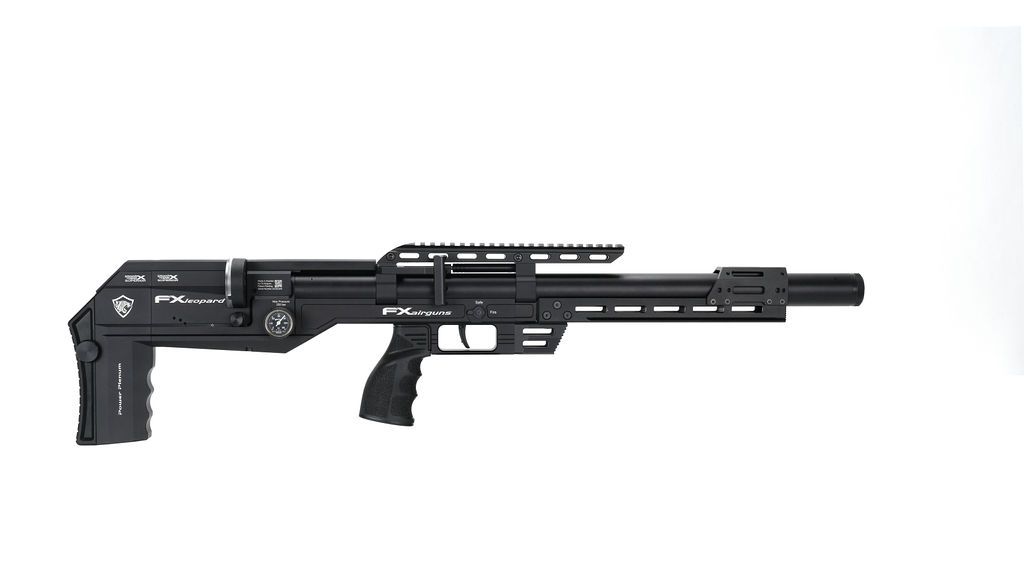


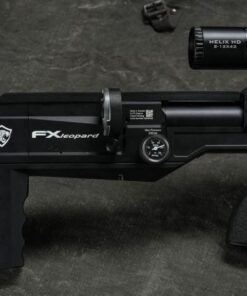
FX Leopard Standard Tube

€1,340.00
FX Leopard Standard Tube
The FX Leopard is a precision-engineered bullpup air rifle that embodies power and adaptability. This high-performance platform integrates the latest FX innovations, offering shooters an unparalleled experience and fantastic looks! The rifle has an integrated regulator plenum in the buttstock of the rifle.
To cater for different user preferences, the Leopard comes in a tube and bottle variant. This FX Leopard Standard tube variant is best suited for hunting and all-round use. It brings the following to the table:
- A modular fore-end with a bridge
- Full length Arca-Swiss accessory rail
- M-LOK slots on all sides
- 260 cc’s of pressurised air
Key Features:
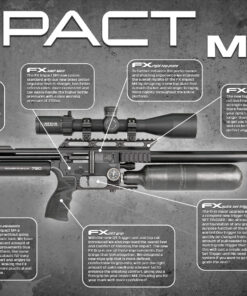
- 54 cc Power Plenum: Concealed within the butt stock, this plenum acts as a buffer between the regulator and the valve, delivering consistent regulated compressed air for each shot.
- AMP MkII Regulator: This externally adjustable regulator allows shooters to fine-tune the compressed air entering the power plenum, optimizing pressure for various ammunition types to achieve superior accuracy.
- Quick Tune System: Enables users to make macro and micro adjustments to hammer strength, allowing for precise airflow control tailored to individual shooting preferences.
- Over-Barrel PCP Reservoir: The shrouded air tank design minimizes bulk, enhancing shooting ergonomics and ease of transport. With a pressurized air capacity of 310 cc, it ensures extended shooting sessions.
- STX Superior Heavy Liner: Featuring a modified choke and groove optimized for heavier pellets and slugs, this liner’s smooth 1:18 rifling minimizes friction and maximizes the seal around the ammunition, ensuring consistent accuracy.
- 20 MOA Mounting Rail: The forward-inclined rail provides an expanded adjustment range for rifle scopes, facilitating precise long-distance shooting.
- Adjustable Two-Stage Trigger: Customizable to match the shooter’s ergonomic preferences, this trigger ensures a tailored shooting experience.
- FX UG1 Grip: Designed with a soft, grippy surface and finger grooves, the UG1 grip offers optimal ergonomics and is compatible with other AR-style grips for further customization.
- Adjustable Butt Pad: Easily adjustable without tools, the butt pad can be moved up or down to achieve a perfect shoulder fit.
- Rotary Magazine: Designed to cycle smoothly, the magazine accommodates projectiles up to 13 mm in length, making it suitable for heavier slugs.
- 1/2UNF-20″ Muzzle Thread: Allows for the attachment of a sound moderator to reduce muzzle noise, enhancing the shooting experience.
- Dual-Sided Safety Switch: Engages the trigger safety mechanism to prevent accidental discharge, ensuring safe handling.
- Weight: Compact: 3.4 kg; Standard: 4 kg; Sniper: 4.2 kg
- Total Length: Compact: 690 mm; Standard: 805 mm; Sniper: 905 mm
- Fill Pressure: Up to 230 bar (3,335 psi)
- Magazine Capacity: 13 rounds (.30 cal), 15 rounds (.25 cal), 18 rounds (.22 cal), 22 rounds (.177 cal)
- Caliber Options: .177 (4.5 mm), .22 (5.5 mm), .25 (6.35 mm), .30 (7.62 mm)
FX Leopard Standard Tube – Precision Bullpup PCP Air Rifle with 600mm STX Superior Heavy Barrel and 260cc Air Reservoir
FX Leopard Standard Tube Overview
The FX Leopard Standard Tube is a precision-engineered bullpup PCP platform designed around compact handling, extensive adjustability, efficient air management, and the ability to work with a broad range of approved pellet and slug configurations. The Standard Tube version uses a 600mm barrel, 260cc over-barrel air reservoir, 54cc power plenum, 230-bar maximum fill pressure, AMP MkII regulator, and Quick Tune System. Its overall length is approximately 805mm, while published weight is around 3.46 kg.
Available chamberings include .177, .22, .25, and .30, although power levels, legal availability, magazine capacity, and configuration vary by market. Consequently, prospective owners should always select a version that complies with local airgun regulations.
Why Choose the FX Leopard Standard Tube?
The biggest attraction is the combination of a full 600mm barrel with compact bullpup dimensions. While a conventional air rifle may become considerably longer with the same barrel length, the Leopard places the action farther rearward. Therefore, the shooter receives substantial barrel length without unnecessary overall bulk.
Among high end air rifles, this arrangement makes the Leopard especially interesting for target shooters and lawful sporting users who value maneuverability, repeatable ergonomics, and extensive adjustability.
FX Leopard and Modern FX Airguns Engineering
The fx leopard brings several established fx airguns technologies into one chassis. The rifle combines an internally positioned power plenum, externally adjustable regulator, modular fore-end, full-length Arca-Swiss accessory interface, M-LOK mounting points, adjustable butt pad, and two-stage trigger.
For anyone following fx airguns sverige, fx airguns sweden, fxairguns, fx air guns, fx usa, or fx airguns usa, the Leopard represents another development in FX’s continuing emphasis on modular PCP design.
54cc Power Plenum
One of the distinctive engineering features is the 54cc power plenum housed in the rear of the rifle.
The plenum stores regulated compressed air between the regulator and valve. Consequently, it helps provide the air volume required for consistent operation while allowing the main reservoir arrangement to remain compact.
This concept reflects the tuning-focused philosophy seen throughout the broader fx product family.
260cc Over-Barrel Air Reservoir
Unlike a bottle-fed configuration, the Standard Tube uses a 260cc over-barrel reservoir.
Because the reservoir surrounds the barrel area, external bulk can be reduced. Furthermore, the design contributes to the Leopard’s distinctive balance and streamlined profile.
For shooters comparing a conventional pcp air gun, pcp airguns, or fx pcp, this integrated reservoir arrangement is one of the Leopard’s defining characteristics.
AMP MkII Regulator and Quick Tune System
The externally adjustable AMP MkII regulator manages the pressure entering the plenum. Meanwhile, the Quick Tune System provides macro and micro hammer adjustments for compatible configurations.
These systems support controlled setup and ammunition matching within manufacturer recommendations. As with any air gun, adjustments should remain within the rifle’s approved specifications and applicable local laws.
600mm STX Superior Heavy Barrel
The Standard configuration uses a 600mm barrel, and current listings describe a Superior Heavy liner for the standard high-power configuration. FX designed this liner around heavier pellets and slugs, with 1:18 rifling reported by current European retailers.
That makes the rifle particularly relevant to users comparing an fx impact m3 .22cal air rifle. 600mm barrel, impact m4 500mm, fx impact air rifle, or other longer-barreled PCP platforms.
Pellet and Slug Compatibility
The redesigned rotary magazine accepts ammunition up to approximately 13mm in length, providing room for heavier compatible projectiles.
Therefore, users researching fx pellets, fx halo slugs, or a premium pellet gun platform have considerable ammunition flexibility, subject to caliber and manufacturer guidance.
Adjustable Trigger and Ergonomics
A two-stage adjustable trigger helps the user tailor trigger feel to personal preference. Meanwhile, the FX UG1 grip incorporates finger grooves and a textured surface, and it can be exchanged for compatible AR-style grips.
The butt pad can also be adjusted vertically without tools. Consequently, the rifle can be adapted to different body dimensions and supported shooting positions.
Accessory Mounting System
A full-length Arca-Swiss rail runs along the fore-end, while M-LOK interfaces provide additional accessory mounting positions. The optical rail incorporates approximately 20 MOA of inclination, giving compatible scopes additional adjustment range.
These features place the Leopard comfortably within the modern fx outdoors and precision-sporting ecosystem.
FX Leopard Airgun Versus FX Impact Platforms
Buyers considering the fx leopard airgun frequently compare it with the fx impact, f x impact, fx impact m3, f x impact m3, fx m3, fx m3 airgun, fx impact m3 air rifle, and newer fx impact m4 or fx m4.
The Leopard follows a different architecture. Its over-barrel tube and bullpup chassis prioritize a slim, compact form, whereas Impact platforms use their own modular bottle-based configuration.
Likewise, searches for impact m4, impact m4 air rifle, fx impact m4 for sale, or impact m4 ballistic coefficient often concern a separate model family rather than Leopard-specific specifications.
Comparison with FX Panthera and Dynamic Platforms
The Leopard also sits alongside performance-oriented models such as fx panthera, fxpanthera, FX Panthera MkII, fx dynamic, fx dynamics, and fx drs pro.
Each platform serves a different purpose. The Leopard emphasizes compact bullpup handling and all-round versatility, while other designs may prioritize bench, competition, or specialized sporting configurations.
Relationship to FX DRS Models
Users researching fx drs, fx drs tactical, fx drs classic, and fx drs air rifle may notice that FX increasingly integrates air storage into streamlined rifle structures.
However, the Leopard remains mechanically and ergonomically distinct, particularly because of its bullpup layout and 54cc rear plenum.
FX Wildcat, Maverick, and Dreamline Comparisons
The broader lineup also includes fx wildcat, fx wildcat mk3, fx maverick, fx dreamline, and fx dreamline classic.
While all belong to the same manufacturer ecosystem, the Leopard’s modern chassis, over-barrel reservoir, and extensive fore-end mounting interfaces distinguish it from these earlier platforms.
FX Crown, Crown Mk2, and King Alternatives
Traditional rifle-format shoppers may instead compare fx king, fx crown, fx crown mk2, fx crown mkii, or fx crown mkll.
Those models have a different handling character, whereas the Leopard concentrates its action toward the rear for a shorter overall package.
Precision Monitoring with an FX Chronograph
Consistent velocity is an important part of PCP setup and ammunition evaluation. An fx chronograph or fx pocket chronograph can be used for lawful sporting measurement and consistency checking.
Monitoring velocity can help users verify that their rifle is operating within manufacturer specifications and applicable legal energy limits.
Why the Standard Tube Configuration Matters
Compared with the Compact and Sniper tube versions, the Standard occupies the middle position.
The Compact uses a 500mm barrel and smaller reservoir, while the Standard combines its 600mm barrel with a 260cc reservoir. The Sniper extends to a 700mm barrel and larger tube.
Therefore, the Standard offers a practical compromise between compact handling, air capacity, and barrel length.
Caliber and Magazine Options
Current specifications list magazine capacities of approximately 22 rounds in .177, 18 in .22, 15 in .25, and 13 in .30 for the US-market rotary magazine configuration.
Therefore, someone comparing an fx impact m3 .22cal air rifle with the Leopard should check the exact caliber and regional configuration rather than assuming specifications transfer between platforms.
Who Should Consider the FX Leopard Standard Tube?
The Leopard Standard Tube is primarily aimed at experienced PCP users, lawful sporting shooters, target shooters, and owners who value compact handling combined with extensive adjustment.
It is a sophisticated fx air rifle, rather than a basic entry-level air guns platform. Its regulator, plenum, trigger adjustment, modular fore-end, air reservoir, and ammunition flexibility provide considerable versatility.
Overall FX Leopard Standard Tube Performance
The FX Leopard Standard Tube combines a 600mm barrel, 260cc reservoir, 54cc power plenum, AMP MkII regulator, Quick Tune System, 20 MOA optics rail, Arca-Swiss interface, M-LOK mounting points, adjustable trigger, adjustable butt pad, and compact 805mm overall length.
For shooters exploring the broader FX lineup—from the fx crown mkii and fx wildcat mk3 to the fx impact m4, fx drs, and fx leopard air rifle—the Standard Tube stands out as a compact, configurable PCP platform built around precision engineering, ergonomic adaptability, and all-round sporting usability.
Precision Performance, Air Efficiency, Handling, Trigger Feel, Shooting Stability, and Real-World Usability
The FX Leopard Standard Tube is designed to give experienced airgun users a compact platform that still delivers the stability, consistency, and adjustability expected from a premium pre-charged pneumatic rifle. Its bullpup layout keeps overall length manageable, while the full-length barrel, regulated air system, and balanced chassis support repeatable shooting performance. In practical use, the rifle feels purpose-built for shooters who value precision, predictable handling, and the ability to tailor the platform to different lawful sporting and target applications.
Compact Bullpup Handling
The bullpup arrangement places much of the action behind the trigger area.
As a result, the rifle remains relatively short even though it uses a substantial barrel length.
This can make it easier to handle in confined shooting positions, from benches, or in situations where a full-length conventional rifle would feel cumbersome.
Balanced Weight Distribution
A compact rifle is only useful if it also balances well.
The placement of the action and air system helps keep the rifle’s mass centered closer to the shooter.
This can make the platform feel less front-heavy and easier to support during longer sessions.
Stable Shoulder Position
The adjustable rear section allows the rifle to be positioned more consistently against the shoulder.
A repeatable shoulder position can help reduce variation between shots.
This matters because even small changes in body position can influence sight alignment.
Cheek Position and Sight Alignment
Consistent head placement is important when using an optic.
The rifle’s layout supports a stable cheek position once the scope is mounted correctly.
A comfortable sight line helps the shooter avoid unnecessary head movement.
Trigger Control
The two-stage trigger is one of the most important components for practical accuracy.
A clean first stage allows the shooter to take up initial movement before reaching the break point.
The second stage can then be pressed more deliberately.
Why Trigger Feel Matters
Good trigger control reduces disturbance during the shot.
If the trigger requires excessive force, the shooter may move the rifle unintentionally.
A lighter, predictable break can support better consistency when adjusted safely and correctly.
Regulated Air Delivery
The regulator plays a major role in maintaining consistent air pressure from shot to shot.
Rather than allowing reservoir pressure to act directly on the firing system, regulated air is delivered at a more controlled level.
This helps maintain repeatable velocity across a useful portion of the fill.
Consistency Over a Shooting Session
As the reservoir pressure gradually decreases, a well-regulated system helps maintain similar shot behavior.
This is important for target shooters who want predictable impact points.
It also reduces the amount of adjustment needed during a session.
Air Reservoir Efficiency
The tube reservoir provides a useful balance between compactness and available air capacity.
Its integrated design avoids the bulk of a large external bottle.
This helps preserve the rifle’s slim profile.
Fill Pressure Management
The rifle should always be filled within the manufacturer’s approved pressure range.
Correct filling practices protect the seals, regulator, reservoir, and associated components.
Overfilling should be avoided.
Power Plenum Function
The plenum acts as a regulated air chamber between the regulator and firing valve.
This stored volume helps the system deliver the required amount of air consistently.
The design allows the rifle to support different approved projectile configurations without relying solely on reservoir pressure.
Barrel Stability
A long precision barrel benefits from secure support and proper alignment.
The barrel system is designed to maintain consistency while keeping the rifle compact overall.
A stable barrel contributes to repeatable grouping.
Ammunition Selection
Projectile quality has a strong influence on accuracy.
Different weights and shapes can behave differently in the same barrel.
For that reason, shooters often test several manufacturer-approved options to identify the most consistent combination.
Magazine Feeding
A reliable rotary magazine allows repeated shots without manually loading each projectile.
The magazine should feed smoothly and remain free from dirt or damaged components.
Careful loading helps prevent deformation of ammunition.
Single-Shot Precision Use
Some shooters may prefer single loading for deliberate target work where permitted by the system.
This can simplify ammunition inspection before each shot.
However, magazine use remains more convenient for general shooting.
Optic Mounting
The integrated optics rail gives shooters a stable platform for scope installation.
Correct ring spacing and secure mounting are important.
A properly mounted optic should remain aligned under normal use.
Scope Height
Scope height influences cheek position and comfort.
A scope mounted too high can force the shooter to lift the head.
A scope mounted too low may create clearance problems.
Benchrest Use
The rifle’s compact body and flat accessory interface make it well suited to supported shooting.
A front rest or bipod can provide additional stability.
Rear support can also help reduce movement.
Field Position Use
In less supported positions, the relatively compact dimensions become more noticeable.
The rifle can be easier to maneuver compared with a longer traditional platform.
However, proper stance remains essential.
Bipod Setup
A bipod can improve stability during supported shooting.
It should be positioned so that the rifle remains balanced rather than excessively front-heavy.
The support should also allow natural recoil movement.
Arca-Compatible Support
The lower rail system can work with compatible rests, clamps, and shooting supports.
This gives shooters flexibility when configuring the rifle for different legal target disciplines.
The mounting position can be adjusted according to balance preference.
M-LOK Accessory Use
Additional side mounting points allow compatible accessories to be positioned without overcrowding the rifle.
Only necessary equipment should be added.
Excessive accessories can increase weight and negatively affect handling.
Sling Use
A sling can make transport easier during lawful outdoor use.
It can also help stabilize some supported shooting positions.
Attachment points should be checked regularly.
Chronograph Testing
A chronograph can be useful for monitoring consistency.
Velocity data can reveal changes in regulator behavior, ammunition variation, or maintenance needs.
Testing should be carried out safely with an appropriate backstop.
Evaluating Shot Spread
A narrow velocity spread generally indicates consistent air delivery and ammunition performance.
Larger variation may suggest differences in projectiles, fill pressure, or system condition.
Several shots should be measured before drawing conclusions.
Accuracy Testing
The best way to evaluate precision is through controlled groups.
A stable rest, consistent aim point, and uniform ammunition provide more meaningful results.
Single-shot results are less useful than repeated groups.
Barrel Cleanliness
A barrel should be kept clean but not over-cleaned.
Excessive cleaning can create unnecessary wear.
Cleaning should follow manufacturer guidance and use suitable materials.
Moisture Control
Moisture can affect both external finishes and internal components.
The rifle should be stored dry.
Condensation should be removed before storage.
Seal Condition
Seals play a major role in maintaining pressure.
Air loss, unusual sounds, or declining consistency may indicate that service is required.
Seal replacement should use correct parts.
Regulator Health
A healthy regulator should provide repeatable pressure control.
If velocity changes become excessive without another clear cause, regulator performance may need inspection.
Complex internal servicing is best handled by qualified technicians.
Temperature Effects
Temperature can influence compressed-air behavior and projectile performance.
Large changes in temperature may cause slight changes in pressure or velocity.
Allowing equipment to acclimate can improve consistency.
Cold-Weather Use
Cold conditions may reduce efficiency slightly.
Lubricants and seals can also behave differently at low temperatures.
Equipment should be checked carefully before use.
Hot-Weather Use
High heat can increase reservoir pressure.
The rifle should not be left in direct sunlight inside a closed vehicle.
Safe storage temperatures help protect components.
Shot Cycle Feel
A refined shooting cycle helps the user maintain sight picture.
Smooth valve operation and consistent air delivery reduce unnecessary disturbance.
This contributes to a more composed shooting experience.
Noise Management
Sound levels vary depending on caliber, power configuration, projectile type, and local regulations.
Any sound-moderating equipment should only be used where lawful.
The rifle should still be treated as potentially loud.
Maintenance Routine
Routine maintenance should remain simple.
Keep the exterior clean.
Inspect seals.
Check mounting screws.
Monitor air pressure.
Use suitable lubricants only where approved.
Avoiding Excessive Lubrication
Too much lubricant can attract dirt or migrate into areas where it is not needed.
Only manufacturer-recommended products should be used.
More lubricant is not automatically better.
Storage Pressure
Long-term storage practices should follow manufacturer guidance.
The rifle should not be stored completely neglected or exposed to extreme environmental conditions.
Pressure should be checked periodically.
Transport
The rifle should be transported unloaded and secured according to local law.
A padded case protects the optic, barrel, trigger, and air system from impact.
Used-Rifle Inspection
If purchasing a used example, inspect the reservoir, trigger, regulator behavior, magazine, barrel, rail, stock components, and seals.
Check for leaks.
Look for damaged screws or signs of poor maintenance.
Cosmetic Wear Versus Mechanical Condition
Small scratches or finish marks may not affect performance.
Mechanical condition is more important.
Air leaks, regulator instability, damaged threads, or poor trigger behavior deserve greater attention.
Practical Buyer Value
A well-maintained example can offer substantial value compared with buying new.
The platform combines a compact chassis, regulated air delivery, adjustable ergonomics, and extensive mounting options.
Its versatility makes it suitable for shooters who want one rifle capable of handling several legal sporting roles.
Overall Real-World Performance
The FX Leopard Standard Tube offers a strong balance of compact dimensions, precision engineering, reliable regulation, comfortable handling, and configurable ergonomics.
Its reservoir design keeps the rifle slim.
Its bullpup layout preserves barrel length without excessive overall size.
Its adjustable trigger supports controlled shooting.
Its regulated air system promotes consistency.
Its accessory interfaces allow the platform to be adapted to different lawful target and sporting environments.
For experienced users who value precision, repeatability, and a highly configurable design, it provides a refined shooting experience with the flexibility expected from a premium modern PCP platform.
Build Quality, Reservoir Care, Barrel Protection, Seal Condition, Hardware Inspection, Maintenance, and Long-Term Reliability
The FX Leopard Standard Tube is built as a premium pre-charged pneumatic platform, so long-term reliability depends on careful maintenance, clean air handling, correct storage, and regular inspection of the rifle’s major mechanical components. Because the system combines a high-pressure reservoir, regulator, precision barrel assembly, trigger mechanism, magazine system, and multiple adjustment points, owners should treat maintenance as part of normal ownership rather than something that is only considered when a problem appears. A well-maintained rifle can remain consistent, smooth, and dependable over a long service life.
Understanding Overall Build Quality
The rifle uses a rigid chassis designed to keep the barrel, action, optic mounting area, and air system aligned.
Structural rigidity matters because precision shooting depends on repeatable geometry.
If mounting points loosen or components shift, accuracy can change.
For that reason, the rifle should be inspected periodically even when it appears to be functioning normally.
Inspecting the Main Chassis
The chassis should remain free from cracks, severe impact marks, or damaged mounting interfaces.
Small cosmetic scratches generally do not affect performance.
However, deformation around critical mounting areas deserves more attention.
Any component that has suffered a hard impact should be checked before continued use.
Reservoir Condition
The air reservoir is one of the most important components.
It should never show deep scratches, dents, corrosion, or other visible damage.
Because it operates under significant pressure, any concern about structural integrity should be assessed by a qualified technician.
Fill Port Inspection
The fill connection should remain clean.
Dust and grit around the fill port can enter the system during charging.
A protective cover should be used whenever available.
Before filling, the connection should be visually checked.
Using Clean, Dry Air
Only clean, dry compressed air from suitable equipment should be used.
Moisture inside a high-pressure system can create corrosion and damage internal components.
A correctly maintained compressor, hand pump, or certified air source helps reduce this risk.
Avoiding Contaminated Fill Equipment
Oil, dirt, and moisture should never be introduced during filling.
Connections should be clean before attachment.
If a hose or fitting has been stored in a dirty environment, it should be inspected before use.
Filling at a Controlled Rate
Rapid filling can create unnecessary heat.
A steady fill is generally preferable.
The user should monitor the pressure gauge carefully and stop within the manufacturer’s approved limit.
Overfilling should never be used to gain additional shots.
Pressure Gauge Condition
The pressure gauge should remain easy to read and free from visible damage.
If the indicated pressure appears inconsistent or unreasonable, the rifle should not simply be filled further.
The gauge and filling system should be checked.
Regulator Reliability
The regulator is responsible for supplying controlled pressure to the firing system.
A healthy regulator contributes to consistent shot behavior.
If velocity changes become unusually large, regulator condition may need to be investigated.
Recognizing Regulator Problems
Possible symptoms include inconsistent shot speed, changing point of impact, unusual pressure behavior, or a gradual shift after the rifle has been left unused.
These symptoms can have several causes, so proper diagnosis is important.
Internal regulator work is best handled by someone familiar with the system.
Plenum Condition
The plenum stores regulated air immediately before firing.
Its sealing surfaces must remain reliable.
Because it is part of the high-pressure system, internal work should not be approached casually.
Any persistent leak requires proper inspection.
Seal Maintenance
Seals are essential for maintaining pressure.
Over time, seals can wear, dry out, or become damaged.
A slow pressure loss may indicate a seal-related problem.
Replacement parts should match the correct specification.
Choosing the Correct Lubricant
Only manufacturer-approved lubricants should be used on pressure-system seals.
Incorrect petroleum-based products can be unsafe around high-pressure compressed air.
Excess lubricant should also be avoided.
Trigger Mechanism Care
The trigger assembly should remain clean and free from contamination.
Dust, grit, or excess oil can interfere with smooth operation.
The trigger should not be disassembled unnecessarily.
Trigger Screw Inspection
Adjustment screws should remain secure after the desired setting has been established.
If a setting changes unexpectedly, the rifle should be inspected.
A predictable trigger contributes to consistent shooting.
Safety Mechanism Inspection
The safety should operate positively and consistently.
If it becomes unusually loose, stiff, or unreliable, the rifle should not be used until the problem has been corrected.
The safety should never be treated as a substitute for proper handling.
Barrel Exterior Care
The barrel should be protected from dents, bending, and hard impact.
Even minor deformation can affect alignment.
During transport, the rifle should be positioned so that the barrel is not carrying external weight.
Barrel Interior Maintenance
The bore generally requires only occasional cleaning.
Excessive cleaning can be unnecessary.
When cleaning is required, use appropriate tools that will not damage the crown or rifling.
Protecting the Crown
The muzzle crown is critical to consistent projectile release.
Damage at this point can negatively affect accuracy.
Cleaning rods and accessories should not scrape or strike the crown.
Barrel Liner Inspection
If the rifle uses a removable liner system, the liner should remain properly seated and aligned.
Any maintenance involving the liner should follow manufacturer procedures.
Incorrect assembly can reduce consistency.
Magazine Maintenance
The magazine should rotate smoothly.
It should be kept free from dust and damaged projectiles.
A magazine that becomes difficult to turn should be inspected rather than forced.
Avoiding Projectile Deformation
Damaged or deformed ammunition can feed poorly.
Projectiles should be stored carefully and inspected during loading.
Consistency in ammunition condition contributes to better performance.
Breech Area Cleanliness
The breech should remain clean.
Small particles can interfere with smooth loading.
The area should be wiped gently when needed.
Bolt and Sidelever Operation
The loading mechanism should move smoothly.
Excessive force should not be required.
If operation becomes rough or unusually stiff, the cause should be investigated.
Mounting Screw Inspection
Vibration and repeated handling can sometimes loosen external hardware.
Scope mounts, accessory rails, grip screws, and chassis screws should be checked periodically.
They should be secure but not excessively tightened.
Avoiding Overtightening
Too much torque can damage threads or mounting surfaces.
Correct tightening is more important than maximum force.
Using the proper tool reduces the risk of damage.
Optic Mount Inspection
Scope mounts should remain secure.
If accuracy changes unexpectedly, checking the optic and mounts is a useful first step.
Loose rings or rail hardware can mimic a mechanical accuracy problem.
Accessory Rail Care
Lower and side accessory interfaces should remain free from dirt and damaged threads.
Accessories should be mounted properly.
Excessive weight should be avoided if it negatively affects balance.
Grip Condition
The grip should remain firmly attached.
Any looseness can affect shooting consistency.
If an interchangeable grip is installed, compatibility should be checked carefully.
Butt Pad Adjustment
The adjustable butt pad should move smoothly when repositioned.
Once adjusted, it should lock securely.
A loose butt pad can make shoulder placement inconsistent.
External Finish Care
The rifle’s external surfaces should be wiped after handling.
Sweat and moisture can remain on metal components.
A soft dry cloth is usually sufficient for routine care.
Moisture After Outdoor Use
After use in rain or humid conditions, the rifle should be dried before storage.
Water can collect around screws, rails, and small gaps.
Leaving moisture trapped inside a case can encourage corrosion.
Case Storage
A padded case protects the rifle during transport.
However, long-term storage inside a damp foam case is not ideal.
The rifle should be dry before it is enclosed.
Temperature Control
Extreme heat should be avoided.
A vehicle parked in direct sunlight can become much hotter than the outside environment.
High temperature can increase reservoir pressure and stress seals.
Cold Conditions
Cold temperatures can influence pressure behavior and seal flexibility.
A rifle moved from a very cold environment into a warm room may also develop condensation.
Allowing the equipment to acclimate gradually is beneficial.
Long-Term Storage
For extended storage, the rifle should remain clean, dry, and protected.
The storage location should be secure and temperature stable.
Pressure condition should follow manufacturer guidance.
Pre-Session Inspection
Before shooting, check reservoir pressure, magazine condition, mounting hardware, optic security, and general mechanical function.
A short inspection can identify problems before they affect performance.
Post-Session Inspection
After shooting, inspect the rifle for fresh damage.
Check the fill area, barrel, magazine, and external hardware.
Any unusual behavior noticed during the session should be investigated.
Monitoring Air Loss
A noticeable pressure drop while the rifle is stored can indicate a leak.
Pressure should be monitored over time.
Persistent air loss should not simply be ignored.
Listening for Leaks
A quiet hiss may help locate a leak, but high-pressure components should not be dismantled casually.
The rifle should be made safe and inspected properly.
Monitoring Accuracy Changes
A sudden reduction in accuracy does not automatically mean the barrel is damaged.
First check ammunition, optic mounts, fill pressure, and general hardware.
A systematic approach helps identify the true cause.
Monitoring Velocity Changes
If a chronograph shows significant changes in velocity, several factors may be responsible.
Ammunition variation, pressure, regulator behavior, temperature, or maintenance condition can all contribute.
Repeated measurements provide better information than a single shot.
Used-Rifle Inspection
A second-hand example should be examined carefully.
Look for reservoir damage, leaks, worn seals, rough loading operation, damaged rails, trigger issues, and poorly maintained hardware.
Ask whether major internal servicing has been performed.
Service History
A documented maintenance history can add confidence when buying used.
Knowing when seals, regulator components, or other parts were serviced helps establish the condition of the rifle.
Cosmetic Wear Versus Mechanical Wear
Minor scratches usually affect appearance more than function.
Air leaks, damaged threads, unstable regulation, and worn moving parts are more important.
Condition should therefore be judged primarily by mechanical performance.
Professional Servicing
Complex internal work should be handled by an experienced technician.
High-pressure pneumatic systems require proper tools and knowledge.
Incorrect disassembly can create safety risks or cause expensive damage.
Preserving Long-Term Value
Careful ownership helps maintain resale value.
Keep the rifle clean.
Use clean, dry air.
Protect the barrel and reservoir.
Inspect seals and hardware.
Store the rifle correctly.
Address faults before they become larger problems.
Overall Long-Term Reliability
The FX Leopard Standard Tube can remain highly dependable when maintained correctly.
A clean air supply protects internal components.
Healthy seals preserve pressure.
A secure barrel maintains alignment.
Stable mounting hardware protects accuracy.
Proper storage reduces corrosion and unnecessary wear.
With sensible maintenance, regular inspection, correct filling practices, and qualified servicing when required, the rifle can continue delivering smooth operation, consistent pressure management, and dependable precision for many future shooting sessions.
Practical Shooting Scenarios, Setup Balance, User Progression, Accuracy Management, and Performance Optimization
The FX Leopard Standard Tube becomes most effective when the complete setup is matched carefully to the shooter, intended use, optic height, ammunition choice, support position, and legal power configuration. Its compact bullpup layout gives it a different handling character from a traditional full-length rifle, while the regulated air system, adjustable trigger, and modular chassis allow the platform to be refined for consistent sporting and target use. Good setup does not require constant adjustment. Instead, the best results usually come from establishing a stable configuration and then changing one variable at a time.
Matching the Rifle to the Shooter
A precision rifle should fit the shooter rather than force the shooter into an uncomfortable position.
The rear support, grip angle, optic height, and overall balance should work together.
When the fit is correct, the shooter can maintain a more natural head position and consistent shoulder contact.
This reduces unnecessary muscle tension.
Establishing a Repeatable Shoulder Position
The rifle should contact the shoulder in approximately the same place for every shot.
A changing shoulder position can alter sight alignment.
It can also affect how the rifle settles on a support.
Consistency is more important than excessive pressure.
Setting the Rear Support
The adjustable rear section allows the shooter to refine vertical placement.
The aim is to create comfortable alignment between the eye and optic.
Once a good position is found, it should be left unchanged unless there is a clear reason to alter it.
Grip Position
The grip should allow the trigger finger to move independently.
If the hand is placed too high or too low, the shooter may apply sideways pressure during the trigger pull.
A relaxed grip usually provides better consistency.
Trigger Finger Placement
The trigger finger should contact the blade in a repeatable position.
The pull should move straight to the rear.
Side pressure can disturb the rifle immediately before the shot.
Good technique becomes especially important when shooting small groups.
Cheek Position
A consistent cheek position helps the eye return naturally to the same point behind the optic.
The shooter should not need to stretch the neck.
Likewise, excessive downward pressure should be avoided.
Comfort supports repeatability.
Optic Height
Optic height influences both cheek position and head posture.
If the scope is too high, the shooter may struggle to maintain a firm reference point.
If it is too low, clearance may become uncomfortable.
The ideal position allows the eye to align naturally.
Eye Relief
Correct eye relief is important for a full field of view.
The optic should be positioned so that the shooter does not need to move the head forward or backward after shouldering the rifle.
This improves speed and consistency.
Benchrest Use
Supported shooting is one of the easiest ways to evaluate the rifle’s true precision.
A stable front rest or bipod reduces human movement.
A rear bag can help control vertical adjustment.
The rifle should sit naturally rather than being forced into position.
Bipod Position
Moving a bipod forward generally increases stability.
However, the rifle should still remain balanced.
If the front becomes excessively heavy, repositioning the support may improve handling.
Rear Bag Technique
The rear bag should support the rifle without creating excessive pressure.
Small squeezes can provide fine vertical correction.
The shooter should avoid lifting the rifle completely with muscle tension.
Table and Bench Stability
The shooting surface itself matters.
A flexible or unstable bench can create movement.
Solid support provides more meaningful accuracy testing.
Unsupported Shooting
When shooting without a rest, the compact layout becomes more noticeable.
The shooter should use skeletal support where possible rather than holding all of the rifle’s weight with muscle tension.
A relaxed stance is generally more consistent.
Standing Position
A standing position is naturally less stable than supported shooting.
The elbows should be positioned comfortably.
The rifle should balance without excessive effort.
Shorter shooting periods can help reduce fatigue.
Kneeling Position
Kneeling can provide more stability than standing.
The shooter can use the knee and supporting arm to create a stable structure.
The rifle should still be allowed to point naturally toward the target.
Prone Position
Prone shooting offers excellent stability when the environment allows it.
The shooter should avoid twisting the body.
A straight and comfortable position makes recoil and movement more predictable.
Natural Point of Aim
Before firing, the rifle should naturally point close to the target.
If the shooter must force it sideways, the body position should be adjusted.
Natural alignment reduces muscular effort.
Breathing Control
Breathing creates movement.
The shooter should avoid holding the breath for too long.
A brief natural pause is usually the most stable moment for a controlled shot.
Trigger Control
The trigger should be pressed smoothly.
Jerking or snatching the trigger can move the rifle.
The goal is a deliberate break without anticipation.
Follow-Through
The shooter should remain in position after the shot.
Lifting the head immediately can disturb consistency.
Good follow-through also helps the shooter observe what happened during the shot.
Consistent Loading
Ammunition should be loaded carefully.
Damaged projectiles can create inconsistent results.
The magazine should rotate smoothly and remain clean.
Ammunition Testing
Different projectile designs may behave differently.
Testing should be done under controlled conditions.
Only one ammunition variable should be changed at a time.
This makes comparisons more meaningful.
Weight Consistency
Projectile weight variation can influence velocity and point of impact.
Shooters seeking maximum precision may benefit from using ammunition from consistent batches.
Extreme sorting is not always necessary for ordinary use.
Head Size and Fit
Fit within the barrel can influence consistency.
A projectile that is poorly matched may produce irregular performance.
Manufacturer-compatible ammunition should always be the starting point.
Establishing a Baseline
Before making adjustments, establish a baseline.
Shoot several groups with the rifle in its current configuration.
Record the conditions and ammunition.
Only then should changes be considered.
Avoiding Constant Adjustment
One of the easiest ways to create confusion is to change several settings at once.
If regulator pressure, hammer adjustment, ammunition, and optic position all change together, it becomes difficult to identify what improved performance.
A controlled process is better.
One Change at a Time
Change one variable.
Test it.
Record the result.
Then decide whether another change is needed.
This approach saves time and reduces unnecessary tuning.
Velocity Monitoring
A chronograph can help identify consistency.
The important information is not just peak speed.
Shot-to-shot variation can reveal whether the system is behaving predictably.
Interpreting Velocity Spread
A small spread generally indicates consistent air delivery and ammunition.
A larger spread may point to pressure changes, projectile variation, temperature effects, or maintenance needs.
Multiple shots are required for a meaningful result.
Accuracy Versus Velocity
Higher velocity does not automatically mean better accuracy.
The most accurate setup is the one that produces stable, repeatable groups.
The shooter should prioritize consistency over chasing maximum speed.
Air Pressure Management
The rifle should be operated within its intended fill range.
Starting pressure and remaining pressure can influence how many useful shots are available.
Regular monitoring helps avoid shooting beyond the most consistent portion of the fill.
Knowing When to Refill
Refilling should occur before performance becomes noticeably unstable.
The exact point depends on configuration and use.
Recording shot behavior can help identify the most efficient refill interval.
Temperature Changes
Temperature can affect compressed air and projectile behavior.
A rifle brought from a cold environment into a warm one may behave slightly differently.
Allowing the system to stabilize can improve consistency.
Wind Conditions
Wind can affect projectile flight substantially.
Accuracy testing should ideally be performed in calm conditions or with wind effects carefully observed.
Strong, variable wind can make an accurate rifle appear inconsistent.
Distance Management
The farther the target, the more visible small inconsistencies become.
Shooters should confirm accuracy at shorter distances before extending range.
This helps separate rifle issues from environmental effects.
Target Selection
Clear, high-contrast targets make aiming easier.
Small defined aiming points provide better feedback than vague or oversized marks.
Consistent targets improve group comparison.
Scope Magnification
More magnification is not always better.
Excessive magnification can exaggerate movement and narrow the field of view.
The best setting is one that allows precise aiming without making the sight picture difficult to manage.
Parallax Adjustment
Parallax should be set appropriately for the shooting distance.
Incorrect adjustment can cause apparent reticle movement when the head shifts.
This can affect precision.
Zero Verification
Zero should be checked after transporting the rifle, changing optics, or performing maintenance.
Even a small shift in mounting hardware can change point of impact.
Group Testing
Groups provide better information than single shots.
A single accurate hit can be accidental.
Several repeatable shots give a more reliable picture of performance.
Evaluating Group Shape
Horizontal spread may suggest wind or trigger influence.
Vertical spread may relate to velocity variation, support pressure, or breathing.
Patterns should be evaluated over several groups.
Light Outdoor Conditions
In calm outdoor conditions, the rifle can perform very consistently.
The shooter should still consider temperature and wind.
Environmental awareness is part of practical precision shooting.
Indoor Target Use
Indoor ranges reduce wind effects.
This makes them useful for testing ammunition and setup consistency.
Ventilation and local range rules should always be followed.
Field Transport
The rifle should be carried unloaded and secured according to local law.
A padded case helps protect the optic and external hardware.
The pressure system should also be protected from impact.
Setting Up After Transport
After arriving at the shooting location, inspect the optic, fill pressure, magazine, and mounting hardware.
Transport can occasionally loosen accessories.
A short check prevents avoidable problems.
Maintaining Balance with Accessories
Adding bipods, large optics, lights, or other accessories changes the rifle’s balance.
Only equipment that serves a clear purpose should be fitted.
An overloaded platform can become less comfortable and harder to control.
Sling Balance
A sling can improve carrying comfort.
Its mounting points should not interfere with the shooting position.
The sling should also remain clear of the trigger and loading controls.
Progression for New PCP Users
A shooter moving into a premium pneumatic platform should first focus on safe handling, consistent positioning, and basic maintenance.
Advanced adjustments are less important than learning how the rifle behaves in its standard configuration.
Progression for Experienced Users
Experienced shooters can make better use of the adjustable ergonomics and regulated system.
They can refine the rifle around a preferred projectile, optic, and shooting position.
The best changes are usually small and measurable.
Pre-Session Routine
Before use, check pressure, optic security, magazine condition, external hardware, and general mechanical function.
The rifle should also be inspected for obvious damage or air leakage.
Post-Session Routine
After shooting, unload the rifle and inspect it.
Wipe away moisture.
Check for loose accessories.
Record any unusual behavior before storing it.
Long-Session Comfort
Ergonomics become more important during extended shooting.
A poor cheek position or awkward trigger reach can create fatigue.
Correct setup allows the shooter to remain consistent for longer periods.
Recognizing Shooter Fatigue
Groups often become larger as fatigue increases.
When technique begins deteriorating, continuing to shoot may provide misleading test results.
Short breaks can restore concentration.
Used-Rifle Performance Evaluation
A used example should be tested for smooth cycling, stable pressure retention, consistent trigger operation, and repeatable accuracy.
Cosmetic condition alone does not prove mechanical health.
Detecting Possible Problems
Unexpected velocity changes, unexplained point-of-impact shifts, rough loading, or pressure loss deserve investigation.
The cause may be simple, but it should not be ignored.
When Professional Service Is Appropriate
High-pressure internal systems should be serviced by qualified technicians when necessary.
External cleaning and routine inspection are appropriate for the owner.
Complex internal repairs require proper tools and knowledge.
Overall Practical Performance
The FX Leopard Standard Tube offers a refined combination of compact handling, consistent air delivery, adjustable ergonomics, and supported-shooting stability.
Its bullpup layout keeps the rifle manageable.
Its regulated system supports repeatable performance.
Its trigger allows precise control.
Its modular mounting system helps the shooter adapt the rifle to different lawful target and sporting situations.
When ammunition, optic placement, support position, fill pressure, and shooter technique are kept consistent, the platform can deliver excellent precision and predictable performance across a wide range of real-world shooting environments.
Be the first to review “FX Leopard Standard Tube”
Related products

FX Air Gun
FX Air Gun
FX Air Gun
FX Air Gun

FX Air Gun
FX Air Gun

FX Air Gun

FX Air Gun
Reviews
There are no reviews yet.