
FX Panthera Hunter – .22 PCP Air Rifle

€2,000.00
FX Panthera Hunter Sub 12 ft/lb air rifle
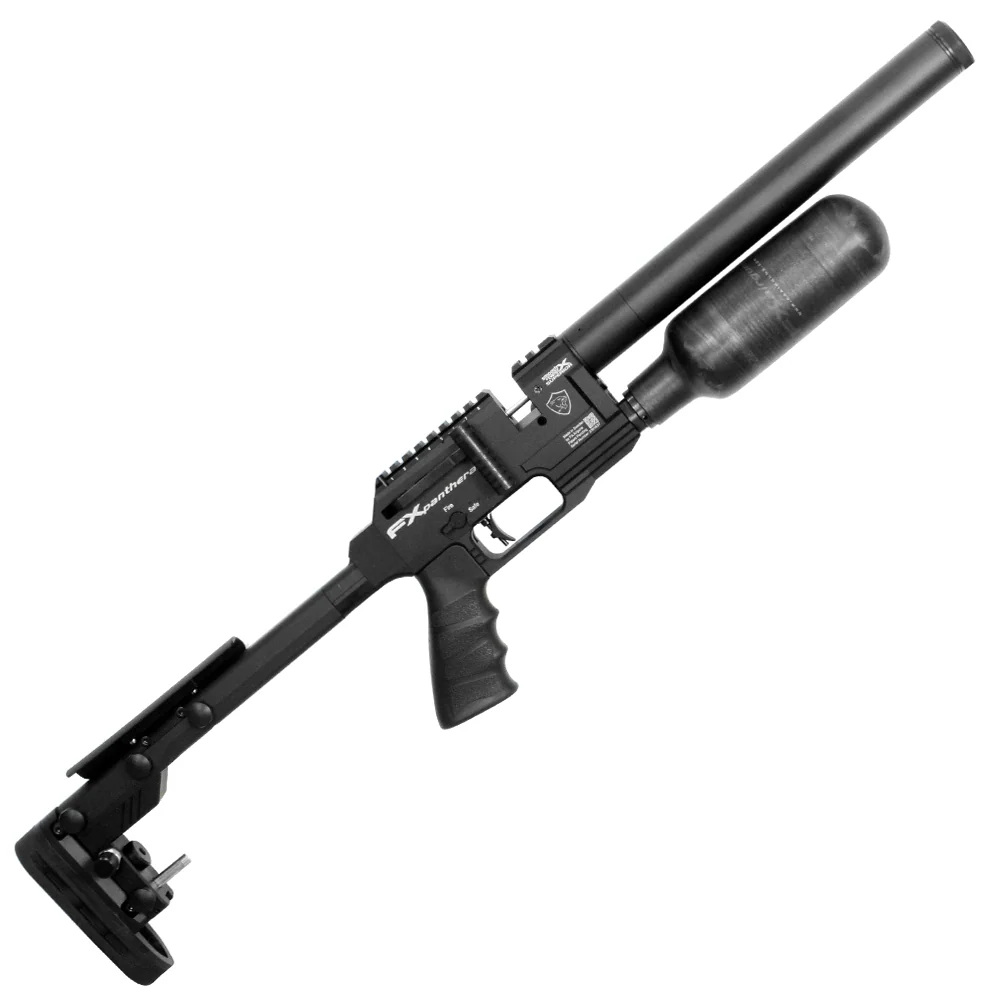
The worlds first air rifle to feature an over the barrel plenum! Built initially for target shooting this hunting version of the FX Panthera features a redesigned bottle system and a shortened 300mm barrel that will have you shooting up to 300 shots per fill in .22 calibre.
Featuring all the technology you would expect from a world leading airgun manufacturer the FX Panthera Hunter adopts a side lever cocking mechanism, front mounted 300cc bottle and an all new over barrel plenum system to create a consistency never before seen in a rifle of this type.
Shot to shot consistency is so refined that some users have shot 10 shot strings and achieved deviations as low as 3-4. This level of consistency in-terms of airflow and fps, leads to a level of accuracy that even the best rimfire rifles struggle to keep pace with.
So how have FX Achieved this in the Panthera
It starts with an FX Dynamic Block, a new unit created from the ground up for hi-performance shooting. The FX unit utilizes a small one-piece valve for high power / short impulse air release, it is is extremely efficient and allows a very precise air flow.
The next stage is the Panthera’s already legendary plenum – an over-the-barrel plenum which provides an ultra consistent regulated pressure. This location not only allows the plenum to be larger than previous rifles (FAC models), but also has the added benefit of stiffening the area around the barrel. Precise levels of pressure are maintained by the single AMP MKII Regulator.
Tuneable and compact In the FX Panthera Hunter model, gone are the Arca rails and M-lok accessory rails to make a lightweight simplified Air Rifle that takes all the best bits of the Panthera and loses all the competition necessary parts. The result is a tune-able state-of-the-art rifle that you can shoot all-day.
At the heart of this rifles mechanism is the tried and tested Quick Tune System (the same as found on the FX Impact M3). Dual angled Manometers on the left side of the block show the bottle pressure and the regulated plenum pressure, for instant feedback to the operator.
FX Panthera Hunter .22 PCP Air Rifle – Swedish Precision Engineering, Compact Design, Smooth Twist X Barrel and Advanced Pneumatic Technology
FX Panthera Hunter .22 PCP Air Rifle – Advanced Swedish Manufacturing, Modern Industrial Design and Precision Mechanical Engineering
The FX Panthera Hunter .22 PCP Air Rifle combines Swedish manufacturing heritage with modern compressed-air technology, precision-engineered components, and a distinctive compact sporting design.
Developed from the original Panthera platform, the Hunter Compact introduces a shorter barrel configuration, redesigned air-reservoir arrangement, and contemporary ergonomic architecture FX Panthera Hunter -.22 PCP Air Rifle.
Furthermore, its construction incorporates the manufacturer’s Dynamic Block system, Smooth Twist X Superior barrel technology, and regulated pneumatic components.
The .22-calibre version features a 300mm barrel and 62cc Macro Plenum, while its carbon-fibre air bottle has a nominal capacity of 300cc.
Additionally, the original configuration incorporates an adjustable stock, reversible sidelever, and two-stage mechanical trigger.
Unlike conventional spring-powered equipment, the design relies on a high-pressure compressed-air reservoir manufactured for specified operating conditions.
Consequently, technical maintenance requires appropriate expertise and strict adherence to manufacturer instructions.
Swedish Manufacturing Heritage and Engineering Quality
FX Airguns is a Swedish manufacturer recognized for developing specialized pneumatic sporting equipment.
Its industrial approach combines mechanical engineering, material science, and precision manufacturing.
Furthermore, the Panthera family reflects the company’s development of advanced pressure-containing systems.
However, manufacturer reputation should not replace assessment of an individual product’s condition.
Authentic documentation and qualified servicing remain important.
Advanced Pneumatic Technology and Dynamic Block Construction
The original architecture incorporates the FX Dynamic Block and an over-the-barrel plenum design.
These components form part of the manufacturer’s proprietary pneumatic system.
Furthermore, the arrangement reflects specialized industrial engineering involving pressure containment and structural integration.
However, internal components are safety-critical assemblies.
Unauthorized alterations or improvised repairs may create serious hazards.
Consequently, the factory configuration should remain intact.
Smooth Twist X Superior Barrel Manufacturing
The Hunter Compact incorporates a 300mm Smooth Twist X Superior barrel in its .22 configuration.
Its manufacture reflects the manufacturer’s specialized approach to barrel engineering.
Furthermore, the relatively short construction distinguishes the Hunter from longer Panthera competition configurations.
However, barrel length alone does not guarantee particular performance results.
Individual condition, authentic specifications, and appropriate maintenance remain important.
Carbon-Fibre Reservoir and Modern Material Technology
The original configuration incorporates a 300cc carbon-fibre air bottle.
Its manufacture combines lightweight composite materials with specialized pressure-container engineering.
Furthermore, this technology reflects developments in industrial material science.
However, pressure-containing components require careful handling, approved inspection, and appropriate servicing.
Damaged reservoirs must not be repaired through improvised methods.
Contemporary Ergonomic Design and Structural Construction
The original Hunter features an adjustable rear stock, cheekpiece, and modern pistol-style grip.
Its construction combines metallic assemblies with engineered synthetic materials.
Furthermore, the compact exterior provides a distinctive alternative to longer competition-oriented configurations.
However, individual ergonomic preferences vary.
Original structural components should remain free from unauthorized modification.
Related FX Airguns Models and Manufacturer Searches
Related manufacturer searches include FX Panthera MkII, fx airguns sverige, fx airguns, fxairguns, fx airguns sweden, fx airguns usa, fx air guns, fx usa, fx outdoors, fx dynamics, fx dynamic, and fx.
Additional product-family searches include fx impact, f x impact, fx impact m4, fx m4, impact m4, impact m4 air rifle, fx impact m3, f x impact m3, fx m3, fx impact air rifle, fx impact m3 air rifle, fx impact m3 .22cal air rifle, fx impact m3 .22cal air rifle. 600mm barrel, and impact m4 500mm.
Other model searches include fx leopard, fx leopard airgun, fx drs, fx drs classic, fx drs tactical, fx drs pro, fx drs air rifle, fx dreamline, fx dreamline classic, fx wildcat, fx king, fx maverick, fx crown, fx crown mk2, and fx crown mkii.
These expressions refer to separate products and generations rather than components supplied with the Hunter.
Pneumatic Equipment and Sporting Technology Searches
Broader research includes pellet gun, air guns, air rifle, fx air rifle, pcp airguns, pcp air gun, fx pcp, air rifle and air pistol, what is an air rifle, bolt action air rifles, and air guns for target shooting.
Additional technical searches include fx chronograph, air gun pump, impact m4 ballistic coefficient, high powered air rifles 4000 fps, and airgun shooting range near me.
These terms describe various equipment categories, technical subjects, and recreational activities.
They should not be interpreted as verified performance specifications for this model.
AirForce Models and Independent Manufacturer Research
Related searches include AirForce, airforce airguns, air force guns, airforce texan, airforce texan air rifle, air force texan lss, airforce texan ss, airforce texanss, airforce talon p, air force talon p, air force talon, airforce condor, and airforce 25.
Other expressions include Tex-Rex AirForce brush gun, Brush Gun, tex-rex, air force tex rex, airforce tex rex, AirForce Tex-Rex PCP rifle, texas air force rifle, and 50 caliber air rifle for deer hunting.
These identify unrelated equipment, manufacturers, and search topics.
Their characteristics should not be attributed to the featured Swedish model.
Technical Specifications and Original Manufacturer Features
Product Identification
- Manufacturer: FX Airguns
- Country of origin: Sweden
- Product family: Panthera
- Model: Hunter Compact
- Calibre: .22 / 5.5mm
- Power system: Pre-charged pneumatic
- Barrel: Smooth Twist X Superior
- Barrel length: 300mm
- Air bottle: 300cc carbon-fibre
- Plenum: 62cc Macro
- Maximum specified fill pressure: 250 bar
- Action: Reversible sidelever
- Magazine capacity: 18 rounds
- Trigger: Two-stage adjustable
- Safety: Manual
- Stock: Adjustable synthetic and metallic construction
- Cheekpiece: Adjustable, ambidextrous design
- Regulator: AMP MKII
- Pressure indication: Dual gauges
- Optical interface: Picatinny rail
- Overall length: Approximately 775mm
- Weight: Approximately 2.83kg
- Original configuration: Compact sporting design
Original Equipment and Retail Package Considerations
Retail packages may contain the original sporting instrument, detachable magazine, filling connection, and manufacturer documentation.
However, included equipment varies between distributors.
Optics, compressors, carrying cases, and independent accessories should not be advertised as standard unless confirmed by the supplying retailer.
Why Authentic Engineering Information Matters
The Hunter combines an established Swedish manufacturing background with distinctive compressed-air technology and contemporary materials.
Furthermore, its compact construction differentiates it from longer Panthera variants.
However, customers should distinguish manufacturer specifications from independent marketing claims.
Authentic model identification remains essential.
Responsible Ownership and Long-Term Preservation
The equipment incorporates high-pressure components and safety-critical mechanical assemblies.
Consequently, unauthorized modifications and improvised repairs should be avoided.
Secure storage prevents unauthorized access, while appropriate environmental protection helps preserve metallic and synthetic components.
Furthermore, manufacturer-approved servicing remains essential throughout ownership.
Final Product Overview
The FX Panthera Hunter .22 PCP Air Rifle combines Swedish engineering heritage, a compact Smooth Twist X barrel, carbon-fibre pressure storage, and distinctive modern industrial construction.
Its technical identity reflects specialized pneumatic manufacturing and ongoing material innovation.
Ultimately, responsible ownership depends on verified specifications, structural integrity, suitable maintenance, qualified technical support, secure storage, and compliance with applicable regulations.
Advanced Swedish Engineering, Precision Manufacturing, Carbon-Fibre Technology, Premium Mechanical Construction, Contemporary Design, Structural Durability and Long-Term Reliability
2.1 Swedish Manufacturing Heritage and Engineering Excellence
Sweden has developed a distinguished industrial reputation through generations of mechanical innovation, material science, and advanced manufacturing. The featured sporting instrument reflects this tradition through its carefully integrated metallic components, modern composite materials, and sophisticated pneumatic architecture.
Its construction combines established engineering principles with contemporary industrial production methods. Furthermore, the manufacturer’s approach emphasizes distinctive design, specialized component development, and mechanical consistency.
Unlike conventional sporting equipment built around traditional wooden furniture, this configuration incorporates modern materials and carefully manufactured structural assemblies.
However, manufacturing reputation alone cannot guarantee permanent reliability. Individual condition depends on previous handling, environmental exposure, and maintenance history.
Consequently, responsible ownership requires attention to authentic specifications, structural integrity, and appropriate preservation.
2.2 Modern Scandinavian Industrial Design Philosophy
Scandinavian industrial design frequently emphasizes functional construction, carefully selected materials, and recognizable geometric proportions.
The featured instrument reflects these principles through its compact profile, contemporary exterior, and integrated mechanical architecture.
Furthermore, the overall appearance demonstrates how modern manufacturers combine structural requirements with distinctive industrial styling.
Each visible component contributes to a unified design rather than functioning solely as decoration.
However, attractive appearance does not independently establish mechanical quality.
Authentic documentation, material condition, and manufacturing consistency remain essential considerations.
The relationship between visual identity and structural engineering demonstrates how contemporary industrial design continues evolving across specialized sporting equipment categories.
2.3 Advanced Pre-Charged Pneumatic Engineering
Modern compressed-air technology represents an established approach to storing energy within purpose-designed mechanical equipment.
The original system incorporates a pressure reservoir, specialized internal assemblies, and carefully manufactured connecting components.
Furthermore, its architecture differs from conventional spring-powered mechanisms and disposable carbon-dioxide cartridge systems.
This technology reflects the application of industrial pressure engineering within a compact mechanical structure.
However, pressure-containing equipment requires appropriate materials, qualified technical support, and responsible maintenance.
Unauthorized modifications may compromise structural integrity and introduce serious hazards.
Consequently, manufacturer-approved specifications should remain the governing reference throughout ownership.
2.4 Understanding High-Pressure Reservoir Technology
Pressure reservoirs require careful structural engineering because they contain compressed gases under defined operating conditions.
Their manufacture involves suitable materials, controlled production methods, and specialized quality requirements.
Furthermore, industrial designers must consider environmental temperature, material properties, and the integrity of pressure-containing assemblies.
However, exterior appearance cannot always reveal internal deterioration.
Accidental impacts or unsuitable handling may compromise structural condition.
Consequently, damaged reservoirs require qualified professional assessment.
Improvised repairs and unauthorized alterations should be avoided.
The technology demonstrates how advanced engineering depends on careful coordination between material science, industrial manufacturing, and responsible maintenance.
2.5 Carbon-Fibre Composite Manufacturing
Carbon-fibre composites represent an important advancement in modern industrial material technology.
These materials combine reinforcing fibres with specialized binding systems to create engineered structures with distinctive physical characteristics.
Furthermore, composite manufacturing allows industrial designers to produce components with different strength-to-weight properties from conventional metallic alternatives.
However, carbon-fibre construction does not make a component immune to damage.
Impacts, environmental exposure, and unsuitable servicing may affect structural integrity.
Consequently, original manufacturer inspection requirements remain essential.
The integration of composite materials demonstrates how contemporary engineering continues incorporating technologies developed across multiple industrial sectors.
2.6 Composite Pressure-Container Safety
Composite pressure vessels require specialized manufacturing and inspection procedures.
Their structural characteristics differ from those of ordinary decorative carbon-fibre components.
Furthermore, pressure-containing applications demand appropriate material certification and documented operating conditions.
However, superficial inspection cannot establish complete structural integrity.
Hidden damage may exist even when the exterior appears relatively normal.
Consequently, suspected defects should receive assessment from an appropriately qualified professional.
Unauthorized drilling, cutting, structural alterations, or improvised repairs must be avoided.
Responsible ownership depends on preserving the original certified pressure-container configuration and following the manufacturer’s service-life guidance.
2.7 Specialized Metallic Component Manufacturing
Modern sporting equipment incorporates metallic assemblies developed through controlled industrial processes.
The featured instrument combines precision-manufactured components with a distinctive modern mechanical structure.
Furthermore, material selection contributes to the original product’s structural characteristics and manufacturing identity.
Industrial machining enables manufacturers to produce complex shapes with carefully maintained dimensions.
However, advanced production techniques cannot prevent every form of deterioration.
Corrosion, accidental impacts, and unsuitable replacement parts may influence condition.
Consequently, manufacturer-approved maintenance remains important.
The use of specialized metallic materials demonstrates how contemporary mechanical engineering depends on consistent industrial production and appropriate technical documentation.
2.8 Understanding Precision Manufacturing Tolerances
Manufacturing tolerances describe the acceptable dimensional variations permitted during component production.
These specifications help manufacturers achieve consistency across individual assemblies.
Furthermore, controlled machining contributes to maintaining the intended relationships between interconnected parts.
The featured construction illustrates how compact industrial products may contain numerous carefully manufactured components.
However, original manufacturing precision cannot guarantee permanent mechanical integrity.
Wear, contamination, and accidental damage may affect individual assemblies.
Consequently, unusual mechanical behavior requires qualified technical assessment.
Preserving factory specifications contributes to responsible long-term ownership and helps protect the original engineering characteristics.
2.9 Advanced Barrel Manufacturing Heritage
Specialized barrel manufacturing incorporates controlled industrial processes, material selection, and carefully defined internal geometry.
The original component reflects the manufacturer’s established approach to modern metalworking.
Furthermore, compact mechanical construction requires careful integration of the barrel within the surrounding structural assembly.
However, manufacturing technology alone cannot guarantee a particular outcome under every operating condition.
Individual condition and appropriate preservation remain important.
Consequently, unauthorized alterations should be avoided.
The manufacturing process demonstrates how traditional precision metalworking continues contributing to contemporary sporting equipment.
It also reflects the continuing importance of industrial craftsmanship within specialized mechanical production.
2.10 Modern Compact Construction and Structural Integration
Compact industrial designs require careful coordination of numerous mechanical assemblies within relatively limited physical dimensions.
The featured configuration incorporates a recognizable modern profile supported by metallic and composite components.
Furthermore, its original proportions distinguish it from longer configurations within the broader product family.
However, compact construction should not automatically be interpreted as evidence of superior quality.
Material selection, manufacturing consistency, and structural condition remain important.
Consequently, accurate product identification should accompany any dimensional description.
The design illustrates how contemporary manufacturers integrate complex technologies without abandoning recognizable product-family characteristics.
2.11 Modern Mechanical Action Architecture
The original action incorporates carefully manufactured interacting components arranged within the manufacturer’s defined mechanical configuration.
Its construction reflects established industrial principles involving mechanical movement, material strength, and dimensional consistency.
Furthermore, the architecture demonstrates how traditional operating concepts remain relevant within contemporary engineering.
However, moving components may experience wear, contamination, or accidental damage.
Consequently, suspected malfunction requires qualified professional assessment.
Unauthorized alterations may compromise the intended factory configuration.
The mechanical assembly illustrates how sophisticated industrial products depend on the successful integration of relatively small components within a larger structure.
2.12 Reversible Mechanical Design and Manufacturing Flexibility
Reversible mechanical components illustrate how manufacturers incorporate different user preferences into original product development.
Their construction involves carefully defined dimensions and interacting parts.
Furthermore, the original design reflects an industrial approach to incorporating versatility without fundamentally changing the equipment’s identity.
However, reversible components remain subject to manufacturer-specific compatibility requirements.
Unauthorized alterations or unsuitable replacement parts may compromise safety.
Consequently, qualified technical guidance should govern any necessary servicing.
The engineering demonstrates how modern mechanical design can accommodate variations in user requirements while preserving established manufacturing standards.
2.13 Advanced Internal Pressure Regulation
Pressure-regulation systems represent an important category of industrial pneumatic technology.
Their construction incorporates specialized mechanical assemblies manufactured for defined operating conditions.
Furthermore, regulated equipment demonstrates the application of established physical principles involving gas pressure and mechanical control.
However, internal pressure systems remain safety-critical components.
Unauthorized adjustments, modifications, or substitute parts may create dangerous conditions.
Consequently, qualified professionals should assess suspected defects.
The original manufacturer configuration should remain intact.
The technology demonstrates how compact equipment can incorporate sophisticated industrial control systems without relying on conventional electronic operation.
2.14 Specialized Internal Chamber Construction
Internal chambers form part of the broader architecture of certain pneumatic mechanical systems.
Their development requires carefully selected materials, appropriate structural relationships, and documented manufacturing requirements.
Furthermore, the integration of these assemblies reflects specialized industrial design.
However, pressure-containing components must never undergo improvised repair or unauthorized modification.
Damage may not always be apparent through exterior inspection.
Consequently, qualified professional assessment remains essential whenever structural concerns arise.
The engineering illustrates how relatively compact mechanical assemblies can incorporate components subject to substantial industrial manufacturing requirements.
2.15 Modern Synthetic Furniture and Material Technology
Engineered polymers provide important manufacturing possibilities across numerous industrial sectors.
Their characteristics may include relatively low density, consistent moldability, and resistance to selected environmental conditions.
Furthermore, synthetic components allow manufacturers to produce distinctive exterior surfaces with repeatable dimensions.
However, polymer durability depends on material formulation, temperature exposure, and previous handling.
Aggressive chemicals and accidental impacts may cause deterioration.
Consequently, gentle cleaning and suitable storage remain important.
The integration of synthetic materials with metallic construction demonstrates how modern manufacturing combines different technologies within a recognizable industrial design.
2.16 Ergonomic Design and Human-Centered Engineering
Human-centered industrial design considers the relationship between manufactured equipment and individual physical characteristics.
The original exterior incorporates carefully selected proportions, shaped surfaces, and adjustable structural elements.
Furthermore, consistent manufacturing contributes to preserving intended product dimensions.
However, individual anatomical differences mean that no single configuration guarantees identical comfort for every person.
Consequently, ergonomic suitability remains an individual consideration.
Unauthorized alterations may compromise original material integrity.
The relationship between external geometry and mechanical engineering demonstrates how manufacturers incorporate human factors alongside industrial requirements.
This approach reflects the broader development of contemporary sporting-equipment design.
2.17 Adjustable Stock Manufacturing and Structural Design
Adjustable structural components represent an established element of modern industrial design.
Their construction incorporates carefully manufactured assemblies developed according to original dimensional requirements.
Furthermore, these components demonstrate how manufacturers integrate movable exterior elements within a specialized mechanical product.
However, adjustable structures remain susceptible to wear, accidental impacts, and unsuitable handling.
Consequently, suspected damage requires professional assessment.
Replacement parts should conform to manufacturer-approved specifications.
The engineering illustrates how relatively straightforward exterior features can involve substantial material selection, mechanical integration, and industrial production considerations.
2.18 Mechanical Trigger Construction and Material Quality
The original trigger incorporates specialized interacting components manufactured according to defined engineering specifications.
Its construction involves accurate production dimensions, selected materials, and controlled mechanical assembly.
Furthermore, the mechanism reflects the manufacturer’s approach to integrating traditional mechanical principles within contemporary sporting equipment.
However, trigger assemblies are safety-critical components.
Unauthorized adjustments or replacement parts may create dangerous conditions.
Consequently, suspected malfunction requires qualified technical assessment.
The original factory arrangement should remain intact.
This component demonstrates how comparatively small assemblies can involve substantial manufacturing precision and important safety responsibilities.
2.19 Mechanical Safety and Protective Engineering
Safety-related components form an important part of the manufacturer’s original mechanical architecture.
Their production involves carefully selected materials and accurately manufactured interacting parts.
Furthermore, protective engineering reflects the importance of considering potential hazards during industrial product development.
However, no mechanical safety device can eliminate every accident or compensate for irresponsible handling.
Consequently, secure storage and compliance with official instructions remain essential.
Safety mechanisms should never be bypassed.
Suspected defects require professional technical evaluation.
Responsible ownership remains important regardless of the equipment’s original protective characteristics.
2.20 Modern Modular Industrial Construction
Modular design represents an important development across contemporary manufacturing.
Its underlying philosophy involves organizing complex products into identifiable assemblies with defined structural relationships.
Furthermore, this approach contributes to consistent production and clearer technical documentation.
However, modular construction does not establish universal compatibility between different product generations.
Manufacturing revisions may introduce meaningful differences.
Consequently, visually similar components should not automatically be considered interchangeable.
Unauthorized modifications may compromise original structural integrity.
The design demonstrates how modern industrial engineering coordinates multiple technologies within a coherent manufacturing architecture.
2.21 Precision Assembly and Quality Control
Industrial assembly requires coordination between component production, material inspection, and manufacturing documentation.
Specialized products may incorporate metallic, polymer, and composite elements with different physical properties.
Furthermore, controlled production procedures help maintain consistency between individual examples.
However, original quality control cannot prevent every form of later deterioration.
Environmental exposure, accidental impacts, and inappropriate servicing may influence condition.
Consequently, current structural integrity remains important.
The relationship between individual components and overall manufacturing quality demonstrates why reliable engineering depends on more than isolated technical specifications.
2.22 Protective Surface Finishing and Appearance
Protective finishes contribute to preserving the appearance of exposed metallic and synthetic components.
Manufacturers select treatments according to material characteristics and environmental requirements.
Furthermore, consistent finishing reflects attention to industrial production quality.
However, protective surfaces remain susceptible to scratching, abrasion, and chemical exposure.
Consequently, gentle maintenance methods should be preferred.
Significant deterioration may require professional assessment.
The relationship between exterior appearance and material protection illustrates how finishing processes contribute to long-term preservation.
Maintaining original surfaces may also support historical authenticity and accurate product identification.
2.23 Understanding Mechanical Wear and Component Aging
Mechanical wear develops when interacting components experience repeated contact or environmental deterioration.
Its characteristics depend on material composition, manufacturing quality, and previous handling.
Furthermore, protective treatments may reduce certain forms of surface damage.
However, no mechanical assembly can guarantee permanent resistance to wear.
Consequently, unusual changes in equipment condition deserve appropriate attention.
Suspected defects require qualified technical assessment.
Understanding mechanical aging contributes to realistic expectations regarding long-term reliability.
It also highlights why external appearance alone cannot establish the condition of every internal component.
2.24 Material Fatigue and Structural Durability
Material fatigue develops when components experience repeated mechanical stress.
Different materials respond according to their composition, manufacturing history, and environmental conditions.
Furthermore, industrial engineering must account for relevant structural requirements.
However, external appearance cannot always reveal internal defects.
Consequently, suspected damage requires professional inspection.
Unauthorized repairs may introduce additional hazards.
The relationship between repeated stress and material behavior demonstrates why appropriate manufacturing and responsible preservation remain important.
Structural durability depends on the condition of the complete assembly rather than any single material.
2.25 Environmental Temperature and Material Behavior
Environmental temperature influences the physical characteristics of compressed gases, metals, polymers, and composite materials.
Different substances respond according to their established physical properties.
Furthermore, excessive heat may affect protective finishes and pressure-sensitive components.
However, extreme environmental conditions can introduce serious safety concerns.
Consequently, manufacturer storage recommendations should be respected.
Prolonged exposure to intense sunlight inside enclosed vehicles may be unsuitable.
Understanding environmental influences contributes to responsible preservation.
The relationship between temperature and material behavior demonstrates why appropriate storage conditions remain important throughout ownership.
2.26 Humidity and Corrosion Prevention
Humidity influences the condition of exposed metallic components and protective surfaces.
Prolonged moisture exposure may contribute to corrosion.
Furthermore, unsuitable storage materials may retain dampness against equipment surfaces.
Consequently, clean and dry conditions remain preferable.
However, exterior appearance cannot establish the condition of every internal component.
Visible corrosion or suspected structural damage requires professional assessment.
Appropriate environmental protection contributes to preserving original manufacturing quality.
Consistent storage conditions also help protect exterior finishes and synthetic materials against unnecessary deterioration.
2.27 Routine Exterior Inspection and Condition Assessment
Periodic visual inspection helps identify obvious signs of deterioration.
Metallic components may develop corrosion, while synthetic surfaces may exhibit cracks or impact damage.
Furthermore, exposed mechanical assemblies deserve appropriate attention.
However, exterior inspection cannot reveal every internal defect.
Consequently, suspected malfunction requires qualified technical assessment.
Unauthorized disassembly should be avoided.
Maintaining records of significant condition changes may assist future servicing.
The distinction between cosmetic deterioration and structural damage remains important when assessing previously owned mechanical equipment.
2.28 Professional Servicing and Technical Support
Specialized mechanical equipment incorporating high-pressure components requires appropriate expertise during servicing.
Qualified technicians can assess suspected defects using established professional procedures.
Furthermore, original manufacturer documentation helps identify approved replacement materials.
However, visually similar components should not automatically be considered interchangeable.
Consequently, unauthorized repairs and modifications should be avoided.
Professional servicing contributes to preserving structural integrity and supporting responsible ownership.
Reliable technical assistance remains valuable throughout the equipment’s service life.
Documentation of completed professional work may also help establish an accurate maintenance history.
2.29 Product Authenticity and Manufacturing Identification
Accurate identification depends on manufacturer markings, original documentation, and the specific production configuration.
Related models may share recognizable exterior characteristics.
Furthermore, manufacturing revisions can introduce meaningful technical differences.
However, similar appearance does not guarantee identical internal specifications.
Consequently, the exact version should be verified before relying on published descriptions.
Original packaging and purchase records may assist identification.
Authenticity contributes to transparent product information and responsible long-term ownership.
Maintaining accurate records also helps distinguish original components from later replacements.
2.30 Regional Manufacturing Variations and Documentation
Manufacturers may offer different configurations across international markets.
Variations can involve exterior finishes, accessories, internal components, or regulatory classifications.
Furthermore, regional distribution arrangements may influence commercial product descriptions.
However, specifications associated with one configuration should not automatically be attributed to another.
Consequently, accurate descriptions should distinguish verified features from those belonging to related models.
Preserving original documentation helps establish authentic characteristics.
Understanding regional differences contributes to informed purchasing decisions and reduces confusion concerning product identity.
2.31 Secure Storage and Unauthorized Access Prevention
Secure storage represents an essential responsibility associated with sporting equipment ownership.
Appropriate arrangements help prevent unauthorized access, accidental damage, and unnecessary environmental exposure.
Furthermore, clean and dry conditions contribute to preserving metallic and synthetic components.
However, excessive heat or inappropriate storage conditions may create safety concerns.
Consequently, storage should follow manufacturer guidance and applicable legal requirements.
Children and unauthorized persons must not have access to the equipment.
Responsible preservation protects both the product and surrounding individuals.
2.32 Transportation and Legal Responsibilities
Transportation requirements for air-powered sporting equipment vary according to jurisdiction.
Different countries may establish separate rules concerning ownership, storage, transportation, and permitted activities.
Furthermore, regional classifications influence applicable legal responsibilities.
However, requirements in one country should not automatically be assumed valid elsewhere.
Consequently, owners should consult authoritative local guidance.
Secure transportation and appropriate documentation contribute to lawful ownership.
Manufacturer safety instructions remain relevant regardless of regional classification.
Additional restrictions may apply to sporting facilities and organized activities.
2.33 Warranty Coverage and Manufacturer Support
Warranty arrangements provide information concerning manufacturer responsibilities and applicable service conditions.
Coverage may depend on purchase location, production version, and original terms.
Furthermore, qualified service providers can assess suspected mechanical defects.
However, warranties do not necessarily cover accidental damage, ordinary wear, or unauthorized alterations.
Consequently, customers should review the applicable conditions.
Retaining purchase records and technical documentation may assist future inquiries.
Reliable professional assistance contributes to responsible ownership and long-term preservation.
Access to suitable technical support remains an important consideration when evaluating specialized mechanical equipment.
2.34 Why Premium Material Selection Matters
Material selection influences structural characteristics, manufacturing consistency, and long-term preservation.
Metallic components, engineered polymers, and composite assemblies respond differently to physical stress and environmental exposure.
Furthermore, manufacturers must coordinate these materials according to defined engineering requirements.
However, premium construction cannot guarantee permanent resistance to deterioration.
Consequently, responsible maintenance and qualified technical assessment remain important.
The relationship between material quality and manufacturing consistency demonstrates why product evaluation should consider the entire structure.
Authentic documentation and current condition remain more meaningful than unsupported promotional claims.
2.35 Final Assessment of Advanced Swedish Mechanical Engineering
The featured sporting instrument combines Swedish manufacturing heritage, modern compressed-air technology, carbon-fibre construction, specialized steel components, and contemporary industrial design.
Its recognizable exterior reflects the continuing development of specialized pneumatic equipment, while its original architecture demonstrates the importance of precision manufacturing and advanced material science.
Furthermore, the integration of different industrial technologies contributes to its distinctive engineering identity.
However, responsible ownership remains essential throughout the equipment’s service life.
Pressure-containing components require appropriate care, safety mechanisms must remain unmodified, and suspected defects should receive qualified professional assessment.
Ultimately, long-term value depends on authentic specifications, structural condition, manufacturing consistency, suitable maintenance, secure storage, reliable technical support, and lawful ownership.
Be the first to review “FX Panthera Hunter – .22 PCP Air Rifle”
Related products
FX Air Gun
FX Air Gun
FX Air Gun

FX Air Gun


FX Air Gun
FX Air Gun


FX Air Gun
FX Air Gun
Reviews
There are no reviews yet.