
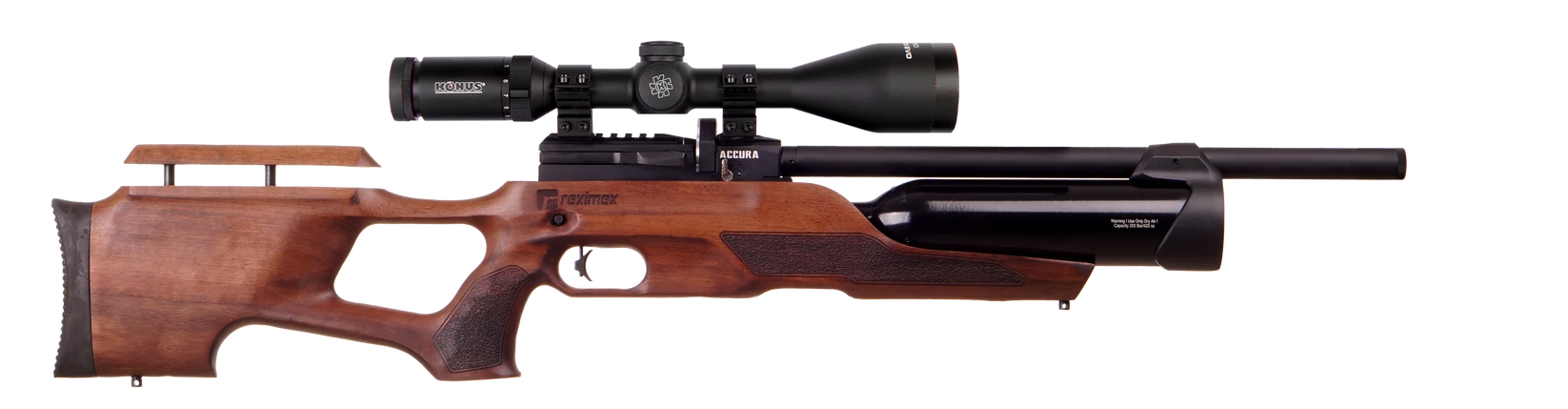
REXIMEX ACCURA WALNUT

€430.00
Reximex ACCURA is both technically outstanding and designed to be customizable according to your needs. Its versatile design gives the user comfort in handling, cocking and carry around.
Trigger sensitivity can easily be adjusted and the trigger shoe can also be adjusted in 4-directions, right, left, up and down.
Butt-pad and cheek piece are specially designed for user comfort, and can be easily adjusted in order to give the user a better aiming and handling opportunity.
With the help of the High-Tech components used and the special design, ACCURA weighs only 3,5 kg and creates a difference in the market.
The 11-22 mm PICANTINNY RAIL system is in accordance with the MILSPEC standards. Scope or various accessories can easily be mounted and customized.
NB Does not include Scopes and Mounts
- Calibre: .177/.22
- Capacity: 14/12
- Power: 11.5
- Stock: Walnut
- Tube Size: 425cc
Reximex Accura Walnut – Premium Turkish Walnut PCP Air Rifle with 425cc Air Bottle
The Reximex Accura Walnut combines premium Turkish walnut craftsmanship with a high-capacity PCP air system, modern sidelever operation and extensive shooter adjustment.
Its traditional natural wood furniture immediately gives the rifle a more refined appearance than a standard synthetic platform. However, the attraction goes considerably deeper than cosmetics.
The factory Accura W configuration uses a substantial 425cc aluminium air bottle, a maximum 250-bar fill pressure, sidelever cocking and a four-way adjustable trigger. It is offered in .177, .22 and .25 calibre, with magazine capacities of 14, 12 and 10 shots respectively.
Reximex also equips the platform with an adjustable cheekpiece and integrated sound moderation. The factory specification lists an overall length of approximately 1010mm, a 380mm barrel and a weight of about 3.1kg for the walnut version.
Consequently, the rifle combines generous stored-air capacity with a conventional sporting profile that remains comfortable for careful target shooting.
Why Choose the Walnut Configuration
Turkish walnut changes both the visual character and the tactile experience of the rifle.
Natural grain means individual examples can display slightly different patterns and tones.
Furthermore, wood feels warmer in the hands than polymer.
For shooters who appreciate traditional materials alongside modern PCP engineering, this version offers an attractive balance.
Turkish Walnut Stock
The stock is produced from Turkish walnut and incorporates an adjustable cheekpiece.
Its natural grain gives the rifle a premium sporting appearance while retaining practical ergonomic adjustment.
Adjustable Cheekpiece
An adjustable cheekpiece allows the shooter to establish a more natural head position behind the optic.
That can improve comfort and help maintain consistent eye alignment.
425cc Aluminium Air Bottle
The large 425cc bottle provides substantial stored-air capacity.
Therefore, fewer interruptions may be required during longer target sessions.
250-Bar Fill Pressure
Factory specifications list a maximum fill pressure of 250 bar.
Only correctly rated PCP filling equipment should be used, and the manufacturer’s pressure limits should never be exceeded.
Sidelever Action
The sidelever cycles the action manually.
Smooth operation helps preserve shooting position and rhythm during multi-shot target sessions.
Multi-Shot Magazine
Factory magazine capacities are:
.177 – 14 shots
.22 – 12 shots
.25 – 10 shots
This provides convenient repeated shooting while keeping the loading system compact.
Integrated Sound Moderator
The barrel assembly incorporates sound moderation.
This can reduce muzzle report, although mechanical action and pellet-impact noise remain.
Four-Way Adjustable Trigger
The trigger provides several adjustment possibilities.
A predictable break can help support deliberate shooting when adjustment remains within the manufacturer’s safe guidance.
Factory Shot Capacity
Reximex lists approximately:
.177 – 168 optimal-velocity shots
.22 – 144 optimal-velocity shots
.25 – 120 optimal-velocity shots
Actual performance can vary according to pellet choice, temperature, operating conditions and individual rifle setup.
Precision Potential
The rifle’s precision potential depends on the complete shooting system rather than any single component.
Important factors include:
Barrel condition
Pellet consistency
Air-system consistency
Scope stability
Trigger technique
Shooter position
Environmental conditions
Reximex Lyra K
Reximex Lyra K is a separate PCP rifle within the manufacturer’s range.
It should not be confused with the Accura Walnut platform.
reximex
reximex manufactures PCP rifles, bullpups and compact pneumatic platforms.
The Accura Walnut occupies a premium full-size PCP category with natural wood furniture.
reximex airguns
reximex airguns include multiple reservoir, stock and chassis configurations.
The Accura distinguishes itself through its large bottle and Turkish walnut stock.
reximex throne gen2
The reximex throne gen2 is a different bullpup PCP platform and should not be used as an Accura specification reference.
reximex гр
The phrase reximex гр may appear in regional-language searches.
Specifications should always be verified against the exact product.
reximex throne gen 2
The reximex throne gen 2 belongs to another rifle family with different dimensions and ergonomics.
reximex mito
The reximex mito is a compact PCP pistol platform rather than a full-size rifle.
reximex rра
The reximex rра term commonly relates to a smaller compact pneumatic platform and does not describe the Accura.
reximex mitos
Searches for reximex mitos generally lead to compact pistol configurations rather than this rifle.
reximex lieva
The reximex lieva is another PCP rifle and should be evaluated independently.
tps to joules calculator
A tps to joules calculator search generally relates to projectile-energy calculations.
Accurate calculation requires projectile mass and measured velocity.
reximex accura pcp air rifle
The reximex accura pcp air rifle combines large-capacity compressed-air storage with adjustable ergonomics and multi-shot operation.
The walnut configuration adds a traditional premium finish.
Tps joule calculator
A Tps joule calculator should use accurate pellet mass and chronograph information.
Velocity alone cannot determine muzzle energy.
roxy max
roxy max is not the correct designation for the product described here.
The rifle is the Accura Walnut.
mx rex
mx rex should not be confused with the Accura model designation.
Correct identification helps ensure compatible magazines and accessories are selected.
fps to ft Ibs
An fps to ft Ibs calculation requires both projectile weight and measured velocity.
airgun joules calculator
An airgun joules calculator can determine approximate muzzle energy when reliable pellet-weight and velocity measurements are available.
It can also assist with legal-compliance checks.
gunseek
gunseek and similar terms may appear when buyers compare PCP rifles, specifications and availability.
Purchases should comply with applicable local requirements.
Reximex Lyra-K PCP air rifle
The Reximex Lyra-K PCP air rifle is a separate platform and should not be treated as mechanically identical to the Accura.
Reximex Lyra-K airgun
The Reximex Lyra-K airgun belongs to another rifle family within the wider manufacturer range.
Reximex Lyra-K review
A Reximex Lyra-K review concerns a different rifle and does not directly represent Accura performance.
Reximex Lyra-K PCP rifle
The Reximex Lyra-K PCP rifle uses its own stock, barrel and reservoir configuration.
Reximex Lyra-K regulated PCP
A Reximex Lyra-K regulated PCP may share modern pneumatic principles, but specifications should always be kept separate between models.
Reximex Lyra-K compact PCP rifle
The Reximex Lyra-K compact PCP rifle emphasizes different dimensions and handling compared with the larger Accura platform.
Reximex Lyra-K tactical air rifle
The phrase Reximex Lyra-K tactical air rifle refers to another configuration and should not be substituted for Accura specifications.
Reximex Lyra-K hunting rifle
A Reximex Lyra-K hunting rifle search concerns another model.
Any lawful field use should comply with relevant local regulations.
buy Reximex Lyra-K online
Anyone searching buy Reximex Lyra-K online should confirm local age, purchase, ownership, transfer and delivery requirements.
The same principle applies to any PCP rifle purchase.
best price Reximex Lyra-K
A best price Reximex Lyra-K comparison should consider seller reputation, included accessories, warranty and condition rather than price alone.
Reximex Lyra-K accuracy test
A Reximex Lyra-K accuracy test relates to a different platform.
The Accura should be tested independently using repeatable conditions.
Reximex Lyra-K scope package
A Reximex Lyra-K scope package may include an optic depending on the retailer.
The Accura factory catalogue specifies that a scope is not included as standard.
Reximex Lyra-K pellet gun
The Reximex Lyra-K pellet gun belongs to the broader PCP category but remains a different rifle platform.
Reximex Lyra-K for pest control
A Reximex Lyra-K for pest control search concerns a regulated use case.
Any pest-management use should comply with applicable law and animal-welfare requirements.
Reximex Lyra-K small game hunting
A Reximex Lyra-K small game hunting search relates to another rifle and must be considered within local hunting regulations.
AirForce
AirForce is a separate airgun manufacturer and has no direct connection with Reximex.
Tex-Rex AirForce brush gun
The phrase Tex-Rex AirForce brush gun refers to different equipment and should not be confused with the Accura.
Brush Gun
A Brush Gun is not the product category represented here.
The Accura Walnut is a PCP sporting air rifle.
airforce airguns
airforce airguns use different reservoir and chassis systems and should be compared separately.
airforce airguns
The repeated airforce airguns phrase refers to another manufacturer rather than this model.
airforce texan
The airforce texan is a specialist PCP platform designed around very different performance characteristics.
pellet gun
The Accura Walnut is a pellet gun in the broad sense because it fires conventional airgun pellets in supported calibres.
Pellet quality strongly influences practical precision.
air force guns
air force guns refers to products made by a separate manufacturer.
tex-rex
The term tex-rex is unrelated to the Accura Walnut model designation.
air rifle and air pistol
The difference between an air rifle and air pistol includes stock design, barrel length, overall dimensions and intended shooting position.
The Accura is a full-size shoulder-fired rifle platform.
airforce texan air rifle
The airforce texan air rifle is a different PCP system with separate specifications and design priorities.
texas air force rifle
A texas air force rifle search normally relates to AirForce products rather than Reximex equipment.
air force texan lss
The air force texan lss belongs to another specialist PCP family.
airforce talon p
The airforce talon p is a compact PCP platform produced by another manufacturer.
airforce texan ss
The airforce texan ss is a separate PCP rifle and should not be treated as a direct Accura equivalent.
air gun pump
A correctly rated air gun pump may be used with compatible PCP equipment.
However, filling a 425cc bottle manually requires considerably more effort than filling a small reservoir.
Why the 425cc Bottle Is Important
Large air capacity is one of the defining characteristics of the Accura Walnut.
The 425cc bottle supports lengthy shooting sessions before refilling becomes necessary.
For target shooters, fewer interruptions can help maintain concentration and a consistent shooting position.
How the Air System Supports Consistency
Compressed air stored in the bottle supplies the firing mechanism.
Good pressure management helps the rifle deliver predictable operation through its usable pressure range.
Consistent air supply is only one element of accuracy, although it provides a strong mechanical foundation.
Why the Walnut Stock Matters
Natural Turkish walnut gives the rifle a different ownership character from a synthetic model.
It provides warmth in the hand, individual grain and a premium traditional appearance.
Meanwhile, the adjustable cheekpiece prevents the classic material from sacrificing modern ergonomic flexibility.
How Good Is the Precision Potential?
The platform combines several useful features for controlled target work:
A rifled barrel
Stable PCP air supply
Multi-shot magazine
Adjustable trigger
Adjustable cheekpiece
Substantial overall mass
Secure optic mounting capability
Nevertheless, the smallest groups come from matching the rifle with suitable pellets and maintaining consistent shooter technique.
Why Pellet Choice Matters
Individual barrels can show preferences for certain projectile weights, head dimensions and designs.
Therefore, several quality pellets should be tested under identical conditions.
Controlled Accuracy Testing
Keep the following consistent:
Distance
Air-pressure range
Shooting rest
Scope setting
Target type
Shooting position
Then compare several groups rather than judging performance from a single result.
Where the Rifle Fits Best
The Accura Walnut is particularly suited to lawful uses such as:
Paper-target shooting
Bench practice
Recreational range shooting
Scope zero confirmation
Pellet testing
General sporting practice
When a Large-Capacity PCP Makes Sense
A high-capacity platform makes particular sense when the shooter values longer sessions between fills.
It can also suit owners who have access to a suitable charging bottle or PCP compressor.
Optics
The factory catalogue notes that a scope is not included.
A suitable optic should provide:
Clear glass
Reliable adjustment
Comfortable eye relief
Appropriate magnification
Secure mounting
Adjustable Cheekpiece and Optic Alignment
The cheekpiece should be positioned so the shooter naturally sees through the center of the optic.
A consistent head position supports repeatable aiming.
Air Management
Use only clean, dry compressed air.
Filling equipment must be suitable for high-pressure PCP use.
Never exceed the manufacturer’s 250-bar maximum.
Walnut Care
Natural wood should be kept dry and protected from prolonged extreme heat.
Routine care can usually be handled with a soft cloth and suitable wood-safe products.
Aggressive solvents should be avoided.
Magazine Care
Keep magazines clean and inspect them for:
Cracks
Debris
Poor indexing
Loose components
If feeding becomes difficult, stop and inspect rather than forcing the action.
Air Bottle Inspection
Check the 425cc bottle for:
Dents
Deep scratches
Corrosion
Impact damage
Damaged fittings
Any questionable high-pressure component should be professionally assessed.
Trigger Control
A smooth trigger press helps reduce unwanted movement.
The finger should apply controlled rearward pressure.
A predictable break is generally more useful than an excessively light setting.
Safe Handling
Always maintain safe muzzle direction.
Keep the finger away from the trigger until firing is intended.
Use a secure pellet trap or suitable backstop.
Eye protection is recommended.
Storage
Store the rifle:
Unloaded
Dry
Secure
Away from excessive heat
Away from unauthorized users
In accordance with applicable law
Responsible Ownership
Regulations differ between jurisdictions.
Owners should confirm relevant requirements covering:
Power
Calibre
Licensing
Age
Purchase
Transport
Storage
Permitted shooting locations
Final Section 1 Assessment
The Reximex Accura Walnut combines Turkish walnut craftsmanship with a large-capacity PCP system and extensive shooter-focused adjustment.
The current Reximex catalogue lists a 425cc aluminium air bottle, 250-bar maximum fill pressure, sidelever action, Turkish walnut stock with adjustable cheekpiece, integrated sound moderator and four-way adjustable trigger. It is offered in .177, .22 and .25, with respective 14-, 12- and 10-shot magazine capacities.
Factory dimensions list approximately 1010mm overall length, a 380mm barrel and 3.1kg weight for the wood configuration. Reximex also lists approximately 168 shots in .177, 144 in .22 and 120 in .25 at optimal velocity under its published test conditions.
Current dealer listings likewise identify the walnut stock, large-capacity bottle, adjustable trigger and multi-shot system, although package contents and market-specific power levels can vary.
The main appeal comes from the balance between traditional material and modern pneumatic engineering.
The walnut stock gives the rifle premium character.
The adjustable cheekpiece improves fit.
The large bottle supports extended sessions.
The sidelever keeps cycling straightforward.
The multi-shot magazines improve convenience.
The integrated moderation helps reduce muzzle report.
For lawful target and recreational range use, strong results depend on good pellets, secure optics, consistent air management, careful trigger technique and repeatable shooter positioning.
When maintained properly and used responsibly, the Accura Walnut offers an appealing combination of high-capacity PCP performance, traditional walnut craftsmanship, adjustable ergonomics and precision-focused sporting design.
Real-World Handling, Accuracy, Air Management, Walnut Care, Maintenance and Ownership
Everyday Shooting Character
The Reximex Accura Walnut combines the familiar feel of a traditional full-size sporting rifle with the practical advantages of a large-capacity PCP platform.
Its walnut stock gives the rifle a premium appearance, while the adjustable cheekpiece, sidelever action, large air bottle and multi-shot magazine make the platform practical for long target sessions.
The overall design feels more traditional than a bullpup because the action, trigger and stock are arranged in a conventional sequence.
For lawful target shooting and recreational range use, that familiar geometry can make the rifle easy to adapt to.
Why Full-Length Rifle Geometry Matters
A traditional rifle layout spreads weight over a longer platform.
The support hand remains forward.
The firing hand stays behind the action.
The cheek rests naturally on the stock.
The shoulder supports the rear.
This arrangement can feel intuitive to shooters who are accustomed to conventional sporter rifles.
Natural Shoulder Position
The rifle should settle into the shoulder without forcing the body into an awkward posture.
A natural mounting position reduces unnecessary muscle tension.
Why Reduced Tension Helps
Muscle tension changes as a session continues.
If the shooter relies on excessive force to keep the sights aligned, point of aim can change as fatigue develops.
A relaxed position is easier to repeat.
Walnut Stock Character
Natural walnut gives the rifle a more refined appearance than synthetic furniture.
Each stock can display slightly different grain, tone and figuring.
Why Walnut Feels Different
Wood generally feels warmer in the hand than polymer.
It also gives the rifle a more traditional sporting character.
Walnut and Long-Term Ownership
Natural wood can remain attractive for many years when it is cared for properly.
Routine maintenance is straightforward, but a little more attention is required than with synthetic furniture.
Moisture Protection
Walnut should not remain wet for long periods.
If the stock becomes damp, it should be dried with a soft cloth.
Why Moisture Matters
Wood can respond to prolonged humidity.
Repeated exposure may affect the finish or appearance.
Heat Protection
The rifle should not be stored for long periods in very hot vehicles or close to direct heating sources.
Why Stable Temperature Helps
Extreme heat can affect wood finishes and other materials.
Cleaning the Walnut
Routine cleaning should remain gentle.
A soft cloth is usually sufficient for fingerprints, dust and light surface dirt.
Why Harsh Chemicals Should Be Avoided
Strong solvents may damage the finish.
Only wood-safe products should be used when treatment is necessary.
Adjustable Cheekpiece
The adjustable cheekpiece allows the shooter to refine head position behind the optic.
This can significantly improve comfort.
Why Eye Alignment Matters
The eye should naturally line up with the scope.
If the shooter has to repeatedly lift or lower the head, sight alignment can become inconsistent.
Repeatable Cheek Weld
A consistent cheek position supports:
Stable eye relief
Predictable sight picture
Comfort
Repeatable head placement
Why Cheekpiece Adjustment Is Valuable
Different scope mounts place the optic at different heights.
The adjustable cheekpiece allows the stock to adapt to those changes.
Air Bottle Capacity
The large air bottle is one of the most important practical features.
It provides a substantial reserve of compressed air.
Why Large Capacity Matters
More stored air means fewer interruptions for refilling.
This can be useful during:
Pellet testing
Scope zeroing
Bench sessions
Group shooting
General recreational use
Why Fewer Refills Improve Session Flow
Repeated filling can interrupt concentration.
A larger air supply lets the shooter remain focused on technique and target analysis.
Shot Count Variation
Actual shot count depends on several factors.
These can include:
Calibre
Pellet weight
Temperature
Seal condition
Operating pressure
Individual rifle setup
Why Factory Figures Are Only a Guide
Published shot counts are useful for comparison.
However, real-world performance can vary.
Keeping a Shooting Log
A simple record can help track normal behavior.
Useful Details to Record
Note:
Starting pressure
Ending pressure
Number of shots
Pellet type
Group size
Any chronograph readings
Why Records Help
A log makes gradual changes easier to notice.
It can also help identify which pellets perform best.
Pressure Gauge Monitoring
The gauge should be checked before and during longer sessions.
Why Pressure Is Better Than Guessing
Shot count can vary.
The pressure gauge provides a more direct indication of air remaining.
Filling Equipment
Only correctly rated PCP filling equipment should be used.
Common Filling Options
These may include:
High-pressure hand pumps
Compatible charging bottles
Purpose-built PCP compressors
Hand Pump Use
A hand pump offers independence.
However, filling a large bottle manually can require significant physical effort.
Charging Bottle Use
A compatible bottle can make refilling faster and easier.
Compressor Use
A suitable PCP compressor can be convenient for frequent users.
Why Filling Equipment Quality Matters
The rifle operates at high pressure.
Hoses, fittings and gauges should all be appropriate for PCP use.
Improvised equipment should never be used.
Clean, Dry Air
Only clean, dry compressed air should enter the system.
Why Moisture Is Undesirable
Moisture can contribute to:
Corrosion
Seal deterioration
Internal contamination
Controlled Filling
A slow, controlled fill is easier to monitor.
Why Air Heats During Filling
Compressed air naturally warms.
That can temporarily produce a higher gauge reading.
Why Pressure May Settle Lower
After cooling, the pressure reading can reduce slightly.
Fill Connection Care
The fill point should remain clean.
Keep It Free From
Dust
Sand
Oil
Moisture
Debris
Why Clean Connections Matter
Contamination can damage seals or enter the pneumatic system.
Air Bottle Inspection
The bottle should be checked regularly.
Look For
Inspect for:
Dents
Deep scratches
Corrosion
Impact damage
Damaged fittings
Why Bottle Condition Matters
The bottle stores high-pressure air.
Any questionable structural damage should be professionally assessed before further use.
Pressure Retention
The rifle should hold pressure appropriately during storage.
Why Small Changes Can Occur
Temperature can affect gauge readings.
When Pressure Loss Is More Concerning
Continuous pressure loss may indicate a leak.
Seal Monitoring
Possible signs of seal problems include:
Audible leakage
Reduced shot count
Pressure loss
Irregular output
Sidelever Operation
The sidelever should move smoothly.
Why Smooth Cycling Matters
Controlled cycling helps preserve:
Shoulder position
Cheek weld
Grip
Scope alignment
If Resistance Appears
Do not force the lever.
Possible causes include:
Magazine misalignment
Damaged pellet
Debris
Mechanical wear
Why Forcing the Action Can Make Things Worse
A minor feeding issue can become a larger mechanical problem if excessive force is applied.
Magazine Reliability
The magazine should rotate and index correctly.
Why Magazine Condition Matters
Poor indexing can damage pellets or create feeding resistance.
Magazine Inspection
Check for:
Cracks
Loose parts
Debris
Poor rotation
Internal wear
Pellet Handling
Pellets should be clean and undamaged.
Why Pellet Shape Matters
A bent skirt may not seal consistently in the bore.
That can affect velocity and grouping.
Pellet Selection
Different barrels can prefer different pellet designs.
Why Controlled Testing Matters
Changing several variables at once makes comparison difficult.
Keep the Same
Use the same:
Distance
Pressure range
Rest
Scope setting
Target type
Shooting position
Test Several Groups
One unusually tight group may not represent normal performance.
Repeated results provide stronger evidence.
Barrel Condition
The barrel should remain protected from impact.
Crown Protection
The crown deserves particular care.
Why the Crown Matters
The pellet exits at this point.
Damage can disturb the release of air around the projectile.
Barrel Cleaning
Cleaning should be based on actual need.
When Cleaning May Be Appropriate
Consider cleaning if:
Accuracy changes unexpectedly
Contamination is suspected
The rifle has been stored for a long period
A qualified technician recommends it
Why Over-Cleaning Can Be Counterproductive
A barrel that already performs consistently may not benefit from unnecessary intervention.
Optic Selection
The full-size sporter layout gives broad flexibility for scope choice.
Useful Optic Characteristics
Look for:
Clear glass
Reliable adjustment
Comfortable eye relief
Appropriate magnification
Secure mounting
Magnification Choice
More magnification is not always better.
Why Excessive Magnification Can Be Difficult
High magnification can:
Exaggerate movement
Reduce field of view
Add weight
Scope Weight
A heavy optic can change balance.
Scope Height
The adjustable cheekpiece can help accommodate different mount heights.
Why Eye Relief Matters
The shooter should see a full image without stretching forward or pulling the head back excessively.
Scope Mount Security
Mounts should remain tight.
Why Loose Mounts Create False Accuracy Problems
A moving optic can shift point of impact even when the rifle itself is functioning correctly.
Zeroing
Zero should be established at a safe and known distance.
A Consistent Zeroing Setup Uses
A stable rest
Consistent pellets
Small scope adjustments
A secure backstop
When to Recheck Zero
Zero should be verified after:
Transport
Impact
Scope removal
Mount adjustment
Pellet changes
Maintenance
Bench Shooting
Bench shooting is useful for evaluating the rifle with fewer shooter variables.
Why Bench Testing Helps
It makes it easier to assess:
Pellet performance
Magazine reliability
Scope stability
Air-system consistency
Seated Shooting
A seated position can provide useful support.
Standing Shooting
Standing requires greater muscle control and balance.
Why the Traditional Stock Can Help
The full-length stock gives familiar shoulder support and support-hand placement.
Shooter Fatigue
Fatigue can gradually reduce accuracy.
Common Signs
Tighter grip
Changing cheek pressure
Poor trigger control
Rushed shots
Reduced concentration
Why Breaks Matter
Short breaks can help restore consistency.
Support-Hand Position
The support hand should remain in approximately the same place.
Why Support Position Matters
Changing support location can alter balance and natural point of aim.
Firing-Hand Grip
The firing hand should remain secure but relaxed.
Why Excessive Tension Is Unhelpful
Too much grip pressure can interfere with smooth trigger movement.
Four-Way Adjustable Trigger
The trigger provides several adjustment possibilities.
This can help the shooter establish a comfortable and predictable feel.
Why Predictability Matters
A predictable trigger break can reduce sudden movement during the shot.
Trigger Finger Placement
The finger should apply pressure straight to the rear.
Why Side Pressure Can Affect Accuracy
Sideways pressure can disturb alignment.
Trigger Adjustment
Any adjustment should remain within manufacturer guidance.
Why Extremely Light Settings Are Not Always Better
A very light trigger can reduce handling margin.
Predictable and safe operation is more important.
Follow-Through
Remain in position briefly after firing.
Maintain
Keep:
Sight picture
Shoulder contact
Cheek position
Grip pressure
Why Follow-Through Helps
It encourages consistent technique.
Integrated Sound Moderation
The integrated moderation system can reduce muzzle report.
Why Some Noise Remains
The rifle can still produce:
Mechanical action noise
Valve noise
Pellet impact
Chronograph Monitoring
A chronograph can provide useful diagnostic information.
It Can Help Show
Velocity variation
Pressure-related changes
Pellet differences
Possible seal issues
Why Chronograph Data Needs Context
Stable velocity does not automatically guarantee tight groups.
Barrel behavior, pellets and shooter technique still matter.
Energy Monitoring
Muzzle energy depends on both projectile mass and measured velocity.
Both values are required.
Legal Compliance
Owners should understand local rules covering:
Power
Calibre
Licensing
Transport
Storage
Permitted shooting locations
Safe Backstop
A secure pellet trap or suitable backstop is essential.
Why Paper Alone Is Not Enough
Paper records the hit.
It does not safely stop the projectile.
Ricochet Awareness
Hard surfaces can cause pellets to rebound.
Eye Protection
Eye protection is recommended.
Muzzle Discipline
The muzzle should always remain pointed in a safe direction.
Trigger Discipline
The finger should remain away from the trigger until firing is intended.
Exterior Metal Care
Exposed metal should remain clean and dry.
Walnut and Metal Contact Areas
Areas where wood meets metal should remain free from trapped moisture and debris.
Why This Matters
Moisture trapped in tight areas can affect finish condition over time.
Routine Exterior Cleaning
After use, wipe away:
Dust
Moisture
Fingerprints
Debris
Walnut Inspection
Check the stock occasionally for:
Cracks
Deep dents
Moisture damage
Finish wear
Loose fittings
Why Wood Condition Matters
Small surface marks may only affect appearance.
Structural cracks deserve more attention.
Adjustable Cheekpiece Mechanism
The cheekpiece should move smoothly and lock securely.
Why Loose Adjustment Hardware Matters
Movement can change head position from shot to shot.
Professional Service
Qualified service is appropriate for:
Major leaks
Valve problems
Trigger faults
Bottle concerns
Persistent pressure loss
Why Internal Work Should Be Limited
The rifle contains high-pressure pneumatic components.
Incorrect internal work can affect safety and reliability.
Storage
Store the rifle:
Unloaded
Dry
Secure
Away from excessive heat
Away from unauthorized users
In accordance with applicable law
Magazine Storage
Magazines should remain clean and dry.
Long-Term Bottle Storage
Follow manufacturer guidance for stored pressure during extended periods.
Transport
The rifle should be transported unloaded and secured.
Protective Case
A padded case can protect:
Walnut stock
Barrel
Bottle
Scope
Action
Why Case Protection Matters
Impact can affect both appearance and zero.
Documentation
Keep:
Owner manual
Serial number
Purchase record
Warranty information
Service history
Pellet-testing notes
Chronograph data
Why Documentation Helps
Good records simplify maintenance and future resale.
Buying Used
A used example should be inspected carefully.
Bottle Condition
Check for:
Dents
Deep scratches
Corrosion
Damage around fittings
Pressure Retention
The system should hold pressure appropriately.
Sidelever Check
The lever should operate smoothly.
Magazine Check
The magazine should index properly.
Trigger Check
The trigger should feel safe and predictable.
Walnut Stock Condition
Inspect for:
Cracks
Splits
Deep dents
Water damage
Repair marks
Loose hardware
Cheekpiece Check
The adjustment should move smoothly and lock securely.
Scope Mounting Area
The mounting surface should remain secure and undamaged.
Fill Connection Check
The fill point should remain clean and intact.
Questions to Ask a Seller
Useful questions include:
Has the rifle leaked?
Have seals been replaced?
Has the air bottle suffered damage?
Has the trigger been altered?
Has internal work been performed?
Has the walnut been repaired?
Why Modification History Matters
Unknown changes can affect:
Reliability
Safety
Legal status
Resale value
Cosmetic Wear Versus Mechanical Condition
A light mark in the wood may only affect appearance.
Damage to the air bottle or pressure system is far more important.
Ownership Costs
Long-term ownership may include:
Pellets
Optics
Mounts
Filling equipment
Spare magazines
Seals
Professional servicing
Storage equipment
Wood-care products
Why Filling Equipment Is Part of the Ownership Cost
A PCP rifle depends on a reliable source of compressed air.
That should be considered before purchase.
Who May Appreciate This Configuration
The rifle may suit shooters who value:
Traditional walnut craftsmanship
Large air capacity
Conventional full-size handling
Adjustable cheek support
Multi-shot convenience
Sidelever operation
Distinctive premium appearance
Who May Prefer Synthetic Furniture
A shooter who wants the lowest-maintenance stock may prefer a synthetic alternative.
Who May Prefer a Smaller Platform
A shooter who prioritizes compact dimensions may prefer a bullpup.
Who May Prefer a Simpler Powerplant
Someone who does not want external filling equipment may prefer a spring-powered system.
Preparing for a Session
Before use, check:
Air pressure
Magazine
Pellets
Scope security
Cheekpiece position
Backstop
Safety area
Filling equipment
Why Preparation Matters
Good preparation reduces unnecessary interruptions.
Troubleshooting Poor Grouping
If groups widen unexpectedly, check:
Pellets
Pressure
Scope mounts
Shooter fatigue
Magazine condition
Barrel condition
Change One Variable at a Time
This makes diagnosis easier.
Troubleshooting Feeding Resistance
If feeding becomes difficult:
Stop safely
Remove the magazine
Inspect the pellet
Check for debris
Do not force the sidelever
Troubleshooting Air Loss
If pressure falls unexpectedly:
Check the gauge
Listen for leaks
Inspect the fill connection
Check accessible seals
Seek qualified service if required
Routine Inspection
Regularly inspect:
Air bottle
Gauge
Fill point
Magazine
Sidelever
Trigger
Walnut stock
Cheekpiece
Scope mounts
Visible seals
Preventive Maintenance
Routine care is more useful than unnecessary disassembly.
Keep the rifle clean.
Use suitable pellets.
Protect the bottle.
Maintain magazines.
Keep the fill connection clean.
Monitor pressure.
Protect the walnut from prolonged moisture.
Address leaks promptly.
Long-Term Ownership Value
The Accura Walnut can offer strong long-term appeal for shooters who value traditional materials combined with modern PCP convenience.
The large bottle supports lengthy shooting sessions.
The adjustable cheekpiece improves fit.
The multi-shot magazine adds convenience.
The sidelever provides straightforward cycling.
The walnut stock gives the rifle lasting visual character.
Resale Confidence
Resale confidence can be supported by keeping:
Original magazines
Fill accessories
Manuals
Packaging
Original components
Service records
Why Completeness Matters
A complete package is easier for another buyer to assess.
Final Section 2 Assessment
The Reximex Accura Walnut combines substantial PCP air capacity with traditional walnut craftsmanship and practical modern ergonomics.
Its full-size layout provides familiar shoulder and support-hand placement.
The walnut stock gives the rifle a premium appearance and warmer feel.
The adjustable cheekpiece helps establish consistent head alignment.
The large air bottle reduces refill frequency.
The sidelever supports straightforward operation.
The multi-shot magazine increases convenience.
The adjustable trigger supports deliberate target shooting.
The integrated sound moderation reduces muzzle report.
For the strongest long-term results, care should remain simple and consistent.
Use clean, dry compressed air.
Use properly rated filling equipment.
Protect the air bottle from impact.
Keep the fill connection clean.
Maintain magazines.
Use suitable pellets.
Keep optics secure.
Operate the sidelever smoothly.
Monitor pressure retention.
Protect the walnut from prolonged moisture and excessive heat.
Store the rifle securely.
Follow applicable local laws.
When properly maintained and used responsibly, the Accura Walnut can provide a dependable combination of large-capacity PCP performance, traditional sporting ergonomics, adjustable fit and premium natural-wood character for lawful target shooting and recreational range use.
Section 3 – Long-Term Reliability, Precision Potential, Walnut Preservation, Service and Buyer Guidance
Long-Term Ownership Character
The Reximex Accura Walnut is designed for shooters who want the traditional feel of a full-size sporting rifle combined with the convenience and consistency of a modern PCP system.
Its long-term appeal comes from the way several practical features work together.
The walnut stock gives the rifle a premium appearance.
The large air bottle reduces refill frequency.
The adjustable cheekpiece helps establish a repeatable head position.
The sidelever provides straightforward cycling.
The multi-shot magazine improves convenience.
The adjustable trigger supports controlled shooting.
The integrated sound moderation helps reduce muzzle report.
For lawful target shooting and recreational range use, that combination can make the rifle both enjoyable to use and rewarding to maintain over time.
Why Walnut Changes the Ownership Experience
Natural walnut gives the rifle a different character from synthetic furniture.
It feels warmer in the hand and presents a more traditional sporting appearance.
Because every stock is made from natural material, grain and tone can vary slightly from one example to another.
Why Individual Grain Matters
Natural variation gives each stock a degree of uniqueness.
Some examples may show stronger figuring.
Others may have straighter grain.
Neither automatically indicates better performance.
Walnut Preservation
The stock should be protected from prolonged moisture.
It should also be kept away from unnecessary extreme heat.
Why Moisture Matters
Wood can respond to humidity and water exposure.
Repeated damp conditions may affect the finish over time.
Drying the Stock
If the rifle becomes damp, wipe the stock with a soft cloth.
Allow it to dry naturally before storage.
Avoiding Heat
Do not leave the rifle for long periods in a very hot vehicle or directly beside a heater.
Why Temperature Stability Helps
Repeated extreme temperature changes can affect finishes and natural materials.
Routine Walnut Cleaning
Most routine cleaning should remain simple.
Use a soft cloth to remove:
Dust
Fingerprints
Light surface dirt
Moisture
Why Aggressive Solvents Should Be Avoided
Strong chemicals may affect the wood finish.
Only suitable wood-care products should be used.
Stock Inspection
The walnut should occasionally be checked for:
Cracks
Splits
Deep dents
Finish wear
Moisture staining
Loose hardware
Cosmetic Marks Versus Structural Damage
A light surface mark may only affect appearance.
A deep crack near a mounting point is more important.
Adjustable Cheekpiece
The cheekpiece allows the shooter to tailor head position to the optic setup.
Why Head Position Is Important
Consistent eye alignment makes it easier to obtain the same sight picture from shot to shot.
Natural Cheek Weld
The shooter should be able to place the head naturally without excessive neck movement.
Why Comfort Supports Accuracy
A comfortable position is easier to repeat.
A strained position becomes less consistent as fatigue develops.
Cheekpiece Security
Once adjusted, the cheekpiece should remain firmly in place.
Why Movement Matters
Any shift can change eye alignment.
This may appear as an optic or accuracy problem.
Traditional Rifle Geometry
The full-size layout gives the shooter familiar shoulder and support-hand positions.
Why Conventional Geometry Remains Popular
Many shooters find a traditional layout easier to adapt to than a compact bullpup.
The relationship between grip, trigger, shoulder and optic is familiar.
Natural Point of Aim
The rifle should settle toward the target without being forced.
Why Forcing the Rifle Is Unhelpful
Muscular tension changes during a session.
A naturally balanced position is more repeatable.
Air Bottle Capacity
The large air bottle supports longer shooting sessions.
Why Larger Capacity Is Useful
More stored air means fewer interruptions for refilling.
This can help during:
Pellet testing
Scope zeroing
Bench sessions
Group shooting
General practice
Why Fewer Refills Can Improve Session Quality
Repeated filling interrupts concentration and position.
A larger air reserve allows the shooter to remain focused for longer.
Shot Count Variation
Real-world shot count can vary.
Factors include:
Calibre
Pellet weight
Temperature
Seal condition
Air-system condition
Individual rifle setup
Why Personal Records Matter
Factory figures are useful as guidance.
The owner’s own shooting record provides a better picture of the individual rifle.
Keeping a Shooting Log
Record:
Starting pressure
Ending pressure
Number of shots
Pellet type
Group size
Any chronograph information
Why Logs Help
A record can reveal gradual changes that might otherwise go unnoticed.
Pressure Gauge Monitoring
The gauge should be checked regularly.
Why Pressure Is Better Than Guessing
Shot count can vary with conditions.
The gauge gives a more direct indication of remaining air.
Filling Equipment
Only properly rated high-pressure PCP equipment should be used.
Suitable Options
These may include:
High-pressure hand pump
Compatible charging bottle
Purpose-built compressor
Hand Pump Ownership
Manual filling provides independence.
However, a large bottle can require significant physical effort.
Charging Bottle Ownership
A suitable charging bottle can make refilling faster.
Compressor Ownership
A purpose-built PCP compressor can be convenient for frequent shooters.
Why Filling Equipment Quality Matters
The system operates at high pressure.
Fittings, hoses and gauges should all be suitable for PCP use.
Clean, Dry Air
Only clean, dry compressed air should enter the system.
Why Moisture Is Undesirable
Moisture can contribute to:
Internal corrosion
Seal deterioration
Contamination
Controlled Filling
A slow fill is easier to monitor.
Why Air Heats During Filling
Compressed air naturally warms.
Why Pressure May Settle Lower
As the air cools, the gauge may show slightly less pressure.
Fill Connection Care
The fill point should remain clean.
Keep It Free From
Dust
Sand
Oil
Moisture
Debris
Why Clean Connections Matter
Contamination can damage seals or enter the air system.
Air Bottle Inspection
The bottle should be inspected regularly.
Look For
Check for:
Dents
Deep scratches
Corrosion
Impact marks
Damaged fittings
Why Bottle Condition Matters
The bottle stores high-pressure air.
Any questionable damage should be professionally assessed before further filling.
Pressure Retention
The system should maintain pressure appropriately during storage.
Why Small Changes May Occur
Temperature can affect gauge readings.
When Pressure Loss Is More Concerning
Continuous loss may indicate a leak.
Seal Monitoring
Possible signs include:
Audible leakage
Reduced shot count
Pressure loss
Irregular output
Sidelever Reliability
The sidelever should move smoothly.
Why Smooth Cycling Matters
Controlled cycling helps preserve:
Shoulder position
Cheek weld
Grip
Scope alignment
If Resistance Appears
Do not force the action.
Possible causes include:
Magazine misalignment
Damaged pellet
Debris
Mechanical wear
Why Forcing the Action Can Cause More Damage
A small feeding issue can become a larger mechanical problem.
Magazine Reliability
The magazine should index correctly.
What to Inspect
Look for:
Cracks
Loose parts
Debris
Poor rotation
Internal wear
Pellet Condition
Pellets should remain clean and undamaged.
Why Pellet Skirts Matter
The skirt helps form the seal inside the bore.
A bent skirt can affect consistency.
Pellet Selection
Different barrels can prefer different projectile designs.
Why Testing Is Necessary
No single pellet is automatically best for every individual barrel.
Controlled Testing
Keep the same:
Distance
Pressure range
Rest
Scope setting
Target type
Shooting position
Why Several Groups Matter
One tight group may happen by chance.
Repeated results are more meaningful.
Barrel Condition
The barrel should remain protected from impact.
Crown Protection
The crown deserves particular care.
Why the Crown Matters
The pellet exits at this point.
Damage can disturb the release of air around the projectile.
Barrel Cleaning
Cleaning should be based on actual need.
When Cleaning May Be Appropriate
Consider cleaning if:
Accuracy changes unexpectedly
Contamination is suspected
The rifle has been stored for an extended period
A qualified technician recommends it
Why Over-Cleaning Can Be Counterproductive
A barrel that already performs consistently may not benefit from frequent intervention.
Scope Selection
The full-size rifle layout provides broad optic compatibility.
Useful Scope Characteristics
Look for:
Clear glass
Reliable adjustments
Comfortable eye relief
Appropriate magnification
Secure mounting
Why Excessive Magnification Is Not Always Better
High magnification can exaggerate movement.
It can also narrow field of view.
Scope Weight
A very heavy optic can change balance.
Scope Height
The adjustable cheekpiece can help accommodate different mount heights.
Why Natural Eye Alignment Matters
The shooter should see through the scope without repeatedly lifting or lowering the head.
Mount Security
Scope mounts should remain tight.
Why Loose Mounts Create False Accuracy Problems
A shifting optic can move point of impact even when the rifle is functioning properly.
Zero Verification
Zero should be checked after:
Transport
Impact
Scope removal
Mount adjustment
Pellet changes
Maintenance
Why Zero Can Shift
Small changes in mount position can alter point of impact.
Bench Shooting
Bench shooting is useful for evaluating mechanical consistency.
What Bench Testing Can Reveal
It can help assess:
Pellet performance
Magazine function
Scope stability
Air-system consistency
Seated Shooting
A seated position can provide useful support.
Standing Shooting
Standing requires more balance and muscular control.
Why Traditional Stock Geometry Helps
The full-size stock provides familiar shoulder support.
Shooter Fatigue
Fatigue can gradually reduce accuracy.
Common Signs
Tighter grip
Changing cheek pressure
Rushed shots
Poor trigger control
Reduced concentration
Why Breaks Matter
Short breaks can restore focus and consistency.
Support-Hand Position
The support hand should remain in a similar place.
Why Position Matters
Moving the support point changes balance and natural aim.
Firing-Hand Grip
The firing hand should remain secure but relaxed.
Why Excessive Tension Is Unhelpful
Too much pressure can interfere with smooth trigger movement.
Trigger Familiarity
A predictable trigger becomes easier to use as the shooter gains experience with the rifle.
Why Predictability Helps
A known break point reduces sudden movement.
Trigger Finger Position
The finger should press straight to the rear.
Why Side Pressure Can Affect Accuracy
Sideways pressure can disturb the rifle at the moment of firing.
Trigger Adjustment
Adjustments should remain within manufacturer guidance.
Why Extremely Light Settings Are Not Always Better
A very light trigger can reduce handling margin.
Safe and predictable operation is more important.
Follow-Through
Remain in position briefly after firing.
Maintain
Keep:
Sight picture
Shoulder contact
Cheek position
Grip pressure
Why Follow-Through Helps
It reinforces repeatable technique.
Integrated Sound Moderation
The rifle’s moderation system helps reduce muzzle report.
Why Noise Still Remains
A PCP system can still produce:
Valve noise
Mechanical action noise
Pellet impact
Chronograph Monitoring
A chronograph can provide useful diagnostic information.
What It Can Show
Velocity variation
Pressure-related changes
Pellet differences
Possible seal issues
Why Velocity Is Only One Part of Precision
Consistent velocity is useful, but grouping also depends on barrel condition, optics, pellets and shooting technique.
Energy Monitoring
Muzzle energy depends on projectile mass and measured velocity.
Both values are required.
Legal Compliance
Owners should understand local rules covering:
Power
Calibre
Licensing
Ownership
Transport
Storage
Permitted shooting locations
Safe Backstop
A secure pellet trap or suitable backstop is essential.
Why Paper Alone Is Not Enough
Paper records the hit.
It does not stop the projectile.
Ricochet Awareness
Hard surfaces can cause pellets to rebound.
Eye Protection
Eye protection is recommended.
Muzzle Discipline
The muzzle should always remain pointed in a safe direction.
Trigger Discipline
The finger should remain away from the trigger until firing is intended.
Exterior Metal Care
Exposed metal should remain clean and dry.
Wood and Metal Contact Areas
Areas where the stock meets the action should remain free from trapped moisture.
Why This Matters
Moisture trapped in tight spaces can affect finish condition.
Routine Exterior Cleaning
After use, wipe away:
Dust
Moisture
Fingerprints
Debris
Professional Service
Qualified service is appropriate for:
Major leaks
Valve problems
Trigger concerns
Air-bottle concerns
Persistent pressure loss
Why Internal Work Should Be Limited
The rifle contains high-pressure pneumatic components.
Incorrect internal work can affect safety and reliability.
Storage
The rifle should be stored:
Unloaded
Dry
Secure
Away from excessive heat
Away from unauthorized users
According to applicable law
Magazine Storage
Magazines should remain clean and dry.
Long-Term Bottle Storage
Follow manufacturer guidance for stored air pressure during extended periods.
Transport
The rifle should be transported unloaded and secured.
Protective Case
A padded case can protect:
Walnut stock
Barrel
Air bottle
Scope
Action
Why Case Protection Matters
Impact can affect both cosmetic condition and zero.
Documentation
Keep:
Owner manual
Serial number
Purchase records
Warranty information
Service history
Pellet-testing notes
Chronograph records
Why Documentation Helps
Good records make servicing and resale easier.
Buying Used
A used example should be inspected carefully.
Air Bottle Condition
Check for:
Dents
Deep scratches
Corrosion
Damage around fittings
Pressure Retention
The rifle should hold pressure appropriately.
Sidelever Check
The action should cycle smoothly.
Magazine Check
The magazine should index reliably.
Trigger Check
The trigger should feel safe and predictable.
Walnut Stock Check
Inspect for:
Cracks
Splitting
Deep dents
Water damage
Repair marks
Loose fittings
Cheekpiece Check
The adjustment should move smoothly and lock securely.
Scope Mounting Area
The mounting surface should remain secure and undamaged.
Fill Connection
The fill point should remain clean and intact.
Questions to Ask a Seller
Useful questions include:
Has the rifle leaked?
Have seals been replaced?
Has the air bottle been damaged?
Has the trigger been altered?
Has internal work been performed?
Has the walnut stock been repaired?
Why Modification History Matters
Unknown changes can affect:
Reliability
Safety
Legal status
Resale value
Cosmetic Wear Versus Mechanical Wear
A small mark in the stock may only affect appearance.
Damage to the pressure system is significantly more important.
Why Mechanical Condition Comes First
A buyer should prioritize:
Pressure retention
Air bottle integrity
Action operation
Magazine reliability
Trigger condition
Ownership Costs
Long-term ownership may involve:
Pellets
Optics
Mounts
Filling equipment
Spare magazines
Seals
Professional servicing
Storage equipment
Wood-care products
Hand Pump Ownership
Manual filling can provide independence.
However, a large bottle requires considerable effort.
Charging Bottle Ownership
A compatible bottle can make refilling faster.
Compressor Ownership
A suitable compressor can be convenient for regular shooters.
Why Filling Equipment Also Needs Maintenance
Poorly maintained equipment can introduce moisture or contamination.
Who May Appreciate This Configuration Most
The rifle may appeal to shooters who value:
Traditional walnut craftsmanship
Large air capacity
Full-size rifle ergonomics
Adjustable cheek support
Multi-shot convenience
Sidelever operation
Premium presentation
Who May Prefer Synthetic Furniture
A shooter who wants the lowest-maintenance stock may prefer a synthetic option.
Who May Prefer a Smaller Platform
Someone who prioritizes compact dimensions may prefer a bullpup.
Who May Prefer a Simpler Airgun
A spring-powered platform may suit someone who does not want external filling equipment.
Why This Version Can Remain Appealing Long Term
The walnut stock gives the rifle lasting visual character.
The large bottle reduces interruptions.
The adjustable cheekpiece improves fit.
The sidelever makes operation straightforward.
The magazine improves convenience.
The trigger supports deliberate shooting.
These features remain useful long after the initial visual appeal has worn off.
Preparing for a Shooting Session
Before use, check:
Air pressure
Magazine
Pellets
Scope security
Cheekpiece setting
Backstop
Safety area
Filling equipment
Why Preparation Helps
Good preparation reduces unnecessary interruption.
Troubleshooting Poor Grouping
If groups widen unexpectedly, check:
Pellets
Pressure
Scope mounts
Shooter fatigue
Magazine condition
Barrel condition
Change One Variable at a Time
This makes diagnosis easier.
Troubleshooting Feeding Resistance
If feeding becomes difficult:
Stop safely
Remove the magazine
Inspect the pellet
Check for debris
Do not force the sidelever
Troubleshooting Air Loss
If pressure falls unexpectedly:
Check the gauge
Listen for leaks
Inspect the fill connection
Check accessible seals
Seek qualified service if required
Routine Inspection
Regularly inspect:
Air bottle
Gauge
Fill point
Magazine
Sidelever
Trigger
Walnut stock
Cheekpiece
Scope mounts
Visible seals
Preventive Maintenance
Routine care is more useful than unnecessary disassembly.
Keep the rifle clean.
Use suitable pellets.
Protect the air bottle.
Maintain magazines.
Keep the fill connection clean.
Monitor pressure.
Protect the walnut from prolonged moisture.
Address leaks promptly.
Long-Term Ownership Value
The Accura Walnut can provide strong long-term value for shooters who appreciate traditional materials and modern pneumatic convenience.
The large air bottle supports extended sessions.
The adjustable cheekpiece improves fit.
The sidelever provides straightforward operation.
The multi-shot magazine adds convenience.
The walnut stock gives the rifle a premium and timeless appearance.
Resale Confidence
Resale confidence can be improved by keeping:
Original magazines
Fill accessories
Manuals
Packaging
Original components
Service records
Why Completeness Matters
A complete package is easier for another buyer to assess.
Final Section 3 Assessment
The Reximex Accura Walnut combines large-capacity PCP performance with traditional natural-wood craftsmanship and modern shooter-focused adjustment.
Its full-size layout provides familiar shoulder placement and support-hand positioning.
The walnut stock gives the rifle a premium appearance and distinctive tactile character.
The adjustable cheekpiece helps establish repeatable eye alignment.
The large air bottle reduces refill frequency.
The sidelever supports straightforward cycling.
The multi-shot magazine improves convenience.
The adjustable trigger supports deliberate target shooting.
The integrated sound moderation helps reduce muzzle report.
Long-term ownership remains straightforward when maintenance focuses on the essentials.
Use clean, dry compressed air.
Use properly rated filling equipment.
Protect the air bottle from impact.
Keep the fill point clean.
Maintain magazines.
Use suitable pellets.
Keep optics secure.
Operate the sidelever smoothly.
Monitor pressure retention.
Protect the walnut from prolonged moisture and excessive heat.
Store the rifle securely.
Follow applicable local laws.
When properly maintained and used responsibly, the Accura Walnut can remain a dependable, refined and enjoyable PCP sporting rifle for lawful target shooting, recreational practice and long-term ownership.
Be the first to review “REXIMEX ACCURA WALNUT”
Related products


Reximex


Reximex

Reximex



Reximex

Reximex
Reviews
There are no reviews yet.