
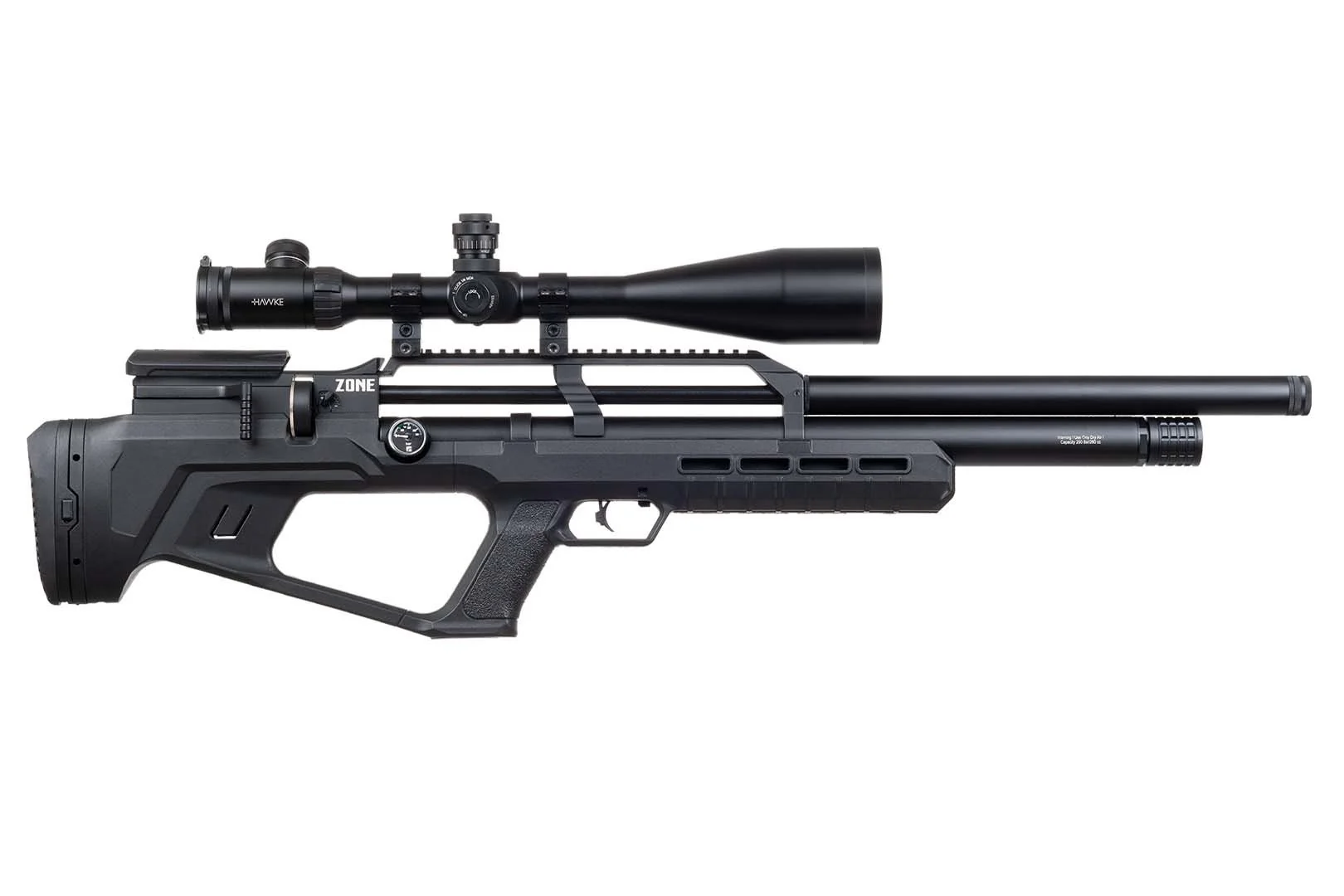

REXIMEX ZONE SYNTHETIC

€525.00
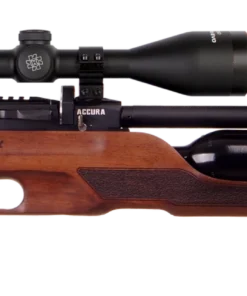
The Reximex Zone bullpup is a great choice for all shooters who want a quality PCP air rifle with a regulator for a reasonable price. The stock of the Zone is made from Turkish walnut and is very comfortable to handle out in the field.
- Calibre: .177
- Capacity: 14
- Length: 90cm
- Power: 11.5
- Stock: Turkish Walnut
- Tube Size: 260cc
Reximex Zone Synthetic – Regulated Bullpup PCP Air Rifle with Adjustable Synthetic Stock
The Reximex Zone Synthetic is a modern regulated PCP bullpup air rifle built for shooters who want compact handling, substantial air capacity, adjustable ergonomics and a long precision barrel inside a relatively short overall platform.
Rather than using traditional wood furniture, this version features a high-quality black synthetic bullpup stock designed for durability, low maintenance and comfortable handling.
The current factory specification lists the Zone in .177, .22 and .25 calibre, with magazine capacities of approximately 14 shots, 12 shots and 10 shots respectively.
A 260cc aluminium air reservoir operates at a maximum filling pressure of 250 bar, while the standard regulator helps provide more consistent working pressure through the useful portion of the fill.
The rifle also features a reversible sidelever, adjustable butt pad, four-way adjustable metal trigger, manual safety, Picatinny optics rail and integrated sound-moderation system.
Why Choose the Synthetic Version
The synthetic stock makes the rifle particularly practical for owners who want a durable PCP that requires less cosmetic maintenance than natural wood.
It resists ordinary moisture and handling marks well and can be easier to clean after regular range or outdoor use.
The textured grip surfaces also improve control.
Bullpup Design
The bullpup configuration positions the action farther toward the rear of the rifle.
As a result, the rifle can use a long 580mm barrel while keeping overall length to approximately 900mm.
This can make it easier to carry and maneuver than a traditional rifle with the same barrel length.
Regulated PCP System
The regulator controls air pressure supplied from the main cylinder to the firing system.
This helps reduce large shot-to-shot changes as cylinder pressure decreases.
Consistent air delivery can support more predictable velocity and point of impact.
260cc Air Cylinder
The aluminium reservoir provides enough capacity for extended shooting sessions.
Factory figures list approximately 75 optimal-velocity shots in .177, 65 in .22 and 55 in .25, although actual performance depends on calibre, pellet, power setting, temperature and individual configuration.
Precision-Rifled Barrel
The Zone uses a 580mm precision-rifled barrel.
Good accuracy depends on suitable pellets, barrel condition, regulated pressure, secure optics and consistent shooter technique.
Adjustable Butt Pad
The synthetic version includes an adjustable butt pad.
This helps the shooter position the rifle more naturally against the shoulder.
A consistent shoulder position can improve repeatable sight alignment.
Reversible Sidelever
The cocking lever can be configured for either side.
This makes the rifle more adaptable for right- or left-handed shooters.
Four-Way Adjustable Trigger
The metal trigger provides multiple adjustment points.
A predictable trigger break can support deliberate target shooting when adjusted within manufacturer guidance.
22mm Picatinny Rail
The rifle includes a 22mm Picatinny optics rail.
This provides compatibility with a wide range of appropriate scope and sight mounts.
The factory specification does not include a scope.
Integrated Sound Moderator
The barrel assembly incorporates the manufacturer’s integrated moderation system.
The muzzle also uses a 1/2″ UNF threaded interface.
Any additional accessory should be legal and mechanically compatible.
Adjustable Power System
The rifle includes a factory power-control system.
Any adjustment should remain within manufacturer guidance and local law.
Changing an approved setting may affect velocity, air consumption and point of impact.
Reximex Lyra K
Reximex Lyra K is another rifle within the manufacturer’s PCP lineup.
It should not be confused with the bullpup Zone Synthetic.
reximex
reximex produces a broad range of PCP rifles and pistols.
The Zone represents the company’s compact regulated bullpup category.
reximex airguns
reximex airguns include full-length sporters, bullpups, compact rifles and PCP pistols.
The Zone Synthetic emphasizes compact overall length and adjustable handling.
reximex throne gen2
The reximex throne gen2 is another bullpup platform with a different air system and layout.
reximex гр
The phrase reximex гр can appear in regional-language product searches.
Buyers should always confirm the exact model before comparing specifications.
reximex throne gen 2
The reximex throne gen 2 belongs to a different model family and should not be treated as mechanically identical to the Zone.
reximex mito
The reximex mito is a compact PCP pistol-oriented platform rather than a bullpup rifle.
reximex rра
The reximex rра phrase relates to another compact PCP design and should not be confused with this model.
reximex mitos
Searches for reximex mitos usually relate to the Mito family rather than the Zone Synthetic.
reximex lieva
The reximex lieva is another rifle design with a different action and stock configuration.
tps to joules calculator
A tps to joules calculator search generally refers to muzzle-energy calculation.
Correct energy calculation requires projectile mass as well as measured velocity.
reximex accura pcp air rifle
The reximex accura pcp air rifle is a separate full-size PCP model in the same broader brand family.
Tps joule calculator
A Tps joule calculator should use accurate pellet weight and chronograph data.
Velocity alone cannot determine muzzle energy.
roxy max
roxy max is not the correct designation for this product.
The product described here is the Zone Synthetic.
mx rex
mx rex should not be confused with the Zone model name.
Correct product identification helps prevent compatibility mistakes.
fps to ft Ibs
An fps to ft Ibs conversion requires both velocity and projectile weight.
airgun joules calculator
An airgun joules calculator can help estimate muzzle energy when accurate velocity and pellet mass are known.
This is useful for checking legal compliance.
gunseek
gunseek and similar terms can appear when buyers compare airgun specifications and availability.
Local acquisition laws should always be checked.
Reximex Lyra-K PCP air rifle
The Reximex Lyra-K PCP air rifle is a separate PCP model with different dimensions and handling.
Reximex Lyra-K airgun
The Reximex Lyra-K airgun should not be used as a direct specification reference for the Zone Synthetic.
Reximex Lyra-K review
A Reximex Lyra-K review concerns a different rifle and does not directly describe Zone performance.
Reximex Lyra-K PCP rifle
The Reximex Lyra-K PCP rifle belongs to the same manufacturer but uses a different layout.
Reximex Lyra-K regulated PCP
A Reximex Lyra-K regulated PCP may share the general advantage of regulated air delivery, although the platforms differ.
Reximex Lyra-K compact PCP rifle
The Reximex Lyra-K compact PCP rifle uses reduced dimensions, while the Zone achieves compactness through its bullpup configuration.
Reximex Lyra-K tactical air rifle
The phrase Reximex Lyra-K tactical air rifle refers to another configuration and should not be substituted for Zone specifications.
Reximex Lyra-K hunting rifle
A Reximex Lyra-K hunting rifle search concerns another platform.
Any hunting use should follow local law and humane sporting practices.
buy Reximex Lyra-K online
A search for buy Reximex Lyra-K online relates to a different model.
The same legal ownership and transfer requirements should be checked before acquiring the Zone.
best price Reximex Lyra-K
A best price Reximex Lyra-K comparison should consider included equipment, warranty and seller support.
Reximex Lyra-K accuracy test
A Reximex Lyra-K accuracy test relates to another rifle.
The Zone should be evaluated with controlled pellet testing and repeatable shooting technique.
Reximex Lyra-K scope package
A Reximex Lyra-K scope package may include optics depending on the seller.
The factory Zone specification does not include a scope.
Reximex Lyra-K pellet gun
The Reximex Lyra-K pellet gun is a different PCP rifle but likewise uses appropriate airgun pellets.
Reximex Lyra-K for pest control
A Reximex Lyra-K for pest control search concerns applications that may be regulated.
Any pest-management use should be lawful and humane.
Reximex Lyra-K small game hunting
A Reximex Lyra-K small game hunting search likewise concerns a different rifle and local hunting regulations.
AirForce
AirForce is a separate airgun manufacturer and is not connected with Reximex.
Tex-Rex AirForce brush gun
The phrase Tex-Rex AirForce brush gun relates to different PCP products and does not describe the Zone.
Brush Gun
A Brush Gun is not the product category represented here.
The Zone Synthetic is a regulated bullpup PCP air rifle.
airforce airguns
airforce airguns use their own stock, reservoir and action systems.
They should be compared separately.
airforce airguns
The repeated airforce airguns phrase refers to a different manufacturer.
airforce texan
The airforce texan is a specialist large-format PCP platform designed around very different performance goals.
pellet gun
The Zone Synthetic is a pellet gun in the broad sense that it fires conventional airgun pellets.
Pellet quality has a substantial influence on grouping.
air force guns
air force guns refers to products made by another manufacturer.
tex-rex
The term tex-rex is unrelated to the Zone model designation.
air rifle and air pistol
The difference between an air rifle and air pistol includes stock design, barrel length, handling and intended shooting position.
The Zone is a full rifle in compact bullpup form.
airforce texan air rifle
The airforce texan air rifle belongs to a different product class and manufacturer.
texas air force rifle
The phrase texas air force rifle generally refers to AirForce products rather than Reximex.
air force texan lss
The air force texan lss is a separate specialist platform and should not be used as a direct Zone comparison.
airforce talon p
The airforce talon p is a compact PCP platform from another manufacturer.
Its architecture differs considerably from the Zone.
airforce texan ss
The airforce texan ss is another separate PCP rifle with different dimensions and operating goals.
air gun pump
A correctly rated air gun pump can be used with compatible PCP systems when the pressure capability and fill fittings are suitable.
The Zone’s 260cc reservoir and 250-bar maximum fill pressure require genuine high-pressure PCP equipment.
Why the Synthetic Stock Is Practical
The synthetic stock is one of the clearest reasons to choose this version over the walnut model.
It is easier to maintain.
It is less sensitive to ordinary moisture.
It tolerates routine handling marks well.
Texturing on the grip surfaces can also help maintain secure control.
For shooters who prioritize practicality over natural wood appearance, the synthetic version can make more sense.
How the Bullpup Design Improves Compact Handling
By positioning the action behind the trigger area, the rifle retains a long barrel while reducing overall length.
This helps make the rifle easier to transport and maneuver.
It can also centralize weight closer to the shooter.
Why Regulation Supports Precision
A regulated firing system reduces one major variable by controlling working pressure.
This can help maintain more stable velocity during a shooting session.
However, precision also depends heavily on pellet quality, optic stability and shooter technique.
Pellet Selection and Accuracy
Different barrels can prefer different pellet weights and head sizes.
The most useful approach is controlled testing.
Use the same distance.
Use the same pressure range.
Keep the optic unchanged.
Compare multiple groups rather than a single target.
The most consistent pellet is usually more valuable than the one producing the highest velocity.
Air Management
The cylinder should be filled only with clean, dry compressed air.
Use properly rated equipment.
Never exceed the stated maximum pressure.
Inspect the cylinder and fill connection regularly.
Scope Setup
The Picatinny rail allows broad optics compatibility.
A moderate scope or suitable sight can be selected according to intended lawful target distance.
Mounts should remain secure because loose optics can create false accuracy problems.
Magazine Care
Keep the magazine clean.
Inspect it for damage.
Avoid forcing the action if feeding resistance appears.
A damaged pellet or incorrectly indexed magazine should be addressed before continuing.
Maintenance
Routine maintenance should focus on:
Keeping the rifle dry
Keeping the fill connection clean
Inspecting the air reservoir
Protecting the muzzle
Checking magazines
Monitoring pressure retention
Keeping optics secure
Avoiding unnecessary internal disassembly
High-pressure servicing should be left to qualified personnel.
Safety and Legal Responsibility
Treat the rifle as loaded until personally verified otherwise.
Keep the muzzle pointed in a safe direction.
Keep the finger away from the trigger until firing is intended.
Use a proper pellet trap or secure backstop.
Eye protection is recommended.
Ownership, transport, calibre and power laws vary by jurisdiction and should be checked before use.
Final Section 1 Assessment
The Reximex Zone Synthetic combines compact bullpup handling with a long precision barrel, substantial air capacity and a practical low-maintenance stock.
Its factory specification includes a 260cc aluminium reservoir, 250-bar maximum fill pressure, regulator, reversible sidelever, adjustable butt pad, four-way adjustable metal trigger, Picatinny optic rail, power-adjustment system and integrated sound moderator.
Current factory data lists .177, .22 and .25 calibre options with 14-, 12- and 10-shot magazines respectively. Reximex also lists approximately 75, 65 and 55 optimal-velocity shots depending on calibre and operating conditions.
At approximately 900mm overall with a 580mm barrel and a listed weight of around 3.3kg, the rifle combines full barrel length with relatively compact handling.
The synthetic stock makes this version especially attractive to owners who want durability, easy maintenance and adjustable ergonomics rather than traditional wood furniture.
For lawful target shooting and recreational use, its strongest qualities are regulated consistency, a large reservoir, multi-shot convenience, reversible sidelever operation, adjustable controls and a long precision-rifled barrel.
Good performance still depends on suitable pellets, secure optics, correct pressure management, safe handling and repeatable shooting technique.
When maintained properly and used within applicable law, the Zone Synthetic provides a practical blend of compact bullpup design, regulated PCP engineering and durable everyday construction.
Accuracy, Handling, Air Management, Optics, Maintenance and Real-World Ownership
Understanding the Rifle in Everyday Use
The Reximex Zone Synthetic is designed for shooters who want the compact handling of a bullpup combined with the air capacity, barrel length and regulated consistency expected from a full-size PCP platform.
Its layout places much of the action close to the shoulder, while the long barrel remains positioned forward inside a comparatively short overall rifle.
This arrangement helps create a platform that can feel compact without becoming excessively light or unstable.
For lawful target shooting, range practice and structured pellet testing, that combination can be especially useful.
Why the Bullpup Layout Matters
A bullpup places the action behind the trigger area.
This shortens the rifle without requiring a dramatically shorter barrel.
The result is a more centralized package.
That can improve maneuverability while still preserving a long barrel.
Balance and Weight Distribution
Weight distribution strongly affects how a rifle feels.
A rifle that carries too much weight at the muzzle can become tiring.
A bullpup usually keeps more mass closer to the shooter.
That can make the rifle feel easier to control.
Why Balance Affects Accuracy
A balanced rifle requires less muscular effort to hold.
Less tension can help the shooter maintain:
A stable sight picture
Consistent shoulder contact
Relaxed trigger control
Repeatable head position
Synthetic Stock Advantages
The synthetic stock is a practical choice for frequent use.
It is less sensitive to ordinary moisture than natural wood.
It also tolerates routine handling marks more easily.
Why Synthetic Furniture Is Useful
A synthetic stock can be especially practical for shooters who value:
Low maintenance
Weather resistance
Easy cleaning
Consistent dimensions
Durability
Adjustable Butt Pad
The adjustable butt pad allows the shooter to change how the rifle sits against the shoulder.
A better shoulder position can improve both comfort and stability.
Why Shoulder Fit Matters
If the rifle sits too high, low or awkwardly, the shooter may compensate with excessive muscle tension.
That can affect grouping.
A more natural fit supports repeatable technique.
Grip Design
The grip area is shaped to provide a secure hold.
Textured surfaces can help maintain control.
Why Grip Pressure Should Remain Consistent
A very tight grip can introduce unwanted movement.
A relaxed but secure hold is generally more repeatable.
Regulated Air Delivery
The regulator is one of the most important features in the rifle.
It helps manage the air pressure supplied to the firing system.
This can reduce large changes in velocity as the main cylinder pressure falls.
Why Consistency Matters More Than Maximum Speed
For target shooting, repeatability is usually more useful than headline velocity.
A pellet that leaves the barrel at a very consistent velocity can produce more predictable vertical point of impact.
Regulator Performance
A healthy regulator should provide stable behavior through the useful portion of the fill.
Signs of Possible Regulator Problems
Potential signs can include:
Unexpected velocity changes
Irregular shot count
Point-of-impact shifts
Different behavior near the same cylinder pressure
Any internal regulator service should be performed by qualified personnel.
Air Reservoir Capacity
The large reservoir allows longer sessions between fills.
That reduces interruptions.
Why Fewer Refills Help
Frequent stopping can disrupt:
Bench position
Scope alignment
Shooting rhythm
Pellet testing
Concentration
A larger reservoir helps maintain a more consistent session.
Shot Count
Published shot counts should be treated as guidance.
Actual results depend on:
Calibre
Pellet weight
Power setting
Temperature
Regulator pressure
Seal condition
Individual rifle variation
Keeping a Shot Log
A simple log can help determine how the exact rifle behaves.
Record:
Starting pressure
Ending pressure
Number of shots
Pellet type
Group size
Any velocity information
Why a Shooting Log Is Useful
Over time, the shooter can identify patterns.
This helps with both maintenance and ammunition selection.
Filling Equipment
Only suitable high-pressure PCP filling equipment should be used.
Common options include:
A PCP hand pump
A rated charging bottle
A purpose-built compressor
Why Correct Equipment Matters
High-pressure air requires properly rated components.
Improvised hoses or fittings should not be used.
Slow Filling
A slow fill is easier to monitor.
Compressed air also heats during filling.
Temperature and Pressure
Immediately after filling, warm air can produce a higher gauge reading.
After cooling, the reading may drop slightly.
Clean, Dry Air
Dry air helps protect internal seals and metal parts.
Why Moisture Should Be Avoided
Moisture can contribute to:
Corrosion
Seal wear
Internal contamination
Fill Connection Care
The fill connection should be kept clean.
Dust and grit should not be allowed into the system.
Pressure Gauge Use
The gauge should be checked before long sessions.
It is more reliable than simply estimating remaining air from shot count.
Sidelever Operation
The reversible sidelever should move smoothly.
It provides an efficient way to cycle the action.
Why Smooth Cycling Matters
Smooth cycling helps preserve:
Cheek position
Shoulder contact
Grip
Scope alignment
If the Lever Feels Stiff
Do not force it.
Possible causes include:
Magazine misalignment
A damaged pellet
Debris
Mechanical wear
A feeding problem
Magazine Function
The multi-shot magazine provides convenience.
It allows repeated shooting without loading every pellet individually.
Why Magazine Reliability Matters
A magazine that does not index correctly can damage pellets or create feeding resistance.
Magazine Inspection
Check for:
Cracks
Debris
Poor indexing
Loose components
Damaged internal parts
Pellet Loading
Pellets should be inserted carefully.
A damaged skirt can affect feeding and accuracy.
Pellet Quality
Pellet consistency has a major influence on group size.
What to Look For
Good pellets should have:
Uniform heads
Clean skirts
Consistent weight
Smooth finish
Reliable manufacturing
Pellet Weight
Different weights can behave differently.
Heavier pellets may retain energy differently.
Lighter pellets may produce more velocity.
Neither automatically means better accuracy.
Controlled Pellet Testing
Keep the following conditions consistent:
Distance
Pressure range
Scope setting
Rest
Shooting position
Target type
Then compare several groups.
Why Multiple Groups Matter
One tight group may be chance.
Repeated groups provide better evidence.
Barrel Performance
The long barrel provides a stable guided path for the pellet.
However, barrel quality is more important than length alone.
Important Barrel Factors
These include:
Rifling consistency
Bore condition
Crown quality
Pellet fit
Cleanliness
Crown Protection
The muzzle crown should be protected from impact.
Why the Crown Matters
The pellet exits at the crown.
Damage there can disturb the air release around the pellet.
That can affect accuracy.
Barrel Cleaning
Routine aggressive cleaning is not usually necessary.
Cleaning should be based on need.
When Cleaning May Be Appropriate
Consider cleaning if:
Accuracy changes unexpectedly
Contamination is suspected
The rifle has been stored for a long time
A technician recommends it
Scope Selection
The Picatinny rail provides wide compatibility with suitable optics.
Choosing a Scope
A useful scope should provide:
Clear image quality
Reliable adjustment
Appropriate magnification
Comfortable eye relief
Secure mounting
Why Excessive Magnification Is Not Always Helpful
Very high magnification can exaggerate movement.
It can also reduce field of view.
A moderate optic may be more practical for general target shooting.
Scope Weight
A heavy scope can affect rifle balance.
Scope Height
The optic should allow a natural head position.
Why Head Position Matters
A repeatable eye position supports more consistent sight alignment.
Mount Security
Loose rings can create point-of-impact shifts.
They should be checked periodically.
Zeroing
Zero should be established at a known safe distance.
Use:
A stable rest
Consistent pellets
Small adjustments
A proper backstop
Rechecking Zero
Zero should be checked after:
Transport
Impact
Scope removal
Mount changes
Pellet changes
Maintenance
Why Zero Can Shift
Possible causes include:
Loose mounts
Different ammunition
Temperature change
Shooter inconsistency
Mechanical movement
Benchrest Shooting
A bench can help reveal the rifle’s mechanical potential.
Why Bench Testing Helps
It reduces shooter movement.
That makes it easier to evaluate:
Pellet performance
Regulator consistency
Magazine function
Scope stability
Seated Shooting
Seated shooting can provide good stability.
Standing Shooting
Standing requires greater muscle control.
The compact bullpup format can help keep the rifle manageable.
Shooter Fatigue
Fatigue can reduce consistency.
Common Signs
Tighter grip
Poor trigger control
Changing head position
Increased wobble
Rushed shots
Taking Breaks
Short breaks can improve concentration.
Trigger Control
The adjustable trigger can support careful shooting.
Why a Predictable Break Matters
A predictable break reduces the temptation to snatch the trigger.
Finger Placement
The finger should press straight to the rear.
Sideways pressure can move the rifle.
Follow-Through
After each shot, remain in position briefly.
Maintain:
Sight picture
Grip
Shoulder contact
Head position
Why Follow-Through Helps
It encourages consistent technique through the complete firing cycle.
Power Adjustment
The rifle includes a factory power-control system.
Any adjustment should remain within manufacturer guidance and local law.
Why Power Changes Affect More Than Velocity
Changing an approved setting may alter:
Air use
Shot count
Point of impact
Pellet behavior
Regulator interaction
Rechecking Zero After Adjustment
Any authorized change should be followed by a zero confirmation.
Chronograph Use
A chronograph can be useful for lawful performance monitoring.
What Chronograph Data Can Reveal
It can show:
Velocity consistency
Pressure-related changes
Pellet variation
Possible seal problems
Why It Should Be Used for Diagnosis
The main value is monitoring performance and legal compliance.
Muzzle Energy
Muzzle energy depends on both projectile mass and velocity.
Legal Compliance
Airgun rules can regulate:
Power
Calibre
Ownership
Transport
Storage
Use location
The owner should check applicable local law.
Sound Moderation
The integrated moderator helps reduce muzzle report.
Why the Rifle Is Not Completely Silent
Other sounds remain, including:
Valve movement
Hammer movement
Action cycling
Pellet impact
Muzzle Thread
The threaded muzzle allows compatible accessories where legal.
Why Compatibility Matters
Incorrect accessories can damage threads or interfere with safe operation.
Safe Backstop
A proper backstop is essential.
Why Targets Alone Are Not Enough
Paper records impacts.
It does not safely stop pellets.
Eye Protection
Eye protection is recommended.
Muzzle Discipline
The rifle should always be pointed in a safe direction.
Trigger Discipline
The finger should remain outside the trigger area until firing is intended.
Exterior Cleaning
The rifle should be wiped after use.
Remove:
Dust
Moisture
Fingerprints
Debris
Synthetic Stock Care
The stock is simple to maintain.
A mild cleaning method is normally sufficient.
Why Harsh Solvents Should Be Avoided
Strong chemicals can affect surface finish or polymer components.
Metal Surface Care
Exposed metal should remain dry.
Reservoir Inspection
Inspect the cylinder for:
Dents
Deep scratches
Corrosion
Impact damage
Damaged fittings
Why Reservoir Condition Matters
The cylinder stores high-pressure air.
Any questionable damage should be professionally assessed.
Seal Monitoring
Possible signs of seal problems include:
Pressure loss
Audible leakage
Reduced shot count
Inconsistent performance
Difficulty holding pressure
Pressure Loss During Storage
A small change may be temperature related.
Continuous loss may indicate a leak.
Why Internal Disassembly Should Be Limited
The rifle contains high-pressure components.
Internal work should follow manufacturer procedures.
Professional Servicing
Qualified service is appropriate for:
Regulator issues
Valve faults
Major leaks
Trigger problems
Reservoir concerns
Storage
The rifle should be stored:
Unloaded
Dry
Secure
Away from excessive heat
Away from unauthorized users
In accordance with local law
Magazine Storage
Magazines should remain clean and dry.
Long-Term Air Storage
Manufacturer guidance should be followed regarding reservoir pressure during extended storage.
Transport
The rifle should be transported unloaded and secured.
A padded case can protect:
Barrel
Stock
Scope
Reservoir
Action
Why a Case Matters
Transport damage can affect both appearance and zero.
Documentation
Keep:
Owner manual
Serial number
Purchase record
Service history
Warranty information
Pellet-testing notes
Chronograph records
Why Documentation Helps
Good records simplify future maintenance and resale.
Buying Used
A used rifle should be inspected carefully.
Important Areas to Check
Reservoir condition
Pressure retention
Sidelever operation
Magazine function
Trigger feel
Stock condition
Scope rail
Fill connection
Pressure Retention Test
A healthy PCP should hold pressure.
A steadily falling gauge may indicate a leak.
Lever Check
The sidelever should move smoothly.
Magazine Check
The magazine should feed reliably.
Trigger Check
The trigger should feel safe and predictable.
Stock Inspection
Look for:
Cracks
Loose fittings
Impact damage
Excessive wear
Scope Rail Inspection
The rail should be secure and undamaged.
Service History
Useful questions include:
Has the rifle leaked?
Has the regulator been serviced?
Have seals been replaced?
Has the cylinder been damaged?
Has the trigger been altered?
Has any internal work been performed?
Why Unknown Modifications Matter
Unknown changes can affect:
Reliability
Safety
Legal compliance
Resale value
Ownership Costs
The rifle is only part of the total cost.
Additional expenses may include:
Pellets
Scope
Mounts
Filling equipment
Spare magazines
Seals
Professional servicing
Storage case
Hand Pump Ownership
Manual filling is possible with suitable equipment.
However, a larger reservoir and high fill pressure require effort.
Charging Bottle
A high-pressure bottle can make refilling faster.
Compressor
A purpose-built PCP compressor can offer more independence.
Why Air Quality Matters
Clean, dry air helps preserve internal components.
Who May Appreciate This Rifle
The rifle may suit shooters who value:
Compact bullpup handling
Durable synthetic construction
Regulated performance
Large air capacity
Long barrel length
Multi-shot convenience
Reversible sidelever operation
Adjustable controls
Who May Prefer Walnut
A buyer who values traditional appearance may prefer natural wood.
Who May Prefer a Conventional Sporter
Someone who prefers traditional action and trigger placement may find a standard rifle layout more familiar.
Who May Prefer a Simpler Powerplant
A shooter who does not want external fill equipment may prefer a spring-powered rifle.
Why the Synthetic Version Makes Sense
This version emphasizes practicality.
It is easier to maintain than natural wood.
It handles ordinary moisture well.
It preserves the same core regulated PCP architecture.
That makes it appealing for regular use.
Session Preparation
Before shooting, check:
Cylinder pressure
Magazine
Pellets
Scope
Backstop
Safety area
Filling equipment
Why Preparation Helps
A prepared session reduces interruptions.
Troubleshooting Large Groups
If groups suddenly become wider, check:
Pellets
Cylinder pressure
Scope mounts
Shooter fatigue
Magazine
Wind
Barrel condition
Change One Variable at a Time
This makes diagnosis easier.
Feeding Problems
If feeding becomes difficult:
Stop safely
Remove the magazine
Inspect the pellet
Check for debris
Do not force the lever
Air Loss
If pressure drops unexpectedly:
Check the gauge
Listen for leaks
Inspect the fill area
Check accessible seals
Seek qualified service if needed
Routine Inspection
Regularly inspect:
Reservoir
Gauge
Fill point
Magazine
Sidelever
Trigger
Safety
Stock
Scope mounts
Visible seals
Preventive Maintenance
Routine care is more useful than unnecessary disassembly.
Keep the rifle clean.
Use suitable pellets.
Protect the air system.
Maintain magazines.
Monitor pressure.
Address leaks early.
Long-Term Ownership Value
The Zone Synthetic offers a strong combination of compact handling, regulated consistency and practical construction.
Its synthetic stock is especially useful for shooters who value function and durability.
Resale Value
Resale confidence is helped by keeping:
Original magazines
Fill probe
Manuals
Packaging
Service records
Original accessories
Why Completeness Matters
A complete rifle is easier for a future buyer to evaluate.
Final Section 2 Assessment
The Reximex Zone Synthetic combines modern bullpup packaging with the practical benefits of a regulated PCP system.
Its compact overall length makes it easy to handle.
The long barrel provides a strong mechanical foundation for accurate target shooting.
The large air reservoir supports extended sessions.
The regulator helps stabilize air delivery.
The multi-shot magazine reduces interruptions.
The reversible sidelever improves adaptability.
The adjustable trigger supports deliberate shooting.
The Picatinny rail allows flexible optic selection.
The synthetic stock keeps maintenance straightforward.
The integrated moderator helps reduce muzzle report.
For the best results, consistency should remain the priority.
Use good-quality pellets.
Keep the air system within the correct pressure range.
Mount optics securely.
Use a repeatable shooting position.
Operate the lever smoothly.
Protect the reservoir.
Keep the rifle clean.
Monitor pressure retention.
Store it securely.
Follow local law.
When properly maintained and matched with suitable ammunition, the Zone Synthetic can provide a durable, precise and practical regulated PCP platform for lawful target shooting, recreational practice and long-term ownership.
Section 3 – Long-Term Ownership, Reliability, Accuracy Potential, Ergonomics, Service and Buyer Guidance
Long-Term Ownership Character
The Reximex Zone Synthetic is a practical regulated PCP platform for shooters who want compact dimensions, low-maintenance furniture and a full-length barrel within a bullpup layout.
Its appeal becomes clearer over time because the design focuses on everyday usability rather than appearance alone.
The synthetic stock requires less cosmetic care than natural wood.
The regulated action supports consistent air delivery.
The large reservoir reduces the frequency of refilling.
The reversible sidelever makes the action adaptable.
The multi-shot magazine supports efficient range use.
For owners who shoot regularly, these qualities can make the rifle easier to live with over the long term.
Why the Bullpup Layout Can Remain Practical Over Time
A bullpup moves the action closer to the shooter.
That means the rifle can retain a relatively long barrel without becoming excessively long overall.
This layout is especially useful for shooters who want easier transport and a compact feel.
Weight Distribution
Because more of the action sits toward the rear, the rifle can feel more centralized than a conventional sporter.
This can reduce the sense of front heaviness.
Why Centralized Weight Helps
A more centralized balance can reduce support-arm fatigue.
That can improve comfort during longer sessions.
Synthetic Stock Durability
The synthetic stock is one of the strongest reasons to choose this version.
It is resistant to ordinary moisture and does not require the same level of finish care as walnut.
Why Synthetic Furniture Suits Regular Use
A synthetic stock is especially practical for shooters who:
Transport equipment often
Shoot outdoors
Prefer easy cleaning
Do not want to worry about cosmetic marks
Value function over traditional appearance
Routine Stock Care
The stock can usually be cleaned with a soft cloth and mild cleaning method.
Avoid aggressive chemicals unless specifically approved by the manufacturer.
Why Harsh Chemicals Are Unnecessary
Strong solvents can affect polymer finishes.
Routine dust, moisture and fingerprints generally do not require aggressive treatment.
Ergonomic Fit
The rifle should fit the shooter naturally.
A good fit helps maintain:
Consistent shoulder contact
Stable eye position
Comfortable trigger reach
Balanced grip pressure
Adjustable Butt Pad
The adjustable butt pad allows the rear contact point to be tuned to the shooter.
This can improve stability.
Why Shoulder Position Matters
If the rifle sits awkwardly, the shooter may compensate with muscle tension.
That can reduce consistency.
Grip Geometry
The grip should allow a natural wrist position.
A relaxed grip is often more repeatable than a very tight grip.
Trigger Reach
Trigger reach should feel natural.
The finger should contact the blade without stretching or excessive bending.
Trigger Familiarity
The adjustable trigger can become one of the most useful parts of the rifle once the shooter becomes familiar with its behavior.
Why a Predictable Trigger Matters
The shooter should know when the break is approaching.
A predictable trigger reduces the temptation to jerk or snatch the shot.
Safe Adjustment
Any trigger adjustment should remain within manufacturer guidance.
Reliability and safety matter more than achieving an extremely light pull.
Follow-Through
After firing, remain in position briefly.
Maintain:
Sight alignment
Grip
Shoulder contact
Head position
Why Follow-Through Matters
It helps build repeatable technique.
Regulated Performance Over Time
The regulator helps control the pressure delivered to the firing system.
Over long-term ownership, consistency is one of the main areas worth monitoring.
What Stable Regulation Should Look Like
A healthy regulated system should provide relatively predictable behavior across the useful fill range.
Signs of Possible Problems
Possible warning signs include:
Unexpected velocity changes
Sudden point-of-impact shifts
Reduced shot count
Unusual behavior near familiar pressures
Why Diagnosis Should Be Systematic
Not every inconsistency comes from the regulator.
Other possible causes include:
Pellets
Scope mounts
Magazine issues
Shooter fatigue
Seal wear
Environmental conditions
Recording Performance
A simple record can help identify changes.
Useful Information to Record
Note:
Starting pressure
Ending pressure
Shot count
Pellet type
Group size
Any chronograph data
Weather conditions
Why Records Matter
Gradual mechanical changes can be difficult to notice without comparison.
A shooting log creates a reference.
Reservoir Capacity
The large reservoir supports longer sessions before refilling.
Why Fewer Refills Are Useful
Reduced interruption can help maintain:
Concentration
Bench setup
Scope position
Shooting rhythm
Pellet-testing conditions
Shot Count Variation
Shot count is not fixed.
It depends on:
Calibre
Power level
Pellet
Temperature
Regulator behavior
Seal condition
Individual configuration
Why Real-World Numbers Differ
Different markets may use different legal power limits.
This can significantly change air consumption.
Filling Equipment
Only properly rated PCP equipment should be used.
Common Filling Options
These may include:
A high-pressure hand pump
A compatible bottle
A suitable compressor
Why Equipment Quality Matters
High-pressure filling equipment should provide:
Reliable seals
Correct fittings
Accurate gauges
Clean air
Suitable pressure rating
Filling Slowly
A controlled fill is easier to monitor.
It also reduces rapid temperature rise.
Temperature Effects
Air heats during filling.
After cooling, the gauge may settle slightly lower.
Clean, Dry Air
Dry air supports long-term seal and metal condition.
Why Moisture Matters
Moisture can contribute to:
Internal corrosion
Seal degradation
Contamination
Fill Port Care
The fill connection should remain clean.
Keep out:
Dust
Grit
Moisture
Foreign material
Reservoir Inspection
Check the cylinder regularly.
What to Look For
Inspect for:
Dents
Deep scratches
Corrosion
Impact damage
Damaged fittings
Why Cylinder Damage Matters
The reservoir contains high-pressure air.
Significant damage should not be ignored.
Pressure Retention
The rifle should hold pressure properly.
Why Pressure Loss Can Be Misleading
Temperature changes can affect gauge readings.
However, continuous loss may indicate a leak.
Seal Life
Seals are normal wear components.
Eventually, some may require replacement.
Signs of Seal Wear
Possible symptoms include:
Audible leakage
Slow pressure loss
Reduced shot count
Irregular output
Professional Service
Qualified technicians should handle high-pressure internal work.
Why Professional Service Is Preferable
The rifle contains:
Regulator components
Valve assemblies
High-pressure seals
Trigger parts
Pressurized reservoir systems
Incorrect servicing can reduce reliability or safety.
Sidelever Reliability
The sidelever should operate smoothly.
Why Smooth Cycling Matters
A smooth action reduces disruption between shots.
If Resistance Appears
Stop and inspect.
Potential causes include:
Magazine misalignment
Pellet damage
Debris
Mechanical wear
Why Forcing the Lever Is a Bad Idea
Extra force can worsen a minor feeding problem.
Magazine Life
The magazine should be kept clean.
What to Inspect
Check for:
Cracks
Indexing problems
Loose parts
Debris
Internal damage
Pellet Damage
A bent pellet can create feeding problems.
Why Pellet Skirts Matter
A damaged skirt can affect bore sealing and accuracy.
Spare Magazines
Keeping a spare can improve convenience.
It can also help diagnose whether a problem comes from one magazine.
Pellet Selection
A barrel may prefer one pellet more than another.
Why Pellet Testing Should Be Repeated Occasionally
Manufacturing batches can change.
A previously excellent pellet may behave differently in another batch.
Controlled Testing
Use the same:
Distance
Rest
Pressure range
Optic setting
Target type
Shooting position
Why Multiple Groups Matter
One group is not enough to judge consistency.
Several groups provide a more reliable pattern.
Barrel Condition
The barrel should remain protected from impact.
Muzzle Protection
The crown area deserves special attention.
Why the Crown Matters
The pellet exits at the crown.
Damage there can affect how air releases around it.
Cleaning Philosophy
Cleaning should be based on need rather than habit.
When Cleaning May Be Useful
Consider cleaning if:
Accuracy changes unexpectedly
Contamination is suspected
The rifle has been stored for a long period
A qualified technician recommends it
Why Over-Cleaning Is Unhelpful
Unnecessary aggressive cleaning can create wear or disturb a barrel that was already performing well.
Optic Selection
The Picatinny rail supports a wide range of compatible sights.
Choosing an Appropriate Optic
A useful optic should match intended shooting distance.
Important qualities include:
Clear glass
Reliable adjustment
Suitable magnification
Comfortable eye relief
Secure mounting
Why Bigger Is Not Always Better
A very large scope can add unnecessary weight.
This may reduce the handling benefit of the compact bullpup layout.
Scope Height
The optic should align naturally with the shooter’s eye.
Why Eye Alignment Matters
Inconsistent head position can create inconsistent sight picture.
Mount Security
Loose rings can cause zero movement.
Rechecking Mounts
Check after:
Transport
Impact
Long periods of use
Maintenance
Zero Verification
Zero should be confirmed whenever something changes.
Common Reasons to Recheck Zero
Scope removal
Mount adjustment
New pellets
Transport
Impact
Maintenance
Authorized power changes
Why Zero Shifts Can Be Misdiagnosed
A shooter may assume the rifle is inaccurate when the real cause is a loose optic.
Bench Testing
A bench is useful for evaluating mechanical performance.
What Bench Shooting Helps Reveal
It can help isolate:
Pellet quality
Regulator behavior
Magazine consistency
Scope stability
Seated Shooting
A seated position can provide good stability.
Standing Shooting
Standing is more demanding.
The compact format can help make the rifle feel manageable.
Shooter Fatigue
Fatigue can increase group size.
Signs of Fatigue
These may include:
Tighter grip
Poor breathing rhythm
Changing head position
Rushed shots
Increased movement
Why Breaks Help
Short breaks can restore concentration and muscle control.
Support-Hand Position
The support hand should remain in the same location.
Why Consistency Matters
Changing hand position can alter balance and point of aim.
Grip Pressure
The firing hand should remain secure but relaxed.
Why Excessive Tension Is Unhelpful
Too much grip pressure can disturb trigger control.
Chronograph Monitoring
A chronograph can provide useful diagnostic information.
What It Can Show
Velocity spread
Changes through the pressure range
Pellet variation
Possible mechanical inconsistencies
Why Chronograph Data Should Be Interpreted Carefully
Good velocity numbers do not automatically guarantee small groups.
Accuracy still depends on optics, ammunition and technique.
Muzzle Energy
Muzzle energy depends on velocity and pellet mass.
Legal Responsibility
The owner should understand local laws concerning:
Power
Calibre
Licensing
Ownership
Transport
Storage
Use location
Factory Power Control
The rifle includes a factory adjustment system.
Any use of this system should remain within manufacturer guidance and applicable law.
Why Adjustment Changes More Than Speed
An approved change can affect:
Air consumption
Shot count
Point of impact
Pellet behavior
Rechecking Performance
After an authorized change, verify:
Zero
Consistency
Legal compliance
Integrated Sound Moderation
The built-in system helps reduce muzzle report.
Why Mechanical Noise Remains
A PCP still produces:
Valve noise
Hammer movement
Action sounds
Pellet impact
Muzzle Thread Care
The threaded muzzle should be kept clean.
Why Thread Protection Matters
Damaged threads can make accessory fitting difficult.
Safe Backstop
A secure backstop is essential.
Why Paper Targets Are Not Enough
Paper shows where the pellet lands.
It does not stop the projectile.
Ricochet Awareness
Hard surfaces can cause pellets to rebound.
Eye Protection
Eye protection is recommended.
Muzzle Discipline
The muzzle should remain pointed in a safe direction.
Trigger Discipline
The finger should remain outside the trigger area until firing is intended.
Storage
The rifle should be stored:
Unloaded
Dry
Secure
Away from unauthorized users
Away from excessive heat
In accordance with local law
Why Secure Storage Matters
Responsible storage protects both the rifle and other people.
Magazine Storage
Magazines should be kept clean and dry.
Long-Term Reservoir Storage
Follow manufacturer guidance for air pressure during extended storage.
Transport
The rifle should be transported unloaded and secured.
Padded Case Benefits
A suitable case can protect:
Stock
Barrel
Optic
Reservoir
Action
Why Transport Protection Matters
Impact can affect both appearance and zero.
Documentation
Keep:
Owner manual
Serial number
Purchase records
Service history
Warranty information
Pellet notes
Chronograph records
Why Documentation Adds Value
Good records improve troubleshooting and resale confidence.
Buying Used
A used example should be inspected carefully.
Reservoir Check
Look for:
Dents
Scratches
Corrosion
Impact marks
Damage around fittings
Pressure Retention Check
The rifle should hold pressure.
Sidelever Check
The action should cycle smoothly.
Magazine Check
The magazine should index properly.
Trigger Check
The trigger should feel safe and predictable.
Stock Check
Inspect for:
Cracks
Loose fittings
Heavy impact damage
Excessive wear
Optic Rail Check
The rail should be secure.
Fill Connection Check
The fill point should be clean and undamaged.
Service History Questions
Ask:
Has the rifle leaked?
Has the regulator been serviced?
Have seals been replaced?
Has the cylinder been damaged?
Has the trigger been altered?
Has internal work been performed?
Why Modification History Matters
Unknown modifications can affect:
Reliability
Legal status
Safety
Resale value
Cosmetic Wear Versus Mechanical Wear
A scratch in the synthetic stock may only affect appearance.
A damaged cylinder or loose action component is more serious.
Why Mechanical Condition Comes First
A used buyer should prioritize:
Pressure retention
Action operation
Magazine reliability
Trigger condition
Reservoir integrity
Ownership Costs
Long-term ownership may involve:
Pellets
Optics
Mounts
Filling equipment
Magazines
Seals
Professional servicing
Storage equipment
Hand Pump Use
A hand pump provides independence.
However, filling a larger reservoir manually requires effort.
Charging Bottle Use
A bottle can make refilling quicker.
Compressor Use
A suitable compressor can be practical for frequent use.
Why Filling Equipment Also Needs Maintenance
Pumps and compressors can introduce contamination if poorly maintained.
Who May Appreciate the Rifle Most
The rifle may appeal to shooters who value:
Compact bullpup dimensions
Low-maintenance synthetic furniture
Regulated consistency
Large air capacity
Long barrel length
Multi-shot operation
Reversible lever positioning
Adjustable controls
Who May Prefer Walnut
A buyer who values natural grain and traditional appearance may prefer a wood-stocked version.
Who May Prefer a Conventional Sporter
Some shooters prefer the traditional trigger and action placement of a standard rifle.
Who May Prefer a Simpler Powerplant
A shooter who does not want external filling equipment may prefer a spring-powered rifle.
Why the Synthetic Version Has Strong Practical Appeal
The synthetic version prioritizes function.
It requires minimal cosmetic maintenance.
It handles normal moisture well.
It preserves the same regulated PCP engineering found in the platform.
For frequent use, that practicality can be more valuable than decorative materials.
Preparing for a Range Session
Before shooting, check:
Pressure
Magazine
Pellets
Scope security
Backstop
Safety area
Filling equipment
Why Preparation Improves the Session
A prepared setup reduces interruption.
Troubleshooting Poor Accuracy
If group size suddenly increases, check:
Pellets
Pressure
Scope mounts
Shooter fatigue
Magazine condition
Wind
Barrel condition
Change One Thing at a Time
This makes the cause easier to identify.
Troubleshooting Feeding Problems
If feeding becomes difficult:
Stop safely
Remove the magazine
Inspect the pellet
Look for debris
Do not force the lever
Troubleshooting Air Loss
If pressure falls unexpectedly:
Check the gauge
Listen for leaks
Inspect the fill connection
Check accessible seals
Seek qualified service if necessary
Routine Inspection
Regularly inspect:
Reservoir
Gauge
Fill point
Magazine
Sidelever
Trigger
Safety
Stock
Scope mounts
Visible seals
Preventive Maintenance
Preventive care is more valuable than unnecessary disassembly.
Keep the rifle clean.
Use suitable pellets.
Protect the air system.
Maintain magazines.
Monitor pressure.
Address leaks promptly.
Long-Term Value
The rifle can offer strong long-term value because it combines practical construction with modern PCP performance.
The stock is easy to maintain.
The regulated system supports consistency.
The bullpup layout keeps the platform compact.
The large reservoir supports longer sessions.
Resale Value
Keep:
Original magazines
Fill probe
Manuals
Packaging
Service records
Original accessories
Why Completeness Matters
A complete package is easier for a future buyer to evaluate.
Final Section 3 Assessment
The Reximex Zone Synthetic is a practical regulated PCP bullpup designed for shooters who value compact handling, durability and consistent performance.
Its synthetic stock minimizes cosmetic maintenance.
The large reservoir supports extended shooting sessions.
The regulator helps stabilize air delivery.
The long barrel provides a strong mechanical foundation for accurate target use.
The reversible sidelever makes the action adaptable to different shooters.
The multi-shot magazine improves convenience.
The adjustable trigger supports deliberate shooting.
The Picatinny rail allows flexible optic selection.
The integrated sound-moderation system reduces muzzle report.
The most important factor in long-term ownership is consistency.
Use quality pellets.
Keep the air system clean.
Fill only with correctly rated equipment.
Protect the reservoir.
Keep optics secure.
Use repeatable shooting technique.
Operate the action smoothly.
Monitor pressure retention.
Store the rifle safely.
Follow local regulations.
For lawful target shooting and recreational use, the rifle can provide a durable combination of compact dimensions, regulated PCP efficiency and low-maintenance construction.
With proper care, sensible servicing and suitable ammunition, the Zone Synthetic can remain a reliable and accurate platform for long-term ownership.
Be the first to review “REXIMEX ZONE SYNTHETIC” Cancel reply
Related products

Reximex

Reximex


Reximex
Reximex

Reximex

Reximex
Reximex
Reviews
There are no reviews yet.