


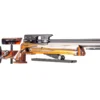
Air Arms TX200US Ultimate Springer Hunter Carbine, Walnut

€1,250.00
The Air Arms TX200 Ultimate Springer Hunter Carbine with walnut stock delivers on the demand for an airgun that joins incredible performance with the fully-adjustable stock from their flagship PCP models. The combination of features and adjustments on this air rifle yields results that allows it to excel at field target, small-game hunting and target practice.
This model of the air rifle offers an eye-catching walnut stock with laser-cut stippled texturing on the forearm and grip to provide a firm hold. In addition, it includes a fully-adjustable cheekpiece that adjusts for both vertical and horizontal adjustment, as well as a 3-axis rubber buttpad for ideal fit and comfort, and it also includes a ball joint for complete tilt and rotation adjustment.
Consistent and predictable shots from the Air Arms TX200 Ultimate Springer Hunter Carbine are further aided by the adjustable, high-luster trivalent chrome plated two-stage trigger with a tactile finish for improved feel. The renowned accuracy of this air rifle is enabled by its use of a Lothar Walther match-grade barrel that includes a full barrel shroud that leads to quieter shots.
The air rifle has an 11mm dovetail optics rail In order to accommodate a scope to provide improved sighting options and to work in conjunction with the adjustable cheekpiece for optimal eye alignment. To experience outstanding craftsmanship that results in an heirloom-quality air rifle, buy an Air Arms TX200 Ultimate Springer Hunter Carbine with walnut stock from Pyramyd AIR today.
- Shop related categories: pellet guns, pellet rifles
Air Arms TX200 Ultimate Springer Hunter Carbine, Walnut
- Spring-piston powerplant
- Lothar Walther match-grade barrel
- Ambidextrous walnut stock
- Shrouded barrel with 1/2″x20 female threaded end
- Max. power: 14.3 FPE (.177), 17.4 FPE (.22)
- Two-stage adjustable trigger
- High-luster trivalent chrome plated trigger with tactile finish
- Automatic safety on trigger unit
- Secondary bear-trap safety
- 11mm dovetail optics rail
- Laser-cut stippled grip and forearm
- Cheekpiece with vertical, lateral, tilt, and swivel adjustments
- Three-axis adjustable rubber buttpad
- Barrel length: 12.56″
- Overall length: 38.39″
- Weight: 9.7 lbs.
- Limited lifetime warranty
Specifications
BrandCaliber.177 (4.5mm)Max Velocity930 fpsMuzzle Energy14.3 ft/lbsSuggested forSmall game hunting/target practicePowerplantSpring-pistonLoudness3-MediumWeight9.7 lbsFunctionSingle-shotActionUnderleverFixed/adj. powerFixedShroudedYesScopeable11mm dovetailFront SightsnoneRear SightsnoneSafetyAutomaticTriggerTwo-stage adjustableBarrelLothar WaltherBarrel Length12.56″Overall Length38.39″Capacity1 round(s)Cocking Effort34lbsBody TypeRifleStockWalnutButtplateAdjustableColorWalnutGrip OrientationAmbidextrous
Air Arms TX200US Ultimate Springer Hunter Carbine Walnut – Precision Underlever Springer with Adjustable Walnut Stock
The Air Arms TX200US Ultimate Springer Hunter Carbine Walnut combines the compact dimensions of the Hunter Carbine with the adjustable ergonomics of Air Arms’ Ultimate Springer stock and the traditional appearance of genuine walnut.
At its core, this rifle remains a sophisticated self-contained spring-powered underlever platform.
There is no compressed-air reservoir to refill, no charging cylinder to carry and no compressor required before a shooting session.
Instead, each shot is powered by the rifle’s mechanical mainspring and piston system.
Air Arms currently describes the TX200 as a premium spring-powered underlever rifle built around mechanical precision, smooth operation and a match-grade Lothar Walther barrel. The Hunter Carbine version uses a shorter barrel and air chamber than the standard TX200, producing a more compact and slightly lighter format.
Meanwhile, the Ultimate Springer stock adds an adjustable cheekpiece and butt pad.
For the walnut version, that adjustability is combined with the grain, feel and traditional appearance of natural hardwood rather than laminate.
The result is a platform intended for shooters who appreciate conventional spring-rifle engineering but also want finer control over rifle fit.
Air Arms TX200US Ultimate Springer Hunter Carbine Walnut
The Air Arms TX200US Ultimate Springer Hunter Carbine Walnut combines three important characteristics:
Compact Hunter Carbine geometry
Adjustable Ultimate Springer ergonomics
Traditional walnut construction
Why This Combination Matters
The shorter action can make the rifle feel more manageable.
At the same time, stock adjustment allows the shooter to refine head and shoulder position.
Why Fit Supports Precision
A consistent fit makes it easier to reproduce:
Cheek pressure
Scope alignment
Trigger reach
Shoulder placement
Support-hand position
Hunter Carbine Design
The Hunter Carbine version is shorter than the standard TX200.
Air Arms states that the HC uses a shorter barrel and air chamber, resulting in a more compact and slightly lighter rifle.
Why Compact Dimensions Help
A shorter rifle can feel easier to manage during:
Standing positions
Kneeling positions
Target-course movement
Supported range shooting
Why the Standard Rifle Still Feels Different
Air Arms notes that the full-length TX200 provides a marginally smoother firing cycle and slightly greater accuracy potential, while both platforms remain highly accurate.
Ultimate Springer Walnut Stock
The Ultimate Springer stock is available in walnut and includes an adjustable cheekpiece and butt pad.
Why Walnut Is Appealing
Walnut offers:
Natural grain
Traditional appearance
Rigid stock structure
Comfortable tactile feel
Why Every Walnut Stock Is Different
Natural wood grain varies.
Therefore, no two stocks will look completely identical.
Adjustable Cheekpiece
The cheekpiece can be positioned to improve head alignment.
Why This Matters
The shooter’s eye should settle naturally behind the scope.
Why Repeatability Matters
A different cheek position from shot to shot can alter the sight picture.
Adjustable Butt Pad
The butt pad can be positioned to suit the shooter’s shoulder and stance.
Why
Different body proportions require different stock geometry.
Why This Helps
A properly fitted butt pad can improve:
Shoulder contact
Head position
Rifle stability
Comfort
Spring-Powered Underlever Action
The TX200 uses a spring-powered underlever mechanism.
How It Works
The shooter operates the underlever.
The mainspring is compressed.
The rifle is loaded.
When the trigger is released, the mainspring drives the piston forward.
The piston compresses air.
That compressed air propels the pellet.
Fixed-Barrel Construction
Unlike a break-barrel rifle, the TX200 barrel remains fixed.
Why This Matters
The barrel does not hinge during cocking.
Why This Can Support Repeatability
The barrel and scope rail maintain a fixed mechanical relationship.
Direct Barrel Loading
The pellet is loaded directly into the barrel.
Why
There is no magazine mechanism between pellet and bore.
Why This Appeals to Precision Shooters
Each pellet can be checked individually before loading.
Lothar Walther Match-Grade Barrel
Air Arms uses a Lothar Walther match-grade barrel in the TX200 family.
Why Barrel Quality Matters
The barrel determines the final alignment and stabilization of the pellet.
Why Bore Consistency Matters
Uniform dimensions support repeatable pellet travel.
Synthetic Bearing System
Air Arms describes the piston system as running on synthetic bearings to reduce friction.
Why Reduced Friction Helps
Lower friction can support:
Smoother cocking
More consistent piston travel
Reduced mechanical harshness
Improved efficiency
Balanced Mainspring
The mainspring system is engineered to deliver a controlled firing cycle.
Why
Spring rifles create internal movement during firing.
Why Smoothness Matters
Less harsh vibration can make the rifle easier to shoot consistently.
Adjustable Two-Stage Trigger
The TX200 uses an adjustable two-stage trigger with safety.
First Stage
Allows the shooter to prepare the trigger.
Second Stage
Provides the final release point.
Why This Helps
A predictable break can reduce disturbance at the moment of firing.
Safe-Lok Loading System
Air Arms specifies its Safe-Lok loading system on the TX200.
Why This Is Important
It is intended to support safer underlever loading.
Important
Mechanical safeties never replace safe hand placement and muzzle control.
Self-Contained Power
The TX200 needs no external compressed-air source.
Why This Matters
There is no need for:
PCP bottle
Compressor
Hand pump
Charging hose
Why Some Shooters Prefer This
The rifle remains mechanically independent between shots.
.177 Configuration
Air Arms currently offers the TX200 in .177 calibre.
Why .177 Is Common for Targets
It typically provides a comparatively flat trajectory.
.22 Configuration
The TX200 is also available in .22 calibre.
Why .22 Feels Different
The pellet is generally heavier.
Its trajectory and velocity characteristics differ accordingly.
Spring-Rifle Recoil
The TX200 is not recoil-free.
Why
The piston moves rapidly inside the action.
Why Technique Matters
The shooter should maintain a repeatable hold rather than clamping the rifle excessively.
Air Arms S510 XS Ultimate Sporter FAC
The Air Arms S510 XS Ultimate Sporter FAC belongs to Air Arms’ PCP range.
It stores compressed air and differs fundamentally from this spring-powered platform.
air rifle
An air rifle propels a pellet using compressed air or another non-cartridge energy source.
The TX200 creates compressed air mechanically through its piston system.
air gun
An air gun may use spring power, PCP air, CO₂ or another pneumatic system.
The TX200 belongs to the spring-piston category.
air arms
Air Arms is the British manufacturer behind the TX200, Pro Sport and several PCP platforms.
The TX200 first became part of the company’s spring-rifle heritage in the early 1990s.
air rifles
Air rifles cover a broad range of operating systems.
The TX200 is a fixed-barrel spring-powered underlever design.
pellet guns
The term pellet guns generally refers to air-powered equipment that fires shaped pellets.
cal .177 pellets
cal .177 pellets are intended for rifles chambered in .177.
Why Correct Calibre Matters
Never attempt to load ammunition of the wrong diameter.
break barrel pellet gun
A break barrel pellet gun uses the barrel itself as the cocking lever.
The TX200 does not.
airguns
Airguns include both spring and pneumatic platforms.
The TX200 is mechanically self-powered.
air pisto
The phrase air pisto commonly refers to an air pistol.
The TX200 is a shoulder-fired rifle.
177 caliber
177 caliber is one of the available chamberings in the current TX200 family.
177 pellet vs.22 pellet
The 177 pellet vs.22 pellet comparison centers mainly on pellet mass and trajectory.
.177
Generally follows a flatter trajectory.
.22
Typically uses a heavier pellet.
air arms s510 ultimate sporter .177 sub 12
The air arms s510 ultimate sporter .177 sub 12 is a PCP rifle rather than a spring-powered TX200.
what is an air rifle
For what is an air rifle, it is a shoulder-fired air-powered platform that launches a pellet without conventional firearm propellant.
airgins
The term airgins is commonly a misspelling of airguns.
.22 air rifle
A .22 air rifle uses a 5.5 mm pellet.
The TX200 is available in that calibre.
air arms s510
The air arms s510 is a magazine-fed PCP family.
The TX200 uses a completely different self-contained mechanical powerplant.
air riflery
air riflery includes formal target, field-target and other lawful sporting disciplines.
Spring-powered rifles remain widely used in recoil-specific target classes.
airgun shooting range near me
For airgun shooting range near me, a recognized range or shooting club provides controlled firing points, target distances and reliable backstops.
air arm
The phrase air arm may be used informally, although Air Arms is the correct brand name.
target air rifle shooting
target air rifle shooting rewards:
Stable position
Consistent hold
Sight alignment
Trigger control
Follow-through
Why Spring Rifles Add Another Challenge
The internal recoil cycle makes hold consistency especially important.
air arms s410
The air arms s410 is a PCP model.
It differs from the fixed-barrel spring-powered TX200.
air arms tx200
The air arms tx200 is a spring-powered underlever rifle known for mechanical precision and smooth operation.
177 air rifle
A 177 air rifle uses 4.5 mm pellets.
The .177 TX200 is particularly suited to controlled target work.
how do air guns work
For how do air guns work, different mechanisms create the launch pressure.
In This Rifle
The spring drives a piston.
The piston compresses air.
The compressed air then propels the pellet.
Air rifle cleaning kit
An Air rifle cleaning kit suitable for a precision spring rifle may include:
Soft cloth
Appropriate pull-through
Suitable cleaning patches
Manufacturer-approved care products
Why Gentle Cleaning Matters
Aggressive cleaning can damage the bore or crown.
177 caliber vs 22
The 177 caliber vs 22 comparison depends on intended sporting use and legal configuration.
The smaller calibre generally produces a flatter trajectory, while the larger calibre usually uses heavier pellets.
air guns for home defense
The phrase air guns for home defense is not an appropriate recommended role for this rifle.
The TX200 should be used only for lawful sporting and target activities.
air compressor rifle
The phrase air compressor rifle normally refers informally to PCP equipment.
The TX200 does not need a compressor.
pcp hand pump
A pcp hand pump is unnecessary for normal TX200 operation.
Why
There is no compressed-air cylinder to refill.
air rifle calibers
Common air rifle calibers include .177 and .22.
Both are currently available in the TX200 family.
prosport air arms
The prosport air arms reference relates to the Air Arms Pro Sport.
It is another spring-powered platform but uses a different cocking layout and stock geometry.
what is break barrel air rifle
For what is break barrel air rifle, it is a spring or gas-ram system where the barrel hinges downward for cocking.
The TX200 instead uses a separate underlever.
Air Arms S510 XS Ultimate Sporter FAC Walnut Stock
The Air Arms S510 XS Ultimate Sporter FAC Walnut Stock belongs to the PCP S510 family.
It should not be confused with this walnut-stocked spring rifle.
Air Arms S510 XS Ultimate Sporter
The Air Arms S510 XS Ultimate Sporter uses a multi-shot pneumatic action.
The TX200 remains single-shot and spring-powered.
Air Arms S510 FAC
The Air Arms S510 FAC is a high-power PCP configuration.
It does not share the TX200 spring mechanism.
Air Arms S510 XS FAC PCP Air Rifle
The Air Arms S510 XS FAC PCP Air Rifle relies on pre-compressed air.
The TX200 generates compressed air mechanically for each shot.
Air Arms air rifle
An Air Arms air rifle may belong to either the PCP or spring-powered range.
The TX200 is one of the company’s principal traditional spring platforms.
JTS AirStryke Carbine
The JTS AirStryke Carbine belongs to another manufacturer.
It is not a version or component of the TX200.
jts airguns
jts airguns refers to a different product family.
jts airacuda
The jts airacuda is a separate PCP design.
jts airacuda max
The jts airacuda max is another unrelated PCP platform.
jts airacuda 25
The jts airacuda 25 belongs to the same separate manufacturer family.
airacuda
airacuda is a JTS model name rather than an Air Arms designation.
Jts aircuda
Jts aircuda is commonly a misspelling or shortened spelling of Airacuda.
jts pellets
jts pellets are ammunition products made by a different manufacturer.
Any pellet used in the TX200 should match the rifle’s calibre and manufacturer guidance.
jts stealth hawk
The jts stealth hawk is not part of the TX200 product family.
airacuda max
airacuda max refers to another pneumatic platform.
airacuda pcp
The airacuda pcp stores compressed air externally within the rifle.
The TX200 does not.
jts compressor
A jts compressor relates to high-pressure PCP filling.
No compressor is required for the TX200.
jts airacuda max 30
The jts airacuda max 30 is a different large-calibre PCP platform.
jts airacuda max 30 cal
The jts airacuda max 30 cal is unrelated to the TX200 system.
jts airstryke
jts airstryke refers to a different product family.
jts firearms
The phrase jts firearms refers to a different manufacturer’s products and should not be associated with Air Arms engineering.
177 cal pellet gun
A 177 cal pellet gun uses 4.5 mm pellets.
The .177 version of this rifle is a precision fixed-barrel spring platform rather than a generic break-barrel design.
Why the Walnut Stock Changes the Character
The walnut version offers a more traditional feel than the laminate alternative.
Why
Natural walnut has visible grain and color variation.
Why Shooters Appreciate It
The material combines functional rigidity with classic styling.
Why Walnut Requires Care
Natural wood reacts more to environmental conditions than synthetic materials.
Therefore
Keep it:
Dry
Clean
Protected from prolonged moisture
Away from extreme heat
Why the Adjustable Stock Is Important
The Ultimate Springer stock lets the shooter tailor rifle fit.
Why
Not every shooter has the same:
Neck length
Shoulder height
Scope height
Arm reach
Why Scope Height Matters
A tall optic may require additional cheekpiece height.
Why
The eye should align naturally with the center of the scope.
Why the Butt Pad Matters in Standing Positions
The shoulder contact point strongly influences balance.
Why
A poor fit can make the rifle feel heavier than it is.
Why the Hunter Carbine Can Feel More Agile
The shorter barrel places less length ahead of the shooter.
Why This Matters
The rifle may feel quicker to reposition.
Why the Full-Length Version Feels Different
Air Arms notes that the standard TX200 offers a marginally smoother firing cycle.
Why
The longer action geometry changes the way the mechanical cycle is perceived.
Why the Carbine Remains Precise
The shorter barrel does not remove the key precision features.
It still uses:
Fixed-barrel construction
Match-grade barrel
Adjustable trigger
Controlled piston system
Why Spring-Rifle Technique Matters
The TX200 moves during the shot.
Why
The piston begins moving before the pellet exits.
Why Hold Consistency Matters
Different support pressure can alter how the rifle reacts.
Why an Overly Tight Grip Can Be Counterproductive
Trying to stop all recoil can make each shot behave differently.
Better Principle
Use a controlled, repeatable hold.
Why Follow-Through Matters
The shooter should remain still immediately after the trigger releases.
Why
The internal firing cycle has not finished instantly.
Why Trigger Control Matters
Smooth trigger pressure reduces unwanted movement.
Why
A sudden pull can change point of aim just before pellet departure.
Why the Fixed Barrel Is Important
The barrel stays in one position throughout cocking and firing.
Why
There is no pivoting barrel joint.
Why Direct Loading Is Useful
The pellet goes straight into the barrel.
Why
The shooter can inspect it before firing.
Why Pellet Condition Matters
Damaged skirts or heads can influence fit.
Therefore
Avoid using visibly damaged ammunition.
Why Scope Choice Matters
Spring rifles create a bidirectional recoil impulse.
Therefore
A suitable spring-rated scope should be used.
Air Arms specifically advises using spring-rated optics and properly fitted mounts.
Why Mount Security Matters
Repeated recoil can cause unsuitable mounts to move.
Why This Creates Problems
Zero can shift.
Why Zeroing Should Be Methodical
Do not adjust the optic after every individual shot.
Better Method
Shoot consistent groups first.
Why Grouping Matters More Than One Shot
One pellet can be affected by:
Shooter error
Wind
Pellet variation
Why a Consistent Support Point Matters
Place the rifle on the same section of the forend during testing.
Why
Spring rifles can respond differently to changes in support location.
Why Hard Clamping Is Not Ideal
The rifle should be allowed to recoil consistently.
Why
Rigid clamping can change how the action behaves.
Why Wind Still Matters
An accurate rifle cannot eliminate wind drift.
Why
Airgun pellets are relatively light.
Why a Known Zero Matters
The pellet follows a curved trajectory.
Therefore
The shooter needs a consistent reference distance.
Why .177 Is Frequently Chosen for Formal Targets
The relatively flat trajectory simplifies elevation correction.
Why .22 Has a Different Character
Its heavier projectile follows a different flight path.
Why No External Air Equipment Is Needed
The powerplant is completely self-contained.
Why This Simplifies Ownership
There is no:
Fill bottle
Charging probe
Pressure gauge routine
Compressor
Why This Does Not Mean Maintenance-Free
Mechanical systems still require inspection.
Monitor
Mainspring
Piston seal
Trigger
Cocking linkage
Stock screws
Why Spring Condition Matters
The mainspring stores energy for every shot.
Possible Signs of Change
Different firing sound
Different vibration
Reduced consistency
Why Internal Spring Work Requires Caution
The spring remains under mechanical preload.
Why
Incorrect disassembly can cause injury or damage.
Why the Piston Seal Matters
The piston must compress air efficiently.
Why
A damaged seal can change output and firing feel.
Why Excess Lubricant Is Undesirable
Lubricant can enter the compression chamber.
Why
That can create inconsistent combustion-like effects.
Why Manufacturer Guidance Matters
The correct lubricant and amount should be used.
Why Routine Exterior Care Matters
Moisture and fingerprints can affect blued steel.
Good Practice
Wipe exposed metal after use.
Why the Walnut Stock Should Be Dried After Rain
Water should not remain on or around the wood.
Why
Long-term moisture can affect finish quality.
Why Storage Matters
Store the rifle unloaded and secured.
Why
Unauthorized access should be prevented.
Why the Rifle Should Not Be Stored Cocked
The spring should not remain unnecessarily compressed during storage.
Why a Suitable Case Helps
The stock, metalwork and scope can be damaged during transport.
Why Zero Should Be Checked After Travel
The optic may have shifted even if the rifle looks undamaged.
Why Professional Servicing Makes Sense
Experienced technicians can inspect:
Spring
Guides
Piston seal
Trigger
Cocking linkage
Why Unnecessary Internal Modification Is Poor Practice
It can alter:
Safety
Reliability
Firing behavior
Legal status
Why Legal Compliance Matters
Power limits and ownership rules differ by jurisdiction.
Therefore
The rifle should remain within the lawful configuration applicable to its owner.
Why a Reliable Backstop Is Essential
Targets alone do not necessarily contain pellets safely.
Therefore
Every range should have an appropriate stopping surface.
Where This Rifle Fits Best
Appropriate settings include:
Authorized ranges
Formal field-target courses
Lawful private target areas with suitable backstops
When the Hunter Carbine Format Makes Sense
It is particularly useful when the shooter values:
Compact handling
Fixed-barrel precision
Traditional spring operation
Adjustable stock fit
Mechanical independence
Why the Walnut Version Appeals to Traditional Shooters
Its natural stock gives the rifle a more classic appearance while retaining modern adjustment features.
How Good Is the TX200US Hunter Carbine Walnut?
Its strength comes from combining traditional spring-rifle engineering with unusually refined mechanical and ergonomic features.
Those Features Include
Match-grade barrel
Fixed-barrel underlever design
Adjustable two-stage trigger
Adjustable walnut stock
Synthetic bearing-supported piston system
Why Precision Depends on the Whole System
Accuracy is not created by the barrel alone.
Mechanical Factors
Barrel quality
Trigger consistency
Spring behavior
Stock fit
Scope security
Human Factors
Hold
Breathing
Trigger control
Follow-through
Important Ownership Information
Before use, confirm:
Correct calibre
Safe trigger operation
Secure scope mounting
Local legal requirements
Suitable backstop
Correct pellet type
Final Section 1 Assessment
The Air Arms TX200US Ultimate Springer Hunter Carbine Walnut combines classic spring-rifle mechanics with a more modern approach to ergonomic adjustment.
Air Arms confirms that the Hunter Carbine is the shorter, more compact version of the TX200 and that the Ultimate Springer configuration adds an adjustable cheekpiece and butt pad. Walnut is currently offered as one of the Ultimate Springer stock choices.
That combination gives the rifle a distinctive position within the TX200 family.
The standard model emphasizes a slightly longer and smoother layout.
The Hunter Carbine prioritizes compact handling.
The Ultimate Springer stock then adds the ability to tailor cheek and shoulder position more precisely.
Meanwhile, walnut gives the rifle a traditional visual character that differs substantially from the laminate version.
Mechanically, the TX200 remains a fixed-barrel, spring-powered underlever rifle.
Its precision foundation comes from the Lothar Walther match-grade barrel, direct barrel loading, adjustable trigger and carefully controlled piston system. Air Arms also uses synthetic bearings to reduce friction and improve the smoothness of piston movement.
The rifle does not require any external compressed-air equipment.
Every shot is powered through its own spring and piston system.
For some shooters, that simplicity is a major advantage.
There is no cylinder to refill, no charging hose to maintain and no compressor to transport.
However, spring operation also creates a distinctive recoil cycle.
Therefore, the shooter must use a consistent hold, suitable spring-rated optic and disciplined follow-through.
The adjustable walnut stock helps in this respect because it allows head position and shoulder contact to be tuned more precisely.
The shorter Hunter Carbine format can also make the rifle feel more manageable during standing and kneeling positions.
Safe handling remains essential.
The underlever should be controlled throughout the loading process.
The Safe-Lok system should be treated as an additional mechanical safety rather than a substitute for correct hand placement.
A reliable backstop should always be used.
The rifle should also remain within all applicable local power and ownership laws.
For lawful target and sporting use, the TX200US Ultimate Springer Hunter Carbine Walnut provides a sophisticated combination of compact dimensions, natural walnut construction, adjustable ergonomics, fixed-barrel precision and traditional self-contained spring power.
Handling, Recoil Control, Ergonomics, Accuracy, Setup, Maintenance and Long-Term Ownership
Overall Handling Character
The Air Arms TX200US Ultimate Springer Hunter Carbine Walnut combines a compact spring-powered action with a traditional adjustable walnut stock, creating a rifle that feels deliberate, controlled and mechanically refined.
Its shorter Hunter Carbine format reduces some of the forward length of the standard platform, which can make the rifle feel more manageable when moving between standing, kneeling and supported positions.
At the same time, the walnut stock gives the rifle substantial presence and a solid connection with the shooter.
That matters because spring-powered rifles are more sensitive to hold technique than low-recoil pneumatic systems.
The mainspring and piston move during every firing cycle.
Therefore, the shooter’s grip, support point, shoulder pressure and follow-through can influence the final result.
The rifle works best when the shooter develops a repeatable routine rather than trying to overpower the recoil cycle.
Why the Carbine Format Feels Different
A shorter front end changes the way the rifle balances.
Why This Matters
Weight that sits farther from the shooter creates greater leverage.
Reducing that forward leverage can make the rifle feel quicker to reposition.
Practical Benefits
The rifle may feel easier to manage during:
Standing practice
Kneeling positions
Range transitions
Supported target work
Why Compact Does Not Mean Lightweight
The rifle still contains a substantial steel spring action and a solid walnut stock.
As a result, it retains useful mass.
Why Mass Can Help
A heavier rifle can feel more settled during the firing cycle.
Why Mass Can Also Cause Fatigue
Long unsupported sessions may become tiring.
Better Approach
Use body structure rather than relying entirely on muscular effort.
Natural Point of Aim
The rifle should settle naturally toward the target.
Why
If the shooter has to force the rifle into position, muscle tension increases.
Why Tension Can Hurt Consistency
Muscles fatigue and tremble.
That creates movement.
Spring-Rifle Recoil Cycle
The recoil cycle is one of the defining characteristics of this platform.
What Happens Internally
The trigger releases the piston.
The mainspring expands.
The piston accelerates forward.
Air is compressed.
The pellet begins moving.
The piston reaches the end of its stroke.
Why This Creates a Complex Impulse
Movement occurs in more than one direction.
Why This Is Different From Many Other Rifles
The shooter feels both the initial movement and the piston’s forward stop.
Why Technique Matters
A different hold can change how the rifle reacts.
Why Consistency Beats Force
Trying to clamp the rifle as tightly as possible is not usually the best approach.
Better Principle
Use the same moderate, controlled hold every time.
Support-Hand Position
The support hand should contact the stock in a consistent place.
Why
Moving the support point can change how the rifle recoils.
Why This Can Change Point of Impact
The rifle moves before the pellet leaves the barrel.
Repeatability
If the same support point is used for each shot, the firing behavior becomes easier to predict.
Grip Pressure
The firing hand should remain controlled but not overly tense.
Why
Excess pressure can twist the stock.
Why Trigger Control Becomes Harder With a Tense Grip
The trigger finger may pull the whole hand sideways.
Shoulder Contact
The butt should return to the same place.
Why
Changing shoulder pressure can alter the way the rifle moves.
Adjustable Butt Pad
The adjustable butt pad can help create a repeatable contact point.
Why This Matters
Different shooters have different shoulder height and body geometry.
Standing Position
Standing requires the shooter to support the rifle without external assistance.
Why the Carbine Can Help
Its reduced front length can decrease the feeling of leverage.
Why the Walnut Stock Still Adds Stability
The stock provides useful mass close to the shooter.
Why Balance Matters More Than Total Weight
A well-balanced heavy rifle can sometimes feel easier to hold than a lighter rifle with excessive forward weight.
Kneeling Position
Kneeling provides more body support.
Why
The shooter can use skeletal structure rather than muscle alone.
Why Stock Fit Still Matters
Cheek and shoulder placement remain important.
Supported Shooting
A rest can help evaluate grouping.
Why
It removes some human movement.
Why Spring Rifles Should Not Be Hard-Clamped
The rifle needs to move naturally through the recoil cycle.
Why a Soft Rest Is Better
A soft support can allow consistent movement.
Why the Same Rest Position Matters
Changing the forend support point can change recoil behavior.
Adjustable Cheekpiece
The cheekpiece should bring the eye naturally behind the scope.
Why This Matters
The shooter should not need to stretch or tilt the head.
Why Head Position Affects Precision
Inconsistent eye placement can change the apparent sight picture.
Scope Height
Higher mounts may require more cheekpiece elevation.
Why
The eye should remain aligned with the optic’s centerline.
Why Too Low Is Also a Problem
If the cheekpiece is too low, the shooter may lift the head inconsistently.
Walnut Stock Feel
Walnut gives the rifle a traditional tactile character.
Why Natural Wood Feels Different
The stock has unique grain and density variation.
Why This Matters for Ownership
Every walnut stock has its own appearance.
Why Walnut Needs More Care Than Laminate
Natural wood responds more to moisture and temperature.
Moisture Protection
The stock should be dried after wet use.
Why
Water can affect the finish and wood over time.
Heat Protection
Avoid leaving the rifle in extreme heat.
Why
Large temperature changes can affect both wood and lubrication.
Stock Cleaning
Use a soft cloth.
Why
Harsh chemicals can damage the finish.
Stock Screws
Stock hardware should remain secure.
Why
Loose screws can change the relationship between action and stock.
Why Over-Tightening Is Also Wrong
Excessive force can damage threads or compress the wood.
Trigger Reach
The firing hand should sit naturally.
Why
The trigger finger should move independently.
Trigger Control
Apply pressure smoothly.
Why
A sudden pull can disturb the rifle.
Two-Stage Trigger
The first stage prepares the shot.
The second stage provides the final release point.
Why This Helps
The shooter can build pressure gradually.
Why Over-Adjustment Is Risky
Reducing engagement too far can compromise safety.
Better Practice
Keep trigger adjustment within manufacturer guidance.
Follow-Through
The shooter should maintain position after the trigger breaks.
Why
The firing cycle continues briefly after release.
Why Moving Early Can Cause Problems
The pellet may still be travelling through the barrel.
Breathing
Breathing changes upper-body position.
Why
The chest and shoulders move naturally.
Practical Technique
Use a natural respiratory pause rather than holding the breath for too long.
Why Excess Breath Holding Is Counterproductive
It creates tension.
Scope Selection
A suitable spring-rated scope is important.
Why
The rifle creates bidirectional recoil.
Why Some Optics Fail
Scopes designed only for conventional firearm recoil may not tolerate repeated forward and rearward shock.
Mount Selection
Strong mounts should be used.
Why
Mount movement can shift zero.
Scope Creep
Repeated recoil may move unsuitable mounts along the rail.
Why Stop Features Can Help
Appropriate mounting systems can resist movement.
Why Regular Inspection Is Important
Even a small shift can affect point of impact.
Eye Relief
The optic should sit at a comfortable distance from the eye.
Why
The shooter should not need to move the head unnaturally.
Why Eye Relief Should Be Checked in Real Positions
A setup that works from a bench may feel different when standing.
Scope Parallax
Parallax can create aiming error if eye position changes.
Why
The target image and reticle may not be on the same optical plane.
Why Cheekpiece Consistency Helps
A repeatable head position reduces parallax-related variation.
Fixed Barrel
The barrel remains stationary during cocking.
Why This Matters
There is no barrel hinge.
Why This Supports Mechanical Consistency
The barrel and scope rail remain in a fixed relationship.
Direct Pellet Loading
The pellet is inserted directly into the barrel.
Why
There is no magazine system.
Why This Helps Inspection
The shooter can check each pellet.
Pellet Condition
Look for:
Damaged skirts
Deformed heads
Dirt
Why
Damage can affect fit and flight.
Pellet Selection
Different pellet designs may produce different groups.
Why
Barrels can show preferences for specific dimensions or weights.
Controlled Testing
Use one pellet type at a time.
Why
Changing several variables makes results difficult to interpret.
Group Testing
Use repeated groups instead of judging one shot.
Why
Single shots can be affected by technique or wind.
Barrel Condition
The barrel should be kept clean but not over-cleaned.
Why
Aggressive maintenance can damage precision surfaces.
Cleaning Frequency
Clean when there is a reason.
Possible Reasons
Accuracy deterioration
Contamination
Major pellet change
Long service interval
Crown Protection
The muzzle crown should remain undamaged.
Why
The pellet exits here.
Why Uneven Damage Can Matter
It may disturb the airflow around the pellet.
Pull-Through Cleaning
A suitable soft pull-through can reduce the risk of crown damage.
Why Hard Rods Need Caution
Incorrect use may scrape the bore.
Cocking Technique
The underlever should be operated smoothly.
Why
The action stores substantial mechanical energy.
Why the Lever Should Remain Controlled
Sudden release can cause damage or injury.
Loading Safety
Keep hands clear of unsafe pinch areas.
Why
Spring-powered mechanisms can close with force.
Safe-Lok System
The rifle includes a safety-oriented loading mechanism.
Why This Helps
It adds mechanical protection.
Why It Does Not Replace Good Technique
The user should still maintain control of the underlever.
Muzzle Discipline
The muzzle should always remain directed toward a safe area.
Why
Mechanical safeties are not substitutes for safe handling.
Mainspring Condition
The mainspring stores the energy for each shot.
Why
Its condition influences the firing cycle.
Signs of Possible Spring Change
Different vibration
Different firing sound
Reduced consistency
Why Internal Inspection Requires Care
The spring remains under preload.
Why Professional Service Is Sensible
A qualified technician can disassemble the system safely.
Piston Seal
The piston seal helps compress air.
Why
A good seal supports consistent pressure.
Possible Symptoms of Wear
Reduced efficiency
Harsh firing feel
Inconsistent performance
Lubrication
Use only suitable lubricant.
Why Too Much Is Harmful
Excess lubricant can migrate into the compression chamber.
Why This Can Cause Problems
It may create inconsistent combustion-like effects.
Why Internal Polishing Is Not Automatically Better
Removing material can alter tolerances.
Better Approach
Leave major internal work to experienced specialists.
Spring Guides
The guide system helps control mainspring movement.
Why
A well-supported spring can reduce vibration.
Why Wear Matters
Excessive clearance can create mechanical noise.
Cocking Linkage
The linkage should operate smoothly.
Why
It transfers force from the lever to the piston mechanism.
Signs Worth Investigating
Grinding
Excess play
Unexpected resistance
Why Force Should Be Avoided
Resistance usually has a cause.
Range Zeroing
Zero the rifle in stable conditions.
Why
The zero provides a reference for all other distances.
Why Several Groups Are Better Than One
Spring-rifle technique can produce occasional flyers.
Why Adjusting After Every Shot Is Poor Practice
One shot may not represent the actual group center.
Range Data
Record the rifle’s actual behavior.
Why
Generic ballistic tables may not exactly match the setup.
Useful Notes
Pellet type
Zero distance
Scope height
Group size
Weather
Why Environmental Conditions Matter
Wind and temperature affect pellet flight.
Wind
Wind can push pellets sideways.
Why
Airgun projectiles are relatively light.
Why an Accurate Rifle Cannot Eliminate Wind Drift
Mechanical precision does not control the environment.
Why Wind Reading Matters
The shooter should observe range indicators and natural movement.
Temperature
Temperature can influence lubrication and shooter comfort.
Why Clothing Matters
Heavy clothing changes shoulder contact.
Why Cold Hands Matter
Grip and trigger control may become less consistent.
Rain
Wet conditions require additional care.
Why
Water can remain on steel and walnut.
After Rain
Dry the rifle thoroughly.
Why the Scope Also Needs Care
Moisture can remain on lenses and mounts.
Storage
Store the rifle unloaded and secured.
Why
Unauthorized access should be prevented.
Why It Should Not Be Stored Cocked
The mainspring should not remain unnecessarily compressed.
Dry Storage
Persistent humidity should be avoided.
Why
It can affect steel and walnut.
Case Storage
A padded case protects the rifle during transport.
Why
The optic, stock and cocking lever can all be damaged by impact.
Why Long-Term Case Storage Needs Care
A damp case can trap moisture.
Better Practice
Store the rifle dry.
Transport
Secure the rifle so it cannot move inside the case.
Why
Repeated knocks can shift the optic.
After Travel
Recheck zero before important target sessions.
Why
Mounts may have moved slightly.
Pre-Session Inspection
Before shooting, check:
Scope mounts
Stock screws
Trigger operation
Cocking lever
Barrel condition
Why
Small issues are easier to address before the session.
Post-Session Inspection
After use:
Wipe the rifle
Check for new damage
Dry the stock
Inspect mounts
Why
Regular inspection makes gradual changes easier to notice.
Diagnosing Accuracy Problems
Start with the simplest possibilities.
Check First
Pellet condition
Wind
Hold technique
Scope mounts
Stock screws
Then Consider
Barrel condition
Spring behavior
Piston seal
Why This Order Helps
It avoids unnecessary internal work.
Vertical Spread
Possible causes include:
Hold inconsistency
Scope movement
Pellet variation
Firing-cycle change
Horizontal Spread
Possible causes include:
Wind
Rifle cant
Trigger technique
Mount movement
Why Repeated Testing Matters
One poor group is not enough evidence.
Rifle Cant
Tilting the rifle changes the geometry between the scope and gravity.
Why
The shot can move laterally as distance increases.
Why a Consistent Orientation Helps
It removes another source of variation.
Spring-Rifle Hold Sensitivity
Different support pressure can affect point of impact.
Why
The rifle moves during the firing cycle.
Why the Same Support Point Matters
Changing it changes recoil behavior.
Artillery-Style Hold Principle
Many spring-rifle shooters use a relaxed support method.
Why
It allows the rifle to recoil in a consistent manner.
Why This Is Not a Universal Rule
Every rifle and shooter combination behaves differently.
Best Approach
Find a repeatable hold and keep it consistent.
Competition Preparation
Major setup changes should be tested before formal target sessions.
Why
The shooter needs time to adapt.
Why Familiarity Matters
Confidence comes from knowing how the rifle reacts.
Practice Priorities
Hold consistency
Trigger control
Breathing
Follow-through
Position building
Why Structured Practice Helps
It isolates weaknesses.
Why Simply Shooting More Is Not Enough
Repetition can reinforce poor technique if attention is not focused.
Standing Practice
Focus on balance and natural point of aim.
Kneeling Practice
Focus on skeletal support.
Supported Practice
Focus on mechanical grouping and scope setup.
Why Comparing Positions Helps
Different positions reveal different technique issues.
Long-Term Mechanical Care
Routine care should remain simple.
Main Tasks
Keep the exterior clean.
Protect the walnut.
Check mounts.
Inspect cocking behavior.
Monitor firing feel.
Why Internal Service Should Not Be Frequent Without Reason
Unnecessary disassembly can introduce problems.
When Professional Service Is Appropriate
If the rifle develops:
Abnormal vibration
Reduced consistency
Trigger issues
Cocking resistance
Mechanical noise
Why Service Records Help
They provide a history of maintenance.
Long-Term Value
A well-maintained rifle can remain reliable for many years.
Why
The mechanical design is robust and self-contained.
What Can Wear
Mainspring
Piston seal
Trigger components
Cocking linkage
Why Wear Does Not Mean Failure
These components can be serviced.
Walnut Preservation
The stock should be protected from dents and prolonged moisture.
Why
Cosmetic condition affects long-term appearance.
Why Natural Grain Remains Valuable
Walnut can retain a distinctive traditional character.
Why Small Marks Are Mostly Cosmetic
Minor stock wear does not automatically affect mechanical performance.
Why Structural Stock Damage Is Different
Cracks around the action or mounting points deserve attention.
Long-Term Accuracy
A fixed-barrel spring rifle can remain very consistent if the action, scope and stock remain stable.
Why
The barrel does not need to return to position after every shot.
Why Shooter Technique Often Becomes the Main Variable
Once the mechanism is functioning correctly, hold consistency matters greatly.
Why This Can Be Good for Training
The rifle gives clear feedback.
Why Poor Technique Becomes Visible
Inconsistent hold can open groups noticeably.
Ownership Costs
Ongoing costs are relatively straightforward.
Common Expenses
Pellets
Scope maintenance
Professional servicing
Cleaning supplies
What Is Not Required
High-pressure air cylinder
Compressor
Charging hose
Hand pump
Why This Makes Ownership Simple
The rifle provides its own power for every shot.
Why Cocking Effort Should Still Be Considered
The shooter supplies the energy mechanically.
Why Long Sessions Can Be Physically Demanding
Every shot requires a complete cocking cycle.
Why Smooth Cocking Is Better
Rushing adds unnecessary effort and risk.
Who May Appreciate This Platform
It can suit shooters who value:
Traditional mechanics
Adjustable fit
Compact handling
Self-contained power
Fixed-barrel construction
Who May Prefer a Pneumatic Rifle
A shooter prioritizing very low recoil or easier cycling may prefer another power system.
Why the Spring-Rifle Experience Is Different
Mechanical movement is part of the challenge.
Why Some Shooters Enjoy That
It rewards technique and consistency.
Practical Strengths
The rifle combines:
Compact carbine handling
Adjustable walnut ergonomics
Precision barrel
Fixed-barrel construction
Refined spring mechanics
Practical Considerations
The owner should be comfortable with:
Cocking effort
Spring recoil
Hold sensitivity
Scope selection
Routine mechanical inspection
Why These Are Normal Characteristics
They come directly from the spring-piston operating system.
Safe Range Use
The rifle should be used only where lawful and with a reliable backstop.
Why
A target alone does not guarantee pellet containment.
Why Hard Surfaces Need Caution
They can create ricochets.
Why Local Law Matters
Power limits and ownership requirements differ by jurisdiction.
Why Internal Power Changes Should Be Avoided
Unapproved alterations can affect:
Safety
Reliability
Legal classification
Final Section 2 Assessment
The Air Arms TX200US Ultimate Springer Hunter Carbine Walnut is best understood as a compact, technically refined spring-powered rifle that rewards careful setup and repeatable technique.
Its shorter Hunter Carbine proportions reduce some of the forward leverage of the standard full-length design.
The adjustable walnut stock then allows the shooter to refine cheek height and shoulder position without losing the traditional appearance and feel of natural wood.
The fixed barrel provides a stable mechanical foundation.
The underlever keeps the barrel stationary during cocking.
The match-grade barrel provides the basis for precise pellet guidance.
The adjustable trigger helps the shooter release each shot cleanly.
The spring and piston system provide complete mechanical independence from external compressed-air equipment.
However, spring power also means that the rifle moves during the firing cycle.
That movement cannot simply be ignored.
The shooter must learn to use a consistent support point, moderate grip pressure, stable shoulder contact and disciplined follow-through.
Scope selection is equally important.
The optic and mounts should be suitable for spring-rifle recoil, and they should be inspected regularly for movement.
Barrel care should remain conservative.
The muzzle crown should be protected.
The walnut stock should be kept clean and dry.
Stock screws, scope mounts and cocking components should remain secure.
Internal spring or piston work should be handled carefully because the mechanism contains substantial stored mechanical energy.
Long-term ownership is otherwise straightforward.
The rifle does not need a compressor, air cylinder, charging probe or hand pump.
Its main requirements are quality pellets, appropriate optics, sensible maintenance and good technique.
For lawful target and sporting use, the rifle offers a distinctive combination of compact handling, adjustable walnut ergonomics, fixed-barrel precision and traditional self-contained spring operation.
When the shooter keeps the setup stable and uses the same hold, support point, trigger routine and follow-through from shot to shot, the platform can provide highly consistent performance over many years of careful ownership.
Be the first to review “Air Arms TX200US Ultimate Springer Hunter Carbine, Walnut”
Related products

Air Arms


Air Arms


Reviews
There are no reviews yet.