


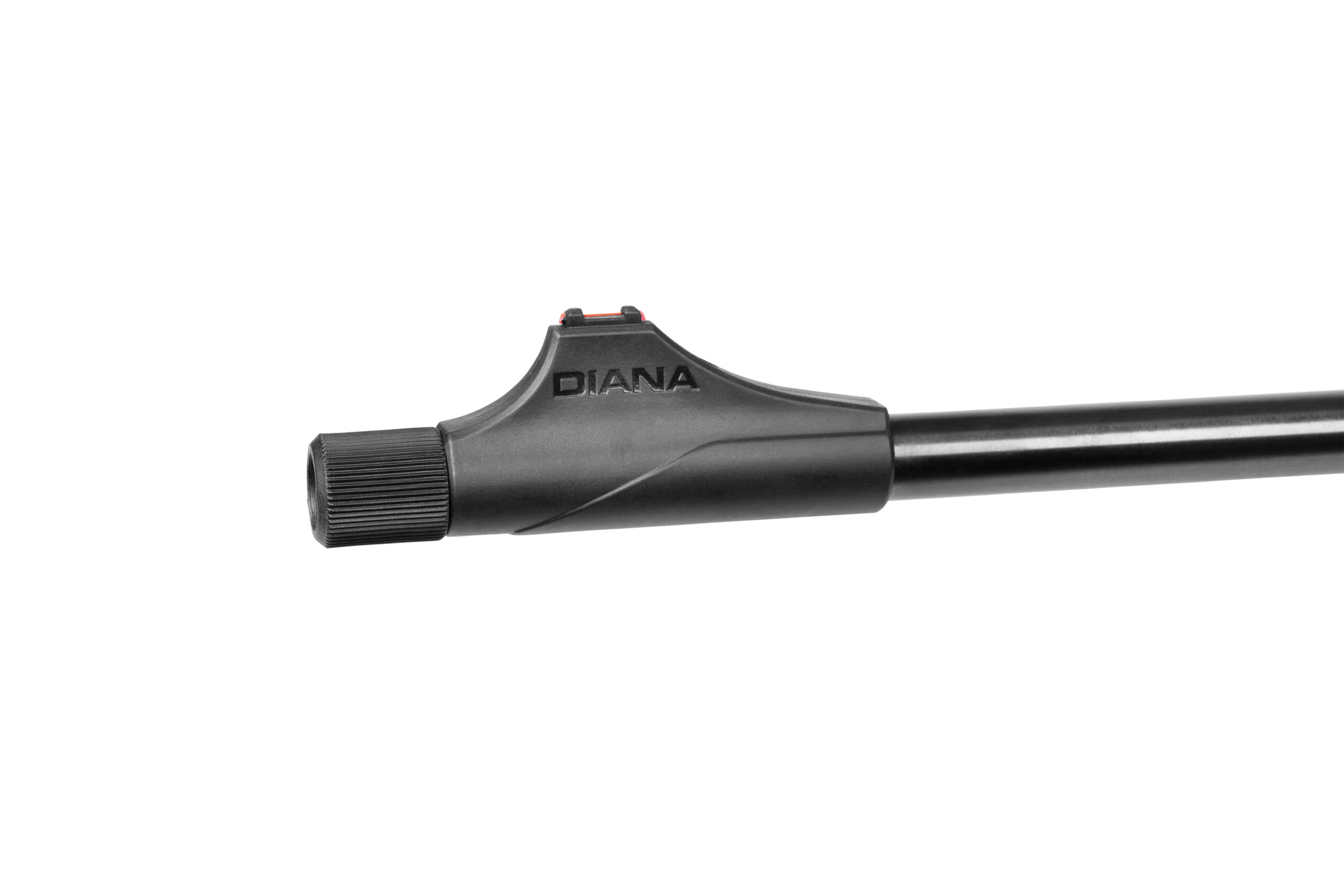



DIANA 34 EMS Black
€200.00
Product information “DIANA 34 EMS Black”
The DIANA 34 EMS stands out with its high modularity and customizable features.
Thanks to the interchangeable sights, the air rifle can be perfectly adjusted to the shooter’s needs.
The adjustable barrel alignment with an improved locking mechanism ensures greater shooting precision.
Additionally, the barrel with a 1/2” UNF muzzle thread can be easily swapped and fitted with a
suppressor.
The two-piece cocking lever with polymer-coated inlays provides a smoother handling experience.
Furthermore, the rifle is compatible with a gas spring, which enables an even smoother cocking mechanism
by N_TEC and constant shooting performance.
The DIANA 34 EMS sets new standards in flexibility and customization.
Features
- All weather synthetic stock
- Improved cocking mechanism
- Convertable to N_TEC gas piston
- Adjustable barrel alignment with improved locking mechanism
- T06 precision trigger, individually adjustable (trigger pull, pressure point, trigger weight)
- Automatic safety against unintentional shooting
- Fiber optic sights, adjustable & interchangeable for optimized sight conditions
- Milled 11mm rail for riflescopes or red dot sights
- Ideal for beginners & experienced shooters
Technical specifications Material Polymer Caliber 4.5 mm (.177) Type of shot Diabolo Magazine capacity 1 piece Feed type Spring-loaded Type of string Classic broken Overall length 1158 mm Barrel length 495 mm Weight 3380 g Color Black
DIANA 34 EMS Black Air Rifle: Modular Break-Barrel Engineering, Adjustable Precision, and All-Weather Performance
Why Choose the DIANA 34 EMS Black?
The primary reason to choose this air rifle diana platform is its balance of proven spring-piston operation and modern adaptability. A conventional springer usually provides a fixed combination of stock, sights, barrel, and power system. However, this rifle was developed around replaceable and adjustable components.
Its weather-resistant polymer stock supports outdoor use without requiring the same moisture protection as an untreated wooden stock. Furthermore, the improved two-piece cocking linkage uses polymer-coated inserts to promote quieter and more comfortable handling. The rifle is also compatible with the manufacturer’s N_TEC gas-ram conversion system.
Shooters researching diana air rifles, rws diana air rifle, diana pellet gun, or Buy Diana air rifle products will find that this model suits target practice, recreational marksmanship, training, and lawful field applications where its caliber and energy are permitted.
How Does the Break-Barrel System Work?
The barrel functions as the cocking lever. When the shooter pivots it downward, the internal spring and piston mechanism are compressed. A pellet is placed directly into the open breech, after which the barrel is returned to its locked position.
Pulling the trigger releases the piston, which compresses air behind the pellet and drives it through the rifled barrel. Therefore, this Diana break barrel air rifle does not require a pump, compressor, removable cylinder, or charging bottle.
Unlike a pcp air gun, the rifle generates the energy for each shot mechanically. This independent operation makes the air gun practical for owners who prefer straightforward equipment and minimal supporting hardware.
How Good Is DIANA Air Rifle Accuracy?
Diana air rifle accuracy depends on barrel alignment, pellet compatibility, trigger control, sight adjustment, and consistent shooting technique.
The EMS design incorporates adjustable barrel alignment with an improved locking mechanism. This feature helps maintain a consistent relationship between the barrel and receiver after every cocking cycle. Additionally, the individually adjustable T06 trigger allows changes to first-stage travel, release point, and trigger weight.
The diana 34 ems fiber optic sights are adjustable and interchangeable, helping shooters acquire targets in changing light. A milled 11mm rail also accepts compatible scopes or red-dot sights. Because a powerful spring mechanism creates a bidirectional recoil impulse, any optic should be rated for spring-powered use.
Where and When Should It Be Used?
The rifle is suitable for controlled target ranges, authorized private land, supervised training areas, and lawful outdoor sporting environments with a reliable backstop.
A Diana air rifle .177 configuration generally favors flatter trajectories and economical target practice. In contrast, a Diana air rifle .22 configuration uses a heavier projectile and provides greater listed muzzle energy.
Where local law permits Diana air rifle hunting, users must select suitable ammunition, understand the rifle’s practical range, and follow all licensing, quarry, power, and land-access regulations. The rifle should never be discharged without a safe target area and an effective pellet trap or backstop.
Important Engineering Features
The modular barrel can be changed, and its 1/2-inch UNF muzzle thread can accept lawful compatible accessories where permitted. The improved cocking mechanism promotes smoother handling, while the automatic safety helps reduce the possibility of an unintended shot.
The rifle’s core features include:
- All-weather synthetic stock
- Adjustable T06 two-stage trigger
- Improved barrel-locking mechanism
- Adjustable barrel alignment
- Interchangeable fiber-optic sights
- Milled 11mm optics rail
- N_TEC gas-ram compatibility
- Single-shot break-barrel action
- .177 and .22 caliber availability
These features make the diana 34 ems adaptable for beginners and experienced shooters alike.
Comparison with Other DIANA Models
The diana 34, diana r34, diana 34 air rifle, and repeated buyer phrase Diana 34 air rifle refer to the wider Model 34 family. The Black EMS version differs through its modular sighting system, adjustable barrel interface, synthetic stock, and conversion options.
The diana 250, diana 250 air rifle, and diana two fifty occupy a more accessible sporting category. Meanwhile, the diana 350 magnum and diana 350 magnum air rifle emphasize higher spring-powered performance.
The diana 48 and diana mod 48 use a fixed-barrel sidelever layout, whereas the diana rws 460 magnum uses an underlever system.
The diana r22 belongs to a separate modern rifle category. Therefore, buyers should compare propulsion method, caliber, stock type, weight, cocking effort, and intended application before ordering.
Rifle and Pistol Search Differences
A diana air pistol uses handgun-style ergonomics and should not be confused with this full-length rifle. The lp8 diana is a recognizable break-barrel pistol, while searches for diana chaser parts and diana chaser accessories relate to the modular CO₂-powered Chaser range.
Similarly, the general phrase diana pellet gun may describe several rifles or pistols. Confirming the exact model prevents buyers from ordering incompatible sights, seals, barrels, or stock components.
Comparison with Premium Pneumatic Platforms
Some shoppers compare traditional springers with high end air rifles from FX. Frequent searches include fx dynamic, fx maverick, impact m4, fx pcp, fx crown, fx crown mk2, fx crown mkii, and the spelling variation fx crown mkll.
Additional comparison terms include fxpanthera, fx m3 airgun, fx wildcat mk3, fx leopard air rifle, fx impact m4 for sale, and fx usa. These platforms use stored compressed air and differ greatly in recoil behavior, loading systems, air capacity, tuning, and maintenance requirements.
An fx pocket chronograph can measure projectile speed, while impact m4 ballistic coefficient relates to projectile aerodynamics rather than a permanent rifle specification. Likewise, fx pellets and fx halo slugs should not automatically be assumed suitable for this spring-powered barrel. Caliber, weight, length, and manufacturer guidance must be checked first.
The Scandinavian word luftgevær simply means air rifle and may appear in European search results.
Final Section 1 Evaluation
The DIANA 34 EMS Black offers an effective combination of traditional mechanical independence and contemporary modular design. Its synthetic stock withstands changing conditions, while its adjustable barrel interface, interchangeable sights, refined trigger, improved locking mechanism, and optics rail support accurate, personalized setup.
For shooters seeking a durable air rifle, a proven Diana springer air rifle, or a configurable sporting platform without external charging equipment, the 34 EMS Black provides an authoritative blend of reliability, precision, usability, and long-term adaptability.
Advanced Engineering, Mechanical Performance, and Practical Shooting Experience
Engineered for Reliable Performance
A well-designed sporting rifle begins with a carefully engineered mechanical system that emphasizes consistency, durability, and ease of operation. Every component is manufactured to work together with minimal tolerance variation, allowing the rifle to perform reliably throughout thousands of shooting cycles.
The receiver, barrel, trigger assembly, cocking linkage, and locking mechanism function as one integrated system rather than separate parts. This coordinated design improves operational smoothness while minimizing unnecessary mechanical stress during repeated use.
Careful machining also contributes to dependable long-term performance by reducing internal friction and maintaining proper component alignment.
Efficient Spring-Piston Power Delivery
Mechanical efficiency plays an essential role in achieving consistent accuracy.
During the firing cycle, stored spring energy drives the piston forward, rapidly compressing air inside the compression chamber. The resulting air pressure propels the projectile through the barrel with remarkable consistency.
Stable power delivery allows each shot to begin under nearly identical internal conditions, helping reduce unnecessary velocity variation between shots.
When maintained correctly, this efficient operating cycle provides dependable performance throughout years of regular shooting.
Precision Barrel Construction
The barrel remains one of the most important contributors to practical accuracy.
Its carefully manufactured internal dimensions guide every projectile through a uniform path while the rifling imparts controlled rotational spin that stabilizes flight after leaving the muzzle.
Maintaining precise bore geometry helps minimize unpredictable deviations and supports consistent point-of-impact performance across varying shooting distances.
Combined with quality ammunition and disciplined shooting technique, a precision barrel establishes the foundation for repeatable accuracy.
Improved Mechanical Consistency
Reliable operation depends upon consistent interaction between all moving components.
Proper barrel alignment, secure locking surfaces, controlled piston movement, and stable trigger engagement contribute to repeatable performance throughout every firing cycle.
Reducing unnecessary movement within the action allows the rifle to maintain consistent mechanical behavior over extended periods of regular use.
This level of consistency improves shooter confidence while supporting predictable shot placement.
Trigger Characteristics and Control
Accurate shooting begins with disciplined trigger control.
A smooth and predictable trigger encourages gradual pressure application without disturbing the sight picture immediately before discharge.
Proper trigger technique minimizes unwanted movement while improving consistency from one shot to the next.
Developing disciplined trigger control frequently produces greater improvements in practical accuracy than changing optics or other accessories.
Ergonomic Design
Comfort directly influences shooting performance.
Proper stock geometry supports natural shoulder placement while encouraging consistent cheek position and comfortable hand alignment.
Balanced weight distribution reduces fatigue during prolonged practice sessions, allowing shooters to maintain stable body positioning over extended periods.
Whether shooting from a standing position, seated rest, prone position, or shooting bench, comfortable ergonomics promote repeatable body alignment and improved control.
Managing the Recoil Cycle
Spring-powered rifles generate a distinctive firing cycle that differs from many other propulsion systems.
Both rearward and forward movement occur as internal mechanical components complete their operating sequence.
Rather than attempting to eliminate this movement entirely, experienced shooters often develop a relaxed and repeatable shooting technique that allows the rifle to complete its natural firing cycle consistently.
This approach frequently produces tighter shot groups while improving overall shooting consistency.
Optical Performance
Proper sight alignment remains essential for accurate shooting.
After installing an optical sight, careful zeroing should be completed using the intended ammunition at the preferred shooting distance.
Maintaining consistent eye relief and identical cheek placement minimizes aiming inconsistencies while improving repeatability.
Mounting hardware should be inspected periodically to confirm that alignment remains secure after repeated shooting sessions.
Reliable optical setup contributes directly to long-term accuracy.
External Ballistics
Projectile flight is influenced by several environmental factors immediately after leaving the barrel.
Wind has the greatest effect on horizontal movement, particularly as distance increases.
Additional variables include temperature, humidity, atmospheric pressure, elevation, and available light.
Learning to recognize these changing conditions allows shooters to make thoughtful corrections before each shot rather than relying solely on mechanical adjustments.
Developing environmental awareness is an important step toward consistent marksmanship.
Building Better Shooting Skills
Consistent improvement results from structured practice rather than simply increasing the number of shots fired.
Effective training should emphasize:
- Stable shooting positions.
- Controlled breathing.
- Smooth trigger operation.
- Proper follow-through.
- Consistent head placement.
- Careful observation of shot placement.
- Recording shooting results.
- Gradual adjustment based on performance.
Repeating these fundamentals regularly strengthens confidence while producing measurable improvements in practical accuracy.
Designed for Long-Term Dependability
Durability is achieved through thoughtful engineering, quality materials, and responsible ownership.
Strong mechanical construction allows the rifle to withstand regular use while maintaining dependable operation over an extended service life.
Routine inspections, careful cleaning, appropriate lubrication where recommended, and proper storage help preserve this reliability throughout many years of recreational target shooting, precision practice, competitive training, and other lawful sporting activities.
With disciplined care and continued practice, the rifle remains capable of delivering consistent performance, reliable operation, and an enjoyable shooting experience across countless shooting sessions.
Maintenance, Care, and Long-Term Reliability
Building a Preventive Maintenance Routine
Consistent maintenance is essential for preserving reliability, accuracy, and mechanical efficiency. Even though precision sporting rifles are built from durable materials and carefully machined components, regular care ensures that every part continues to function smoothly throughout years of operation.
After every shooting session, inspect the rifle for dust, fingerprints, moisture, and any visible debris. Wipe all exterior surfaces with a clean microfiber cloth before storing the rifle. This simple practice helps preserve the finish while reducing the possibility of corrosion.
Where appropriate, apply a light protective coating of high-quality gun oil to exposed metal surfaces. Excess lubrication should always be removed because surplus oil attracts dirt and dust that may eventually interfere with moving components.
Routine preventive care significantly extends the operational life of the rifle.
Proper Barrel Maintenance
The barrel deserves special attention because it directly influences long-term precision.
Unlike conventional firearms, air rifles typically leave minimal residue inside the bore. Consequently, excessive cleaning is unnecessary and may temporarily alter shooting consistency until the barrel naturally returns to its preferred condition.
Cleaning should generally be performed only after noticeable changes in accuracy or following an extended number of shooting sessions.
Use pull-through cleaning cords or coated cleaning rods specifically designed for precision air rifles. Soft cleaning patches are usually sufficient for removing accumulated debris without damaging the rifling.
Avoid steel brushes, abrasive compounds, or aggressive solvents because they may shorten barrel life and reduce accuracy.
Caring for the Power System
The internal powerplant relies on precisely fitted components working together efficiently throughout every firing cycle.
Avoid dry-firing because releasing the mechanism without a projectile may place unnecessary stress on internal components.
Likewise, avoid leaving the rifle cocked for extended periods. Keeping the spring under continuous compression longer than necessary may gradually reduce its long-term efficiency.
Operate the cocking mechanism smoothly without forcing any movement. Controlled operation reduces unnecessary wear while helping preserve mechanical consistency.
Inspecting Mechanical Components
Routine inspection allows developing issues to be identified before they become costly repairs.
Regularly examine:
- Barrel locking mechanism.
- Cocking linkage.
- Trigger assembly.
- Safety mechanism.
- Receiver attachment points.
- Pivot bolts.
- Stock fasteners.
- Sight mounting hardware.
If any component becomes loose, correct it according to the manufacturer’s recommendations before further use.
Frequent inspections improve both reliability and operational safety.
Protecting Exterior Surfaces
Maintaining exterior components preserves both appearance and durability.
After use in humid, wet, or dusty conditions, dry all exposed surfaces thoroughly before storage.
Synthetic components require only basic cleaning using a soft cloth and mild cleaning products intended for sporting equipment.
Metal surfaces should be inspected regularly for signs of corrosion or finish wear. Early treatment of minor cosmetic damage helps prevent more significant deterioration over time.
Proper exterior care contributes to both appearance and long-term value.
Safe Storage Practices
Correct storage significantly extends service life.
Always store the rifle unloaded inside a secure cabinet, safe, or protective case where unauthorized access is prevented.
Choose a storage location with stable temperature and low humidity whenever possible.
Avoid prolonged exposure to direct sunlight, excessive heat, or damp environments because changing environmental conditions may negatively affect both metal and synthetic materials.
If the rifle remains unused for an extended period, inspect it periodically to ensure that no corrosion or environmental damage has developed.
Preserving Long-Term Accuracy
Maintaining consistent accuracy requires attention to both equipment and technique.
Projectiles should remain clean, undamaged, and stored appropriately before use.
Optics and sighting equipment should be inspected regularly to verify that mounting hardware remains secure and correctly aligned.
Environmental conditions such as wind, humidity, temperature, lighting, and elevation should always be considered when evaluating shooting performance because each influences projectile flight differently.
Maintaining a shooting log helps identify combinations of ammunition, distance, and environmental conditions that consistently produce the most accurate results.
Pre-Shooting Inspection Checklist
Before every shooting session, complete a brief inspection to confirm safe and reliable operation.
Recommended checks include:
- Confirm all visible screws remain secure.
- Inspect the barrel for obstructions.
- Verify correct safety operation.
- Check trigger movement.
- Confirm the barrel locks securely.
- Examine the stock for visible damage.
- Verify sight alignment.
- Ensure the rifle is clean and dry.
These inspections require only a few minutes while significantly improving confidence and operational reliability.
Safe Maintenance Procedures
Every maintenance procedure should begin with a complete safety check.
Always verify that the rifle is unloaded before performing any cleaning or inspection.
Keep the muzzle pointed in a safe direction throughout the maintenance process.
Wear appropriate eye protection whenever working around mechanical assemblies or spring-loaded components.
Avoid disassembling internal powerplant components without proper tools, technical knowledge, and manufacturer guidance. If unusual resistance, excessive vibration, or mechanical damage is observed, discontinue use until appropriate repairs have been completed.
Extending Service Life
Long-term reliability depends upon responsible ownership and consistent preventive care.
Routine cleaning, regular inspections, proper lubrication where appropriate, careful handling, and suitable storage conditions all contribute to dependable performance throughout many years of regular use.
Minor maintenance concerns should always be addressed promptly before they develop into more significant mechanical problems.
Owners who establish disciplined maintenance habits often experience smoother operation, improved reliability, fewer unexpected interruptions, and lower long-term maintenance costs.
Benefits of Responsible Care
Preventive maintenance provides lasting benefits beyond preserving appearance.
Regular care helps maintain mechanical consistency, protects precision components, reduces unnecessary wear, and extends overall equipment life.
Combined with responsible handling and structured practice, these maintenance habits allow the rifle to continue delivering dependable performance, repeatable accuracy, and an enjoyable shooting experience throughout years of recreational target shooting, precision training, organized competitions, and other lawful sporting activities.
Buying Guide, Ownership Experience, and Final Evaluation
Choosing the Right Sporting Rifle
Selecting the ideal sporting rifle requires careful evaluation of your intended use, experience level, preferred shooting style, and long-term expectations. Rather than focusing solely on power or velocity, buyers should also consider ergonomics, build quality, ease of maintenance, and overall reliability.
Those who enjoy recreational target shooting often benefit from a rifle that provides comfortable handling and consistent accuracy. Enthusiasts who practice regularly may appreciate refined trigger characteristics, dependable construction, and balanced weight distribution. Choosing equipment that matches your personal goals creates a more satisfying ownership experience while reducing the need for future upgrades.
Understanding Long-Term Value
A quality sporting rifle should be viewed as a long-term investment rather than a temporary purchase.
Well-engineered equipment typically delivers years of dependable service when combined with responsible ownership and routine maintenance. High-quality materials, precision machining, and durable internal components contribute to lower maintenance requirements and improved reliability throughout the rifle’s lifespan.
Although premium equipment may require a greater initial investment, the long-term benefits often include greater consistency, reduced repair costs, and higher overall satisfaction.
Developing Strong Marksmanship Skills
Excellent equipment performs best when supported by disciplined shooting technique.
Consistent improvement comes from practicing the same fundamental skills during every shooting session.
Key areas to develop include:
- Stable body positioning.
- Proper shoulder placement.
- Controlled breathing.
- Smooth trigger control.
- Consistent head alignment.
- Follow-through after each shot.
- Careful observation of impact points.
- Gradual correction based on shooting results.
Developing these habits steadily produces measurable improvements in both confidence and precision.
Planning Effective Practice Sessions
Organized practice sessions provide far greater value than simply firing large numbers of shots.
Begin every session by confirming that equipment is functioning correctly and that the shooting area remains safe.
Establish realistic goals before starting practice, such as improving group size, refining trigger control, or maintaining consistent body positioning.
Rather than making large adjustments after every shot, evaluate shot groups before deciding whether corrections are necessary.
Recording distances, weather conditions, ammunition used, and shooting observations creates valuable reference material that supports continued improvement.
Choosing Quality Accessories
Appropriate accessories enhance both convenience and overall shooting performance.
A dependable optical sight improves target visibility and aiming precision, while secure mounting hardware helps maintain consistent alignment during repeated use.
Support equipment such as shooting rests, bipods, protective carrying cases, cleaning kits, and secure storage solutions contributes to a more enjoyable ownership experience while protecting the rifle from unnecessary wear.
Selecting durable accessories from the beginning often improves long-term reliability and overall value.
Understanding Environmental Conditions
Outdoor shooting conditions constantly change, and every environmental factor influences projectile flight.
Wind has the greatest impact on horizontal movement, particularly at longer distances.
Temperature, humidity, atmospheric pressure, elevation, and lighting conditions also affect trajectory and target visibility.
Learning to recognize these changing conditions before every shot helps shooters make thoughtful corrections while improving consistency under real-world circumstances.
Environmental awareness gradually becomes an important part of advanced marksmanship.
Responsible Ownership
Owning precision sporting equipment carries important responsibilities.
Always store the rifle unloaded inside a secure cabinet, safe, or protective case that prevents unauthorized access.
Transport the rifle safely while following all local laws and regulations governing transportation and use.
Before beginning any shooting session luftgevær, verify that the target area includes a suitable backstop capable of safely stopping every projectile.
Remain aware of nearby people, animals, structures, vehicles, and surrounding property throughout every shooting activity.
Responsible ownership protects both the shooter and the wider sporting community.
Protecting Your Investment
Routine preventive maintenance remains one of the most effective ways to preserve long-term performance.
Cleaning after use, inspecting moving components, protecting exposed surfaces, and storing the rifle under suitable environmental conditions all contribute to dependable operation over many years.
Small maintenance concerns should always be corrected promptly before developing into larger mechanical issues.
Preventive care not only preserves reliability but also helps maintain the rifle’s appearance and long-term value.
Who Will Benefit Most?
This rifle is an excellent choice for individuals who appreciate dependable engineering, practical design, and consistent target performance.
Its comfortable handling and reliable operation make it suitable for recreational shooters, experienced enthusiasts, and individuals seeking long-term equipment for regular practice and skill development.
The combination of durable construction, balanced ergonomics, and dependable mechanical performance supports a wide variety of target shooting activities while providing an enjoyable ownership experience.
Final Thoughts
A premium sporting rifle represents more than precision engineering alone. Its true value comes from combining thoughtful design with disciplined practice, responsible ownership, and consistent maintenance.
Shooters who dedicate time to refining their technique, maintaining their equipment properly, and following established safety principles will enjoy dependable performance for many years. With its durable construction, reliable operation, comfortable handling, and lasting mechanical consistency, this rifle offers an outstanding foundation for recreational target shooting, precision practice, organized competitions, and other lawful sporting activities while continuing to reward careful owners throughout its service life.
Be the first to review “DIANA 34 EMS Black”
Related products


Diana Air Rifles


Diana Air Rifles
Diana Air Rifles
Reviews
There are no reviews yet.