
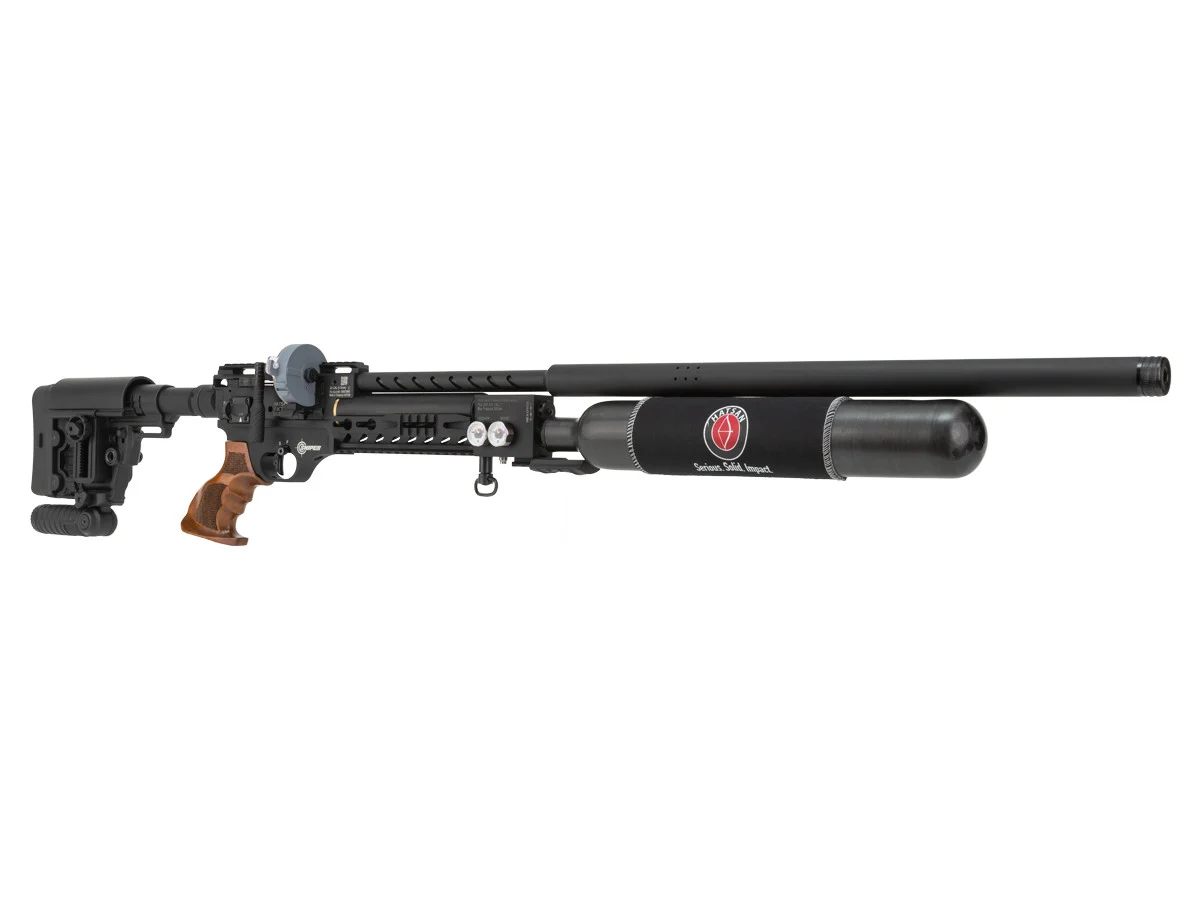





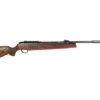
Hatsan Factor Sniper Long

€950.00
Description
The Hatsan Factor Sniper Long PCP Air Rifle is designed for maximum performance for long-range precision shooting such as benchrest and other competitive disciplines. Capable of power up to 81 FPE in .22, 115 FPE in .25, 157 FPE in .30, and 169 FPE in .35, this air rifle delivers on its promise of remarkable performance for activities including target shooting, hunting, and pest control.
This air rifle includes a removable 700cc carbon fiber air bottle that fills to 4,351 PSI/300 BAR to yield up to 100 shots at optimal velocity* in .22, 80 shots in .25, and 70 shots in .30 and .35. In addition, it has integrated pressure gauges on the side that conveniently show both the regulator pressure and the fill pressure.
The Hatsan Factor Sniper Long has features designed to optimize its versatility, including an externally adjustable regulator for consistent shot velocities and an externally-adjustable hammer preload dial for tuning. It also provides quiet accuracy because of its QuietEnergy fully-shrouded barrel with integrated moderator, which is precision rifled and choked, and the 1/2″ UNF threads for adding an external moderator.
For durability and accuracy, the air rifle has an aluminum frame with an integrated combination 11mm dovetail and Weaver/Picatinny optics rail, as well as an aluminum trigger guard and blade. The two-stage Quattro Trigger is fully-adjustable and has a horizontal and vertical shoe adjustment, and the sidelever is reversible for ambidextrous use.
The stock uses a mil-spec telescoping buffer tube and has an elevation-adjustable ridged rubber recoil pad, an adjustable cheekpiece, and an integrated folding monopod on the buttstock, in addition to a textured ergonomic wood pistol grip. To get an adaptable airgun with features designed for comfort and outstanding long-range accuracy, buy the Hatsan Factor Sniper Long PCP Air Rifle from Pyramyd AIR today.
Hatsan Factor Sniper Long PCP Air Rifle
- Precharged pneumatic
- Repeater
- Reversible sidelever
- Externally-adjustable regulator
- Precision rifled and choked barrel
- Fully-shrouded QuietEnergy barrel with integrated moderator
- Fitted muzzle cap with 1/2″ UNF threads (.22/.25 cal)
- Fitted muzzle cap with M14 x 1.25 threads (.30/.35 cal)
- Removable 700cc carbon fiber bottle, plus 100cc pre-air chamber
- 4,351 PSI/300 BAR max. fill pressure
- Shots at optimal velocity*: 100 (.22), 80 (.25), 70 (.30, .35)
- Magazine capacity: 21 rounds (.22), 19 rounds (.25), 16 rounds (.30), 13 rounds (.35)
- Max. velocity (lead pellets): 1050 FPS (.22), 1075 FPS (.25), 940 FPS (.30), 970 FPS (.35)
- Max. energy: 81 FPE (.22), 115 FPE (.25), 157 FPE (.30), 169 FPE (.35)
- Externally-adjustable hammer preload
- 2-stage adjustable Quattro Trigger
- Vertical and horizontal trigger shoe adjustment
- Mil-spec telescoping buttstock with built-in folding monopod
- Textured ergonomic wood pistol grip
- Adjustable cheekpiece
- Elevation-adjustable ridged rubber buttpad
- Aluminum frame with integrated combination 11mm dovetail and Weaver/Picatinny optics rail
- Picatinny accessory rails
- Patented anti-knock system to prevent accidental discharge
- Manual safety
- Foster quick-disconnect male fill port
- Regulator and fill pressure manometers
- Includes female Foster fill adapter, multi-tool, two magazines, and hard shell case
- Barrel length: 30″
- Overall length: 46.5″- 49.6″
- Weight: 13 lbs.
Specifications
BrandCaliber.22 (5.5mm)Max Velocity1050 fpsMuzzle Energy81 ft/lbsSuggested forSmall game hunting/target practicePowerplantPre-charged pneumaticLoudness3-MediumWeight13.0 lbsFunctionRepeaterMax Shots per Fill100Cylinder Size700 ccActionSideleverFixed/adj. powerMultiple settingsShroudedYesScopeableWeaver & 11mm dovetailsFront SightsnoneRear SightsnoneSafetyManualTriggerTwo-stage adjustableBarrelRifledBarrel Length30.0″Overall Length42.9″Capacity21 round(s)Body TypeRifleStockSyntheticButtplateRubberColorBlackOperating Pressure4351 PSI / 300 BARGrip OrientationAmbidextrousRegulatedYesIs Safe To Dry FireYes
Hatsan Factor Sniper Long – 700cc Carbon-Fiber PCP Power, 30-Inch Precision Barrel and Externally Adjustable Regulation
The Hatsan Factor Sniper Long, officially listed as the Factor Sniper L, is a large-format precision PCP air rifle built for shooters who want substantial air capacity, a long barrel, extensive external adjustment and a highly configurable shooting platform.
Rather than following the simpler layout of a basic PCP, this model combines a 700cc detachable carbon-fiber air bottle, 300-bar maximum fill pressure, externally adjustable regulator, externally adjustable hammer preload and a 100cc pre-air chamber. Therefore, the shooter receives considerably more control over the rifle’s operating behavior than is offered by many fixed-setting pneumatic designs.
The rifle is offered in .22/5.5mm, .25/6.35mm, .30/7.62mm and .35/9mm configurations. Hatsan lists a long 760mm / 30-inch precision-rifled and choked steel barrel, helping distinguish the Long version from the shorter Factor and Factor Sniper S platforms.
700cc Carbon-Fiber Air Bottle
One of the defining features of the Factor Sniper Long is its 700cc detachable carbon-fiber bottle.
The substantial capacity supports extended shooting sessions while carbon-fiber construction helps manage the weight that would otherwise come with such a large air reservoir.
A spare compatible bottle can also be used where appropriate, while the detachable design simplifies inspection and servicing.
300-Bar Maximum Fill Pressure
The Factor Sniper Long operates with a maximum fill pressure of 300 bar.
This gives the rifle considerably more stored air than the standard Factor, which Hatsan currently lists with a 500cc bottle and 250-bar fill pressure.
Because this is a high-pressure system, properly rated filling equipment and clean, dry compressed air are essential.
100cc Pre-Air Chamber
The rifle incorporates a 100cc pre-air chamber.
This works with the regulated pneumatic system to provide a controlled supply of air for each shot.
Combined with the adjustable regulator, it gives experienced users a more sophisticated platform for maintaining consistent performance.
Externally Adjustable Regulator
The regulator can be adjusted externally.
A separate gauge is provided to monitor regulator pressure, while another gauge monitors cylinder pressure.
This arrangement allows the shooter to distinguish between stored bottle pressure and regulated working pressure.
For consistent results, adjustments should be made gradually and within manufacturer guidance rather than simply chasing maximum output.
External Hammer-Preload Adjustment
Hammer preload can also be adjusted externally.
This provides another way to refine valve behavior.
However, the most useful setting is not necessarily the strongest one.
A balanced configuration should emphasize consistency, pellet compatibility and efficient air use.
Side-Lever PCP Action
The rifle uses a manual side-lever action.
This keeps the loading movement close to the firing position and creates a deliberate shooting rhythm.
The cocking handle is also reversible, allowing the action to be configured for different shooter preferences.
30-Inch Precision Barrel
The 760mm / 30-inch barrel is one of the most distinctive characteristics of the Long model.
The barrel is precision rifled and choked.
The extra barrel length gives the pneumatic system more space to deliver controlled acceleration while maintaining the rifle’s long-range-oriented physical format.
However, precision still depends on pellet or slug compatibility, optic setup, pressure consistency and shooter technique.
QuietEnergy Fully Shrouded Barrel
The barrel is fully shrouded with Hatsan’s QuietEnergy system.
Hatsan states that its integrated sound moderation system is designed to reduce firing report by approximately 50 percent.
The muzzle is also threaded 1/2-inch UNF for an additional compatible moderator where ownership and use are lawful.
High-Capacity Magazine System
Magazine capacity varies by calibre.
Hatsan lists:
- 21-shot standard magazine in .22
- 19-shot standard magazine in .25
- 16-shot standard magazine in .30
- 13-shot magazine in .35
The manufacturer also lists higher-capacity magazine configurations for selected calibres, while two magazines are included with the rifle.
.22 Calibre Performance
The .22 version is listed with energy up to approximately 133 joules / 98 ft-lb under unrestricted manufacturer specifications.
Hatsan lists about 100 shots at optimal velocity under its test conditions.
Actual performance will depend on projectile selection, regulator configuration and regional restrictions.
.25 Calibre Performance
The .25 version is listed at up to approximately 156 joules / 115 ft-lb.
The manufacturer lists approximately 80 shots at optimal velocity under its testing conditions.
.30 Calibre Performance
The .30 configuration increases projectile diameter and is listed at up to approximately 213 joules / 157 ft-lb.
Hatsan lists around 70 shots at optimal velocity under the stated test configuration.
.35 Calibre Performance
The .35 version represents the largest listed calibre.
Hatsan specifies energy up to approximately 229 joules / 169 ft-lb, again subject to projectile choice, regulator setting and applicable regional restrictions.
Adjustable Tactical Stock
The rifle uses a modular precision buttstock.
The cheek rest can be adjusted for elevation.
A rubber buttpad provides comfortable shoulder contact.
These adjustments help the shooter establish a more repeatable relationship between the eye, optic, shoulder and trigger.
Ergonomic Grip Options
Hatsan lists both an ergonomic wood grip and soft rubber pistol-grip configuration.
A natural wrist angle can reduce unnecessary tension.
This becomes increasingly important on a rifle that weighs approximately 5kg / 11.1lb without accessories.
Quattro Adjustable Match Trigger
The Factor Sniper Long uses Hatsan’s Quattro two-stage adjustable match trigger.
Trigger travel and trigger load can be adjusted.
The trigger shoe can also be adjusted vertically and horizontally.
This allows the trigger position to be fitted more naturally to the shooter’s hand.
Optic Mounting System
The aluminum chassis includes integrated mounting compatibility for 11mm and 22mm optics.
An additional Picatinny rail is located beneath the fore-end.
This provides flexibility for a compatible scope and lawful support accessories.
Overall Size and Weight
The rifle measures approximately:
- 1180mm / 46.5 inches with the stock shortened
- 1260mm / 49.6 inches with the stock extended
- 760mm / 30-inch barrel
- 5kg / 11.1lb average weight
These dimensions clearly place the rifle in the large, precision-oriented PCP category.
Why the Long Configuration Matters
The Long version is designed for shooters who prefer the combination of a large reservoir and extended barrel.
Compared with the shorter Factor Sniper S, which uses a 585mm barrel and 480cc bottle, the Long version increases barrel length to 760mm and bottle volume to 700cc.
That difference makes the Long particularly suitable for supported precision shooting where overall size is less important than stability and air capacity.
How to Achieve Consistent Precision
Consistency should be approached methodically.
Choose one projectile.
Begin from a similar bottle pressure.
Keep regulator settings stable.
Keep hammer preload unchanged during projectile comparisons.
Use the same optic.
Maintain the same stock position.
Fire multiple groups.
Record the results.
Only one variable should be changed at a time.
Why Maximum Output Is Not Always Best
A high-capacity adjustable PCP allows significant performance variation.
However, the highest possible output is not automatically the most useful setting.
Higher air consumption can reduce shot count.
A projectile may also perform more consistently at a lower setting.
For precision work, grouping and repeatability should remain the main priorities.
CARABINA HATSAN PCP BT65 SB ELITE Comparison
Buyers researching CARABINA HATSAN PCP BT65 SB ELITE or hatsan bt65.25 specifications may also encounter the Factor Sniper Long.
Both are PCP platforms, but they use very different architectures.
The Factor Sniper Long provides a 700cc carbon bottle, externally adjustable regulator, external hammer preload and a substantially different chassis system.
Hatsan Air Rifle Search Context
Searches for hatsan air rifle, hatsanusa, hatsan usa, hatsan, and hatsan refurbished cover many different products.
The Factor Sniper Long should be identified specifically by its 700cc carbon bottle, 300-bar fill system, 760mm barrel and externally adjustable regulator.
Hatsan Factor Family Comparison
The standard Factor uses a 500cc aluminum bottle, 250-bar fill pressure and 585mm barrel, whereas the Factor Sniper Long increases bottle capacity, operating pressure and barrel length.
This makes the Long a clearly different configuration rather than simply a cosmetic variation.
Hatsan Sortie Comparison
Searches for hatsan sortie, hatsan sortie tact, hatsan sortie tact semi-auto pcp, and hatsan sortie threaded adapter relate to a semi-automatic platform.
The Factor Sniper Long instead uses a manual side lever.
Their specifications and operating systems should not be mixed.
Hatsan Velox Comparison
The hatsan velox belongs to a more compact pneumatic category.
The Factor Sniper Long is substantially larger and built around extended air capacity and a much longer barrel.
Hatsan Jet and Jet 2 Comparison
The hatsan jet, hatsan jet 2, and hatsan jet i pcp .22 caliber pellet rifle kit belong to Hatsan’s compact modular PCP range.
The Factor Sniper Long is a full-size precision platform and provides a very different shooting experience.
Hatsan Flash Comparison
The hatsan flash is lighter and mechanically simpler.
The Factor Sniper Long provides substantially more air capacity, external regulator adjustment and a longer barrel.
Hatsan BullBoss and FlashPup QE Comparison
The hatsan bullboss and hatsan flashpup qe use compact bullpup layouts.
They prioritize shorter overall dimensions.
The Factor Sniper Long instead prioritizes air capacity, barrel length and a full-size precision chassis.
Hatsan Hercules and Hercules Bully Comparison
The hatsan hercules, hatsan hercules bully, and hercules bully air rifle also belong to Hatsan’s high-capacity PCP family.
However, their reservoir arrangements, dimensions and mechanical architecture differ.
Their specifications should not be transferred to the Factor Sniper Long.
Hatsan Harpoon and Piledriver Comparison
The hatsan harpoon and hatsan piledriver belong to specialized high-output product categories.
Their calibre ranges and design goals differ from the Factor Sniper Long.
Hatsan Invader and Neutron Star Comparison
Searches for hatsan invader and hatsan neutron star lead to other pneumatic platforms.
The Factor Sniper Long distinguishes itself through its externally adjustable regulator, long barrel and large carbon bottle.
Hassan Blitz Comparison
The phrase hassan blitz is commonly used as a misspelling of the Hatsan Blitz.
The Blitz family uses rapid-cycling pneumatic operation.
The Factor Sniper Long instead uses deliberate manual side-lever cycling.
Hatsan Model 95, Mod 95 and 135 Comparison
The hatsan model 95, hatsan mod 95, hatsan 95, model 95, hatsan 135, hatsan airtact air rifle, and hatsan mod 25 refer mainly to spring or gas-piston platforms.
They do not use the same pre-charged pneumatic architecture.
Therefore, their cocking, recoil and maintenance characteristics differ considerably.
Air Pellet Gun and CO2 Pellet Rifle Comparison
The broad search phrase air pellet gun covers many types of airgun.
A co2 pellet rifle uses a completely different gas source.
The Factor Sniper Long relies on a high-pressure pre-charged air system rather than CO2.
H&N Field Target Trophy and Projectile Selection
The phrase h&n field target trophy often appears during pellet research.
However, projectile choice should always be determined through actual compatibility testing.
Different barrel, calibre and power configurations can respond differently.
Snowpeak PP750L PCP Air Pistol Comparison
The Snowpeak PP750L PCP Air Pistol, snowpeak pp750, pp750, and snow peak pp750 belong to an entirely different compact PCP category.
They should not be compared directly by dimensions or air capacity with the full-size Factor Sniper Long.
Snowpeak Airgun Search Context
Additional comparison terms include snowpeak airguns, snowpeak sports, snowpeak ap900, snowpeak max, snowpeak p35x, pr900 gen 3, snowpeak p35, snowpeak m60b, snow peak pp20, p35, p35x, p35x pcp, snowpeak m25, ap900b pcp air rifle, snowpeak m60, snowpeak max 1 price, pcp p 35, m25 rifle, snow peak equipment, hp300, pellet 9mm, snowpeak p35 vs p35x, snowpeak pp20, and m25 weapon.
These phrases relate to separate Snowpeak products and broader airgun searches.
They should be used only for comparison and search relevance, not as technical specifications for this rifle.
Why Choose the Hatsan Factor Sniper Long?
The strongest reason to choose this platform is its combination of capacity, adjustability and full-size precision-oriented engineering.
The 700cc carbon-fiber bottle supports extended sessions.
The 300-bar fill pressure provides substantial stored air.
The 100cc pre-air chamber supports the regulated system.
The externally adjustable regulator gives experienced users greater control over operating pressure.
External hammer-preload adjustment provides another tuning variable.
The 760mm barrel gives the Long version its distinctive full-size configuration.
The adjustable stock and cheek rest improve ergonomics.
The side lever provides smooth manual cycling.
The high-capacity magazines reduce interruptions.
The Quattro trigger supports a controlled release.
Where and When the Rifle Makes Sense
The Factor Sniper Long is most appropriate for controlled, lawful recreational target shooting and other permitted sporting applications where a large, supported PCP platform is desirable.
Its size and 5kg weight mean it is not designed primarily around ultralight portability.
Instead, it makes the most sense when stability, long-session air capacity and extensive external adjustment are valued more highly than compact dimensions.
Final Section 1 Assessment
The Hatsan Factor Sniper Long is a highly configurable PCP platform designed around a large 700cc carbon-fiber air bottle, 300-bar fill pressure, 100cc pre-air chamber, externally adjustable regulator, adjustable hammer preload and an unusually long 760mm precision barrel.
Its design provides significant flexibility, but that flexibility is most valuable when used methodically.
Projectile choice should be tested carefully.
Pressure should be monitored.
Regulator and hammer settings should be documented.
The optic should remain secure.
The stock should be adjusted for comfortable eye alignment.
The magazine system should remain clean.
Only one variable should be changed during performance testing.
When these principles are followed, the Factor Sniper Long provides a substantial, sophisticated and precision-oriented PCP platform for experienced shooters seeking high air capacity, extensive adjustability and long-session capability within lawful sporting use.
Precision Setup, Air Management, Ergonomics, Optics and Practical Ownership
Understanding the Rifle as a Precision System
The Hatsan Factor Sniper Long performs best when the shooter treats it as a complete precision platform rather than simply a powerful PCP.
Its large air bottle, regulated pneumatic system, long barrel, side-lever action, adjustable hammer preload, trigger, stock, magazine, and optic all influence the final result.
Because the rifle offers substantial adjustment, the shooter benefits from a disciplined approach.
The same projectile should be used during comparison testing.
The same pressure range should be maintained.
The stock should remain in the same position.
The optic should stay securely mounted.
The same shooting position should be repeated.
Only one adjustment should be changed at a time.
This approach makes the rifle much easier to understand.
Establishing a Reference Configuration
Before changing regulator pressure or hammer preload, a stable reference configuration should be established.
Choose one suitable projectile.
Use one regulator setting.
Leave hammer preload unchanged.
Begin from a similar bottle pressure.
Set the stock and cheekpiece comfortably.
Use the same optic.
Shoot several groups.
Record the results.
This baseline provides something reliable to return to if later experimentation produces worse results.
Why One Variable at a Time Matters
A highly adjustable PCP can quickly become confusing if too many settings are changed together.
If the regulator is altered, hammer preload is increased, a new projectile is loaded, and the scope is adjusted during the same session, the final result becomes difficult to interpret.
A better method is straightforward.
Change one factor.
Shoot several controlled groups.
Record what happened.
Then decide whether another adjustment is necessary.
Projectile Selection
Projectile selection plays a major role in accuracy.
Different weights behave differently.
Head diameter can affect fit.
Shape can influence feeding.
Manufacturing consistency matters.
A projectile that performs well in one barrel may not perform identically in another.
For that reason, several suitable options should be tested.
Projectile Weight
Heavier projectiles generally move more slowly.
Lighter projectiles may produce higher velocity.
However, velocity alone should not determine the final choice.
The most useful option is the one that produces stable groups, predictable air use, and consistent feeding.
Projectile Shape
Shape can influence how smoothly the projectile enters the chamber.
It can also affect aerodynamic behavior.
Some designs may perform better from the long barrel.
Others may feed more reliably from the magazine.
Real target results should guide the decision.
Inspecting Ammunition
Damaged projectiles can create misleading results.
Deformed skirts or irregular shapes may affect sealing.
Dirt can introduce inconsistency.
For serious testing, visibly damaged ammunition should be removed before loading.
Batch Consistency
Different production batches can behave slightly differently.
If a new batch suddenly changes group size, the rifle should not immediately be retuned.
The ammunition itself may be responsible.
Comparing a new batch against a known one can help identify the cause.
Understanding the Large Air Bottle
The rifle’s large carbon-fiber bottle is one of its defining features.
It provides substantial stored air for long shooting sessions.
However, large capacity does not remove the need for pressure management.
The shooter should still learn the range where performance remains most stable.
Consistent Starting Pressure
Accuracy testing becomes more meaningful when each session begins from a similar pressure.
If one test starts from a full bottle and another begins much lower, the results may not be directly comparable.
A consistent starting point removes one important variable.
Learning the Useful Pressure Window
The rifle may perform best within a particular pressure range.
Velocity can remain stable.
Point of impact can stay predictable.
The action can feel consistent.
Once performance begins to change, the rifle may be moving outside its useful range.
Why the Bottle Does Not Need to Be Fully Emptied
The presence of remaining air does not mean every remaining shot will perform identically.
For precision shooting, it is often better to refill once consistency begins to decline rather than trying to use every possible shot.
Filling the Rifle Correctly
Only suitable high-pressure equipment should be used.
Connections should remain clean.
The fill process should be controlled.
The marked pressure limit should never be exceeded.
Why Slow Filling Helps
Rapid filling generates heat.
After the bottle cools, the displayed pressure can drop.
A slower fill generally produces a more stable final reading.
It also reduces unnecessary thermal stress.
Clean and Dry Compressed Air
Clean, dry air helps protect the internal pneumatic system.
Moisture can contribute to corrosion.
Dust can damage seals.
The filling connection should remain protected when not in use.
Fill Fitting Care
The fill connection should remain clean.
Protective caps should be used where supplied.
Dust and grit can damage sealing surfaces.
The fitting should be inspected regularly.
Hose and Coupler Condition
High-pressure hoses should remain in good condition.
Cracks, cuts, or damaged fittings should not be ignored.
Couplers should lock securely.
Questionable equipment should be replaced.
Understanding Regulator Function
The regulator helps control the pressure supplied for each shot.
A stable regulator supports repeatable velocity.
This is one of the most important systems in a precision PCP.
However, it should be adjusted with purpose.
Random changes can reduce consistency instead of improving it.
Regulator Adjustment Strategy
Before changing regulator pressure, the shooter should know what they are trying to achieve.
The goal may be improved efficiency.
It may be better consistency.
It may be compatibility with a particular projectile.
Any change should be small and recorded.
Why Maximum Regulator Pressure Is Not Always Better
More pressure does not automatically produce better accuracy.
Higher settings may increase air consumption.
They may also move a projectile outside the velocity range where it performs best.
For precision work, stable performance matters more than the highest possible output.
Understanding Hammer Preload
Hammer preload influences how the valve is opened.
Small adjustments can change air use and velocity.
The setting should be changed gradually.
Large adjustments make the effect more difficult to understand.
Balancing Hammer and Regulator Settings
The most effective setup usually comes from balance.
The regulator and hammer should work together rather than being pushed to their extremes.
A useful configuration should provide:
Stable velocity.
Good grouping.
Reasonable air consumption.
Predictable shot count.
Smooth firing behavior.
That balance is more valuable than maximum output.
Using the 100cc Pre-Air Chamber
The pre-air chamber supports the regulated system by providing a controlled volume of air for each shot.
The shooter does not need to manipulate this chamber directly during normal use.
Instead, its value appears through consistency.
When the regulator, hammer, and projectile are well matched, the chamber supports a stable firing cycle.
Side-Lever Operation
The side lever should move smoothly.
It should not be forced.
A complete and controlled cycling motion helps ensure reliable loading.
If resistance changes suddenly, the cause should be investigated.
Why Smooth Cycling Matters
Smooth lever operation helps protect projectiles from damage.
It also allows the shooter to maintain position more effectively.
A consistent loading rhythm can improve concentration during long sessions.
Reversible Cocking Handle
The cocking handle can be configured to suit the shooter.
This is useful for left- or right-side preference.
The best position is the one that minimizes unnecessary hand movement and allows comfortable cycling.
Magazine Convenience
The high-capacity magazine reduces interruptions.
The shooter can remain behind the rifle.
The cheek weld can stay consistent.
The support hand can remain stable.
This can improve rhythm during extended target sessions.
Magazine Care
The magazine should rotate smoothly.
Projectiles should sit correctly.
The mechanism should remain clean.
Any unusual resistance should be investigated.
Loading the Magazine
Ammunition should be loaded carefully.
Damaged projectiles should be rejected.
The magazine should not be overfilled.
Any projectile that does not sit properly should be removed rather than forced.
Comparing Multiple Magazines
If several magazines are used, they can be identified individually.
This helps troubleshooting.
If one magazine repeatedly causes feeding problems while another works correctly, the source of the issue becomes easier to isolate.
Long Barrel Behavior
The long barrel gives the rifle its distinctive configuration.
It provides an extended path for controlled acceleration.
However, barrel length alone does not create accuracy.
Projectile compatibility, pressure stability, optic setup, and shooter technique remain important.
Barrel Maintenance
The barrel should not be cleaned automatically after a fixed number of shots.
If accuracy remains stable, frequent cleaning may not be necessary.
Cleaning should be based on actual performance.
Gentle Cleaning
When cleaning becomes necessary, the process should remain careful.
The bore should be protected.
The muzzle should not be damaged.
Suitable equipment should be used.
Barrel Conditioning
A freshly cleaned barrel may require several shots before normal grouping returns.
The shooter should allow the barrel to stabilize before adjusting the optic.
Muzzle Condition
The muzzle should remain clean and protected from impact.
Damage can affect projectile release.
A sudden change in accuracy should include a muzzle inspection.
Shroud Condition
The barrel shroud should remain secure.
Unexpected looseness should be investigated.
A change in firing sound or group behavior can justify inspection.
Trigger Control
The trigger should be pressed smoothly.
The finger should move mainly rearward.
The rest of the hand should remain relaxed.
A sudden pull can disturb the sight picture.
Trigger Finger Position
The trigger finger should contact the blade naturally.
Too much finger can create sideways pressure.
Too little contact can reduce control.
The ideal position supports a straight rearward press.
Trigger Shoe Adjustment
The adjustable trigger shoe can improve ergonomics.
Its position should allow the finger to contact the trigger comfortably.
A natural finger angle reduces unnecessary hand tension.
Trigger Weight and Travel
Trigger adjustment should prioritize control and safety.
A very light trigger is not automatically better.
The first stage should remain predictable.
The final release should feel clean.
Follow-Through
The shot does not end at trigger release.
The shooter should remain behind the rifle.
The cheek should stay on the stock.
The optic should remain observed.
The trigger movement should finish naturally.
This makes each shot easier to evaluate.
Calling the Shot
Shot calling is a useful precision skill.
The shooter watches the reticle during release.
Any movement is noted.
The likely impact is predicted.
The target is then checked.
This helps separate shooter error from equipment problems.
Adjustable Stock Length
The stock should be configured so the rifle comes naturally to the shoulder.
The trigger hand should feel relaxed.
The elbow should not be forced into an awkward position.
Correct stock length improves comfort and repeatability.
Cheekpiece Position
The cheekpiece should place the eye naturally behind the optic.
The shooter should not need to raise or lower the head excessively.
A repeatable head position supports consistent sight alignment.
Buttpad Position
The buttpad should contact the shoulder comfortably.
Its position should remain repeatable.
Proper fit can reduce unnecessary muscular tension.
Grip Position
The grip should allow a neutral wrist angle.
The trigger finger should reach naturally.
Excessive grip pressure should be avoided.
Shoulder Contact
The stock should return to the same place on the shoulder.
Changing shoulder pressure can alter alignment.
Consistency improves repeatability.
Support-Hand Placement
The support hand should use a consistent reference point.
Moving it significantly changes balance.
A repeatable support position helps the rifle settle naturally.
Understanding Weight and Balance
The rifle is substantial.
Its long barrel and large bottle influence balance.
That weight can improve stability from supported positions.
However, it can also increase fatigue during unsupported shooting.
The shooter should find a position that minimizes unnecessary muscular effort.
Bench Shooting
A stable bench is one of the best ways to evaluate mechanical accuracy.
The same support points should be used.
The rifle should not be forced into alignment.
Several groups should be compared.
Front Support
The front support should reduce movement without creating unnecessary pressure.
A consistent support point is more important than absolute rigidity.
Rear Support
A rear bag can help stabilize the stock.
Small elevation corrections can then be made without changing the entire shooting position.
Bipod Use
A compatible bipod can provide a stable front support.
However, rear support and shoulder pressure should remain consistent.
The rifle should still be allowed to settle naturally.
Standing Practice
Standing is naturally less stable.
The rifle’s weight can make longer holds tiring.
A balanced stance and shorter hold time can help preserve technique.
Kneeling Practice
Kneeling provides more support.
The shooter should find a position that feels stable without excessive tension.
Seated Practice
A seated position can provide excellent stability.
Cheek and shoulder contact should remain consistent.
Prone Practice
Prone can be highly stable.
The optic and stock should allow a comfortable head position.
Neck strain should be avoided.
Natural Point of Aim
The rifle should settle toward the target when the body relaxes.
If the shooter constantly forces alignment, body position should be adjusted.
Breathing Control
Breathing moves the upper body.
A comfortable pause after exhaling is often used for the shot.
The pause should remain natural.
Long forced breath holds can increase tension.
Avoiding Excessive Hold Time
Holding on target too long can increase movement.
Muscles become tired.
Visual focus decreases.
If the shot does not develop naturally, lowering the rifle and restarting is often better.
Managing Fatigue
The rifle’s size and weight can increase fatigue during long sessions.
Short breaks can help maintain concentration.
They also allow shoulder, arm, and eye muscles to recover.
Optic Selection
A suitable optic should match the rifle and intended shooting distance.
Clear glass matters.
Reliable adjustment matters.
Eye relief matters.
A useful field of view matters.
Extreme magnification is not always necessary.
Scope Mounting
The optic should be mounted securely.
The reticle should remain level.
Eye relief should feel natural.
The shooter should not need an awkward head position.
Mount Inspection
Scope mounts should be checked periodically.
Loose hardware can create point-of-impact shifts.
Overtightening should also be avoided.
Zeroing
Zero should be established with the final chosen projectile and stable rifle settings.
Once a reliable zero is found, unnecessary adjustment should be avoided.
Confirming Zero
Zero should be checked periodically.
If groups remain tight but move, the optic and mounts should be inspected before deeper tuning begins.
A shifted group is different from a larger group.
Different Distances
Point of impact changes with distance.
The shooter should confirm actual performance at several useful ranges.
Real target data is more valuable than generic trajectory estimates.
Creating a Personal Range Reference
Actual point of impact can be recorded at different distances.
This creates a practical reference specific to the rifle, projectile, pressure settings, and optic.
Wind Effects
Wind can influence projectile flight.
Its effect becomes more noticeable as distance increases.
Outdoor groups should always be interpreted alongside wind conditions.
Temperature Effects
Temperature influences compressed air.
A bottle filled while warm may show lower pressure after cooling.
Environmental temperature can also influence projectile behavior.
Lighting Effects
Lighting changes how the target and reticle appear.
Bright glare can reduce clarity.
Low light can make aiming more difficult.
Consistent lighting helps when comparing groups.
Chronograph Testing
A chronograph can provide useful information.
Average velocity can be recorded.
Extreme spread can be observed.
Standard deviation can be calculated.
This helps the shooter understand consistency.
Average Velocity
Average velocity provides a useful baseline.
If it changes significantly without an intentional adjustment, pressure, regulator behavior, projectile selection, or temperature may have changed.
Extreme Spread
Extreme spread shows the difference between the fastest and slowest measured shot.
A smaller spread generally suggests more consistent velocity.
However, good numerical results should still be confirmed on target.
Standard Deviation
Standard deviation gives another view of consistency.
Lower values can be useful.
However, numerical improvement only matters if practical accuracy also remains strong.
Accuracy Troubleshooting
Troubleshooting should follow a logical order.
Check the projectile.
Check the magazine.
Check bottle pressure.
Check the regulator setting.
Check hammer preload.
Check the optic.
Check the mounts.
Check shooting position.
Check environmental conditions.
Only after these areas are reviewed should deeper mechanical causes be considered.
Tight Groups That Shift
If groups remain tight but move to a different location, the rifle may still be mechanically consistent.
Possible causes include optic movement, pressure differences, regulator changes, or altered body position.
Groups That Become Larger
If groups open up, several factors should be reviewed.
Ammunition condition.
Magazine feeding.
Barrel condition.
Pressure stability.
Optic security.
Shooter fatigue.
Trigger technique.
The simplest causes should be checked first.
Exterior Maintenance
The rifle should remain clean and dry.
Dust should be removed.
Moisture should not remain on metal surfaces.
Excess lubricant should be avoided.
Chassis Care
The aluminum chassis should be inspected periodically.
Fasteners should remain secure.
Adjustment mechanisms should operate smoothly.
Any unusual looseness should be addressed.
Stock Mechanism Care
The stock and cheekpiece should move correctly.
Locking points should remain secure.
A loose stock can affect consistency.
Air Bottle Inspection
The bottle should be examined periodically.
Visible damage should not be ignored.
The neck, threads, and connection area should remain clean.
Applicable service requirements should be respected.
Bottle Removal
The detachable bottle should only be removed according to manufacturer guidance.
Threads should not be forced.
Seals should remain clean.
Cross-threading should be avoided.
Seal Wear
Seals are normal service items.
Their lifespan depends on pressure, temperature, cleanliness, and use.
Correct replacements should be used when servicing becomes necessary.
Detecting Air Loss
A small pressure change after cooling may be normal.
Repeated pressure loss under stable conditions may indicate a leak.
The pattern should be observed before the cause is assumed.
Internal Servicing
The rifle operates at high pressure.
Internal regulator, valve, and air-system work should be handled by someone with appropriate knowledge and tools.
Avoiding Unnecessary Internal Work
A rifle that performs correctly does not need constant disassembly.
Unnecessary internal work can introduce leaks or disturb settings.
Routine external inspection is usually enough until a real issue appears.
Storage
The rifle should be stored securely.
Unauthorized access should be prevented.
The environment should remain dry.
Extreme heat should be avoided.
Heat Exposure
High temperatures can affect seals, optics, and pressurized systems.
The rifle should not be left unnecessarily in a hot vehicle or similar environment.
Moisture Control
The rifle should be dried before long-term storage if it has been exposed to moisture.
This helps protect the chassis, optic, and accessories.
Transport Protection
A suitable case can protect the rifle during transport.
The long barrel, optic, stock, magazine area, and carbon-fiber bottle should be protected from impact.
The rifle should be transported unloaded and in accordance with applicable law.
Evaluating a Used Example
A used rifle should be inspected systematically.
Check bottle condition.
Observe pressure retention.
Cycle the side lever.
Check magazine function.
Evaluate the trigger.
Check stock and cheekpiece adjustments.
Inspect the optic rail.
Inspect the barrel and shroud.
Review service history where available.
Cosmetic Wear Versus Mechanical Condition
Cosmetic marks do not automatically indicate poor performance.
A rifle may show normal handling wear and still function very well.
Likewise, a visually clean example may still require servicing.
Mechanical condition matters more than appearance.
Why the Large Bottle Matters
The large air bottle supports extended sessions.
Fewer fills are required.
This is useful during projectile testing, zeroing, and longer supported shooting sessions.
Why the Long Barrel Matters
The long barrel gives the platform a distinctive precision-oriented character.
It provides a longer acceleration path and contributes to the rifle’s full-size balance.
Why External Regulation Matters
External regulator adjustment gives experienced users more control over the operating behavior of the rifle.
This makes systematic testing easier.
Why Hammer Adjustment Matters
Hammer preload provides another tuning variable.
When used carefully, it can help refine efficiency and consistency.
Why the Side Lever Matters
The side lever keeps manual cycling close to the firing position.
This creates a smooth and deliberate shooting rhythm.
Why the Trigger Matters
A predictable trigger helps the shooter release the shot without disturbing aim.
The adjustable trigger shoe adds further ergonomic flexibility.
Why the Adjustable Stock Matters
Stock length, cheek position, and buttpad fit influence shooter comfort.
A well-fitted stock improves eye alignment and reduces unnecessary tension.
Why Optic Stability Matters
A secure optic allows meaningful accuracy testing.
A loose scope can make a mechanically consistent rifle appear inaccurate.
Who Will Appreciate This Platform
The rifle is best suited to experienced PCP users who value large air capacity, extensive adjustability, long-barrel stability, and structured performance testing.
It is particularly suitable for supported recreational target shooting and other lawful sporting applications where portability is less important than consistency and configuration flexibility.
Final Practical Assessment
The Hatsan Factor Sniper Long combines a large carbon-fiber air system, externally adjustable regulation, hammer-preload control, a long precision barrel, side-lever action, high-capacity magazines, adjustable trigger, and configurable stock in one substantial PCP platform.
Its strongest advantage is not simply power.
Its real value comes from control.
The shooter can evaluate pressure.
The regulator can be tuned methodically.
Hammer preload can be refined.
Projectile compatibility can be tested.
The stock can be fitted correctly.
The optic can be positioned precisely.
The large bottle supports extended sessions.
The long barrel and substantial chassis provide stability.
However, the rifle performs best when adjustment remains disciplined.
A reliable projectile should be selected.
Pressure behavior should be understood.
Only one variable should be changed at a time.
The magazine should remain clean.
The optic should remain secure.
The barrel should be maintained carefully.
The air connections should remain protected.
Seals and bottle condition should be monitored.
Internal high-pressure work should be handled appropriately.
When these habits are followed, the Factor Sniper Long can provide dependable precision, excellent air capacity, strong ergonomic flexibility, and a highly refined ownership experience for lawful recreational target shooting and other sporting use.
Be the first to review “Hatsan Factor Sniper Long”
Related products


Hatsan




Hatsan
Reviews
There are no reviews yet.