








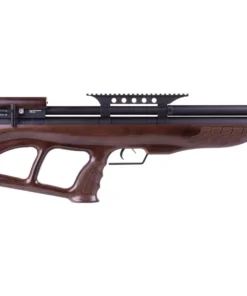






JTS Brawn Bullpup PCP Air Rifle
Price range: €250.00 through €265.00
Description
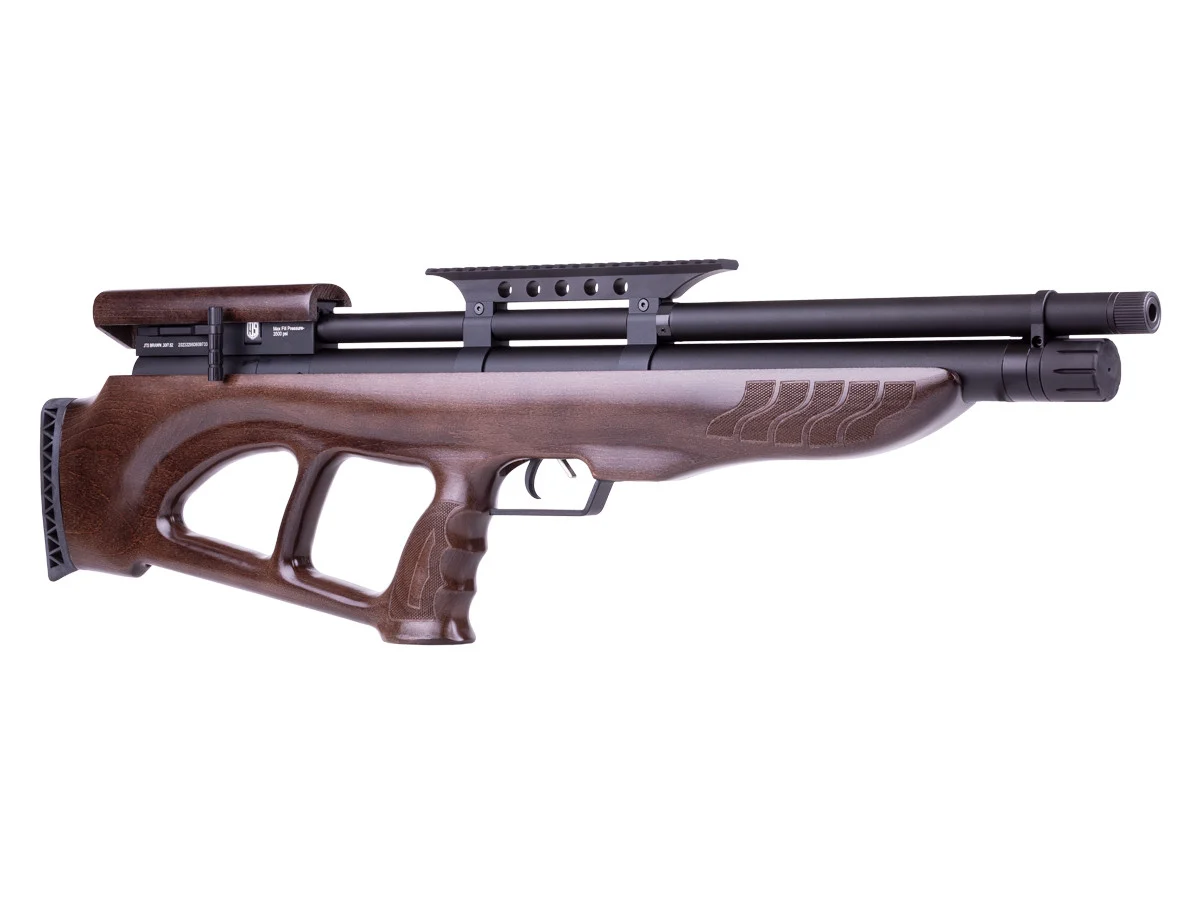
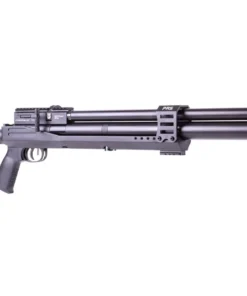
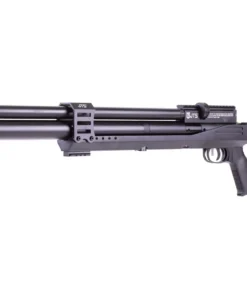
The JTS Brawn Bullpup PCP Air Rifle is a maneuverable version of the previous successful airguns in the lineup. Capable of reaching velocities up to 980 FPS in .177, 900 FPS in .22, 860 FPS in .25, and 830 FPS in .30, this airgun provides effective performance for pest control, small-game hunting, and plinking.
The air rifle delivers steady shots with stable velocity because it is fully regulated, so it offers dependable performance from every shot. It also has a shrouded barrel for quiet shots.
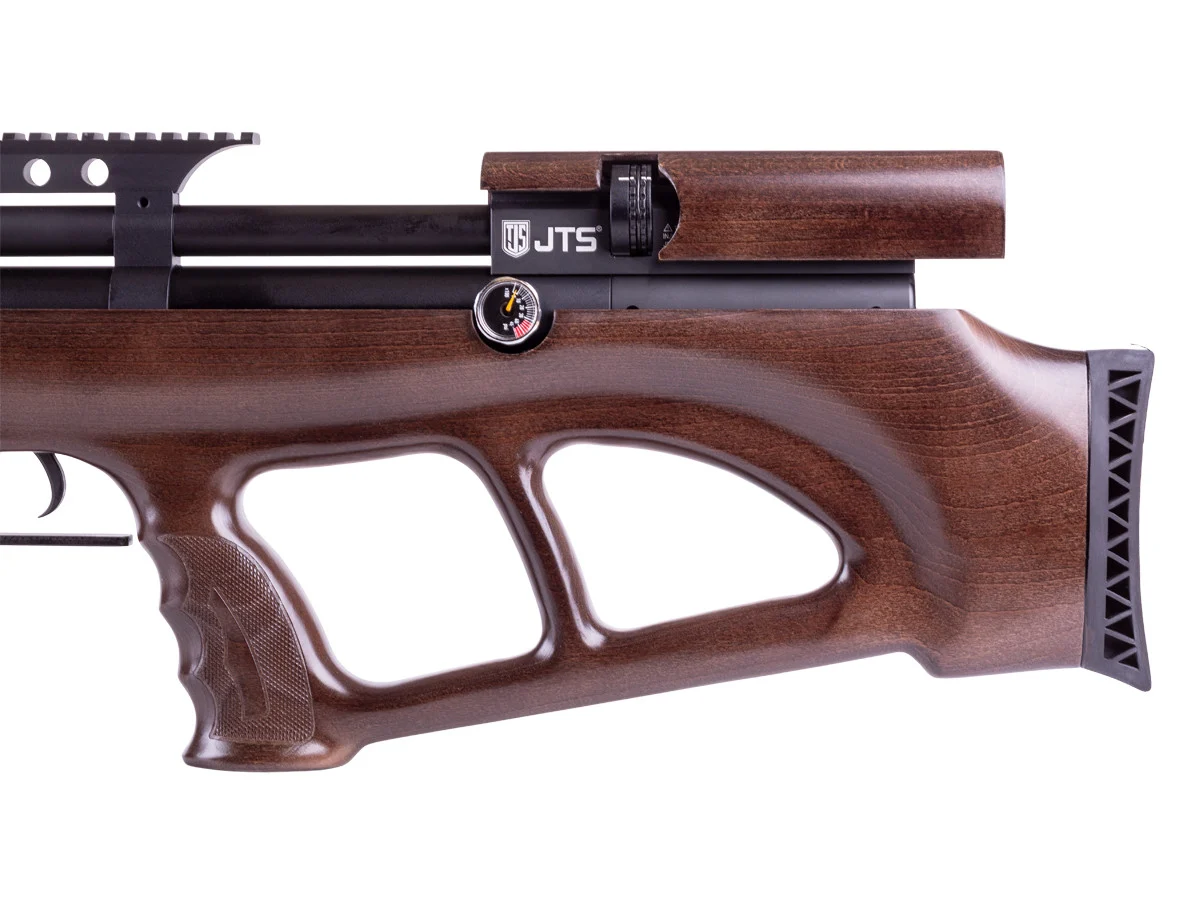
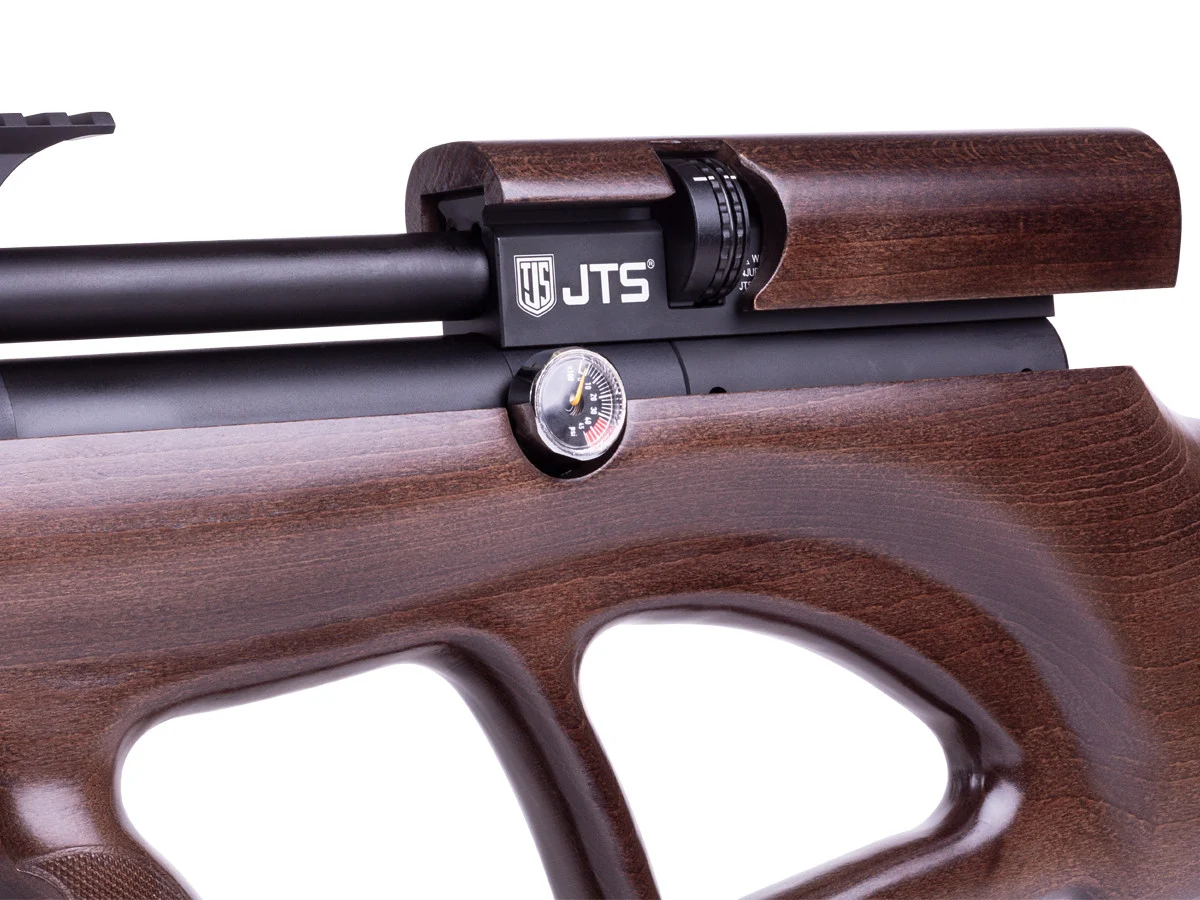
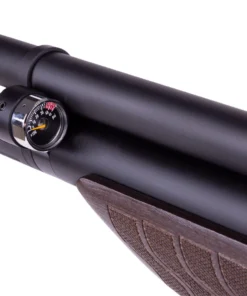
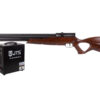
The JTS Brawn has the same reservoir fill pressure gauge and regulator pressure gauge from the earlier airguns in the lineup, with an upgrade that makes the pressure gauge reversible and places it near the end of the barrel facing the shooter for the ability to constantly monitor the performance of each shot. In addition, this PCP air rifle has a solid wood bullpup thumbhole stock with generous and handsome laser-engraved checkering on the forearm and the pistol grip for a stable hold, and the textured rubber buttpad provides simple and comfortable control.
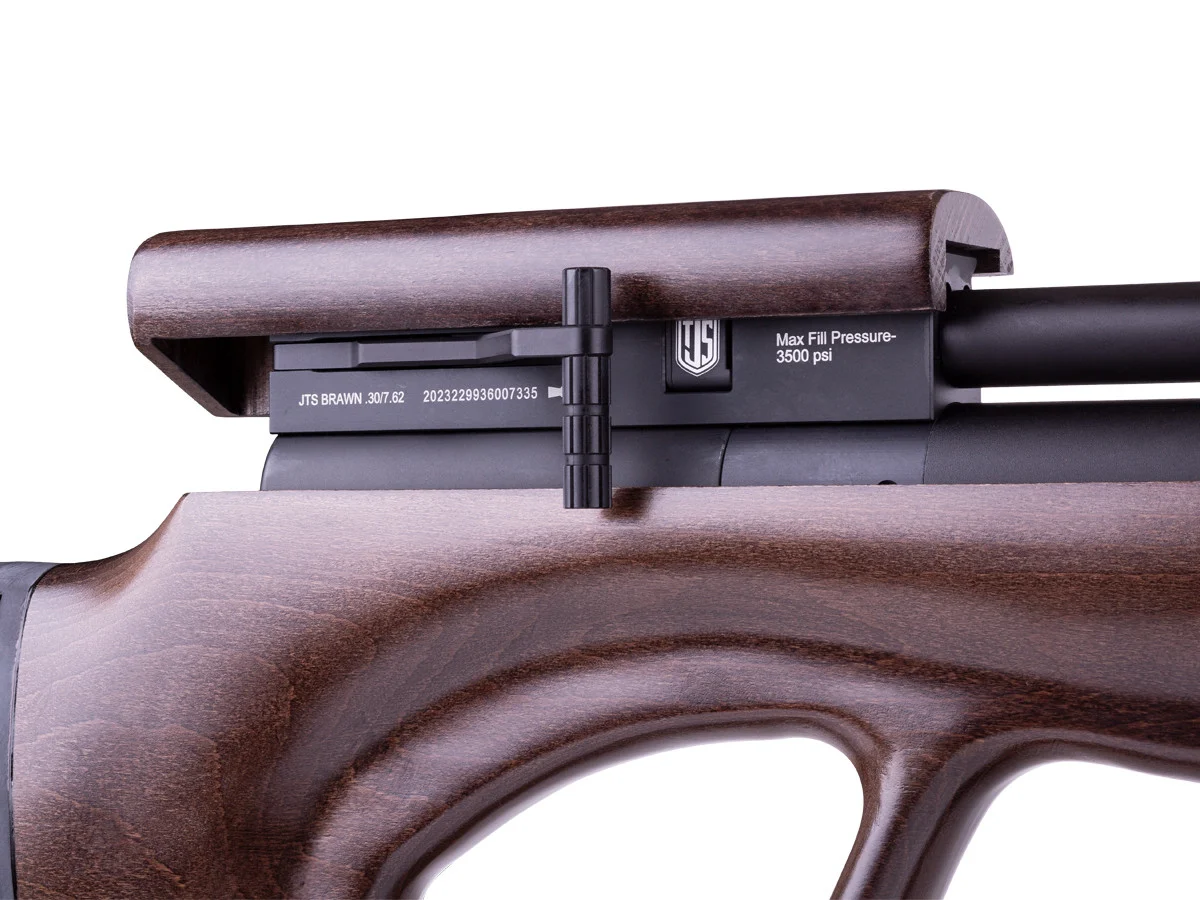
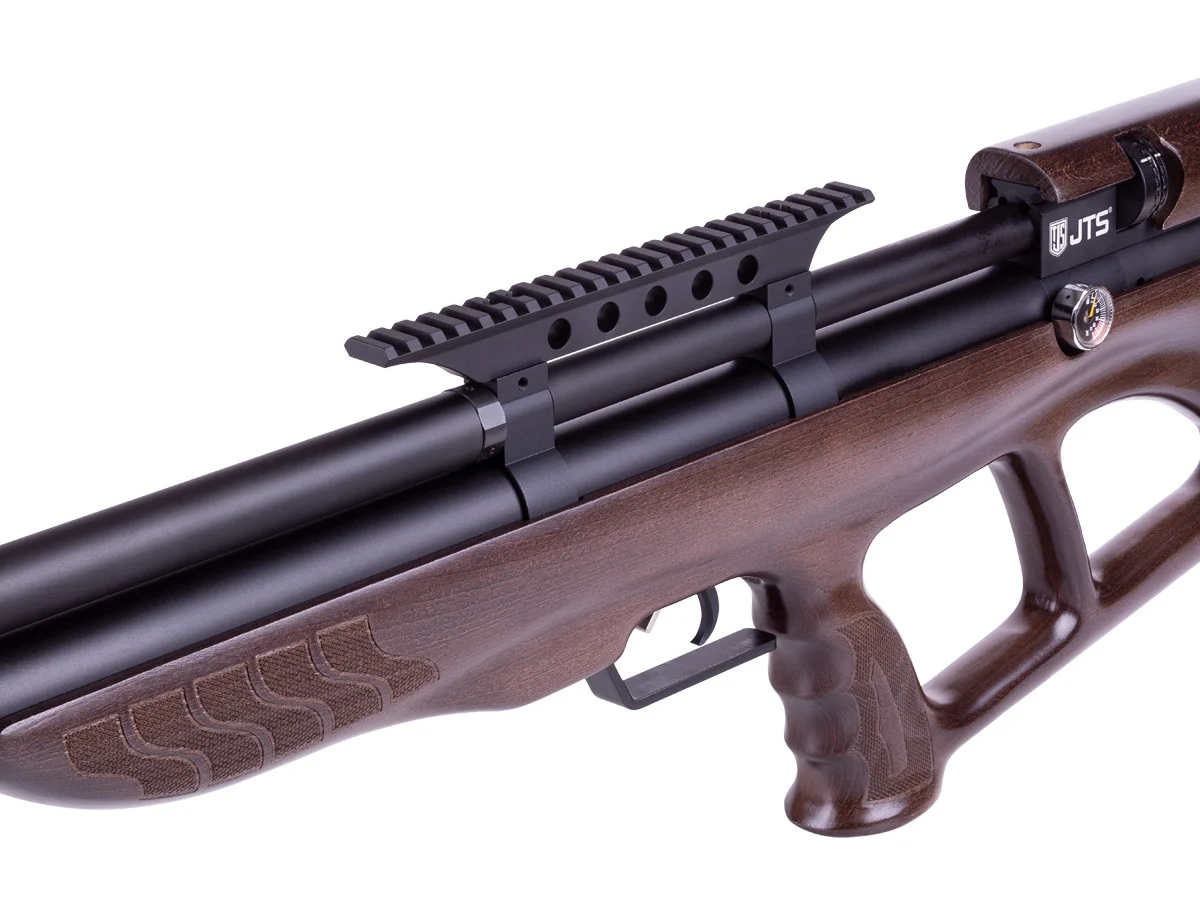
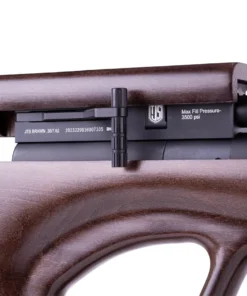
To provide accurate sighting options, this air rifle uses a metal Picatinny optics rail to allow the addition of a scope or other optics. The wooden cheekpiece helps with comfortable eye alignment, and the sidelever offers reliable performance.
To get a shorter version in this line of reliable air guns with improved maneuverability for small-game hunting, pest control, and plinking, buy the JTS Brawn Bullpup PCP Air Rifle from Pyramyd AIR today.
JTS Brawn Bullpup PCP Air Rifle
- Precharged pneumatic
- Sidelever action
- Repeater
- Bullpup wood thumbhole stock
- Fully regulated
- All-metal construction
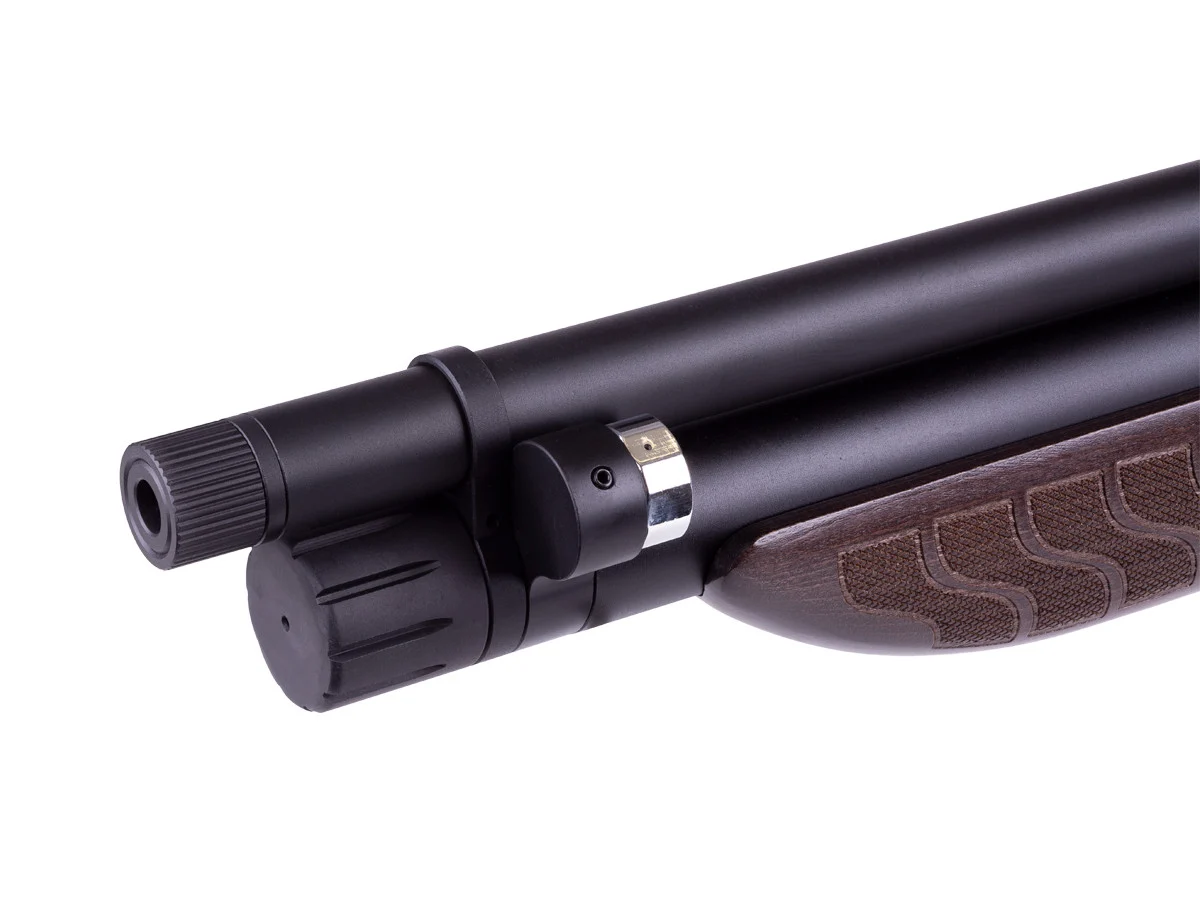
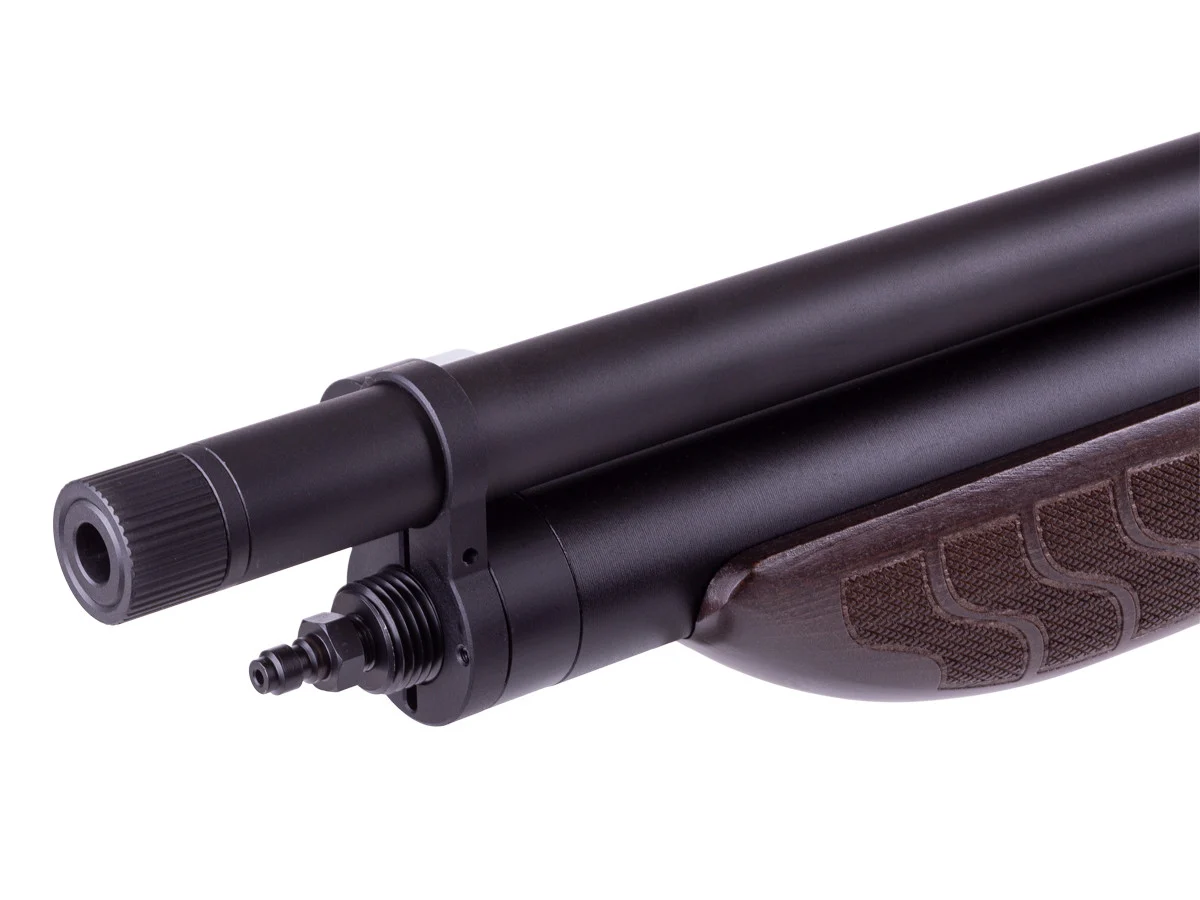
- Shrouded barrel
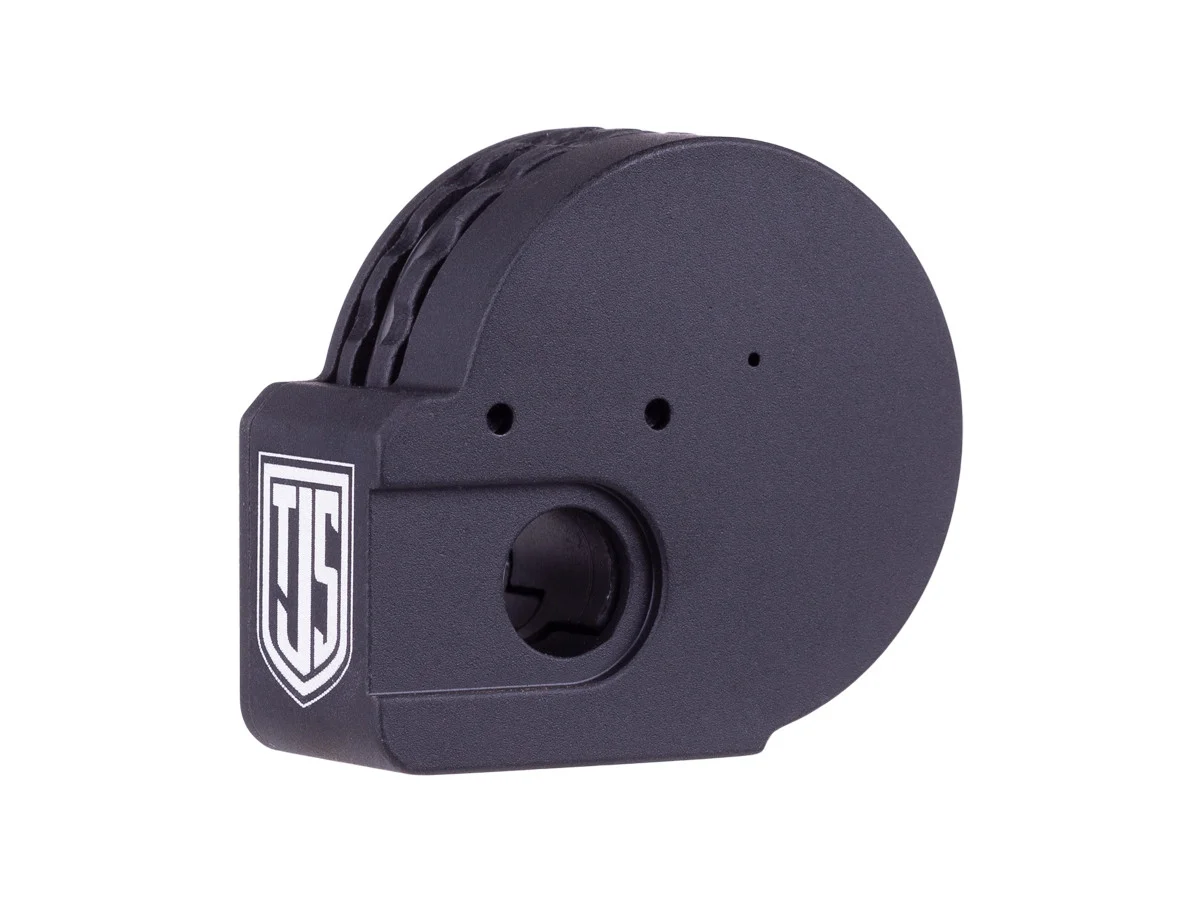
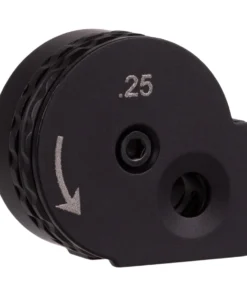
- Magazine capacity: 12rd (.177), 10rd (.22, .25), 7rd (.30)
- Max. shots per fill: 35 (.177, .22, .25), 15 (.30)
- Max. velocity: 980 FPS (.177), 900 FPS (.22), 860 FPS (.25), 830 FPS (.30)
- Manual safety
- Picatinny optics rail
- Ergonomic pistol grip
- Laser-engraved checkering on pistol grip and forearm
- Textured rubber buttpad
- Integrated reservoir pressure gauge and regulator pressure gauge
- Reversible pressure gauge faces shooter
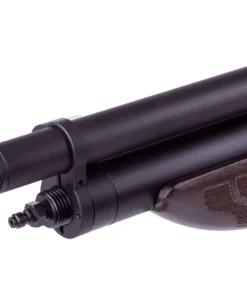
- Foster quick-disconnect fill fitting
- Includes 2 all-metal magazines
- Barrel length: 17.2″
- Overall length: 33″
- Weight: 9.3 lbs.
Specifications
BrandCaliber.177 (4.5mm)Max Velocity980 fpsSuggested forSmall game hunting/target practicePowerplantPre-charged pneumaticLoudness3-MediumNoise Level82.22 dB Weight9.3 lbsFunctionRepeaterMax Shots per Fill35ActionSideleverFixed/adj. powerMultiple settingsShroudedYesScopeableWeaver/PicatinnyFront SightsnoneRear SightsnoneSafetyManualTriggerTwo-stage adjustableBarrelRifledBarrel Length17.2″Overall Length33.0″Capacity12 round(s)Body TypeBullpupButtplateRubberColorBrownOperating Pressure3190 PSI / 220 BARGrip OrientationAmbidextrousRegulatedYesIs Safe To Dry FireYes
JTS Brawn Bullpup PCP Air Rifle – Technical Product Guide
Bullpup Engineering, Regulated PCP Operation, Precision, and JTS Platform Context
JTS Brawn
The jts brawn is distinguished by its bullpup architecture. Moving the action rearward allows the platform to retain a 17.2-inch barrel while keeping overall length to approximately 33 inches. JTS combines this compact layout with a wood thumbhole stock, ergonomic pistol grip, laser-engraved checkering, and textured rubber buttpad.
JTS Airguns
jts airguns currently lists the Brawn alongside the Airacuda Standard, Airacuda Max, Airacuda PRS Max, AirStryke, and AirStryke Carbine. The same current catalog also includes compressors, hand pumps, magazines, and several projectile lines.
JTS PCP Air Rifle
The phrase JTS PCP air rifle applies broadly to several products rather than one specification.
The Brawn specifically combines fully regulated operation, a compact bullpup stock, side-lever repeating action, multi-caliber support, multiple pressure gauges, and a Foster quick-disconnect filling interface.
Compressed Air Rifle
A compressed air rifle of this type stores high-pressure air onboard rather than generating operating pressure through a conventional spring during every firing cycle.
Because pressure-bearing components are involved, the reservoir, fittings, gauges, and compatible charging equipment should be inspected and maintained according to manufacturer requirements.
Regulated PCP System
The regulator is an important part of the design because it helps manage pressure supplied from the main reservoir to the operating system.
Consistent pressure delivery can support repeatable recreational target performance, although practical precision still depends on ammunition uniformity, barrel condition, temperature, sighting stability, maintenance, and user technique.
Bullpup Layout and Compact Dimensions
A bullpup rearranges the conventional rifle layout by positioning much of the action behind the trigger.
This architecture allows a relatively substantial barrel length within a shorter overall package.
JTS lists the Brawn at 33 inches long, 6 inches wide, and 12 inches high, with a weight of approximately 9.3 pounds.
17.2-Inch Barrel
The current manufacturer specification gives the Brawn a 17.2-inch barrel.
Barrel length is only one component of practical accuracy. Crown condition, internal consistency, projectile dimensions, pressure stability, and optical alignment also contribute.
JTS Airacuda
The jts airacuda is a different PCP family with a conventional full-length sporting layout.
It should not be treated as another name for the Brawn because JTS lists the models separately and their stock architecture and overall dimensions differ.
Airacuda
The airacuda family currently includes Standard, Max, and PRS Max configurations. These remain technically separate from the compact bullpup platform.
JTS Aircuda
Jts aircuda is a spelling variation of Airacuda rather than a separate verified JTS model.
Using the manufacturer’s correct model names is important when comparing specifications.
JTS Airacuda 25
The jts airacuda 25 refers to a .25-caliber Airacuda configuration, not to the Brawn.
Although the Brawn itself is available in .25, its dimensions, stock layout, gauges, and shot-count characteristics should be taken from the Brawn specification rather than transferred from another family.
JTS Airacuda Max
The jts airacuda max is also a separate regulated PCP platform. JTS lists it independently from the Brawn in its current catalog.
Airacuda Max
The airacuda max should therefore not be used as an alternative product name for the Brawn.
Each model should be evaluated according to its own barrel, stock, magazine, reservoir, and ergonomic specifications.
JTS Airacuda Max 30
The jts airacuda max 30 describes a .30-caliber Airacuda Max.
The Brawn also has a .30 configuration, but JTS lists that version with a 7-round magazine, approximately 830 fps maximum velocity, and roughly 15 maximum shots per fill.
JTS Airacuda Max 30 Cal
The phrase jts airacuda max 30 cal therefore concerns another platform and should not be used to define this model’s .30 specification.
JTS AirStryke
The jts airstryke is another JTS PCP family.
Current JTS listings separate the full-size AirStryke, AirStryke Carbine, Airacuda family, and Brawn rather than treating them as one interchangeable platform.
JTS AirStryke Carbine
The JTS AirStryke Carbine is the manufacturer’s compact carbine-format PCP and remains separate from the bullpup architecture described here.
JTS AirStryke Carbine PCP Air Rifle
The exact phrase JTS AirStryke Carbine PCP air rifle refers to that distinct carbine model, not the Brawn.
AirStryke Carbine Airgun
Similarly, AirStryke Carbine airgun represents another JTS product family and should not be used to establish Brawn dimensions or performance.
JTS Pellets
jts pellets refers to JTS’s projectile catalog.
The company’s current catalog includes multiple .177, .22, .25, and .30 caliber pellet options, corresponding with the broad caliber range offered across its pneumatic platforms.
.177 Caliber Configuration
The Brawn’s .177 configuration uses a 12-round magazine and is manufacturer-rated at up to approximately 980 fps. JTS lists a maximum of about 35 shots per fill for this configuration.
177 Cal Pellet Gun
The phrase 177 cal pellet gun can therefore apply descriptively to the .177 version, although the more precise designation is a .177-caliber regulated bullpup PCP air rifle.
177 Cartridge
The phrase 177 cartridge is technically inappropriate here.
The platform uses airgun projectiles rather than conventional firearm cartridges.
.22 Caliber Configuration
The .22 version uses a 10-round magazine and is manufacturer-rated up to approximately 900 fps, with a listed maximum of around 35 shots per fill.
.25 Caliber Configuration
The .25 version also uses a 10-round magazine. JTS rates this configuration at up to approximately 860 fps and lists around 35 maximum shots per fill.
.30 Caliber Configuration
The .30 model uses a 7-round magazine, is rated up to approximately 830 fps, and has a listed maximum of roughly 15 shots per fill.
Side-Lever Repeating Action
JTS identifies the Brawn as a sidelever repeater PCP air rifle.
The lever should retain smooth, predictable operation. Binding or substantial mechanical resistance should prompt inspection rather than additional force.
Multiple Pressure Gauges
A notable feature is the use of integrated reservoir and regulator gauges along with a newly listed reversible gauge that can face the shooter.
This provides several pressure-reference points within the regulated pneumatic architecture.
Wood Thumbhole Stock
The Brawn uses a wood thumbhole stock with an ergonomic pistol grip.
Laser-engraved checkering appears on the pistol grip and forearm, while a textured rubber buttpad forms the shoulder contact surface.
Practical Precision
The combination of regulated pressure management, a 17.2-inch barrel, compact structural layout, and stable stock provides a technical foundation for repeatable recreational target performance.
However, advertised velocity should not be treated as an accuracy measurement. Projectile consistency, optics, environmental conditions, pressure behavior, maintenance, and user technique remain important.
Best Scope for PCP Air Rifle
The phrase best scope for PCP air rifle relates to accessory selection rather than a fixed Brawn specification.
A suitable optic should be selected according to intended lawful recreational use, eye relief, mounting compatibility, magnification requirements, and ergonomics rather than assuming one model is universally ideal.
JTS Compressor
The term jts compressor refers to separate PCP charging equipment.
JTS’s current catalog includes the COMP100, COMP1, a four-stage hand pump, and a two-stage hand pump.
Any filling equipment used with a PCP should remain within the manufacturer’s pressure ratings and compatibility requirements.
JTS Stealth Hawk
The phrase jts stealth hawk does not appear among the current official JTS product listings reviewed here, so it should not be presented as a verified Brawn feature.
JTS Firearms and JTS Guns
The broad phrases jts firearms and jts guns do not identify this product precisely.
The manufacturer’s current listing identifies the Brawn specifically as a bullpup PCP air rifle.
JTS Group
The phrase Jts group does not establish a technical specification.
Official JTS product documentation should be used when identifying the platform’s current dimensions, calibers, magazine capacities, and pressure-system features.
Air Guns of Texas
The phrase air guns of texas is location- or retailer-oriented rather than a technical feature of this platform.
Lindstradt Air Gun
The phrase lindstradt air gun does not correspond to a verified current Brawn specification in the JTS sources reviewed.
Tom Air Gun
Likewise, tom air gun does not establish any verified specification for this platform.
Airgins
The term airgins appears to be a spelling variation or unrelated search phrase and should not be treated as authoritative product terminology.
JTS Shotgun Accessories
The phrase jts shotgun accessories belongs to a different product category and does not describe the pneumatic system, barrel, stock, magazine, or pressure equipment used here.
JTS Air Rifle for Hunting
The phrase JTS air rifle for hunting concerns intended use rather than a verified engineering specification.
Whether any pneumatic platform may legally or appropriately be used for hunting depends on jurisdiction, caliber, energy, species, and applicable local rules.
Commercial Search Terms
Phrases including buy JTS AirStryke Carbine online, JTS AirStryke Carbine for sale, and JTS AirStryke Carbine price concern purchasing a separate weapon platform, so they are not used here to provide sellers, prices, or transactional guidance.
JTS AirStryke Carbine Review
The phrase JTS AirStryke Carbine review concerns evaluation of a different JTS product and should not be used as evidence about this bullpup platform.
Why the Bullpup Configuration Matters
The strongest engineering advantage of the layout is dimensional efficiency.
By positioning the action rearward, JTS fits a 17.2-inch barrel into a platform only approximately 33 inches long. That provides a compact external footprint without requiring an exceptionally short barrel.
Overall Technical Perspective
The JTS Brawn combines a fully regulated PCP system, side-lever repeating action, 17.2-inch barrel, 33-inch overall length, 9.3-pound weight, wood thumbhole stock, ergonomic pistol grip, textured buttpad, multiple pressure gauges, Foster quick-disconnect filling interface, and caliber-dependent metal magazines.
Current manufacturer specifications cover .177, .22, .25, and .30, with rated velocities ranging from approximately 980 fps in .177 to 830 fps in .30 and magazine capacities ranging from 12 to 7 rounds.
For responsible recreational ownership, the important considerations remain exact caliber identification, correct manufacturer-supported ammunition, compatible high-pressure charging equipment, reservoir and seal inspection, secure storage, appropriate eye protection, a properly controlled range environment, and qualified servicing whenever pneumatic or mechanical condition becomes uncertain.
Engineering Performance, Bullpup Ergonomics, Pressure Management, Precision, and Practical Design
The compact architecture combines several engineering systems within a relatively short overall package. Consequently, performance should not be judged solely by velocity figures or external appearance. Pressure regulation, barrel condition, mechanical repeatability, magazine function, trigger consistency, balance, sight stability, and maintenance all influence how the platform behaves during controlled recreational use. Understanding these elements provides a clearer picture of why the design differs from a conventional full-length configuration and what matters for dependable long-term operation.
Bullpup Engineering Philosophy
The defining feature is the rearward placement of much of the operating mechanism.
Traditional layouts position the action farther forward, whereas this configuration moves significant mechanical components behind the trigger area. As a result, substantial barrel length can be retained without requiring an equally long overall platform.
This arrangement creates a compact external footprint while preserving the internal space needed for the pneumatic and mechanical systems.
Compact Handling Characteristics
Reduced overall length changes how the platform feels when carried and positioned.
The center of mass can feel different from that of a conventional sporting stock because more equipment sits toward the rear. Some users may find this arrangement naturally compact, while others may require time to become accustomed to the balance.
Therefore, ergonomic suitability should be evaluated independently from technical performance.
Regulated Pressure Management
An internal regulator contributes significantly to pneumatic consistency.
As reservoir pressure changes during use, the regulator helps manage the pressure supplied to the operating system. This provides a more controlled foundation for repeatable behavior across an appropriate portion of the available air supply.
Nevertheless, regulation cannot compensate for damaged seals, contamination, temperature extremes, or poor maintenance.
Why Pressure Consistency Matters
Consistent pressure helps reduce one variable within the overall performance equation.
However, pneumatic consistency represents only one part of practical precision.
Ammunition uniformity, barrel condition, sighting stability, environmental conditions, mechanical integrity, and user technique remain important.
Therefore, a sudden change in performance should be investigated systematically rather than automatically attributed to the regulator.
Reservoir Awareness
The onboard reservoir is a pressure-bearing component and deserves careful inspection.
Its exterior should remain free from severe dents, deep scratches, corrosion, or deformation.
Unexpected pressure loss should also receive attention because it can indicate seal, valve, fitting, or internal pneumatic problems.
Questionable pressure-bearing components should be professionally assessed rather than repaired through improvised methods.
Multiple Pressure References
Having accessible pressure information can make routine condition monitoring easier.
A gauge should remain clear, securely mounted, and physically undamaged.
If a reading appears inconsistent with normal system behavior, the cause should be investigated.
A cracked gauge face, loose housing, severe corrosion, or obviously unreliable indication warrants qualified inspection.
Barrel Integrity
The barrel provides the physical pathway responsible for guiding and stabilizing the projectile.
Its condition therefore contributes directly to repeatability.
The crown should remain protected from impact damage, while internal surfaces should not be subjected to unnecessary aggressive cleaning.
A longer cleaning schedule is not automatically better; conservative maintenance using appropriate methods is generally preferable.
Understanding Practical Precision
Precision is best understood as repeatability rather than a single successful result.
Controlled recreational target sessions conducted under similar conditions provide a better indication of mechanical consistency.
Wind, temperature, ammunition variation, sight alignment, and user technique can create differences even when the platform itself remains mechanically healthy.
This is why isolated results should be interpreted carefully.
Side-Lever Operation
The side-mounted cycling mechanism provides a straightforward interface for normal operation.
Movement should remain smooth and predictable.
Grinding, binding, excessive looseness, or unexpected resistance may indicate contamination, misalignment, or mechanical wear.
Applying additional force to an abnormal mechanism can worsen an existing issue, so inspection should come before continued use.
Magazine System
A removable magazine provides organized multi-shot functionality during controlled recreational sessions.
Reliable operation depends on correct indexing, dimensional integrity, and cleanliness.
Dirt or physical deformation can interfere with normal movement.
Magazines should therefore be protected from impacts and should not be stored loosely alongside heavy tools or charging equipment.
Trigger Characteristics
A predictable trigger contributes to consistent handling.
The user becomes familiar with normal movement, resistance, and release characteristics over time.
If these characteristics change substantially, internal modification should not be the first response.
Inspection is appropriate because abnormal behavior can indicate contamination, wear, or another mechanical problem requiring qualified attention.
Thumbhole Stock Ergonomics
A thumbhole stock combines shoulder support, grip positioning, and fore-end control within an integrated structure.
The grip geometry helps define hand placement, while the fore-end provides a stable support area.
Because natural hand size and arm length vary considerably between users, comfort remains individual rather than universal.
Wood Construction
Wood provides a traditional appearance and rigid structural foundation, but it also requires reasonable environmental care.
Prolonged exposure to moisture should be avoided.
After wet conditions, accessible surfaces should be dried before storage.
Extreme heat and harsh chemicals should also be minimized because they can affect finishes and potentially contribute to long-term deterioration.
Checkered Contact Areas
Textured grip and fore-end surfaces improve tactile definition.
These areas should remain clean enough to preserve their intended texture.
Aggressive scraping or abrasive cleaning is unnecessary and may damage the surrounding finish.
A soft brush or suitable cloth is generally more appropriate for ordinary external care.
Rubber Shoulder Contact
The rubberized shoulder surface provides a defined contact point between the stock and the user.
Over time, rubber can deteriorate through heat, ultraviolet exposure, or unsuitable chemicals.
Periodic inspection for severe cracking, separation, or hardening helps identify aging before the component becomes uncomfortable or structurally compromised.
Balance and Weight Distribution
Compact dimensions do not necessarily mean extremely low weight.
A bullpup can feel relatively dense because several components occupy a shorter overall structure.
Optical equipment can further influence balance.
Consequently, the complete configuration should be evaluated after accessories are installed rather than judging handling solely from the unaccessorized platform.
Optical Mounting Stability
Any installed sighting equipment depends on secure mounting hardware.
Loose rings or bases can create apparent precision problems even when the pneumatic and barrel systems remain healthy.
Therefore, mounting interfaces should be checked whenever unexplained sighting changes appear.
Overtightening should also be avoided because damaged threads can create additional problems.
Temperature Considerations
Compressed-air systems can respond to significant temperature changes.
Environmental conditions may influence pressure behavior, while outdoor wind can influence projectile flight.
Comparisons between different recreational sessions are most meaningful when conditions are reasonably similar.
Large environmental differences should be considered before assuming that mechanical performance has changed.
Moisture Protection
Humidity and direct moisture can affect metal components, wood, optics, fasteners, and storage materials.
Wet equipment should not remain sealed inside a case for extended periods.
After outdoor exposure, accessible surfaces should be dried and the carrying case should also be checked.
Damp padding can repeatedly expose stored equipment to moisture.
Transportation Protection
Compact dimensions can simplify transportation, but the pressure system, barrel, gauges, stock, and sights still require protection.
A padded case can reduce accidental impacts.
Heavy accessories and charging equipment should be stored separately so they cannot strike sensitive components.
Transportation should always comply with applicable regulations.
Appropriate Recreational Environment
A controlled range environment provides an appropriate setting for recreational target use.
Suitable containment, eye protection, established procedures, and clear operating boundaries reduce unnecessary risk.
Applicable laws and facility rules should determine where the equipment can be transported, stored, and used.
Long-Term Mechanical Reliability
Reliability depends on the complete system rather than one headline feature.
The reservoir, regulator, seals, valve components, barrel, cycling mechanism, trigger, magazine, stock, gauges, sights, and mounting hardware all contribute.
Regular inspection makes gradual changes easier to identify before they develop into larger mechanical problems.
Overall Engineering Perspective
The compact bullpup configuration demonstrates how a substantial pneumatic operating system and useful barrel length can be packaged into a shorter external structure. Its principal engineering strengths lie in dimensional efficiency, regulated pressure management, multi-shot operation, structured ergonomics, and integrated pressure monitoring.
For dependable recreational service, the most important factors remain correct maintenance, careful handling, secure storage, protection from moisture and impacts, appropriate pressure-system inspection, and qualified servicing whenever abnormal leakage or mechanical behavior develops. When those fundamentals are maintained, the platform has a solid foundation for consistent and reliable long-term operation.
Maintenance, Inspection, Storage, Durability, and Long-Term Care
Long-term reliability depends on preventive care rather than frequent modification. A regulated pneumatic platform contains several interconnected components that experience normal wear over time, including seals, pressure-bearing parts, gauges, mechanical controls, magazines, stock hardware, and sighting interfaces. Consequently, routine inspection should focus on detecting changes before they become significant faults. Keeping the equipment clean, dry, protected from impacts, securely stored, and professionally serviced when necessary provides a sensible foundation for preserving its condition.
Routine Condition Inspection
A brief visual inspection should form part of regular ownership.
Look for corrosion, cracks, dents, loose hardware, contamination, unusual movement, or other visible deterioration. Becoming familiar with the normal appearance of the equipment makes gradual changes easier to identify.
Any substantial structural damage should be investigated before further recreational use.
Pressure-Bearing Components
The air-storage system deserves particular attention because it operates under substantial pressure.
Its exterior should remain free from serious dents, deep scratches, severe corrosion, or deformation. Damage to a pressure-bearing component should never be dismissed simply because the rest of the equipment appears functional.
Manufacturer inspection requirements should always take priority.
Pressure Retention
Normal pressure retention provides useful information about pneumatic condition.
A noticeable increase in pressure loss while the equipment is stored may indicate deterioration somewhere within the sealed system.
Persistent leakage should be professionally diagnosed rather than accepted as normal aging.
Repeatedly restoring pressure without identifying the underlying problem does not constitute effective maintenance.
Gauge Condition
Pressure gauges should remain clear, secure, and physically undamaged.
A cracked lens, loose housing, corrosion, or abnormal indication deserves attention. Because accurate pressure information is important for assessing system condition, a questionable gauge should be professionally inspected or replaced with an appropriate manufacturer-compatible component.
Internal Pressure Management
The internal pressure-management mechanism normally operates without routine user disassembly.
If pneumatic behavior becomes unexpectedly inconsistent, several components may potentially be responsible. Therefore, opening internal pressure equipment without the necessary technical knowledge can create additional problems.
Qualified diagnosis is preferable whenever an internal fault is suspected.
Seal Aging
Seals are wear components.
Temperature variation, environmental contamination, storage conditions, age, and ordinary cycling can gradually influence their condition.
Possible deterioration may become noticeable through pressure loss or irregular behavior.
When replacement becomes necessary, appropriate manufacturer-compatible components should be used.
Filling Interface Condition
The external filling interface should remain clean and protected from contamination.
Dust, grit, and moisture can interfere with sealing surfaces.
Protective covers should remain installed when provided, particularly during storage and transportation.
Damaged pressure fittings should receive professional attention rather than improvised repair.
Barrel Protection
The barrel assembly should be protected from impacts and corrosion.
After exposure to moisture, accessible exterior surfaces can be dried carefully with a soft cloth.
Harsh abrasives should be avoided because they may damage protective finishes.
Particular care should be taken during transportation because impact damage near the front assembly can affect mechanical integrity.
Conservative Internal Cleaning
Internal cleaning should remain conservative and consistent with manufacturer recommendations.
Excessive cleaning can be counterproductive when unsuitable equipment or aggressive chemicals are used.
The objective is to preserve internal surfaces rather than polish them unnecessarily.
If significant contamination is suspected, manufacturer-supported maintenance guidance provides the appropriate reference.
Mechanical Control Inspection
Moving controls should retain their normal smooth and predictable behavior.
Grinding, binding, excessive looseness, or substantial changes in resistance can indicate contamination, misalignment, or wear.
A mechanism that suddenly feels abnormal should not simply be forced.
Qualified inspection is appropriate when basic external examination does not reveal the cause.
Magazine Condition
Removable magazines should remain clean, correctly aligned, and protected from deformation.
Impact damage or accumulated debris can interfere with normal indexing.
During transportation, magazines should be protected rather than stored loosely among heavy equipment.
A damaged magazine should be replaced instead of repeatedly forced into operation.
Trigger-System Condition
The trigger should retain familiar and predictable mechanical behavior.
A significant change in movement, resistance, or engagement deserves investigation.
Routine ownership generally does not require internal trigger disassembly.
Unauthorized alteration can affect reliability, so persistent abnormalities should receive qualified technical attention.
Stock Inspection
Wooden furniture requires reasonable environmental protection.
Prolonged exposure to water, extreme heat, and aggressive chemicals should be avoided.
Inspect the stock periodically for structural cracks, separation, or unusual movement around attachment points.
Small cosmetic marks are generally less important than damage that compromises structural integrity.
Grip and Fore-End Care
Textured contact areas naturally collect dust and debris.
A soft cloth or suitable brush can generally handle ordinary external cleaning without damaging the finish.
Aggressive scraping should be avoided.
Keeping these areas clean also makes cracks or other structural changes easier to identify during inspection.
Shoulder Pad Condition
Rubber components can deteriorate through age, sunlight, heat, and chemical exposure.
The shoulder pad should remain securely attached and reasonably flexible.
Severe cracking, hardening, or separation indicates deterioration.
Replacement with a suitable compatible component is preferable to temporary adhesive repairs.
Sight and Mount Inspection
Sighting equipment should remain straight and securely attached.
Loose mounting hardware can create apparent performance problems even when the underlying pneumatic system remains healthy.
After transportation or a significant impact, mounts and attachment points should be inspected.
Excessive tightening should be avoided because threads can be damaged.
Fastener Awareness
Visible screws and bolts should periodically be checked for unexpected looseness.
More force is not always the solution.
If the same fastener repeatedly loosens, the underlying cause should be identified rather than continually overtightening it.
Replacement hardware should match the appropriate specification.
Moisture Management
Moisture is one of the most important long-term storage concerns.
Wet equipment should not remain enclosed inside a case for extended periods.
After exposure to rain or high humidity, accessible surfaces should be dried thoroughly.
The interior of the carrying case should also be checked because damp padding can maintain prolonged moisture exposure.
Corrosion Prevention
Metal components benefit from clean and reasonably dry storage conditions.
Salt, persistent humidity, and corrosive chemicals should be kept away from the equipment.
Recessed areas deserve occasional attention because corrosion can begin where it is not immediately visible.
Early prevention is considerably easier than restoring heavily deteriorated components.
Temperature Management
Extreme temperatures should be avoided during storage.
A closed vehicle exposed to direct sunlight can become considerably hotter than the surrounding environment.
Excessive heat may affect seals, wood finishes, rubber components, optics, and other materials.
Rapid transitions from cold environments into warm humid spaces can also encourage condensation.
Transportation Protection
A padded protective case helps reduce accidental impacts during transportation.
Heavy tools or pressure-related accessories should be separated so they cannot strike sensitive components.
The equipment should remain unloaded and transported in accordance with applicable laws and regulations.
After a substantial impact, structural condition should be checked before further recreational use.
Secure Storage
Storage should prevent unauthorized access.
The equipment should remain unloaded, dry, protected from physical damage, and secured appropriately for the household and jurisdiction.
Children and unauthorized individuals should not have access.
Local regulations may impose additional storage requirements and should always be followed.
Long-Term Storage
Equipment stored for extended periods still benefits from occasional inspection.
Look for corrosion, environmental damage, deteriorating seals, loose components, or other changes.
Manufacturer guidance should determine appropriate management of the pressure system during prolonged storage rather than relying on assumptions.
Avoiding Improvised Repairs
Critical mechanical and pressure-bearing components should not be repaired with makeshift fittings, unknown seals, unsuitable adhesives, or hardware of uncertain specification.
Improvised repairs can introduce additional faults and complicate later servicing.
When internal work becomes necessary, qualified servicing with appropriate components provides the more dependable approach.
Maintenance Records
A simple service history can be valuable.
Professional inspections, seal replacements, repairs, significant impacts, unusual pressure loss, and major component replacements can all be documented.
These records help identify recurring issues and provide useful information if professional servicing becomes necessary later.
Overall Long-Term Care
Durability depends on both engineering quality and ownership practices. Regular visual inspection, dry storage, protection from impacts, careful environmental management, secure storage, and timely professional servicing reduce avoidable deterioration.
Most importantly, significant pressure loss, structural damage, corrosion, abnormal mechanical behavior, or uncertainty about pressure-bearing components should prompt inspection rather than continued use. A consistent preventive-care routine provides the strongest foundation for preserving mechanical condition and dependable recreational service over the long term.
Be the first to review “JTS Brawn Bullpup PCP Air Rifle”
Related products

JTS Air Rifles
JTS Air Rifles
JTS Air Rifles


JTS Air Rifles
Reviews
There are no reviews yet.