
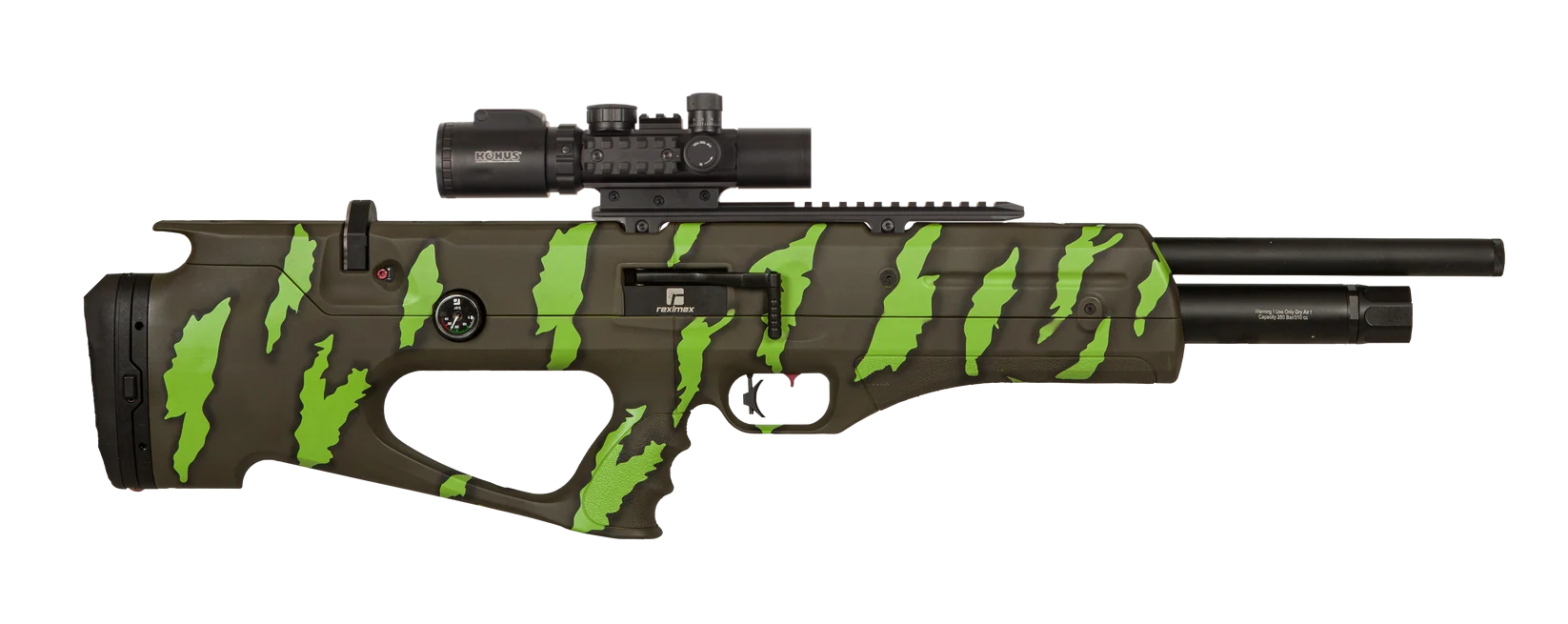
REXIMEX REGIME GREEN LEAF CERAKOTE
€600.00
The Reximex Regime is a new semi-bullpup concept to the market. The gun might be slight in stature but boasts plenty of features which are sure to impress the avid shooter.
The key features of the rifle are:
- Biathlon lever is ambidextrous
- Adjustable weaver rail with fitted level gauges
- Adjustable butt pad
- Adjustable 2 stage trigger
- Easy Access safety lever
The Regime has a 310cc reservoir giving you 150 shots at 200bar.
- Calibre: .177/.22
- Capacity: 14/12
- Colour: Green leaf
- Length: 81cm
- Power: 11.5
- Stock: Synthetic
- Tube Size: 310cc
REXIMEX REGIME GREEN LEAF CERAKOTE PCP AIR RIFLE – Premium Camouflage Finish, Compact Semi-Bullpup Design and Advanced Turkish Engineering
REXIMEX REGIME GREEN LEAF CERAKOTE – Precision Engineering, Contemporary Craftsmanship and Compact Sporting Performance
The REXIMEX REGIME GREEN LEAF CERAKOTE combines contemporary Turkish manufacturing, specialized pneumatic technology, and distinctive green camouflage styling within a compact semi-bullpup sporting rifle.
Designed for enthusiasts who appreciate modern mechanical engineering and adaptable synthetic furniture, this configuration incorporates a 480mm barrel, 310cc compressed-air reservoir, ambidextrous biathlon-style operating lever, and adjustable two-stage trigger.
Furthermore, its green-and-black exterior introduces a recognizable camouflage-inspired appearance that differs considerably from traditional plain-black sporting equipment.
The approximately 810mm overall length reflects its compact semi-bullpup construction, while the synthetic stock contributes to the equipment’s contemporary industrial identity.
Additionally, the adjustable rear buttpad accommodates different physical preferences.
The rifle incorporates a manual safety and adjustable optics mounting bridge with integrated leveling indicators.
These features demonstrate the manufacturer’s emphasis on adaptable mechanical design.
For lawful recreational target shooting, the platform combines distinctive styling with carefully manufactured components.
However, actual sporting precision depends on suitable ammunition, equipment condition, environmental circumstances, and individual experience.
Consequently, buyers should evaluate verified factory specifications rather than rely exclusively on appearance or generalized performance claims.
Green Leaf Cerakote Finish and Premium Synthetic Construction
The distinctive camouflage-inspired exterior represents the most recognizable characteristic of this configuration.
Its green-and-black decorative pattern complements the darker barrel, receiver, and surrounding pneumatic assemblies.
Furthermore, the synthetic furniture offers an alternative to traditional wooden sporting stocks.
However, the exact components receiving ceramic-based protective treatment should be confirmed through official product documentation.
Appropriate cleaning and storage contribute to preserving the decorative finish.
Reximex Airguns, Turkish Manufacturing and Related Models
The expressions reximex, reximex airguns, and reximex accura pcp air rifle concern the manufacturer’s wider sporting equipment collection.
Related model searches include Reximex Lyra K, reximex throne gen2, reximex throne gen 2, reximex mito, reximex mitos, and reximex lieva.
Meanwhile, reximex гр, reximex rра, roxy max, and mx rex represent multilingual, irregular, or loosely associated search variations.
These expressions should not be interpreted as specifications of the featured configuration.
Reximex Lyra-K PCP Air Rifle and Alternative Sporting Configurations
Customers researching related products may encounter Reximex Lyra-K PCP air rifle, Reximex Lyra-K airgun, Reximex Lyra-K review, and Reximex Lyra-K PCP rifle.
Additional searches include Reximex Lyra-K regulated PCP, Reximex Lyra-K compact PCP rifle, Reximex Lyra-K tactical air rifle, and Reximex Lyra-K hunting rifle.
Buyer-oriented expressions include buy Reximex Lyra-K online, best price Reximex Lyra-K, and Reximex Lyra-K scope package.
Further research phrases include Reximex Lyra-K accuracy test, Reximex Lyra-K pellet gun, Reximex Lyra-K for pest control, and Reximex Lyra-K small game hunting.
However, these terms concern a separate model family rather than the specifications or accessories of the featured equipment.
FX Airguns and Alternative Sporting Equipment Comparisons
Enthusiasts comparing manufacturers may encounter FX Panthera MkII, fx panthera, fx airguns, fxairguns, fx airguns sverige, fx airguns sweden, and fx airguns usa.
Related product searches include fx impact m4, fx impact m3, f x impact m3, fx impact, f x impact, fx m4, impact m4 air rifle, impact m4 500mm, and fx impact m3 air rifle.
Additional sporting alternatives include fx leopard, fx leopard airgun, fx drs, fx drs classic, fx drs tactical, fx drs pro, fx wildcat, and fx king.
Meanwhile, fx air rifle, fx outdoors, fx chronograph, and fx dynamics concern wider sporting equipment research.
These are separate products or search expressions rather than components included with this rifle.
Understanding Velocity, Kinetic Energy and Technical Measurements
The expressions tps to joules calculator, Tps joule calculator, fps to ft Ibs, and airgun joules calculator relate to sporting performance measurements.
Velocity describes projectile speed, whereas kinetic energy depends on projectile mass and velocity.
Furthermore, published figures vary according to ammunition, factory configuration, and regional restrictions.
Consequently, meaningful technical comparisons require verified specifications.
General Sporting Equipment Research and Buyer Information
The expressions pellet gun, air guns, pcp airguns, and gunseek appear in broader equipment research.
However, search popularity does not establish mechanical quality or legal suitability.
Customers should prioritize authentic documentation, warranty coverage, and access to qualified servicing.
Compact Semi-Bullpup Architecture and Precision Construction
The semi-bullpup design incorporates carefully manufactured metallic assemblies within a compact sporting configuration.
Furthermore, the substantial barrel integrates with the pneumatic reservoir and synthetic furniture.
The ambidextrous operating lever, adjustable trigger, and manual safety contribute to its distinctive mechanical architecture.
Additionally, the adjustable rear buttpad provides ergonomic flexibility.
However, individual comfort depends on physical proportions and personal preferences.
Pneumatic Reservoir and Mechanical Engineering
The 310cc reservoir forms an important component of the compressed-air operating system.
Furthermore, specialized fittings, seals, and internal mechanisms contribute to its construction.
UK-market listings describe operation at 200 bar and approximately 11.3 ft-lbs.
However, power classifications may differ internationally, and a factory regulator should not be assumed without confirmation.
REXIMEX REGIME GREEN LEAF CERAKOTE – Technical Specifications
- Manufacturer: Reximex
- Country of manufacture: Turkey
- Model: Regime Green Leaf Cerakote
- Operating system: Pre-charged pneumatic
- Configuration: Compact semi-bullpup
- Stock: Green-and-black synthetic
- Exterior: Green Leaf camouflage-inspired finish
- Available calibers: .177 (4.5mm), .22 (5.5mm), .25 (6.35mm), depending on retailer and region
- Barrel length: 480mm / 18.9 inches
- Overall length: Approximately 810mm / 31.9 inches
- Weight: Approximately 3kg / 6.6 pounds
- Air reservoir: 310cc
- Filling pressure: 200 bar in referenced UK-market listings
- Magazine capacity: 14 (.177), 12 (.22), 10 (.25)
- Operating mechanism: Ambidextrous biathlon-style side lever
- Trigger: Adjustable two-stage
- Safety: Manual
- Rear furniture: Adjustable buttpad
- Optics interface: Adjustable Weaver-style rail with integrated leveling indicators
- Published UK-market power: Approximately 11.3 ft-lbs
- Published shot counts: Approximately 150 (.177) and 210 (.22) under specified retailer conditions
- Muzzle threading: 1/2-inch UNF end cap on certain current versions
- Included magazines: Two on referenced retailer packages
- Filling accessory: Fill probe on selected packages
- Scope: Not included as standard
- Regulator: Not confirmed as standard
- Warranty: Depends on retailer and jurisdiction
Why Consider the REXIMEX REGIME GREEN LEAF CERAKOTE?
The Green Leaf configuration combines compact semi-bullpup construction, contemporary synthetic furniture, and distinctive camouflage-inspired styling.
Furthermore, the ambidextrous operating lever, adjustable trigger, and leveling-equipped optics rail contribute to its mechanical identity.
The substantial pneumatic reservoir and precision-rifled barrel reflect the manufacturer’s emphasis on specialized sporting equipment design.
Additionally, the green camouflage exterior provides an alternative to traditional single-color configurations.
For prospective owners, important considerations include regional power restrictions, factory specifications, physical suitability, maintenance requirements, and warranty coverage.
Ultimately, the rifle combines contemporary Turkish manufacturing, distinctive exterior craftsmanship, and compact pneumatic engineering within one recognizable sporting platform.
Advanced Engineering, Green Leaf Craftsmanship, Compact Construction, Mechanical Precision and Long-Term Ownership
2.1 Turkish Manufacturing Heritage and Engineering Development
Turkey has established a significant presence in the international sporting equipment industry through specialized manufacturing, precision metalworking, and continuing investment in industrial technology. This background supports the development of contemporary compressed-air products that combine mechanical expertise with modern materials.
The Green Leaf configuration reflects this approach through its carefully manufactured action, compact semi-bullpup architecture, precision-rifled barrel, and distinctive synthetic furniture.
Furthermore, manufacturing quality depends on several interconnected factors. Accurate component dimensions, suitable material selection, consistent assembly procedures, and appropriate quality-control inspections contribute to the overall integrity of the finished product.
However, manufacturing heritage alone cannot guarantee identical performance throughout every product’s service life.
Environmental exposure, accidental impacts, ordinary mechanical wear, and maintenance history may affect equipment condition.
Consequently, prospective owners should consider documented specifications, genuine replacement-part availability, warranty coverage, and qualified servicing.
The completed design demonstrates how established manufacturing expertise can complement sophisticated pneumatic technology within a modern sporting platform.
2.2 Green Leaf Camouflage and Distinctive Exterior Craftsmanship
The green-and-black camouflage-inspired exterior represents the defining visual characteristic of this configuration. Its decorative pattern incorporates contrasting shades that create a distinctive appearance compared with traditional plain-black sporting equipment.
Furthermore, the green surfaces complement darker metallic components, producing a contemporary industrial identity while maintaining the recognizable proportions of a compact sporting rifle.
The exterior design may appeal to enthusiasts who appreciate nature-inspired colors and distinctive sporting furniture.
However, appearance should remain separate from objective manufacturing quality.
A decorative pattern cannot independently establish accuracy, mechanical reliability, or structural superiority.
Nevertheless, visual presentation contributes to ownership satisfaction.
Routine cleaning helps preserve the original appearance by removing fingerprints, dust, and accumulated surface contamination.
Consequently, appropriate maintenance contributes to maintaining the decorative finish and surrounding components throughout ownership.
2.3 Ceramic-Based Protective Finishing Technology
Modern ceramic-based surface treatments have become increasingly recognizable in sporting equipment manufacturing. Depending on their composition and application method, these finishes can combine decorative coloration with resistance to certain forms of ordinary environmental wear.
Furthermore, professional application requires suitable surface preparation, controlled manufacturing conditions, and compatibility with underlying materials.
However, the exact coating formulation and treated components should always be confirmed through official documentation.
A commercial finish designation does not establish that every exterior surface incorporates identical protective technology.
Even professionally applied coatings remain vulnerable to severe impacts, abrasion, and unsuitable chemicals.
Consequently, responsible maintenance remains essential.
Cleaning materials should be selected according to the manufacturer’s recommendations rather than assumptions about unlimited chemical resistance.
The exterior treatment demonstrates how contemporary surface technology can complement established mechanical manufacturing.
Its long-term condition depends on finishing quality, environmental exposure, and appropriate care.
2.4 Premium Synthetic Stock and Modern Material Construction
The synthetic stock provides a contemporary alternative to traditional wooden sporting furniture. Its manufactured structure incorporates carefully shaped surfaces, modern polymer materials, and a decorative exterior treatment that complements surrounding mechanical components.
Unlike natural timber, synthetic furniture does not depend on individual wood-grain patterns for its visual identity.
Furthermore, molded construction supports consistent external coloration and distinctive ergonomic shapes.
However, polymer materials should not be regarded as completely resistant to deterioration.
Excessive heat, prolonged sunlight exposure, unsuitable solvents, and accidental impacts may affect their condition.
Consequently, appropriate storage remains important.
Routine inspection helps identify visible cracking, deformation, or deterioration around attachment points.
The stock contributes significantly to the platform’s modern appearance while preserving recognizable sporting design characteristics.
Its construction illustrates how contemporary materials can complement traditional mechanical engineering principles.
2.5 Compact Semi-Bullpup Architecture and Structural Organization
The semi-bullpup arrangement contributes to the equipment’s distinctive proportions by positioning important operating components farther toward the rear than in conventional full-length sporting designs.
Consequently, the manufacturer accommodates a substantial barrel within a comparatively compact overall structure.
Furthermore, the surrounding synthetic furniture integrates the mechanical assemblies into a cohesive exterior configuration.
However, compact construction requires careful engineering.
Structural support, manufacturing tolerances, component alignment, and maintenance accessibility remain important considerations.
The shorter profile may appeal to enthusiasts who appreciate compact sporting equipment.
Nevertheless, physical suitability depends on individual preferences, body proportions, and overall weight distribution.
The architecture demonstrates how contemporary manufacturing techniques can combine established mechanical principles with modern compact design.
2.6 Precision-Rifled Barrel and Manufacturing Quality
The substantial rifled barrel forms an essential component of the mechanical architecture.
Its construction requires suitable metallic materials, carefully controlled internal dimensions, and consistent manufacturing procedures.
Furthermore, the barrel must maintain the intended relationship with the surrounding action and supporting assemblies.
Manufacturing consistency contributes to structural integrity and appropriate mechanical integration.
However, barrel length alone cannot establish a guaranteed numerical accuracy figure.
Actual sporting results depend on suitable ammunition, environmental circumstances, equipment condition, and operator experience.
Consequently, technical descriptions should distinguish verified manufacturing characteristics from unsupported performance promises.
Sensitive internal surfaces also require appropriate care.
Aggressive cleaning techniques, unsuitable materials, and unauthorized modifications may compromise their condition.
Qualified inspection remains advisable whenever suspected damage or unusual deterioration becomes apparent.
2.7 Precision-Machined Action and Mechanical Integrity
The main action incorporates carefully manufactured metallic components intended to function within the manufacturer’s established specifications.
Accurate machining, suitable material selection, and controlled assembly procedures contribute to its intended condition.
Furthermore, the action integrates with the synthetic furniture and surrounding pneumatic assemblies.
Dimensional consistency helps preserve the intended relationship between interacting components.
However, precision manufacturing does not eliminate ordinary mechanical wear.
Environmental contamination, accidental impacts, and unsuitable maintenance may influence long-term condition.
Consequently, periodic visual inspection remains valuable.
Unexpected resistance, abnormal movement, or visible deterioration should receive qualified technical attention.
The action demonstrates how established metalworking expertise complements contemporary compressed-air engineering.
Its construction reinforces the importance of evaluating complete mechanical assemblies rather than considering individual components independently.
2.8 Compressed-Air Reservoir and Pressure Vessel Engineering
The compressed-air reservoir represents a central component of the equipment’s operating architecture.
Its construction incorporates specialized pressure-vessel engineering intended to function within the manufacturer’s approved limits.
Furthermore, the reservoir connects with carefully manufactured fittings and internal pneumatic assemblies.
These components must maintain appropriate structural integrity throughout their intended service life.
However, reservoir volume alone cannot establish a guaranteed number of usable discharges.
Actual operating characteristics depend on factory specifications, mechanical condition, and environmental circumstances.
High-pressure components require particular care.
Excessive heat, accidental impacts, unauthorized alterations, and unsuitable repairs may introduce serious hazards.
Consequently, suspected leakage or visible structural deterioration requires qualified professional assessment.
The reservoir illustrates how sophisticated engineering must be accompanied by responsible maintenance and appropriate safety precautions.
2.9 Pneumatic Operating System and Internal Component Coordination
The pneumatic system incorporates specialized valves, seals, and interconnected mechanical assemblies.
These components are intended to function according to the manufacturer’s established operating parameters.
Furthermore, accurate manufacturing tolerances contribute to the relationship between pressure-containing parts and surrounding mechanisms.
However, different factory configurations may possess different internal characteristics.
Consequently, buyers should confirm the precise supplied version rather than assume identical technology across related products.
Internal components may experience ordinary wear throughout ownership.
Environmental contamination, unsuitable maintenance, and accidental damage can influence mechanical condition.
Therefore, qualified technical servicing remains important.
Unauthorized modifications may compromise structural integrity and create serious safety hazards.
The operating system demonstrates how fluid dynamics, mechanical manufacturing, and industrial engineering contribute to contemporary sporting technology.
2.10 Ambidextrous Side-Lever Mechanism and Adaptable Controls
The ambidextrous biathlon-style side lever represents a distinctive component of the mechanical construction.
Its arrangement acknowledges different individual preferences while maintaining the platform’s compact exterior.
Furthermore, the mechanism incorporates carefully manufactured moving parts intended to function within approved factory specifications.
However, ergonomic flexibility does not eliminate ordinary mechanical wear.
Dust, moisture, accidental impacts, and unsuitable cleaning chemicals may influence exposed components.
Consequently, periodic inspection remains important.
Any mechanism displaying unexpected resistance should not be forced.
Qualified technical assessment remains appropriate whenever suspected malfunction or visible deterioration becomes apparent.
The adaptable arrangement contributes to the equipment’s distinctive engineering identity.
Its construction demonstrates how modern sporting platforms can incorporate flexible mechanical controls while preserving established manufacturing principles.
2.11 Adjustable Two-Stage Trigger and Mechanical Refinement
The adjustable two-stage trigger contributes to the equipment’s specialized mechanical design.
Its construction incorporates carefully manufactured interacting components intended to function within approved factory parameters.
Furthermore, suitable materials and consistent manufacturing standards support mechanical integrity.
However, trigger mechanisms remain safety-critical assemblies.
Unauthorized modifications may compromise safe operation and introduce serious hazards.
Individual impressions of mechanical feel also differ.
Consequently, subjective preferences should not replace correct assembly, safe function, and qualified professional inspection.
Unexpected movement, inconsistent behavior, or abnormal resistance requires technical attention.
The trigger demonstrates how specialized mechanical controls contribute to contemporary sporting equipment manufacturing.
Responsible ownership includes preserving the approved factory configuration and following manufacturer guidance.
2.12 Manual Safety and Responsible Equipment Handling
The manual safety forms an important part of the equipment’s operating architecture.
Its construction incorporates specialized components intended to function according to the manufacturer’s approved specifications.
Furthermore, the inclusion of a dedicated safety mechanism reflects attention to responsible product design.
However, no mechanical safety replaces correct handling practices.
Owners must follow applicable safety rules, respect local regulations, and prevent unauthorized access.
Mechanical components also require appropriate inspection.
Unexpected resistance, abnormal movement, or suspected malfunction should receive qualified professional attention.
Consequently, responsible ownership involves more than the presence of a particular safety control.
The manufacturer’s documentation provides the appropriate foundation for understanding approved operating procedures.
Secure storage, professional servicing, and compliance with applicable legislation remain essential responsibilities.
2.13 Detachable Rotary Magazine and Mechanical Compatibility
The detachable magazine system forms part of the equipment’s mechanical operating structure.
Its construction requires suitable materials, accurate dimensions, and consistent manufacturing quality.
Furthermore, the magazine must integrate correctly with the surrounding action.
However, similar-looking components developed for different factory configurations may not be interchangeable.
Exterior resemblance does not guarantee identical internal dimensions or attachment requirements.
Consequently, customers should verify compatibility through official documentation.
Routine inspection helps identify visible damage, contamination, or abnormal movement.
Improvised repairs should be avoided whenever they could compromise mechanical integrity.
The magazine demonstrates how comparatively compact assemblies may involve sophisticated manufacturing requirements.
Appropriate storage contributes to maintaining component condition throughout ownership.
2.14 Adjustable Rear Buttpad and Ergonomic Comfort
The adjustable buttpad contributes to the equipment’s rear furniture and ergonomic characteristics.
Its construction incorporates contemporary synthetic material and a supporting adjustment assembly.
Furthermore, the component complements the compact exterior design.
However, physical comfort remains subjective.
Different individuals possess different body proportions, ergonomic requirements, and personal expectations.
Consequently, no single rear furniture configuration can guarantee identical suitability.
The adjustment mechanism also requires appropriate care.
Loose hardware, visible damage, or accidental impacts may affect its intended condition.
Routine inspection helps identify concerns requiring qualified attention.
The rear furniture demonstrates how contemporary sporting equipment incorporates adaptable physical components within specialized mechanical construction.
2.15 Adjustable Optics Rail and Integrated Level Indicators
The adjustable mounting rail contributes to the platform’s distinctive technical architecture.
Its construction requires suitable materials, accurate dimensions, and appropriate structural support.
Furthermore, integrated leveling indicators form part of the manufacturer’s documented design.
However, the presence of a mounting interface does not establish universal compatibility with every aftermarket accessory.
Different components may incorporate variations in dimensions, attachment systems, or mechanical requirements.
Consequently, compatibility should be verified through manufacturer documentation.
Incorrectly fitted accessories may damage mounting surfaces or create unnecessary mechanical concerns.
Routine inspection helps identify insecure hardware or visible deterioration.
The integrated rail illustrates how contemporary sporting equipment combines established attachment standards with additional mechanical features.
Optional accessories should not be assumed to form part of the standard package unless specifically documented.
2.16 Contemporary Materials and Traditional Mechanical Principles
The equipment combines several material categories within one integrated structure.
Metallic assemblies provide important mechanical functions, while synthetic furniture contributes to the external appearance.
Furthermore, protective surface treatments may help preserve selected components against ordinary environmental exposure.
However, different materials require different maintenance considerations.
A cleaning product suitable for one component may not be appropriate for another.
Consequently, manufacturer-approved procedures should guide routine care.
Accidental impacts may also affect materials differently depending on their properties.
Visual inspection helps identify deterioration requiring professional attention.
The integration of metallic, synthetic, and decorative elements demonstrates how contemporary industrial design involves both engineering compatibility and visual coordination.
2.17 Camouflage-Inspired Appearance and Ownership Appeal
The decorative exterior contributes significantly to the equipment’s visual identity.
Its layered green tones complement darker mechanical components and create a distinctive alternative to conventional sporting finishes.
Furthermore, the appearance reflects an interest in natural colors and contemporary industrial styling.
However, decorative camouflage should not be interpreted as proof of superior mechanical performance.
Actual characteristics depend on verified manufacturing specifications and equipment condition.
Nevertheless, appearance may influence personal preferences.
Some enthusiasts appreciate traditional wooden furniture, while others prefer synthetic construction with distinctive patterns.
This configuration provides an alternative for owners interested in contemporary design.
Appropriate care helps preserve the decorative surfaces throughout ownership.
2.18 Compact Dimensions and Physical Weight Distribution
The overall dimensions reflect the relationship between the barrel, pneumatic reservoir, action, and supporting synthetic furniture.
However, total length alone does not describe every aspect of physical suitability.
Weight distribution also influences perceived balance.
Furthermore, optional equipment may change the completed configuration’s total mass and exterior dimensions.
Consequently, prospective owners should evaluate the complete product.
Some enthusiasts appreciate compact sporting proportions, while others prefer conventional full-length arrangements.
Individual preferences therefore remain important.
The synthetic stock contributes to the equipment’s physical characteristics while providing a modern alternative to traditional wooden construction.
The design illustrates how component arrangement and material selection influence the overall identity of contemporary sporting equipment.
2.19 Exterior Cleaning and Decorative Finish Preservation
The camouflage-inspired finish creates a distinctive appearance but may also accumulate ordinary surface contamination.
Dust, fingerprints, moisture residue, and superficial marks can affect its presentation.
Furthermore, decorative coatings may possess different cleaning requirements depending on the underlying materials and application processes.
Consequently, owners should consult the manufacturer’s maintenance recommendations.
Aggressive solvents, abrasive brushes, and unsuitable cleaning methods may damage protective surfaces.
Light contamination can generally be removed using appropriate nonabrasive materials.
However, stubborn marks should not be addressed through excessive scraping or improvised chemical treatments.
Routine care contributes to preserving the original appearance.
The decorative exterior represents an important element of the equipment’s identity, making appropriate surface maintenance a worthwhile ownership consideration.
2.20 Environmental Conditions and Material Stability
Environmental conditions influence the behavior of metallic, synthetic, and pneumatic components.
Compressed gas responds to temperature changes, while exposed metal surfaces may experience condensation.
Furthermore, prolonged sunlight exposure or excessive heat may affect certain synthetic materials.
Appropriate storage therefore deserves careful consideration.
The equipment should not be exposed to extreme temperatures, particularly inside enclosed vehicles under direct sunlight.
Similarly, prolonged humidity may influence vulnerable mechanical assemblies.
However, suitability for ordinary outdoor sporting activities does not automatically establish waterproof construction.
Specific environmental resistance ratings should not be assumed without official documentation.
Responsible storage helps preserve structural integrity and exterior condition.
Periodic inspection remains valuable following exposure to unsuitable environmental circumstances.
2.21 Mechanical Reliability and Preventive Inspection
Mechanical reliability depends on the condition of several interconnected assemblies.
Seals, valves, structural components, and moving mechanisms must remain within their intended operating conditions.
Furthermore, manufacturing quality provides only part of the foundation for dependable ownership.
Ordinary wear, environmental exposure, accidental damage, and unsuitable maintenance may influence mechanical behavior.
Consequently, periodic visual inspection remains valuable.
Owners should remain attentive to unexpected resistance, visible deterioration, or abnormal movement.
However, internal inspection should never involve unauthorized dismantling of pressurized assemblies.
Qualified professional assistance remains appropriate whenever suspected malfunction becomes apparent.
Responsible maintenance contributes to preserving the manufacturer’s intended mechanical characteristics.
Access to approved replacement components also deserves consideration when evaluating long-term ownership requirements.
2.22 High-Pressure Safety and Qualified Technical Servicing
The pressure-containing system represents an essential safety consideration.
Its reservoir and connecting assemblies operate under substantial mechanical stress.
Therefore, the manufacturer’s published operating limits must always be respected.
Furthermore, pressure vessels should never be drilled, heated, structurally modified, or repaired using improvised methods.
Replacement components must satisfy appropriate pressure and compatibility requirements.
A fitting that appears physically similar may not possess the necessary engineering characteristics.
Consequently, genuine approved parts and qualified professional servicing remain important.
Any indication of leakage, visible damage, or compromised structural integrity requires professional assessment.
Sophisticated pneumatic technology must always be accompanied by responsible ownership.
The manufacturer’s documentation provides the appropriate foundation for understanding approved maintenance responsibilities.
2.23 Secure Storage and Responsible Transportation
Secure storage forms an essential part of responsible sporting equipment ownership.
The product should remain inaccessible to unauthorized individuals whenever it is not in use.
A suitable locked cabinet or another legally compliant arrangement can help meet this requirement.
Furthermore, protective cases may reduce accidental transportation damage.
However, compact sporting construction does not automatically make transportation legally unrestricted.
Regional requirements may address possession, licensing, storage, and movement between locations.
These conditions vary considerably between jurisdictions.
Consequently, owners should verify applicable legislation before purchasing or transporting the equipment.
International travel may involve additional documentation or restrictions.
Responsible ownership combines physical security, legal compliance, and appropriate care during storage and transportation.
2.24 Manufacturer Documentation and Warranty Considerations
Official documentation contributes significantly to the long-term ownership experience.
The instruction manual provides important information concerning approved maintenance, operating limits, safety responsibilities, and professional servicing requirements.
Furthermore, genuine replacement components may become necessary as equipment ages.
The availability of qualified technical support therefore deserves consideration.
Warranty conditions also require careful review.
Coverage may vary according to distributor, region, purchase date, and the nature of the reported concern.
Unauthorized modifications, accidental damage, or unsuitable maintenance may fall outside applicable protection.
Consequently, owners should retain purchasing records and consult authorized support channels whenever necessary.
A reliable supplier should clearly identify the exact factory configuration and distinguish included equipment from optional accessories.
Accurate documentation supports informed purchasing decisions and responsible long-term ownership.
2.25 Practical Sporting Applications and Ownership Suitability
The compact semi-bullpup architecture, modern synthetic furniture, and specialized pneumatic construction contribute to a distinctive sporting platform.
Its documented features reflect an emphasis on mechanical engineering, material selection, and contemporary exterior styling.
Furthermore, the substantial barrel and adaptable controls contribute to its technical identity.
However, suitability for any particular sporting activity depends on local legislation, factory specifications, physical requirements, and responsible handling practices.
The equipment should only be used in lawful environments with appropriate safety controls.
Owners must also understand applicable storage and transportation requirements.
Consequently, product evaluation should include more than exterior appearance or published performance figures.
Maintenance responsibilities, warranty coverage, and access to qualified servicing remain important considerations throughout ownership.
2.26 Long-Term Ownership Value and Final Engineering Assessment
Long-term ownership value involves more than the initial purchase price.
Material quality, manufacturing consistency, maintenance requirements, and access to qualified servicing influence the overall experience.
Furthermore, genuine replacement components may become increasingly important as equipment ages.
However, distinctive appearance does not necessarily establish superior mechanical reliability.
Consequently, prospective owners should evaluate verified specifications and service availability.
The Green Leaf exterior contributes to visual identity, while the internal pneumatic assemblies establish the equipment’s technical character.
The compact architecture, precision-rifled barrel, ambidextrous operating lever, adjustable trigger, and specialized mounting system demonstrate the manufacturer’s approach to integrated mechanical construction.
Nevertheless, responsible ownership remains essential.
High-pressure components require qualified servicing, secure storage deserves priority, and applicable legislation must always be respected.
Ultimately, this configuration combines contemporary Turkish manufacturing, modern materials, compact sporting architecture, and distinctive camouflage-inspired craftsmanship within one recognizable mechanical platform.
Be the first to review “REXIMEX REGIME GREEN LEAF CERAKOTE”
Related products

Reximex
Reximex


Reximex

Air Gun Pistol

Reximex
Reximex
Reviews
There are no reviews yet.