
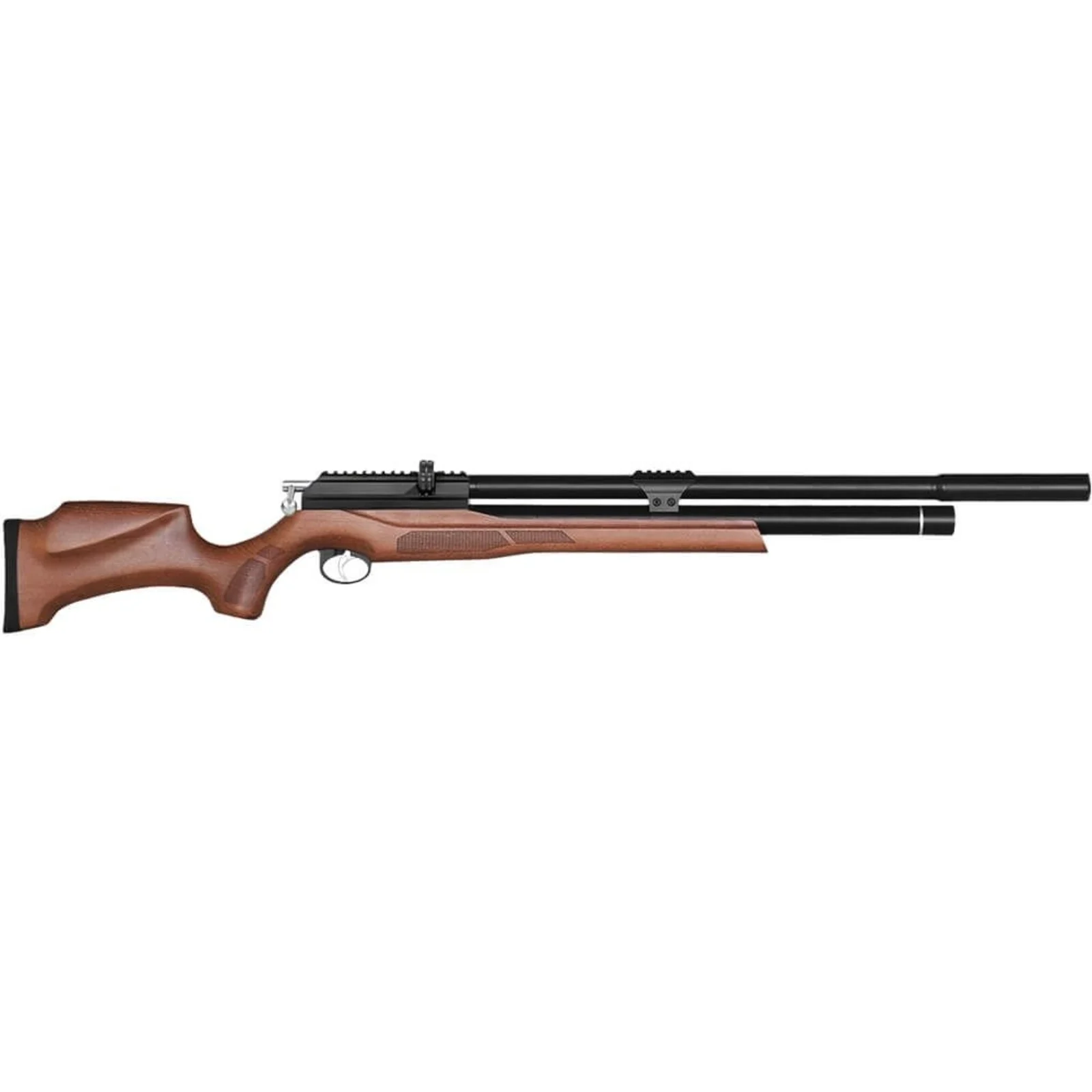




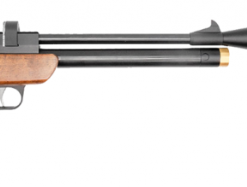
SPA/Artemis M25 Wood Gen-2
€300.00
With a sleek and sturdy design, a modular sound moderator, and a built‑in regulator, the Snowpeak M25 offers exceptional power and and accuracy for its price-range.
Bolt action
The M25W is loaded via an easy‑to‑operate rear bolt (bolt‑action).
It comes with a self‑indexing magazine which, combined with the smooth bolt system, makes quick follow‑up shots easy and smooth.
As with most repeating air rifles from SPA/Artemis, this rifle is also supplied with a single‑shot tray, allowing the use of longer ammunition as well.
A two‑stage trigger with a manual trigger safety provides extra control and safety.
Built‑in regulator
The M25 provides consistent power thanks to its built‑in regulator.
This results in higher accuracy because the power will not drop as the pressure in the reservoir decreases.
Stock & Accessories
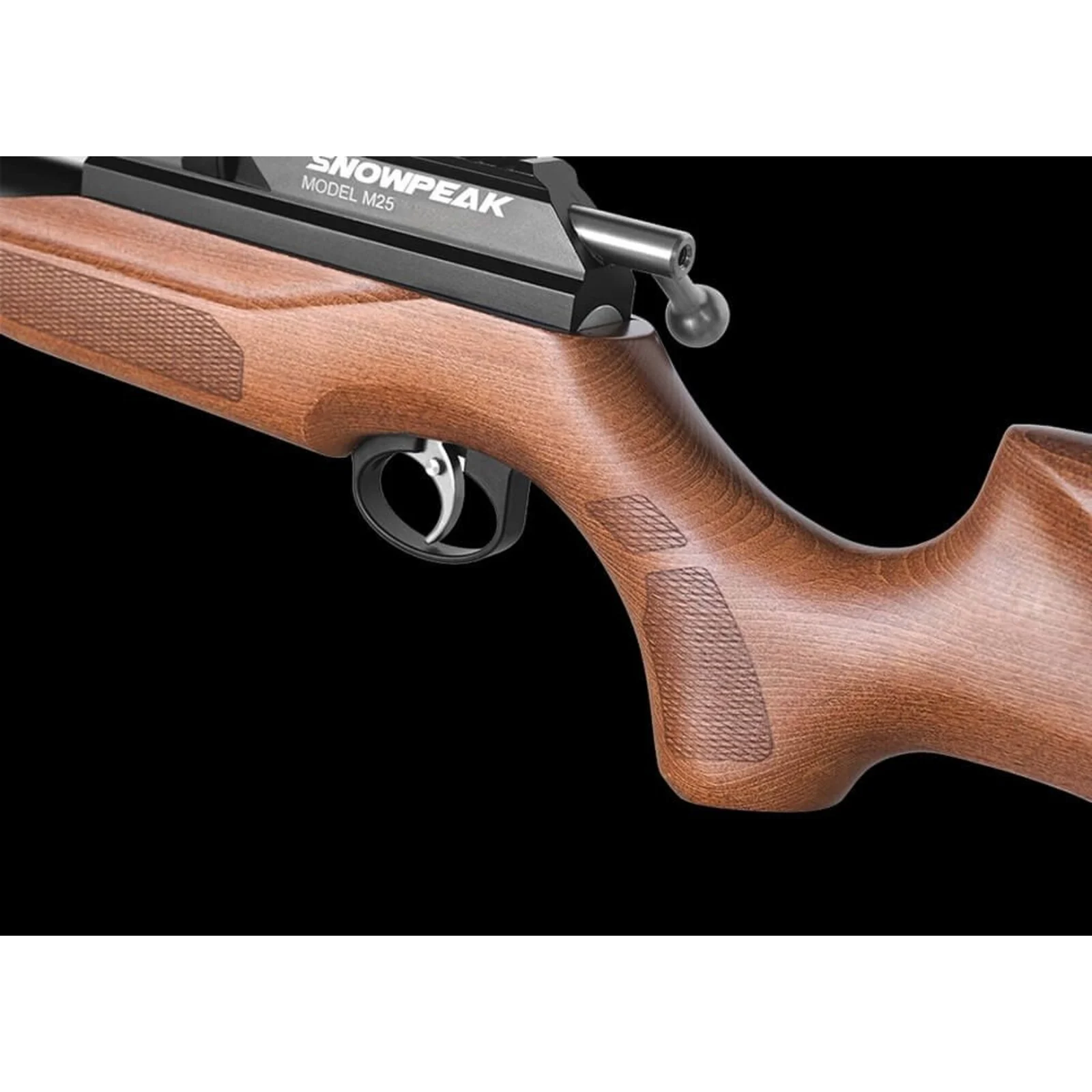
The Snowpeak M25W features a robust wooden stock with a classic look and a comfortable grip.
The raised cheek piece provides comfortable positioning when using a scope on the Weaver/Picatinny rail.
At the front of the stock there is a Weaver/Picatinny accessory rail for attachments such as bipods, lights, or lasers.
The M25W is pressurized using the included fill probe.
This probe does not have a screw thread but uses a Foster connection.
The air source (tank, compressor) must therefore have a female Foster coupling.
| Power source: | Pre compressed pneumatic (PCP) |
| Caliber: | 6.35mm (.25) | 7.62mm (.30) | 9mm (.35) |
| Muzzle energy: | 60 | 90 | 115 joule |
| Fill pressure: | 250 bar |
| Air capacity: | |
| Regulator: | Yes |
| Operating system: | Bolt-action |
| Magazine: | 9 | 8 | 6 shots |
| Max. projectile length: | 10.9mm |
| Optic mounting: | Picatinny/weaver |
| Weight: | 3.4kg |
| Length: | 1230mm |
| Barrel length: | 550mm |
| Muzzle: | Non-standard thread. Moderator included |
| Accessories: | Fill-probe, 1 magazine, single shot tray, manual |
SPA/Artemis M25 Wood Gen-2 – Technical Regulated PCP Air Rifle Overview
M25 Wood Gen-2 Engineering, Regulated PCP Architecture, Precision, and Related Snowpeak Platforms
Snowpeak Airguns
snowpeak airguns includes PCP pistols, carbines, bullpups, and full-size rifles. Specifications should therefore remain tied to the exact platform rather than being transferred between similarly named models.
Snowpeak Sports
snowpeak sports is Snowpeak’s manufacturer catalog and currently identifies the wood Gen-2 platform as M25WG2.
Snowpeak M25
The snowpeak m25 name refers to the broader M25 family. The standard current version differs from the wood Gen-2 by using polymer furniture, 245 cc rather than 250 cc air capacity, and a wider caliber range extending through 7.62 mm and 9 mm.
M25 Rifle
The phrase m25 rifle broadly identifies this PCP family. For technical accuracy, the Gen-2 wood version should be distinguished from the standard polymer model.
M25 Weapon
The phrase m25 weapon may appear in broad searches, although model-specific pneumatic terminology such as regulated PCP rifle provides more useful technical context.
European Beech Stock
The Gen-2 wood configuration uses European beech. This gives the platform a more traditional appearance while retaining the pneumatic architecture of the modern M25 family.
250 cc Air Reservoir
The Gen-2 uses a 250 cc air reservoir, providing more onboard air capacity than many lighter PCP platforms.
Regulated Pneumatic System
A regulator is incorporated into the current design. Its purpose is to stabilize downstream pressure as reservoir pressure falls, helping support more predictable shot-to-shot pneumatic behavior.
25 MPa Maximum Pressure
The manufacturer lists a maximum fill pressure of 25 MPa, equivalent to 250 BAR. Because this is a high-pressure system, reservoir damage, persistent leakage, or internal valve problems should receive qualified professional attention.
550 mm Barrel
A 550 mm barrel is standard on the wood Gen-2 according to current Snowpeak specifications. Barrel condition, ammunition uniformity, pressure consistency, and sight stability all contribute to practical repeatability.
Multi-Shot Magazine
Magazine capacity is listed at 12 shots in .177, 10 in .22, and 9 in .25.
Manual Safety
The platform incorporates a manual safety. Mechanical safeguards remain secondary to responsible handling.
Trigger Characteristics
Snowpeak lists approximately 2–5 lbf trigger pull on the Gen-2 wood model. Predictable trigger behavior contributes to consistent recreational target use, although internal adjustment should remain within manufacturer guidance.
Snowpeak PP750L PCP Air Pistol
The Snowpeak PP750L PCP Air Pistol belongs to a compact pistol/carbine family rather than this full-size wood-stock rifle.
Snowpeak PP750L
The Snowpeak PP750L should remain technically separate from the Gen-2 M25 because its frame, reservoir, dimensions, and handling differ.
Snowpeak PP750
The snowpeak pp750, pp750, and snow peak pp750 terms refer to another regulated compact PCP platform. The current PP750 uses a 66 cc reservoir and is substantially smaller than the M25.
Snowpeak Air Pistol
The phrase Snowpeak Air Pistol refers to pistol-format equipment and does not describe the full-size rifle architecture here.
PCP Pistol
A PCP Pistol uses the same broad compressed-air principle but differs substantially in barrel length, reservoir size, stock configuration, and ergonomics.
Airgun Pistol
An Airgun Pistol is broader terminology that may include PCP, spring-powered, or CO₂ systems.
High Power PCP Air Pistol
The phrase High power PCP air pistol does not accurately describe this model because it is a shoulder-stocked rifle platform rather than a pistol.
Snowpeak PP750L PCP Air Pistol for Sale
The phrase Snowpeak PP750L PCP Air Pistol for sale concerns another product family and should remain separate from M25WG2 technical information.
Snowpeak AP900
The snowpeak ap900 is a lighter compact carbine and differs substantially from the longer, heavier M25 configuration.
AP900B PCP Air Rifle
The ap900b pcp air rifle belongs to Snowpeak’s folding-stock compact carbine family rather than the M-series wood platform.
Snowpeak P35
The snowpeak p35, p35, and pcp p 35 searches concern a bullpup PCP family rather than a conventional full-length rifle.
Snowpeak P35X
The snowpeak p35x, p35x, and p35x pcp terms identify another bullpup configuration.
Snowpeak P35 vs P35X
The phrase snowpeak p35 vs p35x concerns comparison within that bullpup family and should not be used as M25 technical data.
PR900 Gen 3
The pr900 gen 3 is a lighter conventional PCP platform. Snowpeak currently lists it with a 130 cc reservoir, 485 mm barrel, regulator, and wood or polymer stock options.
Snow Peak PP20
The snow peak pp20 and snowpeak pp20 terms refer to a precision-oriented pneumatic pistol rather than a full-size rifle.
Snowpeak M60
The snowpeak m60 belongs to another rifle family with different dimensions and operating characteristics.
Snowpeak M60B
The snowpeak m60b is likewise a distinct model and should not be treated as another M25 designation.
How Much Did the M60 Weigh?
The phrase how much did the m60 weigh is ambiguous because unrelated products also use the M60 designation. Manufacturer context must be established before quoting a specification.
M50 Rifle
The phrase m50 rifle refers to another platform and should remain separate from M25WG2 specifications.
Snowpeak Max
The term snowpeak max belongs to a different Snowpeak product family.
Snowpeak Max 1 Price
The phrase snowpeak max 1 price concerns another model rather than the wood Gen-2 M25.
HP300
The term hp300 is ambiguous and should not be incorporated into this model’s technical description without exact product confirmation.
Pellet 9mm
The phrase pellet 9mm does not describe the wood Gen-2 version. The current M25WG2 is officially listed only in 4.5, 5.5, and 6.35 mm.
PCP Pellet Rifle
The M25WG2 is correctly categorized as a pcp pellet rifle because compressed air stored in the onboard reservoir provides its propulsion source.
Snow Peak Equipment
The phrase snow peak equipment is broad enough to generate unrelated outdoor-equipment results, so exact product identification is important.
Snowpeaks
snowpeaks is a generic spelling variation and should not replace the manufacturer’s precise model terminology.
Air Gun Accessories
The phrase air gun accessories can include compatible sighting equipment, protective cases, maintenance supplies, and manufacturer-approved replacement components. Exact compatibility should always be confirmed.
Snowfall Gun
The phrase snowfall gun is not a verified synonym for this platform.
Snow Peak Customer Service
The phrase snow peak customer service can produce results for unrelated companies using similar branding. Manufacturer-specific support should therefore be verified carefully.
Snow Peak Brand Origin
The Snowpeak airgun manufacturer operates from Shaoxing City, Zhejiang Province, China, according to its official catalog.
What Is a PCP Airgun?
For what is a pcp airgun, PCP means pre-charged pneumatic. Air is compressed into an onboard reservoir before use and managed through the rifle’s valve system.
Pistolet PCP Arcea-Snowpeak Onix Sport
The phrase pistolet pcp arcea-snowpeak onix sport reflects regional distributor terminology for different pneumatic equipment and should not be treated as an M25WG2 designation.
T Rex 6000
The term t rex 6000 does not represent a verified specification for this model. Snowpeak does separately manufacture T-Rex-family PCP rifles.
Why the Wood Gen-2 Configuration Matters
The Gen-2 version combines traditional European beech furniture with a regulated PCP system, 250 cc reservoir, 550 mm barrel, and revised magazine architecture. This separates it clearly from the standard polymer M25.
Why the Regulator Matters
A regulator can help maintain more controlled pressure delivery as reservoir pressure changes. This supports repeatability, although ammunition consistency, barrel condition, trigger behavior, sight stability, and environmental factors remain equally important.
Why the Larger Reservoir Matters
A 250 cc reservoir provides substantial onboard compressed-air volume compared with smaller compact models.
However, capacity alone does not determine performance. Reservoir integrity, regulator health, valve consistency, and seal condition remain essential.
Why Precision Depends on More Than Velocity
Manufacturer velocity figures provide only one technical reference. Practical precision depends on barrel integrity, pellet uniformity, pressure regulation, trigger consistency, sight stability, environmental conditions, and user technique.
Overall Technical Perspective
The SPA/Artemis M25 Wood Gen-2, currently identified by Snowpeak as the M25WG2, is best understood as a regulated wood-stock PCP rifle offered in .177, .22, and .25 caliber, using a 250 cc air reservoir, 25 MPa maximum fill pressure, 550 mm barrel, 12/10/9-shot magazines, European beech stock, manual safety, approximately 2–5 lbf trigger pull, and roughly 3.4 kg listed weight.
For a neutral technical assessment, the most meaningful considerations are reservoir integrity, regulator health, barrel condition, magazine reliability, trigger consistency, suitable ammunition, sight stability, dry storage, and professional servicing whenever pressure-bearing components require attention.
Wood-Stock Engineering, Precision, Handling, Pressure Consistency, and Practical Performance
A full-size regulated pneumatic rifle with traditional wooden furniture combines established stock construction with modern compressed-air engineering. Its practical quality cannot be measured through velocity figures alone. Instead, barrel stability, pressure consistency, reservoir integrity, trigger predictability, stock geometry, sight security, ammunition uniformity, and maintenance condition work together to determine the overall experience. Furthermore, the additional mass and dimensions associated with a full-length platform create a different handling character from lightweight compact designs. Understanding these characteristics provides a more realistic picture of precision, comfort, durability, and long-term recreational usefulness.
Traditional Wooden Construction
Natural wood provides a distinctive appearance and tactile character that differs considerably from synthetic furniture.
The grain, tone, and minor visual variations can make individual examples slightly different from one another.
However, wood requires appropriate environmental care because moisture and extreme temperature changes can influence its condition.
Stock Geometry
Stock shape contributes directly to comfort.
The relationship between the grip, shoulder contact point, trigger position, and sight line determines how naturally the platform can be supported.
A comfortable position can reduce unnecessary physical tension.
Weight Distribution
A full-size platform generally distributes its mass across a longer structure.
The barrel, reservoir, action, and wooden furniture all contribute to overall balance.
Good weight distribution can make a moderately heavy platform feel stable rather than cumbersome.
Shoulder Support
Consistent shoulder positioning can provide a repeatable foundation for recreational target use.
Comfort depends partly on individual body proportions.
Therefore, stock fit should be considered alongside overall dimensions and weight.
Grip Comfort
Grip geometry influences wrist angle and trigger reach.
A natural hand position can reduce unnecessary strain.
Because hand dimensions vary between individuals, ergonomic preference remains personal.
Barrel Length and Stability
A longer barrel contributes to the physical balance of the platform.
However, length alone does not determine precision.
Structural integrity, internal condition, ammunition consistency, pressure behavior, and sight stability remain equally important.
Barrel Protection
The barrel should remain protected from significant impacts.
Particular attention should be given to the mounting area and muzzle.
Visible deformation or unexpected movement deserves inspection.
Internal Barrel Condition
The bore should remain unobstructed and appropriately maintained.
Cleaning should be performed according to actual condition rather than unnecessarily after every recreational session.
Aggressive cleaning techniques can introduce avoidable wear.
Understanding Precision
Practical precision develops through multiple interacting factors.
Barrel quality provides the mechanical foundation, while ammunition uniformity, trigger predictability, pressure stability, sight alignment, environmental conditions, and user technique contribute to repeatability.
No single specification can represent the complete result.
Ammunition Consistency
Uniform ammunition can provide more predictable behavior.
Physical differences between individual projectiles may influence consistency.
Only the correct caliber and suitable ammunition should be considered.
Regulated Pressure Delivery
A regulator helps control the pressure supplied from the main reservoir to the operating system.
This can support more predictable behavior as reservoir pressure gradually decreases.
However, a regulator must remain mechanically healthy to perform consistently.
Reservoir Capacity
A relatively substantial reservoir provides meaningful onboard compressed-air storage.
Capacity influences the amount of air available, but it does not independently determine overall quality.
Reservoir condition and pressure-system integrity remain more important than volume alone.
Reservoir Protection
Because the reservoir is pressure-bearing, it deserves careful handling.
Significant impact damage, severe corrosion, or deformation should never be dismissed as ordinary cosmetic wear.
Questionable condition requires qualified assessment.
Pressure Retention
Stable pressure retention provides useful information about pneumatic health.
Unexpected pressure loss may indicate deterioration in seals, fittings, valves, or related components.
Persistent leakage should be investigated.
Seal Condition
Seals experience natural aging through time and repeated pressure cycles.
Temperature, contamination, storage environment, and material quality can influence longevity.
Correct replacement components help preserve intended operation.
Valve Reliability
The internal valve controls compressed-air release.
Predictable valve behavior contributes to overall consistency.
Complex internal valve work should be performed by appropriately qualified personnel.
Pressure Monitoring
A readable pressure indicator allows system condition to be observed.
The gauge should remain protected against impact.
Unexpected readings should be investigated rather than ignored.
Trigger Predictability
A consistent trigger provides useful mechanical feedback.
Predictability is generally more important than extremely light resistance.
Sudden changes in movement or engagement deserve inspection.
Trigger Adjustment
Adjustable components should remain within their intended operating range.
Repeated unnecessary adjustment can create reliability concerns.
Professional attention is preferable when correct operation becomes uncertain.
Safety Mechanism
A mechanical safety provides an additional safeguard.
It should operate positively and predictably.
Responsible handling remains necessary regardless of the position of any mechanical safety.
Magazine Reliability
A repeating system depends on a structurally healthy magazine.
Cracks, deformation, contamination, or damaged indexing components can interfere with smooth operation.
A damaged magazine should not be forced into continued service.
Magazine Care
Routine cleaning can help prevent debris from accumulating.
Harsh solvents should be avoided unless they are specifically compatible with the materials involved.
Simple preventive maintenance is generally sufficient.
Mechanical Smoothness
External controls should operate consistently.
Unexpected resistance, stiffness, or looseness can indicate contamination, wear, or mechanical misalignment.
Forcing abnormal movement may create additional damage.
Sight Stability
Sighting equipment must remain mechanically secure when precision is being evaluated.
Even slight movement can create apparent changes in performance.
Mounting security should therefore be checked periodically.
Mounting Interfaces
Accessory mounting surfaces should remain clean and structurally sound.
Compatible equipment should be installed without excessive tightening.
Damaged hardware should be replaced correctly.
Environmental Influence
Outdoor conditions can affect practical results.
Wind can influence projectile movement, while temperature can affect pneumatic behavior.
Performance comparisons are therefore more meaningful when environmental conditions remain reasonably similar.
Wood and Humidity
Natural wood deserves additional attention in humid environments.
Prolonged moisture exposure can affect appearance and potentially influence dimensional stability.
The stock should be dried appropriately before extended storage.
Temperature Management
Extreme heat should be avoided.
High temperatures can affect seals, finishes, adhesives, and other materials.
A reasonably stable indoor environment provides better storage conditions.
Exterior Cleaning
Routine exterior maintenance can remain simple.
Dust, fingerprints, and moisture should be removed from accessible surfaces.
Cleaning products should be compatible with both metal and wooden finishes.
Wood Finish Care
The stock finish should not be exposed unnecessarily to aggressive chemicals.
Gentle cleaning helps preserve its appearance.
Any specialized treatment should be compatible with the existing finish.
Transportation Protection
A full-length platform requires an appropriately sized protective case.
Internal padding can protect the barrel, stock, sights, reservoir, and controls against accidental impact.
The equipment should remain secured inside the case.
Storage
A dry, secure, temperature-stable location is preferable.
The stock should not remain pressed against damp materials.
Pressure-system storage should follow manufacturer recommendations.
Routine Inspection
Regular inspection does not require internal disassembly.
The barrel, reservoir, stock, controls, gauge, sights, magazine, and accessible hardware can all be examined visually.
Developing concerns can therefore be identified early.
Avoiding Unnecessary Modification
Mechanical systems are designed around specific operating relationships.
Unverified modification can affect reliability and component life.
Preserving the intended engineering generally provides the strongest foundation for dependable ownership.
Professional Servicing
Persistent leakage, reservoir concerns, regulator problems, valve malfunction, or significant trigger issues may require specialized attention.
High-pressure pneumatic components should be treated with particular care.
Qualified servicing is preferable to improvised repair.
Long-Term Practical Value
Traditional wooden construction and modern regulated pneumatic engineering can work effectively together when both receive appropriate care. The wooden furniture provides a substantial, traditional handling character, while the pressure system supports predictable mechanical operation.
Long-term quality ultimately depends on preservation. Protecting the barrel and reservoir, maintaining pressure-system integrity, keeping the stock dry, preserving the finish, monitoring seals and controls, securing sighting equipment, and avoiding unnecessary internal modification can significantly extend useful life.
When careful transportation, sensible storage, appropriate cleaning, periodic inspection, suitable ammunition, and professional servicing are combined, the platform can retain its structural integrity, attractive wooden finish, comfortable handling, mechanical consistency, and dependable recreational usefulness for an extended period.
Real-World Usability, Comfort, Reliability, Maintenance, and Long-Term Ownership
A full-size pneumatic platform with traditional wooden furniture offers a distinctive ownership experience because modern compressed-air engineering is combined with the feel and appearance of natural material. In practical terms, however, long-term satisfaction depends on much more than appearance. The condition of the pressure system, barrel, stock, controls, trigger, magazine, mounting interfaces, and external finish all contribute to everyday usability. Consequently, responsible maintenance and careful storage are just as important as the original construction quality when preserving reliability over time.
Everyday Handling Experience
A full-length design creates a more traditional handling profile than a compact configuration.
The distance between the shoulder, grip, and forward section distributes the platform across a larger area.
For some users, this arrangement can provide a stable and familiar recreational experience.
Natural Stock Feel
Wood provides a different tactile character from synthetic materials.
Its surface temperature, texture, grain, and weight distribution contribute to the overall handling experience.
Because natural material varies slightly, no two stocks necessarily appear completely identical.
Comfortable Shoulder Position
A properly shaped rear section can support consistent shoulder placement.
Comfort depends partly on individual body dimensions and the position of installed sighting equipment.
A natural posture can reduce unnecessary muscular tension during controlled recreational sessions.
Grip Ergonomics
Grip shape influences wrist angle and trigger reach.
The hand should be able to maintain a comfortable position without excessive stretching.
Because hand size varies, ergonomic preference remains individual.
Weight and Stability
Additional weight can influence handling in both positive and negative ways.
A moderately substantial platform may feel stable when properly supported, although prolonged unsupported handling can increase fatigue.
Balance therefore matters alongside total mass.
Weight Distribution
The barrel, reservoir, action, and stock determine where mass is concentrated.
Good distribution can create a stable overall feel.
An apparently heavy platform can sometimes feel manageable when its weight is positioned effectively.
Mechanical Reliability
Reliable equipment should behave predictably.
Controls should feel consistent between recreational sessions, while structural components should remain securely positioned.
Unexpected changes can indicate contamination, wear, loose hardware, or another maintenance concern.
Pressure-System Health
The pneumatic system contains several interconnected components.
The reservoir, seals, regulator, fittings, valve, and pressure indicator all contribute to consistent operation.
A problem in one area can influence the behavior of the overall system.
Reservoir Condition
The reservoir should remain protected against significant impact, corrosion, and deformation.
Because it stores compressed air, structural concerns deserve qualified assessment.
Questionable damage should never be treated as a purely cosmetic issue.
Pressure Retention
Stable pressure retention provides useful information about system condition.
Unexpected pressure loss can indicate deterioration in seals, fittings, valves, or related components.
Persistent leakage should be investigated.
Regulator Consistency
A regulator is designed to provide controlled pressure downstream of the main reservoir.
Consistent behavior depends on its internal condition.
If substantial irregularities develop, qualified servicing may be appropriate.
Seal Longevity
Seals naturally age.
Repeated pressure cycles, temperature variation, contamination, and storage conditions can influence their useful life.
Eventually replacing worn sealing components can form part of normal long-term maintenance.
Valve Condition
The valve plays an important role in managing compressed air.
Its behavior should remain predictable.
Internal valve problems should be addressed through appropriate technical servicing rather than improvised modification.
Barrel Integrity
A structurally healthy barrel supports mechanical consistency.
Significant impact should be avoided, particularly around the mounting area and muzzle.
Unexpected movement or visible deformation requires inspection.
Internal Barrel Maintenance
The bore should remain unobstructed and appropriately maintained.
However, frequent aggressive cleaning is unnecessary.
Maintenance should be performed according to actual condition and manufacturer recommendations.
Practical Precision
Precision depends on several variables working together.
Barrel integrity, ammunition uniformity, pressure consistency, sight stability, trigger predictability, environmental conditions, and user technique all influence repeatability.
Therefore, one specification cannot represent complete practical performance.
Ammunition Uniformity
Consistent ammunition provides a better foundation for repeatable results.
Physical damage or significant variation can influence behavior.
Only appropriate ammunition matching the specified caliber should be considered.
Trigger Consistency
A predictable trigger can support controlled recreational target use.
The mechanism should feel familiar from one session to another.
Significant changes deserve inspection.
Trigger Maintenance
Routine ownership generally does not require frequent internal adjustment.
Unnecessary alteration can affect reliability.
Complex trigger servicing should have a specific mechanical purpose.
Safety Mechanism
The safety should engage and disengage positively.
Changes in resistance or engagement deserve attention.
Mechanical safeguards should always complement responsible handling rather than replace it.
Magazine Condition
A detachable magazine should remain structurally sound and clean.
Cracks, deformation, or damaged indexing components can interfere with normal operation.
Damaged components should be replaced correctly.
Magazine Storage
Magazines should remain protected from contamination and physical damage.
A clean, dry storage location is preferable.
They should not be exposed unnecessarily to aggressive chemicals.
Sight Security
Stable sighting equipment is important when evaluating consistency.
Loose mounting hardware can create apparent performance problems.
Mounting integrity should therefore be checked periodically.
Accessory Interfaces
Mounting surfaces should remain clean and undamaged.
Compatible accessories should fit correctly without excessive mechanical force.
Overtightening can damage hardware or mounting interfaces.
Wood Stock Maintenance
Natural wood deserves appropriate care.
Dust and light contamination can usually be removed gently.
The finish should not be exposed unnecessarily to harsh solvents or abrasive cleaning products.
Humidity Protection
Persistent humidity can affect both metal components and natural wood.
Equipment should therefore be reasonably dry before extended storage.
This consideration becomes especially important in tropical or coastal environments.
Temperature Stability
Rapid or extreme temperature changes can influence materials differently.
Wood, metal, seals, and finishes may respond differently to environmental conditions.
A stable indoor storage environment is generally preferable.
Avoiding Excessive Heat
Prolonged exposure to high temperatures can affect sealing materials and finishes.
Storage inside a vehicle exposed to direct sunlight should therefore be avoided for extended periods.
Exterior Metal Care
Accessible metal surfaces should remain reasonably clean and dry.
Fingerprints and moisture can contribute to gradual surface deterioration.
Routine wiping provides simple preventive protection.
Protective Transportation
A suitably sized padded case can protect the barrel, reservoir, stock, sights, and controls.
The platform should remain secured rather than moving freely.
Applicable transportation requirements should always be followed.
Storage Preparation
Before extended storage, accessible surfaces should be cleaned and dried.
The wooden furniture should not remain against damp materials.
Pressure-system storage should follow manufacturer guidance.
Inspection After Storage
After prolonged inactivity, a basic visual inspection is sensible.
The barrel, reservoir, stock, controls, gauge, sights, magazine, and accessible hardware can all be examined.
Significant changes deserve attention.
Fastener Inspection
Accessible hardware should remain secure.
Overtightening should be avoided because excessive force can damage threads or surrounding components.
Correct replacement hardware should be used when necessary.
Avoiding Unnecessary Disassembly
Routine maintenance rarely requires complete internal disassembly.
Repeatedly opening complex mechanisms can disturb seals or introduce contamination.
Internal servicing should therefore be performed only when genuinely required.
Appropriate Maintenance Products
Cleaning and maintenance products should be compatible with the materials involved.
A product suitable for metal may not necessarily be appropriate for wood, polymers, or sealing materials.
Manufacturer recommendations should guide selection.
Professional Servicing
Persistent leakage, reservoir concerns, regulator problems, valve malfunction, or significant structural damage may require specialized attention.
High-pressure pneumatic systems deserve qualified technical assessment.
Maintenance Records
A basic service history can become valuable over time.
Professional inspections, seal replacement, repairs, and major component changes can be documented.
These records can simplify future maintenance decisions.
Preserving Appearance
Wooden furniture can remain visually attractive for many years when protected from moisture, harsh chemicals, excessive heat, and unnecessary abrasion.
Minor handling marks may develop naturally.
These should be distinguished from structural cracking or significant finish deterioration.
Long-Term Reliability
Reliability develops through appropriate ownership practices.
Regular inspection, careful transportation, moisture control, correct maintenance, and timely servicing can preserve mechanical condition substantially longer than neglect.
Overall Ownership Assessment
A full-size pneumatic platform with wooden furniture can provide a comfortable combination of traditional handling, stable construction, and modern pressure-system engineering. Its practical value depends on the complete system remaining healthy rather than any individual specification.
Protecting the reservoir and barrel, preserving the wooden stock, maintaining pressure integrity, keeping the magazine and controls clean, securing sighting equipment, and avoiding unnecessary internal modification can support long-term reliability. Combined with dry storage, appropriate cleaning, careful transportation, regular inspection, and qualified servicing when significant mechanical problems arise, these practices can help preserve structural integrity, attractive appearance, consistent operation, and practical recreational usefulness throughout an extended ownership period.
Be the first to review “SPA/Artemis M25 Wood Gen-2”
Related products


Snowpeak Airguns

Snowpeak Airguns


Snowpeak Airguns

Snowpeak Airguns
Snowpeak Airguns

Snowpeak Airguns


Snowpeak Airguns


Snowpeak Airguns
Reviews
There are no reviews yet.